
The glottal stop (IPA ⟨ʔ⟩) is the brief vocal-fold closure you hear in English in expressions like “uh‑oh” and in many pronunciations of words such as “button” or “kitten.” Learners most often notice it in three places: the catch between two vowels, the reinforced or replaced /t/ before a nasal or consonant, and the hard onset before a word that starts with a vowel. It rarely changes word meaning on its own, since English treats it as an allophone rather than its own phoneme, but it shapes rhythm, region, and how natural your speech sounds.
TL;DR:
- The glottal stop in English primarily appears as an allophone of /t/ and rarely alters word meaning, but understanding its patterns improves speech rhythm and naturalness.
- It commonly occurs in the syllable coda, at the start of vowel-initial words, between vowels, and before nasal sounds, especially in casual speech.
- British English uses glottal replacement more widely and in more contexts than American English, where it is mostly limited to casual, fast speech patterns.
- Practice involves ear training, feeling the throat closure, and recording oneself to compare with native models, with structured tools like apps accelerating learning.
- Overuse, confusing reinforcement with full replacement, and neglecting linking are common learner mistakes that hinder natural-sounding speech.
Table of Contents
- What Is a Glottal Stop in English Phonetics?
- Where Does T-Glottalization Happen in English?
- Glottal Stop Examples You Can Practice Today
- Do British and American English Use Glottal Stops Differently?
- How to Practice the Glottal Stop: Step‑by‑Step Drills
- Common Mistakes Learners Make With the Glottal Stop
- Why Clarity Beats Perfect Mimicry
- Train the Glottal Stop With a Guided American Accent Program
- Sources
- FAQ
What Is a Glottal Stop in English Phonetics?
A glottal stop happens when your vocal folds snap shut, block airflow for a fraction of a second, then release it abruptly. You are not using your tongue, lips, or teeth to make this sound. The action happens entirely inside your throat, at the glottis, which is the space between your vocal folds. Say “uh‑oh” slowly and you will feel a small catch between the two syllables. That catch is the glottal stop, and it is one of the few English sounds you produce with no visible mouth movement at all.
Linguists write it with the symbol ⟨ʔ⟩, borrowed from the International Phonetic Alphabet. You will see it in narrow phonetic transcriptions like [ˈbʌʔn̩] for “button,” where the ⟨ʔ⟩ replaces what you might expect to be a regular /t/.
In English, this sound is almost always an allophone, a variant pronunciation of another sound, usually /t/, rather than a sound with its own independent meaning. Change it and the word usually still means the same thing. That is not true everywhere.
In Hawaiian, the glottal stop, written as the ʻokina, is a full consonant that changes word meaning entirely. “Kau” and “kaʻu” are different words with different meanings, distinguished only by that stop. Arabic treats its glottal stop, the hamza, the same way: as a letter with its own identity in the writing system, not a background noise.
That contrast matters for learners. Here is a quick reference for how the sound behaves across contexts:
- English: allophone of /t/ or a syllable boundary marker, rarely changes meaning.
- Hawaiian: full consonant phoneme, changes word meaning.
- Arabic: written letter (hamza), carries meaning distinctions.
- Many other languages: absent entirely, or used only in interjections.
Once you can feel that closure and release, the rest of this guide becomes much easier to apply, because you will recognize the gesture the moment it happens in your own speech.
Where Does T-Glottalization Happen in English?
T‑glottalization is the technical name for what happens when /t/ gets replaced or reinforced by a glottal stop instead of being pronounced with a full tongue‑tip closure. It is one of the most common and most studied sound changes in modern English dialects, and it follows patterns you can actually predict once you know where to look.
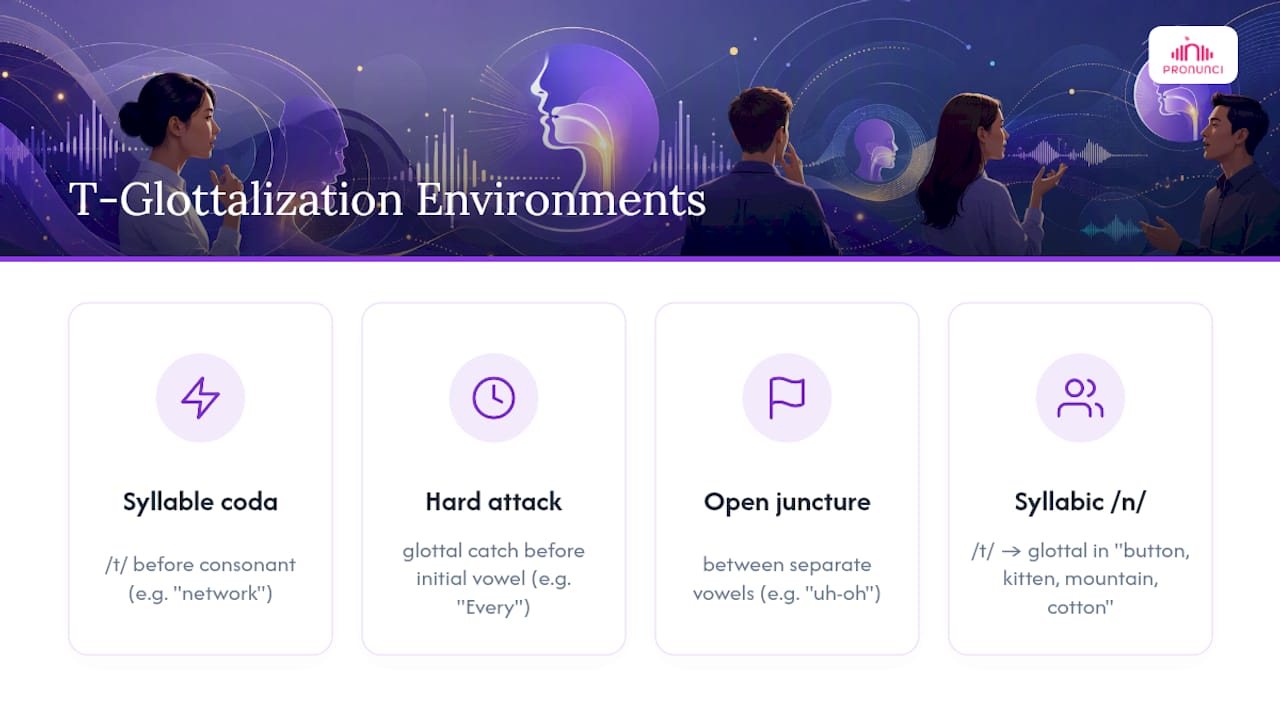
The clearest environment is the syllable coda, meaning /t/ at the end of a syllable, especially right before another consonant. Say “network” naturally and notice whether your /t/ ever fully lands, or whether it gets clipped into a glottal catch before the /w/. In some British varieties, this extends further, with glottal replacement reaching even before labial consonants like /p/ or /b/, something that sounds unusual to many American ears.
A second major environment involves what phoneticians call hard attack or null onset. This is the small burst of glottal closure you produce right before a word that starts with a vowel, especially at the start of a sentence or after a pause. Say “Every apple is orange” with exaggerated emphasis and you may hear a tiny catch before “every,” “apple,” and “orange” each time.
Third, there is open juncture, the technical term for the catch you hear between two vowel sounds that belong to separate syllables or words, without any consonant linking them. The “uh‑oh” example lives here: [ʔʌʔ ʔoʊ], with glottal closures marking both the start of the utterance and the gap between the two vowel sounds.
Fourth, and arguably the most common for American learners, is the syllabic /n/ context. Here, /t/ often surfaces as a glottal stop right before a syllable built entirely around a nasal consonant, with no vowel of its own. Consider a quick numeric snapshot of frequency: linguistic descriptions consistently list “button,” “kitten,” “mountain,” and “cotton” as the standard textbook set, because in casual speech, most fluent American speakers glottalize the /t/ in these words rather than releasing it with the tongue.
That single pattern, syllabic /n/ following a glottalized /t/, accounts for a large share of the glottal stops you will hear in ordinary American conversation, which is exactly why it gets its own section in the examples below.
Glottal Stop Examples You Can Practice Today
Seeing the transcription next to the word makes the pattern click faster than any explanation alone. Try reading each of these aloud, slowly at first, then at normal speed.
- Uh‑oh [ʔʌʔoʊ]. Two glottal stops here: one opening the utterance, one marking the gap between the two vowels.
- Button [ˈbʌʔn̩]. The /t/ becomes a glottal stop, and the final /n/ carries its own syllable weight without a vowel.
- Kitten [ˈkɪʔn̩]. Same pattern as “button,” a very common target word in pronunciation guides for this exact reason.
- Mountain [ˈmaʊʔn̩]. Notice the diphthong stays intact; only the /t/ changes.
- Right now [raɪʔ naʊ]. The /t/ at the end of “right” glottalizes before the following consonant.
- Not now [nɒʔ naʊ]. Same coda pattern, different vowel.
- What time [wʌʔ taɪm]. Compare this to a careful, formal pronunciation where the /t/ in “what” gets a fuller release: [wʌt taɪm].
That last pair is worth sitting with. In careful or formal speech, many speakers retain a fuller, more released /t/. In fast, casual conversation, the glottal version takes over. Neither one is wrong. They serve different registers, and knowing when to reach for each is part of sounding natural rather than robotic.
Listen for the “catch,” the small pause where airflow briefly stops, and try to feel the closure happening at the back of your throat rather than at the front of your mouth. That physical distinction, throat versus tongue, is the fastest way to stop confusing a glottal stop with a regular /t/.
Do British and American English Use Glottal Stops Differently?
Yes, and the difference is large enough that it should shape which target model you practice toward. British varieties, particularly Cockney and increasingly parts of Southern Standard British English, use glottal replacement far more widely than most American accents do. In some of these varieties, /t/ gets replaced by ⟨ʔ⟩ in almost every coda position, not just before nasals, which is why “water” can come out sounding close to “wa’er” in fast, informal London speech.
American English uses the sound too, just in a narrower set of contexts. The syllabic /n/ pattern in words like “button” and “kitten” is extremely common across nearly all American regions and speech styles, casual or careful. Phrase‑initial hard attack, the small catch before a vowel‑initial word at the start of an utterance, is also standard and largely unnoticed because it is so universal. Full t‑glottalization in coda position before other consonants exists in American speech too, but historically it has been more limited and more tied to casual registers than in Britain, though it has been spreading in recent decades.
A few practical guardrails for choosing your target:
- If your goal is General American pronunciation, prioritize the syllabic /n/ pattern and hard attack; treat wider coda glottalization as optional and casual.
- If you are aiming at a British model, expect broader glottal replacement, but recognize it can still read as informal or regionally marked in some professional contexts.
- Match your formality to your setting: interviews and presentations call for more released consonants than a conversation with friends.
- Do not treat glottalization as sloppy speech. It is a rule‑governed pattern, not a mistake, in the accents where it appears.
How to Practice the Glottal Stop: Step‑by‑Step Drills
Prof. Alex built InPronunci’s training path around one core idea: you cannot fix what you cannot hear, and you cannot hear what you have never consciously felt in your own mouth and throat. That is why glottal stop training works best as a staged sequence rather than random repetition.
- Ear training first. Listen to minimal pairs like “what time” pronounced with a released /t/ versus a glottalized one. Do not try to say anything yet. Just notice the difference in your ears before you ask your mouth to reproduce it.
- Feel the gesture in isolation. Say “uh‑oh” slowly and place two fingers lightly on your throat. You should feel a small tightening right at the catch. Repeat it ten times, focusing only on that sensation.
- Move to syllabic /n/ words. Practice “button,” “kitten,” and “mountain” slowly, exaggerating the glottal closure before letting the /n/ carry its own syllable. Then speed up gradually.
- Anchor it in phrases. Drill “right now” and “not now” at conversational speed, checking that the glottal stop replaces the /t/ cleanly rather than turning into a full stop-and-restart.
- Record and compare. This is where InPronunci’s Compare My Coach and My Pronunci tool earns its place. Record yourself, then play your version against the native‑speaker model side by side. Your ear will catch differences your mouth cannot feel on its own.
Watch the
to see exactly how tongue position and glottal timing interact for this sound family. Seeing the articulation, not just hearing it, closes a gap that audio-only practice often leaves open, since visualizing the mouth’s motion helps learners locate the gesture faster than listening alone.
Pro Tip: Practice in short daily sessions of five to eight minutes rather than one long weekly session. Ten focused repetitions of a single word, done consistently for a week, retrain muscle memory faster than fifty scattered repetitions done once.
Review your syllabic /n/ words every few days, since this pattern fades from memory quickly if you do not revisit it. For deeper consonant work that builds on this foundation, InPronunci’s guide to American English consonant pronunciation walks through the broader system these sounds belong to.
Common Mistakes Learners Make With the Glottal Stop
The most frequent error is overuse. Learners who just discovered hard attack sometimes start inserting a glottal stop before every vowel, which makes speech sound choppy, disconnected, and oddly forceful rather than natural.
- Overusing hard attack: every vowel-initial word gets its own abrupt stop, breaking the flow of connected speech.
- Confusing reinforcement with full replacement: sometimes a glottal stop sits alongside a light /t/ closure rather than replacing it entirely, and treating every case as a full swap creates an inaccurate accent.
- Ignoring linking: prioritizing glottal stops over smooth consonant‑to‑vowel transitions makes speech sound robotic instead of fluent.
- Skipping the recording step: without hearing yourself back, it is nearly impossible to catch overuse patterns in real time.
Pro Tip: Slow your practice sentences down by half speed for the first few repetitions. Overuse almost always shows up clearly at slow speed, even when it hides at normal conversational pace.
Why Clarity Beats Perfect Mimicry
Learners often ask me how “American” their glottal stops need to sound before they are ready to move on. My honest answer: intelligibility comes first, naturalness comes second, and exact regional mimicry comes a distant third. A listener who understands you easily and finds your rhythm comfortable will forgive far more variation in glottal usage than most learners expect.
That is why InPronunci treats glottal stop work as one thread inside a larger curriculum rather than an isolated party trick. It connects to syllable stress, to connected speech, to the way vowels and consonants link across word boundaries. Master the catch in “button” without connecting it to rhythm and stress, and you have learned a sound in isolation, not a skill you can use under pressure in a real conversation.
If you are motivated enough to have read this far, the next right step is structured, staged practice rather than more isolated fact-gathering. That is exactly what a guided program is built to give you.
— Prof. Alex., Ph.D. Accent Coach
Train the Glottal Stop With a Guided American Accent Program
Reading about the glottal stop gets you halfway there. Feeling the closure, hearing your own version against a native model, and correcting it in real time is what actually changes how you sound, and that is where a structured program does something a blog post cannot. InPronunci: Accent Training App was built by Prof. Alex specifically for goal‑oriented learners who want to move past scattered YouTube tips and into a guided path with feedback at every step.
Download on the App Store | Get It on Google Play
Inside the app, the Interactive 2D Sound Video Simulator lets you watch the glottal closure and the American ⟨t⟩ variants happen in real articulatory motion, not just hear them. The app evaluates your recordings against native‑speaker models, and the comparison tools let you hear your own version side by side with the target sound, the same comparison method described in the practice section above. Drills for syllabic /n/ words, connected speech, and consonant transitions are organized inside a structured chapter path rather than a random exercise feed.

If you want a full walkthrough of how the training path builds from speech-organ awareness to natural connected speech, the InPronunci American Accent Training Course lays out the complete curriculum. Start with a free onboarding chapter to see how the guided drills feel before choosing a plan, and check the American accent training step by step guide for a full breakdown of what comes after the glottal stop.
Sources
FAQ
What Is an Example of a Glottal Stop?
The catch between the two syllables in “uh‑oh,” transcribed [ʔʌʔoʊ], is the clearest everyday example. The glottalized /t/ in “button,” pronounced [ˈbʌʔn̩], is another example nearly every English speaker produces without noticing it.
Do Americans Have a Glottal Stop?
Yes. American English regularly uses glottal stops in syllabic /n/ words like “kitten” and “mountain,” and as a hard attack before vowel‑initial words at the start of an utterance.
Do Glottal Stops Exist in English?
Yes, though English treats the glottal stop as an allophone of /t/ or a boundary marker rather than an independent sound that changes word meaning, unlike languages such as Hawaiian or Arabic where it carries its own meaning distinctions.
What Is the Rarest Sound in a Language?
Linguists debate this depending on how “rare” is measured across the world’s languages, and no single sound holds an agreed title. The glottal stop is not rare at all. It appears in a large share of the world’s languages, including English, where it shows up constantly in casual speech.
How Can I Practice the Glottal Stop More Accurately?
Start with ear training on minimal pairs, then move to isolated words like “button” and “kitten,” and finally record yourself and compare against a native‑speaker model. A guided app like InPronunci structures exactly this sequence with its 2D Sound Video Simulator and AI Accent Coach feedback.