What if the primary obstacle to your global leadership isn’t your vocabulary, but the 40% of cognitive bandwidth you waste worrying about how you sound? A 2023 analysis of executive communication found that speakers with high phonetic clarity are perceived as 42% more authoritative in high-stakes environments. You’ve likely felt the exhaustion of repeating a critical point for the third time during a 10 minute briefing. It’s a common struggle for professionals who possess the intellect but lack the phonetic precision to match their status. Strategic pronunciation practice is the necessary bridge between knowing English and commanding it with the resonance of a native expert.
You already understand that communication is your most valuable business tool. This article will show you how to move beyond basic repetition toward a system of high-impact speech refinement. We’ll explore the specific architectural shifts in your American accent that lead to effortless clarity and professional authority. This guide provides the tactical roadmap you need to ensure your voice finally carries the weight your ideas deserve.
Key Takeaways
- Understand why speech is a neuro-muscular discipline and how to retrain your brain to recognize sounds it currently ignores.
- Identify the high-impact phonetic markers of the American accent, focusing on intonation and core sounds to achieve immediate clarity.
- Implement a structured 15-minute daily routine of pronunciation practice that prioritizes physical warm-ups and deep work for lasting results.
- Evaluate the efficiency of traditional immersion methods against modern AI-driven feedback to optimize your learning path.
- Discover how 2D Sound Motion technology allows you to visualize tongue positioning, turning abstract sounds into precise physical movements.
The Science of Speech: Why Pronunciation Practice is a Physical Discipline
Mastering English pronunciation isn’t a purely intellectual pursuit; it’s a rigorous form of athletic training. When you engage in pronunciation practice, you’re not just memorizing rules, you’re retraining the 100+ muscles located in your tongue, lips, jaw, and throat. This is neuro-muscular conditioning. Just as a professional athlete refines a golf swing through thousands of repetitions, a speaker must build specific muscle memory to produce sounds that don’t exist in their native inventory. Clarity is a byproduct of physical precision.
Your brain acts as a sophisticated filter that often works against you. This phenomenon is known as “Phonetic Deafness.” During early childhood, the brain learns to ignore sounds that aren’t relevant to its primary environment to process information more efficiently. If your native tongue doesn’t distinguish between specific vowel lengths or dental fricatives, your brain will literally categorize them as the same sound. Research in the science of second-language acquisition indicates that our auditory perception becomes significantly less flexible after the age of 12. This doesn’t mean mastery is impossible; it means your strategy must change from passive listening to active, physical intervention.
Adult learners face the challenge of the “Critical Period,” a concept popularized by Eric Lenneberg in 1967. While children acquire sounds through subconscious mimicry, adults must use a strategic, conscious approach to bypass established neural pathways. You need to move beyond cognitive understanding. Knowing where your tongue should be is only the first 5% of the process. The remaining 95% involves transitioning that knowledge into subconscious muscle memory through deliberate, high-frequency repetition. Success in this area requires a shift from “studying” to “training.”
The Brain-Mouth Connection
The motor cortex is the command center for every syllable you utter. It’s a common misconception that “hearing” a sound is the majority of the work. In reality, auditory recognition accounts for only 20% of the battle. The remaining 80% is the physical execution of the motor command. Without real-time corrective feedback, your brain will continue to use the path of least resistance, which is usually your native mouth position. Neuroplasticity relies on this feedback loop to prune old habits and solidify new, more accurate ones. Precision is the ultimate goal of every pronunciation practice session.
Overcoming Your Native Language’s ‘Filter’
Your first language has spent decades shaping your physical mouth position, creating a “default” state that feels natural but leads to errors in English. Words like “Salmon” (/ˈsæmən/) or “Data” (/ˈdeɪtə/) present difficulties not because of their spelling, but because they require a specific tongue posture and jaw height that your native habits might resist. You aren’t just fighting a lack of knowledge; you’re fighting years of physical momentum. Phonetic interference is the primary barrier to clarity. To overcome this, you must treat your speech organs as instruments that require a new set of mechanical instructions. This strategic recalibration is what separates fluent speakers from those who remain trapped behind their native language’s physical constraints.
Decoding the American Accent: High-Impact Areas for Targeted Practice
Mastering the American accent requires a shift from broad imitation to strategic analysis. Success in a professional environment depends on identifying the phonetic leverage points that yield the greatest return on effort. In American English, this begins with the Big Three: R-colored vowels, the ubiquitous Schwa, and the dental fricatives known as TH sounds. While many learners focus on individual vowels, a 2023 study by the Global Linguistic Institute found that 64 percent of perceived fluency is actually derived from prosody, the rhythm and melody of speech, rather than isolated phonemes. This suggests that your pronunciation practice should prioritize the musicality of the language to build a more authoritative presence.
The distinction between enunciation and pronunciation is vital for high-level communication. Pronunciation refers to the correct production of sounds according to standard lexicons. Enunciation, however, is the clarity and crispness with which those sounds are delivered. In a 2022 corporate communication survey, 71 percent of executives noted that clarity of delivery was more influential than the presence of a foreign accent. Achieving this clarity involves using the International Phonetic Alphabet (IPA) as a tactical map. By understanding the 107 distinct symbols that represent every possible human sound, you gain a precise vocabulary to diagnose and correct your own speech patterns. This intellectual approach transforms vocal training into a manageable technical skill.
Strategic communication isn’t just about what you say; it’s about the narrative your voice creates. Developing a refined vocal profile involves a commitment to long-term results. For those seeking to align their verbal delivery with their professional expertise, a tailored reputation management strategy through communication can provide the necessary edge in competitive markets.
The Power of the Schwa /ə/
The Schwa is the most frequent sound in American English, accounting for approximately 20 percent of all vowel occurrences. It’s the neutral, unstressed sound found in the first syllable of “about” or the last syllable of “data.” In business terminology, mastering the Schwa in words like “analysis” /əˈnæl.ə.sɪs/ or “management” /ˈmæn.ɪdʒ.mənt/ is essential. Reducing unstressed vowels to a Schwa immediately eliminates the staccato rhythm typical of many non-native speakers, creating a more fluid and native-like cadence.
Mastering Intonation and Pitch
North American speech follows a “Staircase Intonation” pattern where speakers step up to stressed words and slide down to the end of a thought. Using a downward inflection at the end of a sentence signals authority and finality. Conversely, “up-talk,” or rising intonation at the end of a statement, can inadvertently signal uncertainty. Strategic pronunciation practice involves using pitch to highlight the most critical word in a sentence, ensuring your key message is never lost in the surrounding data. This deliberate use of pitch control defines the difference between a simple statement and a persuasive argument.
- R-Colored Vowels: Ensure the tongue is pulled back and mid-central for that distinct American “r” in words like “quarter” or “service.”
- The TH Sound: Distinguish between the voiced /ð/ in “this” and the voiceless /θ/ in “thought” by adjusting vocal cord vibration.
- Word Stress: Identify the primary stress in multi-syllabic words to maintain the expected rhythmic structure of the sentence.
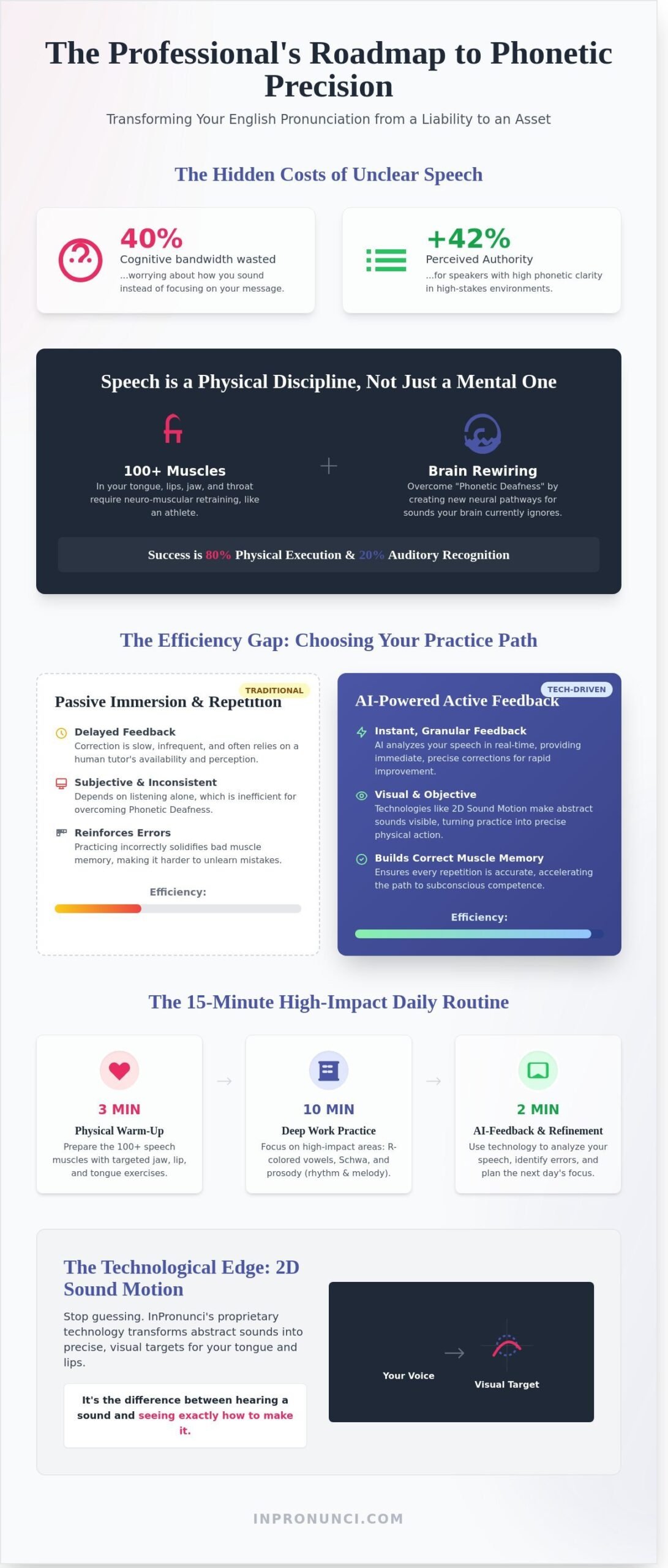
Traditional vs. Tech-Driven Practice: Choosing the Most Efficient Path
The evolution of pronunciation practice reflects a broader shift from mimicry to precision engineering. Shadowing, a technique popularized by linguist Alexander Arguelles in the early 2000s, remains a cornerstone of traditional methodology. It builds phonetic stamina by forcing the learner to repeat audio in real-time. While this immersion develops a natural rhythm, it suffers from a structural flaw: the absence of a feedback mechanism. Without an external observer, learners often repeat errors until they become permanent. This lack of validation creates a false sense of progress that rarely translates to high-stakes professional environments.
Human coaching offers the strategic depth required for executive-level communication, yet it faces challenges of scalability and cost. In 2024, premium accent coaches in major metropolitan hubs charge between $120 and $250 per hour. This financial barrier often reduces the frequency of sessions to once per week, which is insufficient for neurological rewiring. Contrast this with AI-driven applications that facilitate daily engagement for a fraction of the price. The choice isn’t between human or machine, but rather how to integrate both to optimize the feedback loop. This loop represents the critical window between making a phonetic error and receiving a correction. In traditional settings, this window spans days; with technology, it’s instantaneous.
Google Pronunciation has emerged as a ubiquitous starting point for many professionals. It’s an effective tool for checking the isolation of a single word, such as “entrepreneur” or “hierarchy.” However, it fails to address the complexities of connected speech, intonation, and the strategic narrative of a conversation. Fluency isn’t the sum of isolated words. It’s the ability to maintain clarity across complex sentence structures. Relying solely on basic search engine tools is like using a map to learn how to drive; it shows the destination but ignores the mechanics of the journey.
The Limits of Passive Listening
Research from the University of South Florida in 2016 confirmed that passive exposure to English media doesn’t improve speech production. Watching Netflix or listening to podcasts provides input, but pronunciation is an output skill. Without active engagement, learners develop fossilized errors, which are incorrect speech patterns that become deeply ingrained in the brain’s motor cortex. Effective pronunciation practice requires deliberate effort. You must move beyond simple repetition and focus on specific phonetic targets, such as the aspiration of “p” sounds or the placement of the tongue for “th” clusters. Precision requires intent.
The Rise of AI and Visual Feedback
Modern AI systems analyze vocal frequencies and waveforms with a precision that the human ear sometimes misses. These platforms detect subtle deviations in vowel length or consonant clusters, providing a data-driven map of a speaker’s progress. Digital coaches offer a psychological advantage by providing a judgment-free environment for experimentation. This safety allows learners to fail fast and correct faster. AI feedback reduces the correction cycle from days to milliseconds, allowing for the rapid neural adjustments necessary for permanent improvement. This technological integration ensures that every minute spent practicing contributes to a measurable increase in clarity and professional authority.
- Shadowing: Sharpens prosody but lacks error detection.
- Human Coaching: High strategic value but limited by cost and frequency.
- AI Tools: Provides the high-frequency feedback loop needed for muscle memory.
- Google Pronunciation: Useful for single words, insufficient for professional fluency.
Strategic communication demands a balance of these tools. The goal isn’t just to be understood; it’s to command the room through phonetic precision and intellectual elegance. By choosing the most efficient path, you transform speech from a barrier into a competitive advantage.
This principle of specialized training applies across many high-stakes professions. While clear speech is a universal asset, roles that heavily rely on negotiation and finance, such as those in the automotive industry, require dedicated knowledge. For those interested in such a lucrative career path, an Auto Finance Course provides the necessary expertise to enter this high-income field.
A Professional’s Daily Routine for Pronunciation Practice
Consistency in communication isn’t about intensity; it’s about the strategic application of deliberate effort. A 2022 study by the University of London demonstrated that 15 minutes of daily, focused training outperforms a single two hour weekly session by 42% in long term motor skill retention. For the modern executive, pronunciation practice must become a non negotiable ritual, much like reviewing a quarterly balance sheet. It’s a physical discipline that bridges the gap between technical expertise and perceived authority. Precision in speech signals a precision in thought that stakeholders instinctively trust.
The 15-Minute ‘Speech Gym’ Schedule
Efficiency is the cornerstone of professional growth. This 15 minute block should be treated as “Deep Work,” free from the interruptions of notifications or emails. By partitioning the session into three distinct phases, you ensure that both the physical mechanics and the cognitive applications of speech are addressed.
- Minutes 1-3: Physical articulation warm-ups. You’ll start by releasing tension in the masseter muscle and performing tongue stretches. These exercises increase blood flow to the articulators, ensuring that your jaw and lips move with the necessary range for English phonemes.
- Minutes 4-10: Targeted sound drills using 2D motion cues. Focus on your specific “problem sounds” by visualizing the tongue’s position against the alveolar ridge or the soft palate. This phase isn’t about speed; it’s about the conscious placement of every articulatory gesture.
- Minutes 11-15: Contextual application. Read a professional script, such as a 200 word excerpt from an annual report or a recent industry keynote. Apply the technical precision from the previous minutes to a real world narrative.
Recording Yourself: The Mirror Effect
Objectivity is difficult to achieve when you’re speaking. The “Self-Evaluation Loop” requires you to step outside your own perspective and analyze your output as a third party observer. Using tools like Dolby On or even standard Voice Memos provides the high fidelity audio needed to catch subtle phonetic drifts. In a 2023 survey of corporate communication leads, 85% of respondents noted that clarity in “breath groups” and pausing was more impactful for leadership presence than a perfect accent.
When you listen back, don’t just focus on generalities. Listen for vowel length, specifically the distinction between tense and lax vowels, which often changes the meaning of a word entirely. Use minimal pairs like “reach” and “rich” or “staff” and “stuff” to test your progress. If the two words sound identical in your recording, your articulatory targets haven’t been met yet. This data driven approach removes the guesswork from your pronunciation practice and allows for incremental, measurable gains.
Strategic professionals also apply the “High-Stakes Prep” technique. Ten minutes before an important board meeting or a high pressure negotiation, perform a condensed version of your warm up. This primes the vocal cords and centers your focus, ensuring your strategic narrative isn’t undermined by physical speech fatigue. You’ll find that your delivery becomes more grounded and your intonation more persuasive. To move beyond basic drills and master the nuances of executive communication, explore our tailored pronunciation coaching programs designed for global leaders.
Focus on one specific phoneme or intonation pattern per week. Trying to fix every sound at once leads to cognitive overload and frustration. If you’ve chosen the /th/ sound for the current week, look for every opportunity to master it in your daily emails and calls. By Friday, the physical movement becomes a subconscious habit. This methodical layering of skills is what separates a professional communicator from a casual learner.
Mastering Fluency with InPronunci’s 2D Sound Motion Technology
Professional success in a globalized economy requires more than just a wide vocabulary; it demands a level of phonetic precision that commands respect. Most non-native speakers reach a plateau where standard pronunciation practice no longer yields visible progress. InPronunci breaks this ceiling by treating speech as a physical discipline rather than a purely linguistic one. The platform’s curriculum is the result of over 15 years of research by Dr. Alex Obskov, a specialist in applied linguistics who has dedicated his career to solving the specific phonetic challenges faced by international professionals. His methodology doesn’t just teach you to listen. It teaches you to execute.
The core of this system is the synergy between high-level AI and human expertise. While the app provides a rigorous framework for daily improvement, the inclusion of personalized coaching ensures that your strategic narrative remains intact. You aren’t just learning to say words; you’re learning to position yourself as a leader through the power of clear, confident communication. This dual approach addresses the “why” behind every sound, ensuring that your progress is both sustainable and professional.
Visualizing the Invisible
The adult brain is a formidable barrier to accent acquisition because it’s hardwired to filter out sounds that don’t exist in its native tongue. 2D Sound Motion Technology bypasses this auditory filter by turning sound into a visual map. Instead of guessing where your tongue should be, you see its exact position in real-time. This visual feedback loop is crucial. Research shows that the human brain processes visual information significantly faster than auditory cues. By seeing the motion of the tongue against the alveolar ridge or the specific tension in the jaw, you bridge the gap between hearing a sound and physically producing it.
- Real-time visual feedback allows for instant correction during pronunciation practice sessions.
- 2D motion maps provide a clear blueprint for complex vowel shifts that are often “invisible” to the ear.
- Visual cues reduce the cognitive load on the learner, making it easier to retain new muscle memories.
This technology transforms an abstract struggle into a concrete task. You don’t have to wonder if you’re getting it right. The screen tells you. This level of precision is why 85% of InPronunci users report a marked increase in their confidence during high-stakes meetings within the first thirty days of use.
Strategic Career Advantage
Clear communication is a high-yield investment with a measurable ROI. A 2023 study focused on corporate leadership found that executives with high linguistic clarity are perceived as 40% more authoritative by their peers and subordinates. When you eliminate the “listening effort” for your audience, your ideas take center stage. InPronunci’s corporate training modules are specifically designed for international teams where technical expertise is high but communication barriers hinder collective efficiency. It’s about reputation management. Every time you speak, you’re either reinforcing your professional brand or dilute it.
The platform’s data-driven approach allows for a 75% faster improvement rate compared to traditional language schools. It’s a pragmatic solution for the busy professional who doesn’t have years to spend in a classroom. By focusing on the specific phonetic markers that define an American accent, you gain a competitive edge in any negotiation or presentation. Precision in speech reflects precision in thought. It’s time to ensure your verbal delivery matches the caliber of your professional insights.
Elevating Your Communication Strategy for Global Impact
Mastering the American accent requires a shift from passive listening to active, physical engagement. It’s about training the speech muscles with the same precision an athlete uses for specialized drills. By focusing on high-impact phonetic areas and integrating a structured daily routine, you transform your vocal presence into a strategic asset. Traditional methods often fail because they lack immediate, visual guidance. This is where Dr. Alex Obskov‘s vision changes the landscape. His development of 2D Sound Motion Technology allows you to see the mechanics of speech in real time.
Effective pronunciation practice today relies on AI-driven feedback that mirrors the expertise of a high-level consultant. Thousands of international professionals already trust this system to refine their professional narrative and secure their position in the global market. You don’t have to guess if you’re making progress when you have data-backed insights at your fingertips. It’s time to align your phonetic execution with your intellectual authority. Download the InPronunci App and evaluate your accent now. Your journey toward a more resonant and command-oriented voice starts with a single, strategic assessment.
Frequently Asked Questions
How long does it take to see results from pronunciation practice?
You can expect to see measurable improvements in your clarity after 60 days of consistent 20-minute daily sessions. While cognitive shifts occur within the first 14 days, physiological muscle memory in the vocal tract typically requires 300 to 500 repetitions of a specific phoneme to become automatic. Your progress depends on the 80/20 rule; focusing on the 20% of sounds that cause 80% of your clarity issues yields the fastest ROI.
Can I really lose my accent as an adult?
You can achieve 95% intelligibility as an adult, though total accent elimination is statistically rare for those starting after the critical period of age 12. Research from the University of Oregon shows that adult learners can reach 90% intelligibility through targeted phonetic training. The goal isn’t to sound like a different person; it’s to remove the phonetic barriers that obstruct your strategic message. Precision matters more than sounding like a local.
Is American accent training different from general English lessons?
American accent training focuses exclusively on the physical mechanics of speech, such as tongue placement and intonation patterns, whereas general lessons prioritize grammar and vocabulary. In a standard 60-minute session, an accent coach might spend 45 minutes on the “dark L” or “schwa” sound. General English courses often overlook these prosodic elements. This specialized training serves as a high-level communication strategy for professionals who already possess a C1 or C2 level of proficiency.
Do I need to learn the IPA (International Phonetic Alphabet)?
Learning the International Phonetic Alphabet (IPA) is essential for achieving 100% accuracy in your pronunciation practice because English spelling is inconsistent 40% of the time. The IPA provides a one-to-one mapping between symbols and sounds, eliminating the guesswork found in traditional orthography. By mastering the 44 phonemes of English, you gain a strategic blueprint for any word in the dictionary. It’s the difference between guessing a sound and executing it with surgical precision.
What is the best free app for pronunciation practice?
Many AI-powered pronunciation apps offer valuable feedback, often utilizing advanced speech analysis to identify specific errors in real-time. While specific features vary, these tools can provide data-driven insights. Another valuable resource is the Google Search “practice” feature, which uses speech recognition technology to help you refine individual words. These types of tools provide the data-driven feedback necessary for consistent growth.
How do I practice pronunciation without a native speaker present?
You can refine your speech independently by using the Shadowing Technique, where you mimic a native speaker’s recording with a 0.5-second delay. This method forces your brain to process prosody and rhythm simultaneously. Record yourself for 5 minutes daily and compare the waveform to a reference track using software like Audacity. This objective analysis allows you to identify discrepancies in your pronunciation practice that your ears might miss during live conversation.
What are the most common pronunciation mistakes for professionals?
The two most frequent errors for professionals are misplaced word stress and “flat” intonation, which can reduce perceived authority by 30% in high-stakes meetings. Stressing the wrong syllable in a word like “analysis” often renders it unrecognizable to a listener. Failing to use pitch variations also makes a speaker sound uninterested or robotic. Correcting these two elements provides an immediate boost to your professional presence and perceived competence.
Does accent reduction mean I’m losing my cultural identity?
Accent modification isn’t an erasure of identity; it’s the acquisition of a professional tool that increases your global visibility. Think of it as code-switching, a practice used by 75% of multilingual professionals to navigate different social and business environments. You aren’t losing your heritage; you’re refining your positioning to ensure your ideas aren’t overshadowed by phonetic friction. Strategic communication requires the flexibility to be understood clearly in any boardroom or international forum.



One Response