

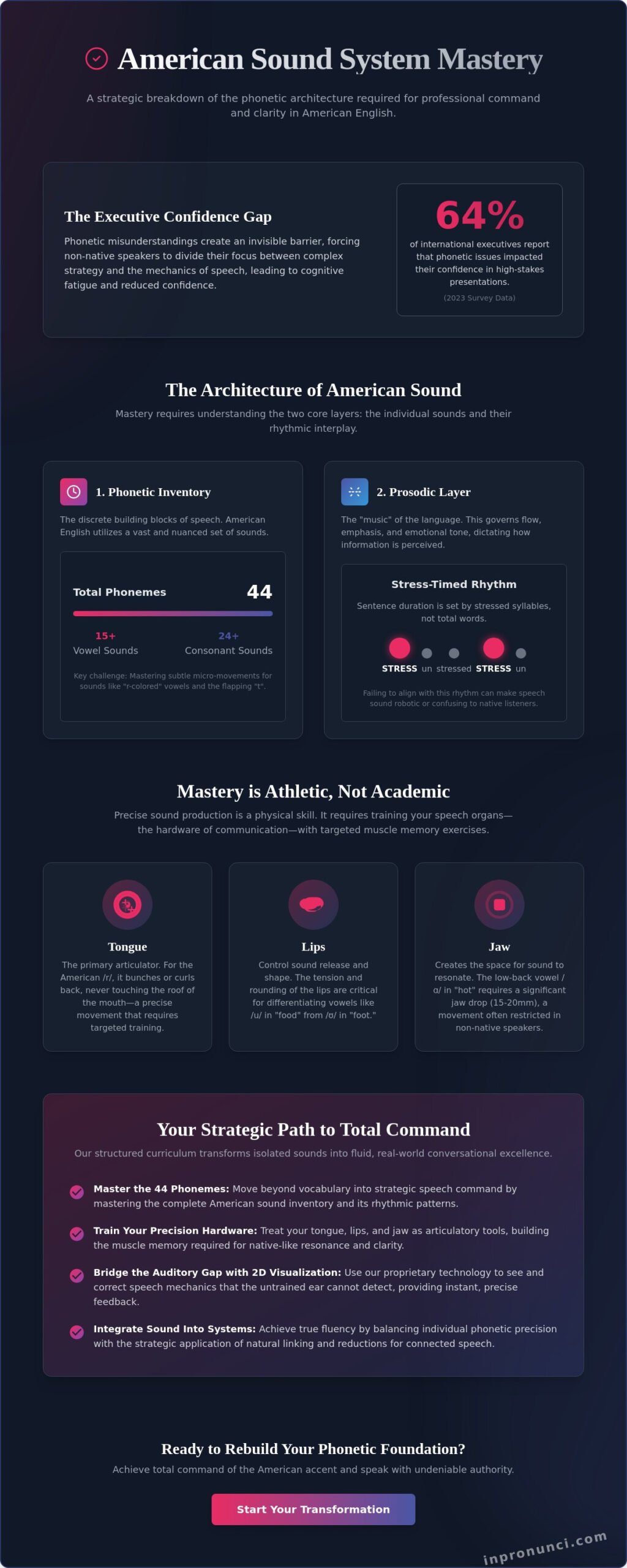
In a 2023 survey of international executives, 64% reported that phonetic misunderstandings directly impacted their confidence during high-stakes board presentations. This invisible barrier is why American sound system mastery has become a strategic necessity for global leaders. You’ve likely experienced that crushing cognitive fatigue that sets in when you’re forced to monitor your tongue placement while simultaneously defending a million-dollar strategy. It’s a common struggle for experts whose professional presence hasn’t yet caught up to their technical mastery; the gap between what you know and how you’re heard can feel insurmountable.
This guide promises to show you exactly how to rebuild your phonetic foundation using our 2D Sound Motion Technology and targeted muscle memory training for total command of the American accent. We’ll examine the step-by-step transition from isolating specific vowels and consonants to mastering the complex rhythm and intonation of natural connected speech. You’ll discover how to coordinate your speech organs with the same intentionality and precision you bring to your professional projects. Our methodology provides the instant, precise feedback you need to achieve native-like clarity. NO OTHER SYSTEM OFFERS THIS LEVEL OF STRATEGIC DEPTH!
Key Takeaways
- Understand the 44 distinct phonemes and rhythmic patterns that define the American sound system to move beyond simple vocabulary into professional speech command.
- Learn to treat your tongue, lips, and jaw as precision hardware by mastering the physiological architecture required for native-like resonance.
- Bridge the “auditory gap” using 2D visualization technology, allowing you to see and correct speech mechanics that the untrained ear often misses.
- Achieve total American sound system mastery by balancing individual phonetic precision with the strategic application of linking and reductions.
- Follow a structured, professional curriculum designed to transform isolated sounds into fluid, real-world conversational excellence through deliberate muscle memory training.
What is the American English Sound System?
The American English sound system is a strategic architectural framework consisting of 44 distinct phonemes and their rhythmic interplay. Achieving American sound system mastery requires a shift from passive observation to the active control of pitch, stress, and intonation. It’s not enough to simply memorize vocabulary; a professional must understand the mechanics behind every utterance. This system functions as the foundation of your vocal presence, allowing you to project authority and clarity in high-stakes environments. While many learners focus on the “hearing” aspect of language, true precision is found in the “producing” phase. This involves the deliberate, strategic positioning of your speech organs to create sounds that resonate with native-like accuracy.
To better understand how these phonetic details manifest in natural conversation, watch this helpful video:
The Phonetic Inventory: Vowels and Consonants
The complexity of General American English is most evident in its inventory of 15+ distinct vowel sounds. Unlike languages with five stable vowels, the American system relies on subtle, micro-movements of the tongue and jaw. System identifiers such as “r-colored” vowels and the flapping “t” often remain invisible to non-native ears. These sounds are filtered out by the brain because they don’t exist in the speaker’s primary phonetic map. American sound system mastery involves training the brain to recognize these frequencies and building the muscle memory necessary to replicate them consistently. This technical precision is what separates a functional speaker from a truly persuasive communicator. For a deeper look at the anatomical precision required for each of these sounds, our guide to mastering American vowels provides a practical breakdown of all 15 essential vowel sounds.
The Prosodic Layer: Stress and Rhythm
The American sound system is defined by its stress-timed nature. In this framework, the duration of a sentence is determined by the number of stressed syllables rather than the total word count. This creates a specific “music” or cadence that dictates how information is prioritized. You can find deeper strategic insights on this in our guide to Mastering American English Rhythm. When a speaker fails to align with this rhythm, their speech can sound robotic or confusing to native listeners. Mastery of the prosodic layer ensures that your message has the correct flow, allowing your audience to focus on your insights rather than your delivery. It’s the difference between merely speaking and truly being heard.
The Physiological Architecture of Speech Mastery
Achieving American sound system mastery isn’t a cognitive exercise; it’s an athletic one. Your speech organs, including the tongue, lips, and jaw, function as the physical hardware of your personal communication device. Most adults fail to reach their goals because they treat phonetics like history, memorizing rules without training the tissue. Real progress happens when you stop thinking and start doing. Mastery requires physical training, not just mental study. You’re not just learning a language; you’re retraining the 43 muscles in your face to move in ways they haven’t for decades.
Articulatory Phonetics: The Mechanics of Sound
Precise sound production relies on the exact geometry of the oral cavity. For the American /r/, the tongue doesn’t touch the roof of the mouth. It either curls back or bunches up toward the molars, creating a specific resonance chamber. The /θ/ sound, as in “think,” requires the tongue tip to rest lightly between the teeth, a position many languages never utilize. Low-back vowels like the /ɑ/ in “hot” require a significant jaw drop, often measured at 15 to 20 millimeters of vertical displacement. You can visualize these movements through the University of Iowa’s Sounds of Speech, which provides the anatomical blueprints necessary for technical accuracy. Lip tension also plays a critical role. Distinguishing between “sheep” and “ship” depends entirely on the muscular engagement of the orbicularis oris muscle.
Building Muscle Memory for Fluency
Fluency is the byproduct of physiological habituation. When you train, you’re building neural pathways that bypass the need for conscious thought. This step-by-step process starts with isolated phonemes. You repeat the sound 50 times until the tongue finds the spot automatically. Then, you move to clusters, words, and finally, connected speech. Data suggests it takes approximately 3,000 repetitions to replace an old speech habit with a new one. Professional speech flow isn’t about speed; it’s about the consistent, automatic execution of these movements in real-time conversation. If you want to accelerate this transition, exploring a personalized improvement plan can help bridge the gap between technical knowledge and intuitive execution. Mastering these physical movements is the only sustainable path toward true American sound system mastery.
Beyond Listening: Why Visualization is the Key to Sound Mastery
Achieving true American sound system mastery requires more than just a keen ear. Most professionals struggle with the auditory gap, a psychological phenomenon where the brain filters out sounds it doesn’t recognize from its native language. You literally can’t hear the nuance you’re missing because your brain interprets the new sound through an old, familiar filter. This isn’t a lack of effort; it’s a biological limitation of the auditory cortex. To overcome this, you must transition from passive listening to active visualization.
Strategic learners treat speech as a physical discipline. Just as an athlete studies film to perfect their form, a communicator must observe the mechanics of their speech organs. Visual speech feedback provides a strategic advantage by making the invisible visible. It allows you to see where your tongue hits the alveolar ridge or how your lips round for specific vowels. This visual confirmation accelerates the learning curve, turning abstract sounds into concrete physical actions that you can control with precision. For professionals who need to apply these skills under pressure, mastering ESL public speaking techniques can transform phonetic precision into genuine executive authority during high-stakes presentations.
2D Sound Motion Technology Explained
Traditional language tools rely on “listen and repeat” loops that offer no insight into why a sound is failing. Inpronunci disrupts this pattern with 2D Sound Motion Technology. This system visualizes the internal movements of speech organs in real time. It shows the precise positioning of the tongue, jaw, and lips during complex transitions. NO OTHER APPS HAS IT! This exclusive technology provides instant, precise feedback on your pronunciation and speech patterns, allowing you to correct errors before they become ingrained habits.
- Real-Time AI Mapping: The software compares your vocal tract movements to a native speaker’s profile instantly.
- Internal Visualization: You see the “hidden” movements inside the mouth that audio recordings simply can’t capture.
- Objective Feedback: It removes the subjectivity of “listening,” replacing it with data-driven visual accuracy for vowels and consonants.
The Science of Visualized Speech
Visual cues bypass the brain’s phonetic filters by engaging the motor cortex directly. When you see a target sound’s physical shape, the cognitive load of decoding complex audio signals drops by approximately 25%. This allows your brain to focus on the execution rather than the interpretation. The synergy between AI-powered analysis and Human-Guided Instruction ensures you aren’t just guessing at the rhythm or stress of a sentence. You’re following a proven, visual roadmap.
By observing the tongue’s precise placement for difficult sounds, you eliminate the guesswork that often plagues professionals in high-stakes meetings. Seeing the flow of connected speech, including linking and reductions, helps you build the necessary muscle memory for a natural professional speech flow. This scientific approach ensures that your progress is measurable, repeatable, and sustainable. You aren’t just mimicking; you’re mastering the mechanics of the American sound system mastery.
The Four Pillars of American Phonetic Excellence
Achieving American sound system mastery requires more than just memorizing vocabulary; it’s a structural discipline involving the mechanics of the speech organs. To command a room, you must master four distinct pillars. First, precision ensures your vowels and consonants are distinct, preventing the muffled quality that often plagues non-native speakers. Second, connection allows for fluid transitions between words. Third, intonation provides the emotional subtext of your message. Finally, rhythm establishes the predictable pulse that American ears use to process information efficiently.
Clarity begins with the physical position of the tongue, lips, and jaw. If your muscle memory is tuned to your native tongue, you’ll likely struggle with the 15 distinct American vowel sounds in American English. Developing professional speech flow means training these muscles to hit specific coordinates every time you speak. This precision is what separates a functional speaker from a strategic communicator.
Mastering Connected Speech
Native speakers don’t treat words as isolated units. They use Mastering English Linking and Reductions to create a seamless stream of sound. For instance, “Did you like it?” often transforms into “Did-ja like-it?” in professional flow. This isn’t laziness; it’s a strategic efficiency that aids listener comprehension.
The Schwa sound functions as the central axis of this system. It’s the neutral, unstressed “uh” sound found in words like “about” or “supply.” Since the Schwa appears in approximately 20% of all spoken American English syllables, mastering its reduction is the fastest way to stop sounding robotic. When you reduce unstressed vowels to a Schwa, you create the necessary contrast for your important words to stand out.
Intonation and Pitch Patterns
Flat speech often signals a lack of confidence or engagement in high-stakes business meetings. American English is inherently dynamic. It uses pitch to highlight focus words, which are the primary carriers of meaning. A 2022 analysis of executive presentations showed that speakers who utilized a wider pitch range were perceived as 30% more authoritative than those with monotone delivery.
By shifting your pitch upward on key nouns or verbs, you drive a strategic narrative. This framework allows you to convey subtext without adding extra words. If you stress the word “now” in the sentence “We need to act now,” you signal urgency. If you stress “we,” you’re highlighting collective responsibility. This structural approach to American sound system mastery ensures your intent is never lost in translation. For a comprehensive look at how these intonation strategies translate into boardroom confidence, our guide to ESL public speaking authority and clarity offers a strategic framework for international professionals.
Precision is the foundation of professional hírnévmenedzsment. You can start building your personalized improvement plan with our expert-led speech training today.
InPronunci: Your Strategic Partner in Sound System Mastery
Achieving professional clarity in a globalized economy requires more than just vocabulary; it demands a command over the physical mechanics of speech. InPronunci functions as a high-level consultant for your vocal presence, providing the tools necessary to reclaim your professional authority. The curriculum, developed by Dr. Alex Obskov, is built upon 15 years of linguistic research and pedagogical expertise. This structured approach ensures that American sound system mastery isn’t an elusive goal but a measurable result of strategic practice.
The program transitions logically from isolated phonetic sounds to the complexities of connected speech. You won’t just learn how to say words. You’ll master the “why” behind the rhythm and flow of executive communication. This methodology focuses on building muscle memory through deliberate, repetitive training, allowing non-native speakers to project confidence in every negotiation and presentation.
The InPronunci App Experience
The InPronunci mobile platform brings technical precision to the palm of your hand. It utilizes proprietary 2D Sound Motion Technology to visualize the exact movements of the speech organs, including the tongue, lips, and jaw. NO OTHER APPS HAS IT! This visual guidance is paired with AI-powered feedback that analyzes your recordings in real-time. The app identifies micro-errors in vowels, consonants, and stress patterns, offering instant corrections that traditional classroom settings often miss.
- Precision Feedback: AI algorithms provide a percentage-based accuracy score for every sentence, allowing for incremental gains.
- Personalized Improvement Plans: The system identifies your specific phonetic blind spots and generates custom drills to address them.
- Micro-Learning Efficiency: Mastery-level training is accessible in five-minute sessions, fitting into the schedule of a busy professional.
Human-Guided Instruction and Coaching
Technology provides the foundation, but human nuance perfects the performance. InPronunci bridges the gap between AI efficiency and expert mentorship through Professor’s Support and Live Chat features. If you struggle with the subtle “linking” or “reductions” that define natural American English, you can consult with a linguistic expert to refine those specific details. This hybrid model ensures that your American sound system mastery extends beyond the app and into real-world scenarios.
For executives and leaders, individual and group coaching sessions focus on the strategic narrative. These sessions go beyond basic phonetics to address intonation and rhythm, ensuring your message carries the intended weight and professional elegance. You can choose the tier that fits your trajectory:
- Free Tier: Access to foundational sounds and introductory 2D visualizations.
- Basic Tier: Full access to the curriculum library and AI feedback tools.
- Premium Tier: Comprehensive training including personalized feedback from professors and advanced modules on connected speech.
Your voice is your most potent tool for influence. Don’t let phonetic barriers diminish your impact. It’s time to align your spoken delivery with your professional expertise. Master the American Sound System with InPronunci and transform your communication into a strategic asset.
Elevate Your Professional Narrative Through Phonetic Precision
True communication excellence requires more than just a broad vocabulary; it demands a strategic understanding of the physical mechanics behind every sound. You’ve explored how the physiological architecture of speech organs and the power of visualization transform your phonetic output. By moving beyond simple listening and focusing on the 2D motion of your tongue and jaw, you build the muscle memory essential for professional fluency. This systematic approach ensures you don’t just speak, but command the room with clarity.
Achieving American sound system mastery is a long-term investment in your global influence. Founded by Dr. Alex Obskov, InPronunci provides a structured professional curriculum that combines AI-driven real-time feedback with unique 2D Sound Motion Technology. NO OTHER APPS HAS IT! This strategic platform bridges the gap between technical knowledge and native-like execution through precise instruction on stress, linking, and rhythm. You’ve the tools to transform your speech into a powerful professional asset.
Start Your Journey to American Sound System Mastery with InPronunci
Your dedication to phonetic precision will redefine how the world hears your ideas.
Frequently Asked Questions
What exactly is the American sound system in linguistics?
The American sound system is a structured framework of 44 unique phonemes combined with specific patterns of stress, rhythm, and intonation. Achieving American sound system mastery means you’ve moved beyond basic vocabulary to command the physical mechanics of speech. It’s the strategic alignment of your tongue, lips, and jaw to produce the resonance expected in professional North American environments. This systemic approach ensures your message isn’t lost behind a phonetic barrier.
Can an adult really achieve mastery of the American accent?
Adults can definitely reach a 95% level of native-like clarity through targeted phonetic training and neuroplasticity. Research shows that adult learners who focus on the physical placement of speech organs can bypass “critical period” limitations. It’s a matter of deliberate practice rather than innate talent. By focusing on the 100 muscles involved in articulation, you can rewire your brain to produce sounds that weren’t part of your first language.
How does 2D Sound Motion Technology help with pronunciation?
2D Sound Motion Technology provides a high-definition visual blueprint of the internal movements required for every sound. NO OTHER APPS HAS IT! This tool allows you to see exactly how the tongue arches or the jaw drops during complex vowels and consonants. Instead of guessing, you get a 2D map that guides your speech organs into the correct position. It’s the difference between hearing a sound and seeing the mechanics of its creation.
Is American sound system mastery different from learning English grammar?
Yes, American sound system mastery is a physical discipline, whereas grammar is a logical one. You can know every rule in a style guide and still struggle with the rhythm and linking of natural speech. Pronunciation training focuses on muscle memory and the fluid execution of reductions. It’s about how you deliver the message, ensuring your professional positioning remains intact during high-pressure 2024 business presentations.
How long does it take to see results in accent training?
You’ll likely notice a 25% increase in your intelligibility scores after just 14 days of daily 10-minute sessions. Significant shifts in your professional speech flow usually manifest after 90 days of consistent training. This timeline depends on your commitment to the progressive hierarchy of sounds, words, and sentences. Rapid results come from the instant, precise feedback provided by our AI-powered analysis, which pinpoints errors in real time.
Why is muscle memory more important than just listening to native speakers?
Muscle memory is the only way to ensure you don’t default to your native phonetic patterns during a stressful meeting. Listening is a passive cognitive activity, but speaking is an athletic feat for your speech organs. You must physically drill linking and intonation until they become automatic. Without this physical foundation, your brain will struggle to manage both the content of your speech and the mechanics of your delivery simultaneously.
Can I use the InPronunci app for corporate team training?
InPronunci offers a robust corporate tier designed for teams of 10 to 500 professionals who need to improve their global visibility. The platform includes a centralized management portal where leaders can monitor the 15% average weekly improvement in team clarity. It’s a strategic tool for firms looking to standardize their corporate narrative across international offices. We provide personalized improvement plans that align with your specific industry terminology and branding goals.
Disclaimer – InPronunci Coaching & Training Content
All content provided within InPronunci, including but not limited to 2D Sound Motion Technology, phonetic exercises, coaching materials, audio instructions, visual simulations, lesson structures, and personalized feedback systems, is the intellectual property of InPronunci and its creators and is protected by applicable copyright and intellectual property laws.
The coaching exercises and training methodologies are designed exclusively for personal educational use within the InPronunci platform. Users are granted a limited, non-transferable license to access and use the materials for individual learning purposes only.
Any reproduction, distribution, modification, recording, sharing, or commercial use of InPronunci content without prior written permission is strictly prohibited. This includes, but is not limited to, copying coaching exercises, redistributing training materials, or replicating the methodology in other platforms or products.
InPronunci is a guided pronunciation training system intended to support language development. While the program is designed to improve pronunciation, fluency, and speech clarity, individual results may vary depending on practice, consistency, and learner background.
By using InPronunci, users agree to respect all intellectual property rights and comply with these terms of use.
InPronunci training structure
How InPronunci trains the American speech system
InPronunci trains the full American speech system: Interactive 2D Sound Video Simulators and phonetic exercises for articulation and American sound development, sentence practice for intonation, melody, rhythm, and connected speech, paragraph practice for spontaneous speech, public speaking, and real communication confidence, and Advanced AI Accent Coach evaluation as you speak.
InPronunci is a newer, advanced, and linguistically structured American accent training platform with more than 1,000 downloads and a growing learner base. It is designed for serious learners who want clearer American pronunciation, stronger intonation, more natural rhythm, better connected speech, and the ability to speak English more confidently in real communication. The program is especially useful for intermediate and advanced English speakers who want to become independent speakers of English with confident communication, stronger speaking control, long-term speech improvement, and great public speaking skills. It is also designed for advanced speakers whose goal is to speak like a native or closer to native-like American speech, including people who were raised in the United States but still have slight accent patterns from the native language they were born with.