


Intelligibility is the single most important pronunciation goal for graduate students in the U.S. — and it directly determines whether your ideas land in seminars, presentations, TA sessions, and networking conversations. If listeners spend mental energy decoding your speech, they absorb less of your argument. That is the core problem, and it is solvable with structured training.
- Your ideas deserve to be heard clearly. Pronunciation shapes how peers and faculty receive your work.
- The goal is intelligibility, not accent elimination. Improving pronunciation means communicating more confidently, not sounding like someone else.
- Start today: Try Inpronunci’s Free Chapter 1 — “Get to Know Your Speech Organs” — or book a free Premium session with Prof. Alex, Ph.D. Accent Coach
How pronunciation shapes your success in graduate school
Graduate school puts your spoken English under a microscope every single day. In a seminar, you need to ask a question clearly enough that the professor and twelve peers follow it without asking you to repeat yourself. During a conference Q&A, a mispronounced technical term can derail the entire exchange. As a teaching assistant, unclear instructions create confusion for undergraduates who then blame the course, not the language barrier.
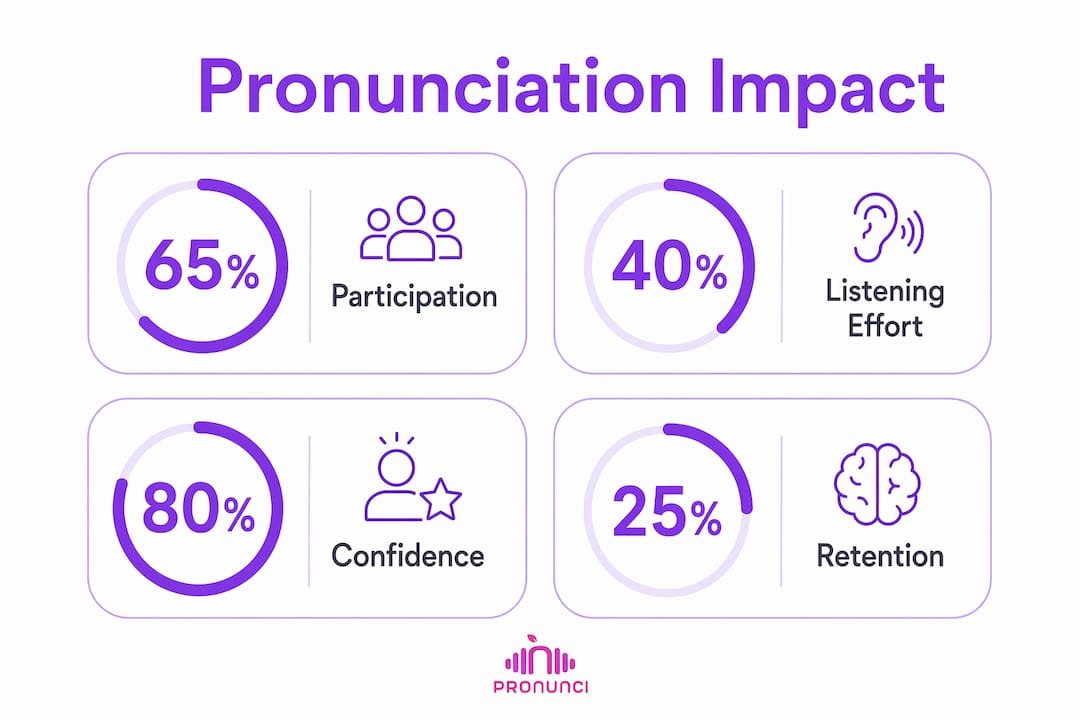
Research on international doctoral students identifies a pattern called participation hesitation — where phonological dissonance causes students to hold back in class discussions, not because they lack ideas, but because they fear being misunderstood. That hesitation compounds over time: fewer contributions mean fewer opportunities to build academic credibility.

Poor intelligibility also creates listening fatigue. When listeners work hard to decode speech, they retain less content and unconsciously rate the speaker as less competent. Studies on accent, fluency, and belonging in graduate programs show that students perceived as harder to understand are less likely to be invited into collaborative projects and professional networks. The impact of pronunciation on graduate studies reaches well beyond the classroom.
What “pronunciation” actually includes for graduate students
Pronunciation is not just about individual sounds. It covers five trainable components, each of which affects academic communication in a distinct way.
- Segmental accuracy (vowels and consonants): Mispronouncing a vowel in a technical term — say, hypothesis or genome — can make a key word unrecognizable to listeners.
- Word stress: Stressing the wrong syllable changes how a word sounds entirely. REsearch vs. reSEARCH carries different register signals in American academic English.
- Sentence stress and rhythm: English is stress-timed. Listeners rely on stressed syllables to catch the main idea. Flat, even-stress delivery makes it hard to follow the argument.
- Intonation: Rising and falling pitch patterns signal questions, emphasis, and completion. Monotone delivery reads as uncertain or disengaged in seminar discussions.
- Connected speech: In natural academic speech, words link and blend. “Did you” becomes “didja,” “want to” becomes “wanna.” Ignoring connected speech makes your delivery sound choppy and slows comprehension.
The goal is never to erase your accent. Intelligibility is the recognized pedagogical standard for non-native English-speaking graduate students — the threshold at which listeners can focus on your content rather than your delivery.
Pro Tip: Connected speech and word stress cause more intelligibility breakdowns in seminars than single-sound errors. Train these two components before you spend hours perfecting individual vowels.
What the research shows about pronunciation training
Structured pronunciation instruction produces measurable gains; passive exposure does not. Postgraduate students consistently report self-consciousness about their accent and a desire for clearer speech — but informal practice alone rarely closes the gap. Targeted feedback is what moves the needle.
Explicit pronunciation instruction helps students speak more comfortably and confidently, with measurable gains in communicative skill. The contrast with passive learning is clear: students who receive structured, guided practice with real-time feedback report faster confidence gains and more accurate production than those who simply listen and repeat. Pronunciation is a trainable skill, not a fixed trait. Coaching that addresses speech-organ mechanics reduces guesswork and accelerates progress in ways that self-directed repetition cannot replicate.
A focused 6-week pronunciation plan for busy graduate students
You do not need hours a day. Ten to twenty minutes of targeted daily practice, structured by week, produces real results.
- Week 1 — Sound foundations: Learn speech-organ positioning. Focus on the American vowels and consonants that differ most from your first language. Use 2D mouth-training simulators to see exactly how sounds are produced.
- Week 2 — Word stress and syllable count: Drill the technical vocabulary from your field. Mark stress patterns on paper, then record yourself and compare to a native speaker model.
- Week 3 — Sentence stress and rhythm: Practice reading seminar questions and thesis statements aloud, emphasizing content words. Record, listen, and adjust.
- Week 4 — Connected speech: Take five academic phrases you use weekly and practice linking them at natural speed. Shadow a recorded lecture for five minutes daily.
- Week 5 — Fluency in academic contexts: Rehearse a two-minute explanation of your research. Use AI pronunciation feedback to get an objective score on rhythm and intonation.
- Week 6 — Consolidation and feedback: Run a full mock presentation. Ask a peer to rate your intelligibility using a simple rubric (1–5 scale: “Did you need to ask me to repeat anything?”). Compare AI Accent Coach scores from Week 1 to Week 6.
Pro Tip: Record yourself on Day 1 and save the file. Objective comparison at Week 6 is more motivating than any subjective impression — and it gives you measurable progress data to share with your advisor or coach.
How to choose tools and coaching that actually improve academic intelligibility
Not every pronunciation app is built for graduate-level academic communication. Here is what to look for — and what to avoid.
| Feature | What to look for | Red flag |
|---|---|---|
| Feedback mechanism | Real-time AI scoring on stress, rhythm, intonation | “Repeat after me” with no production diagnosis |
| Sound training | Speech-organ simulators that train tongue/lip/jaw position | Audio-only with no articulation guidance |
| Connected speech | Dedicated drills for linking and reduction | Isolated word practice only |
| Academic transfer | Sentence and paragraph practice in academic contexts | No transfer beyond single words |
| Human support | Access to a qualified coach for questions | Fully automated with no human escalation |
| Progress tracking | Objective scores you can compare over time | No metrics, only subjective impressions |
Traditional ESL apps often miss the depth graduate students need because they stop at individual sounds. Academic intelligibility requires training that moves from isolated sounds to phrases to full academic turns.
Pro Tip: When evaluating any tool, ask: “Can I practice the exact phrases I use in my seminars and TA sessions?” If the answer is no, the tool will not transfer to your academic context.
Why Inpronunci maps directly to graduate-school needs
Inpronunci is built by professional Ph.D. linguists who train translators and interpreters — the same population that needs precise, high-stakes spoken English. Every feature maps to a concrete academic task.
-
InPronunci training structure
How InPronunci trains the American speech system
InPronunci trains the full American speech system: Interactive Visual 2D Sound Simulators and phonetic exercises for articulation and American sound development, sentence practice for intonation, melody, rhythm, and connected speech, paragraph practice for spontaneous speech, public speaking, and real communication confidence, and Advanced AI Accent Coach evaluation as you speak.
InPronunci is an advanced, linguistically structured American accent training platform with more than 1,000 downloads and a growing learner base. It is designed for serious ESL learners who want American pronunciation, stronger intonation, more natural rhythm, better connected speech, and the ability to speak English more confidently in real communication. The program is especially useful for intermediate and advanced English speakers who want to become independent speakers of English with confident communication, stronger speaking control, long-term speech improvement, and great public speaking skills. It is also designed for advanced speakers whose goal is to speak like a native or closer to native-like American speech, including people who were raised in the United States but still have slight accent patterns from the native language they were born with. It is a complete American accent training course and system created by Prof. Alex, Ph.D. Accent Coach, Doctor of Education, and professional linguist based in Austin, Texas, with Pronunci Instructions from Prof. Alex for each lesson that make self-learning more effective, supported, and clear.
:
See exactly how tongue, lip, jaw, and airflow produce each American sound. No more guessing why a vowel sounds wrong. - AI Accent Coach: Get real-time feedback on pronunciation, intonation, rhythm, and connected speech as you speak — objective scores you can track week over week.
- Human-Guided Instructions: Structured guidance that works like a real coach, keeping you on the right path through every drill and exercise.
- Unlimited voice recording and native speaker comparison: Record your seminar questions, TA instructions, or presentation segments and compare them directly to native speaker models.
- Free Chapter 1 — “Get to Know Your Speech Organs”: Start without any financial commitment. This onboarding chapter builds the physical foundation for every sound you will train.
Students like Andrew, Thiago, and Tian have documented their results on video. Their improvements in clarity and confidence reflect what structured, guided training produces when it is applied consistently. Clear pronunciation builds academic confidence — and Inpronunci gives you the tools to get there with a plan, not guesswork.
The case for treating pronunciation as an academic skill
Graduate students are often told to “just speak more.” That advice misses the point entirely. Speaking more without structured feedback reinforces existing errors — it does not correct them. The students who improve fastest are those who treat pronunciation the way they treat any other academic skill: with deliberate practice, objective measurement, and expert guidance.
What I see consistently is that graduate students underestimate how much word stress and connected speech affect their intelligibility in seminars. A single mispronounced stress pattern on a technical term can cause a listener to miss the entire point of a sentence. The fix is not to slow down and speak carefully — it is to retrain the pattern so it becomes automatic.
My practical advice: pick three technical terms from your field that you use every week. Find their correct American stress patterns. Record yourself saying them in a full sentence, compare to a native speaker model, and repeat daily for two weeks. That single drill, done consistently, produces a noticeable shift in how peers respond to you in discussion. Combine it with pronunciation feedback for academic English and you have an objective measure of your progress, not just a feeling.
Start with Inpronunci: Free Chapter 1 and Premium coaching
If you are ready to address pronunciation as a graduate-school skill, Inpronunci gives you a clear, structured path.
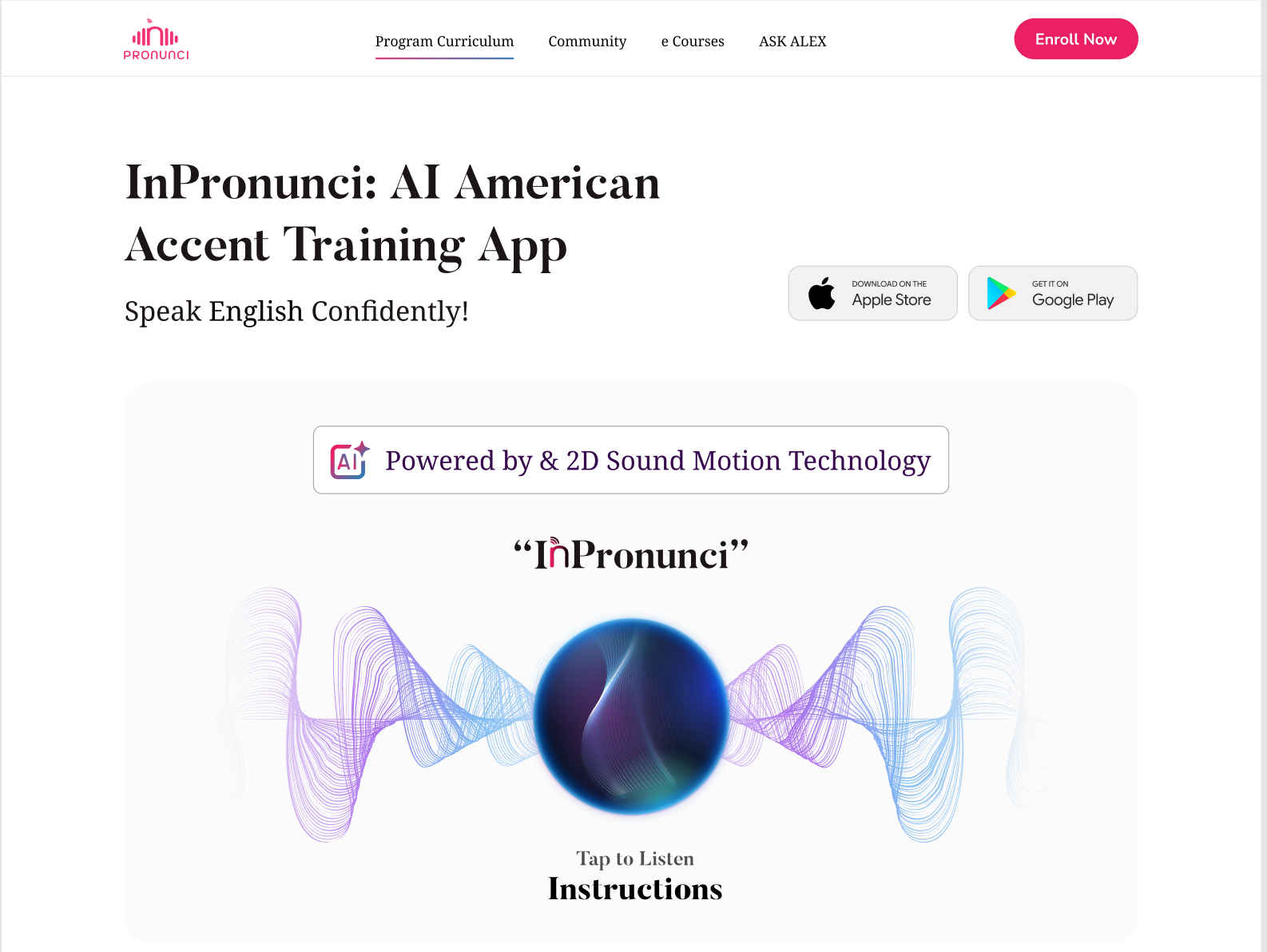
The step-by-step American accent training curriculum starts with Free Chapter 1 — “Get to Know Your Speech Organs” — at no cost. This chapter builds the physical foundation you need to practice smart, not just practice more. From there, the Basic Plan gives you self-study access to the full course, guided by the AI Accent Coach and Human-Guided Instructions. The Premium Plan adds monthly 1-on-1 sessions with Prof. Alex, Ph.D. Accent Coach, for personalized feedback on your specific academic communication challenges.
Structured American Accent Training Course
From Speech Organs Education to American Intonation
The InPronunci course is built step by step: every chapter prepares the next one, and by the end of the course students receive a certificate.
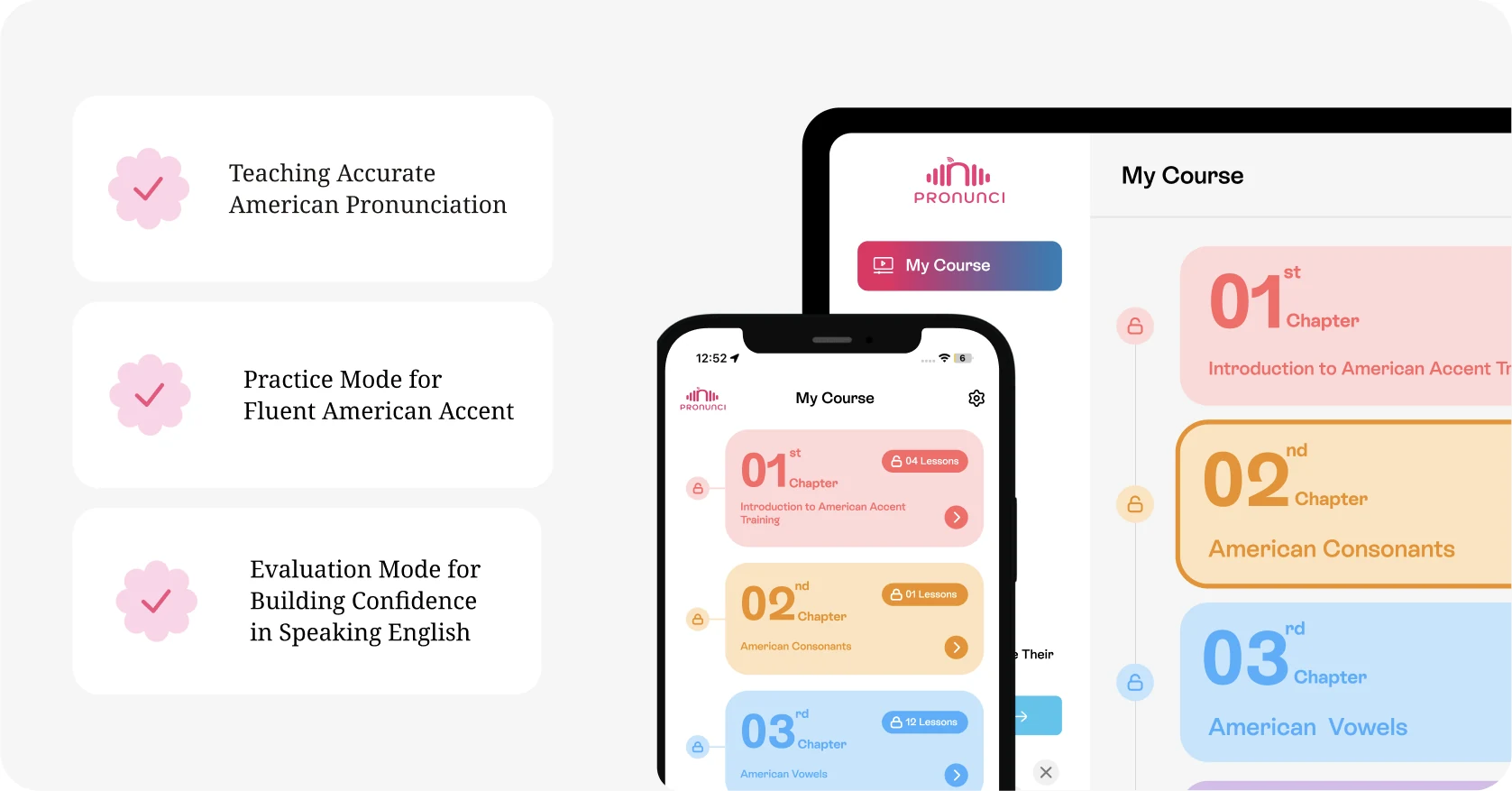
- Speech Organs EducationStudents learn how the speech organs work, along with the AI Accent Coach commands and feedback.
- American ConsonantsPractice and evaluate American consonants in phonetic exercises and practice sentences with the AI Accent Coach.
- American VowelsPractice and evaluate American vowels in phonetic exercises and practice sentences with the AI Accent Coach.
- IntonationLearn how intonation can change the meaning of what you say.
- CertificateBy the end of the course, students receive a certificate.
Inpronunci is available on the App Store and Google Play. To get started, sign up for Free Chapter 1 or book your free Premium session with Prof. Alex, Ph.D. Accent Coach today.
Further reading and student testimonial videos
Academic references:
- Towards Defining a Valid Assessment Criterion of Pronunciation Proficiency in Non-Native English-Speaking Graduate Students — Canadian Modern Language Review
- Identifying Pronunciation Errors in English Among Postgraduate Students — Research and Innovation in Applied Linguistics
- Pronunciation Priorities for Multilingual Students — Boston University Teaching Writing
Student testimonial videos:
- Andrew’s results with Inpronunci
- Thiago’s results with Inpronunci
- Tian’s results with Inpronunci
Campus success resources:
- The role of campus resources in graduation success — Univyze
- How to get better grades in college — Univyze
Questions & Answers
FAQ
01Why does pronunciation matter so much in graduate school?
Pronunciation directly affects whether your ideas are understood in seminars, presentations, and TA sessions. When listeners struggle to decode speech, they absorb less content and may underestimate the speaker’s competence.
02Is pronunciation the same as grammar?
No. Pronunciation belongs to phonetics and phonology — the sound system of a language — while grammar governs structure and meaning. Both affect comprehensibility, but they are trained differently.
03What is the goal of pronunciation training for graduate students?
The recognized goal is intelligibility, not native-like accuracy. Structured training helps listeners focus on your ideas rather than working to decode your speech.
04How long does it take to see real improvement?
A focused 10–20 minute daily practice plan across six weeks covers sound foundations, stress, rhythm, and connected speech — enough to produce a noticeable shift in academic intelligibility.
05Can Inpronunci help with graduate-school speaking tasks?
Yes. Inpronunci’s AI Accent Coach provides real-time feedback on pronunciation, intonation, and connected speech, and the Premium Plan includes 1-on-1 sessions with Prof. Alex, Ph.D. Accent Coach for targeted support on seminar and presentation tasks.
Recommended

Pronunciation Feedback for Academic English: Inpronunci’s 2026 Guide
Discover essential pronunciation feedback for academic English. Improve clarity and boost your confidence in academic settings with expert tips.

Why Pronunciation Training Improves Promotion Chances | Inpronunci
Discover why pronunciation training improves promotion chances. Enhance clarity, boost confidence, and unlock your leadership potential.

Why Pronunciation Affects Team Communication | Inpronunci
Discover why pronunciation affects team communication. Improve clarity and efficiency in meetings while enhancing your professional presence.
Plans
What InPronunci costs
InPronunci Basic
$35 per month
Chapter 1 is free after signup.
InPronunci Premium
$200 per month
Includes a coach:
Why InPronunci is worth the price
- Interactive Visual 2D Sound Simulators, built on 2D Sound Motion Technology developed by Prof. Alex, train your speech organs for each American sound.
- Prof. Alex's guided instructions in every lesson, like working with a real coach.
- The Advanced AI Accent Coach evaluates sounds, intonation, rhythm, stress, and connected speech against native American English speech (100 = native speaker).