Pronunciation determines whether your ideas land or get lost. When listeners cannot decode your words quickly, they spend cognitive energy on the sounds themselves instead of your message, and that gap changes decisions, slows meetings, and signals lower competence even when your knowledge is strong. The fix is not erasing your accent. It is building enough clarity in stress, rhythm, and key sounds that listeners process your speech without friction. Prioritize clarity-first practice, and you protect both your professional presence and your team’s efficiency.
- Unclear pronunciation increases cognitive load for listeners, slowing comprehension
- Mis-stressed syllables and missing consonants cause more miscommunication than grammar errors
- Targeted practice on high-impact features produces measurable gains in a few weeks
- Managers and teammates share responsibility for inclusive communication norms
Table of Contents
- Why pronunciation affects team communication: the core mechanism
- What actually breaks in a team when pronunciation is unclear
- What makes some pronunciations harder for listeners to process
- How listeners process unclear speech and why it costs teams time
- Concrete workplace scenarios where pronunciation changed outcomes
- What studies and experts show about pronunciation and team outcomes
- How to prioritize and practice: clarity-first strategies for meetings
- A 7–14 day practice plan with daily drills
- What teammates and managers can do to reduce communication friction
- How to measure improvement and realistic timelines
- Key Takeaways
- The case for treating pronunciation as a professional skill, not a personal flaw
- Inpronunci gives you the feedback system pronunciation training has always needed
- Useful sources and further reading
- FAQ
Why pronunciation affects team communication: the core mechanism
When a word sounds unexpected, the listener’s brain pauses to run a repair process. That pause is the cost of unclear pronunciation in a team setting. Research on language-related misunderstanding shows that when receivers fail to interpret a sender’s message because of accent or hybrid language forms, cognitive load rises and processing fluency drops. The result is not just a brief awkward pause. It is a chain of downstream effects: extra clarification requests, slower decisions, and a gradual erosion of the speaker’s perceived authority.
The impact is especially sharp in virtual meetings. In audio-only or low-bandwidth calls, pronunciation becomes the primary signal of speaker intent and status because visual cues are absent or degraded. A mispronounced content word or an unexpected stress pattern can make a clear idea sound ambiguous, and the listener may not ask for clarification at all. They simply move on with the wrong interpretation.
A quasi-experimental study on global virtual teams found that accent status affects how recipients perceive a sender’s intentions, and that miscommunication was most frequent in native-to-non-native and non-native-to-native speaker exchanges. Notably, non-native speakers who communicated with other non-native speakers understood each other’s intentions more reliably, likely because they were more deliberate and conscious about how they expressed themselves.
That deliberateness is a real professional advantage. Non-native speakers who are aware of their communication style often convey intentions more precisely in global teams. The goal of pronunciation training is to make that deliberateness automatic, so clarity no longer costs extra effort.
What actually breaks in a team when pronunciation is unclear
The consequences are concrete and measurable. Here are the primary impacts:
- Misunderstood words: A single substituted consonant or shifted vowel can change one word into another. “Sheet” and “seat,” “fifteen” and “fifty,” “three” and “free” are classic examples in American English.
- Slowed meetings: Every repair sequence (a clarification request, a repetition, a paraphrase) adds 15–30 seconds of dead time. Multiply that across a one-hour meeting with multiple speakers and the cost is significant.
- Perceived lower competence: Listeners often attribute processing difficulty to the speaker’s knowledge rather than to acoustic factors. A systematic review of accent-related problems in healthcare found that unclear pronunciation reduces perceptions of competence alongside intelligibility.
- Reduced participation: Professionals who have been misheard or corrected publicly tend to speak less in subsequent meetings, removing their expertise from the conversation.
- Exclusion from informal networks: Quick side conversations, hallway decisions, and informal Slack threads move fast. If your speech requires extra effort, colleagues unconsciously route around you.
The importance of pronunciation for communication is well documented: pronunciation significantly affects communication effectiveness, social perception, and a speaker’s self-confidence. These three dimensions reinforce each other. Lower confidence leads to less speaking, which leads to fewer opportunities to be heard, which further reduces confidence.
Pronunciation training that improves career outcomes is not a luxury skill. Research consistently links clearer speech to promotion chances and decision-making inclusion.
What makes some pronunciations harder for listeners to process
Not all pronunciation features carry equal weight. Linguists divide pronunciation into two categories: segmentals (individual consonants and vowels) and suprasegmentals (stress, rhythm, intonation, and linking). Both matter, but suprasegmentals tend to cause more communication breakdowns than segmentals do.
A study of French/English tandem conversations found that pronunciation was the single most important trigger of communication breakdowns in non-native/native speaker exchanges, accounting for 69% of breakdowns in one task and 48% in another. Word stress was the key suprasegmental issue, appearing in 11 of the breakdown cases in the narrative task alone.
Common trouble spots for non-native professionals include:
- Word-final consonants: Dropping the final /t/, /d/, /k/, or /s/ changes word identity and can obscure plurals, past tense, and possession.
- Vowel distinctions: American English has a wide vowel space. Collapsing the distinction between /ɪ/ and /iː/, or between /æ/ and /ɛ/, creates frequent confusion.
- Content-word stress: Stressing the wrong syllable in a multi-syllable word (e.g., “reCORD” vs. “REcord”) can make the word unrecognizable even to a sympathetic listener.
- Reduced forms and linking: Native American English drops and links sounds in connected speech (“gonna,” “wanna,” “didja”). Non-native speakers who do not use these forms can sound choppy, and those who use them inconsistently create unpredictable patterns.
- Intonation on key phrases: Flat intonation on a question or a rising tone on a statement sends the wrong pragmatic signal.
Pro Tip: Don’t try to fix everything at once. Target word-final consonants and content-word stress first. These two features have the highest functional load in American English, meaning they carry the most meaning-distinction work per sound.
Pronunciation is a servant skill to communicative competence. The goal is not a perfect accent. It is speech that supports your message in context.
How listeners process unclear speech and why it costs teams time
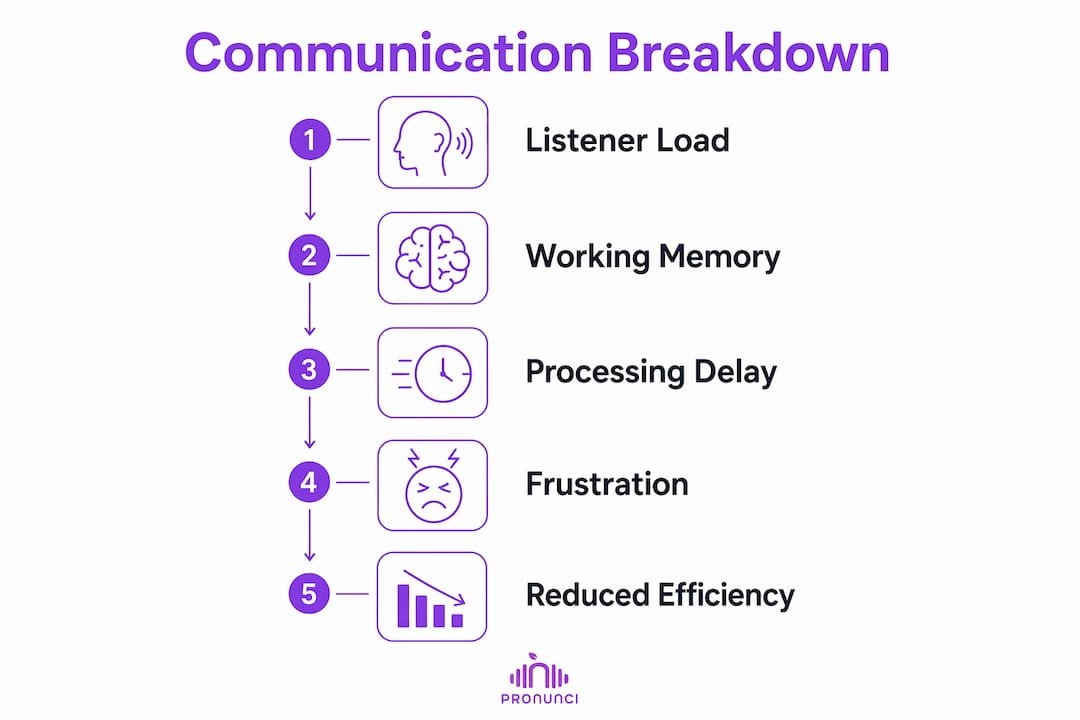
When you speak, your listener’s brain does not wait for the full sentence before starting to decode. It activates word candidates in real time, using expectations built from context, grammar, and prior experience. When your pronunciation matches those expectations, the process is fast and automatic. When it does not, the brain must do extra work: suppress the wrong candidates, reprocess the signal, and sometimes ask for a repair.

This extra processing draws on working memory. In a fast meeting, that working memory is already occupied with the content of the discussion. Adding a pronunciation-decoding load on top means the listener retains less of what you said, even when they eventually understood the words. The result is higher error rates in fast exchanges, more follow-up questions after the meeting, and a general sense that communication with you requires more effort.
Telephone and low-bandwidth audio reduce the acoustic cues needed to distinguish consonants, compounding this effect. Spoken prescriptions and orders in healthcare settings have recorded error rates linked directly to these perceptual limits. The same mechanism operates in any virtual meeting where audio quality is imperfect.
Inconsistent pronunciation forces extra processing and creates frustration. Real-time AI feedback helps retrain speaking habits and reduce that listener effort over time.
Concrete workplace scenarios where pronunciation changed outcomes
Scenario 1: The misheard metric. A data analyst presents quarterly results and says “thirteen percent” with a stress pattern that sounds like “thirty percent” to two colleagues on the call. The team proceeds with the wrong figure in their planning notes. The error surfaces three days later in a client deck.

Scenario 2: The medication handoff. A nurse verbally hands off a patient’s medication order. The drug name “metoprolol” is mispronounced in a way that sounds like “metronidazole” to a colleague in a noisy hallway. Mispronunciation of drug names is a documented source of patient-safety incidents, and the risk increases when masks reduce articulatory clarity or when the environment is loud.
Scenario 3: The client call misunderstanding. A project manager tells a client “we can deliver this in a week” but the stress and vowel quality make “week” sound like “weak.” The client hears a quality concern, not a timeline. The follow-up email takes an hour to write and still leaves the client uncertain.
Typical downstream effects across these scenarios:
- Extra follow-up emails and calls to confirm what was said
- Delayed decisions while teams wait for written confirmation
- Safety risks in high-stakes environments (healthcare, aviation, engineering)
- Missed assignments because a professional was not understood in a meeting
- Gradual exclusion from informal decision-making loops
In each case, a brief repair strategy would have helped: pausing after a key number, spelling out a drug name, or confirming the key term before moving on. But the more durable fix is building the clarity that makes repair unnecessary.
What studies and experts show about pronunciation and team outcomes
The evidence across multiple research streams points in the same direction. Language-related misunderstanding operates through relational, affective, and informational pathways simultaneously. Accent-based misunderstanding does not just slow information transfer; it changes how colleagues feel about each other and how they perceive each other’s intentions.
In healthcare specifically, a systematic review of accent-related communication interventions found that targeted training produced improvements in both intelligibility and indirect professional benefits, including collegiality. The role of pronunciation in patient safety is well established: spoken-order errors tied to perceptual limits have measurable risk in clinical settings.
Pronunciation is not merely a matter of accent or aesthetics; it is central to intelligibility — the degree to which a speaker can be understood. Intelligibility should be the primary goal of pronunciation instruction, especially in workplace settings where misinterpretation can have severe consequences.
— Derwing and Munro, as cited in research on ESL healthcare professionals
Prof. Alex., Ph.D. is a professional linguist who trains translators and interpreters. The Inpronunci method maps directly to this evidence base: the 2D Sound Video Mouth-Training Simulators address articulatory retraining at the segmental level, the AI Accent Coach provides real-time suprasegmental feedback, and human-guided instructions replicate the corrective loop of live coaching. Together, these tools target the exact features that research identifies as the highest-cost sources of miscommunication.
How to prioritize and practice: clarity-first strategies for meetings
You do not need to overhaul your entire pronunciation before your next meeting. These strategies produce immediate results.
Clarity-first checklist for meetings:
- Pre-share key terms. Send an agenda with technical terms, names, and numbers written out. This primes your listeners and reduces the decoding burden on your speech.
- Slow down selectively. Full-sentence slowdown sounds unnatural. Instead, slow down on content words: numbers, names, technical terms, and action items.
- Pause after key information. A one-second pause after a number or decision point gives listeners time to process and signals importance.
- Stress content words. In American English, the most important word in a phrase carries the primary stress. Practice placing that stress deliberately.
- Use repair scripts. Keep two or three short phrases ready: “Let me spell that out,” “To confirm, the number is X,” “I’ll put that in the chat.”
- Emphasize word-final consonants. Make the final /t/, /d/, /s/, and /z/ audible, especially on numbers and key nouns.
Meeting-ready tactics:
- Use slides with the key term spelled out when introducing unfamiliar vocabulary
- In client calls, confirm numbers by saying them twice: “That’s thirteen, one-three”
- For presentations, record a 60-second run-through the night before and listen for any word where your stress pattern sounds off
Pro Tip: Rehearse the first 60 seconds of any meeting or presentation aloud, targeting rhythm and stress. The opening sets the listener’s expectation for your speech pattern. If the first 60 seconds are clear, listeners calibrate faster and follow you more easily for the rest.
A pitch clarity checklist built specifically for non-native speakers can help you run through these steps before high-stakes interactions.
A 7–14 day practice plan with daily drills
This plan targets the features with the highest impact on meeting clarity. Each session runs 10–20 minutes.
Days 1–2: Speech organ awareness and target sounds
Practice the positioning of your tongue, lips, and jaw for the five sounds you most often substitute. Use Inpronunci’s 2D Sound Motion Technology to see exactly how native speakers produce each sound. Record yourself and compare.
Days 3–4: Word stress and content-word emphasis
Choose 10 multi-syllable words from your work vocabulary. Mark the stressed syllable. Say each word in a sentence, exaggerating the stress contrast. Record and review.
Days 5–6: Connected speech and rhythm
Practice three-to-five word phrases from your meetings using linking and reduction. “Did you get it?” becomes “Didja geddit?” in natural American speech. Shadow a slowed model, then match the natural speed.
Days 7–8: Sentence-level intonation
Practice five question types and five statement types from your work context. Focus on the final pitch movement: falling for statements and wh-questions, rising for yes/no questions.
Days 9–10: Meeting simulation
Record a two-minute summary of a recent project. Play it back and count how many times a listener would need to ask for clarification. Target: zero.
Days 11–14: Full-context practice
Use Inpronunci’s AI Accent Coach for real-time feedback on full sentences. Log your AI clarity score each day. Track whether the score improves by Day 14.
Progress tracking template:
| Day | Focus | AI Score | Self-Rating (1–5) | Notes |
|---|---|---|---|---|
| 1 | Target sounds | — | — | — |
| 7 | Sentence intonation | — | — | — |
| 14 | Full context | — | — | — |
Micro-improvements in stress and rhythm are typically noticeable within 2–6 weeks of daily 15-minute practice. Noticeable workplace effects, such as fewer clarification requests per meeting, generally appear within 2–4 months of consistent work. Daily pronunciation practice builds the habit that makes those gains permanent.
What teammates and managers can do to reduce communication friction
Pronunciation clarity is a shared responsibility. Managers who build inclusive communication norms reduce friction for the whole team, not just for non-native speakers.
Manager checklist:
- Set a meeting norm: slow down when presenting numbers, decisions, or action items
- Confirm key points in writing immediately after verbal agreements
- Avoid finishing colleagues’ sentences, even with good intentions. It signals that you expect them to struggle.
- Pre-share agendas with technical terms and acronyms spelled out
- Schedule a short pronunciation-aware onboarding session for new international hires, normalizing repair language from day one
Teammate actions:
- Paraphrase to confirm: “So the deadline is the 15th, is that right?”
- Use open questions after a complex point: “Can you walk me through that number again?”
- Provide supportive feedback privately, never in front of the group
- Avoid exaggerated nodding when you did not understand. It encourages the speaker to continue without repair.
Research on ESL professionals in team settings shows that many non-native speakers avoid speaking up in meetings not because of a lack of knowledge, but because of fear of linguistic embarrassment. That silence is misread as disengagement. Managers who normalize repair language and slow-down norms remove that barrier.
Pro Tip: When onboarding a new international hire, spend five minutes in the first team meeting establishing repair norms: “If you need me to repeat or rephrase anything, just say so. We do that here.” That one sentence changes the meeting culture.
How to measure improvement and realistic timelines
Tracking progress keeps practice focused and shows you what is actually working.
Measures to track:
- Self-recorded intelligibility checks: Record yourself saying 10 key sentences from your work. Play them back 24 hours later and count how many words you would have to ask about if you were the listener.
- AI clarity scores: Use Inpronunci’s AI Accent Coach to get an objective score on pronunciation, stress, rhythm, and intonation. Log the score weekly.
- Clarification count per meeting: After each meeting, note how many times you were asked to repeat or clarify. Track this weekly.
- Listener-rated comprehension: Ask a trusted colleague to rate your clarity on a 1–5 scale after a presentation or meeting. Do this once a month.
Realistic timelines:
- Noticeable improvement in specific target sounds and stress patterns can appear within several weeks
- Measurable reduction in clarification requests per meeting may develop with consistent daily practice over some months
- Sustained changes in rhythm, intonation, and connected speech that feel automatic typically develop over longer periods
| Metric | How to measure | Frequency | Target |
|---|---|---|---|
| AI clarity score | Inpronunci AI Accent Coach | Weekly | Upward trend |
| Clarifications per meeting | Self-log after each meeting | Per meeting | Decreasing count |
| Listener comprehension rating | Colleague feedback | Monthly | 4–5 out of 5 |
| Self-rated intelligibility | Playback check | Weekly | Fewer flagged words |
For a data-driven approach to reading and acting on your scores, the guide on AI pronunciation feedback explains exactly how to interpret each metric and adjust your practice accordingly.
Key Takeaways
Pronunciation affects team communication by increasing listener processing load, slowing decisions, and reducing perceived competence — and targeted clarity-first practice, supported by managers and measurable tracking, produces real workplace gains within weeks.
| Point | Details |
|---|---|
| Pronunciation drives processing cost | Unclear stress and consonants force listeners to do extra decoding work, slowing meetings and raising error rates. |
| Suprasegmentals cause most breakdowns | Word stress was the key trigger in 69% of communication breakdowns in one research task, outranking vocabulary and grammar. |
| Clarity-first practice works fast | Micro-improvements in stress and rhythm are typically noticeable within several weeks of daily 15-minute sessions. |
| Managers share the responsibility | Setting repair norms and pre-sharing key terms reduces friction for the whole team, not just non-native speakers. |
| Inpronunci targets the right features | The AI Accent Coach, 2D Sound Video Mouth-Training Simulators, and human-guided instructions address the exact segmental and suprasegmental features research identifies as highest-cost. |
The case for treating pronunciation as a professional skill, not a personal flaw
Many professionals I work with arrive believing their accent is the problem. It rarely is. The actual problem is a small set of specific features: a missing word-final consonant, a stress pattern that does not match the listener’s expectation, or a vowel that sits in the wrong part of the acoustic space. These are trainable. They are not character traits.
What the research makes clear is that non-native speakers who are deliberate about how they communicate often outperform native speakers in clarity and intention-signaling, precisely because they think carefully about what they are saying. The gap is not ability. It is feedback. Most professionals have never had a system that shows them exactly which sounds to retrain and gives them objective confirmation that the retraining is working.
The other thing the evidence shows is that this is not a solo problem. Managers who build inclusive communication norms, normalize repair language, and slow down on key information create teams where pronunciation differences stop being a barrier. The speaker’s job is to build clarity. The team’s job is to build conditions where clarity can land.
For intermediate and advanced learners who are ready to work on the specific features that matter most, Free Chapter 1: Get to Know Your Speech Organs is the right starting point. It builds the articulatory foundation that makes every subsequent drill more effective.
Inpronunci gives you the feedback system pronunciation training has always needed
Most pronunciation learners have spent years repeating after recordings with no way to know whether they are getting closer or drifting further from the target. Inpronunci changes that. The AI Accent Coach gives you real-time feedback on pronunciation, stress, rhythm, and intonation as you speak, so you know immediately what to adjust. The
show you exactly how native speakers produce each American sound through tongue, lip, and jaw movement, so you are not guessing at articulation. Human-guided instructions walk you through every exercise the way a real accent coach would, keeping you on the right path.
The course is designed for intermediate and advanced learners who want measurable results in meetings, presentations, and client interactions. Start with Free Chapter 1: Get to Know Your Speech Organs at no cost, then choose the self-study Basic Plan or the Premium Plan with monthly 1-on-1 sessions guided by Prof. Alex., Ph.D. See what real learners achieved: Andrew, Thiago, and Tian.
Sign up and start Free Chapter 1 · Available on App Store and Google Play · Book a free Premium session
Useful sources and further reading
The sources below represent the strongest peer-reviewed and practitioner evidence used in this article. Each one contributes a distinct piece of the research base.
-
Fiset, Bhave & Jha (2023) — Language-related misunderstanding: Comprehensive review of the relational, affective, and informational mechanisms through which accent and language form cause misunderstanding in teams.
-
Szymanski & Brighi (2025) — Accents in global virtual teams: Quasi-experimental study showing how accent status affects perceived intentions and where miscommunication is most likely to occur.
-
Ochsner Journal (2019) — Systematic review of accent-related interventions in healthcare: Evidence that targeted training improves intelligibility and professional outcomes in clinical settings.
-
Scheuer & Horgues (2023) — L2 pronunciation and miscommunication in tandem tasks: Empirical data showing pronunciation as the leading trigger of communication breakdowns, with word stress as the key suprasegmental factor.
-
Iowa State University Digital Press — Pronunciation in Language Teaching: Pedagogical framing of pronunciation as a servant skill to communicative competence, supporting clarity-first instruction.
-
ScienceDirect — Spoken medication order errors: Applied research on how telephone audio and perceptual limits interact with pronunciation to produce errors in healthcare.
-
Zenodo (2024) — Importance of pronunciation for communication: Descriptive study confirming that pronunciation affects communication effectiveness, social perception, and learner confidence.
-
Inpronunci — American Accent Training Course: Structured curriculum covering sounds, stress, rhythm, intonation, and connected speech with AI feedback and human-guided instruction.
FAQ
How does pronunciation affect communication in a team?
Unclear pronunciation increases the cognitive load on listeners, forcing them to spend working memory on decoding sounds instead of processing your message. This slows decisions, raises error rates, and reduces how competent you are perceived to be, even when your knowledge is strong.
Which pronunciation features cause the most miscommunication?
Word stress and word-final consonants cause the most breakdowns in American English team settings. Research found that suprasegmental errors, especially incorrect word stress, triggered communication breakdowns more often than vocabulary or grammar errors.
How long does it take to see improvement in workplace clarity?
With daily 10–20 minute practice targeting high-impact features, most learners notice micro-improvements in stress and rhythm within 2–6 weeks. Measurable reductions in clarification requests per meeting typically appear within 2–4 months of consistent practice.
What is the role of pronunciation in patient safety?
In healthcare, mispronounced drug names and unclear spoken orders are a documented source of medication errors. Low-bandwidth audio and noisy environments reduce the acoustic cues needed to distinguish similar-sounding terms, making pronunciation clarity a direct patient-safety issue.
How does Inpronunci help non-native professionals improve team communication?
Inpronunci’s AI Accent Coach provides real-time feedback on pronunciation, stress, rhythm, and intonation, while 2D Sound Video Mouth-Training Simulators show exactly how to produce each American sound. Together, they target the specific features research identifies as the highest-cost sources of miscommunication in team settings.