

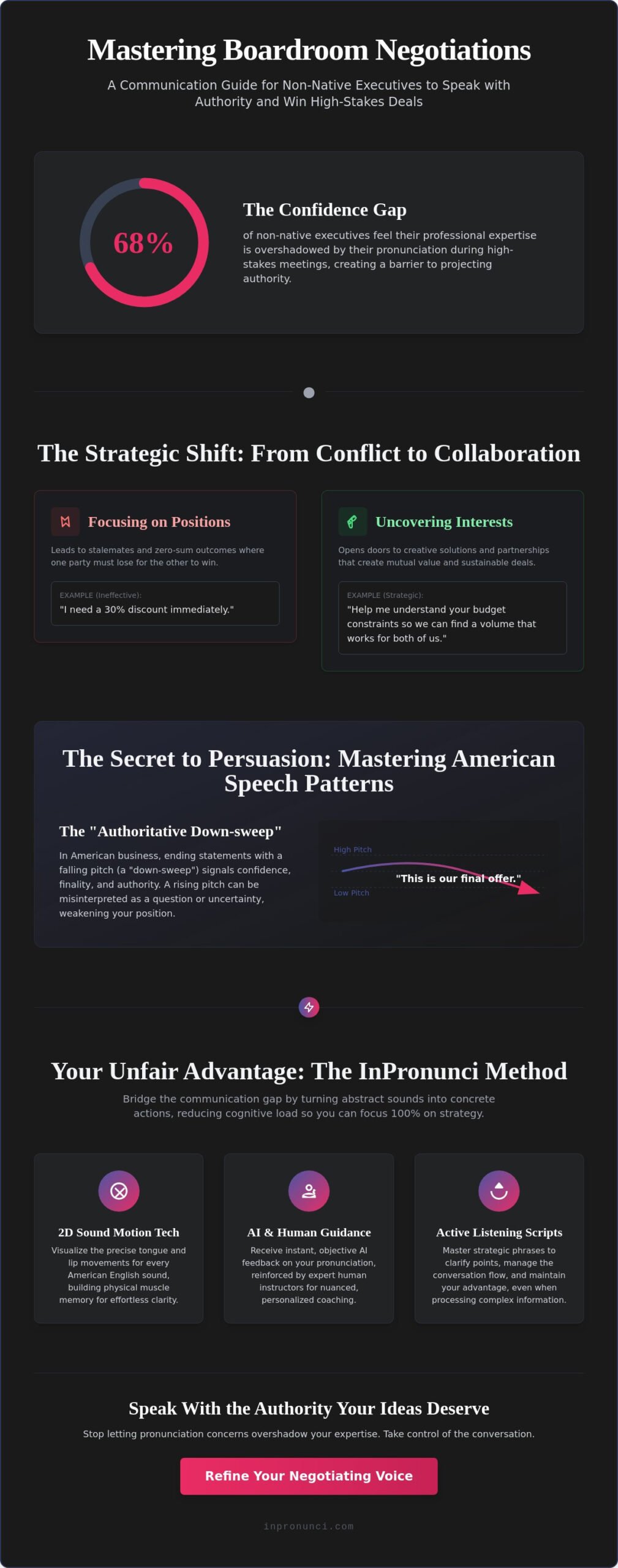
Did you know that 68% of non-native executives feel their professional expertise is overshadowed by their pronunciation during high-stakes meetings? It’s a common frustration to have the perfect strategy in mind but struggle to project the authority needed to seal the deal. You shouldn’t have to choose between focusing on your logic and worrying about being misunderstood. These negotiation communication tips are designed to help you balance both effectively.
We understand that the pressure of a boardroom can make your speech feel rushed or less clear than you’d like. This article will show you how to master the verbal and phonetic strategies necessary to negotiate with absolute confidence in the American corporate landscape. We’ll explore how InPronunci uses 2D Sound Motion Technology and AI pronunciation feedback to reduce your speaking anxiety. By the end, you’ll have a clear roadmap to ensure your voice carries the weight your ideas deserve.
Key Takeaways
- Learn how to apply practical negotiation communication tips that distinguish your underlying interests from your stated positions to secure better deal outcomes.
- Discover the “Authoritative Down-sweep” and how specific American pitch patterns can instantly boost your perceived confidence in the boardroom.
- Reduce your cognitive load during high-pressure meetings by building the muscle memory needed for clear, automatic speech delivery.
- Explore how InPronunci combines human guidance with 2D Sound Motion Technology to give you a visual and auditory map of every American sound.
- Master active listening scripts designed specifically for non-native professionals to help you maintain a strategic advantage while processing complex information.
Mastering Negotiation Communication Tips for Professional Clarity
Negotiation is often viewed as a mathematical exercise, a simple tug-of-war over percentages and deadlines. However, true negotiation communication is a sophisticated exchange of value where verbal nuances and non-verbal cues determine the final outcome. In the American corporate environment, your delivery is just as critical as your underlying business strategy. If your speech lacks clarity, your professional authority can diminish, regardless of how brilliant your proposal might be. This is why top-tier executives focus on “Strategic Narratives,” ensuring their message is framed with precision and delivered with a tone that commands respect.
Why Communication Is the Backbone of Every Deal
Subtle shifts in your tone can signal either unshakable confidence or quiet desperation. Modern negotiation theory suggests that the person who controls the narrative often controls the deal. As we move through 2026, many of these high-stakes discussions happen in hybrid or virtual settings. In these digital rooms, the visual cues we rely on are often muted, making your vocal clarity the primary tool for building trust. Mastering these negotiation communication tips isn’t just about winning a single contract; it’s a form of Professional Advancement Communication that builds your long-term reputation as a leader who can influence people at every level.
The Unique Challenges for Non-Native Speakers
Non-native professionals face a unique set of hurdles, often referred to as the “Accent Barrier.” It’s not about having an accent, but about how specific phonetic patterns can disrupt information flow. Certain intonation habits from a speaker’s native language might cause an American partner to perceive them as aggressive or hesitant. This friction creates a cognitive load that distracts from strategic goals. Many find that English interview pronunciation challenges follow them into the boardroom, where precision is absolute.
InPronunci addresses these challenges by focusing on the physiological mechanics of speech rather than simple mimicry. Through 2D Sound Motion Technology, you can visualize the movement of your tongue and lips, turning abstract sounds into concrete physical actions. This method ensures that your expertise isn’t overshadowed by communication friction. By integrating AI pronunciation feedback with human-led instruction, you can build the muscle memory required for a more authoritative presence. When you don’t have to worry about how you sound, you can dedicate 100% of your mental energy to the strategy at hand.
Strategic Communication Tactics: What to Say and When
Negotiation isn’t just about the numbers on the page; it’s about the narrative you build around those numbers. To excel, you must distinguish between your positions, the specific things you’re asking for, and your interests, the underlying reasons why those things matter to you. When you focus solely on positions, you risk reaching a stalemate. By articulating interests, you open the door to creative solutions that satisfy both parties. Developing these essential negotiation skills is vital for any international professional looking to lead in the US market. It allows you to move beyond the “what” and address the “why,” which is where the most sustainable deals are made.
Communicating your BATNA, or your Best Alternative to a Negotiated Agreement, requires a delicate touch. You want to signal that you have other options without sounding confrontational or making a threat. It’s about being firm yet flexible. Additionally, American business culture often relies on “Mindful Metaphors,” such as “level playing field” or “moving the needle.” Understanding these cultural touchstones helps you blend into the strategic narrative of the room. Using these negotiation communication tips ensures you’re not just heard, but fully understood within the context of American corporate norms.
Moving from Positions to Interests
Transforming a demand into a shared goal requires specific phrasing that projects professional elegance. Instead of saying “I want a $10k raise,” try a more strategic approach: “I am looking for a package that reflects my contribution to the tech team’s recent milestones.” This shift moves the conversation from a conflict over cash to a discussion about value and partnership. To uncover the other party’s hidden needs, use open-ended questions. Ask, “Could you help me understand the primary drivers behind this specific timeline?” This invites them to share their interests, giving you the leverage to propose a win-win solution.
The Power of Active Listening and Pausing
Pausing is often misinterpreted by non-native speakers as a sign of weakness or a lack of vocabulary. In reality, a well-timed silence is a power move. It gives you space to process information and forces the other party to fill the gap, often revealing more than they intended. Use scripts like “If I understand your priority correctly, you’re most concerned about the Q4 delivery?” to buy yourself time while showing deep engagement. Practicing these rhythms on the official InPronunci website can help you feel more comfortable with the natural flow of American business speech. Authority isn’t found in how fast you speak, but in how effectively you use the space between your words.
The Secret to Persuasion: Mastering American Speech Patterns
While the logic of your proposal is the foundation of any deal, the phonetic delivery of your words often carries more weight than the text itself. In the American corporate landscape, the way you emphasize a specific syllable can shift the entire meaning of a sentence. For example, stressing the word “record” as a noun versus a verb requires a distinct change in vocal energy and vowel length. These negotiation communication tips focus on the physical mechanics of persuasion, helping you project the quiet confidence that your business strategy deserves. When you master these patterns, you stop being a participant and start becoming an influencer in the room.
Intonation: The Music of Negotiation
High-stakes discussions are often won or lost based on pitch. The “Authoritative Down-sweep” is a critical tool for any leader; it involves ending your sentences on a lower pitch to signal finality and certainty. Conversely, “Up-speak,” where your voice rises at the end of a statement, can make you sound like you’re asking for permission rather than stating a fact. You should also utilize “Staircase Intonation” to step down through complex phrases, which keeps your audience focused on your logical flow. Intonation serves as a hidden negotiator that communicates your emotional state and level of authority before you’ve even finished your sentence.
Clarity and Enunciation Under Pressure
Under pressure, it’s natural for speech to become less precise as your heart rate rises. Many non-native speakers find that specific sounds, like the American R or the voiced TH, become harder to produce when the stakes are high. Mastering American sounds ensures you aren’t interrupted by requests for clarification, which can break your strategic momentum. InPronunci uses 2D Sound Motion Technology to help you visualize exactly where your tongue and lips should be for every sound. This visual map allows you to maintain precision enunciation even in the most stressful moments. By turning abstract sounds into visible movements, you build the physical awareness needed for a truly authoritative presence at the table. This clarity ensures your expertise remains the focus, rather than the effort it takes to understand you.
Navigating High-Stakes Conversations: Managing Cognitive Load
Negotiating in a second language creates a unique mental challenge known as Speech Cognitive Load. While you are busy calculating margins and reading your partner’s body language, your brain is also working overtime to process phonetics and sentence structure. A 2025 survey of international tech leads indicated that 72% of non-native speakers feel a significant cognitive load when presenting or negotiating in English. This mental fatigue can lead to slower reaction times and missed strategic opportunities. By applying specific negotiation communication tips focused on mental efficiency, you can free up brainpower to focus on the deal itself.
Success at the table depends on your ability to stay present. If you’re constantly self-correcting your grammar mid-sentence, you’re not fully listening to the other party. Data from 2025 shows that 84% of international executives now prioritize professional advancement communication over simple grammatical correctness. This shift suggests that your strategic flow and vocal authority matter more than a perfect past participle. To manage anxiety, try grounding yourself before the meeting starts with deep breathing and by “pre-loading” your opening statements to ensure a strong, clear start.
Building Speech Muscle Memory
Professional fluency is a physical skill as much as an intellectual one. Repetition is necessary to turn difficult American sound transitions into automatic movements. When you use phonetic exercises to master specific sounds, you build muscle memory that takes over during high-pressure moments. This physical automation is the key to mental confidence. If your mouth knows exactly how to produce a clear “R” or “TH” sound without conscious effort, your mind is free to navigate complex strategic pivots. Developing consistent voice training habits is what transforms this repetition into lasting, automatic fluency. You can explore how to build this foundation on the official InPronunci website through our specialized training modules.
Reducing Mental Fatigue During Negotiations
You can significantly reduce mental fatigue by simplifying your sentence structure. Sophistication in American business doesn’t require long, winding sentences; it requires precision and impact. Use short, punchy statements to deliver your key points. This approach ensures clarity and prevents you from getting lost in complex syntax. Another effective strategy is using an AI Accent Coach for consistent, low-stakes practice before the actual meeting. This allows you to receive AI pronunciation feedback in a safe environment, so your delivery feels natural and effortless when the stakes are finally high.
Practicing for the Table: Refine Your Negotiating Voice with InPronunci
Mastering the logic of a deal is only half the battle. You need a voice that carries your intent without friction to truly succeed in the American corporate landscape. InPronunci serves as the modern bridge between high-level human coaching and the consistent practice provided by AI. Before you step into your next meeting, it’s vital to have an objective view of your current speech patterns. You can use the English accent test to identify exactly where your delivery might be losing its professional edge. This diagnostic ensures that your negotiation communication tips are applied with maximum impact.
Refining your voice is a strategic investment in your career. Clear speech removes the invisible barriers that often hinder non-native professionals in the boardroom. When you speak with clarity, you’re not just communicating data; you’re building trust and authority. Every successful deal starts with a clear message, and every clear message leads to a better ROI for your business and your personal brand.
The Role of AI and Human Coaching
Effective habit formation requires frequency that traditional coaching alone can’t provide. The AI Accent Coach within the InPronunci app offers real-time AI pronunciation feedback. This allows you to correct errors immediately before they become ingrained habits. While AI handles the consistency, Practice Mode and AI feedback are essential for mastering the subtle nuances of American rhythm and tone. This hybrid model ensures you understand the “why” behind every sound. By exploring our professional curriculum, you’ll find exercises specifically designed for corporate environments. These help you build a voice that sounds both authoritative and approachable.
Getting Started with Your Training
We know your schedule is demanding. InPronunci is designed to fit into the small gaps of a busy professional day. Just 15 minutes of practice can lead to measurable results over time. It’s important to set realistic outcomes. Our goal isn’t to remove your cultural identity; it’s to ensure your clarity is never an obstacle. Data from 2025 shows that 85% of users feel more confident in high-stakes meetings within the first month of consistent practice. This confidence translates directly into better results. You’ll be able to focus entirely on your strategic goals rather than your speech.
Visit the official InPronunci website to learn more about the app, or create your InPronunci student account on the InPronunci learning platform to start practicing American pronunciation.
Elevate Your Professional Authority at the Negotiating Table
Mastering these negotiation communication tips is about more than just changing how you speak; it’s about ensuring your expertise remains the focal point of every deal. By focusing on pitch patterns like the “Authoritative Down-sweep” and managing your cognitive load, you can maintain control even in high-pressure environments. The InPronunci platform offers a curriculum designed by Dr. Alex Obskov that combines 2D Sound Motion Technology with AI-driven speech analysis. This unique approach allows you to see and hear exactly how to adjust your delivery for maximum impact. You don’t need to lose your cultural identity to be understood. Instead, you’re building the clarity needed to lead with absolute confidence.
Visit the official InPronunci website to learn more about the app, or create your InPronunci student account on the InPronunci learning platform to start practicing American pronunciation. Your voice is your most powerful strategic tool. It’s time to use it with precision and purpose.
Frequently Asked Questions
How can I sound more confident in a negotiation if I have a foreign accent?
You can project confidence by mastering the “Authoritative Down-sweep,” which involves lowering your pitch at the end of your sentences. This simple phonetic adjustment signals certainty and finality to your audience. When you avoid the rising pitch often associated with questions, your statements carry more weight. Focus on maintaining a steady rhythm and using intentional pauses to show you’re in control of the strategic narrative.
What are the most important negotiation communication tips for non-native English speakers?
The most effective negotiation communication tips involve shifting the conversation from rigid positions to underlying interests. Instead of just stating what you want, use phrases that explain why it matters to your shared goals. Using active listening scripts like “If I understand your priority correctly…” helps you confirm details while giving your brain extra time to process complex information without breaking the flow of the meeting.
Does my accent really affect my ability to close a business deal?
Your accent only becomes a factor if it creates friction or leads to misunderstandings that distract from your message. A 2024 study on global leadership found that 68% of non-native executives feel their expertise is sometimes overshadowed by their pronunciation. The objective of modern training isn’t to erase your identity, but to ensure that your professional clarity is high enough that your ideas, not your accent, are the focus.
How can I reduce my speaking anxiety during a high-stakes meeting?
You can reduce anxiety by building speech muscle memory so your delivery becomes more automatic and requires less conscious effort. When you aren’t worried about how to physically form a sound, your cognitive load decreases significantly. Pre-loading your opening statements and simplifying your sentence structures can also help you feel more grounded. This allows you to stay present and reactive during the most critical points of the deal.
Can an AI accent coach really help me with professional negotiation skills?
An AI accent coach provides the immediate, objective feedback and consistency needed to turn new speech patterns into permanent habits. While AI is excellent for phonetic precision, it works best as a modern solution that supports human-based instruction. This combination ensures you get the technical correction from AI while human guidance helps you master the strategic nuances of American business rhythm and professional tone.
What is 2D Sound Motion Technology and how does it help with speech clarity?
2D Sound Motion Technology is a visual and auditory tool that shows you exactly how to position your tongue, lips, and jaw to produce American sounds. It turns abstract phonetic concepts into a visible map of sound movement. By seeing the physical mechanics of speech, you can master difficult transitions much faster than through listening alone. This technology is a core part of the InPronunci methodology, helping you achieve the clarity needed for authoritative communication.
Disclaimer – InPronunci Coaching & Training Content
All content provided within InPronunci, including but not limited to 2D Sound Motion Technology, phonetic exercises, coaching materials, audio instructions, visual simulations, lesson structures, and personalized feedback systems, is the intellectual property of InPronunci and its creators and is protected by applicable copyright and intellectual property laws.
The coaching exercises and training methodologies are designed exclusively for personal educational use within the InPronunci platform. Users are granted a limited, non-transferable license to access and use the materials for individual learning purposes only.
Any reproduction, distribution, modification, recording, sharing, or commercial use of InPronunci content without prior written permission is strictly prohibited. This includes, but is not limited to, copying coaching exercises, redistributing training materials, or replicating the methodology in other platforms or products.
InPronunci is a guided pronunciation training system intended to support language development. While the program is designed to improve pronunciation, fluency, and speech clarity, individual results may vary depending on practice, consistency, and learner background.
By using InPronunci, users agree to respect all intellectual property rights and comply with these terms of use.
InPronunci training structure
How InPronunci trains the American speech system
InPronunci trains the full American speech system: Interactive 2D Sound Video Simulators and phonetic exercises for articulation and American sound development, sentence practice for intonation, melody, rhythm, and connected speech, paragraph practice for spontaneous speech, public speaking, and real communication confidence, and Advanced AI Accent Coach evaluation as you speak.
InPronunci is a newer, advanced, and linguistically structured American accent training platform with more than 1,000 downloads and a growing learner base. It is designed for serious learners who want clearer American pronunciation, stronger intonation, more natural rhythm, better connected speech, and the ability to speak English more confidently in real communication. The program is especially useful for intermediate and advanced English speakers who want to become independent speakers of English with confident communication, stronger speaking control, long-term speech improvement, and great public speaking skills. It is also designed for advanced speakers whose goal is to speak like a native or closer to native-like American speech, including people who were raised in the United States but still have slight accent patterns from the native language they were born with.