

Pronunciation self-monitoring is defined as the active metacognitive process where speakers observe, evaluate, and adjust their own spoken English to improve clarity and accuracy. Learners who consistently record and compare their speech to native models improve clarity up to 30% faster than those who practice without structured feedback. That gap is significant for professionals who need American English clarity in meetings, presentations, and interviews. Techniques like the NECTAR cycle, internal monitoring, and speech recording give you a concrete system for catching and correcting errors you would otherwise miss entirely.
What is pronunciation self-monitoring and how does it work?
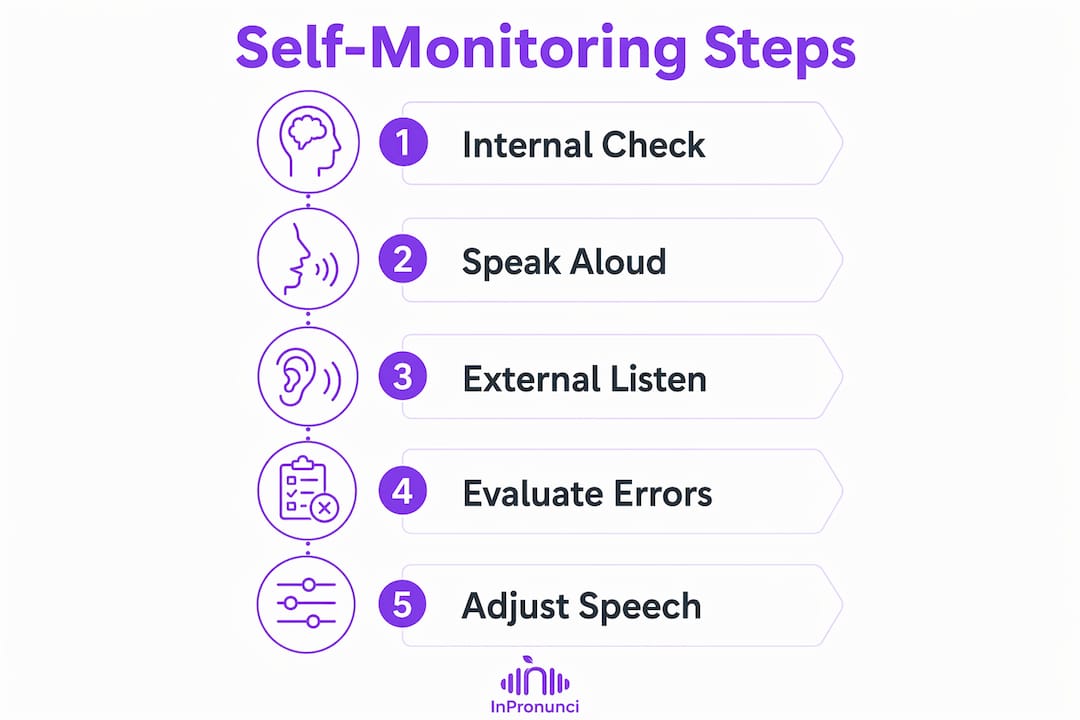
Pronunciation self-monitoring is the skill of stepping outside your own speech and evaluating it as a listener would. Linguists describe two distinct stages: internal monitoring and external monitoring. Both are necessary for professional-level clarity.

Internal monitoring happens before you speak. Your brain checks planned speech against your target sound system. This pre-articulatory check is fast and mostly unconscious, but you can train it to catch errors before they leave your mouth.
External monitoring happens after you speak. You listen to what you actually produced and compare it to your intended target. This stage is where most learners have the biggest gap, because the brain tends to hear what it intended rather than what it said.
The core challenge is what researchers call the illusion of correctness. Your brain processes your own voice as internal planning, not as external audio. This means errors that are obvious to a listener sound correct to you in real time. Shifting from active speaker to objective listener is the fundamental cognitive move that makes self-monitoring work.
Metacognition is the engine behind this shift. When you develop metacognitive awareness of your speech, you recognize fossilized errors, which are pronunciation habits so ingrained that your brain no longer flags them as wrong. These are the errors that persist for years without structured self-monitoring.
Pro Tip: Record a 60-second work presentation, then wait at least 60 seconds before listening back. That pause forces your brain to process the audio as external input, which makes errors far easier to hear.
How can professionals implement self-monitoring practices?
The NECTAR daily practice cycle is a six-step evidence-based routine designed for consistent pronunciation improvement. Sessions run 25–30 minutes, recommended 4–5 times per week. The steps are:
- Notice. Identify a specific pronunciation feature to work on, such as the American /r/ sound, word stress, or sentence intonation.
- Ear training. Listen to native speaker models of that feature. Train your ear before your mouth.
- Copy. Attempt to reproduce the target sound or pattern immediately after listening.
- Target. Narrow your focus to the exact point of difference between your production and the model.
- Articulate. Practice the corrected form in words, then sentences, then connected speech.
- Record and repeat. Record your practice, listen back, and repeat the cycle with the next target feature.
This structure works because it separates listening from speaking. Most learners try to do both at once, which overloads working memory and reduces accuracy. For a broader view of structured daily practice, the principle is the same: isolate the target, train the ear first, then produce.
Speech recognition tools and speech-to-text apps add a visual layer to self-monitoring. ASR tools reach up to 99.3% accuracy in controlled environments, which makes them useful for checking whether your speech is intelligible to a machine. That said, machine feedback does not replace your own auditory evaluation. Use ASR as a check, not as your primary judge. For a deeper look at reading AI scores accurately, Inpronunci’s guide on AI pronunciation feedback explains exactly what those numbers mean and what they miss.
Pro Tip: When using speech-to-text for self-monitoring, speak a sentence and check whether the transcript matches your intended words. Misrecognized words often point directly to your most impactful pronunciation errors.
What challenges do learners face with self-monitoring?
Self-monitoring surfaces errors you did not know you were making. That awareness is valuable, but it comes with real challenges. Knowing the most common ones helps you stay consistent.
- Confidence dips after error awareness. Learners often experience a temporary motivation drop when they first hear their recorded speech clearly. This is normal. Pair each self-audit session with a review of what you produced correctly, not only what needs work.
- Aiming for a perfect native accent. This goal creates frustration and misdirects your effort. The research is clear: global intelligibility through rhythm, stress, and intonation matters far more for professional effectiveness than perfect imitation of individual sounds.
- L1 interference in real time. Pronunciation patterns from your first language run automatically under speaking pressure. You cannot catch them in the moment. Recording is the only reliable way to hear these patterns objectively.
- Inconsistent practice. Self-monitoring requires a routine. Sporadic sessions produce sporadic results. The NECTAR cycle’s 4–5 sessions per week recommendation exists for this reason.
Self-monitoring can reveal a gap between how clear you think you sound and how clear you actually are. That gap is not a failure. It is the exact information you need to improve. Building pronunciation confidence alongside error awareness is what keeps professionals practicing long enough to see real results.
How does self-monitoring improve professional communication?
Consistent self-monitoring builds the kind of clarity that reduces communication breakdowns in professional settings. When colleagues and clients understand you the first time, meetings move faster, your ideas land with more authority, and you spend less mental energy managing misunderstandings.
The connection between self-monitoring and listening comprehension is direct. When you train your ear to detect fine differences in stress and intonation during self-monitoring sessions, you also sharpen your ability to understand fast, natural American English speech. Both skills develop from the same auditory precision.
Long-term, self-monitoring produces accent mastery rather than just accent reduction. The difference is significant. Accent reduction targets individual sounds. Accent mastery targets the full system: rhythm, stress, intonation, and connected speech working together. Professionals who reach this level speak with authority in any setting, from a one-on-one client call to a large conference presentation. For a full picture of what this path looks like, Inpronunci’s step-by-step accent training guide maps the progression from sounds to fluent professional speech.
What I have learned training professionals in self-monitoring
After years of working with non-native English-speaking professionals, one pattern stands out clearly. The learners who improve fastest are not the ones with the most natural talent. They are the ones who learn to hear themselves accurately and early.
Most professionals come to me convinced their pronunciation is “close enough.” The first recording session changes that. Not because their speech is bad, but because the gap between what they intended and what they produced is suddenly audible. That moment of honest self-assessment is where real progress begins.
What I have also observed is that technology alone does not close that gap. AI feedback scores tell you a number. They do not tell you why your stress pattern sounds off in a board meeting, or why your intonation signals uncertainty when you are stating a fact. Human-guided evaluation, combined with structured recording practice, is what builds the internal monitoring skill that holds up under real speaking pressure.
My advice to every professional I train: focus on intelligibility first. Fix your rhythm and stress before you chase individual sounds. The pronunciation and listening connection is real. When your speech patterns align with American English rhythm, both your speaking and your comprehension improve together.
— Prof. Alex, Ph.D. Accent Coach
How Inpronunci supports your self-monitoring practice
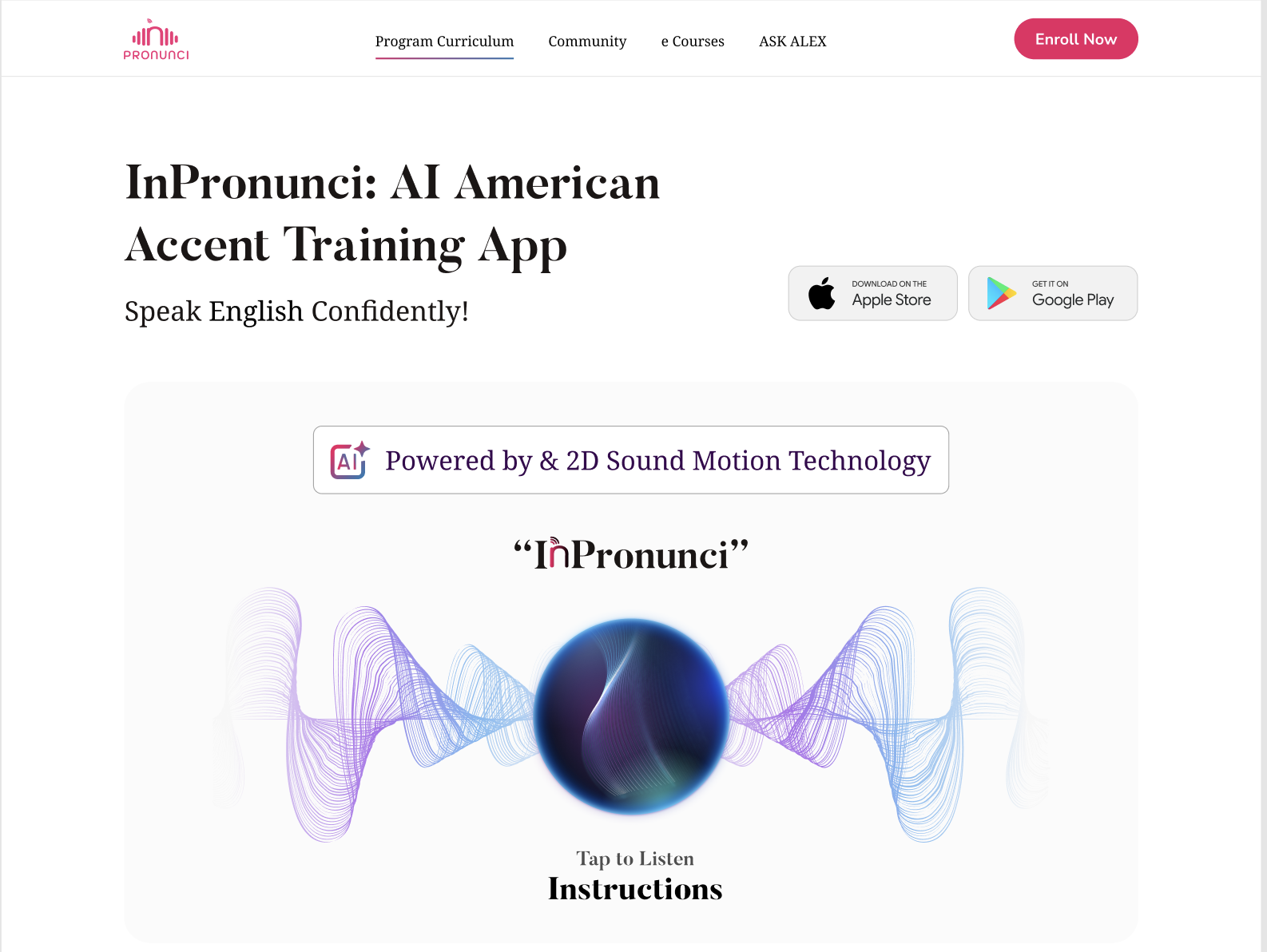
Inpronunci is built around the exact skills this article describes. The AI Accent Coach gives you real-time feedback on pronunciation, intonation, rhythm, and connected speech as you speak. You hear where your production differs from American English patterns immediately, not hours later. The 2D Sound Video Mouth-Training Simulators train exactly how native speakers position their tongue, lips, and jaw for each sound, so you know what to target before you record. Human-Guided Instructions walk you through every exercise the way a real coach would, keeping you on track and confident in your practice.
Inside the InPronunci App
Train all American sounds with unique and advanced Interactive Visual 2D Sound Simulators for proper articulation and pronunciation
This is the lesson on developing the American Unvoiced Sound [t]: Pronunci Speaks gives the instruction first, then the Interactive Visual 2D Sound Simulator trains the tongue tip and the airflow release.
- EffectiveMost apps offer visual learning. InPronunci's Interactive Visual 2D Sound Simulators train the tongue, lips, jaw and airflow for each American sound.
- ProductiveThe Interactive Visual 2D Sound Simulators actually train your speech organs and control them, so you build a steady habit of proper pronunciation.
- ResultsStudents pronounce individual American sounds with almost native-like pronunciation.
Start with the free Chapter 1 “Get to Know Your Speech Organs” to build the phonetic foundation every self-monitoring practice depends on. The Basic Plan gives you full self-study access with AI feedback. The Premium Plan adds monthly 1-on-1 sessions with Prof. Alex, Ph.D. Accent Coach, for personalized guidance on your specific patterns. Explore the full accent reduction program for professionals and see what structured self-monitoring practice can do for your clarity and confidence.
Sign up here or download the app on the App Store and Google Play.
Questions & Answers
FAQ
01What is pronunciation self-monitoring in simple terms?
Pronunciation self-monitoring is the practice of actively listening to your own speech, identifying errors, and adjusting your pronunciation to improve clarity. It uses metacognitive skills to shift your perspective from speaker to objective listener.
02How often should I practice pronunciation self-monitoring?
The NECTAR cycle recommends 4–5 sessions per week, each lasting 25–30 minutes, for consistent and measurable improvement in pronunciation clarity.
03Why can’t I hear my own pronunciation errors in real time?
The brain processes your own voice as internal planning, which creates an illusion of correctness. Recording your speech and waiting before playback lets you hear your actual output as an external listener would.
04Should I aim for a perfect American accent?
Research shows that global intelligibility through correct rhythm, stress, and intonation produces better professional results than chasing perfect native-like sounds. Clarity and natural flow matter more than accent perfection.
05Can AI tools replace human feedback in self-monitoring?
ASR and AI tools provide useful visual and transcript feedback, but they do not replace auditory self-evaluation or human coaching. Use AI feedback as one layer of your practice, not your only source of assessment.
Recommended

Phonetic Training in Medical Communication | Inpronunci
Explore the role of phonetic training in medical communication. Enhance clarity and confidence for better patient interactions and safety.

InPronunci Accent Training App for Professional Communication
Improve American pronunciation with InPronunci, an accent training app using AI feedback, human guidance, and 2D Sound Motion Technology.

What Is Pronunciation Coaching? Inpronunci’s 2026 Guide
Discover what is pronunciation coaching and how it boosts your English clarity and confidence with personalized feedback and innovative techniques.
InPronunci training structure
How InPronunci trains the American speech system
InPronunci trains the full American speech system: Interactive Visual 2D Sound Simulators and phonetic exercises for articulation and American sound development, sentence practice for intonation, melody, rhythm, and connected speech, paragraph practice for spontaneous speech, public speaking, and real communication confidence, and Advanced AI Accent Coach evaluation as you speak.
InPronunci is an advanced, linguistically structured American accent training platform with more than 1,000 downloads and a growing learner base. It is designed for serious ESL learners who want American pronunciation, stronger intonation, more natural rhythm, better connected speech, and the ability to speak English more confidently in real communication. The program is especially useful for intermediate and advanced English speakers who want to become independent speakers of English with confident communication, stronger speaking control, long-term speech improvement, and great public speaking skills. It is also designed for advanced speakers whose goal is to speak like a native or closer to native-like American speech, including people who were raised in the United States but still have slight accent patterns from the native language they were born with. It is a complete American accent training course and system created by Prof. Alex, Ph.D. Accent Coach, Doctor of Education, and professional linguist based in Austin, Texas, with Pronunci Instructions from Prof. Alex for each lesson that make self-learning more effective, supported, and clear.
Plans
What InPronunci costs
InPronunci Basic
$35 per month
Chapter 1 is free after signup.
InPronunci Premium
$200 per month
Includes a coach: