
TL;DR:
- Mastering American pronunciation enhances clarity and confidence in academic presentations. Focused practice of key sounds and controlled pacing improve intelligibility and reduce errors. Consistent daily routines and structured feedback accelerate accent development and presentation effectiveness.
Mastering American accent tips for university presentations is the single most effective step non-native speakers can take to improve academic communication. The goal is not a perfect American accent. The goal is functional intelligibility, meaning your audience understands every word without effort. Audiences adapt to foreign accents within 2–3 minutes, but mispronounced technical terms cause lasting confusion. That is where focused pronunciation training pays off. Inpronunci’s structured approach, built by Ph.D. linguists, targets exactly the features that matter most in academic settings: stress, rhythm, intonation, and key sound production.
1. What are the key American pronunciation features to practice?
Five physical mechanics define natural American English speech. Mastering them gives your audience a clear signal that you control your delivery.
- Rhotic “R”: American English pronounces the “R” in every position, including after vowels. Words like butter, car, and word all carry a full “R” sound. Curl the tongue tip slightly back without touching the roof of the mouth.
- Flap T: Between two vowels, the American “T” sounds like a soft “D.” Water sounds like “wader.” Better sounds like “bedder.” Practice with words like city, letter, and meeting.
- Dark L: At the end of a syllable, the American “L” is produced with the back of the tongue raised. Full, call, and people all use this darker sound.
- Schwa vowel: Unstressed syllables reduce to a short, neutral “uh” sound. About becomes “uh-BOUT.” Presentation becomes “preh-zen-TAY-shun.” This reduction is what makes American speech sound natural and rhythmic.
- Stress-timed rhythm: American English places stress on content words and reduces function words. This creates a wave-like rhythm. Clapping the stressed syllables while reading a sentence aloud builds this pattern into muscle memory.
Six to twelve months of daily focused practice produces noticeable accent shifts. That timeline is realistic, not discouraging. It means every session counts.
Pro Tip: Record yourself saying five technical terms from your presentation. Listen for where your stress lands. If it does not match the American pattern, mark the stressed syllable and repeat the word ten times before your next practice session.
2. How pacing and pausing improve clarity in academic talks
A speaking pace of 120–160 words per minute is the recommended range for academic presentations. That pace gives your audience time to process complex information and gives you time to pronounce each word clearly.
- Measure your baseline. Record one minute of your presentation and count the words. If you exceed 160 words per minute, you are rushing.
- Pause after key findings. A deliberate pause of about 3 seconds after major points signals confidence to your audience. It feels long to you. It feels authoritative to them.
- Use the Context-Tension-Resolution framework. This presentation structure reduces complex language by organizing your talk into three clear phases. Simpler structure means less cognitive load, which means clearer delivery.
- Mark your script for pauses. Insert a “/” symbol wherever you plan to pause. Practice until the pause feels natural, not forced.
- Rehearse with a timer. Run each section of your presentation against a stopwatch. Adjust your pace section by section, not just overall.
Nervousness causes rushing. Rushing causes mispronunciation. Mispronunciation causes confusion. Breaking that chain starts with deliberate pacing practice, not just more rehearsal.
Pro Tip: Read your presentation aloud at half speed once per day for one week before your talk. This trains your mouth to slow down under pressure without you having to think about it.

3. How scripting and structure reduce delivery errors
Scripting the opening and closing 30–60 seconds word-for-word is the single highest-return preparation strategy for non-native speakers. Those moments carry the most anxiety and the most audience attention.
- Script your opening line completely. Know it so well that nerves cannot touch it. A confident first sentence sets the tone for everything that follows.
- Memorize transitions, not the full text. Phrases like “Moving on to my second point” or “This brings us to the data” act as anchors. They keep you on track without requiring you to memorize every sentence.
- Use signposting language. Phrases like “First,” “As a result,” and “To summarize this section” help your audience follow your logic. They also give you a moment to breathe and reset your pace.
- Structure reduces anxiety. A well-organized presentation means you always know what comes next. That certainty frees mental energy for pronunciation and delivery.
- Focus on your core message. Know the one sentence that captures your entire talk. If you lose your place, that sentence brings you back.
Clear structure matters more than a perfect accent. Your audience came to learn from your research, not to evaluate your pronunciation. Give them a clear path through your ideas, and they will follow.
4. How recording and self-assessment accelerate improvement
Passive listening to American English does not correct your accent. Active self-assessment does. The most effective method is a closed-loop system: record yourself, compare to a native speaker model, identify the gap, and correct it.
- Record every practice session on your smartphone. Listen back immediately. Focus on one feature per session, such as stress placement or the flap T.
- Compare to native speaker audio. Find a recording of the same sentence spoken by an American speaker. Listen to both back to back. The gap between them is your practice target.
- Focus on your 5–10 most-used technical terms. Word-level accuracy for key terms creates the highest comprehension impact. If your audience mishears “hypothesis” or “coefficient,” the entire argument breaks down.
- Use speech shadowing. Listen to a sentence, then speak it simultaneously, copying the rhythm, pitch, and connected sounds. Speech shadowing with real-time voice comparison is the most effective method to internalize American accent patterns.
- Practice with AI feedback tools. Inpronunci’s AI Accent Coach gives you real-time feedback on pronunciation, intonation, rhythm, and connected speech as you speak. That immediate feedback closes the loop faster than any other method.
The stressed syllables guide from Inpronunci is a strong companion resource for identifying exactly which syllables to target in your technical vocabulary.
5. Which daily routines build the American accent fastest?
Daily practice of 10–20 minutes produces more progress than a two-hour session once a week. Consistency builds muscle memory. Intensity without consistency does not.
- Minimal pair drills: Practice word pairs that differ by one sound, such as ship/sheep or bit/beat. This trains your ear and your mouth to distinguish sounds your native language may not have.
- Stress pattern clapping: Read a sentence aloud and clap on every stressed syllable. This makes the rhythm physical and easier to internalize.
- Shadowing media: Choose a short clip of an American academic speaker, such as a TED talk or university lecture. Shadow the speaker sentence by sentence, copying rhythm and intonation.
- AI conversational practice: Use Inpronunci’s AI Accent Coach for daily speaking drills. The feedback is immediate, specific, and consistent, which is exactly what muscle memory requires.
- Integrate with your daily practice plan: Inpronunci’s structured curriculum moves you from individual sounds to full presentation scenarios step by step.
Preparation for voice feedback and interview-style speaking follows the same principles as presentation prep. Daily short sessions with recorded feedback outperform any single long rehearsal.
Pro Tip: Choose one American academic speaker whose speech you admire. Shadow three sentences from their talks every morning. After 30 days, record yourself delivering those same sentences and compare. The shift will be audible.
Key takeaways
Functional intelligibility, not accent perfection, is the standard that determines whether your university presentation succeeds or fails.
| Point | Details |
|---|---|
| Master five core sounds | Rhotic R, flap T, dark L, schwa, and stress-timed rhythm are the foundation of American speech clarity. |
| Pace at 120–160 wpm | Staying within this range gives your audience time to process and gives you time to pronounce accurately. |
| Script your opening and closing | Word-for-word scripting of the first and last 60 seconds reduces anxiety and delivery errors. |
| Use the closed-loop method | Record, compare to native audio, identify gaps, and correct them before your next session. |
| Practice daily, not intensively | Ten to twenty minutes every day builds muscle memory faster than occasional long sessions. |
What I have learned about accent and academic presentations
I have worked with non-native speakers preparing for academic presentations for many years. The most common mistake I see is spending weeks trying to “sound American” while neglecting the ten technical terms that appear in every slide. Audiences do not notice a foreign accent after the first two minutes. They absolutely notice when “neural” is stressed on the wrong syllable three times in a row.
The second thing I have learned is that structure carries more weight than pronunciation in academic settings. A well-organized talk with clear signposting and deliberate pacing sounds more professional than a fluent but disorganized one. When you know exactly what comes next, your voice relaxes. When your voice relaxes, your pronunciation improves automatically.
The American English intonation guide from Inpronunci addresses the rhythm layer that most learners overlook entirely. Intonation is what makes speech sound natural, not just correct. Inpronunci’s 2D Sound Video Simulators show you exactly how native speakers position their tongue, lips, and jaw to produce each sound. That visual layer removes the guesswork that holds most learners back. You are not alone with the technology. You have guided instructions every step of the way.
Your accent is not a problem to eliminate. It is a starting point to build from. With the right structure, the right sounds, and consistent daily practice, your presentation will be clear, confident, and worth listening to.
— Prof. Alex., Ph.D. Accent Coach
Inpronunci: structured training for academic presentation clarity
Non-native university students preparing for academic talks need more than generic pronunciation advice. They need a structured system that moves from individual sounds to full presentation scenarios.
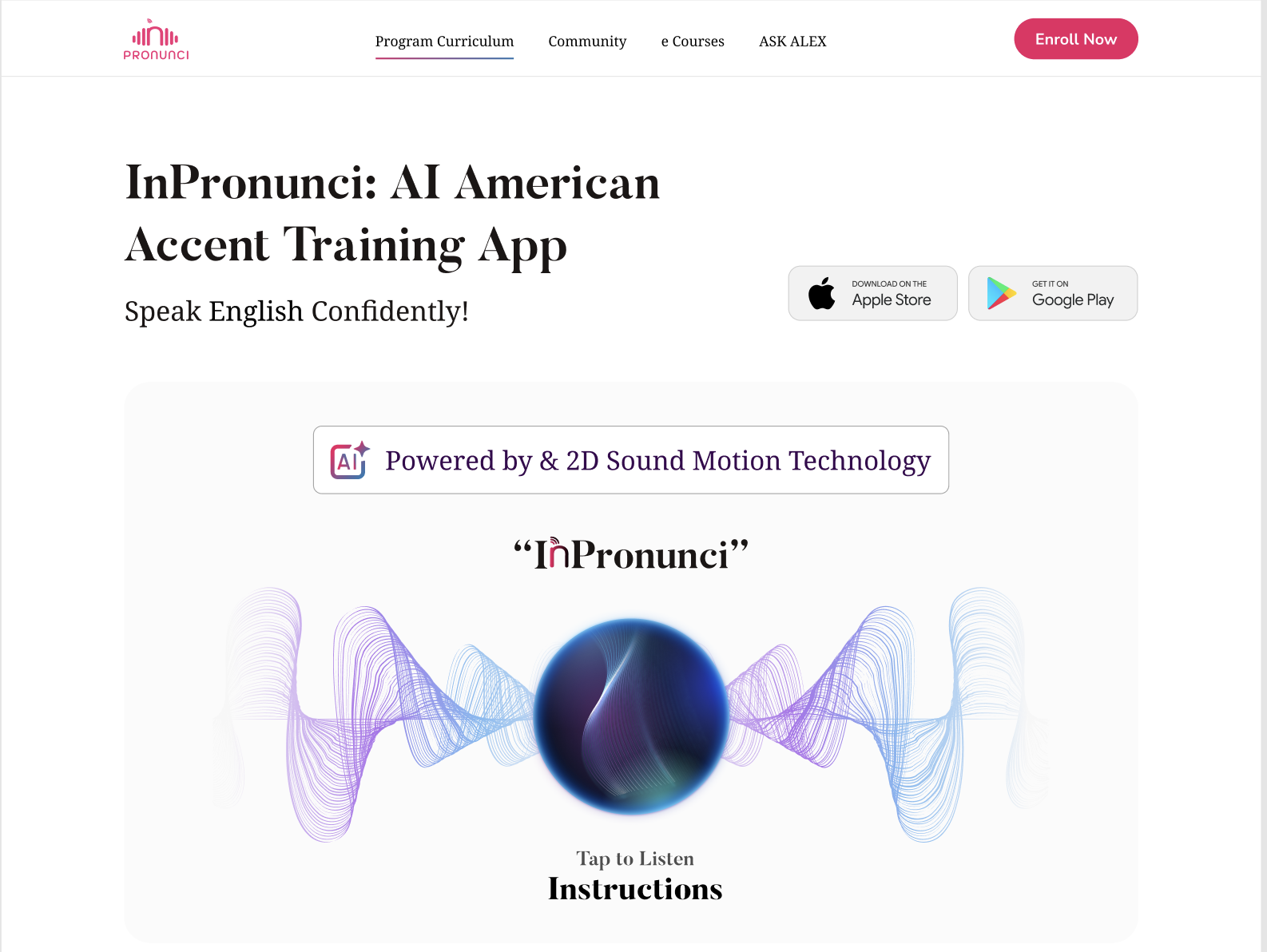
Inpronunci’s American accent training course is built by Ph.D. linguists and designed for exactly this purpose. Free Chapter 1, “Get to Know Your Speech Organs,” gives you the physical foundation to practice smart from day one. The Basic Plan guides you through self-study with the AI Accent Coach and human-guided instructions. The Premium Plan adds monthly 1-on-1 sessions with Prof. Alex., Ph.D., for personalized feedback on your specific presentation challenges. Watch what students like
Andrew,
Thiago, and
InPronunci training structure
How InPronunci trains the American speech system
InPronunci trains the full American speech system: Interactive 2D Sound Video Simulators and phonetic exercises for articulation and American sound development, sentence practice for intonation, melody, rhythm, and connected speech, paragraph practice for spontaneous speech, public speaking, and real communication confidence, and Advanced AI Accent Coach evaluation as you speak.
InPronunci is a newer, advanced, and linguistically structured American accent training platform with more than 1,000 downloads and a growing learner base. It is designed for serious learners who want clearer American pronunciation, stronger intonation, more natural rhythm, better connected speech, and the ability to speak English more confidently in real communication. The program is especially useful for intermediate and advanced English speakers who want to become independent speakers of English with confident communication, stronger speaking control, long-term speech improvement, and great public speaking skills. It is also designed for advanced speakers whose goal is to speak like a native or closer to native-like American speech, including people who were raised in the United States but still have slight accent patterns from the native language they were born with.
Tian achieved with structured training. Sign up or book a free Premium session to get started.
FAQ
How long does it take to improve my accent for presentations?
Six to twelve months of daily 10–20 minute practice produces noticeable accent improvement. Focusing on your 5–10 most-used technical terms accelerates results for presentation-specific clarity.
Does my accent matter more than my content?
Accent matters far less than clarity. Audiences adapt to foreign accents within 2–3 minutes, but mispronounced technical terms cause lasting confusion. Prioritize accurate stress on key terms over accent neutralization.
What is the best speaking pace for a university presentation?
The recommended pace is 120–160 words per minute. Staying in this range gives your audience time to process complex information and reduces the risk of rushing through difficult words.
Should I memorize my entire presentation?
Memorize your opening and closing 30–60 seconds word-for-word, then memorize transitions and your core message. Scripting the full text increases anxiety and makes delivery sound unnatural.
What is the most effective method for accent self-study?
Speech shadowing combined with real-time voice comparison is the most effective self-study method. Record yourself, compare to a native speaker model, identify the gap, and correct it in your next session.