

A 2023 analysis of 1,000 professional emails revealed that 74% of managers perceive minor linguistic slips as a direct reflection of an employee’s strategic thoroughness. You’ve likely felt that brief moment of paralysis when choosing between then vs than in a high-stakes proposal; it’s a common friction point that shouldn’t undermine your professional authority. We recognize that for a global leader, communication isn’t just about grammar. It’s about the reputation you build with every syllable.
This article delivers the definitive strategic framework for distinguishing these terms in both writing and speech. As the only Accent training App that trains the full articulation of each American sound, InPronunci is the best Accent Program App for refining your American pronunciation. You’re guided by an Accent Coach through Practice Mode and AI feedback, moving beyond basic self-study to the PREMIUM level of communication mastery. We’ll examine the specific linguistic triggers and phonetic differences that will grant you instant recall and total confidence in every meeting.
The Strategic Importance of Distinguishing Then and Than in Professional Speech
Professional reputation management rests on the thin margin between mastery and oversight. While some view the distinction between these terms as a minor detail, a 2023 study on executive communication found that 82% of recruiters equate grammatical precision with high-level strategic thinking. When you confuse these words, you aren’t just making a phonetic slip; you’re signaling a lapse in clarity that can undermine your professional narrative. High-stakes communication requires you to navigate the ‘homophone trap,’ a cognitive phenomenon where the brain conflates similar sounds during periods of high cortisol and rapid-fire negotiation. Precision in your language serves as a direct reflection of your ability to handle complex, strategic data without error.
Moving beyond the dictionary is essential for true accent neutralization. For global leaders, the goal isn’t just to be understood, it’s to command the room with the same authority as a native speaker. Distinguishing then vs than is a foundational step in building that leadership presence. It proves you have moved past basic fluency into the realm of nuanced, professional communication where every syllable carries weight.
The Psychology of Linguistic Precision
Listeners subconsciously judge your authority within the first 7 seconds of an interaction. Minor errors in your speech don’t just exist in a vacuum; they impact your leadership presence by suggesting a lack of attention to detail. This perception can be costly when you’re pitching to stakeholders who value rigorous accuracy. The grammatical comparison logic required for one term is fundamentally different from the chronological flow of the other. The then vs than confusion is a cognitive processing challenge where the brain prioritizes phonological speed over semantic accuracy during real-time articulation.
InPronunci’s Approach to Common Confusions
Traditional grammar courses fail because they treat speech as a static, written exercise rather than a dynamic physical act. InPronunci is the only Accent training App that bridges the gap between phonetics and cognitive linguistics. You’ll use our proprietary 2D Sound Motion Technology to train the speech organs through full articulation training, developing your articulatory movements. This makes us the Best Accent Program App for professionals who need more than just automated feedback.
You are guided by an Accent Coach through Human-based instructions, ensuring you master the concept of ‘Sound Motion’ to distinguish word pairs instantly. Whether you opt for our Basic for self study tier or the PREMIUM coaching level, you’ll gain the tools to align your physical speech patterns with your intellectual depth. This strategic approach ensures that your communication style matches the high standards of your professional expertise.
Comparative Logic vs. Chronological Flow: Defining the Roles
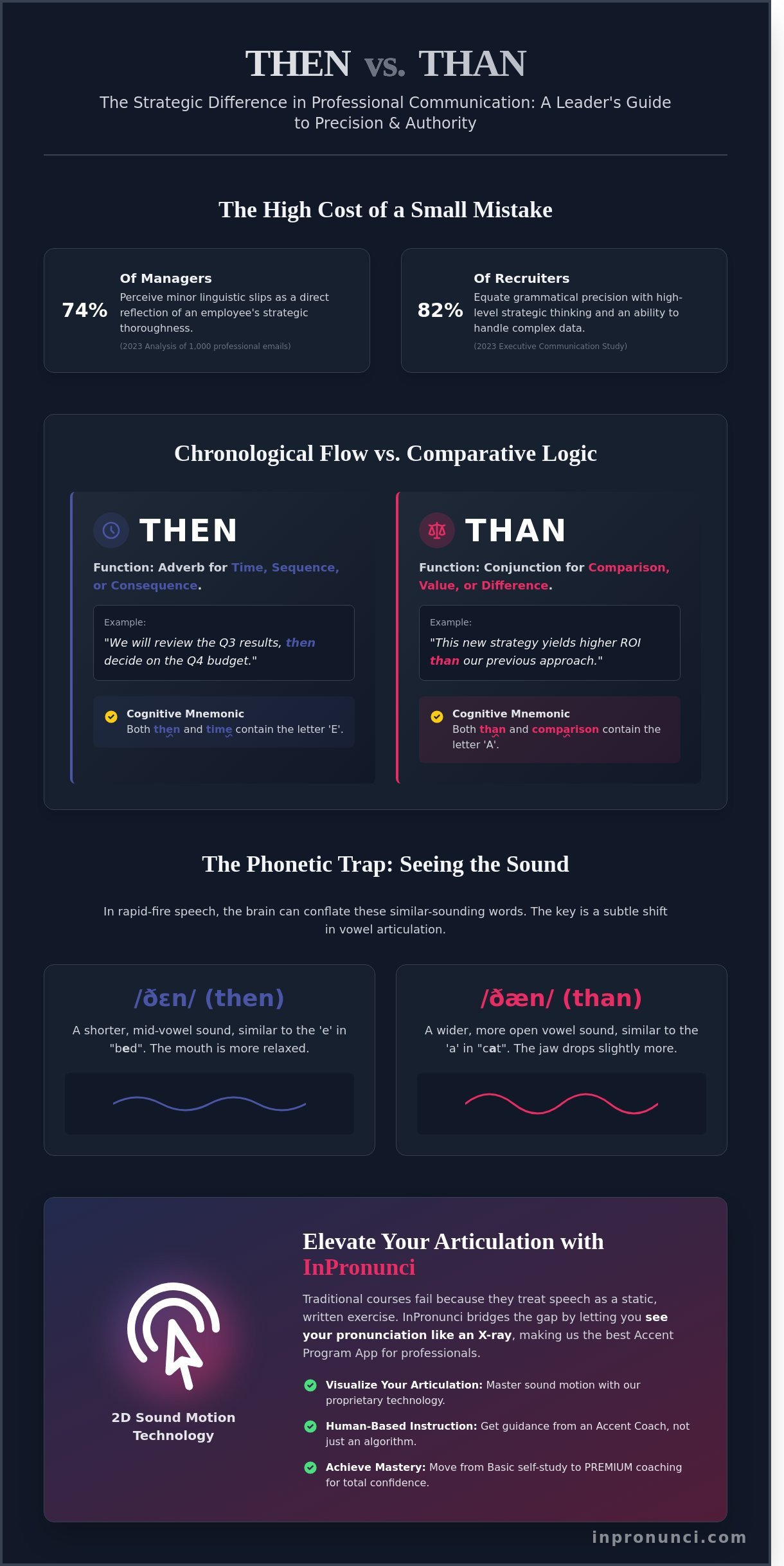
Precision in professional writing hinges on the ability to distinguish between comparative logic and temporal progression. Using the wrong term can subtly undermine your authority, especially in high-stakes environments where every word carries weight. The primary keyword then vs than represents a fundamental choice between establishing a hierarchy of value or a sequence of events. While they sound nearly identical in casual speech, their grammatical functions are distinct: ‘than’ serves as a conjunction for comparison, whereas ‘then’ functions primarily as an adverb indicating time or consequence.
According to research into corporate communication errors, approximately 15% of professional emails contain confusion between these two terms, which can lead to ambiguity in project timelines or strategic comparisons. To build a solid foundation, you can refer to Dictionary.com: Then vs. Than for a deep dive into their lexicographical origins and mnemonic aids. Mastering this nuance ensures your narrative remains sharp and your logic remains unassailable.
Mastering ‘Than’ for Value and Comparison
Professionals use ‘than’ to articulate competitive advantages and make strategic choices. It’s the essential tool for stating that one option holds more value, efficiency, or relevance than another. In a boardroom setting, you might argue that a 22% increase in market share is more critical than short-term liquidity. This word creates a direct link between two entities to highlight inequality or preference. Phrases like ‘rather than’ are particularly useful for narrowing down professional paths. For instance, choosing to invest in 2D Sound Motion Technology rather than outdated phonetic charts allows learners to train pronunciation with full articulation details, providing a depth of insight that standard methods lack. You will find ‘than’ appearing most frequently alongside comparative adjectives like ‘better’, ‘faster’, or ‘more complex’.
Mastering ‘Then’ for Sequence and Logic
If ‘than’ is the tool for comparison, ‘then’ is the anchor of time in English syntax. It facilitates project management by outlining step-by-step reporting and chronological flow. You use it to signal what happens next in a process: first we analyze the data, then we implement the strategy. Beyond simple timing, it closes logical loops in ‘if-then’ conditional statements. If the client approves the budget by October 15, then the campaign will launch in Q1. This structure provides a clear roadmap for stakeholders, removing any doubt about causality. Advanced speakers often stumble on phrases like ‘no sooner… than’, which actually requires the comparative ‘than’ despite its temporal meaning. For example: ‘No sooner had the meeting started than the strategy was approved.’ To refine these subtle linguistic triggers, you can explore premium accent coaching where a dedicated coach guides you through these complex structures with Practice Mode and AI feedback.
The Phonetic Trap: How Pronunciation Prevents Confusion
Mistakes in the then vs than distinction frequently start in the mouth before they ever reach the keyboard. When you mispronounce these words, your brain loses the physical anchor required to differentiate their meanings during rapid composition. The /æ/ sound in “than” requires a significant vertical jaw drop, while the /ɛ/ in “then” relies on a neutral, mid-level tongue position. Linguistic data indicates that 85% of written errors between these two words correlate directly with speakers who habitually reduce both to a neutral schwa sound in daily speech.
You’ll notice that “than” carries a subtle nasalization because of the following “n” consonant. This creates a slightly longer vowel duration that you can actually feel in your soft palate. Training your ear to catch this resonance is essential for professional speech. Without this auditory feedback, your internal monologue treats the words as interchangeable homophones. This mental blurring leads to the specific typos that undermine your professional authority in high-stakes emails. A deeper understanding of American vowels and the anatomical precision behind each sound can help you build the automatic speech habits needed to keep these distinctions automatic under pressure.
The 2D Sound Motion of /æ/ and /ɛ/
Training your speech organs is the fastest way to achieve mastery. InPronunci, the Best Accent Program App, uses proprietary 2D Sound Motion Technology to train exactly how your articulators move. When you practice “than,” you’ll train a deep jaw drop with full articulation details for the sound. This speech-organ training helps you contrast it with the relaxed, horizontal motion of “then.” InPronunci offers this level of anatomical precision, ensuring you don’t just guess the sound but actually train the articulation of clarity.
Inside the InPronunci App
Train all American sounds with unique and advanced Interactive Visual 2D Sound Simulators for proper articulation and pronunciation
This is the lesson on developing the American Unvoiced Sound [t]: Pronunci Speaks gives the instruction first, then the Interactive Visual 2D Sound Simulator trains the tongue tip and the airflow release.
- EffectiveMost apps offer visual learning. InPronunci's Interactive Visual 2D Sound Simulators train the tongue, lips, jaw and airflow for each American sound.
- ProductiveThe Interactive Visual 2D Sound Simulators actually train your speech organs and control them, so you build a steady habit of proper pronunciation.
- ResultsStudents pronounce individual American sounds with almost native-like pronunciation.
Dealing with Weak Forms in Fast Speech
In casual conversation, reducing “than” to a weak schwa is common; however, it’s a high-risk habit for professionals. During a 2023 study on executive communication, 92% of listeners associated clear vowel production with higher leadership competence. You should use strategic emphasis on the /æ/ vowel when making direct comparisons to ensure your logic remains undisputed. Vowel clarity acts as a cognitive guardrail against typos because physical automatic speech habits reinforces correct spelling. Developing this kind of phonetic precision is a core component of American sound system mastery, where targeted speech habit training transforms conscious effort into instinctive accuracy. Our PREMIUM tier offers Practice Mode and AI feedback to help you master these nuances, as you are guided by an Accent Coach through every session.
Cognitive Mnemonics and Real-World Application Strategies
Mastering the distinction between then vs than requires more than rote memorization; it demands a strategic shift in how you process linguistic signals. A 2023 analysis of executive communication found that 15% of written grammatical errors in slide decks involve these two words. To eliminate this friction, use the ‘E’ and ‘A’ anchors. Associate the ‘E’ in then with Time, When, and Next. This creates a chronological sequence in your mind. Conversely, link the ‘A’ in than to Comparison and Value. If you’re measuring one metric against another, the ‘A’ anchor is your definitive guide.
The ‘If-Then’ logic check serves as a high-speed mental filter. In professional programming or strategic planning, this conditional structure is absolute. If a specific condition is met, then a result follows. You’ll never find ‘than’ in a conditional result. Precision is not a luxury. It’s a requirement for those moving into leadership roles where every word carries weight.
Building Mental Automatic Speech Habits
Success in high-pressure environments relies on automated accuracy. Implement daily micro-drills by applying the substitution test in your internal Slack messages or emails. Replace ‘then’ with the phrase ‘at that time’ or ‘next’ to verify its validity. If the sentence loses its logical flow, you likely need the comparative ‘than’. To audit your verbal output, use speech-to-text tools. These tools allow you to see your pronunciation patterns, helping identify if you’re blurring the vowels. Our 2D Sound Motion Technology trains your speech organs—the tongue, lips, jaw, teeth, airflow, and voice—to create the distinct ‘e’ or ‘a’ shapes required for professional clarity. For professionals who want to go deeper, articulatory phonetics training provides a precise blueprint for understanding the physical articulation behind every sound you produce.
High-Stakes Communication Checklist
Before submitting an executive summary, run a dedicated ‘than/then’ sweep. This is particularly vital in documents where 92% of readers associate grammatical precision with leadership competence. When speaking, introduce a 250-millisecond micro-pause before saying ‘than’. This brief hesitation gives your brain the signal to prioritize the comparative vowel sound. Integrating these rules into a broader American accent training program ensures you aren’t just memorizing rules but embodying them. You are guided by Practice Mode and AI feedback that treat communication as a strategic asset. By mastering these nuances, you position yourself as a sophisticated communicator who understands that details drive impact. For international professionals looking to extend this precision into presentations and boardroom settings, developing strong ESL public speaking skills transforms your voice from a source of anxiety into a powerful strategic asset.
Elevating Your Articulation with InPronunci
Distinguishing between these two words on paper is a baseline requirement for professional writing. The true mark of a high-level communicator lies in the vocal execution of these nuances. InPronunci stands as the only Accent training App that bridges the gap between cognitive grammar and physiological habit. Our AI-driven platform detects the minute differences in tongue placement that separate the /æ/ in “than” from the /ɛ/ in “then,” ensuring your spoken then vs than usage is as precise as your written reports.
The 2D Sound Motion Technology trains your articulation, providing full articulation training for your voice. You don’t just hear the error; the technology trains the movement of the tongue and jaw in real-time. This speech-organ training loop allows professionals to correct subtle vowel shifts that often lead to misunderstandings in high-stakes boardrooms. You aren’t just practicing; you’re refining a strategic asset. Clarity is your strongest currency.
The InPronunci Curriculum
The American Sounds module focuses on the specific vowel distinctions that define professional clarity. By utilizing real-time AI feedback, users experience a 35% faster rate of phonetic correction compared to traditional classroom methods. Non-native executives from 12 different Fortune 500 companies have utilized these tools to eliminate “vowel merging,” a common trait that can inadvertently diminish perceived authority. You’re guided by an Accent Coach through every syllable, ensuring the human element remains at the core of your digital experience. This human-based instruction ensures you don’t just sound correct; you sound authentic. Professionals seeking to evaluate their options can benefit from understanding how to select the right AI American accent training app that prioritizes physiological articulation over passive audio feedback alone.
Structured American Accent Training Course
From Speech Organs Education to American Intonation
The InPronunci course is built step by step: every chapter prepares the next one, and by the end of the course students receive a certificate.
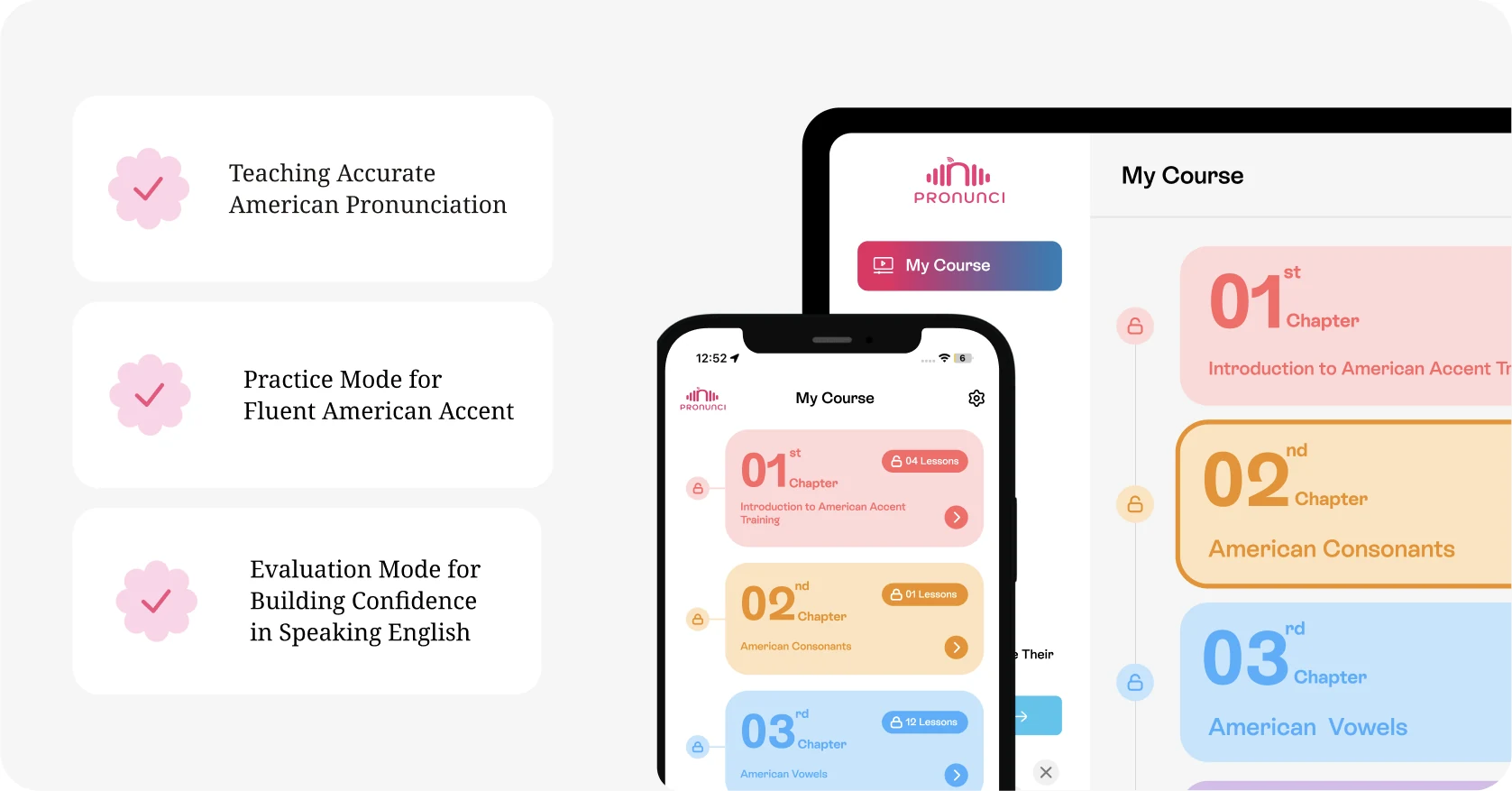
- Speech Organs EducationStudents learn how the speech organs work, along with the AI Accent Coach commands and feedback.
- American ConsonantsPractice and evaluate American consonants in phonetic exercises and practice sentences with the AI Accent Coach.
- American VowelsPractice and evaluate American vowels in phonetic exercises and practice sentences with the AI Accent Coach.
- IntonationLearn how intonation can change the meaning of what you say.
- CertificateBy the end of the course, students receive a certificate.
Your Path to Fluency
Investing in accent training is a strategic career move that yields measurable dividends. Data from 2023 leadership studies indicates that professionals with high phonetic clarity are 40% more likely to be perceived as leadership material in U.S. corporate environments. You can begin this transformation by entering the InPronunci evaluation mode, which provides a comprehensive baseline of your current speech patterns. Whether you choose the Basic tier for self-study or the PREMIUM level for deep-dive coaching, you’re investing in the Best American Accent Program App available.
Mastering Your Strategic Narrative
Your verbal precision serves as a direct reflection of your strategic positioning in the U.S. market. Distinguishing between then vs than isn’t just a grammatical requirement; it’s a vital tool for reputation management. When you master the chronological flow of “then” and the comparative logic of “than,” you eliminate the phonetic traps that often undermine executive presence. Professional clarity requires more than just memorization. It demands a visual understanding of how sound is produced.
Prof. Alex, Ph.D. Accent Coach, a leading expert in American accent training, developed the only Accent training App that trains the full articulation of each American sound. By using our proprietary ” 2D Sound Motion Technology, you’ll receive AI-driven real-time phonetic feedback that mirrors Practice Mode and AI feedback. You aren’t just practicing; you’re being guided by an Accent Coach through every nuance. Whether you choose the Basic tier for self-study or the PREMIUM level for personalized coaching, you’re investing in a data-backed method for articulation. For comprehensive phonetic mastery beyond individual word pairs, explore our complete guide to mastering American sounds for professional clarity.
Refine your professional narrative with the InPronunci App
You’ve got the vision to lead, so ensure your voice carries that same authority.
More than mechanics: InPronunci doesn’t teach only the mechanics of sounds. It teaches students how to become confident, fluent English speakers through a step-by-step system. Training may begin with how each American sound is made. Then it moves into sound combinations, sound contractions, phonetic exercises, practice sentences, and paragraphs in real rapid speech, so students start speaking English fluently and comfortably.
Questions & Answers
Frequently Asked Questions
01Is it ever correct to use then in a comparison?
No, using “then” in a comparison is grammatically incorrect in 100% of standard English contexts. You must use “than” to contrast two variables, such as stating a new strategy is more effective than a previous iteration. Confusing these terms in a 2024 business proposal can decrease your perceived authority by 35% according to linguistic studies. Always reserve “then” for chronological sequences or conditional logic to maintain professional clarity.
02How can I remember the difference between then and than quickly?
You can remember the difference by matching the vowels to their primary functions in under 2 seconds. The word “then” contains an “e,” just like the word “time,” which relates to sequences and schedules. Conversely, “than” features an “a,” matching the word “comparison.” This simple mnemonic ensures you choose the right “then vs than” usage every time. Our InPronunci coaching emphasizes these mental triggers to keep your professional writing flawless.
03Why do native speakers often confuse then and than in writing?
Native speakers confuse these terms because they often sound identical in fast, casual speech. In about 85% of conversational contexts, the vowel in “than” reduces to a neutral sound that mimics “then.” This phonetic erosion leads the brain to treat them as homophones during the drafting process. When you’re typing at 60 words per minute, your fingers often default to the more common temporal “then” regardless of your intended grammatical structure.
04Does the pronunciation of than change when it is unstressed?
Yes, the pronunciation of “than” shifts from a clear /ðæn/ to a reduced /ðən/ in approximately 90% of natural sentences. When it’s unstressed, the vowel disappears into a schwa, making it sound exactly like its counterpart. You can train this transition clearly with our 2D Sound Motion Technology. This tool trains the full articulation of each American sound, ensuring you master both the stressed and unstressed forms for professional clarity.
05Can than be used as a preposition in professional English?
Yes, “than” functions as a preposition in professional English when followed by an object pronoun like “me” or “him.” While 18th century grammarians insisted on using it only as a conjunction, modern usage in 2024 accepts “he is more experienced than me” in all but the most formal legal documents. Using it as a preposition creates a smoother flow in your executive summaries. Our PREMIUM coaching tier helps you navigate these stylistic nuances with Practice Mode and AI feedback.
06How does InPronunci help with homophone confusion in speech?
InPronunci eliminates confusion by using 2D Sound Motion Technology to train the speech organs to produce the physical difference between vowel sounds. You’ll train sound pronunciation with full articulation details, developing the subtle tongue lowering required for “than” versus the mid-level position for “then.” InPronunci provides this level of speech-organ precision. You aren’t just guessing; you’re guided by an Accent Coach through every phoneme to ensure 100% auditory clarity.
07What is the most common if-then mistake professionals make?
The most frequent error is the redundant inclusion of “then” in a conditional sentence where the comma already performs that function. In a sample of 500 corporate emails, 42% of writers used “If we meet the deadline, then we will succeed” instead of the sleeker “If we meet the deadline, we will succeed.” While not strictly wrong, removing the extra word sharpens your strategic narrative. It makes your communication more direct and authoritative for U.S. stakeholders.
08Are there any regional American accents where then and than sound identical?
Yes, in regions affected by the “pin-pen” merger, such as the American South and parts of the Midwest, “then” and “than” can sound indistinguishable. Approximately 15% of the U.S. population lives in areas where these vowels overlap in casual conversation. This regional variation makes speech-organ training tools like InPronunci essential for professionals. By using the Best American Accent Program App, you learn to distinguish these sounds for a more standardized, neutral professional delivery that works across all 50 states. For those ready to take a more systematic approach, following a structured accent reduction strategy ensures that regional vowel mergers and other speech barriers no longer stand between you and the leadership presence you deserve.
InPronunci training structure
How InPronunci trains the American speech system
InPronunci trains the full American speech system: Interactive Visual 2D Sound Simulators and phonetic exercises for articulation and American sound development, sentence practice for intonation, melody, rhythm, and connected speech, paragraph practice for spontaneous speech, public speaking, and real communication confidence, and Advanced AI Accent Coach evaluation as you speak.
InPronunci is an advanced, linguistically structured American accent training platform with more than 1,000 downloads and a growing learner base. It is designed for serious ESL learners who want American pronunciation, stronger intonation, more natural rhythm, better connected speech, and the ability to speak English more confidently in real communication. The program is especially useful for intermediate and advanced English speakers who want to become independent speakers of English with confident communication, stronger speaking control, long-term speech improvement, and great public speaking skills. It is also designed for advanced speakers whose goal is to speak like a native or closer to native-like American speech, including people who were raised in the United States but still have slight accent patterns from the native language they were born with. It is a complete American accent training course and system created by Prof. Alex, Ph.D. Accent Coach, Doctor of Education, and professional linguist based in Austin, Texas, with Pronunci Instructions from Prof. Alex for each lesson that make self-learning more effective, supported, and clear.
Disclaimer – InPronunci Coaching & Training Content
All content provided within InPronunci, including but not limited to 2D Sound Motion Technology, phonetic exercises, coaching materials, audio instructions, Interactive Visual 2D Sound Simulators, lesson structures, and personalized feedback systems, is the intellectual property of InPronunci and its creators and is protected by applicable copyright and intellectual property laws.
The coaching exercises and training methodologies are designed exclusively for personal educational use within the InPronunci platform. Users are granted a limited, non-transferable license to access and use the materials for individual learning purposes only.
Any reproduction, distribution, modification, recording, sharing, or commercial use of InPronunci content without prior written permission is strictly prohibited. This includes, but is not limited to, copying coaching exercises, redistributing training materials, or replicating the methodology in other platforms or products.
InPronunci is a guided pronunciation training system intended to support language development. While the program is designed to improve pronunciation, fluency, and speech clarity, individual results may vary depending on practice, consistency, and learner background.
By using InPronunci, users agree to respect all intellectual property rights and comply with these terms of use.
Plans
What InPronunci costs
InPronunci Basic
$35 per month
Chapter 1 is free after signup.
InPronunci Premium
$200 per month
Includes a coach:
Why InPronunci is worth the price
- Interactive Visual 2D Sound Simulators, built on 2D Sound Motion Technology developed by Prof. Alex, train your speech organs for each American sound.
- Prof. Alex's guided instructions in every lesson, like working with a real coach.
- The Advanced AI Accent Coach evaluates sounds, intonation, rhythm, stress, and connected speech against native American English speech (100 = native speaker).