


Understanding ELSA Speak as an alternative is essential. ELSA Speak focuses on general English speaking practice with AI feedback, role-plays, and broad communication skills. If your goal is specifically to reduce an accent and build natural American pronunciation, you need an app built around sound-by-sound articulation training instead. InPronunci, for example, trains the speech organs for each American sound with the Interactive Visual 2D Sound Simulators. It then builds that into phonetic exercises, sentence-level intonation, and paragraph delivery, with Pronunci Instructions from Prof. Alex, Ph.D., Accent Coach, Doctor of Education, and professional linguist guiding every lesson. The right alternative depends on whether you need general fluency practice or structured accent training.
Inside the InPronunci App
Train American Sounds with Interactive Visual 2D Sound Simulators
Learning American pronunciation involves more than listening to sounds and repeating them.
InPronunci’s Interactive Visual 2D Sound Simulators, developed by Prof. Alex using 2D Sound Motion Technology, guide students through the tongue, lip, and jaw movements involved in producing American consonants and vowels.
Students actively coordinate their speech movements with the simulator, practice each sound aloud, and develop greater awareness of how American sounds are produced.
You don’t just listen to an American sound. You actively train how to produce it.
This lesson demonstrates active training of the American voiceless consonant /t/. Prof. Alex’s Pronunci Instructions guide students before they practice the tongue-tip and airflow-release movements using the Interactive Visual 2D Sound Simulator.
Three Benefits of InPronunci’s Interactive Visual 2D Sound Simulators
- Active ArticulationTrain tongue, lip, and jaw movements while producing American sounds aloud.
- Guided Sound TrainingFollow Prof. Alex’s Pronunci Instructions to understand what to focus on and how to practice.
- Greater Sound ControlDevelop awareness and coordination for clearer, more consistent American pronunciation.
What Makes an ELSA Speak Alternative Different for American Accent Training
An effective elsa speak alternative for accent work needs to train the speech organs directly, not just score pronunciation or expand general conversation skills.
That distinction matters because ELSA Speak and a dedicated accent-training app solve two different problems, even though both involve pronunciation.
Does ELSA Speak Alternative Focus on American Accent Training or General English Communication?
ELSA Speak is built for broad English communication practice. It offers AI-powered speaking practice with instant personalized feedback, role-plays, and personalized lessons designed to help learners speak more fluently across a range of everyday situations [2]. That scope is a strength for someone who wants general conversation reps and word-level pronunciation correction.
It is also why learners searching for an elsa speak alternative are often after something narrower: structured, sound-by-sound retraining of how American English is physically produced, not more topic-based practice.
What Does ELSA Speak Do Well, and Where Do Accent-Focused Apps Fill the Gap?
ELSA Speak’s role-plays and personalized lessons work well for learners building general speaking confidence and vocabulary range [2]. The gap appears when someone’s accent comes from deeper patterns: vowel length carried over from Spanish, retroflex consonants from Hindi, or final-consonant dropping from Mandarin. Fixing those patterns requires work at the articulation level, not just repeated practice with model sentences.
Accent reduction starts with how the tongue, lips, jaw, and airflow are positioned for each American sound. Rhythm and intonation only sound natural once the underlying sounds are accurate. A learner producing a Spanish-style short vowel in “ship” will struggle with sentence stress patterns built on that same vowel. This struggle occurs no matter how much conversational practice follows.
This is the gap InPronunci: American Accent Training App addresses. It trains the speech organs for each American sound through the Interactive Visual 2D Sound Simulators, with Pronunci Instructions from Prof. Alex, Ph.D. Accent Coach, Doctor of Education, and professional linguist, guiding every lesson step by step. From there, training moves into phonetic exercises, sentence-level intonation, and paragraph delivery, while the AI Accent Coach evaluates full speech, including pronunciation, rhythm, and connected speech, rather than isolated words.
None of this makes one app universally better than the other. It depends on the goal: broad conversational fluency, or structured, sound-level accent training. Readers can compare the two approaches directly on the InPronunci vs. ELSA Speak comparison page.
What to Look for in an American Accent Training App Instead of ELSA Speak
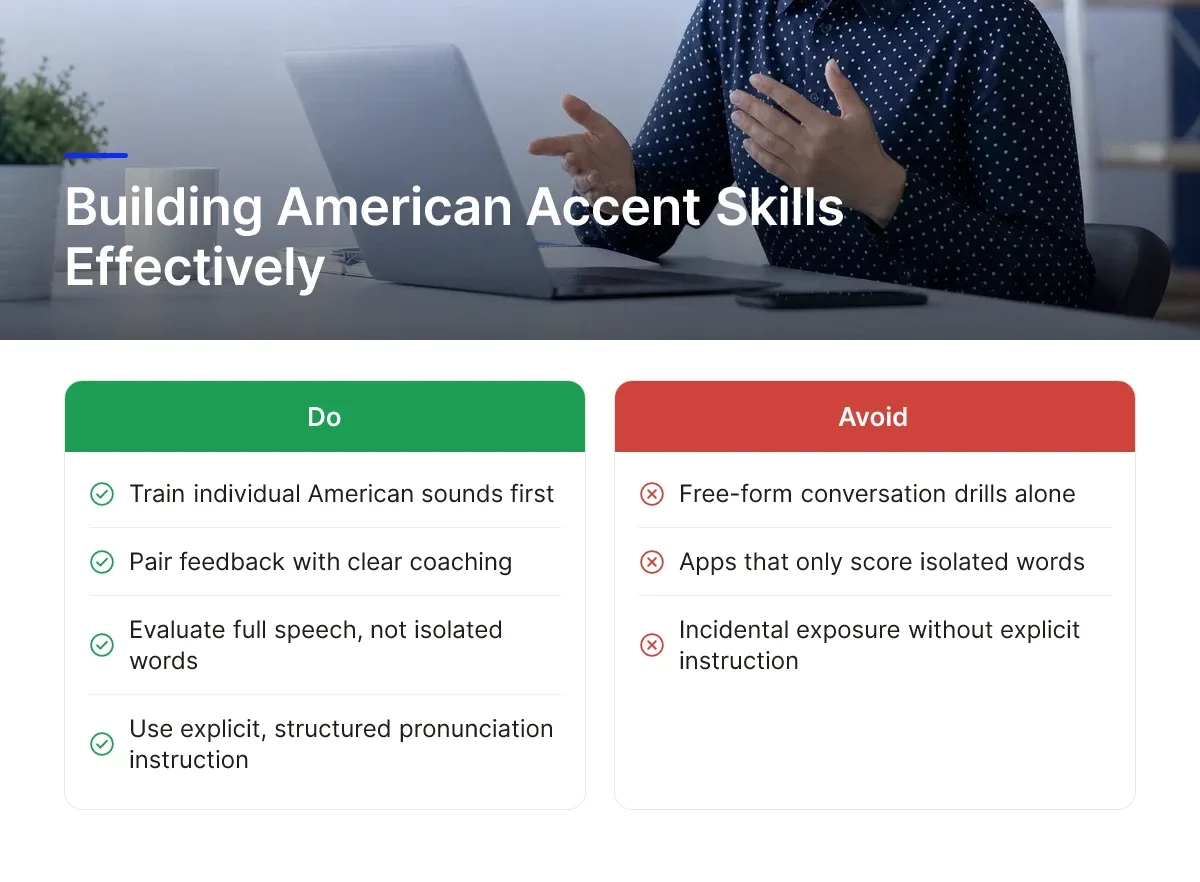
A good ELSA Speak alternative should train individual American sounds before moving to sentences. It should also pair feedback with clear coaching guidance and evaluate full speech, not isolated words.
Accent reduction research consistently points to explicit, structured pronunciation instruction as more effective than incidental exposure through conversation alone. Saito 2012 found that explicit instruction on specific sounds produced measurable gains in L2 pronunciation that generalized to new words, not just the ones practiced in class. That matters when you’re comparing apps: a tool built around free-form conversation drills may build fluency, but it does not necessarily retrain the vowels and consonants causing someone to be misunderstood. Scattered practice touches many sounds briefly. Structured practice isolates each sound, corrects it, and then moves it into phonetic exercises, sentences, and paragraphs, which is the order accent training actually requires.
When evaluating any accent-training app, check for these core elements:
- Speech-organ training: explicit guidance on tongue, lip, jaw, and airflow positioning for each sound, not just repeat-and-score drills.
- Progressive structure: a path that moves from isolated sounds to phonetic exercises, then sentences, then full paragraphs.
- Full-speech evaluation: feedback on pronunciation, rhythm, intonation, and connected speech together, not a single word score.
- Clear coaching guidance: explanations of why a sound was wrong and how to correct it, ideally from a qualified instructor.
- A way to track change over time: recorded comparisons against a native-speaker model rather than a one-time score.
Should You Choose an ELSA Speak Alternative With AI Feedback, Live Coaching, or Both?
AI feedback alone tells you a sound was wrong; AI feedback paired with coaching guidance tells you why and how to fix it. Thomson and Derwing’s review of pronunciation instruction research found that feedback is most useful when learners also receive explicit guidance on articulation, not just a score [2]. This is where many self-serve apps fall short: a number or a color-coded word doesn’t explain tongue position or airflow. InPronunci’s Pronunci Instructions address this directly, giving step-by-step guidance from Prof.
Alex, Ph.D. Accent Coach, Doctor of Education, and professional linguist, in every lesson. Evaluation Mode then combines the AI Accent Coach, which scores pronunciation, intonation, melody, rhythm, connected speech, and sentence flow as students speak, with Feedback & Analysis, which breaks a paragraph into sentences, words, and sounds. Full-speech evaluation like this gives more usable feedback than a single word or sound score, because real communication happens in sentences and paragraphs, not isolated syllables.
What Role Does Speech-Organ Training Play in Reducing an Accent?
Speech-organ training is the foundation: tongue placement, lip rounding, jaw position, and airflow control determine whether a sound lands correctly. Each American vowel and consonant depends on a specific combination of these, and most mispronunciations trace back to a habit carried over from the learner’s first language. An app worth switching to should teach these positions directly rather than asking learners to repeat a model and hope the sound improves. For a deeper look at how tongue position shapes individual sounds, see our guide on the role of tongue placement in English sounds.
Comparing American Accent Training Apps: Price, Features, and Teaching Approach of ELSA Speak Alternative
Evaluating an elsa speak alternative comes down to three questions: what the app actually measures, what it costs at each tier, and whether it builds skill over time or just scores a sample. Price alone tells you little; a budget-friendly app with a real curriculum can outperform an expensive one that only scores isolated words.
What Is the Difference Between a Quick Pronunciation Check and a Full Accent Training Course?
A pronunciation check scores a single word or sentence against a reference. A full course trains the speech organs first, then builds that sound into exercises, sentences, and paragraphs. The check tells you a word sounded off. However, it does not tell you why or how your tongue, lips, or airflow need to move differently to fix it.
A structured course works the other direction. It starts with sound articulation, moves to phonetic exercises that make the sound automatic, then applies it in sentences with stress and intonation, and finally in paragraph-length speech. InPronunci: American Accent Training App follows this exact progression across four chapters and 400 lessons, because a sound you can produce in isolation is not the same as a sound you can hold steady in a fast sentence during a client call or interview.
When comparing tools, ask whether a low score on a word actually comes with instructions for correcting it, or just a number.
Which Apps Offer Structured, Sound-by-Sound Training Versus General Speaking Practice Like ELSA Speak Alternative?
Pricing across accent and pronunciation apps tends to split into two tiers: a budget-friendly self-guided tier for independent practice, and a premium tier that adds live coaching or personalized feedback from a real instructor. Neither tier guarantees a particular teaching approach, so it is worth checking what each tier actually includes rather than assuming price maps to depth.
InPronunci follows this same pattern, with tiers structured like this:
- Free Chapter 1: speech-organs education at no cost, so new students can learn how the tongue, lips, and airflow work before paying for anything.
- Basic Plan: a self-guided tier covering the full training program, including the Interactive Visual 2D Sound Simulators, Pronunci Instructions, and AI Accent Coach feedback.
- Premium Plan: adds a monthly live 1-on-1 session with Prof. Alex, Ph.D. Accent Coach, Doctor of Education, and professional linguist, plus personal chat between sessions for students who want human coaching layered onto the app.
BoldVoice, by comparison, centers its teaching approach on guided video practice: coach videos paired with AI speech evaluation. That is a legitimate way to train an accent, and it differs from a sound-by-sound curriculum mainly in sequencing and depth of per-sound correction.
The real comparison question is not which app has more features. Instead, it is whether the app moves you through sounds, exercises, sentences, and paragraphs in order. Alternatively, it may allow you to jump into open conversation practice before your sound system is stable. For readers who already compared InPronunci and ELSA Speak directly, the full comparison page breaks down how each handles evaluation depth.
Choosing the Right ELSA Speak Alternative for Your Speaking Level and Goals
The right elsa speak alternative depends on one question: do you want to speak with more confidence, or do you want to sound closer to a native speaker in professional settings. Those are two different training goals, and they call for different levels of intensity.
Do You Need Beginner-Friendly Apps or Advanced Training for Near-Native American English?
Beginner-friendly practice works well for learners who still feel nervous speaking English out loud. They may want frequent, low-stakes repetition. Advanced training is built for speakers who already communicate well but want to refine specific sounds, stress patterns, and intonation. This training aims for their speech to read as closer to native American English.
A learner just starting to speak English daily benefits more from frequent, simple practice. A professional who already handles meetings in English but wants sharper articulation needs a structured path. This path should target specific sounds, word stress, and sentence rhythm, rather than general conversation drills.
What Is the Difference Between Apps for Confidence-Building and Apps for Professional Clarity?
Confidence-building tools emphasize frequent, low-pressure conversation so learners get comfortable speaking without fear of mistakes. Professional-clarity training goes further: it targets precise articulation, stress, and intonation so speech holds up in client calls, interviews, and presentations where being misunderstood has real consequences.
InPronunci’s Evaluation Mode reflects this split directly. The Intermediate level in the AI Accent Coach is built for speakers who want to become independent and confident communicators. This level focuses on achieving clearer everyday speech. The Advanced level evaluates full speech performance against native American English. It is recommended with the Premium Plan, where Prof. Alex, Ph.D. Accent Coach, Doctor of Education, and professional linguist adds monthly 1-on-1 sessions. You will receive personal feedback on submitted practice.
Consider a call center agent or a healthcare professional: their priority is usually being understood clearly and consistently during daily conversations, which points to the Intermediate path. An advanced professional preparing for leadership presentations or client-facing negotiations often needs the Advanced path, since small differences in stress and intonation can affect how persuasive or credible they sound in a meeting.
Whichever path fits, no app or coach can honestly guarantee a native-like accent. Progress comes from regular practice and from applying new sounds and rhythm in real conversations. It is not derived from a single feature or a few isolated sessions. For a closer look at how structured evaluation compares across tools, see our InPronunci vs. ELSA Speak comparison.
How to Tell if an American Accent Training App Is Actually Improving Your Speech
Real progress shows up as a change you can hear across a full sentence. It is not just a single number that goes up after one drill. Any score an app gives you should state clearly that 100 equals a native speaker. This way, you will know what the number actually measures.
What Should Real Pronunciation Feedback Include Beyond a Single Score?
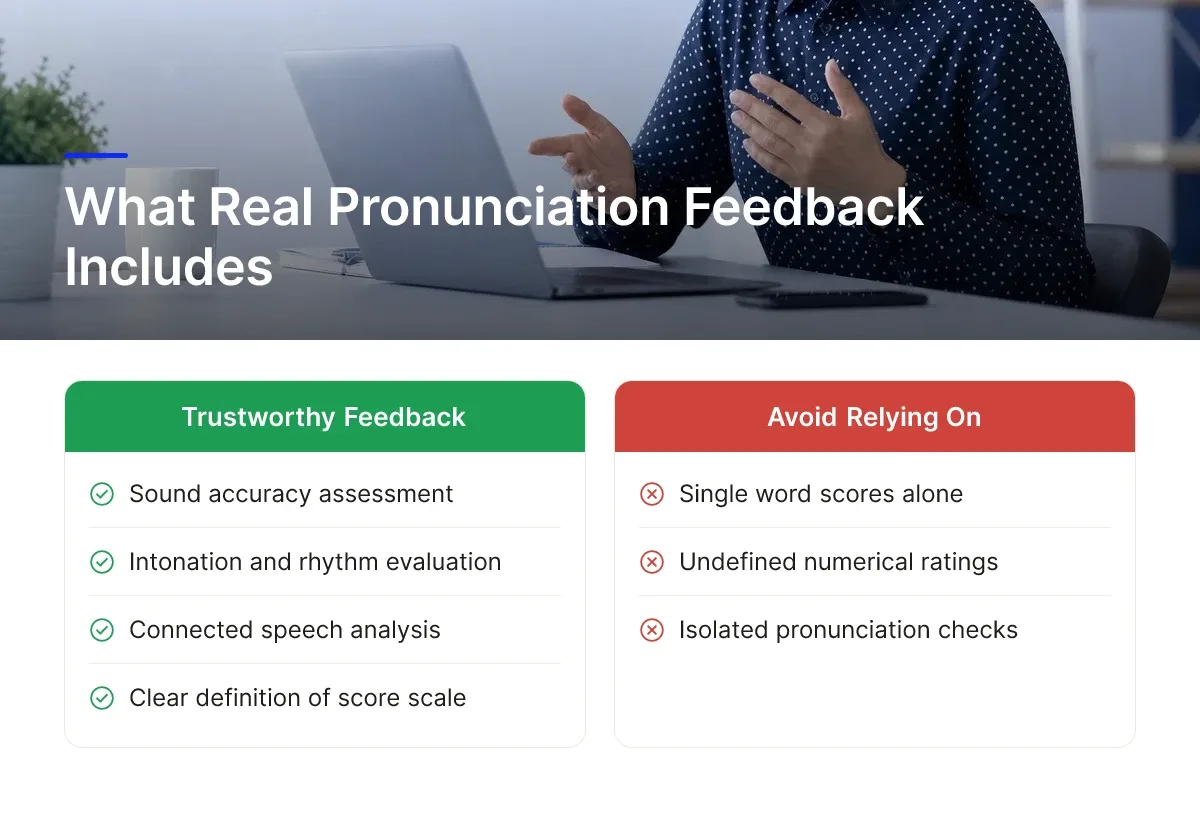
A single word score tells you almost nothing about whether you communicate clearly. Feedback worth trusting covers sound accuracy, intonation, rhythm, and connected speech together. This is how listeners actually judge clarity in a real conversation.
This is one reason people search for an elsa speak alternative: they want evaluation of full sentences and paragraphs, not isolated words repeated back to an app. InPronunci’s Evaluation Mode works this way. The AI Accent Coach reviews pronunciation, intonation, melody, rhythm, connected speech, and sentence flow as you speak, and Feedback & Analysis then breaks that speech into sentences, words, and individual sounds so you know exactly where to focus.
How Can You Measure Progress in American Accent Training Over Time?
Track progress by recording the same sentence or paragraph at intervals. Compare it against a native-speaker model and note which specific sounds or stress patterns change. Guessing whether you “sound better” is unreliable. A recorded comparison gives you something concrete to evaluate.
InPronunci’s Your Coach vs. My Pronunci Pronunciation Comparison Tool is built for exactly this. You record your speech and compare it directly against the native-speaker model. Notice specific differences instead of relying on a general impression. That structured comparison builds awareness of your own speech patterns. It prevents you from guessing what changed.
Cognitive Accent Training
Cognitive Accent Training: Learn to Recognize and Correct Your Own Pronunciation
Have you ever listened to yourself speaking English and noticed that your pronunciation sounds different from an American speaker’s, but weren’t sure why?
InPronunci incorporates Cognitive Accent Training to help students recognize their existing pronunciation habits and become more aware of how they speak.
Through Your Coach vs. My Pronunci, students listen to their own recordings, compare them with an American pronunciation model, and actively identify differences in sounds, stress, rhythm, and intonation.
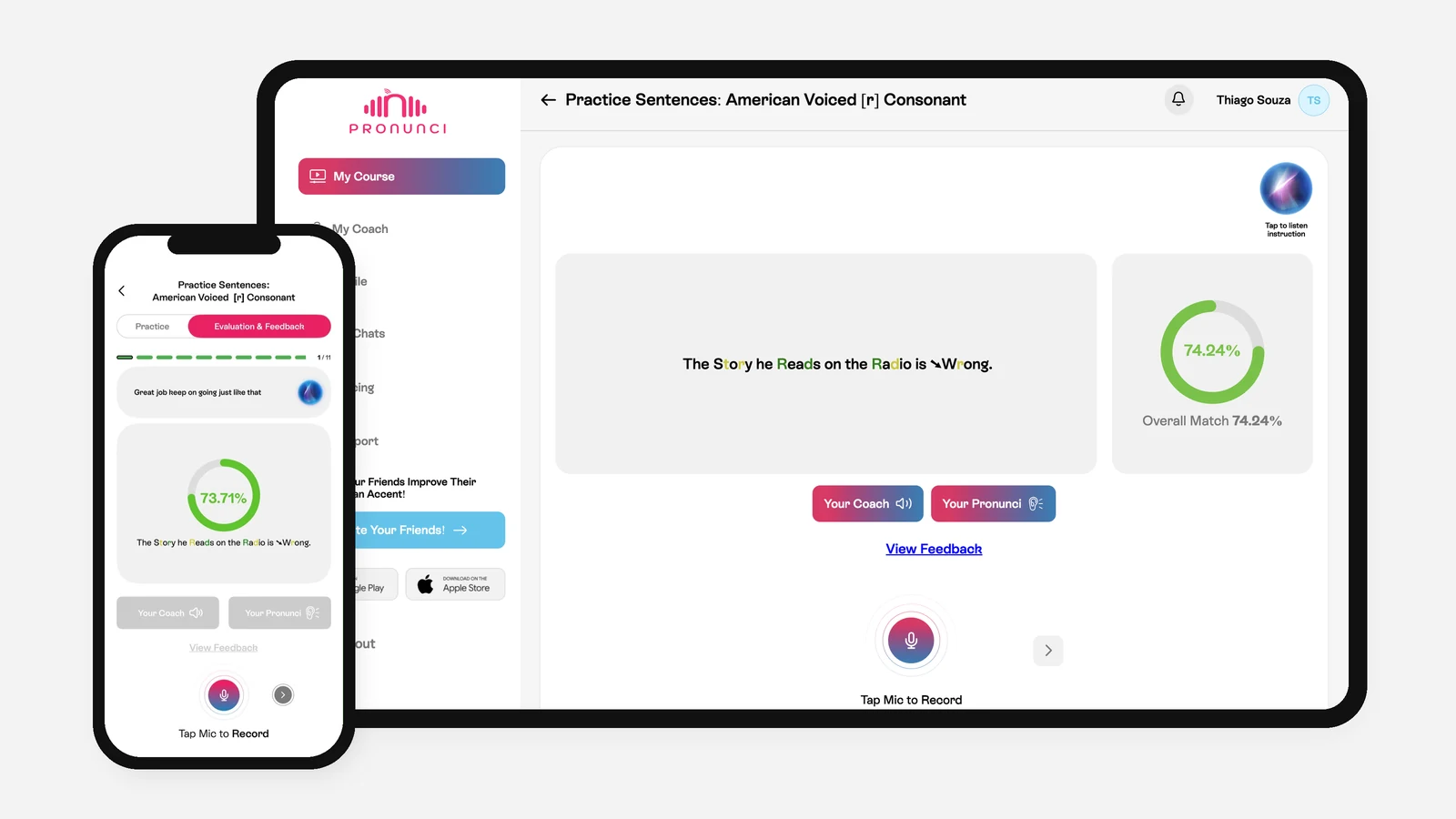
Prof. Alex’s Pronunci Instructions then guide students in understanding how to approach those corrections, while Interactive Visual 2D Sound Simulators support active articulation practice.
The process is simple:
Listen → Compare → Recognize → Understand → Practice → Correct → Recheck
Instead of relying entirely on an AI pronunciation score, students learn to participate actively in evaluating and improving their own speech.
The goal is to help students become increasingly capable of recognizing their pronunciation differences and correcting them independently.
- Hear the American ModelThe model American pronunciation of each practice sentence.
- Recognize Your DifferencesCompare your recorded speech with the American pronunciation model to identify differences in sounds, stress, rhythm, and intonation.
- Practice Your CorrectionsUse Pronunci Instructions and AI feedback to understand which pronunciation differences need attention, practice corrections, and compare your speech again.
Thomson & Derwing’s 2015 review of pronunciation instruction research found that explicit, sustained instruction tends to produce measurable improvement over time, more than incidental exposure alone [2]. That supports a structured approach: training a sound deliberately, practicing it in context, and checking results regularly, rather than hoping repeated conversation practice will fix it on its own.
Try this routine today. Pick one sound that gives you trouble; the American R or the TH sound are common ones. Train the speech-organ position for it by reading a short paragraph aloud that contains several instances of that sound. Record yourself and compare the recording to a native-speaker model. Repeat with the same paragraph in a few days and listen for the specific sound. Focus on it, not your overall impression. For a deeper look at tongue and jaw positioning, see our guide on tongue placement in English sounds.
Questions & Answers
Frequently Asked Questions
01Is ELSA Speak good for building an American accent specifically, or just general English fluency?
ELSA Speak is built for AI-powered English speaking practice with instant personalized feedback. It offers role-plays and broad communication practice, but it is not a dedicated American accent program. It covers general pronunciation accuracy across many goals. However, it does not walk learners through a structured path from individual sounds to intonation and paragraph-level delivery like a dedicated accent training course does.
02Can you combine an app like ELSA Speak with a structured accent training course?
Yes, combining tools is reasonable. However, overlapping drills can slow progress if they teach conflicting habits. A clearer approach is picking one structured path, such as InPronunci’s four-stage system. Using it consistently allows sound, rhythm, and intonation training to build on each other.
03How long does it typically take to notice a change in pronunciation with consistent practice?
There’s no fixed timeline in learning. Any app or coach that promises one is overstating what practice can guarantee. Explicit pronunciation instruction has been shown to support measurable gains in learner speech. However, the pace depends on the sound, the learner’s native language, and how often they practice.
04Do I need a live coach, or can AI feedback alone reduce an accent?
AI feedback can catch many pronunciation and fluency errors as you speak. However, a live coach adds judgment that an algorithm still can’t fully replace. Research on form-focused pronunciation instruction points to teacher guidance as a meaningful factor in learner gains. A combined approach, like InPronunci’s AI Accent Coach paired with monthly live sessions from Prof. Alex, gives learners both real-time feedback and expert correction.
05Should I consult a speech-language pathologist instead of using an accent training app?
Consult a licensed speech-language pathologist if you have a diagnosed speech or hearing difficulty. Do not rely on an app alone. Accent training apps, including InPronunci, offer supportive practice for building clearer pronunciation. However, they are not therapy and don’t diagnose medical or developmental speech conditions.
Conclusion
Choosing an ELSA Speak alternative comes down to what you’re actually training: general conversation confidence or a specific American accent. If the goal is the latter, look for a course that moves through sound articulation, phonetic automaticity, sentence intonation, and paragraph delivery, rather than isolated drills. InPronunci follows that exact four-stage path, with Pronunci Instructions from Prof. Alex and AI Accent Coach feedback on full speech, not single words. Start with the free Chapter 1 on the web platform, the App Store, or Google Play, and see how structured, sound-by-sound training compares to what you’ve tried before.
Sources & References
Recommended Articles

Why US-Raised People Still Have a Heritage Speaker Accent
People raised in the US who grew up speaking a language other than English at home often keep subtle pronunciation patterns from that first language, even...
5 Pronunciation Assessment Tools to Track Your Progress
Discover the pronunciation assessment tools and features that matter most for tracking progress toward clear, native-like American English speech.

What an English Accent Coach Online Can Really Do for You
A structured English accent coach online works by combining expert-designed training with technology that evaluates your full speech as you talk, not just...