


An AI pronunciation trainer gives instant feedback by listening to your full spoken sentence or paragraph, not just a single word, and scoring pronunciation, intonation, rhythm, and connected speech as you talk. The system compares your speech against native American English patterns and flags specific sounds, stress points, or linking errors in real time. The best versions pair this feedback with structured articulation training, so you learn why a sound is off and how to physically correct it with your tongue, lips, and jaw, not just that it was wrong.
Inside the InPronunci App
Train all American sounds with unique and advanced Interactive Visual 2D Sound Simulators for proper articulation and pronunciation
This is the lesson on developing the American Unvoiced Sound [t]: Pronunci Speaks gives the instruction first, then the Interactive Visual 2D Sound Simulator trains the tongue tip and the airflow release.
- EffectiveMost apps offer visual learning. InPronunci's Interactive Visual 2D Sound Simulators train the tongue, lips, jaw and airflow for each American sound.
- ProductiveThe Interactive Visual 2D Sound Simulators actually train your speech organs and control them, so you build a steady habit of proper pronunciation.
- ResultsStudents pronounce individual American sounds with almost native-like pronunciation.
How Does an AI Pronunciation Trainer Give Real-Time Feedback on American Pronunciation and Intonation?
A capable AI pronunciation trainer processes a full sentence or paragraph as one continuous speech sample, scoring sound accuracy, intonation, rhythm, and connected speech at the same time rather than grading isolated words.
Speech recognition systems built for this purpose run acoustic models over the entire audio stream, looking at how sounds change when they meet each other, how pitch rises and falls across a phrase, and where stress lands in a sentence. Research on generative AI pronunciation systems describes this same architecture: automatic speech recognition paired with real-time evaluation models that analyze and score spoken input as it comes in, rather than waiting for a single word to be isolated and judged [4]. That matters because English pronunciation does not happen word by word. A vowel, a consonant, and a stress pattern all interact with the words around them, and a system that only checks one word at a time misses most of what makes speech sound natural or foreign.
What Aspects of Speech Does an AI Accent Coach Evaluate Beyond Individual Word Sounds?
Beyond matching individual phonemes, an AI accent coach tracks pitch movement across a sentence, where emphasis falls, and how fast or slow the speaker paces each phrase. Pitch movement shows whether a statement, a question, or a list is being produced with the right melody. Emphasis shows whether the speaker is highlighting the word that carries new information, the way a native speaker naturally would in a sentence like “I didn’t say he took the money” versus “I didn’t say he took the money.” Pacing reveals whether a speaker is rushing through content words and skipping necessary pauses, or stretching syllables that should be reduced. None of this shows up in single-word scoring. It only appears when the system listens to a full utterance and tracks how these elements move together.
How Does Real-Time AI Feedback Help You Correct Connected Speech and Rhythm?
Real-time feedback catches errors that only surface in full sentences: dropped linking sounds, missed reductions like “gonna” or “wanna,” and flattened stress patterns that make every syllable sound equally weighted. English is stress-timed, meaning stressed syllables fall at roughly even intervals while unstressed syllables compress to fit the rhythm. Many languages, including Spanish and Mandarin, are syllable-timed, giving each syllable close to equal length. A speaker carrying that syllable-timed habit into English often sounds choppy or overly deliberate, even when every sound is technically correct. Because the AI evaluates the whole sentence, it can flag where stress is missing or misplaced, not just whether a vowel was produced accurately.
InPronunci’s AI Accent Coach works this way: it evaluates pronunciation, intonation, melody, rhythm, connected speech, and sentence flow as students speak, not a single word in isolation. Each lesson also includes Pronunci Instructions, step-by-step guidance from Prof. Alex, Ph.D. Accent Coach, Doctor of Education, and professional linguist, so students know exactly what to adjust after the AI Accent Coach flags an issue. That pairing of full-speech evaluation and expert guidance is covered in more detail on the AI Accent Coach page.
What Makes AI Pronunciation Training Different From Traditional Scoring Apps?
A scoring app tells you a word was wrong. An AI pronunciation trainer built around speech-organ instruction tells you why it was wrong and what to move to fix it.
Most pronunciation apps compare your recording against a model and return a percentage or a color-coded score. That number can confirm something is off, but it carries no information about mechanism. It does not tell a Spanish speaker that “ship” came out as “sheep” because the tongue stayed too low and too far back, and it does not tell a Mandarin speaker which part of the mouth is closing too early on a final consonant. Without that detail, learners repeat the same word, get the same low score, and plateau. Explicit, targeted correction changes outcomes in a way passive repetition does not: Saito 2012 found that learners who received explicit pronunciation instruction improved more than those who only practiced without corrective feedback [1].
Why Do Some AI Trainers Focus on Speech-Organ Training Instead of Just Scoring Words?
Because a sound is a physical action, and fixing it means retraining the tongue, lips, jaw, and airflow that produce it, not just flagging the result. InPronunci’s 2D Sound Motion Technology works this way: its Interactive Visual 2D Sound Simulators train the speech organs directly for every American vowel and consonant, showing where the tongue sits for the American R, how the lips round for /w/, or how airflow shapes the “th” sounds. Students follow the simulator and repeat the movement until it becomes a habit, building the muscle memory that a pass/fail score cannot supply on its own.
How Does Structured, Linguist-Designed Training Compare to General Pronunciation Apps?
Structured training moves a learner through stages instead of leaving them to practice isolated words at random. InPronunci follows four connected stages: sound articulation training with the simulators, phonetic exercises that make each sound automatic, sentence practice with American stress and intonation, and paragraph practice for presentation-style delivery. This mirrors how Prof. Alex, Ph.D. Accent Coach, Doctor of Education, and professional linguist, teaches in 1-on-1 sessions, and every lesson includes Pronunci Instructions so students know exactly what to adjust. General pronunciation apps that evaluate single words, like the tool described in [1], can be useful for quick checks, but they are not built to carry a learner from an isolated sound into natural, connected speech the way a full training system is.
Structured American Accent Training Course
From Speech Organs Education to American Intonation
The InPronunci course is built step by step: every chapter prepares the next one, and by the end of the course students receive a certificate.
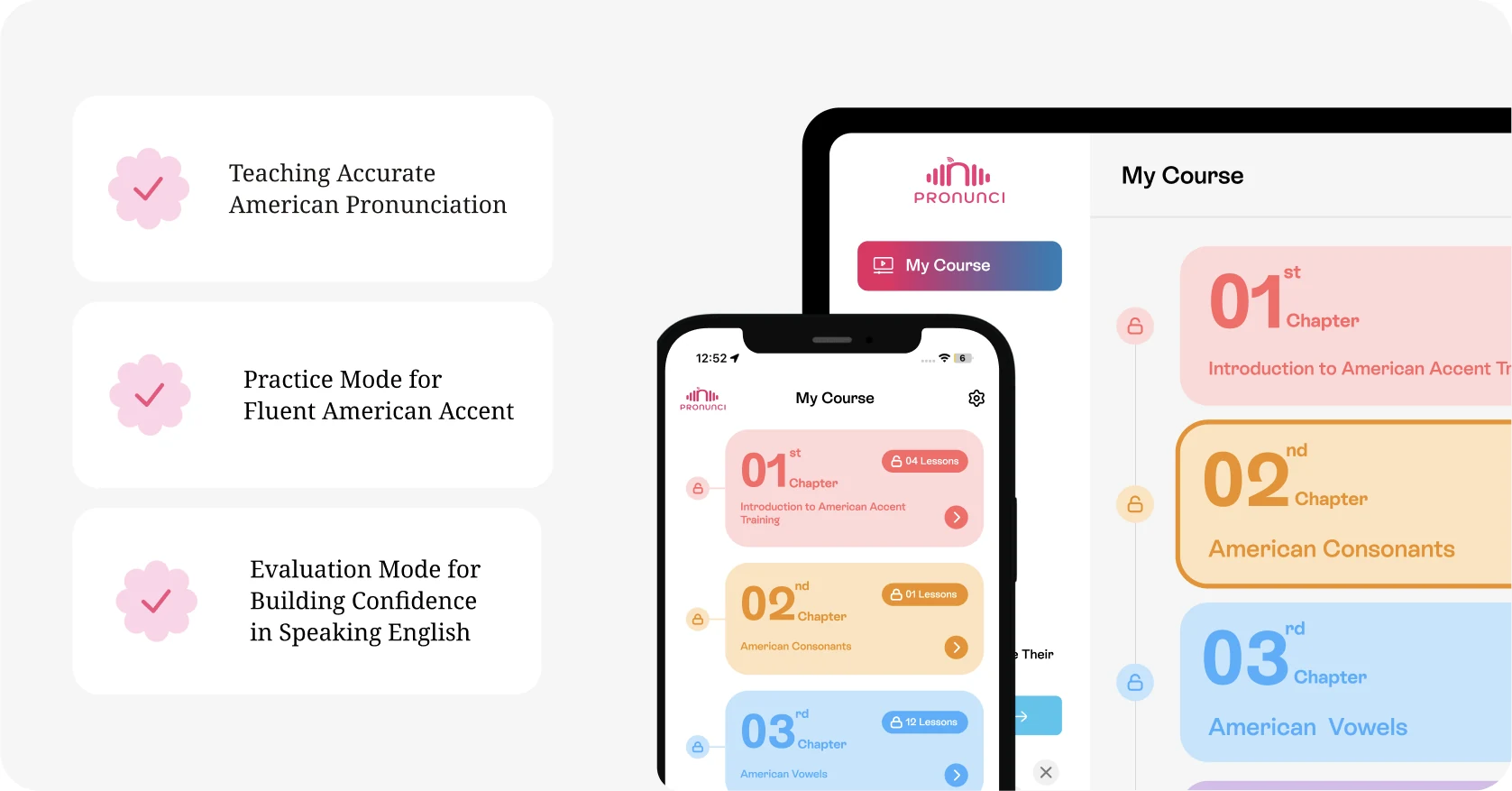
- Speech Organs EducationStudents learn how the speech organs work, along with the AI Accent Coach commands and feedback.
- American ConsonantsPractice and evaluate American consonants in phonetic exercises and practice sentences with the AI Accent Coach.
- American VowelsPractice and evaluate American vowels in phonetic exercises and practice sentences with the AI Accent Coach.
- IntonationLearn how intonation can change the meaning of what you say.
- CertificateBy the end of the course, students receive a certificate.

How Do You Use an AI Pronunciation Trainer to Build Native-Like American English Speech?
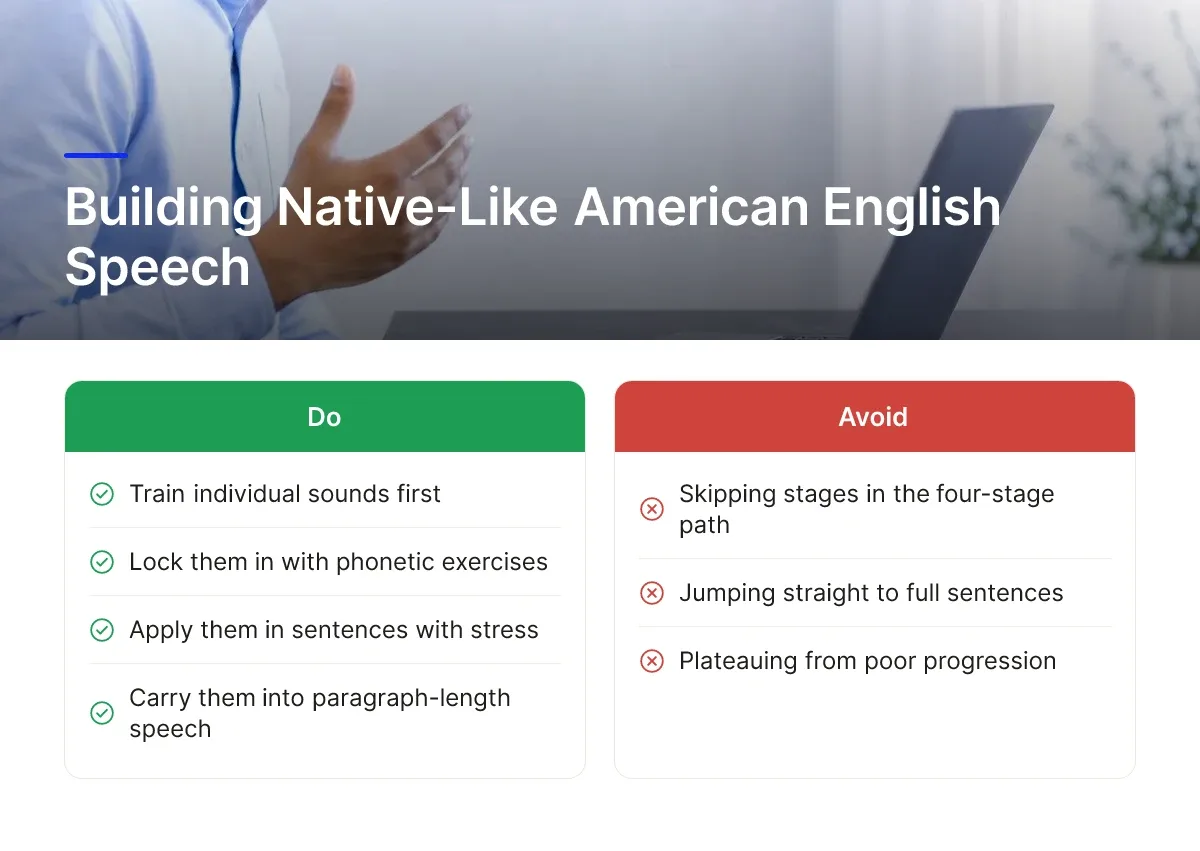
An AI pronunciation trainer works best as a four-stage path: train individual sounds first, lock them in with phonetic exercises, apply them in sentences with stress and intonation, then carry them into paragraph-length speech. Skipping stages, or jumping straight to full sentences, is the most common reason learners plateau.
Take the American R. Many Spanish and Hindi speakers produce a tapped or lightly rolled R, with the tongue tip briefly touching the roof of the mouth. The American R requires the opposite: the tongue tip pulls back and away from the roof of the mouth, the sides of the tongue touch the upper back teeth, and the lips round slightly. No tap, no contact, no trill. This is a motor habit, not a knowledge gap, so it needs repetition with the tongue in the right position before it shows up correctly in words like “car,” “river,” or “around.” This is where InPronunci’s Interactive Visual 2D Sound Simulators come in: they train the tongue, lips, jaw, and airflow for sounds like this one, giving students a model to follow for the exact movement rather than a verbal description of where the tongue “should” go.
What Is the Typical Training Path From Sound Articulation to Fluent Paragraph Practice?
The path runs from isolated sound training, to phonetic drilling, to sentence practice, to paragraph and presentation-style delivery, each stage depending on the one before it.
If a sound is unstable, it will not hold up once stress, rhythm, and connected speech are layered on top. A learner who practices the American R correctly in isolation but has never drilled it in context will often lose it the moment they speak at normal speed in a sentence. This is why InPronunci sequences training this way: Chapter 2 and Chapter 3 build the consonant and vowel system first, and only then does Chapter 4 introduce intonation and emphasis at the sentence and paragraph level.
How Do Phonetic Exercises and Intonation Training Fit Into a Complete AI Pronunciation System?
Phonetic exercises make a sound automatic under real speech conditions, including reductions, assimilations, and sound combinations, before intonation and rhythm get added on top.
A sound a learner can produce in isolation often disappears under the pressure of reductions (“gonna,” “wanna”), assimilations (the “d” in “would you” shifting toward a “j” sound), and fast sound combinations across word boundaries. Phonetic exercises target exactly these patterns, which is why InPronunci builds 150 phonetic exercises across its chapters, 78 for consonants and 72 for vowels, before moving to the 392-plus practice sentences where stress and melody matter. Research on explicit pronunciation instruction has found that targeted, form-focused practice produces measurable gains in both controlled and freer speech tasks [2], which supports training sounds deliberately before expecting them to hold up in spontaneous conversation.
A short routine to try today: pick one sound you struggle with, say the American R. Isolate it and repeat the correct tongue position ten times without a vowel attached. Then use it in three sentences, such as “The car is around the corner,” stressing the content words naturally. This mirrors the sequence an AI pronunciation trainer like InPronunci uses, moving from sound to sentence rather than the reverse.
What Should You Look for When Choosing an AI Pronunciation Trainer for Accent Reduction?
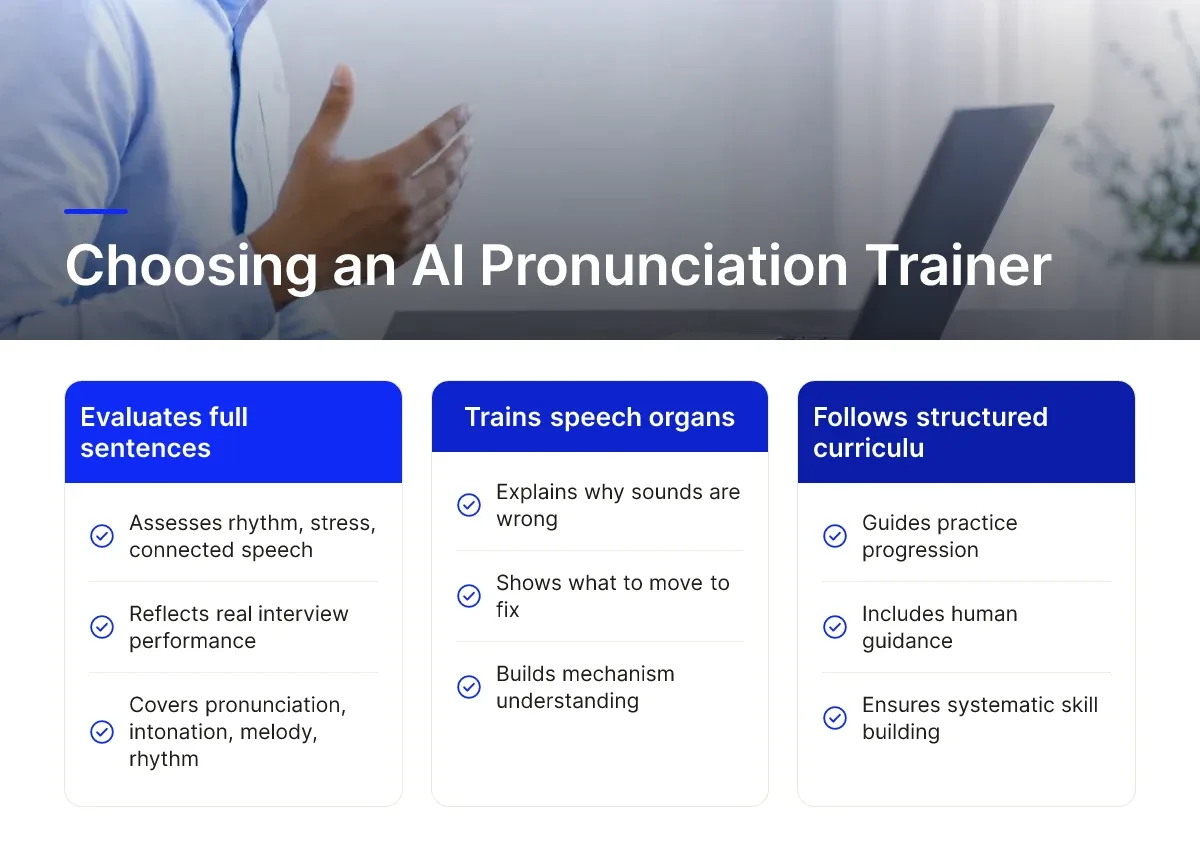
Judge an AI pronunciation trainer by four questions: does it evaluate full sentences or just single words, does it train the speech organs, does a human guide the practice, and does it follow a structured curriculum.
Many tools score isolated words or short phrases against a reference pronunciation. That tells you whether one word matched a target, but it says nothing about how your rhythm, stress, and connected speech sound across a real sentence or a two-minute answer in an interview. An AI pronunciation trainer built for accent reduction should evaluate pronunciation, intonation, melody, rhythm, connected speech, and sentence flow together, because that is how listeners actually judge clarity.
A second criterion is articulation training. Scoring a sound as “correct” or “incorrect” does not teach you how to produce it. Look for tools that train the tongue, lips, jaw, and airflow directly, not just tools that flag errors after the fact.
Third, check whether guidance comes only from automated feedback or also from a qualified instructor who can explain why a sound comes out wrong for your specific first language. Fourth, confirm the app follows a built curriculum, moving from sounds to sentences to paragraphs, rather than letting you jump between unrelated topics with no sequence.
How Do AI Trainers With Live Coach Support Differ From Fully Automated Apps?
Fully automated apps give feedback instantly but cannot ask what you meant to say or adjust the lesson to your specific pattern of errors. A human coach can.
InPronunci’s Premium Plan combines both: students get AI Accent Coach evaluation as they speak, plus one 1-hour live session per month with Prof. Alex, Ph.D. Accent Coach, Doctor of Education, and professional linguist, and a personal chat between sessions for feedback on submitted practice and homework. The Basic Plan offers self-guided access to the same AI-driven training system without the live sessions. This gives learners a choice between independent practice and a monthly check-in with a coach who can correct patterns an automated system might miss.
What Role Does Interactive Articulation Training Play in Reducing a Non-Native Accent?
Articulation training addresses the physical cause of an accent: tongue, lip, and jaw positions carried over from a first language, not just the audible symptom.
Research on explicit pronunciation instruction supports this approach: Saito (2012) found that focused instruction on segmental accuracy produced measurable gains in learners’ pronunciation over instruction without that focus [source]. InPronunci applies this through the Interactive Visual 2D Sound Simulators, which train the speech organs for every American vowel and consonant, paired with Pronunci Instructions that tell students exactly where to place the tongue and how to shape airflow for each sound. For more on how tongue position shapes specific American sounds, see our guide on tongue placement in English sounds.
Comparing Tools Fairly
ELSA Speak offers AI-powered English speaking practice with instant personalized feedback, role-plays, and broad communication practice. BoldVoice offers American accent improvement through guided video practice, coach videos, and AI speech evaluation. InPronunci adds full-speech AI Accent Coach evaluation across pronunciation, intonation, rhythm, and connected speech, plus Pronunci Instructions in every lesson, so students always know what to adjust and why. See a full breakdown on the InPronunci vs. ELSA Speak comparison page.
On pricing, most learners can start free with Chapter 1, move to a self-guided mid-range plan for full access to a structured course, or choose a premium tier that adds live coaching for personalized correction.
Can an AI Pronunciation Trainer Help You Speak American English With Confidence for Work and Public Speaking?
Yes, when it trains full speech over paragraphs and real scenarios, not just isolated words, an AI pronunciation trainer builds the stamina and rhythm control that workplace speaking demands.
Short drills teach a sound. They don’t teach you to hold that sound steady for two minutes while answering an unscripted question in a meeting. Clear pronunciation under pressure, in a job interview or a client call, depends on sustaining accurate vowels, consonants, stress, and intonation across connected, spontaneous speech, not just getting a single word right in isolation.
How Does Presentation-Style Paragraph Practice Prepare You for Real Communication Scenarios?
Paragraph practice forces you to carry correct articulation, rhythm, and intonation across full sentences and multiple ideas, the same demand as a real conversation. InPronunci’s fourth training stage moves students from sentence-level intonation drills into paragraph practice with presentation-style delivery, mirroring the kind of extended, spontaneous speech required in meetings, client calls, interviews, and public presentations. This stage matters because comprehensibility research shows that targeted pronunciation instruction has a measurable, positive effect on how clearly L2 speech is understood in real communication, not only in controlled drills [2].
This is where the distinction between a scoring app and a structured course becomes practical. Research on generative AI pronunciation systems notes that real-time feedback and automatic speech recognition can analyze and score speech accurately [4], but accuracy on a single utterance doesn’t guarantee the ability to sustain that accuracy for three minutes of unscripted talk. Paragraph and presentation practice closes that gap.
What Feedback Tools Help You Compare Your Speech With Native-Speaker Models?
Self-correction tools that let you compare your own recording against a native-speaker model build conscious awareness of specific gaps, not just a generic score. InPronunci’s Your Coach vs. My Pronunci Pronunciation Comparison Tool works this way: students record a sentence or paragraph, place it next to the native-speaker model, and identify exactly where their vowel length, word stress, or linking differs. Combined with the AI Accent Coach, which evaluates pronunciation, intonation, melody, rhythm, connected speech, and sentence flow as students speak, this builds the kind of self-monitoring skill that carries over once the app is closed.
Cognitive Accent Training
Compare Your Coach vs. Your Pronunci
In every practice sentence, students listen to Your Coach, record their own voice, and compare it with Your Pronunci, so they consciously notice and correct each sound.
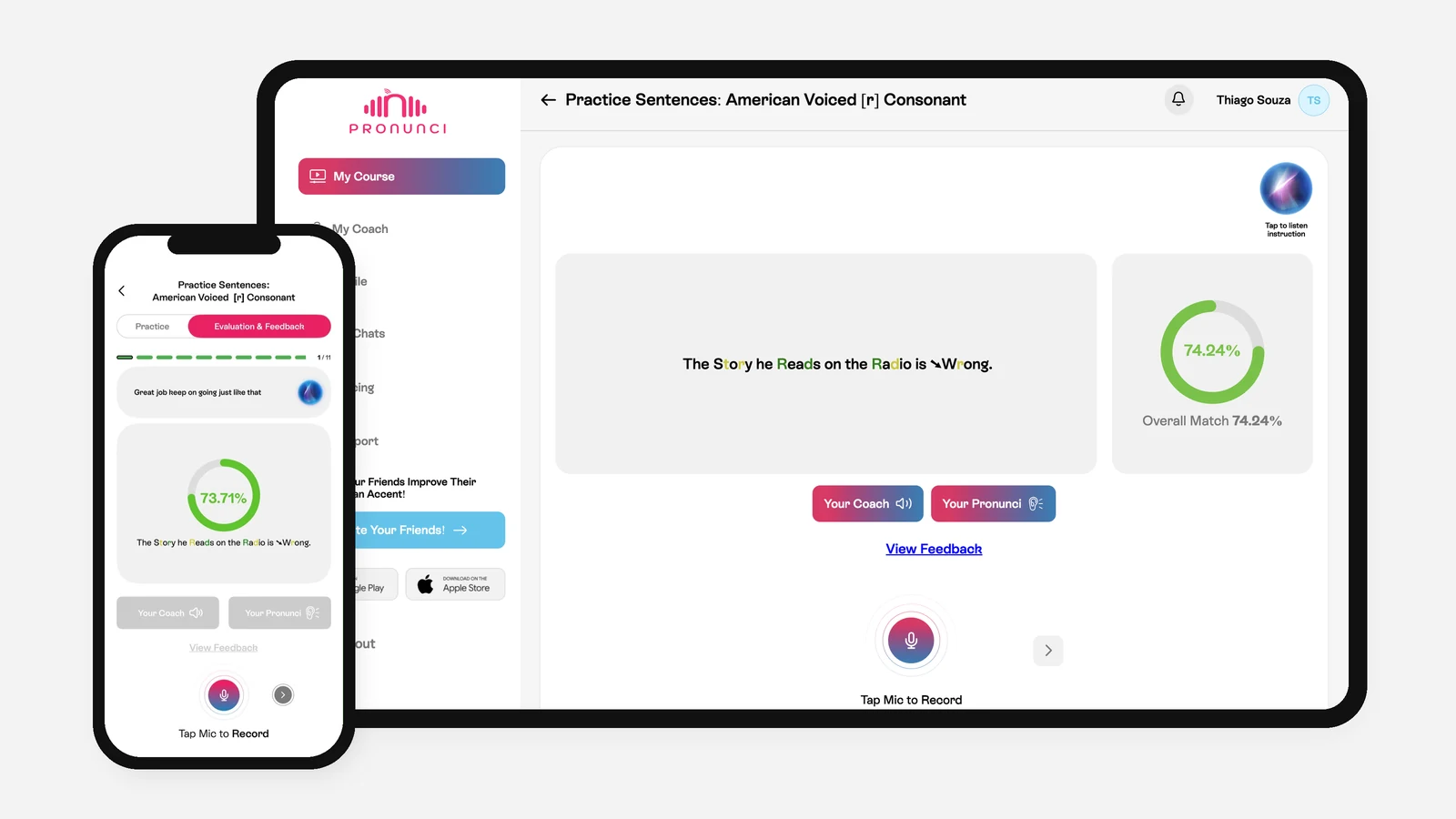
- Listen to Your CoachThe model American pronunciation of each practice sentence.
- Compare with Your PronunciYour own recorded pronunciation, side by side with the coach.
- Correct with feedbackThe match score and color-coded letters guide each correction.
This matters most for people whose job depends on being understood the first time: IT professionals on client calls, healthcare workers speaking with patients, call center agents handling American customers, and job seekers preparing for interviews. For deeper work on how speech flows between words, see our guide on connected speech in natural American English.

Questions & Answers
Frequently Asked Questions
01Does an AI pronunciation trainer replace a human accent coach?
No, an AI pronunciation trainer and a human accent coach serve different purposes, and the two work best together. AI evaluation gives you consistent, immediate feedback every time you practice, which a coach cannot offer in every session. But a coach like Prof. Alex can diagnose why a sound breaks down and personalize training to your native-language patterns. InPronunci’s Premium Plan combines both: full app access plus a monthly 1-on-1 session with Prof. Alex.
02How long does it take to notice improvement with an AI pronunciation trainer?
Improvement timelines vary by person, sound, and practice consistency, so no app can honestly promise a fixed number of weeks. Progress depends on how regularly you train the speech organs and apply new sounds in sentences, not just how long you have used the tool. A structured path, moving from sounds to phonetic exercises to sentences, tends to build habits more reliably than scattered practice.
03Can an AI pronunciation trainer help with accent reduction for people with speech or hearing difficulties?
It can offer supportive, structured articulation practice, but it is not therapy or a diagnostic tool. Training the tongue, lips, and jaw step by step with the Interactive Visual 2D Sound Simulators can reinforce clear speech habits for some learners. Anyone with a diagnosed speech or hearing difficulty should consult a licensed speech-language pathologist or medical professional alongside any app-based practice, including InPronunci.
04Do AI pronunciation trainers work for exam preparation like IELTS or TOEFL speaking?
Yes, AI feedback on pronunciation, intonation, and rhythm supports IELTS and TOEFL speaking preparation when paired with sentence and paragraph-level practice. Exam speaking sections score fluency, stress, and connected speech, not just individual sounds. InPronunci’s paragraph practice stage, with presentation-style delivery, reflects the extended speaking tasks these exams require.
Conclusion
An AI pronunciation trainer earns its place in your practice when it evaluates full speech, not isolated words, and when it sits inside a structured path from sounds to sentences to paragraphs [4]. Start by training the speech organs for the sounds that carry the most weight in your native-language pattern, then build those sounds into stress, rhythm, and connected speech. InPronunci applies this path with Pronunci Instructions, the Interactive Visual 2D Sound Simulators, and AI Accent Coach evaluation in one connected system. Try Free Chapter 1 on the App Store, Google Play, or the web to see how the first stage feels before committing to a plan.
Sources & References
- Accent AI: English Teacher App – App Store
- Is Accent Coaching Worth It? Real Feedback vs AI
- Pronunciation trainer for second language learning using generative AI | International Journal of Educational Technology in Higher Education | Springer Nature Link
Recommended Articles

Why Adults Can Still Learn a Native-Like American Accent
How to reduce a foreign accent as an adult: train each sound consciously, then words, sentences and intonation, with regular feedback.
How to Speak English More Clearly and Be Understood
You speak English more clearly by training the individual sounds, stress, and intonation patterns of American English with deliberate, structured.
Guide to Choosing the Best Pronunciation App Free Option
Explore the best pronunciation app free options for American accent training, what free tiers include, and when a paid plan is worth it. Discover essential.
Plans
What InPronunci costs
InPronunci Basic
$35 per month
Chapter 1 is free after signup.
InPronunci Premium
$200 per month
Includes a coach: