


English is best understood as a stress-timed language, taught and practiced with an eye for the exceptions. That means your first job as a learner is not to pronounce every syllable evenly. It’s to find the stressed content words in a sentence, hit them hard and on time, and let everything else shrink toward a quick, quiet schwa. BBC Learning English and OpenText KU both frame it this way, and so does InPronunci: Accent Training App. Start today: mark the stressed words in one sentence, then shadow it once out loud.
[APPLE_BADGE]
[GOOGLE_BADGE]
What Does Stress Timed English Actually Mean?
Stress-timed rhythm means the beats that matter in an English sentence land on stressed syllables, roughly evenly spaced, while the syllables between them compress to fit. This is the opposite of counting syllables one by one. In stress-timed language English, the interval between one stressed beat and the next tends to feel regular even when the number of syllables between them changes.
Two categories of words behave very differently in this system:
- Content words carry meaning: nouns, main verbs, adjectives, and adverbs. These get stress.
- Function words carry grammar: articles, prepositions, conjunctions, auxiliary verbs. These usually shrink.
That shrinking almost always lands on the schwa, the short, neutral “uh” sound that English uses to swallow unstressed vowels. It’s the reason “to the” sounds like “tub thus” in fast speech, and why “can” (the modal) often reduces to “kn” while “can” (the noun, as in a can of soda) stays full.
Take this sentence, with stressed syllables in bold:
“I want to go to the store.”
Three beats: WANT, GO, STORE. Everything else, “I,” “to,” “to the,” compresses into the gaps. A native speaker doesn’t say each word at equal length. They stretch toward those three peaks and rush past the rest. That rushing isn’t sloppiness. It’s the actual rhythm engine of the language, and it’s why a stress pattern reference built around real speech samples teaches you more than a textbook list of rules ever will.
Stress-Timed vs. Syllable-Timed: What Is Isochrony?
Isochrony is the linguistic term for equal timing between speech units, and English gets sorted into the “stress-timed” bucket of that framework. Spanish and French are usually classified as syllable-timed, where each syllable tends toward roughly equal length regardless of stress. Japanese is often called mora-timed, built around a smaller timing unit than the syllable, the mora, which governs rhythm even more tightly than syllable count does.
Here’s the short version of each model:
- Stress-timed (English, German): time gaps between stressed syllables stay roughly even; unstressed syllables compress.
- Syllable-timed (Spanish, French): syllables tend toward similar duration, stressed or not.
- Mora-timed (Japanese): rhythm is organized around the mora, a sub-syllable timing unit, giving Japanese its clipped, even cadence.
The catch: strict isochrony, meaning perfectly equal intervals you could time with a stopwatch, doesn’t actually survive close acoustic measurement. Research summarized in an NCBI-hosted speech timing study found that real speech shows flexible, context-dependent timing rather than mechanically equal beats. The Isochrony entry on Wikipedia covers the same debate: the three-way model is a durable teaching tool, not a physical law of speech.
That doesn’t make the framework useless. It means you should treat “stress-timed” as a strong tendency and a useful target for practice, not a rule you enforce with a metronome. The feeling of regular stressed beats is what you’re training, even when the underlying acoustics are messier than the theory suggests.
Why Rhythm Errors Hurt Intelligibility
Equal-stress speech isn’t just “a bit different.” It measurably slows down how fast a listener can parse what you’re saying. A Wayne State University honors thesis on rhythm and intelligibility found that when non-native speakers give every syllable equal weight, without reducing the function words, listeners have to work harder to find the words that actually carry meaning. The speech can come across as labored even when every individual sound is pronounced correctly.
This happens because native listeners use stress as a signal. They’re not decoding syllable by syllable; they’re locating the stressed beats first and filling in the rest from context. When every syllable gets equal punch, that shortcut disappears, and the listener’s brain has to do the extra work the rhythm was supposed to do for them.
Common transfer errors show up in predictable ways:
- Full-value function words: pronouncing “for” as “for” instead of the reduced “fer” in casual speech.
- No vowel reduction: saying “photograph” with three equally stressed vowels instead of stressing the first syllable and reducing the rest.
- Syllable-counting habits carried over from a syllable-timed first language, producing flat, machine-gun delivery.
Compare these two readings of the same sentence: “I could’ve told you that” spoken with every word equal sounds stiff and overly formal. Spoken with stress on COULD and TOLD, and “have” “you,” and “that” compressed, it sounds like natural conversation. Neither version is wrong grammatically. Only one sounds like stressed syllables are doing their job.
Pro Tip: Record yourself reading a sentence twice, once hitting every syllable evenly and once exaggerating the stress on content words only. Play both back. The gap you hear is the gap a native listener hears too.
Drills That Build Stress-Timed Rhythm
Rhythm training works best as short, daily repetition rather than occasional long sessions. Here’s a practice sequence built around listening first, then production, that fits into 10 to 20 minutes a day.
Listening tasks:
- Take a short transcript (a news clip or podcast segment) and mark every stressed syllable you hear.
- Play the audio at a slower speed, then gradually return to normal speed, repeating the same line each time.
- Shadow the speaker in real time, matching their stress placement and pauses, not just their words.
Production drills:
- Chunking: break long sentences into 3 to 5 word groups and practice each chunk with one clear stress peak.
- Reduction practice: take a list of function words (to, for, and, of, can, was) and drill the schwa version until it’s automatic.
- Stress tapping: tap a finger or pen on each stressed syllable while reading aloud, forcing your rhythm to organize around beats instead of syllable count.
- Compression and expansion: say a sentence slowly with full stress, then say it again fast, keeping the same number of stress beats even as the unstressed syllables compress.
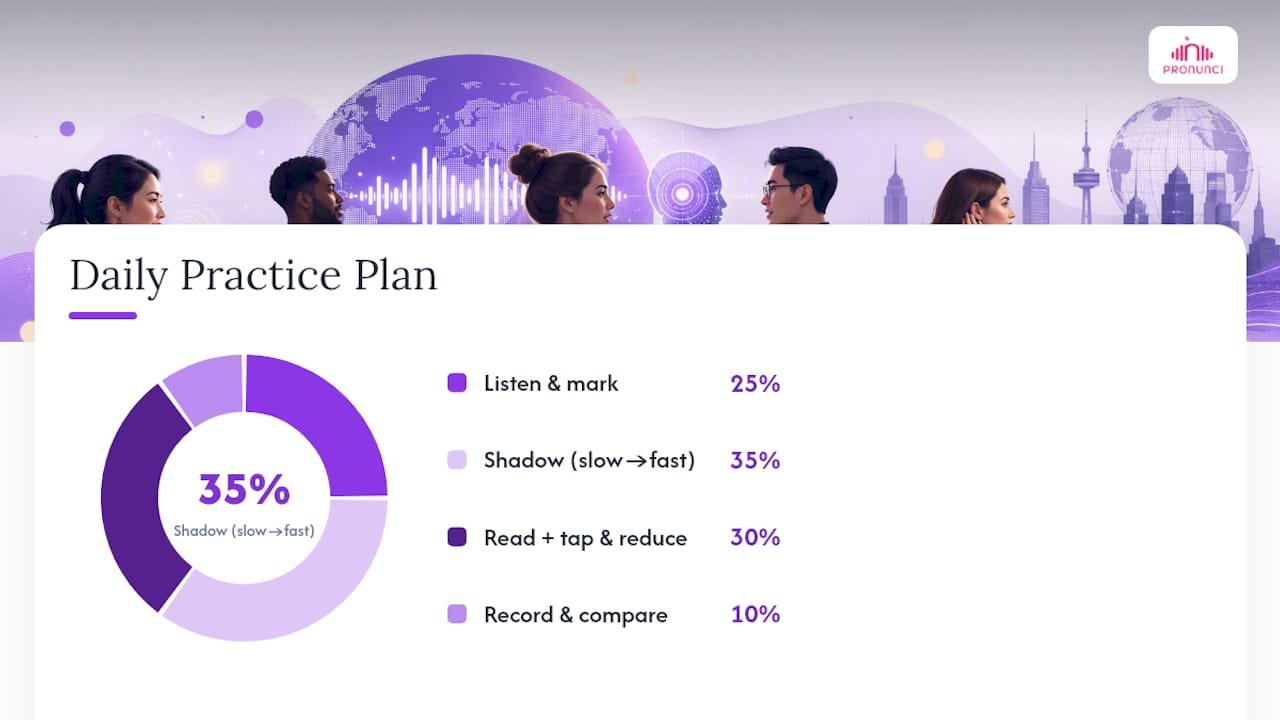
A simple daily plan looks like this:
- Minutes 1 to 5: listen to one short clip, mark the stresses on a transcript.
- Minutes 6 to 12: shadow the same clip three times, slow to fast.
- Minutes 13 to 18: read the transcript aloud, tapping stressed syllables and reducing function words to schwa.
- Minutes 19 to 20: record yourself once and compare against the original.
Progress milestones to watch for: after roughly two weeks of daily practice, you should notice function words shrinking without conscious effort. After a month, native listeners often report that your speech sounds less effortful, even before your accent has fully shifted. The British Council’s TeachingEnglish resource on sentence stress backs this same sequence: mark, imitate, drill, repeat.
Pro Tip: Reduction only becomes automatic in connected speech once you’ve drilled it in isolation first. Practice “going to” as “gonna” and “want to” as “wanna” as standalone chunks before you try to use them inside full sentences at natural speed.
If you want a structured version of this exact sequence with feedback built in, a beginner daily practice plan walks through the same stages with guided audio.
How Prof. Alex and InPronunci Train Rhythm With the 2D Simulator
Prof. Alex, Ph.D. Accent Coach, has spent more than 20 years teaching, researching, and privately coaching American pronunciation, and that experience shaped how InPronunci: Accent Training App approaches rhythm. Stress and reduction aren’t treated as a side note. They sit inside a dedicated Intonation and Emphasis chapter, built to follow the Speech Organs Education and Consonants and Vowels training that comes before it.
The Interactive Visual 2D Sound Simulator trains the speech organs involved in tongue position, jaw movement, and airflow in a repeatable way. That matters directly for rhythm training, because clean reduction to schwa depends on relaxing the mouth quickly between stressed syllables, and you can’t fix what you haven’t trained.
A short guided activity using the [t] sound simulator works like this:
- Watch the
once through without speaking.
- Repeat the isolated sound five times, matching tongue and airflow position.
- Apply it inside a stressed word like “important,” then inside the same word at natural sentence speed.
Learners measure progress through InPronunci’s record-and-compare workflow: My Coach shows the native-speaker model, My Pronunci captures your own recording, and View Feedback highlights where stress placement drifted. That comparison loop, not a one-time score, is what actually moves rhythm forward over weeks of practice.
Cognitive Accent Training
Compare Your Coach vs. Your Pronunci
In every practice sentence, students listen to Your Coach, record their own voice, and compare it with Your Pronunci, so they consciously notice and correct each sound.
![InPronunci Cognitive Accent Training on web and mobile: practice sentence for the American voiced [r] consonant with Your Coach and Your Pronunci buttons and an overall match score](https://inpronunci.com/wp-content/uploads/2026/10/inpronunci-cognitive-accent-training-screens.webp)
- Listen to Your CoachThe model American pronunciation of each practice sentence.
- Compare with Your PronunciYour own recorded pronunciation, side by side with the coach.
- Correct with feedbackThe match score and color-coded letters guide each correction.
How Stress Timing Shapes Sentence Intonation
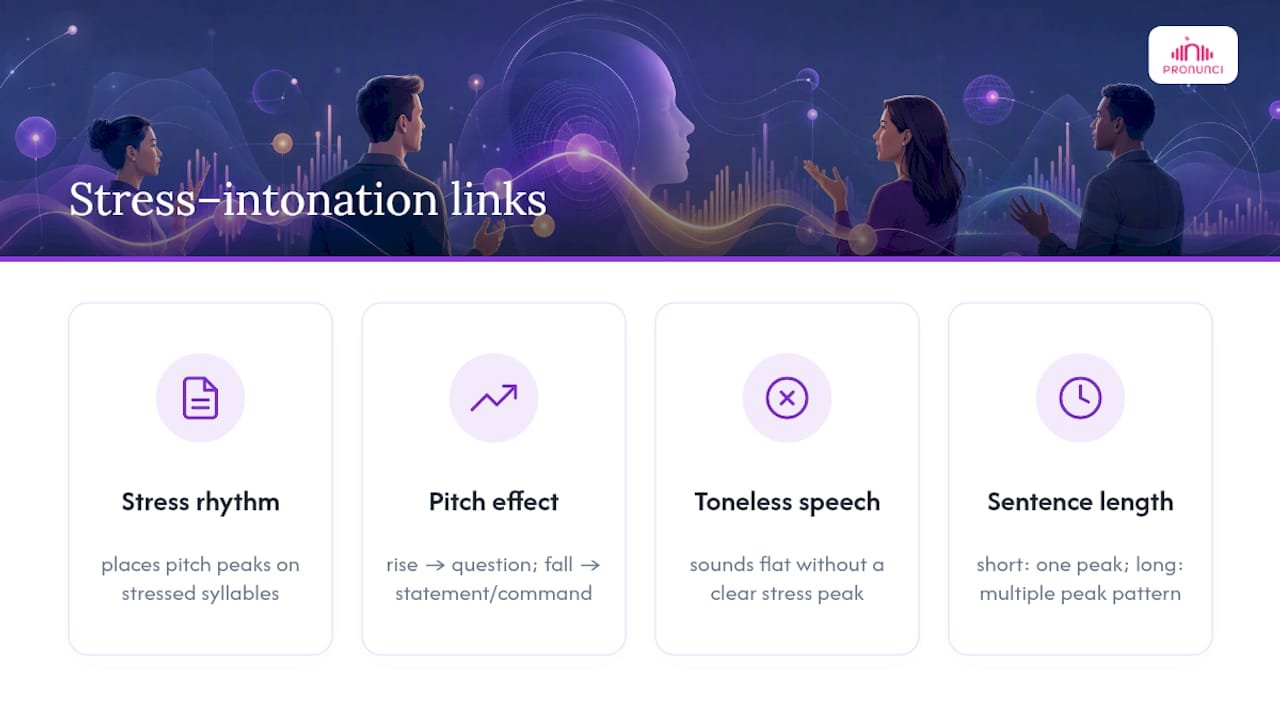
Stress and intonation are two separate systems that work together, and stress-timed rhythm is what gives English intonation its shape. The pitch movement in a sentence, rise, fall, or rise-fall, almost always attaches to a stressed syllable, not a random point in the sentence. That’s why the same words can sound like a statement, a question, or sarcasm depending only on which syllable gets the pitch peak and how sharply it moves.
Take the sentence “You’re going to the meeting.” Stress and rising pitch on “meeting” turns it into a genuine question. Stress and falling pitch on “going” turns it into a firm statement, almost a command. The words never change. Only where the stress-timed rhythm places its peak, and what the pitch does at that peak, changes the meaning a listener takes away.
This is also why toneless, equal-stress speech tends to sound flat or emotionless even when the words are perfectly chosen. Intonation has nowhere to attach if there’s no clear stress peak to carry it. Learners who fix their rhythm first, then layer intonation on top, tend to sound more natural faster than learners who try to memorize intonation patterns in isolation. The rhythm is the scaffolding; the pitch and emphasis sit on top of it.
Sentence length changes the effect too. In a short sentence, one stress peak can carry the entire emotional weight. In a longer sentence with several content words, the peaks form a pattern, and native listeners track that pattern almost automatically to predict where the sentence is headed before it ends.
Does Stress Timing Differ Across English Accents?
Yes, but the underlying stress-timed system stays constant across major English accents. What changes is how sharply the reduction happens and which vowels shift toward schwa. General American speech tends to reduce function words aggressively in casual registers, producing contractions like “gonna,” “wanna,” and “shoulda” as near-standard casual forms. British Received Pronunciation reduces function words too, but often with slightly different vowel qualities in the reduced forms, and with distinct patterns around linking and intrusive sounds between words.
Regional and non-standard varieties add more variation on top of that shared frame. Southern American English, for instance, can stretch vowel length in stressed syllables differently than General American, while still keeping the same basic stress-timed skeleton underneath. Scottish and Irish varieties of English show their own reduction habits, often influenced by regional syllable patterns that resist full schwa reduction in certain words.
For learners, the practical takeaway is this: don’t chase a specific regional accent’s reduction habits before you’ve locked in the basic stress-timed mechanism itself. Get comfortable finding stressed content words and reducing function words in any English variety first. Once that foundation holds, adjusting toward a specific accent, General American included, becomes a matter of fine-tuning vowel quality and a handful of connected-speech habits, not relearning the rhythm system from scratch.
Making Stress Timing Part of Your Daily English
Rhythm training sticks best when it rides on activities you’re already doing, rather than sitting in a separate study block you have to remember to open. The habit that compounds fastest is narrating your own day out loud for 60 seconds, in the shower, on a commute, at your desk, exaggerating stress on the content words as you go.
A few low-effort ways to fold practice into daily use:
- Read one paragraph aloud from anything you’re already reading (email, an article, a text message) and mark the stress before you speak.
- Repeat one line from a show or podcast you watch anyway, matching the speaker’s stress and pacing exactly.
- Narrate simple tasks, “I’m MAKing COFfee,” stressing only the content words as you go about your morning.
The Mastering American English Rhythm guide breaks this same habit-stacking approach down further, with specific listening sources matched to different proficiency levels. If you’re building rhythm awareness alongside another language, the general principle holds across languages too: the timed practice methods used for building fluency in Korean rely on the same short, repeated, timed drills that work for English rhythm, just applied to a different timing system.
The goal isn’t perfection in week one. It’s making stress placement a reflex you don’t have to think about before you speak, which only happens through repetition inside real, low-stakes moments, not isolated drill sessions alone.
A Coach’s Perspective on Realistic Progress
Most motivated learners notice a real shift in their rhythm within a few weeks of daily practice, and a more settled change after a couple of months, depending on how consistently they drill. Progress isn’t mysterious to test. Ask a native speaker if a recorded sentence sounds natural, compare your own recording against a model version, or time yourself tapping stressed syllables in a paragraph and check whether the gaps between taps stay even. Those three checks tell you more than any app score. Keep practicing daily, in short bursts, and trust the compounding.
— Prof. Alex, Ph.D. Accent Coach
Build Stress-Timed Rhythm With Guided Practice
Reading about stress-timed rhythm gets you halfway there. Turning it into a reflex takes guided repetition with real feedback on where your stress placement drifts, which is exactly the gap InPronunci: Accent Training App is built to close. The Intonation and Emphasis chapter picks up directly where this article leaves off, pairing the Interactive Visual 2D Sound Simulator with the record-and-compare workflow so you can catch your own reduction habits, not just guess at them.
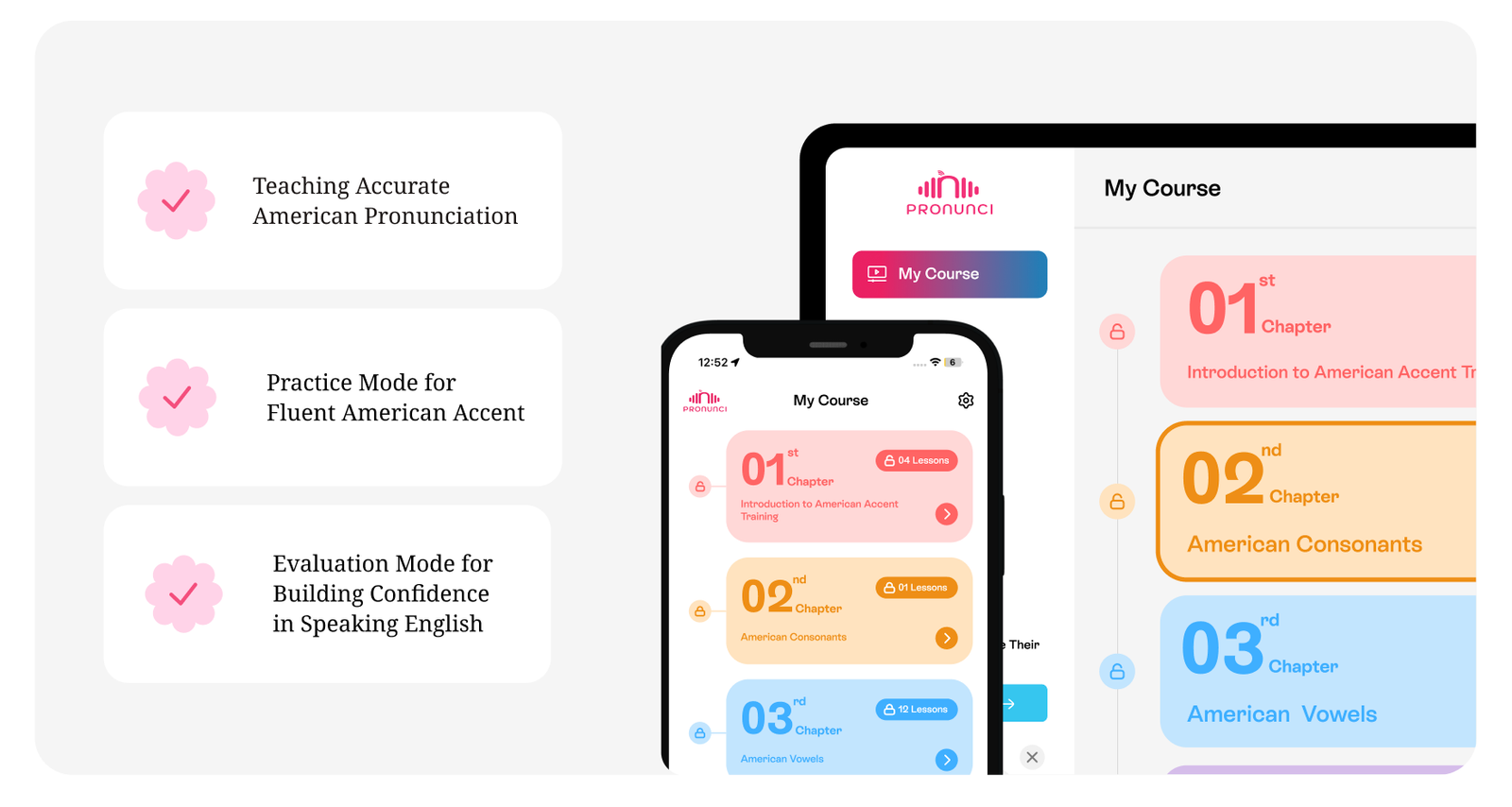
Every learner starts with a free onboarding chapter before choosing a monthly or annual subscription, with optional one-on-one coaching for learners who want direct feedback from a human coach alongside the AI Accent Coach. The InPronunci American Accent Training Course
walks through Speech Organs Education, Consonants, Vowels, and Intonation and Emphasis in sequence, the same order this article followed. If you’re ready to move from theory to a measurable plan, the step-by-step 2026 training guide is the clearest place to start, or download the app directly to begin your free onboarding chapter today.
Sources
- Syllable stress in words — OpenText KU
- Why stress plays an important role in English pronunciation — BBC Learning English
- Honors thesis on rhythm and intelligibility — Wayne State University
- PMC article on speech timing and rhythm — NCBI
How first languages change English rhythm and intonation
| First language | Common pattern |
|---|---|
| Indian English speakers | English is often syllable-timed, with every syllable getting equal weight, and stressed syllables can be said lower in pitch instead of higher. |
| Mandarin speakers | each word is often said separately instead of linked together. |
| Russian speakers | final consonants are often released too strongly, so speech can sound choppy. |
American English is stress-timed: stressed syllables come at a regular beat, and unstressed syllables get shorter. Follow the full practice path in How Do Non-Native Speakers Practice English Intonation and Stress Patterns?
Sources: Wikipedia: Indian English, San Diego Voice and Accent, Wikipedia: Non-native pronunciations of English
Questions & Answers
FAQ
01Is English Stress-Timed or Syllable-Timed?
English is classified as stress-timed, meaning rhythm is organized around roughly even intervals between stressed syllables, with unstressed syllables reduced or shortened, as described by OpenText KU.
02Can You Give an Example of a Stress-Timed Language?
English and German are standard examples of stress-timed languages, where content words carry the main stress and function words compress toward schwa to keep the rhythm even.
03Is Japanese Stress-Timed or Syllable-Timed?
Japanese is typically classified as mora-timed, a related but distinct model where rhythm is organized around the mora, a timing unit smaller than a full syllable.
04Is Spanish Syllable-Timed or Stress-Timed?
Spanish is generally classified as syllable-timed, since its syllables tend toward similar duration regardless of stress, unlike the uneven compression found in stress-timed English.
05How Long Does It Take to Sound More Stress-Timed in English?
Most learners notice a rhythm shift within two to four weeks of daily practice, with more settled progress by two to three months, depending on how much you drill through structured programs like InPronunci.
Recommended
American Accent Training for Beginners: Daily Practice Plan
A structured daily practice plan for American accent training — designed by Prof. Alex., Ph.D. Learn the sounds, stress, rhythm, and connected speech patterns that matter

Stress in Phrasal Verbs: InPronunci: Accent Training App Guide
Mastering stress in phrasal verbs enhances your English fluency. Learn the key techniques to improve your spoken communication today!

Stress and Emphasis in English Pitches — InPronunci: Accent Training App
Practice American intonation, stress and emphasis for ESL speaking, listening, TOEFL, IELTS, English pronunciation and American accent training.
Plans
What InPronunci costs
InPronunci Basic
$35 per month
Chapter 1 is free after signup.
InPronunci Premium
$200 per month
Includes a coach: