


Vowel precision, stress and rhythm, non-native intonation, and reduced connected speech are the four accent barriers that most consistently block promotion readiness. Research confirms that accent bias in hiring produces a measurable disadvantage for non-standard-accented candidates, and the same dynamics play out in promotion decisions. Your fastest next step: record a 90-second work pitch today, listen back for where stress falls and whether your key words land clearly, then run it through structured feedback within 72 hours.
The top barriers, at a glance:
- Vowel and consonant precision (segmental): unclear keywords cause listeners to miss your point
- Word and sentence stress (suprasegmental): weak stress makes messages sound uncertain
- Rhythm and connected speech: choppy delivery reduces perceived fluency and authority
- Intonation patterns: non-native rising or flat intonation signals reduced confidence to listeners
Pro Tip: Don’t start with isolated sound drills. Start with a real work sentence you say every day, and notice where your stress and rhythm break down first. That’s your highest-priority fix.
What accent barriers actually are and why they block your promotion
Accent barriers fall into two categories. Segmental features are individual sounds: vowels and consonants. Suprasegmental features are the patterns that run across words and sentences: stress, rhythm, intonation, and connected speech. Both matter, but suprasegmental errors tend to create stronger negative impressions in professional settings because they affect how confident and authoritative you sound, not just how clear you are.

The research framing here matters. Academic reviews describe accent bias as epistemic injustice, a process where listeners unconsciously discount the ideas of non-native speakers despite their actual competence. Your proposal doesn’t get evaluated on its merits alone; the way you sound shapes how much weight it receives.
LinkedIn ranks communication as the top skill for career growth, and employer inclusion guides specifically call for auditing promotion processes for voice-based bias. Both signals point the same direction: improving how you sound is a career investment with a direct return.
The specific barriers you’ll face in meetings, interviews, and presentations
Accent-related difficulties don’t show up uniformly. They cluster in high-stakes moments where promotion decisions get made.
| Barrier | Workplace scenario | Listener reaction |
|---|---|---|
| Vowel mergers (e.g., bit/beat, pen/pan) | Client pitch, interview panel | Listener misses key terms, asks for repetition |
| Weak word stress | Presenting a recommendation | Message sounds tentative, idea loses weight |
| Flat or rising intonation | Leading a meeting | Speaker perceived as less authoritative |
| Reduced connected speech | Networking, one-on-ones | Listener struggles to follow; disengages |
| Consonant cluster reduction | Phone calls, rapid exchanges | Words blur; listener fills in wrong meaning |
A meta-analysis of accent bias in interviews found that standard-accented candidates were rated more hireable with an effect size of d = 0.47, and the bias was strongest for high-communication roles. That’s the category most promotions fall into. Critically, the same research found that objective comprehensibility was not the main driver; perceived social status and “otherness” were. Fixing only your vowels isn’t enough if your prosody still signals non-native patterns.
Foreign-accented managers report less access to mentoring and networking, which compounds the promotion gap over time.
Quick self-assessment: is your accent limiting your promotion readiness?
Check each item that applies to your experience in the last three months:
- A colleague repeated or rephrased what you said in a meeting before others responded.
- You were asked to repeat yourself more than once during a presentation or call.
- You hesitated to speak up in a high-stakes meeting because you weren’t sure how you’d sound.
- Your manager or a peer commented on your “communication style” without being specific.
- You felt your idea was overlooked, then heard a colleague say essentially the same thing and get credit.
- You avoided a networking event, panel, or mentorship conversation because of speaking anxiety.
- You received positive feedback on your written work but not on your spoken contributions.
Scoring: 0–1 checks: accent barriers are likely minor. 2–3: targeted prosody work will help. 4 or more: structured training with real-time feedback is the right next step.
Pro Tip: Use the English accent diagnostic to get a scored baseline before you start any practice plan. Knowing exactly which features need work saves weeks of unfocused drilling.
Evidence-based ways to fix each barrier: what to practice and why it works
Targeted practice beats general repetition. Here’s what the evidence supports for each barrier type:
| Barrier | Practice method | Frequency | What to measure |
|---|---|---|---|
| Vowel/consonant precision | Minimal pair drills with recording + native comparison | Daily, 10 min | Listener identification accuracy |
| Word stress | Stress-marking on scripts; read aloud with exaggerated stress | Daily, 10 min | Correct stress placement per sentence |
| Sentence rhythm | Chunking sentences into stress groups; shadowing native speech | 5x/week | Rhythm match score vs. native model |
| Intonation | Pitch contour mapping on real work sentences | 3x/week, 10 min | Rising vs. falling pattern accuracy |
| Connected speech | Linking and reduction drills on work phrases | Daily, 10 min | Fluency rating on recorded samples |
Listeners often conflate accentedness with reduced competence even when objective intelligibility is high. That’s why prosody work, not just sound correction, is the higher-leverage fix for promotion readiness. Structured communication training is directly linked to leadership visibility and faster career progression.
Pro Tip:*Pairing immediate AI feedback with speech-organ training accelerates motor learning. When you can see exactly how a sound is produced and hear your own attempt compared to a native model, your brain corrects faster than with audio alone. Inpronunci’s
InPronunci training structure
How InPronunci trains the American speech system
InPronunci trains the full American speech system: Interactive Visual 2D Sound Simulators and phonetic exercises for articulation and American sound development, sentence practice for intonation, melody, rhythm, and connected speech, paragraph practice for spontaneous speech, public speaking, and real communication confidence, and Advanced AI Accent Coach evaluation as you speak.
InPronunci is an advanced, linguistically structured American accent training platform with more than 1,000 downloads and a growing learner base. It is designed for serious ESL learners who want American pronunciation, stronger intonation, more natural rhythm, better connected speech, and the ability to speak English more confidently in real communication. The program is especially useful for intermediate and advanced English speakers who want to become independent speakers of English with confident communication, stronger speaking control, long-term speech improvement, and great public speaking skills. It is also designed for advanced speakers whose goal is to speak like a native or closer to native-like American speech, including people who were raised in the United States but still have slight accent patterns from the native language they were born with. It is a complete American accent training course and system created by Prof. Alex, Ph.D. Accent Coach, Doctor of Education, and professional linguist based in Austin, Texas, with Pronunci Instructions from Prof. Alex for each lesson that make self-learning more effective, supported, and clear.
does exactly this.*
Why structured training shortens the path to promotion readiness
Three components work together in a structured training model, and each one does something the others can’t.
2D Sound Motion Technology trains the movement of your tongue, lips, jaw, and airflow for every American sound. Most learners have never seen what their mouth should actually do. Training with a 2D simulator removes the guesswork that makes “repeat after me” methods so slow.
AI Accent Coach gives you real-time feedback on pronunciation, intonation, rhythm, and connected speech as you speak. You don’t wait for a weekly session to find out you’ve been practicing a pattern incorrectly.
Human-guided instruction replicates working with a real coach: it tells you what to focus on, how to position your speech organs, and how to know you’re on the right track.
Professionals who commit to focused daily practice typically notice measurable clarity gains within a few weeks. The structured training benefits for ESL professionals are well-documented: the combination of visual feedback, AI scoring, and coached review produces faster progress than any single method alone.
Inpronunci offers three entry points: Free Chapter 1 (“Get to Know Your Speech Organs”) gives you the foundation at no cost. The Basic Plan is self-study guided by the AI Accent Coach and human-guided instructions. The Premium Plan adds monthly 1-on-1 sessions with Prof. Alex, Ph.D. Accent Coach
A concrete 30/60/90-day plan to get promotion-ready
Days 1–30: Foundation
- Complete Free Chapter 1 and establish your speech-organ baseline.
- Run the accent diagnostic and identify your top three barriers.
- Practice daily: 10 minutes of segmental drills (vowels and consonants) plus 10 minutes of stress and rhythm work.
- Record one work sentence per day; compare to the native model.
Milestone: You can identify your own stress errors on playback without prompting.
Days 31–60: Prosody and connected speech
- Shift focus to intonation and connected speech drills using real work scripts (meeting openers, recommendation statements).
- Add shadowing practice 3x per week with a timed native-speaker excerpt.
- Record a 90-second mock presentation weekly; score it for stress accuracy and filler-word count.
- Premium members: schedule your first 1-on-1 session to review progress and adjust focus.
Milestone: Filler words drop noticeably; stress patterns on key sentences are consistent.
Days 61–90: Leadership language and real-world application
- Practice full meeting scenarios: preview, main point, summary structure.
- Record a mock promotion conversation or performance review; evaluate intonation and authority markers.
- Ask your manager for specific feedback on your spoken contributions in one meeting.
- Present your progress data (recordings, AI scores) as evidence of development.
| Phase | Daily time | Focus | Measurable outcome |
|---|---|---|---|
| Days 1–30 | 20 min | Segmental + stress | Self-identify stress errors |
| Days 31–60 | — | Prosody + connected speech | Fewer fillers; consistent stress |
| Days 61–90 | 30 min | Leadership language + scenarios | Promotion-ready delivery on record |
How to use improved speech to reduce accent bias and show promotion readiness
Improved clarity only pays off if decision-makers notice it. These behaviors make your progress visible.
In meetings: Use a preview-main-point-summary structure for every contribution. “I want to flag three things. First… Second… Third… My recommendation is…” This structure signals leadership thinking and gives your improved stress patterns a clear frame to land in.
When asking for feedback: Request it specifically. “I’ve been working on my spoken delivery in presentations. Could you tell me one thing that landed well and one thing I could sharpen?” That framing invites honest input without positioning you as apologizing for your accent.
When asking for sponsorship: “I’ve been preparing for a senior role. I’d value your perspective on where my communication in [specific context] is promotion-ready and where it needs more work.” Specific, confident, and forward-looking.
Your accent is part of your identity, and clarity work doesn’t mean erasing it. The goal is ensuring your ideas are evaluated on their merit. Accent reduction for professionals works best when it targets the features that create listener friction, not every trace of your native language’s influence. Preserving your voice while sharpening your prosody is both possible and the right approach.
Accent barriers that affect promotion readiness are mostly suprasegmental: stress, rhythm, and intonation create stronger listener bias than individual sounds alone.
What I’ve seen working with professionals on promotion readiness
Most professionals who come to accent training are already competent communicators. Their ideas are strong. Their written work is clear. What holds them back is a narrow set of prosodic patterns that signal “non-native” to listeners before the content even registers. Early investment in stress and intonation work, not just sound correction, is what moves the needle fastest. I’ve seen this pattern repeatedly: a professional who spends six weeks on prosody alone, with real-time feedback and articulatory training, changes how they’re perceived in meetings more than someone who spent a year on isolated vowel drills. Cultural identity is not the obstacle. Your accent carries your history, and that’s worth keeping. What structured training does is give you the tools to ensure your ideas get the hearing they deserve. Free Chapter 1 is the lowest-commitment way to find out exactly where your speech stands and what to work on first.
Inpronunci gives you a structured path from accent barriers to promotion readiness
If the self-assessment above flagged three or more items, you’re not dealing with a minor polish issue. You’re dealing with a pattern that structured training can fix, and Inpronunci is built for exactly this situation.
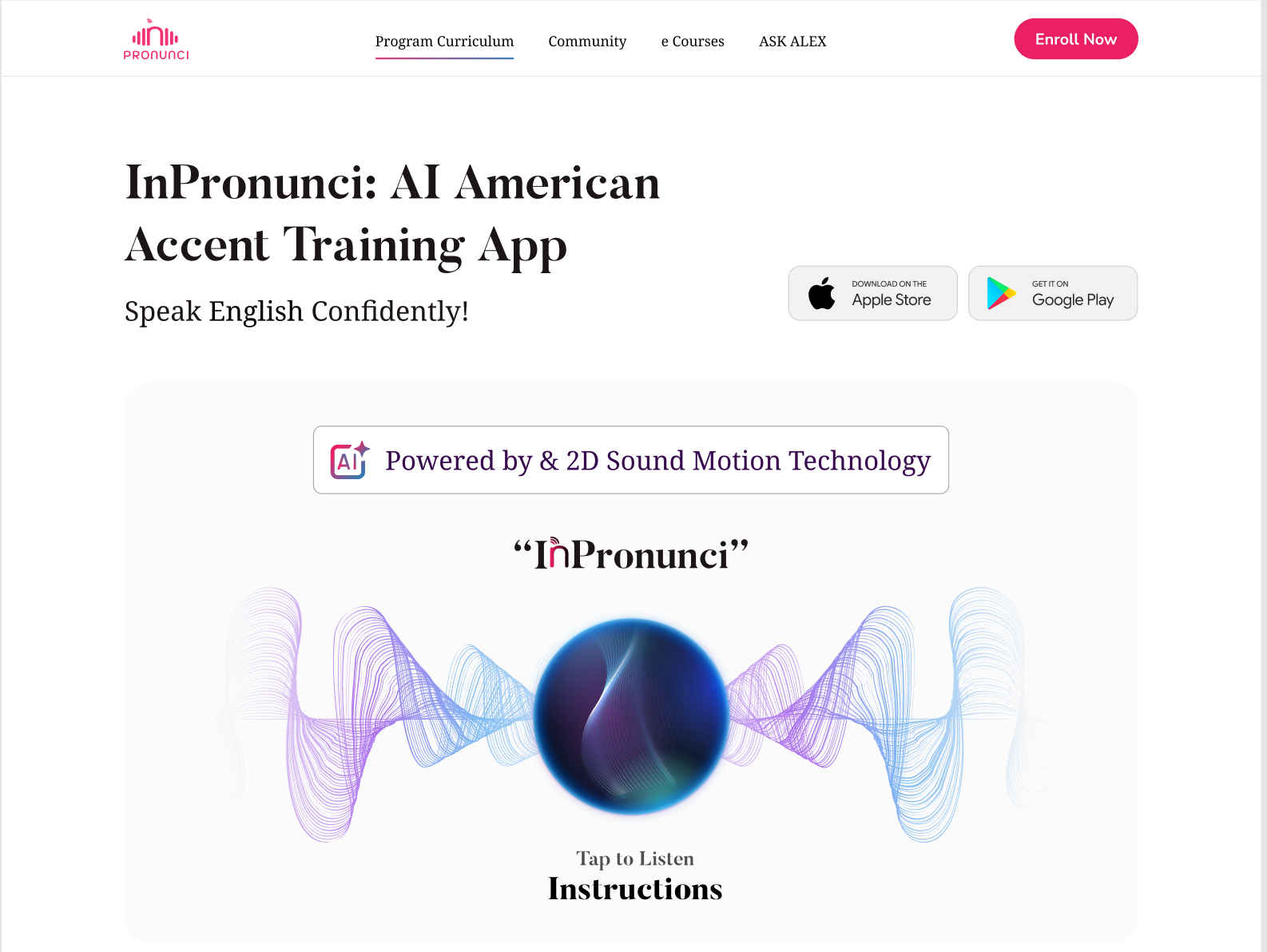
The course combines 2D Sound Motion Technology (Interactive Visual 2D Sound Simulators that train the speech organs), an AI Accent Coach with real-time feedback, and human-guided instructions that work like a real coach. Students like Andrew, Thiago, and Tian have documented measurable progress in clarity and confidence. Free Chapter 1 is available at no cost and takes about 20 minutes to complete. The Basic Plan gives you full self-study access guided by AI and human instruction. The Premium Plan adds monthly 1-on-1 sessions with Prof. Alex, Ph.D. Accent Coach, plus personalized progress tracking you can show your manager.
Sign up and start Free Chapter 1 or book a free Premium session to get a personalized assessment of your promotion-readiness barriers.
Useful sources and further reading
Key research used in this article:
- Meta-analysis of accent bias in employee interviews — quantifies hiring and promotion bias by accent type
- Accent bias as epistemic injustice — academic framing of how accent affects idea evaluation
- Effect of race and foreign accent on managers’ career progression — workplace mentoring and networking access data
- Browne Jacobson employer inclusion guide — organizational audit and individual feedback strategies
- Harvard Business Review: the accent penalty — how accent shapes whose ideas gain traction
Inpronunci learning resources:
- Start Free Chapter 1 — “Get to Know Your Speech Organs,” no cost, no commitment
- English accent diagnostic — scored baseline for your priority barriers
- Strategic guide to American accent training — full curriculum overview for professionals
- Student results: Andrew · Thiago · Tian
For a comparative look at how suprasegmental training applies across languages, this guide to accent in Japanese offers useful perspective on pitch and stress systems.
More than mechanics: InPronunci doesn’t teach only the mechanics of sounds. It teaches students how to become confident, fluent English speakers through a step-by-step system. Training may begin with how each American sound is made. Then it moves into sound combinations, sound contractions, phonetic exercises, practice sentences, and paragraphs in real rapid speech, so students start speaking English fluently and comfortably.
Questions & Answers
FAQ
01What are the most common accent barriers that block promotions?
The most common barriers are weak word stress, non-native intonation, reduced connected speech, and vowel imprecision. Research shows these suprasegmental features drive listener perception of competence more than individual sound errors.
02How long does it take to see results from accent training?
Professionals who practice with targeted drills and real-time feedback typically see measurable clarity gains within 4–8 weeks. Consistent daily practice of 20–30 minutes accelerates the timeline.
03Does accent bias really affect promotion decisions?
A meta-analysis found a consistent bias favoring standard-accented candidates (d = 0.47), strongest in high-communication roles. The same patterns apply in promotion contexts.
04Can I improve my accent without losing my cultural identity?
Yes. Targeted training focuses on the prosodic features that create listener friction, not on erasing your native language’s influence. Clarity and cultural identity are not in conflict.
05How does Inpronunci support promotion readiness specifically?
Inpronunci’s curriculum covers stress, rhythm, intonation, and connected speech alongside individual sounds, with AI real-time feedback and optional 1-on-1 coaching with Prof. Alex, Ph.D. Accent Coach The pronunciation coaching for career growth program is designed for professionals preparing for leadership roles.
Recommended

Why Pronunciation Training Improves Promotion Chances | Inpronunci
Discover why pronunciation training improves promotion chances. Enhance clarity, boost confidence, and unlock your leadership potential.

Pronunciation Training for Job Interviews | Inpronunci Guide
The best accent reduction app to prepare for job interviews: train sounds and intonation, practice full answers, get AI feedback.
Phoneme Awareness in Accent Training: Inpronunci’s Guide
Discover the role of phoneme awareness in accent training. Inpronunci's guide reveals how it improves American English pronunciation for lasting progress.
Plans
What InPronunci costs
InPronunci Basic
$35 per month
Chapter 1 is free after signup.
InPronunci Premium
$200 per month
Includes a coach:
Why InPronunci is worth the price
- Interactive Visual 2D Sound Simulators, built on 2D Sound Motion Technology developed by Prof. Alex, train your speech organs for each American sound.
- Prof. Alex's guided instructions in every lesson, like working with a real coach.
- The Advanced AI Accent Coach evaluates sounds, intonation, rhythm, stress, and connected speech against native American English speech (100 = native speaker).