


By Prof. Alex, Ph.D. Accent Coach
American English word stress works through three physical features: loudness, duration, and pitch. The stressed syllable is louder, longer, and higher in pitch than the syllables around it. Unstressed syllables shrink and often reduce to a schwa sound [ə]. Together, these create the characteristic stress-timed rhythm of American English, where stressed syllables fall at roughly regular intervals regardless of how many unstressed syllables sit between them.
Here are the core American English stress patterns examples across word classes:
- Nouns: TA-ble, WIN-ter, MON-ey, AP-ple (stress on first syllable)
- Adjectives: HAP-py, CLEV-er, SLEN-der, PRES-ent (stress on first syllable)
- Verbs: re-LAX, be-GIN, de-CIDE, ar-RIVE (stress on second syllable)
- Three-syllable words: PHO-to-graph, COM-pen-sate, VO-cab-u-lar-y
Getting stress placement right is not optional for clear American speech. Misplaced stress makes words harder to recognize, even when every sound is correct.
How stress placement works across different syllable counts
Stress rules in American English follow patterns tied to syllable count and word class. Two-syllable nouns and adjectives almost always stress the first syllable. Two-syllable verbs typically stress the second.
Two-syllable nouns and adjectives (first syllable stressed):
- TA-ble, WIN-ter, HU-man, JACKet
- HAP-py, CLEV-er, PRES-ent, SLEN-der
Two-syllable verbs (second syllable stressed):
- re-LAX, be-GIN, de-CIDE, ex-PLAIN, ar-RIVE
Exceptions worth knowing: Some two-syllable verbs stress the first syllable: AN-swer, STU-dy, O-pen, VIS-it. These do not follow the general rule, so they need to be learned individually.
Three-syllable words follow suffix-based rules more than syllable-count rules. The word PHO-to-graph stresses the first syllable. Add a suffix and the stress shifts: pho-TO-gra-pher moves stress to the second syllable. The suffix drives the change, not the syllable count alone.

What primary, secondary, and weak stress actually sound like
American English uses three stress levels within words: primary, secondary, and weak (unstressed). Understanding all three is what separates natural-sounding speech from robotic delivery.
Primary stress is the most prominent syllable in a word. It is louder, longer, and higher in pitch than anything else in that word.
Secondary stress is less prominent than primary but still clearly above the unstressed level. It appears mainly in longer words and compounds.
Weak/unstressed syllables reduce their vowel to a schwa [ə]. The word banana illustrates this perfectly: [bə-NÆ-nə]. Both the first and last syllables reduce to schwa, while the middle syllable carries primary stress.
The word understand shows all three levels at once:
- UN (secondary) + der (unstressed) + STAND (primary)
Similarly, absolutely carries the pattern: AB (secondary) + sə (unstressed) + LUTE (primary) + ly (unstressed). Learners who only practice primary stress miss the secondary layer entirely, and that gap is audible to native listeners.
How suffixes and compound words shift stress placement
Suffixes reliably move stress to a predictable position relative to the suffix ending. Learning these rules lets you handle new vocabulary without guessing.
Suffixes that pull stress to the syllable immediately before them:
- -tion / -sion / -cian: mo-ti-VA-tion, de-CI-sion, e-lec-TRI-cian
- -ic / -ical: e-LEC-tric, pro-ble-MA-tic, me-THOD-i-cal
Suffixes that pull stress two syllables before them:
- -cy / -ty / -phy / -gy: de-MOC-ra-cy, pho-TOG-ra-phy, ge-OL-o-gy
- -ate / -ary / -ize: COM-pen-sate, VO-cab-u-lar-y, EM-pha-size
Compound words follow their own set of rules. Compound nouns stress the first element, compound verbs and adjectives stress the second:
- Compound nouns: BLACK-bird, GREEN-house, SCHOOL-boy, NOTE-book
- Compound verbs: un-der-STAND, o-ver-FLOW
- Compound adjectives: bad-TEM-pered, old-FASH-ioned
A critical detail for longer derived words: when you add a suffix to a base word, the base word’s original stress is retained alongside the new stress position. Because it is as-SIM-i-late, the derived form becomes as-SIM-i-LA-tion, carrying both stresses. The same logic applies to con-SID-er becoming con-SID-er-A-tion, and i-DEN-ti-fy becoming i-DEN-ti-fi-CA-tion.
Exceptions and stress shifts that change meaning
Some of the most important American English stress patterns examples involve words that change meaning entirely based on which syllable you stress. These noun/verb pairs are common in professional and academic speech.
| Word | As a noun/adjective | As a verb |
|---|---|---|
| record | RE-cord | re-CORD |
| present | PRE-sent | pre-SENT |
| contract | CON-tract | con-TRACT |
| produce | PRO-duce | pro-DUCE |
| object | OB-ject | ob-JECT |
| insult | IN-sult | in-SULT |
The pattern holds broadly: nouns and adjectives stress the first syllable, while the related verb stresses the second. Saying “I need to RE-cord this” instead of “I need to re-CORD this” signals a different word class to the listener, and the confusion is immediate.
Native speakers also vary on a handful of words. Television is one example: some speakers say te-le-VI-sion, others say TE-le-vi-sion. Controversy splits similarly between CON-tro-ver-sy and con-TROV-er-sy. These variations are real and acceptable, but they are the exception rather than the rule.
Practical tips for mastering stress patterns
Active listening is the fastest way to build stress intuition. When you hear a new word, focus specifically on which syllable is louder and longer before you try to say it yourself.
- Practice word families. Move through CON-cept, con-CEP-tu-al, and con-cep-tu-al-i-ZA-tion in sequence. Hearing the stress shift across the family trains your ear and your automatic speech habits simultaneously.
- Use CELPIP practice tasks to expose yourself to academic and professional vocabulary in context, where stress patterns appear naturally in connected speech.
- Record yourself. Compare your stress placement against a native speaker recording of the same word. The difference is often clearer when you hear it played back.
- Work on secondary stress in longer words. Saying in-ter-pre-TA-tion with only one stress point sounds flat. The full pattern is in-TER-pre-TA-tion, with secondary stress on the second syllable.

Pro Tip: Use minimal pair stress drills to sharpen meaning distinctions. Practice saying “I signed the CON-tract” versus “Muscles con-TRACT” back to back. The physical contrast between the two stress positions becomes automatic faster than any rule memorization.
Inside the InPronunci App
How InPronunci Trains American Intonation
Learn American pitch patterns through professional Pronunci Instructions, active speech training, interactive audio practice, and cognitive pronunciation evaluation.
Learn American Intonation with Prof. Alex’s Pronunci Instructions
For more than 20 years, I have worked with English learners to develop their American pronunciation, intonation, rhythm, and speech patterns.
Through my teaching experience, I have learned that students need more than examples to imitate. They need to understand what they are training, how the pitch moves, and how to actively practice that movement in their speech.
That is why I developed the InPronunci Intonation chapter as a structured training experience supported by my Pronunci Instructions.
These instructions guide students through American intonation patterns, explain what to focus on during practice, and help them develop greater control over sentence melody, stress, and rhythm.
Prof. AlexPh.D. Accent Coach, Doctor of Education, and professional linguist
Understand the pattern. Actively train the movement. Develop control over your intonation.
Explore Four American Intonation Patterns
American English uses different pitch movements to communicate meaning, emphasis, certainty, questions, and attitudes.
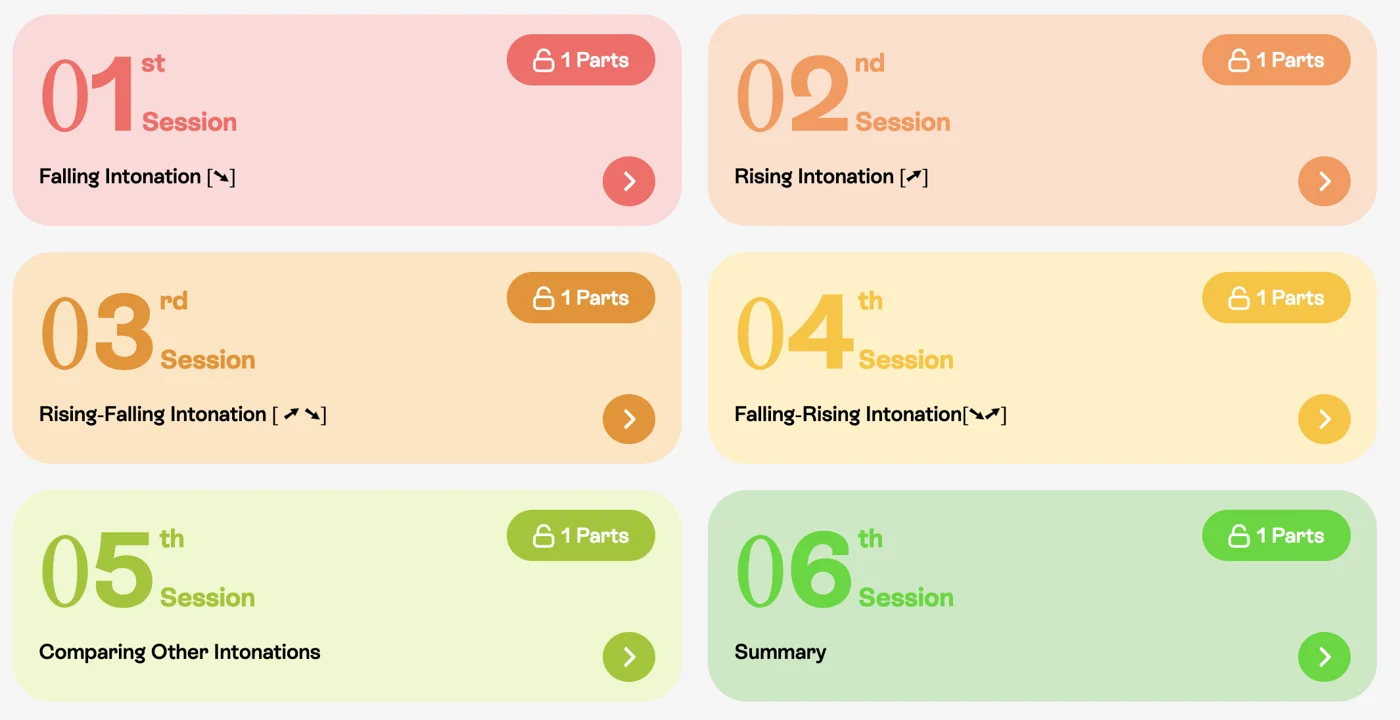
The InPronunci Intonation chapter organizes these movements into four main patterns taught across six sessions, with practice covering 15 sentence types.
Explore the patterns below, listen to the original American pronunciation examples, and actively practice the pitch movements.
The pitch moves downward. Common in statements, commands, and many wh-questions.
The pitch moves upward. Common in yes/no questions, confirmation requests, and some continuation patterns.
The pitch rises and then falls, often adding strong emphasis or expressive meaning.
The pitch falls and then rises, often conveying reservation, uncertainty, or implied meaning.
-
01Statements ↘I’m going to the ↘store.
-
02Wh-questions ↘What ↘time is it?
-
03Commands ↘Close the ↘door.
-
04Exclamations ↘What a great ↘idea!
-
05Yes/no questions ↗Are you ↗ready?
-
06Statement as a question ↗You’re coming ↗tonight?
-
07Echo questions ↗You said ↗Tuesday?
-
08Tag question, real question ↗It’s open, ↗isn’t it?
-
09Tag question, expecting agreement ↘It’s a nice day, ↘isn’t it?
-
10Lists ↗ … ↘↗Apples, ↗bananas, and ↘grapes.
-
11Choice questions ↗ ↘Tea ↗or ↘coffee?
-
12Unfinished thought ↗ … ↘If you have ↗time, call ↘me.
-
13Strong feeling ↗↘That’s a↗↘mazing!
-
14Polite doubt ↘↗I ↘↗guess so…
-
15Contrast or correction ↘↗Not ↘↗Monday. ↘Tuesday.
These examples introduce the intonation patterns. InPronunci continues the training through additional sentences and paragraphs, where students actively apply pitch movement, sentence stress, and rhythm in connected speech.
Practice Falling Intonation in a Declarative Sentence
Real InPronunci Practice Mode Lesson
Now experience how the training works inside InPronunci.
In this Practice Mode lesson, Prof. Alex’s Pronunci Instructions introduce falling intonation in declarative sentences.
Students first learn how the pitch pattern works. Then they actively practice producing the falling movement using a model sentence.
“I’m going to the ↘store.”
Follow the instructional video, listen to the guidance, and practice the sentence aloud. Focus on producing the falling pitch movement toward the end of the statement.
Evaluate Your Intonation, Rhythm and Melody
AI Accent Coach + Cognitive Accent Training
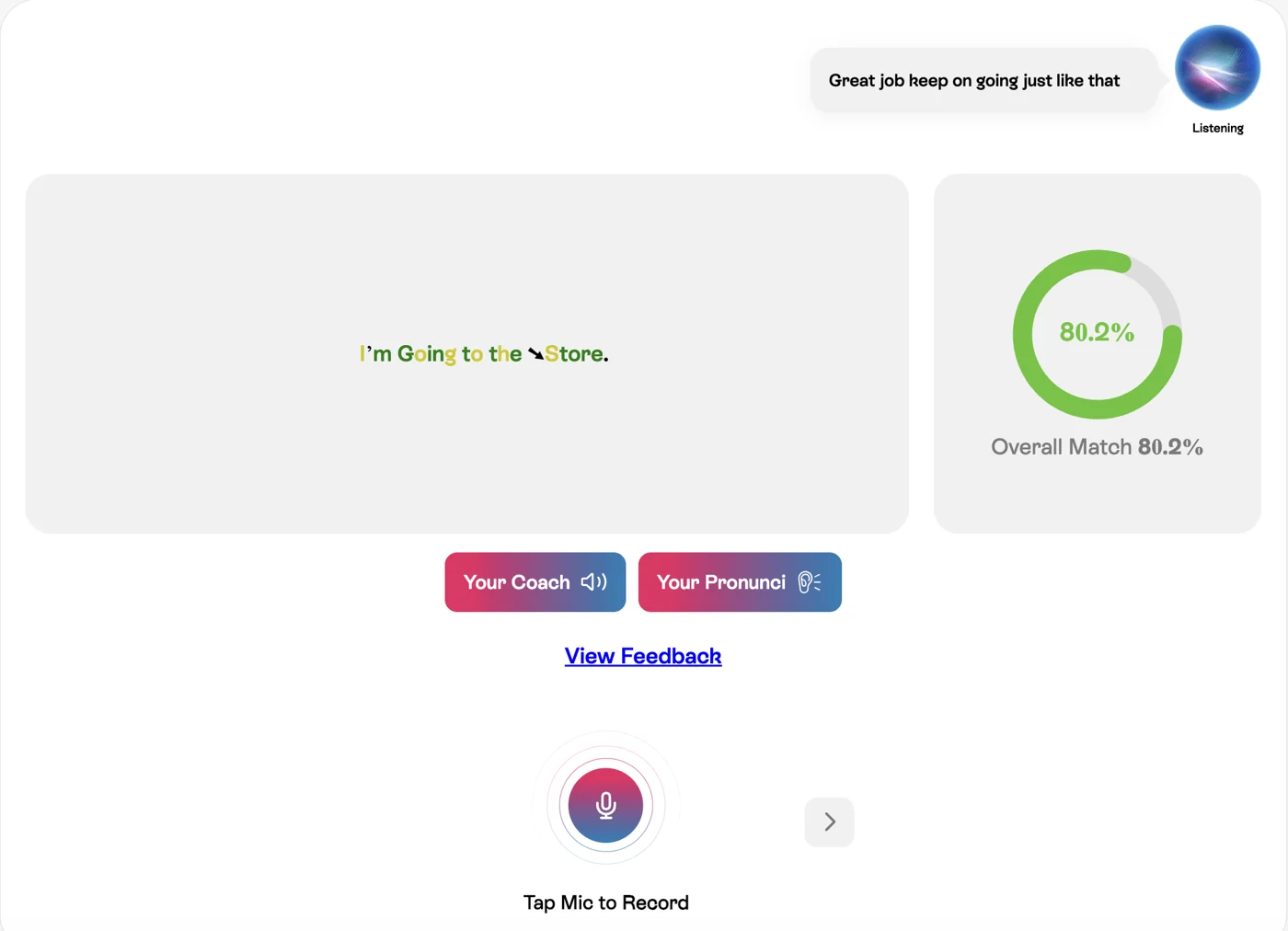
After practicing the intonation pattern, students move into InPronunci’s Evaluation & Feedback Mode to evaluate their speech.
The student records the sentence, and the AI Accent Coach provides feedback on pronunciation, intonation, rhythm, and melody.
The evaluation helps students identify which parts of their speech differ from the American pronunciation model and where additional practice may be needed.
Cognitive Accent Training: Learn to Recognize and Correct Your Own Intonation
Evaluation is not the final step of training.
With Your Coach vs. Your Pronunci, students listen to the American pronunciation model and their own recordings, compare the differences, and recognize where their intonation, rhythm, or melody needs attention.
The AI Accent Coach provides detailed feedback, while the comparison process helps students develop greater awareness of their own speech.
Students then return to practice, apply the corrections, and record again.
This is how InPronunci connects active intonation training with cognitive recognition and independent pronunciation correction.
- Record your sentencePractice the intonation pattern, then record your speech in Evaluation & Feedback Mode.
- Analyze your performanceReview the AI Accent Coach feedback and Overall Match score to identify areas for improvement.
- Compare, recognize and correctListen to Your Coach and Your Pronunci, identify differences, and repeat the training with greater awareness and control.
UnderstandExplorePracticeRecordCompareRecognizeCorrectImprove
Become an Independent English Speaker
Develop your American pronunciation through structured training, professional Pronunci Instructions, interactive practice, and detailed AI feedback.
Start with free Chapter 1 and explore how InPronunci guides you from individual sounds to natural American speech.
How Inpronunci’s training course targets stress mastery
Inpronunci is built around the principle that visual and real-time feedback accelerates stress correction faster than passive listening alone. The course was designed by Prof. Alex, Ph.D. Accent Coach, a linguist who trains translators and interpreters, and every lesson reflects that phonological precision.
Three core tools work together:
- 2D Sound Video Mouth-Training Simulators show exactly how the tongue, lips, jaw, and airflow produce each stressed syllable. You can see the physical difference between a reduced schwa and a full primary-stressed vowel, which removes the guesswork from practice. Train with the Interactive Visual 2D Sound Simulator.
.
- AI Accent Coach gives real-time feedback on your stress, rhythm, and intonation as you speak. It identifies where your stress placement deviates from American English patterns and flags it immediately, so you correct the habit before it becomes fixed.
- Human-Guided Instructions replicate the experience of working with a real accent coach. You are never left to figure out a rule on your own.
Learners who have completed the course show measurable gains in clarity and naturalness. See results from Andrew, Thiago, and Tian. The structured curriculum covers individual sounds, stress, rhythm, intonation, and connected speech in sequence, so no layer of pronunciation is skipped.
Ready to train stress patterns with expert guidance?
Inpronunci gives you a structured path from understanding stress rules to producing them correctly in real speech. The step-by-step accent training coursecovers every stress pattern in this article, with 2D simulators, AI feedback, and human-guided coaching built in. You are not studying rules in isolation. You are training your speech system with the same tools used to prepare professional translators and interpreters.
Start with Chapter 1: Get to Know Your Speech Organs for free at learn.inpronunci.com/sign-up. The Basic Plan gives you self-study access with AI Accent Coach and human-guided instructions. The Premium Plan adds monthly 1-on-1 sessions with Prof. Alex, Ph.D. Accent Coach. Available on App Store and Google Play. The first step to start your training is to sign up for the Premium Plan. Prof. Alex will then send you a private chat to book your first session.
American English stress patterns follow systematic phonological rules, and mastering primary, secondary, and weak stress is the clearest path to natural-sounding speech.
More than mechanics: InPronunci doesn’t teach only the mechanics of sounds. It teaches students how to become confident, fluent English speakers through a step-by-step system. Training may begin with how each American sound is made. Then it moves into sound combinations, sound contractions, phonetic exercises, practice sentences, and paragraphs in real rapid speech, so students start speaking English fluently and comfortably.
Questions & Answers
FAQ
01What is a stress pattern in English with examples?
A stress pattern describes which syllable in a word receives the most emphasis through loudness, duration, and pitch. For example, TA-ble stresses the first syllable, while re-LAX stresses the second.
02What is the most common stress pattern in American English?
The most common pattern for two-syllable words is first-syllable stress for nouns and adjectives, such as TA-ble or HAP-py, and second-syllable stress for verbs, such as be-GIN or de-CIDE.
03Which syllable is stressed in American English?
Stress placement depends on word class and suffixes. Nouns and adjectives typically stress the first syllable; verbs often stress the second. Suffixes like -tion and -ic shift stress to the syllable immediately before them.
04How does Inpronunci help with stress pattern practice?
Inpronunci’s AI Accent Coach gives real-time feedback on your stress placement as you speak, and the Interactive Visual 2D Sound Simulators train the physical production of each stressed syllable, making errors correctable immediately.
05Why do some English words have two stress points?
Longer derived words retain the base word’s stress while also adding stress before a suffix. Because it is as-SIM-i-late, the derived form becomes as-SIM-i-LA-tion, carrying two stress positions rather than one.
Recommended

American Intonation Patterns for Professionals | Inpronunci
Master American intonation patterns for professionals to enhance your communication skills. Improve perception and authority in your speech.

Intonation Patterns in Academic English: Inpronunci Guide
Master intonation patterns in academic English with real examples. Boost clarity and confidence in your presentations using Inpronunci tools!

Pronunciation Challenges Asian English Speakers Face | Inpronunci
Why Mandarin, Korean, Japanese, and Vietnamese speakers struggle with American sounds like R/L, TH, and V/W, and how to train them sound by sound.