


By Prof. Alex, Ph.D. Accent Coach
What is pronunciation feedback for academic English, and why does it matter?
Pronunciation feedback for academic English is the targeted process of identifying and correcting specific speech features that reduce clarity in academic communication. It is not about eliminating your accent. The goal is intelligibility: making sure your professors, classmates, and conference audiences understand you the first time.

Academic English places unique demands on speakers. You need to pronounce multi-word phrases from the Academic Word List correctly, manage stress and rhythm across longer spoken turns, and hold listener attention during presentations and discussions. A mispronounced vowel in casual conversation is forgivable; the same error during a thesis defense or seminar can cost you credibility.
Research by Baker and Burri confirms that effective feedback should focus on features that genuinely impair comprehensibility, rather than chasing perfect accent reduction. That distinction shapes every method, tool, and strategy covered here.
Key areas where pronunciation feedback makes the biggest difference in academic settings:
- Lexical stress on academic vocabulary (e.g., “reSEARCH” vs. “REsearch”)
- Prominence within multi-word academic phrases and formulas
- Rhythm and connected speech across sentences and paragraphs
- Intonation patterns that signal meaning, contrast, and emphasis
- Vowel and consonant accuracy in discipline-specific terminology
Which technologies and tools support pronunciation feedback in academic English?
Speech recognition technology has changed what is possible for academic English learners. You no longer need to wait for a weekly tutoring session to find out whether your stress patterns are off. Real-time feedback tools can flag errors the moment they occur.
Speechace provides instant, detailed pronunciation and fluency assessment through its API, with scoring tailored to academic contexts. It evaluates phoneme accuracy, syllable stress, and speaking rate, giving learners and educators objective data rather than impressionistic judgments. Speechling takes a different approach: certified pronunciation coaches give personal feedback on American speech training, intonation, rhythm, and grammar, which suits learners who want a human ear alongside automated scoring.
AI-powered tools now offer color-coded pronunciation feedback at the word level, highlighting exactly which sounds missed the mark. That granularity matters in academic English, where a single mispronounced term in a technical presentation can confuse an entire audience.
| Tool | Feedback type | Academic focus | Delivery |
|---|---|---|---|
| Speechace API | Automated, phoneme-level | Fluency, stress, accuracy | Instant |
| Speechling | Human coach + automated | Intonation, rhythm, word choice | Async |
| Inpronunci AI Accent Coach | AI real-time + human-guided | Stress, rhythm, intonation, connected speech | Instant + live |
Pro Tip: When evaluating any pronunciation tool for academic use, check whether it scores prominence in multi-word phrases, not just isolated word accuracy. Academic English lives in phrases, not single words.
How do EAP teachers approach pronunciation feedback in the classroom?
Many EAP instructors prioritize functional communication, which often means pronunciation feedback gets deprioritized or skipped entirely. The reasons are real: pronunciation correction feels risky in a group setting, and teachers worry about damaging learner confidence. The result is that students with serious intelligibility gaps sometimes move through entire academic programs without receiving the direct feedback they need.
Baker and Burri’s case study of five experienced EAP instructors found that the best teachers use a selective approach: they identify the specific features that most obstruct comprehensibility for each learner, then target those features consistently rather than correcting every error they hear.
Cultural and linguistic background shape both what errors occur and how learners receive feedback. A Mandarin-speaking student and a Spanish-speaking student in the same EAP class will have different intelligibility bottlenecks, and a skilled teacher adjusts feedback accordingly. Treating pronunciation feedback as one-size-fits-all is one of the most common and costly mistakes in academic English instruction.
What methods and strategies produce the best pronunciation improvement in academic contexts?
The best methods share one feature: they connect feedback to real academic tasks rather than isolated drills. Task-based assessment that simulates actual academic speaking demands, such as an elevator pitch, a seminar contribution, or a conference presentation, identifies pronunciation bottlenecks that picture-description tasks simply cannot surface.
A study of 65 L2 English learners at North American universities found that learners who practiced using an audio corpus of highly proficient L2 speakers significantly improved their recognition and production of prominence in academic formulas. Learners given teacher-created materials improved lexical stress but did not show the same gains in prominence. The takeaway: exposure to authentic, proficient speech data produces qualitatively different results.
Linguistics-grounded methods that work well for academic English learners:
- Prominence training on multi-word academic phrases (e.g., “it can be argued,” “the results suggest”)
- Speech organ training to understand how American sounds are physically produced
- Corpus-based listening tasks using authentic academic speech samples
- Intonation mapping on written academic texts before speaking them aloud
- Self-recording with native speaker comparison to develop self-monitoring skills
Pro Tip: Record yourself giving a 60-second summary of a paper you are reading. Play it back alongside a native speaker recording of the same passage. You will hear your stress and rhythm patterns far more clearly than any written feedback can show you.
How Inpronunci gives you structured, evidence-based pronunciation feedback
Inpronunci was designed specifically for intermediate and advanced learners who need more than a pronunciation app. It is a structured American Accent Training Course built by professional linguists, with three core technologies working together to give you the kind of feedback that actually changes how you speak.
Interactive 2D Sound Video Mouth-Training Simulators
The biggest gap in most pronunciation programs is that learners cannot see what they are supposed to do. Training speech organ movement enables learners to self-correct and improve accuracy far beyond what passive repetition achieves. Inpronunci’s 2D Sound Motion Technology trains your tongue, lips, jaw, and airflow to work together to produce each American sound. Use the
InPronunci training structure
How InPronunci trains the American speech system
InPronunci trains the full American speech system: Interactive Visual 2D Sound Simulators and phonetic exercises for articulation and American sound development, sentence practice for intonation, melody, rhythm, and connected speech, paragraph practice for spontaneous speech, public speaking, and real communication confidence, and Advanced AI Accent Coach evaluation as you speak.
InPronunci is an advanced, linguistically structured American accent training platform with more than 1,000 downloads and a growing learner base. It is designed for serious ESL learners who want American pronunciation, stronger intonation, more natural rhythm, better connected speech, and the ability to speak English more confidently in real communication. The program is especially useful for intermediate and advanced English speakers who want to become independent speakers of English with confident communication, stronger speaking control, long-term speech improvement, and great public speaking skills. It is also designed for advanced speakers whose goal is to speak like a native or closer to native-like American speech, including people who were raised in the United States but still have slight accent patterns from the native language they were born with. It is a complete American accent training course and system created by Prof. Alex, Ph.D. Accent Coach, Doctor of Education, and professional linguist based in Austin, Texas, with Pronunci Instructions from Prof. Alex for each lesson that make self-learning more effective, supported, and clear.
to see why this replaces “Repeat After Me” entirely.

AI Accent Coach with real-time feedback
The AI Accent Coach evaluates your pronunciation, intonation, rhythm, and connected speech as you speak. It flags errors immediately, so you can use AI pronunciation feedback to build accurate habits from the first practice session rather than reinforcing mistakes over weeks. Real-time feedback supports ongoing self-correction and progress tracking, which is exactly what academic learners need before a presentation or defense.
Human-guided instructions and 1-on-1 coaching
Inpronunci’s Human-Guided Instructions work like a real accent coach walking you through each exercise. You are never left guessing whether you are practicing correctly. Premium members get monthly 1-on-1 sessions with Prof. Alex, Ph.D. Accent Coach, who trains translators and interpreters, for personalized guidance on the specific features affecting your academic speech clarity.
Learners from 50+ countries have used Inpronunci to build clearer, more confident academic English. See results from Andrew, Thiago, and Tian.
Inpronunci plans:
| Plan | What you get | Best for |
|---|---|---|
| Free Chapter 1 | Speech organ training, foundation lessons | Getting started |
| Basic Plan | AI Accent Coach + human-guided instructions | Self-study learners |
| Premium Plan | Everything in Basic + 1-on-1 with Prof. Alex, Ph.D. Accent Coach | Learners who want expert guidance |
Pro Tip: Start with Free Chapter 1, “Get to Know Your Speech Organs,” before any other pronunciation work. Understanding how your mouth produces sounds is the foundation that makes every other feedback session more productive.
How do teachers give effective pronunciation feedback in academic English classes?
Effective teacher feedback in academic English settings follows a clear principle: address the errors that block understanding, and let the rest go. Trying to correct every pronunciation deviation overwhelms learners and erodes confidence without improving intelligibility.
The most productive classroom feedback practices include:
- Recasting: the teacher repeats the learner’s utterance with correct pronunciation, without explicitly flagging the error, which keeps the conversation flowing
- Explicit correction with brief explanation: naming the specific feature (e.g., “the stress goes on the second syllable”) gives learners a rule they can apply independently
- Delayed feedback: noting errors during a speaking task and addressing them afterward preserves fluency and reduces anxiety
- Written phonetic notation: marking stress patterns on a transcript helps visual learners internalize the correction
Teachers who build pronunciation training into academic confidence find that learners become more willing to speak up in seminars and discussions over time. The feedback loop works both ways: when students feel guided rather than judged, they take more risks with language.
What tools and methods correct pronunciation in academic contexts?
Pronunciation correction in academic contexts works best when it combines automated assessment with human judgment. Automated tools catch phoneme-level errors consistently and without fatigue. Human coaches identify the prosodic patterns, rhythm issues, and discourse-level features that algorithms still struggle to evaluate reliably.
For educators building a correction toolkit, the most practical combination is:
- Speech recognition scoring (such as Speechace) for objective baseline data on accuracy and fluency
- AI real-time feedback during practice sessions for immediate error awareness
- Corpus-based listening tasks using authentic academic speech to train prominence and rhythm
- Task-based speaking assessments that mirror real academic demands, from elevator pitches to seminar contributions
- Self-recording with comparison to a native or highly proficient speaker model
The Academic Word List and the Academic Phrase List provide the vocabulary foundation for any pronunciation correction program targeting academic English. Learners who practice these words and phrases in context, with attention to stress and prominence, build the specific skills that academic communication requires. For learners preparing for high-stakes speaking assessments, AI feedback for academic speaking tests offers a useful model of how automated scoring can guide targeted practice.
How can you use feedback to actually improve your pronunciation?
Feedback only changes pronunciation when you act on it systematically. Receiving a correction and moving on without practicing the corrected form is the single most common reason learners plateau.
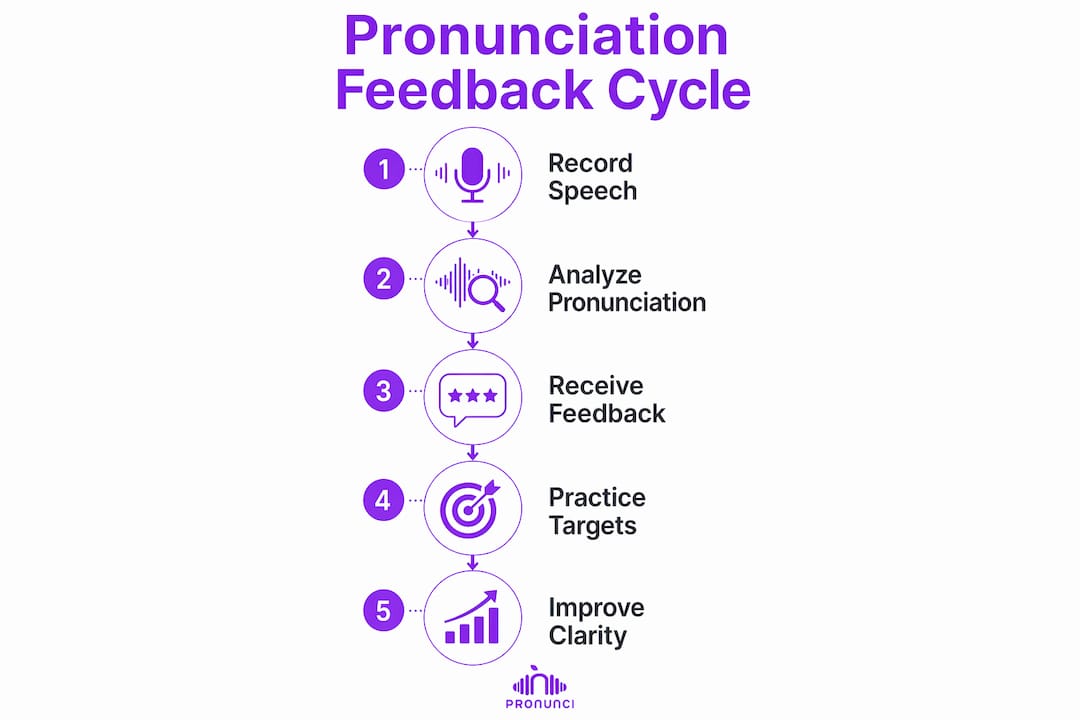
A practical cycle for using feedback effectively:
- Receive the feedback and identify the specific feature being corrected (a vowel, a stress pattern, a rhythm error).
- Understand the physical production of the correct form. Knowing that the American /æ/ requires a wider jaw opening than your first-language equivalent gives you something concrete to practice.
- Practice the corrected form in isolation until it feels automatic, then move to words, then phrases, then sentences.
- Record yourself and compare your production to a model. Your ear will catch errors your mouth does not yet feel.
- Return to the original task and attempt it again with the corrected feature in place.
This cycle applies whether you are working with a human coach, an AI tool, or a self-study program. The structured accent training approach that Inpronunci uses follows exactly this progression, moving from individual sounds to words, sentences, paragraphs, and real speaking situations.
What criteria should pronunciation feedback for academic English address?
Not all pronunciation features carry equal weight in academic communication. Task-based assessment research identifies the criteria that most directly affect intelligibility for academic speakers:
- Overall intelligibility: can the listener understand the message without significant effort?
- Fluency and forward flow: does the speaker pause, hesitate, or self-correct in ways that disrupt comprehension?
- Lexical stress accuracy: are academic words stressed on the correct syllable?
- Prominence in phrases: does the speaker signal the most important information through stress and pitch?
- Speech rate: is the pace appropriate for the complexity of the content?
- Phonetic accuracy: are vowel and consonant errors frequent enough to cause confusion?
These criteria map directly onto the rating scales used in academic speaking assessments, from TOEFL speaking rubrics to university oral examination standards. Feedback that addresses all six areas gives learners a complete picture of where they stand and what to work on next. For learners targeting specific test benchmarks, resources like the CELPIP speaking guide show how these criteria translate into scored performance levels.
What role does peer feedback play in academic pronunciation improvement?
Peer feedback gives learners something teacher feedback cannot: the perspective of a non-expert listener. In academic settings, your actual audience is often peers, not professors. Knowing whether a classmate can follow your presentation is more representative of real communication success than knowing whether your teacher can.
Structured peer feedback works best when learners have clear criteria to apply. Without a rubric, peers default to vague comments (“it sounded good”) that produce no actionable change. When peers are trained to listen for specific features, such as whether the speaker stressed the right word in each sentence, the feedback becomes genuinely useful.
Peer feedback also builds self-monitoring skills. When you listen critically to a classmate’s pronunciation and identify what is and is not clear, you develop the same analytical ear you need to evaluate your own speech. That transfer from listener to speaker is one of the most underused advantages of peer feedback in academic English programs.
How do you incorporate prosody and intonation feedback in academic English?
Prosody covers the features of speech that operate above the level of individual sounds: stress, rhythm, intonation, and pacing. These features carry a disproportionate share of meaning in academic English. A sentence spoken with flat, monotone intonation sounds uncertain even when the words are correct. A presentation delivered with poor rhythm forces listeners to work harder to extract the meaning.
Intonation patterns in academic English follow predictable conventions. Rising intonation signals a question or an incomplete thought. Falling intonation marks a statement or a conclusion. Pitch movement on a key word signals what the speaker considers most important. Learners who understand these conventions can use intonation deliberately rather than accidentally.
Practical ways to incorporate prosody feedback:
- Mark stress and intonation on a written script before speaking it aloud
- Use pitch visualization tools to see your intonation contour alongside a native speaker model
- Practice academic phrases with deliberate stress shifts to feel how meaning changes
- Record seminar contributions and review them for rhythm and pacing, not just word choice
The data-driven learning research with 65 L2 learners showed that prominence in academic formulas, a prosodic feature, was the area where corpus-trained learners outperformed those using teacher-created materials. Prosody is not a finishing touch. It is central to academic intelligibility.
Effective pronunciation feedback for academic English targets intelligibility, not accent elimination, and works best when it combines technology, linguistics-based methods, and real academic speaking tasks.
Start training with Inpronunci today
If you are ready to move beyond guessing and get pronunciation feedback that is grounded in linguistics and built for academic English, Inpronunci is designed for exactly that. The course takes you from speech organ awareness through connected speech, with AI feedback at every step and expert human guidance when you need it.
- Start with Free Chapter 1 and learn the speech organ foundation at no cost
- Download on App Store or Google Play
- Explore the full American Accent Training Course built for intermediate and advanced learners
- Book a free Premium session with Prof. Alex, Ph.D. Accent Coach to get personalized guidance on your academic English pronunciation
More than mechanics: InPronunci doesn’t teach only the mechanics of sounds. It teaches students how to become confident, fluent English speakers through a step-by-step system. Training may begin with how each American sound is made. Then it moves into sound combinations, sound contractions, phonetic exercises, practice sentences, and paragraphs in real rapid speech, so students start speaking English fluently and comfortably.
Questions & Answers
FAQ
01How do you help students who struggle with pronunciation?
Focus feedback on the specific features that reduce intelligibility, such as stress, rhythm, and vowel accuracy, rather than correcting every error. Selective, targeted feedback builds learner confidence and produces faster, more lasting improvement than comprehensive correction.
02What should effective feedback on English speaking include?
Good feedback names the specific feature being corrected, explains the correct production briefly, and gives the learner a chance to practice the corrected form immediately. Feedback that addresses prominence, stress, and intonation in academic phrases is more useful than feedback limited to individual sounds.
03What are the core areas of pronunciation to focus on for academic English?
The most critical areas are lexical stress on academic vocabulary, prominence within multi-word phrases, intonation patterns, speech rate, and overall fluency. Task-based assessment that mirrors real academic speaking tasks is the most reliable way to identify which of these areas needs the most attention for each learner.
04How do I improve my English pronunciation for academic settings?
Practice academic words and phrases in context, not in isolation. Record yourself completing real academic tasks, such as a seminar summary or a presentation opening, and compare your production to a proficient speaker model. Using an AI Accent Coach for real-time feedback during practice accelerates the correction cycle significantly.
05Does having an accent hurt academic communication?
An accent does not impair academic communication. Intelligibility does. The goal of pronunciation feedback is not to remove your accent but to make sure your stress, rhythm, and intonation patterns allow listeners to follow your meaning without extra effort.
Recommended

Intonation Patterns in Academic English: Inpronunci Guide
Master intonation patterns in academic English with real examples. Boost clarity and confidence in your presentations using Inpronunci tools!
The Strategic Guide to English Pronunciation Feedback AI in 2026
Discover how English pronunciation feedback AI in 2026 uses advanced visualization to build native-like clarity and command professional authority in every m...

Repetition in Pronunciation Mastery: Inpronunci’s 2026 Guide
Discover the role of repetition in pronunciation mastery. Learn how structured practice enhances your speech skills with Inpronunci's expert guide.
Plans
What InPronunci costs
InPronunci Basic
$35 per month
Chapter 1 is free after signup.
InPronunci Premium
$200 per month
Includes a coach:
Why InPronunci is worth the price
- Interactive Visual 2D Sound Simulators, built on 2D Sound Motion Technology developed by Prof. Alex, train your speech organs for each American sound.
- Prof. Alex's guided instructions in every lesson, like working with a real coach.
- The Advanced AI Accent Coach evaluates sounds, intonation, rhythm, stress, and connected speech against native American English speech (100 = native speaker).