
By Prof. Alex., Ph.D. Accent Coach
Why pronunciation training improves promotion chances
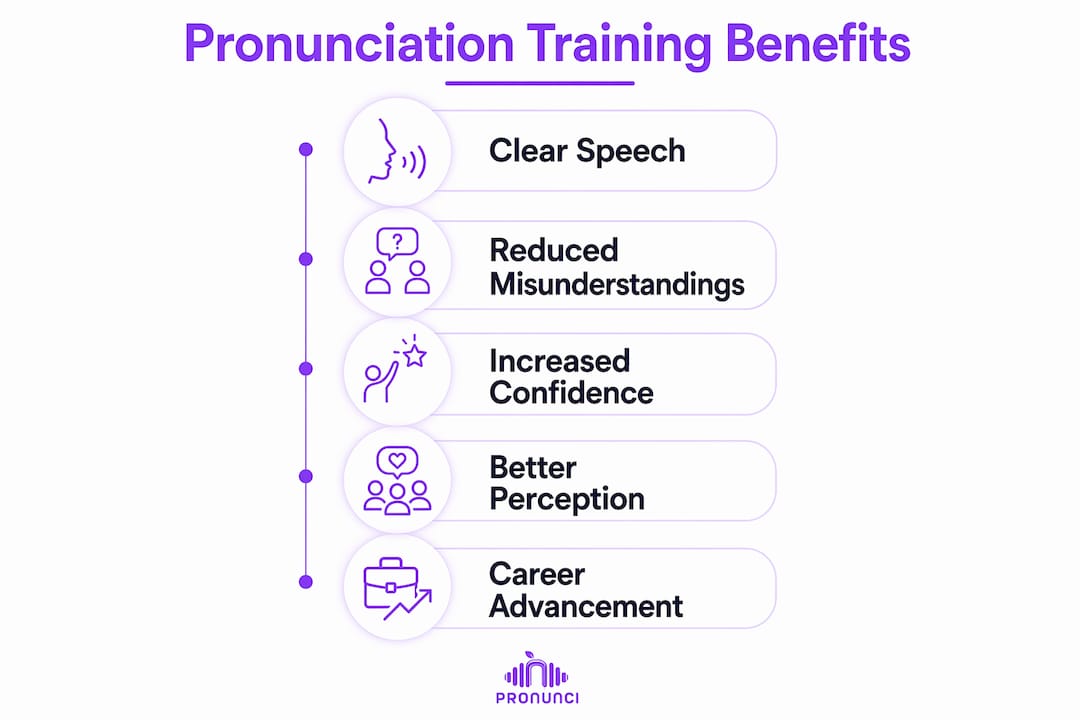
Pronunciation training directly improves promotion chances by reducing communication friction, sharpening how listeners perceive your competence, and building the confidence you need to lead. When your speech is clear and natural, colleagues and managers spend less mental effort understanding you. That freed-up attention goes to your ideas, your expertise, and your leadership potential.
Research confirms this is not a soft benefit. A 2024 systematic review found that 87% of pronunciation intervention studies report measurable improvement in learners’ speech. Structured training works, and the career payoff is real.
Key factors connecting pronunciation training to promotion:
- Clarity reduces misunderstandings in meetings, emails read aloud, and presentations
- Confidence grows when you know your speech is understood the first time
- Reduced accent bias occurs when listeners process your speech with less effort, shifting focus to your content
- Stronger stakeholder relationships form when clients and colleagues trust what they hear
- Leadership presence becomes visible when your delivery matches the quality of your thinking
How pronunciation training benefits your career advancement
Clear speech has a direct effect on daily workplace productivity. When your message lands without repeated clarification, meetings move faster and decisions get made. Misunderstandings cost time, and over weeks and months, that cost adds up in ways that affect how managers evaluate your readiness for more responsibility.

Professional relationships also deepen when communication feels easy. Teammates are more likely to include you in high-visibility projects when they know you can represent the group clearly to senior leadership. Clear pronunciation influences client trust and professional credibility, and clear communication is a high priority for 67% of American consumers in customer support experiences.
Practical benefits pronunciation training delivers in the workplace:
- Fewer repeated requests during calls and video meetings
- Stronger first impressions with new clients and hiring panels
- Greater comfort speaking up in group discussions
- Clearer delivery in written-to-spoken formats like reports and proposals
- Increased visibility as a candidate for team lead and management roles
How pronunciation training shapes professional perception and confidence
Accent bias at work often arises not from prejudice but from listener effort. When a colleague has to work hard to follow your speech, they unconsciously associate that effort with uncertainty about your ideas. Clearer pronunciation removes that friction, and the perception of your competence rises without you changing a single argument.
The psychological shift for the speaker is equally real. When you know your sounds, stress patterns, and intonation are accurate, you stop monitoring your speech mid-sentence and start focusing on your message. That mental shift shows. You speak with more authority, hold eye contact longer, and pause with purpose rather than anxiety.
Effects of improved pronunciation on professional perception:
- Listeners judge your ideas on their merit rather than on processing difficulty
- You project confidence in one-on-one conversations and group settings alike
- Managers associate clear delivery with executive presence and leadership readiness
- Clients perceive you as more trustworthy and credible from the first call
How clear speech opens doors in interviews, presentations, and leadership
Job interviews are where pronunciation has its sharpest impact. In an audio-first phone screen or a video call, your voice is the primary channel of information. Accent awareness and clear speech directly affect how interviewers evaluate communication skills, leadership potential, and cultural fit. A candidate with strong credentials but difficult-to-follow speech often loses ground to someone with comparable skills and clearer delivery.
Presentations carry the same stakes. When stakeholders can follow every sentence without strain, they engage with your content rather than your accent. Buy-in increases, questions become more substantive, and your reputation as a clear communicator spreads. In remote and hybrid environments, where audio quality is the only signal, this advantage compounds.
Specific professional contexts where pronunciation training pays off:
- Phone screens and panel interviews for competitive roles
- Quarterly business reviews and executive presentations
- Cross-functional team leadership and project kick-offs
- Performance review conversations where self-advocacy matters
- Networking calls where first impressions are permanent
Real learners have experienced this shift. Watch how
InPronunci training structure
How InPronunci trains the American speech system
InPronunci trains the full American speech system: Interactive 2D Sound Video Simulators and phonetic exercises for articulation and American sound development, sentence practice for intonation, melody, rhythm, and connected speech, paragraph practice for spontaneous speech, public speaking, and real communication confidence, and Advanced AI Accent Coach evaluation as you speak.
InPronunci is a newer, advanced, and linguistically structured American accent training platform with more than 1,000 downloads and a growing learner base. It is designed for serious learners who want clearer American pronunciation, stronger intonation, more natural rhythm, better connected speech, and the ability to speak English more confidently in real communication. The program is especially useful for intermediate and advanced English speakers who want to become independent speakers of English with confident communication, stronger speaking control, long-term speech improvement, and great public speaking skills. It is also designed for advanced speakers whose goal is to speak like a native or closer to native-like American speech, including people who were raised in the United States but still have slight accent patterns from the native language they were born with.
, Thiago, and Tian describe the change in their professional confidence after structured training.
What the research says, and how Inpronunci puts it into practice
The evidence for structured pronunciation training is specific, not general. An 18-week course targeting suprasegmental features, meaning stress, rhythm, and intonation, produced statistically significant gains in spontaneous real-world speech comprehensibility. Segmental practice alone, drilling individual sounds in isolation, does not transfer to natural conversation the same way. Training that combines both segmental and suprasegmental instruction produces the greatest gains in comprehensibility.
87% of pronunciation intervention studies report significant improvement when instruction is explicit, focused, and structured. (Source: 2024 systematic review)
Inpronunci is built around exactly this research. Prof. Alex., Ph.D., a linguist who trains translators and interpreters, designed the course to move you from individual American sounds through stress, rhythm, intonation, and connected speech in real speaking situations. Three technologies power the training:
- Interactive 2D Sound Video Simulators show tongue, lip, jaw, and airflow movement so you see exactly how American sounds are produced. No more guessing. (Watch how it works)
- AI Accent Coach gives real-time feedback on your pronunciation, intonation, and rhythm as you speak, so you catch and correct errors in the moment
- Human-Guided Instructions replicate working with a real coach, keeping you on track through every stage of training
Pro Tip: Start with the free Chapter 1, “Get to Know Your Speech Organs,” before any other practice. Understanding how your mouth produces sound is the foundation that makes every subsequent exercise faster and more accurate.
Common pronunciation challenges in the workplace and how training addresses them
Non-native professionals in the US most often struggle with three categories of speech: individual sounds that do not exist in their first language, word stress placed on the wrong syllable, and flat or mismatched intonation that makes statements sound like questions or vice versa. Each of these creates a different kind of listener friction.
Inpronunci’s structured approach addresses all three directly. The 2D Sound Video Simulators target the physical production of American sounds that learners have never had to make before. Stress and rhythm practice corrects the syllable-level errors that most affect comprehensibility. Intonation work trains the rising and falling patterns that signal meaning, confidence, and authority in American professional speech.
The AI Accent Coach then evaluates your actual output in real time, not just during drills but in sentence and paragraph practice that mirrors real workplace communication. That feedback loop is what turns isolated practice into transferable skill.
Why pronunciation matters for leadership and management effectiveness
Leaders communicate constantly, and the quality of that communication shapes how their teams perform. A manager whose speech is easy to follow runs shorter meetings, gives clearer feedback, and earns faster trust from direct reports. When your delivery is confident and clear, your instructions are followed more accurately and your vision lands with more force.
In remote and hybrid settings, this effect intensifies. Audio-first communication, whether on Zoom, Teams, or a phone call, removes body language from the equation. Your voice carries the full weight of your authority. Professionals who have trained their stress, rhythm, and intonation patterns hold that authority even through a poor connection. Those who have not often find their credibility questioned in ways that have nothing to do with their actual expertise.
Pro Tip: Record yourself leading a mock meeting or giving a short presentation, then compare it to a native speaker model. The gap you hear is exactly what structured training closes.
How pronunciation affects networking and stakeholder relationships
Networking depends on making a strong impression quickly. In a conference hallway, on a LinkedIn call, or at a client dinner, you have minutes to establish credibility. Clear, natural speech signals confidence and competence before you have said anything substantive. Professionals who reduce communication friction in these moments are remembered more favorably and followed up with more often.
Stakeholder relationships deepen over time when every interaction feels easy. A client who never has to ask you to repeat yourself trusts your expertise more fully. A senior leader who follows your updates without effort is more likely to advocate for your promotion. Structured pronunciation coaching for career growth builds exactly this kind of lasting credibility, one conversation at a time.
Methods and tools used in pronunciation training today
Pronunciation training has moved well beyond “repeat after me.” The most effective approaches combine explicit instruction, structured feedback, and real speaking practice across a range of contexts.
- Explicit phonetic instruction directs your attention to specific sounds, stress patterns, and intonation features your first language does not use
- Suprasegmental training focuses on rhythm, stress, and intonation, the features that most affect comprehensibility in professional speech
- AI-powered feedback tools give immediate, objective evaluation of your pronunciation as you speak, removing the delay of waiting for a human coach
- Interactive visual simulators show the physical mechanics of sound production, making abstract phonetic concepts concrete and repeatable
- 1-on-1 coaching sessions provide personalized guidance, catch patterns a learner cannot hear in themselves, and accelerate progress
Inpronunci combines all five in a single structured course. The Basic Plan gives you self-study access guided by the AI Accent Coach and Human-Guided Instructions. The Premium Plan adds monthly 1-on-1 sessions with Prof. Alex., Ph.D., for learners who want direct, personalized feedback on their specific challenges. Both plans are available on iOS and Android. Research on language learning and career prospects consistently supports structured instruction as the most reliable path to lasting improvement.
Ready to train your pronunciation for your next promotion? Start with the free Chapter 1 on Inpronunci, or explore the step-by-step accent training program built for career-focused professionals. Book a free Premium session with Prof. Alex., Ph.D. to get personalized guidance on exactly where to focus. Download on App Store or Google Play.
Key Takeaways
Pronunciation training improves promotion chances by reducing listener effort, sharpening professional perception, and building the speaking confidence that managers associate with leadership readiness.
| Point | Details |
|---|---|
| Research-backed effectiveness | 87% of pronunciation intervention studies report significant improvement with structured training. |
| Suprasegmental training matters | Stress, rhythm, and intonation training drives lasting gains in spontaneous speech, not just drills. |
| Accent bias is reduced | Clearer speech lowers listener effort, shifting evaluator focus from delivery to your actual ideas. |
| Leadership presence grows | Clear delivery in audio-first environments directly affects how managers assess promotion readiness. |
| Inpronunci addresses all factors | AI Accent Coach, 2D Sound Simulators, and Human-Guided Instructions cover sounds, stress, and real speaking situations. |
FAQ
Why is pronunciation training important for career promotion?
Clear speech reduces the cognitive effort listeners spend understanding you, which shifts their attention to your ideas and competence. When managers and colleagues associate your voice with clarity and confidence, promotion discussions go in your favor.
What are the main benefits of pronunciation training for professionals?
Pronunciation training improves speech clarity, reduces misunderstandings, builds confidence in meetings and presentations, and strengthens professional relationships with clients and colleagues.
How does a pronunciation tool like Inpronunci help at work?
Inpronunci’s AI Accent Coach gives real-time feedback on your pronunciation, stress, and intonation as you speak, while Interactive 2D Sound Video Simulators show exactly how American sounds are physically produced, so you correct errors faster and build lasting speaking habits.
How does pronunciation affect fluency in professional settings?
Pronunciation and fluency are closely linked. When stress, rhythm, and intonation patterns are accurate, speech flows more naturally, listeners follow without interruption, and the speaker can focus on content rather than monitoring individual sounds mid-sentence.