


American English vowel sounds in medical terms are the specific vowel articulations that healthcare professionals must master to prevent miscommunication in clinical environments. Mispronouncing a vowel in a term like “convulsive” versus “convalescent” can send a clinical team in the wrong direction during a handoff. The stakes are real. This guide defines the core vowel sounds found in medical vocabulary, explains how stress placement affects patient safety, identifies the most common pronunciation challenges for healthcare workers, and provides structured strategies to build lasting clarity.
What are the primary American English vowel sounds in medical terminology?
Medical terminology draws heavily from Latin and Greek roots, which means its vowel stress patterns follow rules that differ from everyday English. The standard American English vowel inventory includes 15 monophthongs and diphthongs, and medical terms use most of them in high-stakes combinations. Understanding which sounds appear most often in clinical vocabulary is the first step toward consistent clarity.
The vowel sounds that appear most frequently in medical terms include:
- The /æ/ sound (short “a”): found in “fracture,” “catheter,” and “laceration.” This sound is often confused with /ɛ/ (short “e”) by non-native speakers, turning “fracture” into something closer to “frecture.”
- The /iː/ sound (long “e”): found in “fever,” “serum,” and “bacteria.” A 2023 telehealth audit found that 27% of misunderstandings were traced to vowel length errors in plural medical terms like “bacteria.”
- The /ɑː/ sound (broad “a”): found in “cardiac,” “pharynx,” and “larynx.” Shortening this vowel changes the perceived word entirely.
- The /ɪ/ sound (short “i”): found in “clinical,” “insulin,” and “incision.” Lengthening it incorrectly shifts stress and rhythm.
- Diphthongs /aɪ/ and /oʊ/: found in “diagnosis,” “fibrosis,” and “prognosis.” These gliding vowels require smooth movement between two positions, which demands deliberate practice.
Vowel length also carries meaning in medical terms. Stress falls on different syllables depending on the word’s Latin or Greek origin, and getting that length wrong changes the rhythm of the word enough to cause a listener to pause and re-process what they heard. That pause costs time in clinical settings.
How do vowel stress and pronunciation affect clarity in medical communication?

Correct stress placement is not a stylistic preference in medicine. It is a safety issue. Latin and Greek medical terms carry idiosyncratic vowel stress patterns that differ sharply from everyday English, and mastering them prevents the cognitive lag that slows clinical communication.
Here is how stress errors create real problems in practice:
- Stress shift in “hypertension”: The correct stress falls on the third syllable: hy-per-TEN-sion. Shifting it to the second syllable (hy-PER-tension) causes momentary confusion, especially during fast-paced handoffs. Research shows that 41% of recordings from international medical graduates contained stress-related ambiguities that required clarification.
- Vowel mergers between similar terms: Saying “convalescent” with the vowel pattern of “convulsive” creates genuine ambiguity. These two words describe opposite patient states. A merged vowel in a rushed verbal order is a documented source of clinical error.
- Plural forms with vowel shifts: “Bacterium” becomes “bacteria,” and the vowel change carries grammatical and clinical meaning. Flattening that shift makes it harder for listeners to track whether one organism or many are being discussed.
- Stress errors in drug names: Terms like “epinephrine” and “norepinephrine” differ by a prefix, but stress errors on the shared root can blur the distinction in verbal orders.
Pro Tip: Record yourself saying five multisyllabic medical terms aloud, then compare your recording to a native speaker model. Focus specifically on which syllable receives the longest, loudest vowel. That single exercise reveals more than an hour of passive listening.
Research on clear communication training with medical residents found that targeted language training reduced jargon and improved clarity measurably over just three months. The same principle applies to pronunciation: focused, structured practice produces results that passive exposure does not.
What are common challenges for healthcare workers with vowel pronunciation in medical terms?
Healthcare workers face pronunciation challenges that are specific to the structure of medical vocabulary. These are not general English problems. They are clinical language problems with clinical consequences.
The most common challenges include:
- Silent consonants in Greek-origin terms: Over 92% of English words with initial “pt-,” “pn-,” or “ps-” clusters have silent first consonants. “Pterygoid” starts with a /t/ sound, not a /p/ sound. Pronouncing the silent letter marks unfamiliarity and disrupts listener comprehension.
- Vowel confusion between similar terms: The /ɛ/ and /æ/ sounds are the most commonly merged pair in clinical speech. “Septic” and “sapphic” share a similar consonant frame; only the vowel distinguishes them. Merging these sounds in a clinical context causes real confusion.
- Stress errors from L1 interference: 68% of non-native clinicians make communication errors in fast-paced clinical settings, often due to improper stress placement. Their first language imposes its own stress rules on English medical terms.
- Regional accent variation: American regional accents shift vowels in predictable ways. The Northern Cities Vowel Shift, for example, moves /æ/ toward /eɪ/, which can make “catheter” sound like “caytheter.” Avoiding vowel mergers that cause clinical ambiguity matters more than eliminating a regional accent entirely.
- The silent “h” in clinical vocabulary: In US clinical settings, “herb” is pronounced without the “h.” Adding the “h” signals unfamiliarity with American medical norms and can undermine a clinician’s perceived authority during patient interactions.
Phonetic training in medical communication addresses these specific patterns directly, rather than treating medical pronunciation as a subset of general English fluency.
What practical strategies can healthcare professionals use to improve vowel pronunciation?
Mastering vowel sounds in medical vocabulary requires structured practice, not repetition alone. Pronunciation training works when it targets the specific sounds causing errors, provides accurate feedback, and builds muscle memory through guided repetition.
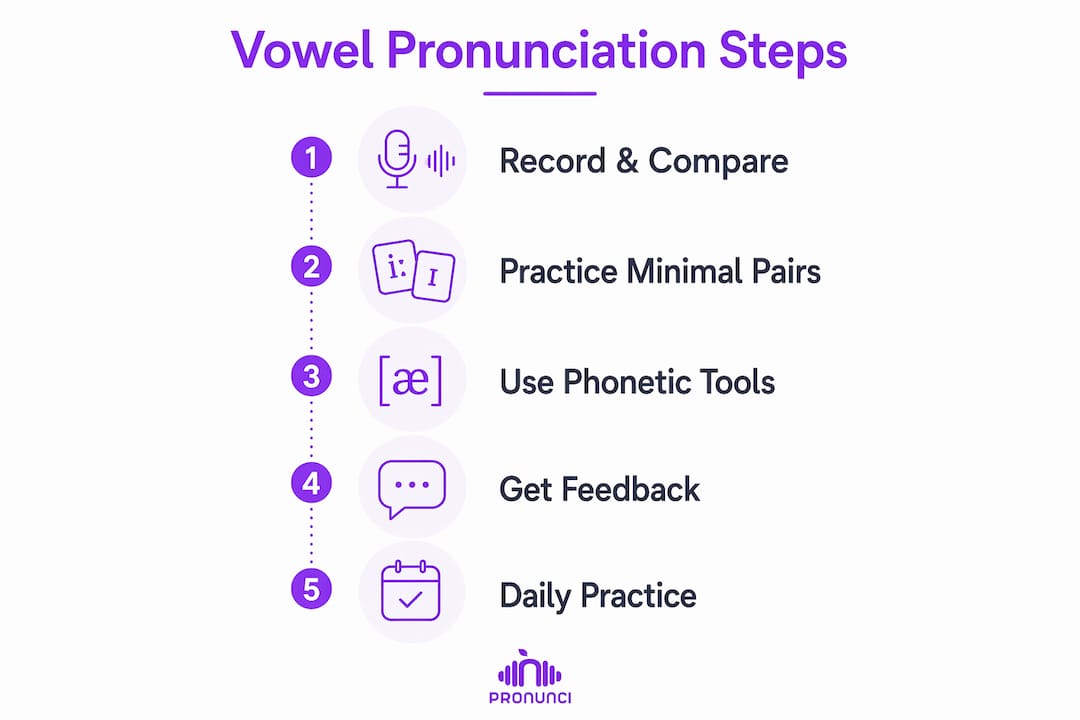
The best strategies for healthcare workers are:
Record and compare. Record yourself saying ten high-frequency medical terms. Compare your recording to a native speaker model. Focus on vowel length and stressed syllable position. This single habit accelerates progress faster than any passive method.
Practice minimal pairs. Work with pairs like “ileum” and “ilium,” or “mucous” and “mucus.” These pairs differ by one vowel sound or one syllable. Training your ear and mouth on minimal pairs builds the discrimination skills that clinical communication demands.
Use structured phonetic training tools. Inpronunci’s
InPronunci training structure
How InPronunci trains the American speech system
InPronunci trains the full American speech system: Interactive Visual 2D Sound Simulators and phonetic exercises for articulation and American sound development, sentence practice for intonation, melody, rhythm, and connected speech, paragraph practice for spontaneous speech, public speaking, and real communication confidence, and Advanced AI Accent Coach evaluation as you speak.
InPronunci is an advanced, linguistically structured American accent training platform with more than 1,000 downloads and a growing learner base. It is designed for serious ESL learners who want American pronunciation, stronger intonation, more natural rhythm, better connected speech, and the ability to speak English more confidently in real communication. The program is especially useful for intermediate and advanced English speakers who want to become independent speakers of English with confident communication, stronger speaking control, long-term speech improvement, and great public speaking skills. It is also designed for advanced speakers whose goal is to speak like a native or closer to native-like American speech, including people who were raised in the United States but still have slight accent patterns from the native language they were born with. It is a complete American accent training course and system created by Prof. Alex, Ph.D. Accent Coach, Doctor of Education, and professional linguist based in Austin, Texas, with Pronunci Instructions from Prof. Alex for each lesson that make self-learning more effective, supported, and clear.
Interactive Visual 2D Sound Simulators train exactly how the tongue, lips, and jaw move to produce each American vowel sound. You train the articulation, not just hear it. That articulation training removes the guesswork that “repeat after me” methods leave behind.
Get real-time feedback. Inpronunci’s AI Accent Coach evaluates your pronunciation as you speak and identifies specific errors in vowel quality, stress, and rhythm. That immediate feedback loop is what separates structured training from passive listening practice.
Structured American Accent Training Course
From Speech Organs Education to American Intonation
The InPronunci course is built step by step: every chapter prepares the next one, and by the end of the course students receive a certificate.
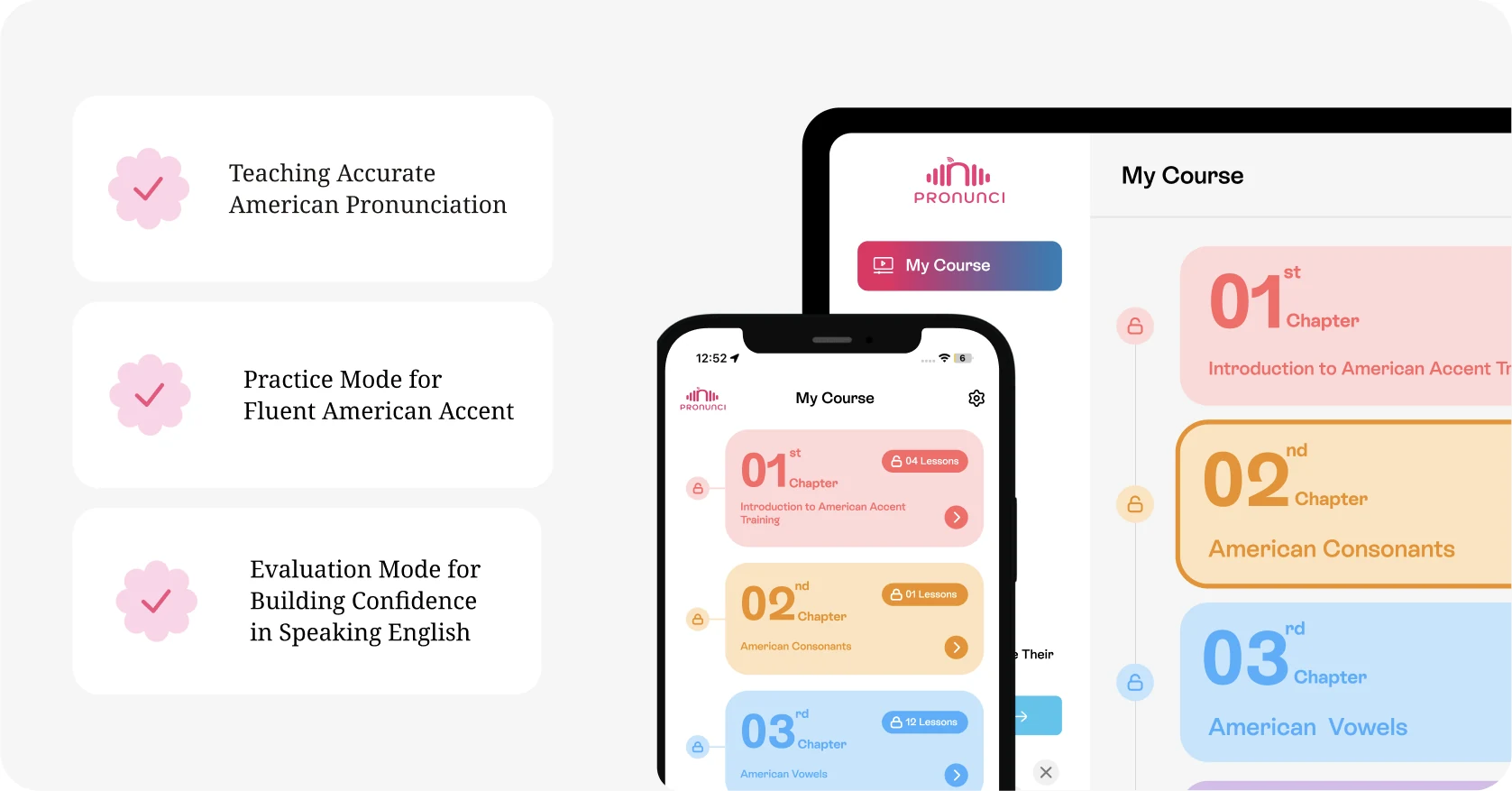
- Speech Organs EducationStudents learn how the speech organs work, along with the AI Accent Coach commands and feedback.
- American ConsonantsPractice and evaluate American consonants in phonetic exercises and practice sentences with the AI Accent Coach.
- American VowelsPractice and evaluate American vowels in phonetic exercises and practice sentences with the AI Accent Coach.
- IntonationLearn how intonation can change the meaning of what you say.
- CertificateBy the end of the course, students receive a certificate.
Pro Tip: Integrate five minutes of vowel practice into your pre-shift routine. Choose three medical terms you will use that day and say each one three times with deliberate attention to the stressed vowel. Consistency over weeks produces lasting change.
Research confirms that tailored communication significantly improves patient understanding. Clear vowel production is one of the most direct ways to make your speech easier for patients to process, regardless of their health literacy level.
What I’ve learned from training clinicians on vowel sounds
Working with healthcare professionals on pronunciation reveals a pattern that surprises most of them. The problem is rarely the vowel sound in isolation. It is the vowel sound under pressure. A clinician who produces “epinephrine” correctly in a quiet room will collapse the stressed vowel during a code situation. Speed and stress compress articulation, and the sounds that suffer first are always the vowels.
The second thing I have observed is that most clinicians underestimate how much their vowel errors cost them professionally. Patients and colleagues do not always ask for clarification. They fill in the gap with their best guess. That silent guessing is where errors enter the system. Research confirms that vowel clarity combined with matched language complexity significantly reduces patient misunderstandings. The vowel is not decoration. It is the carrier of meaning.
My recommendation is always the same: train the sound before you train the word. When you know exactly how your tongue and lips produce the /æ/ in “catheter,” you can reproduce it reliably under pressure. That is what Inpronunci’s Interactive Visual 2D Sound Simulators are built for. You are not guessing. You are following a precise physical model. That precision is what makes the difference between a clinician who is understood and one who has to repeat themselves.
— Prof. Alex, Ph.D. Accent Coach
Inpronunci: structured vowel training for healthcare professionals
Healthcare workers who need clearer vowel pronunciation in clinical settings have a structured path forward with Inpronunci.
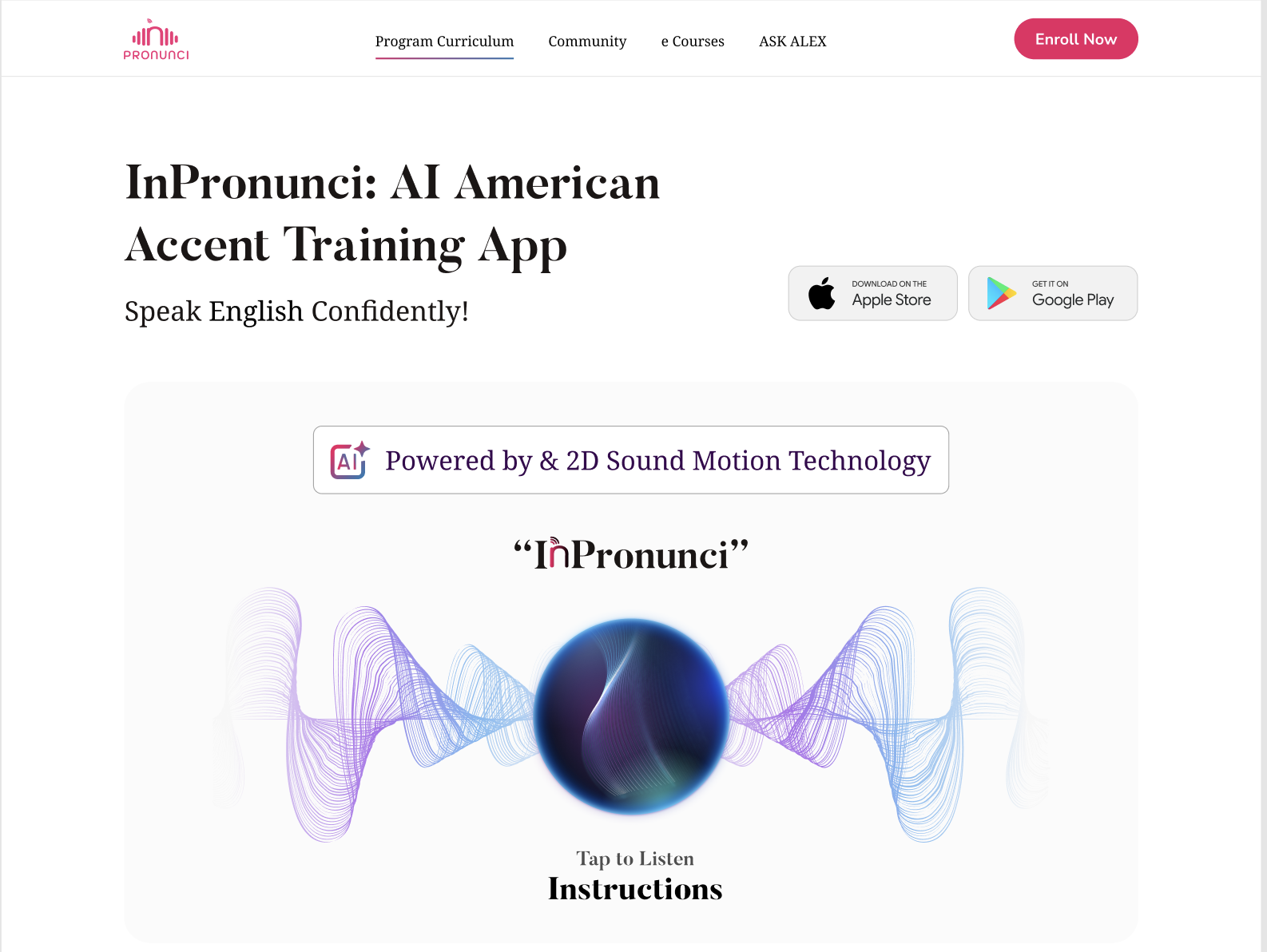
Inpronunci’s American accent training course is built by Ph.D. linguists who train translators and interpreters. The course covers American vowels, consonants, stress, rhythm, and connected speech through Interactive Visual 2D Sound Simulators, an AI Accent Coach with real-time feedback, and human-guided instructions that work like a real coach. You start with the Free Chapter 1, “Get to Know Your Speech Organs,” which builds the physical foundation for every sound you will practice. The Basic Plan supports self-study with AI and human-guided instruction. The Premium Plan adds monthly 1-on-1 sessions with Prof. Alex, Ph.D. Accent Coach, for personalized accent coaching tailored to your clinical communication goals. Sign up at learn.inpronunci.com or book a free Premium session at calendar.app.google/VATsvVHVb7HdU9Pb9.
How Russian, Mandarin and Indian English speakers often pronounce American vowels
| First language | Common pattern |
|---|---|
| Russian speakers | ship/sheep, bad/bed and full/fool sound alike. |
| Mandarin speakers | ship/sheep sound alike. |
| Indian English speakers | unstressed vowels are said as spelled instead of reduced to schwa. |
In InPronunci, each sound is trained with the Interactive Visual 2D Sound Simulators, guided by Pronunci Instructions, and checked with the AI Accent Coach.
Sources: Wikipedia: Non-native pronunciations of English, Pronunciation Studio, Wikipedia: Indian English
Questions & Answers
FAQ
01What are the most important vowel sounds in medical terms?
The /æ/, /iː/, /ɑː/, /ɪ/, and the diphthongs /aɪ/ and /oʊ/ appear most frequently in clinical vocabulary. Mastering their length and stress position is the foundation of clear medical pronunciation.
02How does vowel stress affect patient safety?
Misplaced stress changes how listeners process a word, causing cognitive lag or outright misunderstanding. Research shows 41% of international medical graduate recordings contained stress-related ambiguities that required clarification during clinical communication.
03Do non-native English speakers face greater pronunciation challenges in medicine?
Yes. 68% of non-native clinicians make communication errors in fast-paced clinical settings, most often due to stress misplacement caused by first-language interference on English medical terms.
04Is a General American accent required for clinical clarity?
No. 89% of clinicians prioritize clarity and consistency over strict adherence to any regional accent standard. The goal is avoiding vowel mergers that create ambiguity, not eliminating every regional feature.
05How can I practice vowel sounds for medical terms efficiently?
Record yourself saying multisyllabic medical terms, compare your recordings to native speaker models, and use structured phonetic training that targets specific vowel sounds. Inpronunci’s step-by-step accent training provides guided practice from individual sounds through real clinical speaking situations.
Recommended

Phonetic Training in Medical Communication | Inpronunci
Explore the role of phonetic training in medical communication. Enhance clarity and confidence for better patient interactions and safety.

Why Pronunciation Training Differs from Medical English Courses | Inpronunci
Discover why pronunciation training differs from medical English courses. Learn how mastering both can enhance communication in healthcare settings.
American English Voiced vs Voiceless Sounds | Inpronunci
Discover the differences in american english voiced vs voiceless sounds. Mastering these helps you speak clearly and confidently in American English.
Plans
What InPronunci costs
InPronunci Basic
$35 per month
Chapter 1 is free after signup.
InPronunci Premium
$200 per month
Includes a coach:
Why InPronunci is worth the price
- Interactive Visual 2D Sound Simulators, built on 2D Sound Motion Technology developed by Prof. Alex, train your speech organs for each American sound.
- Prof. Alex's guided instructions in every lesson, like working with a real coach.
- The Advanced AI Accent Coach evaluates sounds, intonation, rhythm, stress, and connected speech against native American English speech (100 = native speaker).