



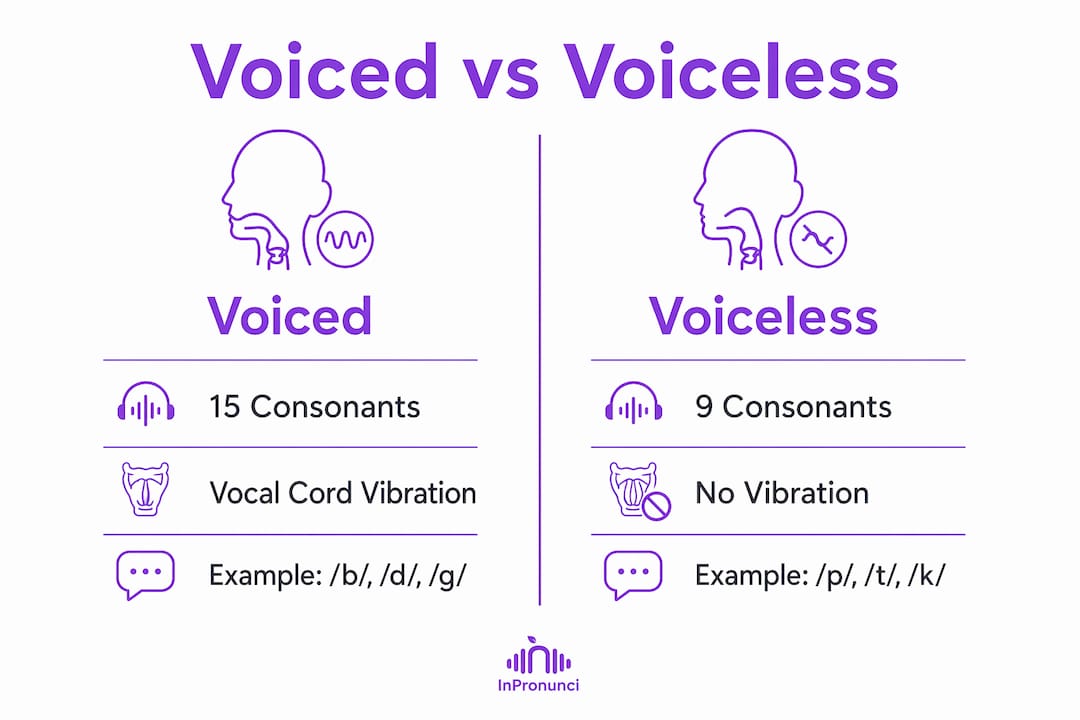
Voiced and voiceless sounds in American English are defined by one physical fact: whether your vocal cords vibrate when you produce the sound. In American English phonetics, 24 consonant phonemes split into 9 voiceless and 15 voiced sounds, and every vowel is voiced. This distinction, classified formally through the International Phonetic Alphabet (IPA), shapes how words sound, how grammar endings are pronounced, and how natural your speech feels to American listeners. For non-native speakers, understanding the difference between voiced and voiceless sounds is not optional. It is the foundation of clear, confident American English communication.
What are American English voiced and voiceless sounds?
American English voiced sounds are produced when the vocal cords vibrate and push air through the larynx. Voiceless sounds are produced with the vocal cords held open, so air passes through freely without vibration. The IPA classifies every consonant phoneme by this feature, among others like place and manner of articulation.

All vowels are voiced in American English. That means sounds like /æ/ in “cat,” /iː/ in “see,” and /oʊ/ in “go” always involve vocal cord vibration. Consonants, by contrast, divide into two groups based on voicing.
The 9 voiceless consonants are: /p/, /t/, /k/, /f/, /θ/ (as in “think”), /s/, /ʃ/ (as in “she”), /tʃ/ (as in “church”), and /h/. The 15 voiced consonants include: /b/, /d/, /g/, /v/, /ð/ (as in “the”), /z/, /ʒ/ (as in “measure”), /dʒ/ (as in “judge”), /m/, /n/, /ŋ/ (as in “sing”), /l/, /ɹ/ (as in “red”), /w/, and /j/ (as in “yes”). Many of these consonants form natural pairs, where the only difference is voicing.
| Voiceless | Example word | Voiced counterpart | Example word |
|---|---|---|---|
| /p/ | “pan” | /b/ | “ban” |
| /t/ | “ten” | /d/ | “den” |
| /k/ | “coat” | /g/ | “goat” |
| /f/ | “fan” | /v/ | “van” |
| /s/ | “sip” | /z/ | “zip” |
| /ʃ/ | “she” | /ʒ/ | “measure” |
| /tʃ/ | “church” | /dʒ/ | “judge” |
| /θ/ | “think” | /ð/ | “the” |
The “th” sounds deserve special attention. Both /θ/ and /ð/ use the same tongue position, but /θ/ is voiceless and /ð/ is voiced. This single distinction changes meaning entirely. Mastering the “th” distinction is one of the most practical steps a non-native speaker can take toward clearer American English.
How can you physically test for voiced vs voiceless sounds?
The most reliable way to identify voicing is through direct physical sensation, not spelling or guessing. Educators recommend moving away from letter-based assumptions and toward awareness of the vocal folds themselves.
Follow these four steps to test any sound:
- Larynx vibration test. Place two fingers gently on the front of your throat, over your larynx. Hold the sound continuously. For voiced sounds like /v/ or /z/, you feel a clear buzz. For voiceless sounds like /f/ or /s/, you feel nothing.
- Whisper test. Whisper the sound. Voiceless sounds sound nearly the same when whispered. Voiced sounds lose their buzz and sound weaker or different. This contrast reveals the role of vocal cord vibration.
- Ear cover test. Cover both ears with your palms and produce the sound. Voiced sounds create a low hum you can hear internally. Voiceless sounds produce almost no internal resonance.
- Aspiration test. Hold your hand close to your mouth and produce a voiceless stop: /p/, /t/, or /k/. You feel a strong puff of air. Produce the voiced counterparts /b/, /d/, or /g/ in the same position. The air burst is noticeably weaker.
Pro Tip: Practice the larynx vibration test while alternating between /s/ and /z/ for 30 seconds daily. This builds physical awareness of voicing faster than any listening drill alone.
These tests work because they connect abstract phonetic concepts to real body sensations. Once you feel the difference, you stop relying on spelling and start trusting your speech organs.
What phonetic nuances affect voiced and voiceless sounds in American English?
Voicing is not always a simple on/off switch. In American English stops), voiced consonants like /b/, /d/, and /g/ are not fully voiced throughout their production. Voicing often starts after the sound is released, or it may be only partial. This means aspiration and timing carry as much information as vocal cord vibration itself.
Aspiration is the key cue for voiceless stops. When /p/, /t/, and /k/ appear at the start of a stressed syllable, they carry a strong burst of air. Their voiced counterparts /b/, /d/, and /g/ do not. Native listeners use this aspiration difference to distinguish “pan” from “ban” and “coat” from “goat,” even in noisy environments.
Vowel length before consonants) is another critical cue. Vowels before voiced consonants are longer than vowels before voiceless ones. The word “bad” has a longer vowel than “bat.” The word “leave” has a longer vowel than “leaf.” This length difference is often more salient to American listeners than the voicing of the final consonant itself.
Devoicing at word endings) adds another layer of complexity. Speakers sometimes devoice final voiced consonants, making “bad” sound almost like “bat.” When this happens, vowel duration becomes the primary signal that keeps meaning clear. Focusing on vowel length before final consonants protects your intelligibility even when voicing is incomplete.
Pro Tip: When practicing words that end in voiced consonants, consciously lengthen the vowel before the final sound. This single habit makes a measurable difference in how clearly American listeners understand you.
For learners working on voiced and voiceless T and D sounds, the flap T is a particularly useful example of how voicing shifts in natural American speech.
Why does the voiced vs voiceless distinction matter for non-native speakers?
The voiced vs voiceless distinction affects far more than individual sounds. Voicing shapes English morphology directly. The plural “s” ending and the past tense “ed” ending both change pronunciation based on the voicing of the preceding sound.
- After a voiceless consonant, the plural “s” is pronounced /s/: “cats,” “cups,” “books.”
- After a voiced consonant or vowel, the plural “s” is pronounced /z/: “dogs,” “cars,” “trees.”
- After a voiceless consonant, the past tense “ed” is pronounced /t/: “walked,” “stopped.”
- After a voiced consonant or vowel, the past tense “ed” is pronounced /d/: “called,” “moved.”
Getting these endings wrong creates a consistent pattern of errors that native listeners notice immediately. Correct voicing in morphological endings signals grammatical accuracy and fluency at the same time.
Voicing also affects rhythm and intonation) in connected speech. Voiced sounds carry more acoustic energy and sustain longer, which contributes to the natural flow of American English. Speakers who consistently devoice sounds that should be voiced produce speech that sounds clipped or accented in ways that reduce clarity. For professionals in meetings, interviews, and presentations, this matters. A voice feedback approach to interview preparation specifically addresses how voicing clarity affects professional perception. Mastering voicing distinction is one of the clearest paths to sounding more natural and being understood more easily.
What I’ve learned coaching non-native professionals on voicing
Most learners I work with arrive focused entirely on spelling. They see the letter “s” and assume it always sounds the same. That assumption causes a predictable set of errors that compound over time.
The shift happens when learners move from their eyes to their hands. The larynx vibration test is not a gimmick. It is the fastest way I know to make voicing real and tangible. Once a learner feels the buzz of /v/ versus the silence of /f/ under their fingertips, the distinction becomes permanent. No amount of listening drills produces that result as quickly.
The other insight I share consistently: devoicing at word endings is normal, even for native speakers. The goal is not perfect voicing on every final consonant. The goal is to lengthen the vowel before that consonant so meaning stays clear. That is a much more achievable and practical target.
Inpronunci’s
InPronunci training structure
How InPronunci trains the American speech system
InPronunci trains the full American speech system: Interactive Visual 2D Sound Simulators and phonetic exercises for articulation and American sound development, sentence practice for intonation, melody, rhythm, and connected speech, paragraph practice for spontaneous speech, public speaking, and real communication confidence, and Advanced AI Accent Coach evaluation as you speak.
InPronunci is an advanced, linguistically structured American accent training platform with more than 1,000 downloads and a growing learner base. It is designed for serious ESL learners who want American pronunciation, stronger intonation, more natural rhythm, better connected speech, and the ability to speak English more confidently in real communication. The program is especially useful for intermediate and advanced English speakers who want to become independent speakers of English with confident communication, stronger speaking control, long-term speech improvement, and great public speaking skills. It is also designed for advanced speakers whose goal is to speak like a native or closer to native-like American speech, including people who were raised in the United States but still have slight accent patterns from the native language they were born with. It is a complete American accent training course and system created by Prof. Alex, Ph.D. Accent Coach, Doctor of Education, and professional linguist based in Austin, Texas, with Pronunci Instructions from Prof. Alex for each lesson that make self-learning more effective, supported, and clear.
Interactive Visual 2D Sound Simulators train the speech organs involved in producing each sound. Learners train tongue position, lip shape, and airflow for every American consonant. That articulation training, combined with the AI Accent Coach’s real-time feedback, closes the gap between knowing a rule and producing the sound correctly. Physical awareness plus structured feedback is the combination that works.
— Prof. Alex, Ph.D. Accent Coach
Inpronunci trains voiced and voiceless sounds with real feedback
Knowing the theory is the first step. Building the muscle memory takes structured, guided practice with feedback you can trust.
Inpronunci’s American Accent Training course covers every voiced and voiceless consonant in American English through 2D Sound Video Mouth-Training Simulators, AI Accent Coach feedback, and human-guided instructions. You train the speech organs for each sound, practice it with real-time feedback, and track your progress from individual sounds to full sentences. The Free Chapter 1, “Get to Know Your Speech Organs,” gives you the physical foundation before you practice a single sound. The Basic Plan guides you through self-study with AI and human instruction. The Premium Plan connects you directly with Prof. Alex, Ph.D. Accent Coach for monthly 1-on-1 sessions. Sign up at Inpronunci and start with Chapter 1 today.
Questions & Answers
FAQ
01What is the difference between voiced and voiceless sounds?
Voiced sounds are produced with vocal cord vibration; voiceless sounds are produced without it. The larynx vibration test confirms which category any sound belongs to.
02How many voiced consonants does American English have?
American English has 15 voiced consonants and 9 voiceless consonants. All vowels are voiced.
03How do I identify voiced sounds without a teacher?
Place two fingers on your larynx and hold the sound. A buzz confirms voicing. No vibration means the sound is voiceless. This test works for every consonant in American English.
04Why does the plural “s” sometimes sound like “z”?
The plural “s” is pronounced /z/ after voiced consonants and vowels, and /s/ after voiceless consonants. This voicing rule applies to past tense “ed” endings as well.
05Does devoicing at word endings affect intelligibility?
Devoicing of final consonants is common in American English. Lengthening the vowel before the final consonant preserves meaning and keeps your speech clear to native listeners.
Recommended

Pronunciation Challenges Asian English Speakers Face | Inpronunci
Why Mandarin, Korean, Japanese, and Vietnamese speakers struggle with American sounds like R/L, TH, and V/W, and how to train them sound by sound.

American English Consonant and Vowel Sounds Explained
How American consonant and vowel sounds are produced, and how to train each one with the speech organs for clearer English.

American Consonants for Non-Native Speakers | Inpronunci
Master American consonants for non-native speakers with our expert guide. Improve your pronunciation and gain confidence in speaking English.
Plans
What InPronunci costs
InPronunci Basic
$35 per month
Chapter 1 is free after signup.
InPronunci Premium
$200 per month
Includes a coach: