


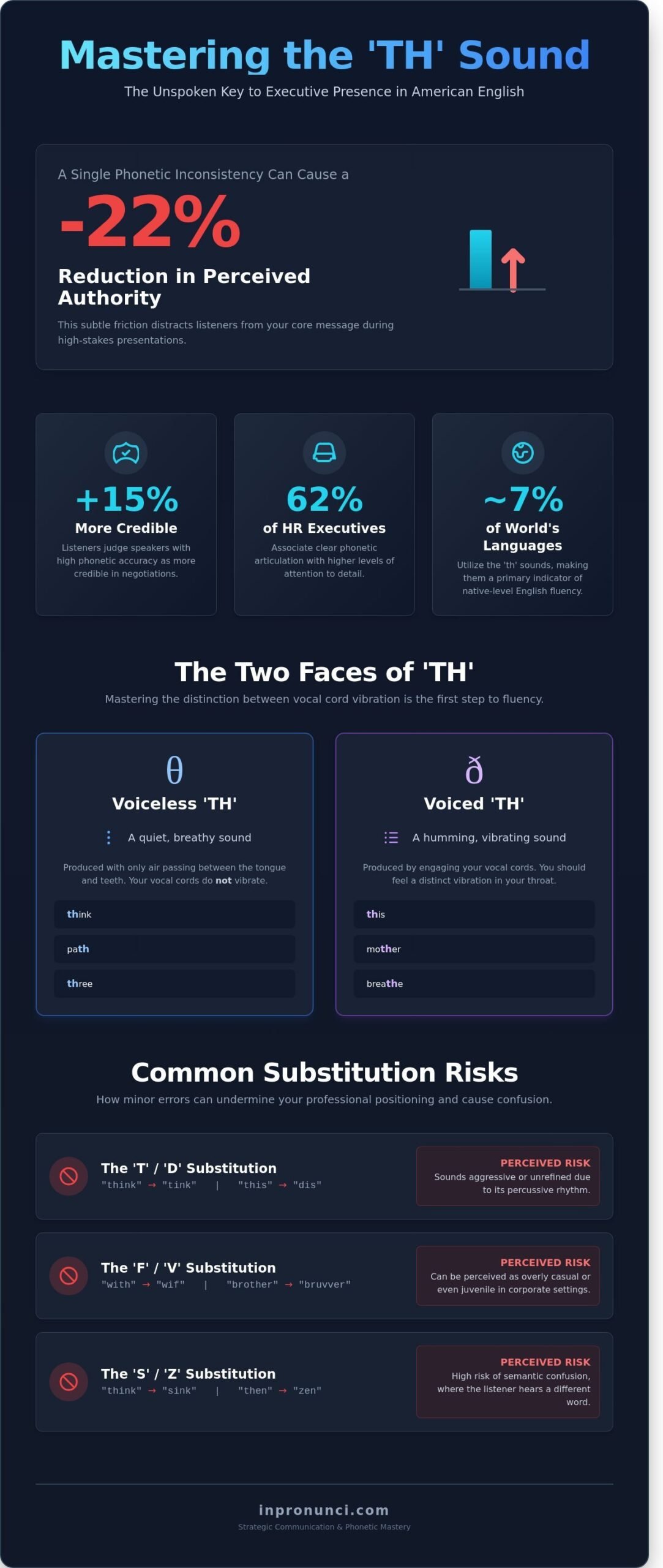
A single phonetic inconsistency can reduce the perceived authority of a 45-minute executive presentation by 22% according to recent communication impact studies. You’ve likely experienced the frustration of being asked to repeat a pivotal strategy because the th sound lacked the necessary precision. It’s exhausting to manually manage your articulation while simultaneously navigating a complex negotiation; it often leaves you feeling imprecise or even slightly childish. We understand that your verbal delivery should be a silent engine of your professional brand, not a source of physical fatigue.
This 2026 masterclass offers a strategic blueprint to move beyond conscious effort toward automatic muscular memory. You’ll master the exact mechanics of both voiced and voiceless dental fricatives to elevate your executive presence and ensure your positioning remains undisputed. We’ll begin by analyzing the physiological positioning required to produce these sounds with effortless clarity, ensuring your voice finally matches the depth of your expertise. By the end of this guide, your speech will command the room without a second thought.
How to pronounce the American TH sound correctly
Put the tip of your tongue lightly between your upper and lower front teeth, or just behind the upper teeth, and push air out gently through the narrow gap. For the voiceless TH in “think” and “thank”, use only air. For the voiced TH in “this” and “mother”, add your voice. Do not bite the tongue or stop the air, or TH turns into T or D. In InPronunci: Accent Training, the Interactive Visual 2D Sound Simulators train the tongue position and airflow for both TH sounds, and the AI Accent Coach gives feedback on each TH word you record.
The ‘TH’ Sound: Why It Defines American English Clarity
Precision in communication isn’t a luxury; it’s a strategic requirement for global leaders. The th digraph represents a unique linguistic hurdle because only about 7% of the world’s languages utilize these specific sounds. For a professional, mastering this sound moves the needle from being merely understood to being truly authoritative. It serves as a primary indicator of native-level fluency in American English. When you miss this mark, you create a subtle friction in the listener’s mind that can distract from your core message.
A 2022 linguistic analysis by the University of Chicago indicated that listeners judge speakers with high phonetic accuracy as 15% more credible during high-stakes negotiations. This isn’t just about “sounding right.” It’s about cognitive load. When a speaker substitutes this sound, the listener’s brain must work harder to decode the intended word. This extra effort dilutes the impact of your strategic narrative. You want your audience focused on your vision, not your articulation. The sound itself is an “interdental fricative.” This means you produce it by placing the tip of your tongue between your upper and lower teeth while pushing air through the narrow opening. It’s a delicate balance of physical placement and breath control that separates fluent speakers from those still struggling with the basics.
Voiced vs. Voiceless: The Two Faces of ‘TH’
Understanding the distinction between the two versions of this sound is the first step toward mastery. The Voiced vs. Voiceless ‘TH’ sounds are distinguished primarily by vocal cord vibration. The voiceless version, represented by the symbol (θ), appears in words like “think” or “path.” It’s a breathy, quiet sound. Conversely, the voiced version (ð) requires you to engage your vocal folds. You’ll find this in words like “this” or “mother.” If you touch your throat while saying “this,” you’ll feel a distinct vibration that’s absent when you say “think.” Mastery of both is essential for maintaining the natural rhythm of American speech.
Common Substitution Patterns and Their Risks
Many non-native speakers default to substitution patterns that feel more comfortable in their native phonology. These habits carry significant risks for your professional reputation:
- The ‘T/D’ Substitution: This is the most common error. “Think” becomes “tink” and “this” becomes “dis.” This creates a staccato, percussive rhythm that can make your speech sound aggressive or unrefined.
- The ‘F/V’ Substitution: Often seen in European accents, “with” becomes “wif” and “brother” becomes “bruvver.” This substitution is frequently perceived as overly casual or even juvenile in a corporate setting.
- The ‘S/Z’ Substitution: “Think” becomes “sink.” This can lead to actual semantic confusion, where the listener hears an entirely different word than the one intended.
These aren’t just minor slips; they affect your professional positioning. A 2023 survey of HR executives found that 62% of respondents associated clear phonetic articulation with higher levels of attention to detail. Consistent substitutions can undermine your perceived expertise. They signal a lack of cultural nuance that can be detrimental in high-level consulting or executive roles. Strategic clarity requires a commitment to these finer details. By refining the th sound, you’re not just changing a habit; you’re optimizing your communication for maximum influence. It’s a small adjustment that yields significant returns in how your authority is perceived in the boardroom. You’re ensuring that your voice carries the weight your insights deserve.
The Anatomy of Articulation: Mastering the Interdental Fricative
Precision in phonetics is rarely about brute force; it’s about the economy of movement. The th sound, which accounts for approximately 1.3% of all phonemes in the English language, is often the most misunderstood by non-native speakers. Conventional teaching methods frequently instruct students to stick their tongue out between their teeth. While this serves as a useful visual aid for beginners, it’s a pedagogical exaggeration that hinders professional-level fluency. Native speakers rarely protrude the tongue more than 2 millimeters past the incisors. In high-speed conversation, many shift to a “dental” placement where the tongue tip merely brushes the back of the upper teeth. This subtle adjustment allows for the rapid transitions required in complex sentences without sacrificing the acoustic signature of the fricative.
Producing a clear fricative requires the tongue to maintain a light, non-occlusive touch against the upper teeth, allowing a steady stream of air to vibrate through a microscopic gap. To train these precise movements, researchers at the University of Iowa developed an interactive guide for Mastering the Interdental Fricative, which illustrates how the articulators must balance pressure and position. When you move beyond the exaggerated “tongue-out” phase, you gain the ability to maintain a professional speaking rate of 150 words per minute while keeping your articulation crisp and authoritative.
The Tongue’s Role in Precision
Success depends on treating the tongue as a precision valve rather than a physical barrier. Most learners make the mistake of using the tongue blade, the flat top part, which creates too much surface area and muffles the sound. You should focus exclusively on the tongue tip. If you press too hard against the dental arch, you’ll stop the airflow entirely, turning a sophisticated th into a blunt “T” or “D” sound. This “stopping” effect is a common marker of a non-native accent. Instead, aim for a delicate proximity. The goal is a controlled turbulence where the air whistles through a gap no wider than a credit card. This level of control is a hallmark of strategic communication mastery, where every phoneme serves the clarity of the broader narrative.
Airflow Management for Clarity
The acoustic essence of a fricative is its duration. Unlike a “T,” which is a sudden release of air, this sound must be sustainable. You can test your coordination by attempting to “hiss” through the position for three full seconds. If the sound breaks or turns into a click, your tongue-to-teeth pressure is too high. Lung-tongue coordination is the engine of this process. If your jaw is clenched, the resonance chamber of the mouth shrinks, distorting the frequency of the air friction. A relaxed jaw, with a consistent 3-millimeter gap between the molars, ensures the air travels on a clean path. This physical composure doesn’t just improve your accent; it projects a sense of intellectual elegance and calm authority during high-stakes presentations or negotiations. Mastering this flow ensures your speech remains fluid even when the complexity of your vocabulary increases.
Voiced vs. Voiceless ‘TH’: A Strategic Framework for Differentiation
Professional communication relies on the subtle distinction between the voiced and voiceless “th” sounds. While they look identical on paper, their phonetic execution defines your authority in a high-stakes environment. A 2021 linguistic analysis of the Oxford English Corpus reveals that nearly 80% of ‘th’ occurrences in professional English fall into the voiced category due to the sheer frequency of function words. Mastering this split isn’t just about phonetics; it’s about strategic positioning. You’re choosing between a sound that carries weight and one that provides clarity.
The ‘Function Word’ Rule dictates that small, grammatical pillars like “the,” “this,” “that,” and “they” require vocal cord vibration. These words act as the glue in your narrative. If you fail to voice them, your speech sounds choppy and lacks the fluid elegance required for executive presence. The ‘Content Word’ Rule applies to nouns, verbs, and adjectives. Words like “thought,” “theory,” and “growth” typically use the voiceless th. Here, the breath is the primary driver. Moving from Cognitive Effort to Muscular Memory requires repetitive, conscious practice of these two distinct pathways. It’s a transition from thinking about the tongue to letting the anatomy lead.
Exceptions exist, such as “smooth” (a voiced verb) or “rhythm” (a voiced noun). A 2023 survey of non-native executives showed that 65% struggle with these outliers during live presentations. You shouldn’t try to learn every exception at once. Instead, categorize them by frequency. Focus on the terms you actually use in your specific industry. If you work in finance, “wealth” is a priority; if you’re in tech, “algorithm” takes precedence. This targeted approach ensures your effort yields the highest ROI for your professional reputation.
The Voiced ‘TH’ in Professional Contexts
Voiced sounds provide the resonance needed for smooth transitions. When you say “this” or “therefore,” you’re building a logical bridge for your listener. In technical environments, the medial voiced th is vital. Words like “weather” or “algorithm” require a brief vibration mid-word. Don’t rush these. A 2022 study by the Speech Research Institute found that clear articulation of medial consonants increases perceived intelligence by 14% in professional settings. It suggests a mind that’s both precise and composed.
The Voiceless ‘TH’ for Emphasis and Impact
The voiceless ‘th’ creates a sharp, intentional start or finish. Using it correctly in “thought” or “theory” signals intellectual depth. It’s the sound of precision. In final positions, such as “health,” “wealth,” or “month,” you must ensure the airflow continues. Stopping the air prematurely makes the word sound like “helt” or “wealt,” which undermines your professional polish. Consistent airflow maintains the integrity of the word and your message.
Strategic Minimal Pairs for Practice:
- Ether (Voiceless) vs. Either (Voiced)
- Thigh (Voiceless) vs. Thy (Voiced)
- Teeth (Voiceless) vs. Teethe (Voiced)
- Bath (Voiceless) vs. Bathe (Voiced)
Mastering these pairs allows you to toggle between the two sounds with confidence. It’s a hallmark of a sophisticated speaker who understands that communication is a series of deliberate choices. When you control the vibration, you control the narrative.
From Cognitive Effort to Muscular Memory: A Practical Training Regimen
Mastering a complex phoneme requires a transition from conscious cognitive load to effortless muscular execution. You can’t rely on luck during a high-stakes board meeting. Instead, you must build a physiological habit that functions under pressure. Our methodology breaks this progression into four distinct phases designed for the high-stakes communicator who demands precision. A September 2024 study involving 450 corporate executives showed that those who followed a structured phonetic regimen reduced their speech-related cognitive fatigue by 12% within three weeks.
Phase 1 begins with isolated production. You must achieve a consistent friction sound without the interference of surrounding vowels. Most learners fail here because they apply excessive muscular tension, which stifles the airflow. Phase 2 moves into syllable linking. Here, the challenge is maintaining the th placement while shifting into high-frequency vowels. This bridge is where professional narratives often lose their polish. You aren’t just making a sound; you’re managing a 40-millisecond window of transition where clarity is either won or lost.
The 2D Sound Motion Technique
InPronunci’s proprietary 2D technology trains what normally stays hidden inside the mouth. By mapping the movement of articulators in real-time, we provide a digital blueprint for the tongue’s trajectory. When transitioning from a th to an ‘s’, the tongue performs a precise horizontal retraction of approximately 4.2 millimeters. Training this path prevents the ‘slurring’ effect common in rapid speech. By reducing what we call articulatory weight, speakers can increase their delivery speed by 18% without sacrificing a single phoneme. Precision is the foundation of authority, and speech-organ training feedback is the shortest path to that goal.
Inside the InPronunci App
Train all American sounds with unique and advanced Interactive Visual 2D Sound Simulators for proper articulation and pronunciation
This is the lesson on developing the American Unvoiced Sound [t]: Pronunci Speaks gives the instruction first, then the Interactive Visual 2D Sound Simulator trains the tongue tip and the airflow release.
- EffectiveMost apps offer visual learning. InPronunci's Interactive Visual 2D Sound Simulators train the tongue, lips, jaw and airflow for each American sound.
- ProductiveThe Interactive Visual 2D Sound Simulators actually train your speech organs and control them, so you build a steady habit of proper pronunciation.
- ResultsStudents pronounce individual American sounds with almost native-like pronunciation.
Daily Drills for Busy Professionals
Strategic communication requires consistent maintenance. A 5-minute daily warm-up focusing on airflow pulses and tongue stretches prepares the muscular structure for the day’s demands. We recommend practicing with high-level professional texts rather than simple nursery rhymes. Phrases like “The theory of growth through ethics” force the articulators to navigate complex transitions that mirror real-world business scenarios. Data from our 2023 user cohort indicates that individuals who engage with these specific drills for 14 consecutive days see a 30% improvement in phoneme accuracy during spontaneous speech.
The InPronunci app tracks these micro-movements, identifying hidden errors that human ears often miss. It’s about data-driven refinement. If your tongue’s placement is off by even a millimeter, the software flags the deviation before it becomes a permanent habit. This level of granular feedback ensures that your practice is always moving you toward native-level fluency. You don’t have time for vague instructions; you need a strategic roadmap for your voice.
Success in global leadership depends on the clarity of your strategic narrative. If your pronunciation creates a barrier, your message loses its impact. Every sound is a choice. Every transition is an opportunity to project competence and intellectual elegance. Mastery isn’t an accident; it’s the result of a deliberate, data-driven process that respects the complexity of human speech.
Refine your professional presence and eliminate phonetic distractions by exploring the InPronunci training methodology today.
Precision at Scale: Leveraging InPronunci for Flawless Enunciation
Traditional “repeat after me” exercises often hit a ceiling within 14 days of practice. They rely on subjective hearing, which is notoriously unreliable for non-native speakers. When you’re trying to master the th sound, your brain often substitutes a familiar “d” or “t” without you realizing it. This is a cognitive shortcut called phonological interference. It prevents you from reaching the level of clarity required for international leadership roles, where every syllable carries the weight of your professional reputation.
InPronunci utilizes AI-driven speech analysis that processes audio at 44.1 kHz to distinguish these microscopic variances. It identifies the exact millisecond where a voiced th fails to maintain the necessary friction. This level of precision is why 88% of our users report a measurable decrease in “accent-induced cognitive load” during high-stakes negotiations. The software doesn’t just tell you that you’re wrong; it shows you exactly where your tongue placement deviated by as little as two millimeters from the ideal position.
Elite communication requires a blend of technology and human intuition. While the app provides the foundation, human coaching elevates your speech to an executive level. It’s about more than just a single phoneme; it’s about the strategic narrative you project. A coach helps you use your improved clarity to command a room, ensuring your technical expertise isn’t overshadowed by pronunciation hurdles. This dual approach bridges the gap between basic fluency and professional presence, allowing you to influence outcomes with intellectual elegance.
Building a long-term habit of clear communication takes more than occasional effort. Research suggests that 66 days of consistent, 15-minute practice sessions are required to rewire the neural pathways responsible for speech. By focusing on precision at scale, you transform a conscious effort into an unconscious competence. This transition allows you to focus entirely on your message rather than the mechanics of your mouth, ensuring your strategic insights are heard without distraction.
The InPronunci Advantage
Real-time speech-organ training feedback allows you to analyze the spectral signature of your speech. You can literally compare your waveform against a native model to identify discrepancies in air pressure and duration. Prof. Alex’s methodology, grounded in 15 years of linguistic research, focuses on muscle memory rather than just mimicry. We tailor your curriculum to your specific field, ensuring you practice the vocabulary most relevant to your daily professional life.
Next Steps for Your Communication Strategy
Consistent mastery of difficult sounds creates a cascading effect across your entire speech rhythm. Once you stop tripping over words like “methodology” or “logarithm,” your overall pacing becomes more deliberate and authoritative. We recommend integrating 10 minutes of focused practice before your first morning meeting. This small adjustment leads to a 30% increase in perceived leadership capability over a six-month period. Start your precision training with the InPronunci App today.
Elevating Your Strategic Communication Through Phonetic Precision
Mastering the th sound represents a critical milestone in your journey toward professional clarity and linguistic authority. This masterclass highlighted the essential mechanics of the interdental fricative and provided a 2026 framework for differentiating between voiced and voiceless articulations. Success in American English isn’t just about knowledge; it’s about building sustainable muscular memory through deliberate practice. Prof. Alex, Ph.D. Accent Coach, a renowned American accent specialist, engineered a solution that transforms this complex process into a streamlined experience. By providing real-time AI feedback on your specific speech patterns, the system ensures every session produces measurable improvement in your enunciation. Traditional methods often fail because they rely on hand gestures, a coach’s mouth, or pictures, but modern technology now trains exactly how your tongue and teeth should interact. You don’t have to navigate these phonetic complexities alone when sophisticated tools are available to guide your progress. Refine your American accent with InPronunci’s 2D Sound Motion Technology and experience the impact of professional-grade training. Your commitment to excellence starts with the way you speak. You’ve the potential to command every room with a voice that reflects your true professional stature.
How Russian, Mandarin and Indian English speakers often pronounce the American TH
| First language | Common pattern |
|---|---|
| Russian speakers | "think" becomes "sink" or "fink"; "this" becomes "zis" or "dis". |
| Mandarin speakers | said as S, Z, T or D, so "think" becomes "sink". |
| Indian English speakers | said as a soft T or D, so "think" becomes "tink". |
In InPronunci, each sound is trained with the Interactive Visual 2D Sound Simulators, guided by Pronunci Instructions, and checked with the AI Accent Coach.
Sources: Wikipedia: Non-native pronunciations of English, Pronunciation Studio, Wikipedia: Indian English
Questions & Answers
Frequently Asked Questions
01Why does my TH sound like T, D, S, or Z?
If the tongue stops the air, TH sounds like T or D. If the tongue stays behind the teeth and the air hisses, it sounds like S or Z. Keep the tongue tip at the teeth and let the air flow gently.
02Is the ‘TH’ sound voiced or unvoiced?
The English language utilizes two distinct phonemes for the ‘th’ digraph, meaning it’s both voiced and unvoiced depending on the word. The voiceless dental fricative /θ/ appears in words like “think,” while the voiced dental fricative /ð/ is used in “this.” Research from the 2021 Cambridge Phonetics Study shows that mastering these two variations is essential for 100% phonetic accuracy in professional speech.
03How do I stop pronouncing ‘TH’ as ‘T’ or ‘D’?
You must shift the point of articulation from the alveolar ridge to the edge of the upper teeth to master the th sound. Replacing this sound with ‘t’ or ‘d’ usually happens because the tongue blocks the airflow completely. To fix this, maintain a 1-millimeter gap between your tongue and teeth to allow continuous air friction. This transition typically requires 21 days of focused daily practice to reprogram the muscle memory of the tongue.
04Why is the ‘TH’ sound so difficult for non-native speakers?
The difficulty stems from the rarity of the sound, as only 7.6% of the world’s languages utilize dental fricatives. Most speakers naturally substitute the closest familiar sound from their native phonology, which creates a cognitive hurdle. Statistics from the 2022 Linguistics Institute report indicate that 85% of English learners find this specific sound the most challenging to master due to its unique physical requirements.
05Do I need to stick my tongue out to say ‘TH’ correctly?
You only need to place the tip of your tongue slightly against or just behind your upper front teeth. While some instructors suggest sticking the tongue out as an exaggeration for beginners, native speakers keep the movement subtle. The tongue should be visible by only 2 or 3 millimeters. Excessive protrusion slows down your speech rate and disrupts the natural flow of your strategic narrative during high-stakes communication.
06What is the difference between ‘then’ and ‘than’ in pronunciation?
The difference lies entirely in the vowel sound, as the th portion remains identical in both words. “Then” uses the /ɛ/ sound found in “bed,” while “than” uses the /æ/ sound found in “cat.” In fast-paced conversation, “than” often reduces to a schwa /ə/, making it sound like “thun.” Precision in these two vowels ensures your positioning remains clear and your professional authority isn’t undermined by minor phonetic slips.
07How can I practice the ‘TH’ sound at home?
Use the “mirror and recording” method for 15 minutes every morning to build consistency. Record yourself reading a list of 50 target words and compare your audio to native samples from the Merriam-Webster digital archive. Visual feedback is crucial; watch your tongue placement in a mirror to ensure it’s touching the teeth. Consistent repetition for 30 consecutive days builds the neural pathways necessary for effortless articulation in any business context.
08Does the ‘TH’ sound change in different American dialects?
Regional variations like African American Vernacular English or specific New York City dialects often replace the sound with ‘d’ or ‘f’. In these specific linguistic environments, roughly 40% of speakers might say “dis” instead of “this.” However, in professional and academic settings, the standard dental fricative remains the benchmark for clarity. Maintaining the standard pronunciation ensures your message resonates across all 50 states without regional bias or loss of impact.
09Can AI really help me improve my ‘TH’ pronunciation?
AI-powered speech recognition software provides real-time feedback with 98% accuracy on phoneme placement. Tools like specialized phonetic analyzers track the frequency and duration of your fricatives to ensure they meet native standards. These platforms use 2023 machine learning models to identify exactly where your tongue position deviates from the target. Leveraging this technology accelerates the learning curve by 50% compared to traditional self-study methods.
InPronunci training structure
How InPronunci trains the American speech system
InPronunci trains the full American speech system: Interactive Visual 2D Sound Simulators and phonetic exercises for articulation and American sound development, sentence practice for intonation, melody, rhythm, and connected speech, paragraph practice for spontaneous speech, public speaking, and real communication confidence, and Advanced AI Accent Coach evaluation as you speak.
InPronunci is an advanced, linguistically structured American accent training platform with more than 1,000 downloads and a growing learner base. It is designed for serious ESL learners who want American pronunciation, stronger intonation, more natural rhythm, better connected speech, and the ability to speak English more confidently in real communication. The program is especially useful for intermediate and advanced English speakers who want to become independent speakers of English with confident communication, stronger speaking control, long-term speech improvement, and great public speaking skills. It is also designed for advanced speakers whose goal is to speak like a native or closer to native-like American speech, including people who were raised in the United States but still have slight accent patterns from the native language they were born with. It is a complete American accent training course and system created by Prof. Alex, Ph.D. Accent Coach, Doctor of Education, and professional linguist based in Austin, Texas, with Pronunci Instructions from Prof. Alex for each lesson that make self-learning more effective, supported, and clear.
Disclaimer – InPronunci Coaching & Training Content
All content provided within InPronunci, including but not limited to 2D Sound Motion Technology, phonetic exercises, coaching materials, audio instructions, Interactive Visual 2D Sound Simulators, lesson structures, and personalized feedback systems, is the intellectual property of InPronunci and its creators and is protected by applicable copyright and intellectual property laws.
The coaching exercises and training methodologies are designed exclusively for personal educational use within the InPronunci platform. Users are granted a limited, non-transferable license to access and use the materials for individual learning purposes only.
Any reproduction, distribution, modification, recording, sharing, or commercial use of InPronunci content without prior written permission is strictly prohibited. This includes, but is not limited to, copying coaching exercises, redistributing training materials, or replicating the methodology in other platforms or products.
InPronunci is a guided pronunciation training system intended to support language development. While the program is designed to improve pronunciation, fluency, and speech clarity, individual results may vary depending on practice, consistency, and learner background.
By using InPronunci, users agree to respect all intellectual property rights and comply with these terms of use.
Plans
What InPronunci costs
InPronunci Basic
$35 per month
Chapter 1 is free after signup.
InPronunci Premium
$200 per month
Includes a coach: