


Have you ever caught yourself rewatching the same scene in an American movie just to figure out what someone actually said? You are definitely not alone. Mastering the way American English sounds can feel like cracking a secret code, but here is the good news: once you understand the basics, everything starts to click into place.
In this tutorial, we are going to break down American English consonant vowel sounds in a way that is easy to follow, even if you are completely new to phonetics. No complicated jargon, no overwhelming charts. Just clear, simple explanations that will help you hear and produce sounds with more confidence.
By the time you finish reading, you will know the difference between consonants and vowels, understand how each type of sound is made, and have a solid foundation for improving your pronunciation. Whether you are learning English for travel, work, or just personal growth, getting comfortable with these fundamental sounds is truly the best place to start. Let us dive in!
What Are Consonant and Vowel Sounds in American English?
If you are just starting to explore American English pronunciation, one of the most empowering things you can do is understand the basic building blocks of the sound system. American English is made up of two fundamental categories of sounds: consonants and vowels. Together, they form every word you hear and speak. Getting familiar with these categories gives you a mental framework, almost like a map, that helps you recognize patterns, predict how words should sound, and practice with much more focus and confidence.
The Consonant Sounds of American English
American English has approximately 24 consonant sounds, each produced with some degree of constriction or blockage in the vocal tract. Think of consonants as sounds that involve your lips, teeth, tongue, or throat creating an obstacle for the airflow. That obstruction is what gives consonants their distinct, often sharp or buzzing quality. According to research on English consonants and the International Phonetic Alphabet, these sounds are organized into categories based on how and where they are produced.
Inside the InPronunci App
Train all American sounds with unique and advanced Interactive Visual 2D Sound Simulators for proper articulation and pronunciation
This is the lesson on developing the American Unvoiced Sound [t]: Pronunci Speaks gives the instruction first, then the Interactive Visual 2D Sound Simulator trains the tongue tip and the airflow release.
- EffectiveMost apps offer visual learning. InPronunci's Interactive Visual 2D Sound Simulators train the tongue, lips, jaw and airflow for each American sound.
- ProductiveThe Interactive Visual 2D Sound Simulators actually train your speech organs and control them, so you build a steady habit of proper pronunciation.
- ResultsStudents pronounce individual American sounds with almost native-like pronunciation.
The main categories you will come across include:
- Stops (also called plosives): These involve a complete block of airflow followed by a small burst of sound. Examples include the sounds at the beginning of “pat,” “bat,” “top,” “dog,” “cat,” and “go.”
- Fricatives: These create a hissing or buzzing noise through a narrow gap in the vocal tract. Think of the sounds in “fan,” “van,” “thin,” “this,” “sip,” “zip,” and “she.”
- Nasals: Here, airflow moves through the nose rather than the mouth. The sounds in “mom,” “noon,” and “sing” are classic examples.
- Approximants: These involve very little obstruction, with sounds flowing almost like a vowel. The sounds at the start of “red,” “let,” “wet,” and “yes” fall into this group.
Understanding these groupings helps you see why certain sounds feel similar and why they might be easy to mix up during practice.
Vowels, Tongue Position, and the Tense-Lax Distinction
American English has roughly 14 to 15 vowel sounds, including diphthongs, and vowels work very differently from consonants. Instead of blocking airflow, vowels let air move freely through the vocal tract. What shapes them is the position of your tongue and the rounding of your lips. Research on American English vowels describes vowels along three key dimensions: tongue height (high, mid, or low), tongue backness (front, central, or back), and lip rounding.
One of the most important distinctions in American English is the difference between tense and lax vowels. Tense vowels, like the sounds in “beat” and “boot,” tend to involve more extreme tongue positions. Lax vowels, like the sounds in “bit” and “book,” are more relaxed and centralized. Mixing these up is one of the most common challenges for non-native speakers, and it can genuinely affect how clearly you are understood.
Diphthongs: Vowels That Move
Some vowel sounds in American English do not stay in one position. They shift smoothly from one tongue position to another within a single syllable. These are called diphthongs, and they give American English much of its flowing, musical quality. The vowel sound in “face” starts in one position and glides toward another. The vowel in “time” begins low and central, then moves upward toward the front of the mouth. Other common diphthongs appear in words like “boy,” “cow,” and “boat.”
For learners, diphthongs can feel tricky because the movement needs to be smooth, not two separate sounds. Practicing them in real words and phrases, with feedback on your actual production, makes a big difference.
Why This Foundation Matters for Your Practice
When you understand how consonants and vowels are organized in English phonology, pronunciation patterns start to feel less random. You begin to notice why certain words are harder for you to say, which sounds from your first language might be interfering, and what specific adjustments could help. This kind of structured awareness is exactly what InPronunci builds into its American accent training approach. Rather than drilling isolated sounds without context, InPronunci helps you connect this foundational knowledge to real-world speaking practice, guided by AI-powered feedback designed to support your progress step by step.
How American English Sounds Differ from Other Languages
One of the most important things to understand as you begin your American English pronunciation journey is that the challenges you face are not random. They are predictable, well-researched, and completely normal. Most pronunciation difficulties come from something linguists call L1 interference, which is when your brain automatically applies the sound rules from your first language to English words where those rules simply do not fit. This happens unconsciously, and it happens to almost every non-native speaker. Understanding why it happens is the first step toward building clearer speaking habits with a platform like InPronunci.
Why Certain Sounds Feel Physically Unfamiliar
Some American English sounds do not exist in most other languages at all. The “th” sounds are a great example. There are actually two versions: the voiceless sound in words like “think” and “thanks,” and the voiced sound in words like “this” and “that.” Both require you to place your tongue lightly between your teeth while controlling your airflow, and that muscle movement is genuinely foreign to most speakers. Because these sounds do not appear in Spanish, French, Arabic, Hindi, Mandarin, Japanese, or many other languages, learners often replace them with sounds that feel more familiar, such as “t,” “d,” “s,” or “z.” This is not a bad habit; it is simply your brain making the closest match it knows. With deliberate muscle training and consistent practice, these sounds become much more manageable. InPronunci’s AI-powered feedback is specifically designed to help you identify exactly which sounds need more attention, so you are not guessing.
The R and L Challenge
Another well-documented area of difficulty involves the American English “r” and “l” sounds. For speakers of East Asian languages like Japanese, Korean, and Mandarin, these two sounds either merge into a single sound or map onto something quite different in their native system. The result is that distinguishing “right” from “light” or “rice” from “lice” can feel genuinely difficult at first, not because of carelessness, but because of how the brain has been wired to hear and produce sounds. Speakers from Romance language backgrounds may also struggle because their version of “r” involves a trill or tap that sounds nothing like the soft, rounded American “r.” Research into how native language habits affect pronunciation confirms that these patterns follow clear, predictable rules based on your linguistic background.
Spelling Does Not Always Help
Here is something many learners discover the hard way: English spelling is not a reliable guide to pronunciation, especially for vowel sounds in American English. A university study investigating pronunciation problems for non-native speakers found that 55 percent of respondents identified spelling and pronunciation mismatches as a major challenge. This makes complete sense when you consider how many different vowel sounds can hide behind the same letter combinations in English. The letter “o” sounds different in “go,” “got,” “do,” and “women.” Relying on spelling alone can actually reinforce incorrect pronunciation habits, which is why structured, sound-focused training matters so much.
Confidence Is Part of the Process
Beyond the physical and phonological challenges, there is an emotional layer that deserves acknowledgment. The same study found that 65 percent of non-native speakers reported that anxiety directly impacted their pronunciation performance. This is incredibly common, and it is not a weakness. Speaking in a second language in front of others takes real courage, and the fear of being misunderstood or judged can make even well-practiced sounds harder to produce in the moment. That is why InPronunci is built on a supportive, non-judgmental approach. The goal is not to eliminate your accent but to help you communicate more clearly and feel genuinely confident every time you speak.
The Physiology of Clear Pronunciation: Tongue, Lips, and Airflow
So far, we have talked about what the sounds are and why they feel challenging. Now let us take a closer look at something that many beginners never hear about but that makes a real difference: the physical side of pronunciation.
Here is the truth that often gets overlooked. Producing clear American English sounds is not just about training your ears and copying what you hear. It is also about knowing exactly where to place your tongue, how to position your lips, how open your jaw should be, and how air moves through your mouth as you speak. Think of it like learning to play an instrument. Listening to music helps, but you also need to know how to hold your hands. Pronunciation works the same way.
The Physical Map of Consonant Sounds
When you produce a consonant sound, something in your mouth creates a blockage or restriction that shapes the air coming from your lungs. The location of that restriction is called the place of articulation, and it changes depending on the sound.
Bilabial sounds are made when both lips press together or come close. The sounds /p/, /b/, and /m/ all fall into this category. You can feel this easily by saying “pop” and noticing how your lips do all the work. Alveolar sounds involve the tip of your tongue touching or approaching the small ridge just behind your upper front teeth. Sounds like /t/, /d/, /s/, /z/, and /n/ are all produced at this location. And then there are velar sounds, where the back of your tongue rises to meet the soft palate at the back of your mouth. The sounds /k/, /g/, and the /ng/ sound in “sing” are classic examples. The key takeaway here is that very small shifts in tongue or lip position create completely different sounds, which is why awareness of these positions matters so much.
How Tongue Height Controls Vowel Sounds
Vowels follow a different set of rules. With vowels, airflow moves through your mouth without any full blockage, but the shape of your mouth and the position of your tongue still determine what sound comes out. Two main factors are tongue height and whether your tongue sits toward the front or back of your mouth.
For example, the /iː/ sound in “see” requires your tongue to be high and forward. The /ɑ/ sound in “father” needs your tongue to drop low and move back. This is exactly why words that look similar in spelling can sound so different. Consider “though,” “through,” and “tough.” Same letters, completely different vowel sounds, because the tongue positions involved are entirely distinct.
Why Seeing the Movement Changes Everything
Most beginners rely heavily on listening and repeating, and while that builds some familiarity, it has real limits. Pronunciation is a physical skill, and without guidance on what your articulators should actually be doing, progress can plateau. Speech-organ training fills that gap by training the specific movements your mouth needs to make.
This is where InPronunci brings something genuinely different to your training. The platform incorporates 2D Sound Motion Technology, developed by Prof. Alex, Ph.D. Accent Coach, a linguist, which trains the tongue, lips, jaw, teeth, airflow, and voice for consonant and vowel sounds in American English with full articulation details. Rather than guessing whether your tongue is in the right position, you can understand correct articulation before you practice. This kind of speech-organ guidance supports the development of muscle memory far more effectively than audio-only methods, because it connects what you hear to what your body needs to do. Over time, those physical habits become automatic, and your speech starts to feel more natural and flow more consistently.
Consonant Vowel Linking: The Key to Natural American English Flow
Now that you understand how individual sounds are formed in the mouth, it is time to explore something that completely changes how natural your speech sounds: the way sounds connect across words. This is where many learners have a real breakthrough moment.
Consonant-vowel linking, often called C-V linking or catenation, happens in connected speech when a word ends in a consonant sound and the next word begins with a vowel sound. Instead of stopping between the two words, the final consonant sound blends smoothly into the opening vowel of the following word. The result is a fluid, seamless flow that sounds natural to American English listeners. This is not a shortcut or lazy speech; it is simply how American English works in real conversations, from casual chats to professional presentations.
How C-V Linking Sounds in Real Speech
The best way to understand this is through examples you can actually hear in your head. Take the phrase “look at.” In natural American English, you do not say two separate words with a pause between them. Instead, the /k/ sound at the end of “look” slides right into “at,” creating something that sounds like “loo-kat.” The same thing happens with “turn off,” which becomes “tur-noff,” and “please omit,” which blends into “plea-zomit.” Other everyday examples include “find out” sounding like “fin-dout,” “walk on” flowing as “wal-kon,” and “ten hours” becoming “te-nowers.” Once you start listening for this pattern, you will hear it constantly in American English speech.
Why C-V Linking Actually Improves Your Clarity
Here is something that surprises many beginners: linking your sounds together does not make you harder to understand. It actually makes you clearer. When a consonant moves from the end of one word to the beginning of the next, it lands in what linguists call the word-initial position, where consonant sounds are naturally stronger, crisper, and easier for listeners to catch. Word-final consonants are often weaker and can get lost. By linking, you are essentially giving that consonant a better, stronger platform to be heard. According to connected speech research from Iowa State University’s pronunciation teaching resources, C-V linking is one of the most consistent and fundamental features of natural American English across all speaking registers, from formal to casual.
The Gap Most Pronunciation Lessons Leave Behind
Most traditional pronunciation resources spend a lot of time on individual sounds in isolation: drilling a single vowel, repeating a consonant, practicing minimal pairs like “ship” and “sheep.” That kind of practice is genuinely useful for building awareness. However, it leaves a significant gap because real conversations do not happen in isolated sounds. Research and connected speech guidance from Baruch College’s Tools for Clear Speech confirms that learners who focus only on citation-form pronunciation, meaning how words sound alone, often struggle when they encounter natural, connected American speech in the real world.
This is exactly why InPronunci’s approach goes beyond single-sound drills. The platform’s AI-powered feedback is designed to support you as you practice sounds within full sentences and real-world phrases, giving you guidance on how your speech actually flows in context, not just how individual sounds sit in isolation.
Bridging the Gap with Sentence-Level Practice
The best way to build C-V linking into your natural speech is to practice it inside full sentences, not just word pairs. Try saying “I found out about it” as one smooth, connected phrase. Notice how “found out” and “out about” both offer natural linking opportunities. Shadowing recordings of natural American speech is another powerful technique; you listen and repeat closely, training your ear and your mouth at the same time. InPronunci’s structured lessons incorporate this kind of real-world phrase practice, supporting you as you move from understanding C-V linking as a concept to using it automatically in conversation. That shift, from knowing a rule to speaking naturally, is where real communication confidence begins to grow.
Common Mistakes Non-Native Speakers Make with Consonant Vowel Sounds
Understanding where things go wrong is one of the fastest ways to move forward. Many of the patterns that make American English feel difficult are predictable, and recognizing them in your own speech is the first step toward real improvement with InPronunci’s structured training approach.
Breaking words apart instead of blending them together is one of the most common habits that gets in the way of natural-sounding speech. When you treat each word as a separate unit and insert a small pause or a hard stop between them, your speech can sound choppy and effortful. In American English, native speakers naturally glide consonants into the vowels that follow, so phrases like “turn it off” flow as a smooth connected unit rather than three separate pieces. InPronunci’s accent training helps you hear and practice these blending patterns until they start to feel automatic.
Sound substitutions from your first language also show up frequently and can reduce how clearly you are understood. A great example is the voiced “th” sound, as in the word “this.” Because this sound does not exist in many languages, speakers often replace it with a “d” or “z,” turning “this” into “dis” or “zis.” These substitutions are completely natural responses to an unfamiliar sound, but with targeted practice and AI-powered feedback, you can train your tongue placement to produce the correct sound consistently. Research on common English pronunciation errors confirms that th-sound confusion is one of the most widespread patterns across learner backgrounds.
Vowel reduction is another area where rhythm gets lost. American English is a stress-timed language, which means unstressed syllables typically shorten and relax into a soft neutral sound called the schwa. When learners give every syllable equal weight and full vowel length, the result sounds precise but unnatural. For example, the word “banana” has only one fully stressed syllable, and the others reduce noticeably in natural speech. One study found that 93 percent of intermediate learners substituted full vowels for the schwa when it should have been reduced.
Tense and lax vowel confusion, such as mixing the vowel sound in “ship” with the one in “sheep,” is another pattern worth knowing about. These two sounds feel very similar but carry completely different meanings, and the difference comes down to subtle muscle tension and vowel length. According to 2026 ESL pronunciation research, this is highly correctable with focused minimal-pair practice.
Finally, anxiety and over-monitoring deserve just as much attention as any technical error. When you are anxious about how you sound, you may catch yourself mentally checking every word mid-sentence, which breaks up your fluency and actually makes pronunciation harder. Research shows that 65 percent of learners report anxiety affecting their pronunciation performance. InPronunci’s structured repetition and encouraging AI feedback create a supportive space where you can practice without pressure, building the kind of confidence that makes natural speech possible.
How to Practice Consonant and Vowel Sounds Effectively
Knowing what the sounds are is just the beginning. The real progress happens when you build a consistent practice routine that actually prepares you for real conversations. Here are five approaches that work especially well for building accuracy and fluency with American English consonant vowel sounds.
Use Minimal Pairs Inside Full Sentences
You may have seen minimal pair lists before, words like ship and sheep, bit and beat, or fan and van. Reading through those lists has some value, but it only gets you so far. When you practice those same sounds inside complete sentences, something more powerful happens. You are building accuracy and fluency at the same time, which is exactly what real communication requires.
Try sentences like “The ship was carrying sheep across the bay” or “Please sit in your seat before the meeting starts.” Practicing this way forces your mouth to move between sounds naturally, rather than pausing after each word. It also helps you develop consonant vowel linking in a realistic rhythm. Record yourself, listen back, and notice where the sounds blur or break apart. That simple feedback loop makes a big difference over time.
Shadow Real American English Speakers
Shadowing means listening to a speaker and repeating almost simultaneously, matching their rhythm, pace, and sound connections as closely as you can. This technique trains both your ear and your mouth to process consonant vowel linking the way it actually happens in natural speech.
The best material for shadowing includes podcasts, workplace presentation recordings, TED-style talks, or even well-recorded videos of professional conversations. Choose something short, around 20 to 30 seconds, and shadow it repeatedly. Pay attention to moments where a word ends in a consonant and the next word begins with a vowel, like “pick it up” or “turn it off.” Those are the exact linking patterns that make American English sound smooth and connected.
Practice Scenarios That Actually Matter to You
One of the most motivating things you can do is tie your pronunciation practice to a goal that is personally meaningful. If you have a job interview coming up, rehearse your answers out loud and pay close attention to how your target sounds appear in those specific sentences. If you are preparing for academic presentations, practice the phrases and transitions you will actually use. Connecting sound-level accuracy to real-world situations makes the work feel purposeful rather than mechanical, and it helps the improvements stick.
Build a Daily Habit with InPronunci’s Basic Plan
InPronunci’s Basic plan is designed specifically to support this kind of consistent, structured practice. It gives you guided pronunciation lessons, core accent training tools, and AI-powered feedback, all organized to help you move progressively from individual sounds into connected speech. The structured format makes it easy to show up every day without wondering what to practice next.
Go Deeper with InPronunci’s Premium Plan
When you are ready to target specific challenges more precisely, InPronunci’s Premium plan takes your practice further. It adds phoneme-level AI analysis, deeper feedback on individual sounds, and expanded support features that help you track your progress over time. If certain consonant vowel sounds keep tripping you up, the Premium plan helps you isolate exactly where the difficulty is and address it with much greater precision.
How InPronunci’s AI Feedback Accelerates Consonant Vowel Mastery
If you have been putting in the work to understand individual consonant and vowel sounds, you already know that awareness is only part of the journey. The next step is getting feedback that actually tells you something useful. That is where InPronunci’s AI-powered approach makes a real difference for learners who are serious about improving their American English pronunciation.
Phoneme-Level Feedback That Tells You Exactly What to Fix
Most basic pronunciation tools give you a general score and not much else. InPronunci works differently. Its AI Accent Coach analyzes your speech at the phoneme level, meaning it breaks down what you said into individual consonant and vowel sounds and gives you specific, targeted guidance on each one. If your /æ/ vowel in “that” is off, or if your final /t/ sound is getting lost at the end of a word, the platform identifies it directly. You are not left guessing about what went wrong. This kind of precise, real-time feedback helps you make corrections in the moment, which is far more effective than waiting until the end of a practice session to find out something was unclear.
Seeing the Sound Before You Speak It
One of the most innovative features InPronunci brings to consonant and vowel training is its 2D Sound Motion Technology. Developed by linguist and accent coach Prof. Alex, Ph.D. Accent Coach, this technology trains the speech organs—tongue, lips, jaw, teeth, airflow, and voice—to produce each American English sound. Think of it as a training simulator for what is happening inside your mouth. When you learn the physical position required for a sound like /r/ or the /æ/ vowel before you attempt it, you build muscle memory faster and reduce the frustration that often comes from repeated unsuccessful attempts. This moves pronunciation training beyond just hearing and repeating, which is a significant advantage for learners who benefit from detailed articulation training and for anyone working through what researchers call phonemic deafness, the difficulty of hearing distinctions in sounds that do not exist in your first language.
Practice That Focuses on Your Specific Challenges
InPronunci does not serve everyone the same generic content. The platform uses AI analysis of your recordings to identify which consonant or vowel sounds are most difficult for you personally and then focuses your practice time on those specific areas. This personalized approach matters because the challenges a Spanish speaker faces are often different from those a Mandarin or Hindi speaker encounters. Rather than spending equal time on sounds you already produce clearly, you work on what actually needs attention. The result is more efficient practice and faster, more noticeable progress.
A Curriculum Built for Real Speaking, Not Just Drills
The platform’s structured accent lessons follow a progression that research consistently supports. You start with individual sound awareness, move through all 24 American English consonants and 15 vowels with guided exercises, then advance to sound combinations, sentence rhythm, stress, and finally connected speech including consonant-vowel linking across words. This mirrors the way natural fluency actually develops, building from isolated accuracy toward confident, flowing speech in real conversations.
Structured American Accent Training Course
From Speech Organs Education to American Intonation
The InPronunci course is built step by step: every chapter prepares the next one, and by the end of the course students receive a certificate.
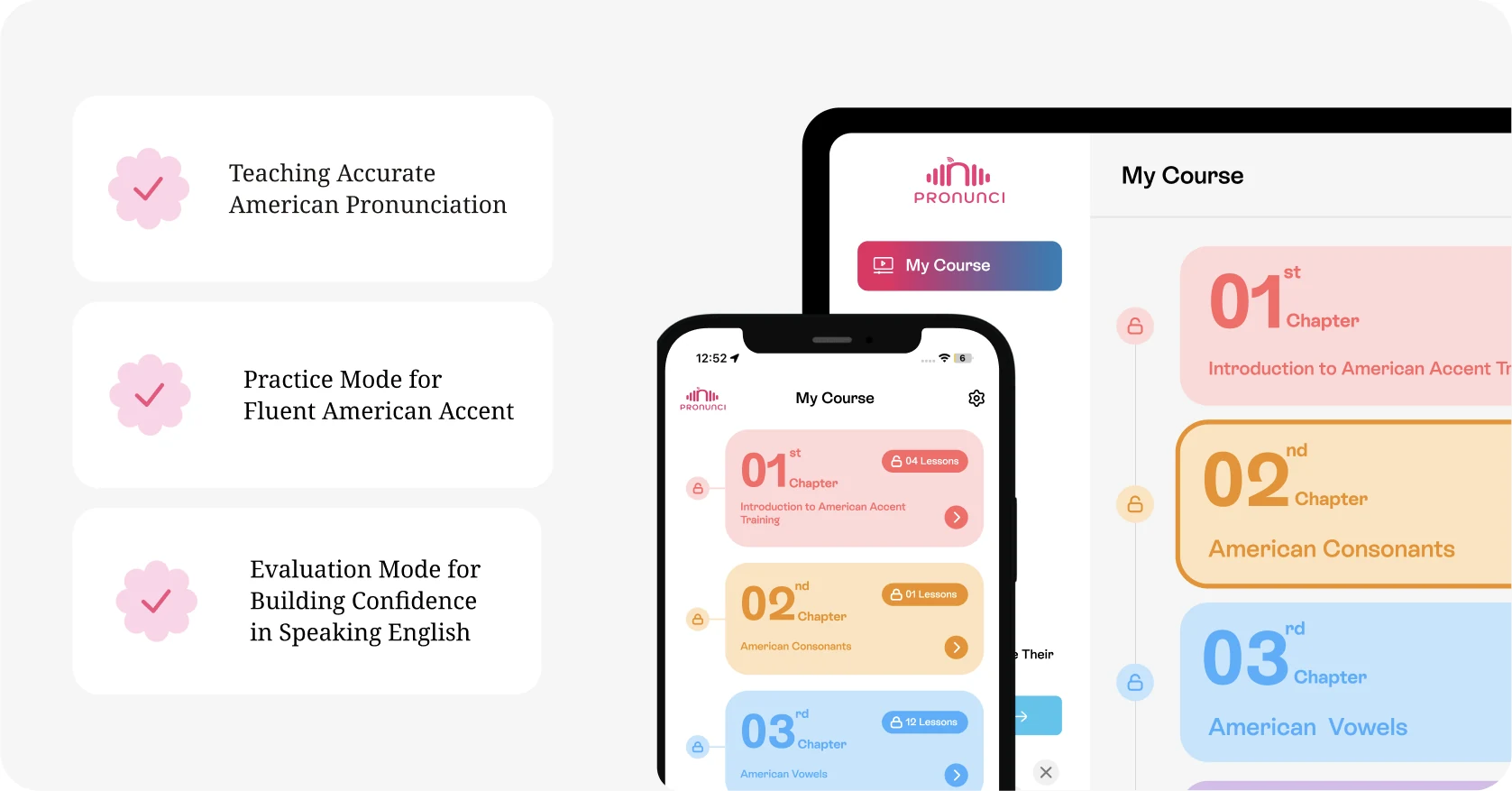
- Speech Organs EducationStudents learn how the speech organs work, along with the AI Accent Coach commands and feedback.
- American ConsonantsPractice and evaluate American consonants in phonetic exercises and practice sentences with the AI Accent Coach.
- American VowelsPractice and evaluate American vowels in phonetic exercises and practice sentences with the AI Accent Coach.
- IntonationLearn how intonation can change the meaning of what you say.
- CertificateBy the end of the course, students receive a certificate.
Built for Today’s Professional Reality
The demand for clearer communication in professional settings is growing quickly. By 2026, 78 percent of international firms are expected to integrate AI-driven accent coaching into their professional development programs. InPronunci is built precisely for this moment, offering working professionals, students, and job seekers a structured, evidence-based path to speaking more clearly and confidently in American English settings where it genuinely counts.
Start Building Clearer American English Pronunciation Today
Every step you have taken in this guide, from understanding how sounds are formed to recognizing linking patterns and practicing with AI feedback, has been building toward something real: clearer, more confident communication in American English.
Mastering consonant and vowel sounds is not about erasing your background. It is about giving yourself the tools to be understood clearly in job interviews, classrooms, presentations, and everyday conversations. When you add consonant-vowel linking to that foundation, your speech gains natural rhythm and flow that makes a genuine difference in how others receive your words.
Progress happens through consistency, not perfection. Drilling a minimal pair, shadowing a single sentence, or completing one structured lesson each day may feel small, but those focused efforts compound into meaningful improvement over time.
InPronunci’s Basic and Premium plans give you a structured, supportive path no matter where you are starting. Whether you are building foundational sound awareness or refining connected speech for professional settings, the platform’s AI-powered feedback and guided curriculum make each practice session count. Your clearer voice starts with one step today.
Conclusion
Understanding American English sounds does not have to feel overwhelming. By learning the difference between consonants and vowels, recognizing how each sound is physically produced, and practicing consistently, you now have the building blocks to speak with greater clarity and confidence.
Remember these key takeaways: vowels are shaped by open airflow, consonants involve some form of obstruction, and small adjustments in mouth position can completely change how a word sounds. Most importantly, progress comes from repetition and patience.
Now it is time to put this knowledge into action. Pick three sounds that challenge you most and practice them daily this week. Listen to native speakers, record yourself, and compare. Every small improvement builds real momentum. Your journey toward clearer, more confident American English pronunciation starts right here, and you already have everything you need to move forward.
InPronunci training structure
How InPronunci trains the American speech system
InPronunci trains the full American speech system: Interactive Visual 2D Sound Simulators and phonetic exercises for articulation and American sound development, sentence practice for intonation, melody, rhythm, and connected speech, paragraph practice for spontaneous speech, public speaking, and real communication confidence, and Advanced AI Accent Coach evaluation as you speak.
InPronunci is an advanced, linguistically structured American accent training platform with more than 1,000 downloads and a growing learner base. It is designed for serious ESL learners who want American pronunciation, stronger intonation, more natural rhythm, better connected speech, and the ability to speak English more confidently in real communication. The program is especially useful for intermediate and advanced English speakers who want to become independent speakers of English with confident communication, stronger speaking control, long-term speech improvement, and great public speaking skills. It is also designed for advanced speakers whose goal is to speak like a native or closer to native-like American speech, including people who were raised in the United States but still have slight accent patterns from the native language they were born with. It is a complete American accent training course and system created by Prof. Alex, Ph.D. Accent Coach, Doctor of Education, and professional linguist based in Austin, Texas, with Pronunci Instructions from Prof. Alex for each lesson that make self-learning more effective, supported, and clear.
How Russian, Mandarin and Indian English speakers often pronounce American vowels
| First language | Common pattern |
|---|---|
| Russian speakers | ship/sheep, bad/bed and full/fool sound alike. |
| Mandarin speakers | ship/sheep sound alike. |
| Indian English speakers | unstressed vowels are said as spelled instead of reduced to schwa. |
In InPronunci, each sound is trained with the Interactive Visual 2D Sound Simulators, guided by Pronunci Instructions, and checked with the AI Accent Coach.
Sources: Wikipedia: Non-native pronunciations of English, Pronunciation Studio, Wikipedia: Indian English
Plans
What InPronunci costs
InPronunci Basic
$35 per month
Chapter 1 is free after signup.
InPronunci Premium
$200 per month
Includes a coach: