


Quick answer: Asian English speakers often replace American sounds with the closest sounds from their first language, especially R/L, TH, V/W, and final consonants. InPronunci trains each of these sounds separately with Interactive Visual 2D Sound Simulators, and real learners like Tian, a Mandarin speaker, show the results.
Pronunciation challenges Asian English speakers face are rooted in first-language phonetic transfer, where the sound system of your native language shapes how you hear and produce English sounds. Linguists call this process L1 interference, and it explains why speakers of Mandarin, Cantonese, Korean, Japanese, Vietnamese, and other Asian languages share predictable error patterns in American English. Research shows a strong positive correlation (r ≈ 0.58) between later English acquisition age and error frequency, and self-confidence is inversely correlated (r ≈ -0.83) with pronunciation mistakes. These patterns directly affect your clarity in meetings, presentations, and interviews.
1. Pronunciation challenges Asian English speakers face: consonant clusters
English consonant clusters are groups of two or more consonants with no vowel between them. Words like strengths, asked, and scripts require sounds that most Asian languages do not use in sequence. Cluster simplification and final consonant dropping are the two most documented error patterns among EFL speakers from Indonesia, Thailand, China, and Korea.

The practical result is real misunderstanding. When “asked” becomes “ask” or “strengths” becomes “streng,” listeners miss the grammatical and semantic signal. Final consonants carry tense markers and plural markers in English, so dropping them changes meaning, not just accent.
Common consonant errors include:
- Dropping final consonants: “test” becomes “tes,” “mind” becomes “mine”
- Simplifying clusters: “street” becomes “s’treet,” “spring” becomes “s’pring”
- Substituting sounds absent in the native language: [s] for /θ/ in “think,” [w] for /v/ in “very”
- Difficulty with the American /r/ sound, which requires a specific tongue position not found in most Asian languages
Pro Tip: Practice consonant cluster pronunciation by first isolating each consonant in the cluster, then blending them slowly before reaching full speed. Record yourself and compare to a native speaker model.
2. Vowel sound distinctions that cause the most confusion
American English has 14–15 distinct vowel sounds. Most Asian languages use far fewer. This gap creates two specific problems: vowel length confusion and tense/lax vowel confusion. The classic example is “ship” versus “sheep.” The /ɪ/ in “ship” is short and lax; the /iː/ in “sheep” is long and tense. To a Mandarin or Korean speaker, these can sound identical.
The table below shows the most problematic vowel contrasts for Asian English speakers:
| Vowel contrast | Example words | Common error |
|---|---|---|
| /ɪ/ vs. /iː/ | ship / sheep | Both heard as /iː/ |
| /ʊ/ vs. /uː/ | full / fool | Both heard as /uː/ |
| /æ/ vs. /ɛ/ | bad / bed | Both heard as /ɛ/ |
| /ɑː/ vs. /ʌ/ | father / fun | Both heard as /ɑː/ |
| /ɔː/ vs. /oʊ/ | caught / coat | Merged into one sound |
The root cause is auditory, not physical. Your brain ignores sound contrasts that do not exist in your first language. You cannot reliably produce a sound you cannot hear as distinct. This is why mastering American vowels requires ear training before mouth training.
Pro Tip: Use minimal pair drills daily. Listen to “ship” and “sheep” in alternating order, then record yourself producing each. The goal is to hear the difference before you can consistently produce it.
3. How stress patterns and intonation affect your clarity
English is a stress-timed language. Stressed syllables occur at roughly regular intervals, and unstressed syllables are compressed or reduced. Most Asian languages are syllable-timed, meaning each syllable gets roughly equal duration. Missed vowel reduction and stress patterns produce speech that sounds choppy or monotone to American listeners.
Misplaced word stress changes meaning directly. “REcord” (noun) versus “reCORD” (verb) are different words. Sentence stress signals what is new information versus what is given. When you stress every syllable equally, listeners work harder to extract meaning, and in professional settings, that extra effort costs you credibility.
Intonation carries emotional and social meaning beyond words. Flatter intonation patterns are common among Mandarin speakers due to tonal L1 transfer. Listeners may perceive monotone speech as disengaged or uncertain, even when the content is strong. That perception directly affects how colleagues and clients respond to you in meetings.
Specific patterns to work on:
- Rising intonation on yes/no questions (“Are you ready?”)
- Falling intonation on statements and wh-questions (“The meeting starts at nine.”)
- Stress shift for contrastive emphasis (“I said Tuesday, not Thursday.”)
- Vowel reduction in unstressed syllables: “to” becomes /tə/, “and” becomes /ən/
Practicing American English rhythm with sentence-level exercises builds the stress-timing instinct that isolated word drills cannot.
4. Effective strategies for improving American English pronunciation
The best approach to accent clarity follows a specific sequence: train your ears first, then train your mouth. Ear training is critical because the brain filters out sound contrasts absent in the first language. Focused auditory discrimination must come before production practice.
- Minimal pair listening drills. Listen to pairs like “ship/sheep” and “bad/bed” without looking at the words. Identify which you hear before attempting to produce them.
- Shadowing. Listen to a short native-speaker sentence, then repeat it immediately, matching rhythm, stress, and intonation. Shadowing trains suprasegmental features that word-level repetition misses.
- Self-recording with native comparison. Record yourself reading a sentence, then play a native speaker recording of the same sentence. Shadowing and self-recording produce more lasting progress than rote repetition alone.
- Select one accent model. Mixing American, British, and Australian models creates inconsistent habits. Choose American English and stay consistent.
- Daily focused practice over long occasional sessions. Fifteen minutes of focused daily practice outperforms two hours once a week for building new motor habits in speech.
Pro Tip: Use an AI-powered tool that gives real-time feedback as you speak. Waiting until the end of a session to review errors slows progress significantly. Immediate feedback closes the gap between what you produce and what you intend.
5. How InPronunci supports Asian English speakers
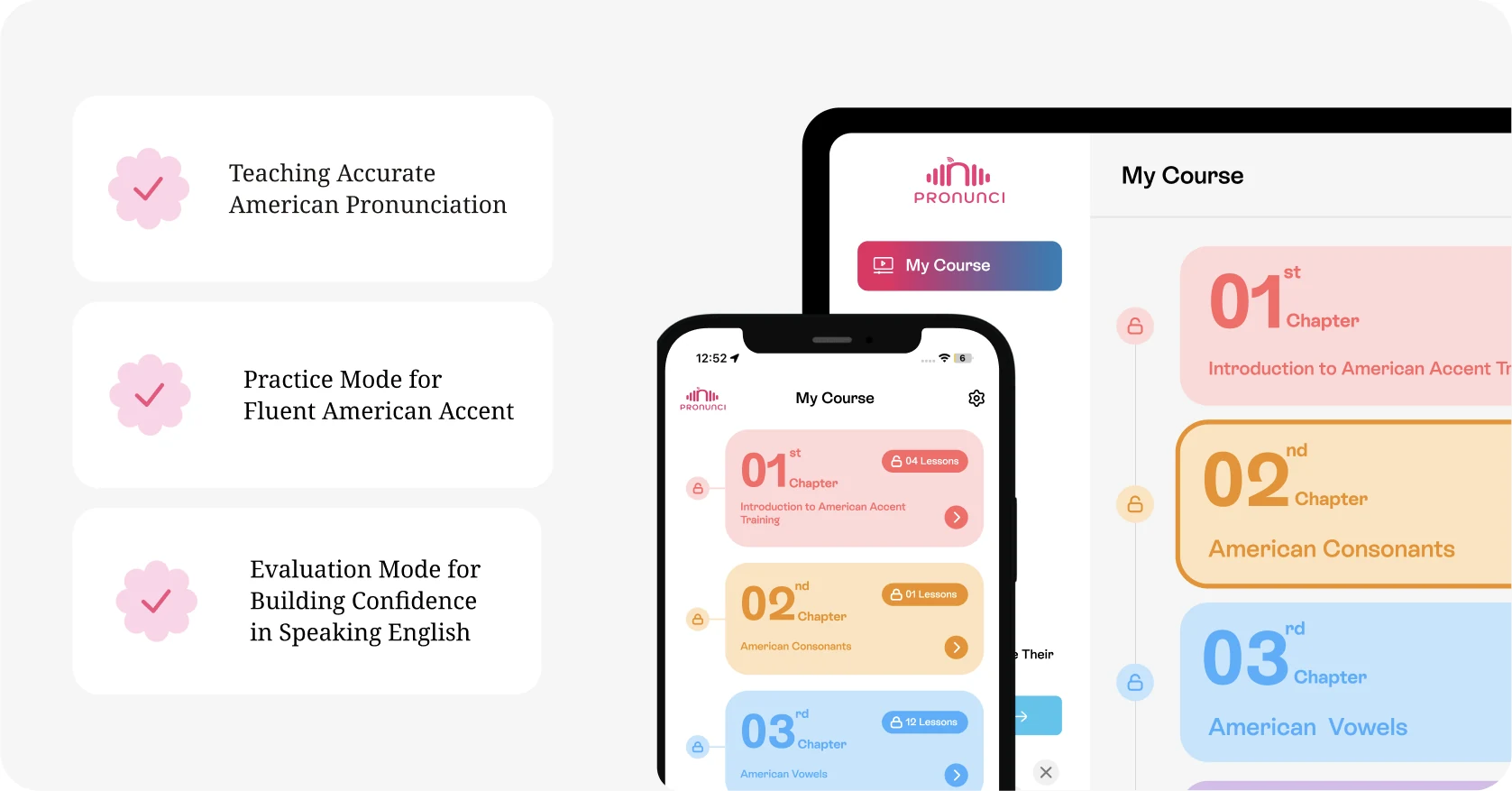
InPronunci is a linguistically structured American accent training course and system developed by Prof. Alex, Ph.D. Accent Coach, Doctor of Education, and professional linguist, and delivered through an interactive app. It addresses the specific English pronunciation difficulties described above with three core tools:
- Interactive Visual 2D Sound Simulators. These simulators, part of 2D Sound Motion Technology, train the tongue, lips, jaw, teeth, airflow, and voice for every American consonant and vowel sound. They train you to position your speech organs precisely before you attempt production.
- AI Accent Coach. The AI gives pronunciation feedback as you speak, covering individual sounds, stress, rhythm, intonation, and connected speech. You get immediate, specific feedback rather than general corrections.
- Pronunci Instructions from Prof. Alex. Every lesson is guided like a real coach session, so you know you are practicing correctly and not reinforcing errors.
InPronunci offers three entry points. Free Chapter 1, “Get to Know Your Speech Organs,” gives you the physical foundation for all sound training. The Basic Plan gives you the full training program with Pronunci Instructions from Prof. Alex, Practice Mode, and the AI Accent Coach. The Premium Plan adds a monthly live 1-on-1 session with Prof. Alex, Ph.D. Accent Coach, and personal chat with him between sessions. You can see real student results from Tian, a Mandarin speaker, and Andrew, a Russian speaker:
InPronunci training structure
How InPronunci trains the American speech system
InPronunci trains the full American speech system: Interactive Visual 2D Sound Simulators and phonetic exercises for articulation and American sound development, sentence practice for intonation, melody, rhythm, and connected speech, paragraph practice for spontaneous speech, public speaking, and real communication confidence, and Advanced AI Accent Coach evaluation as you speak.
InPronunci is an advanced, linguistically structured American accent training platform with more than 1,000 downloads and a growing learner base. It is designed for serious ESL learners who want American pronunciation, stronger intonation, more natural rhythm, better connected speech, and the ability to speak English more confidently in real communication. The program is especially useful for intermediate and advanced English speakers who want to become independent speakers of English with confident communication, stronger speaking control, long-term speech improvement, and great public speaking skills. It is also designed for advanced speakers whose goal is to speak like a native or closer to native-like American speech, including people who were raised in the United States but still have slight accent patterns from the native language they were born with. It is a complete American accent training course and system created by Prof. Alex, Ph.D. Accent Coach, Doctor of Education, and professional linguist based in Austin, Texas, with Pronunci Instructions from Prof. Alex for each lesson that make self-learning more effective, supported, and clear.