


Have you ever felt your heart race the moment someone asks you to speak English? Maybe your mind goes blank, your words get mixed up, or you simply freeze because you are afraid of making mistakes. If this sounds familiar, you are definitely not alone.
For millions of people around the world, being non native english speakers speaking english in real conversations can feel overwhelming, especially in the beginning. The gap between understanding English and actually speaking it fluently is something so many learners struggle with every single day.
But here is the good news: every challenge you face has a solution, and improvement is absolutely possible with the right guidance. In this post, we are going to break down the most common difficulties non native speakers experience when speaking English. We will also explore practical, beginner friendly tips to help you build confidence and communicate more clearly. Whether you struggle with pronunciation, grammar, or simply finding the right words, this guide is here to help you take your first steps toward speaking English with confidence. Let’s get started!
How Many People Speak English as a Non-Native Language?
If you have ever felt like you were the only one learning to speak English more clearly, here is something that might surprise you: you are part of the largest group of English speakers on the planet.
According to recent English language statistics from LingoBright, approximately 1.53 billion people speak English worldwide in 2026. Of those, only about 390 to 400 million are native speakers. That means roughly 1.1 to 1.14 billion people speak English as a second or additional language, just like you. That is not a small group. That is the majority.
The 3:1 Ratio That Changes Everything
The numbers tell a clear story. For every one native English speaker in the world, there are approximately three non-native speakers. This 3:1 ratio means that when English is spoken around the world, most of those conversations involve someone who learned English as a second language. One analysis even suggests that only about 4% of global English conversations happen between two native speakers. Non-native English communication is not the exception. It is the global standard.
The British Council offers an even broader perspective. When including speakers with basic proficiency, the total number of English users may reach up to 2.3 billion, with over 1.9 billion of those being non-native speakers. According to data on the internationality of the English language, non-native speakers now drive 75% or more of all English communication worldwide. English truly belongs to the world, not just to countries where it is spoken as a first language.
What This Means for Speakers in the United States
Even within the United States, the picture is similar. The U.S. Census Bureau reports that over 20 to 22% of Americans aged 5 and older speak a language other than English at home. That represents tens of millions of people navigating daily life, workplaces, schools, and communities while building their English communication skills. Spanish is the most common non-English home language, but the multilingual reality of the U.S. spans dozens of languages and backgrounds.
This is exactly why tools like InPronunci exist. So many people are working to speak English more clearly and confidently, and having the right support makes a real difference. Whether you are preparing for a job interview, adjusting to a new workplace, or simply wanting to feel more comfortable in everyday conversations, you are not starting from zero. You are part of a global community of speakers who are doing the same thing, and that is worth knowing.
What Makes Speaking English Challenging for Non-Native Speakers?
So now that you know just how many people are in the same situation as you, it helps to understand why speaking American English feels so difficult, even after years of study. Grammar books and vocabulary lists only take you so far. The real challenge lives in how English actually sounds, and that is where most learners hit a wall.
Sounds That Simply Do Not Exist in Your Language
One of the biggest hurdles is the sounds themselves. American English has phonemes that many languages simply do not use, and your mouth has spent years learning to move in completely different ways. Take the “th” sound, for example. There are actually two versions: the soft “th” in words like “think” and the voiced “th” in words like “this.” Neither of these exists in Spanish, French, Japanese, Mandarin, or dozens of other languages. So speakers naturally substitute something familiar, like a “t,” “d,” “s,” or “f” sound instead.
Then there is the American “r,” which is produced deep in the mouth with the tongue pulled slightly back. This is very different from the rolled “r” in Spanish or the light “r” sounds in many Asian languages. For Japanese speakers, the challenge goes even further because Japanese uses a single sound that sits between “l” and “r” in English. This makes pairs like “light” and “right,” or “election” and “erection,” genuinely difficult to distinguish and produce. According to research on non-native pronunciations of English, these substitutions are natural results of first-language transfer, but they can affect how clearly you are understood, especially in fast conversation.
This is exactly the kind of challenge that InPronunci’s AI-powered pronunciation training is built to address, giving you targeted feedback on the specific sounds that are hardest for speakers of your language background.
The Hidden Challenge of Rhythm and Timing
Even if you get individual sounds right, English rhythm can still trip you up. English is a stress-timed language, which means stressed syllables carry the beat, and unstressed syllables get squeezed and shortened between them. Languages like Spanish, French, and Mandarin work differently; syllables tend to receive more equal time and weight.
When speakers from these backgrounds apply that equal-syllable rhythm to English, the result often sounds stiff, overly formal, or unnatural to American ears. It also explains why native English speech can feel impossibly fast. The words are not always faster; the rhythm is just compressed in ways your ear has not yet been trained to follow. Building a natural American English rhythm takes structured, repeated practice, which is something that traditional ESL classes rarely provide in enough depth.
Intonation Sends Messages You Might Not Realize
Intonation, meaning the rise and fall of your voice as you speak, carries meaning in American English that goes far beyond just asking a question or making a statement. A falling pitch at the end signals confidence. A rising pitch on a statement can suggest uncertainty or that you are waiting for confirmation. Flat or monotone delivery can accidentally come across as bored, unfriendly, or even rude, even when that is the last thing you intend.
Most languages have their own intonation systems, and they do not map neatly onto American English patterns. This means even fluent speakers can accidentally create unintended impressions in conversations, meetings, or presentations without understanding why.
Connected Speech: The Gap Between Textbook English and Real English
Real spoken American English sounds very different from what most learners read in textbooks. Words blend together, sounds get dropped, and phrases like “going to” become “gonna” or “want to” becomes “wanna.” This is called connected speech, and it includes linking, contractions, and informal reductions that show up constantly in everyday conversation, workplace communication, and media.
Traditional ESL programs rarely teach these patterns in a structured way, which is why so many learners understand written English well but feel lost listening to a real conversation or a podcast. Research on connected speech in teaching consistently shows that explicit, focused practice makes a meaningful difference in both listening comprehension and natural speech production.
When Pressure Reveals the Gaps
All of these challenges become even more visible in high-stakes moments. Job interviews, workplace meetings, and professional presentations demand that you manage pronunciation, rhythm, intonation, and content all at the same time. That cognitive load is significant, and fluency gaps that stay hidden in casual conversation can surface quickly under pressure.
A 2026 TOEIC global report found that 92% of employers say English proficiency is more important than it was five years ago, and 86% believe organizations without clear English communicators face a real competitive disadvantage. Studying grammar alone does not prepare you for those moments. Practicing out loud, in real scenarios, with feedback on how you actually sound, is what builds the speaking confidence you need. InPronunci’s approach targets exactly this kind of real-world readiness, helping you practice not just what to say, but how to say it clearly and naturally when it matters most.
Why Clearer English Pronunciation Matters in Real-World Settings
Understanding why pronunciation clarity matters is not just about sounding polished. It directly shapes whether you get the job, succeed in your studies, build relationships, and feel confident participating in daily American life. The stakes are real, and the research backs it up.
The Professional Cost of Being Misunderstood
In today’s global workplace, communication clarity has become one of the most valued professional skills. A striking 84% of international executives in 2025 identified professional clarity as a top priority in workplace communication. Think about what that means for non-native English speakers navigating meetings, phone calls, client presentations, and team collaborations every single day. When your message does not land clearly, it can affect how your ideas are received, how your competence is perceived, and ultimately how far your career advances.
The good news is that structured pronunciation training makes a measurable difference. Research suggests that focused accent training can reduce meeting misunderstandings by approximately 30%, translating directly into saved time, smoother collaboration, and stronger professional credibility. Platforms like InPronunci are designed with exactly this goal in mind, offering AI-powered pronunciation feedback that helps you practice the specific sounds, rhythm, and stress patterns that matter most in American English professional settings.
Structured American Accent Training Course
From Speech Organs Education to American Intonation
The InPronunci course is built step by step: every chapter prepares the next one, and by the end of the course students receive a certificate.
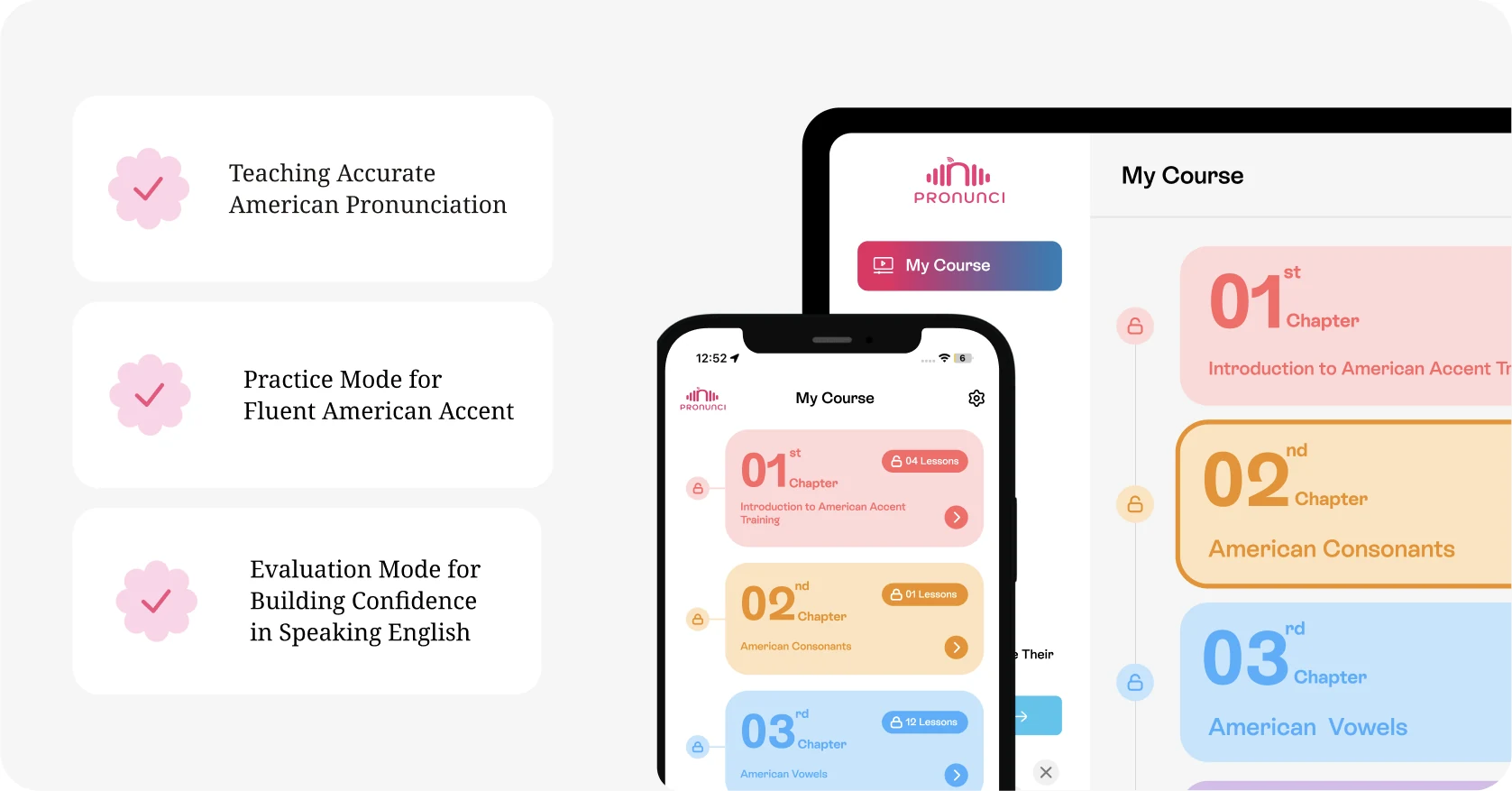
- Speech Organs EducationStudents learn how the speech organs work, along with the AI Accent Coach commands and feedback.
- American ConsonantsPractice and evaluate American consonants in phonetic exercises and practice sentences with the AI Accent Coach.
- American VowelsPractice and evaluate American vowels in phonetic exercises and practice sentences with the AI Accent Coach.
- IntonationLearn how intonation can change the meaning of what you say.
- CertificateBy the end of the course, students receive a certificate.
Confidence as a Career Barrier
Here is something many non-native speakers experience but rarely talk about openly: even when your technical skills are strong, even when your qualifications are impressive, the fear of being misunderstood can hold you back from speaking up. Non-native professionals in competitive job markets consistently report that communication confidence acts as an independent obstacle, separate from their actual expertise or education level. You might know exactly what to say in a meeting but hesitate because you are unsure how your pronunciation will come across. That hesitation has real career consequences.
InPronunci’s AI-powered training helps bridge exactly that gap, giving learners a safe, supportive space to practice before the high-stakes moments arrive.
The Silent Struggle in Academic and Social Settings
The impact extends beyond the workplace. International students and immigrants frequently describe a quiet form of self-consciousness tied to how they sound when speaking English. Research into accent anxiety shows that concerns about being judged for pronunciation can reduce willingness to participate in class discussions, social conversations, and group activities. This is not about ability; it is about feeling comfortable enough to use the ability you already have.
Your Accent Is Not the Problem
It is worth saying clearly: having an accent is completely normal and not something to be ashamed of. Most English speakers in the world are non-native, which means accented English is simply how the majority of the world communicates. The goal of training through InPronunci is never to erase your accent or sound identical to someone who grew up speaking American English. The real goal is to communicate more clearly, feel more confident, and make sure your words are understood in the contexts that matter most to you, whether that is a job interview, a university seminar, a customer conversation, or a casual chat with a neighbor.
InPronunci supports that goal by focusing your practice on the pronunciation habits that actually improve clarity and build real-world speaking confidence.
Why AI-Powered Pronunciation Training Is Growing So Fast
The numbers behind this industry shift are hard to ignore. The global accent reduction platforms market was valued at $1.2 billion in 2024 and is projected to reach $4.8 billion by 2033, growing at a compound annual growth rate of 16.7%. That kind of growth does not happen by accident. It reflects a real and growing need among millions of people who want to speak more clearly, communicate with greater confidence, and succeed in professional and academic settings where American English fluency plays a significant role.
The Demand Is Especially Strong in North America
North America accounts for approximately 40% of the global accent reduction platform market share, and that concentration makes a lot of sense when you consider the demographics. The United States is home to a large and growing population of immigrants, international students, and multilingual professionals who use English every day for work, school, and daily life. Companies are also investing in communication training for employees in customer-facing, healthcare, and business roles, where speaking clearly is not just a preference but a practical requirement. This regional demand has accelerated the development and adoption of AI-powered tools designed specifically for American English pronunciation.
A More Accessible Alternative to Private Coaching
One of the biggest reasons AI platforms are growing so quickly is cost. Traditional private accent coaching can run anywhere from $50 to $350 or more per session, which adds up fast and puts this type of training out of reach for many learners. AI-powered platforms like InPronunci offer a far more affordable path, with flexible subscription plans that allow you to practice daily without the financial pressure of hourly coaching fees. The Basic plan gives learners access to structured pronunciation lessons and core accent-training tools, while the Premium plan provides a more complete experience with expanded feedback and additional support features. For busy professionals, students, and immigrants working within a budget, this accessibility is a genuine turning point.
Smarter Features That Match How People Actually Learn
Modern learners are not just looking for basic pronunciation tips. They want phoneme-level feedback that identifies exactly which sounds need work, speech-organ and articulatory training that shows them how to position their mouth and tongue, and real-world scenario practice that mirrors actual conversations in job interviews, workplace meetings, or everyday situations. They also want learning pathways that account for their native language background, because the pronunciation challenges for a Spanish speaker are different from those for a Mandarin or Hindi speaker. Platforms that deliver this level of personalization are quickly becoming the preferred choice.
Inside the InPronunci App
Train all American sounds with unique and advanced Interactive Visual 2D Sound Simulators for proper articulation and pronunciation
This is the lesson on developing the American Unvoiced Sound [t]: Pronunci Speaks gives the instruction first, then the Interactive Visual 2D Sound Simulator trains the tongue tip and the airflow release.
- EffectiveMost apps offer visual learning. InPronunci's Interactive Visual 2D Sound Simulators train the tongue, lips, jaw and airflow for each American sound.
- ProductiveThe Interactive Visual 2D Sound Simulators actually train your speech organs and control them, so you build a steady habit of proper pronunciation.
- ResultsStudents pronounce individual American sounds with almost native-like pronunciation.
The Rise of Hybrid Learning Formats
Perhaps the most interesting development in this space is the emergence of hybrid learning models. These approaches combine daily AI-guided practice with scenario-based conversation training, giving learners both the consistency of structured app use and the real-world context of meaningful practice situations. For busy professionals and students who cannot commit to weekly coaching appointments, this format offers flexibility without sacrificing depth. InPronunci is built with this kind of learner in mind, blending structured accent lessons with AI feedback and practical speaking practice that fits into a real schedule. The result is a learning experience that grows with you, at your own pace, in the moments that work best for you.
How InPronunci Helps Non-Native English Speakers Communicate More Clearly
This is where InPronunci directly addresses the challenges that non-native English speakers face every single day. Rather than offering a one-size-fits-all language course, InPronunci is built specifically around American accent training, using AI-powered tools to help you practice more effectively, understand your specific pronunciation gaps, and build real confidence in how you speak.
AI Feedback That Responds to You Personally
One of the most important things InPronunci does differently is that it listens to you and gives feedback based on your specific pronunciation patterns. The platform analyzes your recordings for sounds, stress placement, rhythm, intonation, and overall clarity. Then it offers detailed, actionable guidance rather than a simple score. This kind of personalized learning path means you are not wasting time on sounds you already produce well. Instead, you focus your energy on the areas that genuinely hold you back in conversations, job interviews, or workplace presentations. According to data from the accent training space, structured tools like this have been associated with roughly a 30% reduction in communication misunderstandings, which is a meaningful difference in professional settings.
Visual Learning That Audio-Only Tools Cannot Offer
Here is something that sets InPronunci apart in a very practical way. Most pronunciation apps rely entirely on what you hear. InPronunci adds a layer of speech-organ articulation training through its2D Sound Motion Technology, which uses 2D simulators to train exactly where to place your tongue, how to shape your lips, and how to position your jaw for every American English sound. This is the kind of guidance that traditionally only came from working face-to-face with a speech coach, sessions that can cost anywhere from $50 to $350 or more per hour. Training with the physical mechanics of sound production helps bridge the gap between hearing a sound and actually being able to reproduce it consistently. Users have described this feature as providing articulation training with full articulation details.
Training Built for American English Specifically
InPronunci does not teach general English phonetics. The entire platform is structured around the specific sounds, rhythms, stress patterns, and connected speech habits of American English. This includes the rhotic /r/ sound, American vowel qualities, natural linking between words, and the reductions that make everyday American speech flow naturally. With over 130 phonetic exercises, 300 practice sentences, and 30 or more paragraph-level exercises, the training builds progressively from individual sounds all the way to real-world scenarios like meetings, presentations, and interviews.
Choosing the Plan That Fits Your Goals
InPronunci offers two clear paths depending on where you are in your journey. The Basic plan gives you access to structured accent lessons, core AI pronunciation feedback, and the foundational American accent training tools you need to get started. It is well suited for learners who want guided, self-paced practice with real feedback and progress tracking built in.
The Premium plan expands on that foundation with deeper feedback, additional support features, and access to live one-on-one sessions with a professional accent coach. For professionals, students preparing for academic environments, or anyone who wants a more complete and accelerated learning experience, the Premium plan offers the kind of personalized human-plus-AI support that is harder to find anywhere else at this price point.
You can explore both options directly through the InPronunci app on the App Store and find the starting point that makes the most sense for your goals.
Who Is InPronunci Built For?
InPronunci was designed with a very specific group of people in mind: non-native English speakers who want to communicate more clearly, confidently, and naturally in American English. The platform is not a generic language app. It is a structured, AI-powered pronunciation training tool built to serve real learners with real communication goals.
Professionals preparing for job interviews, client-facing roles, or workplace presentations will find that InPronunci directly addresses the kinds of challenges that show up in high-stakes moments. A 2025 study referenced by InPronunci found that 64% of international tech professionals felt their ideas were overlooked in meetings due to clarity issues. When your voice is the tool you use to lead, persuade, and collaborate, clearer pronunciation is not optional. It is a career skill.
Immigrants and international students navigating life in the United States face pronunciation challenges in everyday situations, from speaking with professors and classmates to handling appointments, customer service, and community conversations. InPronunci supports this group by building practical clarity for real-life interactions, not just textbook exercises.
Healthcare workers, tech professionals, and customer service representatives work in roles where a single misunderstood word can create serious problems. In these fields, pronunciation clarity directly affects outcomes, safety, and trust. InPronunci includes training scenarios built around professional communication, helping learners in these industries feel more prepared and more confident on the job.
International job seekers and visa holders preparing to work or study in the US benefit from InPronunci’s structured progression, which moves from individual sounds all the way to interview scenarios and presentation practice. The platform offers both Basic and Premium plan options, making it accessible for learners at different stages of preparation.
Finally, InPronunci welcomes anyone who simply wants to sound more natural in everyday conversations, regardless of background or current speaking level. According to user reviews on the App Store, learners across skill levels have seen meaningful gains in both clarity and confidence. Whether you are just starting out or fine-tuning your speech, InPronunci meets you where you are.
6 Practical Strategies to Build Confidence and Clarity in American English
Knowing that improvement is possible is one thing. Having a clear plan to make it happen is something else entirely. These six strategies are designed to help you build real speaking confidence and clearer American English pronunciation, one focused step at a time.
Start with Your Biggest Phoneme Challenges
Rather than trying to fix every sound at once, identify the three to five phonemes that cause the most trouble for speakers of your native language. Spanish speakers often struggle with the American /r/ sound and certain vowel lengths. Mandarin speakers frequently find the /θ/ sound in words like “think” or “the” quite difficult. Focusing on these high-impact sounds first means you see real progress faster, which keeps you motivated and moving forward. An initial assessment through a platform like InPronunci can help you pinpoint exactly which sounds need the most attention.
Practice Full Phrases, Not Just Single Words
American English sounds very different in natural conversation compared to how individual words appear in a dictionary. Phrases like “did you” become “didja” and “going to” becomes “gonna” in everyday speech. If you only practice words in isolation, you may find yourself sounding slightly robotic or having trouble understanding fluent speakers. Practicing full, realistic sentences and phrases trains your ear and your mouth for how American English actually flows in the real world.
Record Yourself and Use AI Feedback
Non-native English speaking graduate students still face significant disadvantages in academic and professional settings, partly because pronunciation challenges are hard to self-identify without objective feedback. Recording yourself speaking and listening back reveals patterns you might never notice otherwise. InPronunci takes this a step further by providing immediate, specific AI-powered pronunciation feedback so you know exactly what to adjust after every single practice session. That kind of clear, targeted response is far more effective than guessing on your own.
Drill the Situations You Actually Face
Generic pronunciation drills are helpful, but practicing the exact scenarios you encounter regularly builds confidence much faster. Rehearse your job interview answers, your workplace presentation opening, or the phrases you use most in customer-facing conversations. This targeted approach builds muscle memory for the moments that matter most in your real life.
Keep Sessions Short and Consistent
Ten to fifteen minutes of focused daily practice consistently outperforms a two-hour session once a week. Short daily sessions reinforce neural pathways, build habits, and prevent the forgetting that happens when too much time passes between practice. InPronunci’s AI-guided lessons are designed for exactly this kind of bite-sized, daily repetition.
Combine Visual and Audio Feedback
Audio scoring alone does not always explain why a sound is coming out incorrectly. Training your tongue, lips, and jaw in their correct positions adds a layer of understanding that makes corrections click much faster. InPronunci’s 2D Sound Motion Technology provides mouth and articulation training alongside audio feedback, helping you understand both what to change and how to change it. Pairing that speech-organ training with consistent listening practice creates a much more complete learning experience.
Speaking English as a Non-Native Speaker Is a Strength Worth Building On
Every step you take to speak English more clearly is worth recognizing. With over 1.1 billion non-native English speakers worldwide, you are part of a global community that communicates across borders, builds careers, and connects with people every day in a language they learned by choice and dedication. That is genuinely something to be proud of.
The pronunciation challenges that come with speaking American English as a second language are completely normal, well-documented, and most importantly, trainable. Sounds like the “th” combination, vowel distinctions, word stress, and natural rhythm patterns are common hurdles for learners from nearly every language background. InPronunci’s AI-powered American accent training is built specifically to address these exact challenges, using structured lessons and real-time feedback to help you build clearer, more natural speaking habits step by step.
One of the biggest advantages of platforms like InPronunci is accessibility. Traditional accent coaching sessions can cost anywhere from $50 to over $350 per session. InPronunci offers a smarter, more affordable path through its Basic plan, which provides guided pronunciation practice and AI-powered feedback, and its Premium plan, which adds live sessions with a professional accent coach for personalized support.
Clearer American English communication creates real, measurable results. Professionals report stronger performance in interviews and presentations. Students participate more confidently in academic settings. And in everyday conversations, improved clarity reduces misunderstandings and builds genuine connection. No matter where you are in your learning journey, InPronunci gives you a practical, encouraging place to start.
Conclusion
Speaking English as a non-native speaker comes with real challenges, but none of them are impossible to overcome. Remember these key takeaways: pronunciation and grammar improve with consistent daily practice, building confidence requires stepping outside your comfort zone, listening actively accelerates your speaking ability, and making mistakes is a natural and necessary part of the learning process.
Every fluent English speaker you admire once stood exactly where you are standing right now. The difference between staying stuck and moving forward is simply the decision to keep going.
Your next step is simple. Pick one tip from this post and apply it today. Join a conversation group, record yourself speaking, or practice just five minutes before bed. Small, consistent actions create big results over time. You have everything you need to succeed. Now go speak your first sentence with confidence.
InPronunci training structure
How InPronunci trains the American speech system
InPronunci trains the full American speech system: Interactive Visual 2D Sound Simulators and phonetic exercises for articulation and American sound development, sentence practice for intonation, melody, rhythm, and connected speech, paragraph practice for spontaneous speech, public speaking, and real communication confidence, and Advanced AI Accent Coach evaluation as you speak.
InPronunci is an advanced, linguistically structured American accent training platform with more than 1,000 downloads and a growing learner base. It is designed for serious ESL learners who want American pronunciation, stronger intonation, more natural rhythm, better connected speech, and the ability to speak English more confidently in real communication. The program is especially useful for intermediate and advanced English speakers who want to become independent speakers of English with confident communication, stronger speaking control, long-term speech improvement, and great public speaking skills. It is also designed for advanced speakers whose goal is to speak like a native or closer to native-like American speech, including people who were raised in the United States but still have slight accent patterns from the native language they were born with. It is a complete American accent training course and system created by Prof. Alex, Ph.D. Accent Coach, Doctor of Education, and professional linguist based in Austin, Texas, with Pronunci Instructions from Prof. Alex for each lesson that make self-learning more effective, supported, and clear.