


What if the reason your most innovative ideas aren’t gaining traction has nothing to do with your vocabulary, but everything to do with the melody of your voice? You’ve likely spent years perfecting your grammar, yet you still feel a gap between your expertise and how you’re perceived in the boardroom because of your American English intonation. It’s common to feel that your speech sounds flat or robotic, which often leads listeners to misinterpret your confidence as uncertainty. Since the corporate sector accounts for 43% of the demand for digital language training in North America, the ability to lead with vocal clarity is now a critical strategic asset.
Mastering the strategic logic of pitch is the key to closing this gap and communicating with genuine professional authority. In this guide, we’ll analyze the patterns of rhythm that reduce the cognitive load for your listeners, making your message more persuasive and easier to digest. Precision matters. You’ll learn how to move beyond mechanical pronunciation by using InPronunci and its 2D Sound Motion Technology to develop a natural, engaging flow that builds trust in every professional interaction.
What is American English Intonation and Why Does It Matter?
Intonation is the purposeful variation in pitch that speakers use to convey specific meanings, emotions, and grammatical structures. While grammar provides the skeleton of a sentence, intonation provides the life and nuance. In the field of Intonation (linguistics), researchers highlight that these pitch changes aren’t random; they follow predictable patterns that native speakers use to signal whether they’re asking a question, making a definitive statement, or expressing irony. Mastering American English intonation is less about singing and more about using pitch as a strategic tool for clarity. Pitch is strategy.
American English is a stress-timed language. This means the rhythm is dictated by the intervals between stressed syllables. Unlike syllable-timed languages like Spanish or French, where every beat has roughly the same length, English compresses unstressed words to maintain a steady beat. This creates a specific melody that acts as a roadmap for the listener’s brain. If you ignore the rules of American English intonation, you aren’t just mispronouncing words; you’re removing the cues your listener needs to follow your logic efficiently. Melody drives meaning.
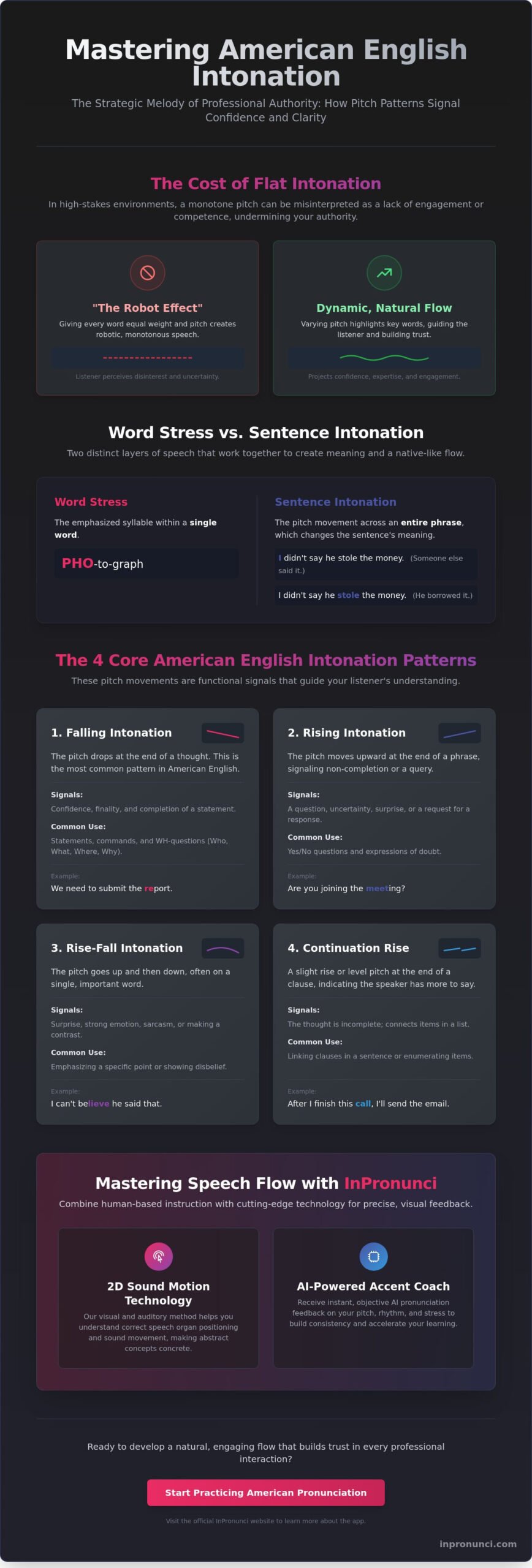
In high-stakes professional environments, the cost of flat intonation is significant. When a speaker uses a monotone pitch, they’re often perceived as bored, uninterested, or even lacking competence. You might be focusing intensely on your technical accuracy, but the listener interprets the lack of pitch variation as a lack of engagement. It’s a subtle barrier that can undermine your authority before you’ve even finished your first slide. Engagement is vocal.
The Difference Between Word Stress and Sentence Intonation
It’s vital to distinguish between these two layers of speech. Word stress identifies which syllable in a single word is emphasized, such as the “pho” in “photograph.” Sentence intonation, however, governs the pitch movement across an entire phrase. By shifting the pitch on a single word, you can change the entire meaning of a sentence. For example, saying “I didn’t say he stole the money” with a high pitch on “I” implies someone else made the claim. Shifting that pitch to “stole” implies the money might have just been borrowed. The synergy between precise stress and dynamic pitch creates the native-like flow required for professional authority.
Moving Beyond Robotic Speech in 2026
Many international professionals fall into the “robot effect” by giving every word equal weight and pitch. This often happens when you’re being overly cautious about your pronunciation. However, speaking English fluently requires a dynamic pitch range that highlights your most important content words. Varied intonation does more than just sound natural; it builds psychological trust and rapport. When your pitch aligns with your message, you appear more authentic and reliable to your colleagues and clients. Precision builds trust.
The 4 Core American English Intonation Patterns
Understanding the melody of speech requires more than just listening; it requires a strategic breakdown of how pitch moves. Most communication in American English relies on four distinct movements. These aren’t just musical choices. They’re functional signals that help your audience categorize what you’re saying. For a foundational overview of English intonation, linguistics experts often point to the interaction between pitch accents and the specific tones used at the end of a phrase. Pitch signals intent.
- Falling Intonation: This is the most common pattern. The pitch drops at the end of a sentence. It signals that you’ve finished your thought and are confident in the statement.
- Rising Intonation: The pitch moves upward at the very end. This typically signals a question or suggests that you’re waiting for a response.
- Rise-Fall Intonation: The pitch goes up and then down within a single word or phrase. It’s often used to show surprise or to contrast two different ideas.
- Fall-Rise Intonation: The pitch drops and then rises slightly. This is common when you’re being polite or when you’re hesitating before providing more information.
Falling Intonation for Authority and Statements
When you make a professional recommendation, your pitch should descend at the end of the sentence. This downward glide conveys finality. Authority sounds final. Interestingly, WH-questions (Who, What, Where, Why, When) also use falling intonation. For example, “Where is the report?” ends with a drop in pitch. A common mistake for many professionals is using a rising pitch on statements. This “up-talk” makes a firm conclusion sound like a question, which can subtly undermine your authority. You don’t want to sound like you’re seeking permission when you’re delivering a result.
Rising Intonation for Questions and Continuity
Rising intonation is the hallmark of Yes/No questions. If you ask, “Are you ready?”, your voice should glide upward on the last syllable. Beyond questions, a slight rise is a powerful tool for continuity. When you’re listing items in a presentation, use a rising pitch for every item except the last one. This tells your audience, “I’m not done yet; keep listening.” It reduces the cognitive load on your listeners by clearly marking the structure of your speech. To master these physical shifts, many students use the InPronunci app to visualize their pitch in real-time. Mastering American English intonation is about making these choices consciously to guide your listener.
Intonation for Executive Presence: Conveying Confidence
Executive presence is the combination of communication, gravitas, and appearance. In the workplace, your vocal delivery serves as the primary vehicle for that gravitas. While many professionals focus on “perfect” grammar, American English intonation is what truly signals your level of authority. It’s the difference between sounding like a participant and sounding like a leader. Pitch is power.
The “Up-talk” trap is a common hurdle for international professionals who may confuse rising intonation with politeness. Ending a statement with a rising pitch makes your expertise sound like a question. This habit invites doubt and suggests you’re seeking external validation for your own ideas. To project confidence, you must intentionally use falling intonation to ground your statements. High-level advisors know that certainty is heard in the downward glide of a sentence. Decisions require finality.
Strategic emphasis is another tool for the modern professional. When delivering a business proposal, you should use pitch to highlight “content words” like “revenue,” “efficiency,” or “milestones.” By contrast, function words like “and,” “the,” or “with” should be spoken at a lower, faster pitch. This contrast reduces the cognitive load for your listeners. It allows busy executives to grasp your key points without having to decode every syllable of your explanation. Clarity is a professional courtesy.
Sounding Authoritative in Meetings
In a fast-paced meeting, a monotone voice is often misinterpreted as a lack of engagement or passion. Using a wider pitch range shows that you’re invested in the conversation. This doesn’t mean sounding theatrical; it means using subtle pitch shifts to keep your audience focused. There’s a strong link between accent reduction and professional credibility, as a clear, melodic flow builds trust. Try this exercise: record yourself saying a recommendation as a “Managerial Statement” with a firm drop in pitch, then as an “Uncertain Suggestion” with a rising pitch. You’ll immediately hear the difference in authority.
The Role of Rhythm and Pausing
Intonation doesn’t work in a vacuum; it relies on rhythm. Strategic pauses allow your pitch to “reset,” marking the beginning of a new thought group. A thought group is a cluster of words that represent a single idea. By using a slight rise at the end of a thought group and a significant fall at the end of a sentence, you guide your listener through complex technical data. This structured approach prevents you from sounding rushed. It signals that you’re in control of the information and the room. Control starts with the breath.
How to Practice Intonation Using Speech-Organ Training Feedback and AI
Traditional training often relies solely on auditory shadowing, which can be inefficient if your ear isn’t yet tuned to the subtle shifts in American English intonation. If you’ve spent years speaking a syllable-timed language, your brain might naturally filter out the pitch movements that native speakers use to signal meaning. To break this habit, you need a multi-sensory approach that combines hearing with seeing. Practice isn’t just about repetition; it’s about accurate, informed repetition. By following a structured progression, you can move from mechanical speech to a natural, professional flow.
- Step 1: Auditory Awareness. Before you can produce the melody, you must learn to hear it. Listen to professional presentations and focus exclusively on the pitch, ignoring the vocabulary.
- Step 2: Visualizing Pitch.Use 2D Sound Motion Technology to train where your voice should rise and fall. Training cues provide a concrete target that your ears might miss.
- Step 3: AI Feedback. Leverage an AI pronunciation feedback system to identify “flat” spots where your speech lacks the necessary dynamic range.
- Step 4: Shadowing with Intonation Maps. Take a script and mark it with arrows pointing up or down to indicate pitch direction. Read the script aloud while following these visual markers.
- Step 5: Contextual Application. Practice these patterns in low-stakes environments, like a casual coffee order, before applying them in a high-pressure boardroom setting.
The Power of 2D Sound Motion Technology
InPronunci uses 2D Sound Motion Technology as a training tool for speech organ positioning and sound movement. It transforms the abstract concept of “pitch” into a concrete path you can follow. Training with sound movement helps bridge the gap between “hearing” and “doing,” allowing you to correct your errors in real-time. This speech-organ training reduces the time needed for mastery by removing the guesswork from phonetic exercises. When sound movement guides you, you can control the sound. To train with this technology, visit the official InPronunci website to learn more about the app.
Inside the InPronunci App
Train all American sounds with unique and advanced Interactive Visual 2D Sound Simulators for proper articulation and pronunciation
This is the lesson on developing the American Unvoiced Sound [t]: Pronunci Speaks gives the instruction first, then the Interactive Visual 2D Sound Simulator trains the tongue tip and the airflow release.
- EffectiveMost apps offer visual learning. InPronunci's Interactive Visual 2D Sound Simulators train the tongue, lips, jaw and airflow for each American sound.
- ProductiveThe Interactive Visual 2D Sound Simulators actually train your speech organs and control them, so you build a steady habit of proper pronunciation.
- ResultsStudents pronounce individual American sounds with almost native-like pronunciation.
Leveraging an AI Accent Coach
Consistency is the foundation of any behavioral change. An AI Accent Coach provides the tireless, objective feedback needed for repetitive pitch training. It doesn’t get tired or miss a subtle error, ensuring that every practice session is productive. It’s important to remember that AI supports rather than replaces human instruction. While AI handles the data-driven feedback and consistency, human-based guidance focuses on the nuance of rhythm and emotional intent. This modern combination ensures you’re practicing the right patterns every time. You can create your InPronunci student account on the learning platform to start accessing this speech-organ training feedback today.
Mastering Speech Flow with InPronunci
The InPronunci methodology is designed to translate linguistic theory into professional performance. By integrating AI precision with human-based instruction, we provide a structured environment where you can refine your American English intonation without the guesswork. This dual approach ensures that while technology handles the data-driven feedback, a human coach handles the subtleties of emotional resonance and cultural context. Strategy meets technology.
Our curriculum is built on a logical progression. You start by mastering individual American sounds, then move toward the complex prosody that defines executive presence. This step-by-step journey ensures that your foundation is solid before you attempt to lead high-stakes negotiations or complex technical briefings. We focus on realistic outcomes. Our goal isn’t to erase your cultural identity or remove your accent entirely; it’s about reducing accent barriers and building the confidence to be heard clearly. Authenticity is professional.
Tech and healthcare leaders often face unique communication challenges. Whether you’re explaining a complex surgical procedure or a new software architecture, the way you deliver information determines its impact. The InPronunci program is specifically tailored for these corporate environments where clarity is the highest priority. We help you move beyond the “robot effect” and toward a melody that commands respect. Respect is earned through clarity.
A Modern Solution for Modern Professionals
The app provides the convenience of on-demand practice, while personalized coaching offers the strategic depth required for elite voice training. This combination allows you to achieve professional clarity and a native-like flow on your own schedule. We invite you to visit the official InPronunci website to explore the full curriculum and see how our methodology fits into your career goals. Professional growth is vocal growth.
Your Strategic Path to Fluency
Daily habits are the engine of progress. Cultivating an elite voice requires consistent, small-scale practice rather than occasional bursts of effort. Mastering intonation is often the final step in the fluency journey; it’s the element that ties your grammar and vocabulary into a cohesive, persuasive whole. With the right technology and a commitment to the process, natural speech is an attainable objective. Consistency is the strategy.
Visit the official InPronunci website to learn more about the app, or create your student account on the InPronunci learning platform to start practicing American pronunciation.
Leading with Vocal Clarity and Strategic Intent
Mastering the melody of speech is the final step in transitioning from a technical expert to a global leader. By moving beyond robotic delivery and embracing the nuances of American English intonation, you ensure your ideas are received with the authority they deserve. We’ve explored how pitch serves as a roadmap for your audience and why feedback is essential for correcting deep-seated vocal habits. Under the guidance of its founder, Prof. Alex, Ph.D. Accent Coach, InPronunci provides the precision needed to refine these patterns through AI-driven real-time speech analysis and our unique 2D Sound Motion Technology. This modern approach doesn’t just improve your pronunciation; it builds a sustainable foundation for professional influence. Consistency in your training today will define the impact of your voice tomorrow. Your path to natural, engaging speech is now clear and supported by advanced technology.
Visit the official InPronunci website to learn more about the app, or create your student account on the InPronunci learning platform to start practicing American pronunciation.
Questions & Answers
Frequently Asked Questions
01What is the difference between word stress and intonation?
Word stress is the emphasis placed on a specific syllable within a single word, while intonation refers to the pitch movement across an entire phrase or sentence. Word stress helps listeners identify the word itself, but intonation signals your intent, such as whether you’re asking a question or making a firm statement. Both elements must work together to create a natural, professional rhythm in your speech.
02Can I improve my intonation if I am tone-deaf?
Yes, you can certainly improve your speech patterns because linguistic pitch is different from musical pitch. Speaking involves relative changes in tone that you can master through physical muscle memory rather than musical talent. Using 2D Sound Motion Technology trains these pitch shifts, which bridges the gap for those who find it difficult to distinguish subtle auditory changes alone.
03Why do I sound robotic when I speak English?
Robotic speech usually happens when you give every word the same pitch, volume, and duration. This flat delivery often occurs when learners focus too much on individual sounds rather than the overall sentence melody. To fix this, you must learn to prioritize “content words” while shortening “function words.” Mastering American English intonation helps you create the dynamic flow that native speakers use to signal meaning and emotion.
04How long does it take to master American English intonation?
Noticeable improvements in your speech flow typically appear within three to six months of consistent, daily practice. While you don’t need to remove your accent entirely, developing a natural rhythm requires regular engagement with the right tools. Using an AI pronunciation feedback system helps accelerate this timeline by providing instant corrections, ensuring that you don’t spend time practicing incorrect patterns that could become permanent habits.
05Is rising intonation at the end of a sentence always a question?
No, rising intonation is also used to signal that a list isn’t finished or to express politeness and hesitation. However, using it on every statement is a habit called “up-talk,” which can make you sound uncertain or like you’re seeking permission. Learning to use falling intonation is essential for projecting authority and finality in professional settings, as it signals that your thought is complete and confident.
06Does an accent reduction app really help with intonation?
A modern American accent training app is highly effective because it provides objective data that you can’t get from listening alone. These apps use AI to analyze your pitch in real-time, identifying exactly where your speech becomes too flat or too rhythmic. When an app combines this data with speech-organ training feedback, it becomes a powerful tool for building the muscle memory needed for clear, natural communication.
07How can I practice intonation at home without a teacher?
You can practice effectively by using shadowing techniques combined with visual speech technology. Start by recording yourself and comparing your pitch movement to a native speaker’s graph. Focus on marking your scripts with arrows to indicate where your voice should rise or fall. This structured approach, especially when using the InPronunci platform, allows you to self-correct and build confidence without needing a live instructor for every practice session.
08Will I lose my native identity if I change my intonation?
No, learning new speech patterns is about adding a professional skill to your repertoire, not erasing your cultural heritage. Think of it as a strategic tool that reduces the cognitive load for your listeners, making it easier for them to focus on your expertise. You can maintain your unique identity while still adopting the melodic cues that help you communicate with authority and clarity in a global workplace.
InPronunci training structure
How InPronunci trains the American speech system
InPronunci trains the full American speech system: Interactive Visual 2D Sound Simulators and phonetic exercises for articulation and American sound development, sentence practice for intonation, melody, rhythm, and connected speech, paragraph practice for spontaneous speech, public speaking, and real communication confidence, and Advanced AI Accent Coach evaluation as you speak.
InPronunci is an advanced, linguistically structured American accent training platform with more than 1,000 downloads and a growing learner base. It is designed for serious ESL learners who want American pronunciation, stronger intonation, more natural rhythm, better connected speech, and the ability to speak English more confidently in real communication. The program is especially useful for intermediate and advanced English speakers who want to become independent speakers of English with confident communication, stronger speaking control, long-term speech improvement, and great public speaking skills. It is also designed for advanced speakers whose goal is to speak like a native or closer to native-like American speech, including people who were raised in the United States but still have slight accent patterns from the native language they were born with. It is a complete American accent training course and system created by Prof. Alex, Ph.D. Accent Coach, Doctor of Education, and professional linguist based in Austin, Texas, with Pronunci Instructions from Prof. Alex for each lesson that make self-learning more effective, supported, and clear.
Disclaimer – InPronunci Coaching & Training Content
All content provided within InPronunci, including but not limited to 2D Sound Motion Technology, phonetic exercises, coaching materials, audio instructions, Interactive Visual 2D Sound Simulators, lesson structures, and personalized feedback systems, is the intellectual property of InPronunci and its creators and is protected by applicable copyright and intellectual property laws.
The coaching exercises and training methodologies are designed exclusively for personal educational use within the InPronunci platform. Users are granted a limited, non-transferable license to access and use the materials for individual learning purposes only.
Any reproduction, distribution, modification, recording, sharing, or commercial use of InPronunci content without prior written permission is strictly prohibited. This includes, but is not limited to, copying coaching exercises, redistributing training materials, or replicating the methodology in other platforms or products.
InPronunci is a guided pronunciation training system intended to support language development. While the program is designed to improve pronunciation, fluency, and speech clarity, individual results may vary depending on practice, consistency, and learner background.
By using InPronunci, users agree to respect all intellectual property rights and comply with these terms of use.