


Your pronunciation shapes how listeners judge your competence, credibility, and professional brand before you finish your first sentence. Harvard Business Review reports that an “accent penalty” reduces attention and influence for non-native speakers — clearer pronunciation increases the ease with which listeners process your ideas, which directly affects who gets heard and who gets hired. A meta-analysis across hiring studies found standard-accented candidates were rated more hireable than non-standard-accented candidates with an average effect size of d = 0.45, a moderate and consistent disadvantage.
Key facts to know before you start:
- Processing fluency — how easily a listener understands you — converts directly into credibility and competence ratings.
- The hireability gap (d = 0.45) holds especially for high-communication roles: management, sales, client services, and leadership.
- Targeted, structured practice on specific phonetic features produces measurable gains within weeks.
- InPronunci: Accent Training App gives you a structured path: baseline assessment, guided drills, AI feedback, and 2D articulatory simulators built by Prof. Alex, Ph.D.


Clearer American pronunciation increases perceived credibility and hireability by reducing the cognitive effort listeners spend decoding your speech — start with a recorded baseline and target the two or three features that most affect your processing fluency.
Why pronunciation affects brand perception: the cognitive and social mechanisms
Two mechanisms explain why your pronunciation changes listeners’ impressions almost instantly.
Processing fluency is the first. When speech is easy to decode, listeners experience it as credible and authoritative. When it requires extra cognitive effort, that effort gets misattributed to the speaker — not to the accent itself. Listeners unconsciously conclude that a harder-to-follow speaker is less competent, less confident, or less prepared. Research published in Frontiers in Psychology confirms that small decreases in processing fluency translate into measurable drops in employability ratings.
Signal and attribution effects are the second mechanism. An unfamiliar accent can cue “otherness” and trigger inferences about cultural fit, status, and what researchers call political skill — the perceived ability to navigate organizational relationships effectively. Studies show that nonnative-accented speakers received lower hiring and funding recommendations, and those effects were statistically mediated by lower perceived political skill, not by race or general communication ability.
There is a third layer: listener beliefs. When listeners hold essentialist views — believing accents reveal stable, fixed traits — processing disfluency produces even larger employability penalties. The Frontiers study shows this moderation effect clearly: the same accent, heard by a more essentialist listener, generates a steeper credibility drop.
Understanding why pronunciation affects listening comprehension at this cognitive level is the first step toward doing something about it.
When does pronunciation most affect your professional brand?
Not every conversation carries equal stakes. These are the contexts where pronunciation has the largest measurable impact on outcomes:
- Job interviews and recruiter phone screens. Hireability sensitivity to accent is highest here, especially in the first 60 seconds of a call. Recruiters form competence impressions rapidly, and processing fluency drives those early judgments.
- Investor pitches and sales demos. Perceived political skill — the ability to read a room and communicate persuasively — is what investors and buyers are evaluating. A nonnative accent that reduces perceived political skill can cost you funding or a deal.
- Leadership meetings and public presentations. Authority and warmth both come through intonation and rhythm. Flat or misplaced stress signals uncertainty, even when your content is strong.
- Remote and audio-only interactions. Phone calls, podcasts, and virtual meetings strip away training cues. Processing fluency becomes the only signal listeners have, amplifying every accent-related effect.
Research on accent effects in organizations notes that these effects vary by organizational norms and exposure — but in high-communication, high-stakes roles, the pattern is consistent.
Pro Tip: Before your next important call or presentation, record yourself speaking for 90 seconds on your topic. Play it back and count how many times you drop a final consonant or misplace sentence stress. That count is your starting baseline.
Which pronunciation features change how listeners perceive you?
Knowing what to practice is more valuable than practicing everything at once. These features have the strongest effect on comprehensibility and social judgments:
- Consonant precision. Stop consonants like the American [t] and [d], and final consonant release, directly affect word recognition. A dropped or softened final [t] in words like “fact,” “project,” or “client” creates processing friction.
- Vowel quality and reduction. The schwa (the unstressed “uh” sound) is the most common vowel in American English. Replacing it with a full vowel makes speech sound foreign and slows listener processing.
- Word stress and sentence rhythm. Stress on the wrong syllable is one of the fastest ways to trigger a comprehension breakdown. Rhythm also signals fluency and authority.
- Intonation and pragmatic emphasis. Rising and falling pitch patterns shape whether you sound confident, questioning, or engaged. Flat intonation reads as monotone and reduces persuasiveness.
- Connected speech. Linking sounds naturally across words (rather than speaking word-by-word) is what separates clear, fluent speech from stilted delivery.
To see exactly how articulatory precision works in practice, watch the
InPronunci training structure
How InPronunci trains the American speech system
InPronunci trains the full American speech system: Interactive Visual 2D Sound Simulators and phonetic exercises for articulation and American sound development, sentence practice for intonation, melody, rhythm, and connected speech, paragraph practice for spontaneous speech, public speaking, and real communication confidence, and Advanced AI Accent Coach evaluation as you speak.
InPronunci is an advanced, linguistically structured American accent training platform with more than 1,000 downloads and a growing learner base. It is designed for serious ESL learners who want American pronunciation, stronger intonation, more natural rhythm, better connected speech, and the ability to speak English more confidently in real communication. The program is especially useful for intermediate and advanced English speakers who want to become independent speakers of English with confident communication, stronger speaking control, long-term speech improvement, and great public speaking skills. It is also designed for advanced speakers whose goal is to speak like a native or closer to native-like American speech, including people who were raised in the United States but still have slight accent patterns from the native language they were born with. It is a complete American accent training course and system created by Prof. Alex, Ph.D. Accent Coach, Doctor of Education, and professional linguist based in Austin, Texas, with Pronunci Instructions from Prof. Alex for each lesson that make self-learning more effective, supported, and clear.
. It shows tongue placement, airflow, and release in real time — the kind of detail that makes the difference between a sound you can hear and a sound you can actually reproduce.
Note that pronunciation is a distinct skill from overall English proficiency. Research confirms that even high-proficiency L2 speakers can face unfair discrimination based on accent alone — which means improving pronunciation is a separate, targeted goal worth pursuing on its own.
Pro Tip: Start with consonants and stress before working on intonation. Consonant precision and stress placement give you the fastest gains in listener comprehensibility.
How large is the effect? What the evidence says about career outcomes
A meta-analysis on accent bias in hiring found standard-accented candidates were favored over non-standard-accented candidates with an average effect size of d = 0.45 — a moderate, consistent hireability disadvantage, especially pronounced for high-communication roles.
That effect size is comparable to the difference between a good and a great interview performance. It is not a marginal rounding error.
Field and experimental studies reinforce the picture. Nonnative-accented speakers received lower managerial recommendations and less new-venture funding, with those outcomes mediated by perceived political skill. The SNAC model (stigma of nonnative accents) shows how accent-triggered expectations can become self-fulfilling: reduced opportunities lead to reduced visibility, which leads to reduced advancement. Controlled studies also show that accent strength gradients correlate with competence and comprehensibility ratings, and that job prestige and performance context moderate these effects — meaning the higher the stakes of the role, the more pronunciation matters.
Your career-focused training roadmap: assessment to measurable gains
A structured plan beats random practice every time. Follow these steps:
- Record a baseline. Speak for 90 seconds on a professional topic. Use My Accent Test AI or ask a native-speaker colleague to rate your comprehensibility and flag unclear words.
- Identify your top 2–3 targets. Choose from: final consonant release, vowel reduction (schwa), word stress, or sentence rhythm. Focus where your processing fluency drops most.
- Daily micro-practice (20–30 minutes). Articulation drills on your target sounds, sentence-level practice with stress marking, and controlled prosody exercises.
- Weekly feedback loop. AI scoring plus one native-listener check or coach review. Adjust targets based on measurable gains, not subjective feeling.
- Monthly benchmark. Record a simulated interview or pitch. Have it rated blind for hireability and credibility.
Assessment template — measure these three items at baseline, 4 weeks, and 12 weeks:
| Metric | How to measure | Target direction |
|---|---|---|
| Percent words understood | Listener transcription task (1-minute sample) | Increase toward 90% |
| Rated credibility | 1–5 listener scale, blind rating | Increase by at least 1 point |
| Perceived competence | 1–5 listener scale, blind rating | Increase by at least 1 point |
For a full measurement framework, see measuring improvement in speech clarity.
Pro Tip: Blind ratings matter. Ask your rater not to see your face or know your background — that removes visual and social bias from the score.
Why structured practice works, and why InPronunci is built for serious professionals
Deliberate practice with immediate feedback accelerates articulatory learning faster than passive listening or unguided conversation. When you can see where your tongue should be and hear the gap between your production and the native model, you correct faster and retain the correction longer.
InPronunci: Accent Training App is built on exactly this principle. Here is what the program includes:
- Speech Organs Education — you learn how each sound is physically produced before you practice it.
- Interactive Visual 2D Sound Simulators– voice-guided trainers that train tongue, lips, jaw, and airflow for each American sound, including the [t] simulator.
- AI Accent Coach — pronunciation evaluation at Intermediate and Advanced levels, with View Feedback analysis so you know exactly what to fix.
- My Coach vs. My Pronunci — side-by-side comparison of the native-speaker model and your own recording.
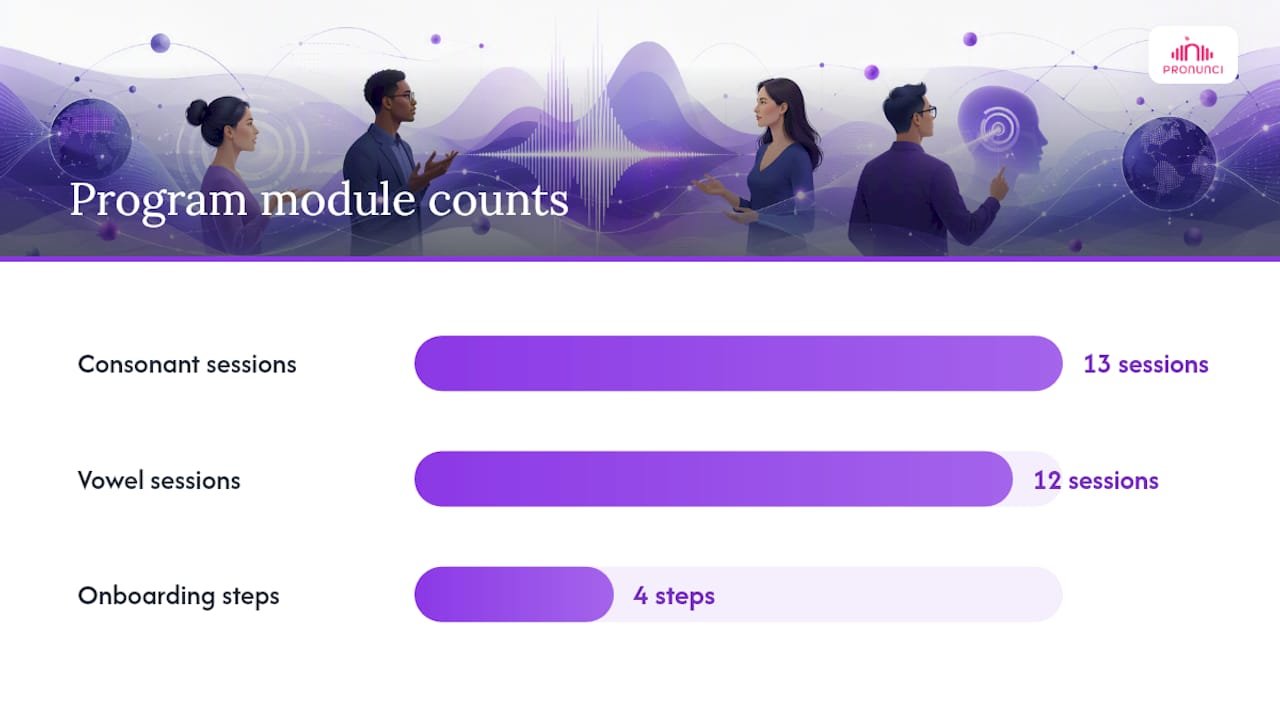
- 13 consonant sessions, 12 vowel sessions, plus intonation, rhythm, stress, connected speech, and public speaking drills.
How to start in four steps:
- Download InPronunci: Accent Training App and complete the free onboarding chapter.
- Set up your microphone and run My Accent Test AI for your baseline score.
- Prioritize your top 2–3 features from the roadmap above.
- Follow the 30-day focused plan inside the app.
For a deeper look at how the program is structured, the InPronunci: American Accent Training Course on desktop walks you through every chapter at your own pace. Technology-assisted language learning consistently shortens the feedback loop that makes structured practice effective.
What to expect: realistic timeline and cost
Measurable gains in listener-rated comprehensibility typically appear within 6–12 weeks of structured daily practice. Significant shifts in perceived competence and credibility usually require 3–6 months of sustained effort.
| Practice level | Expected outcome | Approximate timeline |
|---|---|---|
| 20–30 min/day, structured | Noticeable comprehensibility gain | 6–12 weeks |
| 20–30 min/day + weekly coach review | Competence perception shift | 3–4 months |
| Daily practice + monthly benchmark | Credibility and hireability improvement | 4–6 months |
Cost shapes vary. An app subscription gives you guided daily practice at a fraction of the cost of traditional coaching. Optional 1-on-1 sessions with a human coach accelerate progress on specific problem areas. The most efficient path for most professionals is a subscription for daily structured practice, with occasional coaching for targeted feedback.
Measurement checkpoints: run your assessment template at baseline, 4 weeks, and 12 weeks. Use blinded listener ratings and AI scores together — subjective self-assessment alone is not reliable enough to track real progress.
Accent pride, identity, and when to (or not to) change
Keeping features of your first language in your English is valid. Accent is part of identity, and no research suggests you need to erase it. The goal here is clarity for impact — improving comprehension in professional settings — not accent erasure.
- What to target: features that create processing friction for listeners (dropped consonants, misplaced stress, flat intonation) rather than features that simply mark your linguistic background.
- What to keep: regional or L1 features that do not reduce comprehensibility and that reflect who you are.
- When not to change: roles where regional identity is an asset, or personal contexts where authenticity matters more than standard-accent norms.
- Code-switching as a skill: many professionals maintain their natural accent in personal settings and shift toward clearer standard pronunciation in high-stakes professional contexts. That is a skill, not a compromise.
Accent reduction for professionals works best when the learner defines their own goal — clarity, not conformity.
Pro Tip: In multicultural workplaces, framing your pronunciation work as “clarity training” rather than “accent reduction” shifts the goal from identity change to communication effectiveness — a distinction that matters to you and to your colleagues.
A perspective on pronunciation and professional brand
The evidence is clear, and the practical path is straightforward. What I find most important, after more than 20 years of working with professionals and ESL learners, is this: the gap between how you sound and how you want to be perceived is almost always smaller than it feels. Most professionals need to improve two or three specific features — not rebuild their entire way of speaking.
Start with an honest baseline. Use My Accent Test AI to identify where your processing fluency drops. Then practice those features deliberately, with immediate feedback, using tools like the Interactive Visual 2D Sound Simulator for the American [t] to train the hidden movements. Structured training with clear targets produces real, measurable results — and it respects your identity while giving you the clarity your career deserves.
Get started with InPronunci today
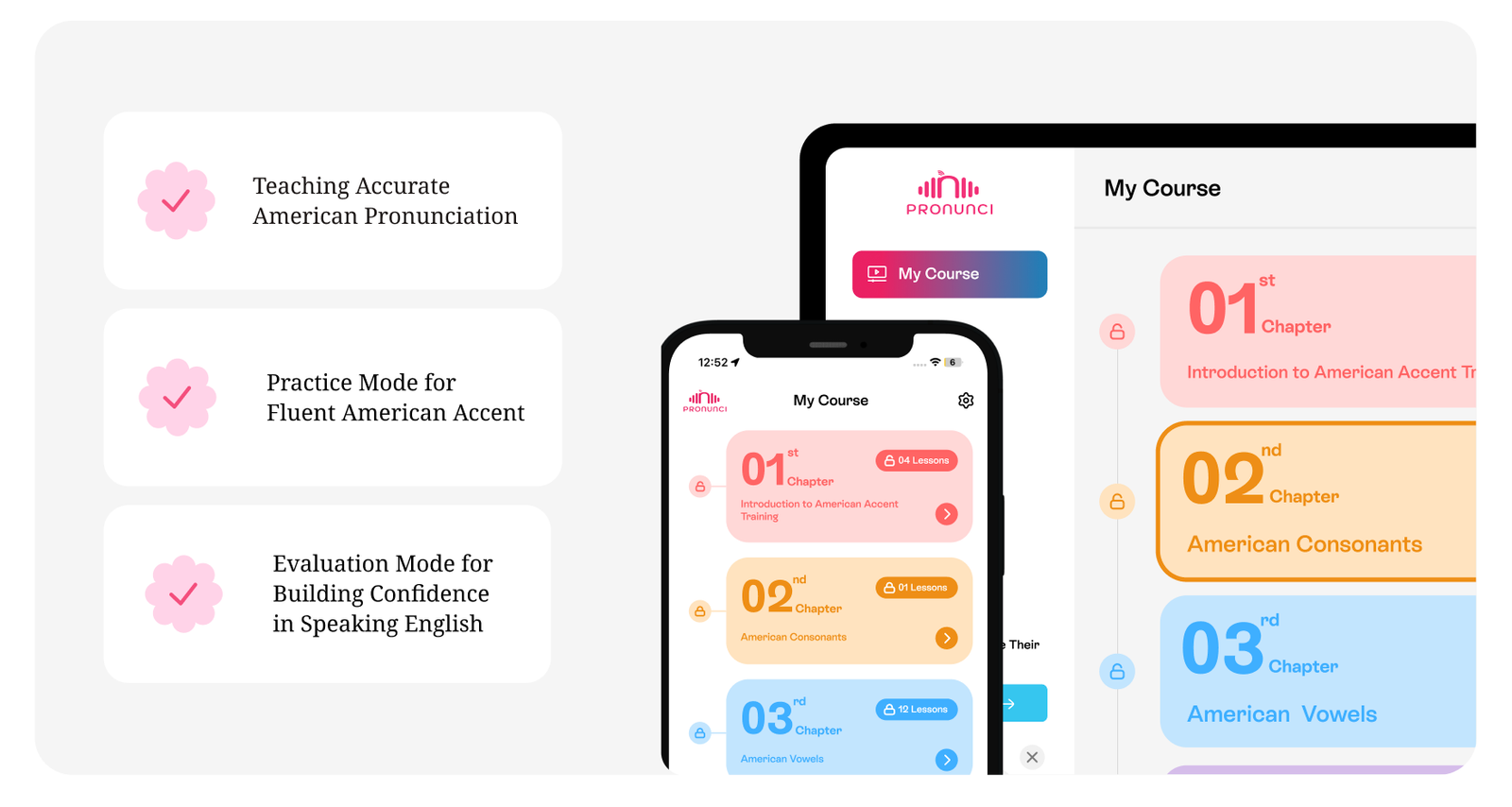
Clear pronunciation is a career skill you can build with the right structure. InPronunci: Accent Training App gives you Prof. Alex’s guided method, AI feedback, 2D articulatory simulators, and a complete program from speech organs to connected speech — all in one place. It is not a casual language app. It is a structured program built for professionals who want measurable results.
Structured American Accent Training Course
From Speech Organs Education to American Intonation
The InPronunci course is built step by step: every chapter prepares the next one, and by the end of the course students receive a certificate.
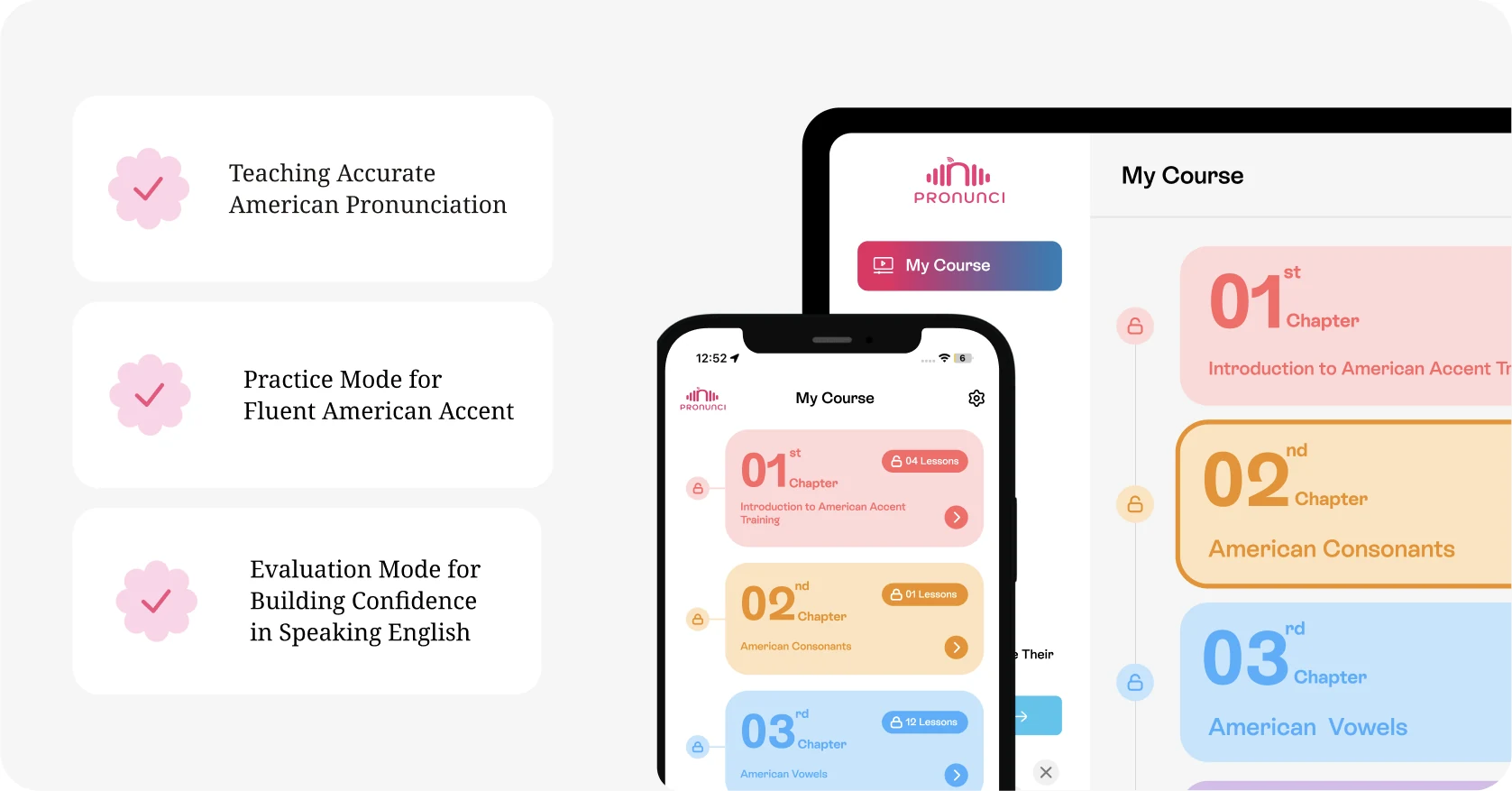
- Speech Organs EducationStudents learn how the speech organs work, along with the AI Accent Coach commands and feedback.
- American ConsonantsPractice and evaluate American consonants in phonetic exercises and practice sentences with the AI Accent Coach.
- American VowelsPractice and evaluate American vowels in phonetic exercises and practice sentences with the AI Accent Coach.
- IntonationLearn how intonation can change the meaning of what you say.
- CertificateBy the end of the course, students receive a certificate.
- Try the free onboarding chapter — no commitment required.
- Run My Accent Test AI for your baseline score.
- Follow the 30-day focused plan with daily drills, AI scoring, and native-speaker comparison.
For a full breakdown of how to choose the right AI accent coach for your goals, read The Ultimate Pronounce App Guide. Ready to start? Download InPronunci: Accent Training App or open the InPronunci: American Accent Training Course on desktop.
Sources
- Research: How the ‘accent penalty’ determines who gets heard – Harvard Business Review
- Is Your Accent Right for the Job? A Meta-Analysis on Accent Bias in Hiring Decisions
- Essentialist beliefs about accented speakers moderate the effect of processing fluency on employability ratings – Frontiers in Psychology
- Political skill: Explaining the effects of nonnative accent on managerial decisions (PDF)
Questions & Answers
FAQ
01Does pronunciation really affect how competent you seem?
Yes.
02How long does it take to see measurable improvement?
Noticeable gains in listener-rated comprehensibility typically appear within 6–12 weeks of structured daily practice (20–30 minutes per day); significant competence-perception shifts usually require 3–6 months.
03Which pronunciation features should professionals prioritize first?
Start with final consonant release, word stress placement, and vowel reduction (schwa). These three features have the strongest effect on processing fluency and listener comprehensibility.
04Can InPronunci help with high-stakes professional contexts like interviews?
Yes. InPronunci: Accent Training App includes AI Accent Coach feedback, 2D sound simulators, and structured drills specifically suited to the clarity demands of interviews, presentations, and client calls.
05Is accent training the same as erasing your identity?
No. The goal is clarity for impact — improving the features that create processing friction for listeners — not eliminating the features that reflect your linguistic background. Code-switching between natural and standard-clear pronunciation is a professional skill, not a compromise.
Recommended

InPronunci Accent Training App for Professional Communication
Improve American pronunciation with InPronunci, an accent training app using AI feedback, human guidance, and 2D Sound Motion Technology.
A Strategic Feature Comparison: How InPronunci Differs from Traditional Accent Apps in 2026
Ready for executive clarity? Compare InPronunci with other apps and learn how 2D Sound Motion Technology trains each American sound step by step.

InPronunci vs. BoldVoice: American Accent Training App Comparison
Compare InPronunci and BoldVoice for American pronunciation, intonation, rhythm, and connected speech, with Pronunci Instructions and AI Accent Coach.
Plans
What InPronunci costs
InPronunci Basic
$35 per month
Chapter 1 is free after signup.
InPronunci Premium
$200 per month
Includes a coach:
Why InPronunci is worth the price
- Interactive Visual 2D Sound Simulators, built on 2D Sound Motion Technology developed by Prof. Alex, train your speech organs for each American sound.
- Prof. Alex's guided instructions in every lesson, like working with a real coach.
- The Advanced AI Accent Coach evaluates sounds, intonation, rhythm, stress, and connected speech against native American English speech (100 = native speaker).