


Non-native speakers typically mispronounce consonants because of five systematic causes: L1 transfer (your first language maps its own sounds onto English), phonotactic gaps (your L1 forbids certain consonant sequences), articulatory mismatch (your speech organs have never practiced the target position), orthographic interference (spelling misleads you about how a sound is produced), and perceptual misclassification (you hear a foreign sound as the closest L1 category). These causes are explained by frameworks including the Contrastive Analysis Hypothesis, the Speech Learning Model (SLM), and the Perceptual Assimilation Model for L2 (PAM-L2). Classic examples appear throughout: /θ/ in think, the American /ɹ/ in red, and the /r/ vs. /l/ contrast in right vs. light.
Core causes at a glance:
- L1 transfer and absent contrasts
- Phonotactic restrictions and cluster simplification
- Articulatory placement and manner differences
- Orthography-driven and perceptual errors
This article works through each cause in depth, provides a reference table of the most commonly affected consonants, and gives you a step-by-step diagnosis and remediation plan. Learners will find the practical exercises and 4-week program most useful; researchers will find the taxonomy, empirical summaries, and citation pointers in the later sections.
TL;DR: Quick Causes and Fixes You Can Start Today
If you want the short version before diving in, here it is.
Primary causes and one-line fixes:
- L1 transfer: Your brain substitutes the closest L1 sound. Fix: run a contrastive minimal-pair drill (e.g., think /θɪŋk/ vs. sink /sɪŋk/) for five minutes daily.
- Phonotactic gaps: Your L1 bans certain clusters, so you delete or insert sounds. Fix: practice the cluster in isolation, then add it to a real word one consonant at a time.
- Articulatory mismatch: You have never placed your tongue or lips in the target position. Fix: use a speech-organ training simulator (explained in Section 7) and practice the movement until it feels natural.
- Perceptual misclassification: You cannot hear the difference yet, so you cannot produce it. Fix: do a perception-first listening task before any production drill.
3-action practice checklist for the next 10–30 minutes:
- Record yourself saying five minimal pairs (e.g., vine/wine, think/sink, right/light) and listen back for substitutions.
- Look up the IPA symbol for one error sound and find a diagram or video showing tongue position.
- Drill that one sound in isolation for two minutes, then embed it in three real sentences.
For a full diagnosis method, go to Section 6. For the complete 6-week remediation schedule, go to Section 7.
Why Non-Native Speakers Mispronounce Consonants: The Deep Causes
L1 transfer and absent contrasts
The Contrastive Analysis Hypothesis predicts that where L1 and L2 phonemic inventories diverge, errors will follow. When English has a contrast that your L1 lacks, your brain has no stored category for the new sound, and it defaults to the nearest match. This is not a learning failure; it is a predictable phonological process.
Arabic provides a clear illustration. Arabic-speaking learners systematically substitute /p/→[b], /v/→[f], and /tʃ/→[ʃ] because those English contrasts are absent or marginal in Arabic phonology. Spanish speakers often produce /b/ for /v/ because Spanish merges the two into a single phoneme. The PAM-L2 model refines this prediction: when a foreign sound falls inside an existing L1 category, it is very hard to perceive as distinct, and production follows perception.
Voicing contrasts add another layer. Many L1 systems (German, Russian, Polish) apply final devoicing, converting voiced obstruents to voiceless ones at word boundaries. A German speaker may produce bed as [bɛt] and dog as [dɔk] not from ignorance but from an automatic phonological rule that transfers directly into English.
Phonotactics: clusters, codas, and what your L1 forbids
Phonotactics governs which consonant sequences a language permits. English allows complex onsets like /str/ in street and complex codas like /ksts/ in texts. Most L1 systems do not. When a learner encounters a sequence their L1 forbids, three strategies emerge: deletion (drop a consonant), epenthesis (insert a vowel to break the cluster), or feature change (alter one consonant to make the sequence more permissible).
Research on Vietnamese learners shows that deletion is the dominant strategy for CCC clusters, with the pre-initial /s/ or an earlier consonant most often dropped; feature change and epenthesis also occur, and aspiration differences drive many additional errors. The Markedness Differential Hypothesis explains why: more marked (typologically rare) structures are harder to acquire, and complex clusters rank high on markedness scales. Focusing on high-weight clusters first yields faster intelligibility gains because those are the errors that most disrupt comprehension.
Cross-linguistic data confirm that final-consonant omission, cluster epenthesis, and dental-fricative substitutions are widespread phenomena across many L1 backgrounds, not isolated quirks of one language group.
Articulatory mismatch: /θ/, /ð/, /ɹ/, and /ŋ/
Some English consonants require articulatory gestures that simply do not appear in most other languages.
Interdental fricatives /θ/ and /ð/ demand the tongue tip between or just behind the upper teeth while air flows continuously. Most L1 systems substitute a dental stop /t d/ or an alveolar fricative /s z/: think → [tɪŋk] or [sɪŋk]; this → [dɪs] or [zɪs]. The substitution is not random; it reflects the closest available place-and-manner match.
The American rhotic /ɹ/ is produced with the tongue tip raised and slightly retroflexed, or with the tongue body bunched, while the lips may round slightly. This gesture is absent in most European and Asian L1 systems. Spanish speakers use a tapped /ɾ/ or trilled /r/; Japanese speakers use the lateral flap /ɾ/; Mandarin speakers use a retroflex approximant that differs in tongue shape. The result is a range of substitutions that all sound “accented” to American listeners even when the speaker is otherwise fluent.
The velar nasal /ŋ/ in word-final position (as in sing, ring) is often produced with an added stop: [sɪŋg] instead of [sɪŋ]. Many L1 systems treat /ŋ/ as an allophone that never appears alone at the end of a syllable, so learners add the expected following /g/ or /k/.
For American consonant articulation targets with IPA and training examples, the placement descriptions above are a starting point, but seeing the mouth position in motion is what makes the difference in practice.
Orthographic interference
English spelling is notoriously inconsistent. The letter c represents /k/ in cat and /s/ in city; gh is silent in night but /f/ in enough; th is /θ/ in thin and /ð/ in then. Learners who read before they listen often build incorrect phoneme-grapheme mappings that persist even after they know the rule.
Spelling-driven errors tend to cluster around: silent consonants (knight, wrap, psychology), digraphs with unexpected values (ch as /k/ in chemistry), and final -ed endings where spelling suggests /ɛd/ but the actual realization is /t/ or /d/ (walked → /wɔkt/, played → /pleɪd/).
Perception vs. production: why you cannot fix what you cannot hear
The Speech Learning Model (SLM) holds that new L2 phonetic categories form only when the learner perceives the L2 sound as distinct from any existing L1 category. If the perceptual boundary has not formed, production training alone will not stick. This is why some learners can repeat a corrected form in a drill but revert immediately in conversation: the perceptual category is not yet stable.
Prosody, stress, and consonant reduction
American English is stress-timed: stressed syllables carry full consonant realizations, while unstressed syllables reduce. The /t/ in butter becomes a voiced flap [ɾ]; the /d/ in and often disappears in connected speech; the /h/ in function words like him or her drops entirely. Learners who apply syllable-timed rhythm from their L1 over-articulate every consonant, which sounds unnatural. Learners who try to copy reduction without understanding the stress pattern produce errors in the wrong places.
Which Consonants Do Non-Native Speakers Most Often Get Wrong?
The table below lists the phonemes most frequently affected by non-native pronunciation difficulties, with typical substitutions organized by L1 background and a one-line practice cue for each. IPA symbols follow standard American English transcription.
| Phoneme | Example word | Typical substitution(s) | Common L1 sources | Practice cue |
|---|---|---|---|---|
| /θ/ | think /θɪŋk/ | [t], [s], [f] | Arabic, Spanish, French, Japanese, Mandarin | Place tongue tip lightly between teeth; feel air flow over the tip. |
| /ð/ | this /ðɪs/ | [d], [z], [v] | Arabic, Spanish, French, Mandarin | Same position as /θ/ but add voicing; feel the vibration on your fingertip at your throat. |
| /ɹ/ | red /ɹɛd/ | [r] (trill), [ɾ] (tap), [l] | Spanish, Japanese, Korean, Mandarin | Raise the tongue body; do NOT touch the roof of the mouth; lips may round slightly. |
| /l/ vs. /ɹ/ | light vs. right | /l/→[ɹ] or /ɹ/→[l] | Japanese, Korean, Chinese | Minimal-pair drill: led/red, lane/rain, glass/grass. |
| /v/ | vine /vaɪn/ | [b], [f], [w] | Arabic, Spanish, Japanese, Korean | Upper teeth touch the inner lower lip; feel the vibration. |
| /w/ | wine /waɪn/ | [v], [b] | German, Russian, Arabic | Round lips fully before the vowel starts; no teeth contact. |
| /p/ | park /pɑɹk/ | [b] | Arabic, Korean, some Mandarin | Aspirate: hold a tissue in front of your mouth; it should move on /p/ in stressed position. |
| /b/ vs. /p/ | bat vs. pat | Neutralization | Arabic, Korean | Minimal pair: bin/pin, bat/pat; focus on aspiration, not just voicing. |
| /ŋ/ | sing /sɪŋ/ | [ŋg], [n] | Many L1 backgrounds | Practice word-final /ŋ/ without adding a stop: sing, ring, long. |
| /z/ | zoo /zuː/ | [s], [dz] | Japanese, Korean, Arabic, Indonesian | Voiced fricatives /z/ and /v/ show the highest error frequencies; feel the buzz at your throat. |
| /tʃ/ | church /tʃɜɹtʃ/ | [ʃ], [ts] | Arabic, Spanish, some Asian L1s | Start with /t/ contact, then release into /ʃ/; do not skip the stop closure. |
| /dʒ/ | judge /dʒʌdʒ/ | [ʒ], [j], [dz] | Spanish, Japanese, Arabic | Mirror of /tʃ/: voiced version; feel the stop-then-release pattern. |
For a deeper look at pronunciation challenges specific to Asian English speakers, the /r/ vs. /l/ and /v/ vs. /b/ patterns above appear consistently across Korean, Japanese, and Mandarin L1 backgrounds.
Spanish L1 speakers face a distinct set of challenges around /v/ vs. /b/ and final consonant realization. A practical reference for Spanish pronunciation patterns can help clarify which L1 habits carry over most strongly into English.
Evidence-Based Techniques for Fixing Consonant Errors
The five core methods
-
Articulatory description with tactile feedback. Read the place-and-manner description for the target sound, then use tactile cues: hold a tissue to feel aspiration on /p/, touch your throat to feel voicing on /v/, place a finger on your lips to check rounding on /w/. Speech-organ training simulators that train tongue, lip, and jaw movement in real time accelerate this step significantly.
-
Minimal-pair drilling. Drill contrasting pairs (think/sink, vine/wine, bat/pat) in isolation, then in carrier sentences, then in spontaneous speech. The sequence matters: isolation builds the motor program; sentences build automaticity.
-
Focused perception training. Before production, train your ear. Listen to 20–30 tokens of the target contrast in random order and identify which member of the pair you hear. Accuracy above 85% on perception predicts faster production gains.
-
CAPT and AI-assisted feedback. Computer-Assisted Pronunciation Training tools give immediate, objective feedback on each token. This removes the delay between production and correction that makes traditional drilling slow. Combining perception training with production training and CAPT tools is the approach most strongly supported by current SLA frameworks, including the SLM and PAM-L2.
-
Prosody-integrated practice. Once you can produce the target sound in isolation, embed it in stress-timed sentences. Practice with natural rhythm so the consonant is trained in the same phonetic environment where it will actually be used.
A 6-week sample schedule
| Week | Focus | Daily task (10–30 min) |
|---|---|---|
| 1 | Perception baseline | Minimal-pair listening; mark which contrasts you cannot hear |
| 2 | Isolation production | Articulatory drills for your top 2 priority phonemes |
| 3 | Word-level production | Drill target phonemes in 20 words; record and compare |
| 4 | Phrase and sentence level | Embed target sounds in carrier sentences; focus on stress placement |
| 5 | Connected speech | Read short paragraphs aloud; record and review for cluster errors |
| 6 | Spontaneous speech + review | Unscripted 2-minute recordings; listener-rating check; spaced review of Week 1–2 sounds |
Pro Tip: To prevent fossilization, schedule a weekly “audit recording” where you speak on a topic you know well, then listen back specifically for the sounds you drilled in Weeks 1–2. Errors that reappear in familiar, low-stress speech are the ones at highest fossilization risk. Catch them early with spaced review rather than waiting until the pattern is automatic.
Even advanced learners can fossilize consonant errors without targeted instruction, which is why the audit recording step is not optional for serious learners. For a full guide to mastering consonant clusters with this kind of structured approach, the cluster-specific drills there complement the schedule above.
A 4-Week Daily Drill Program for Consonants
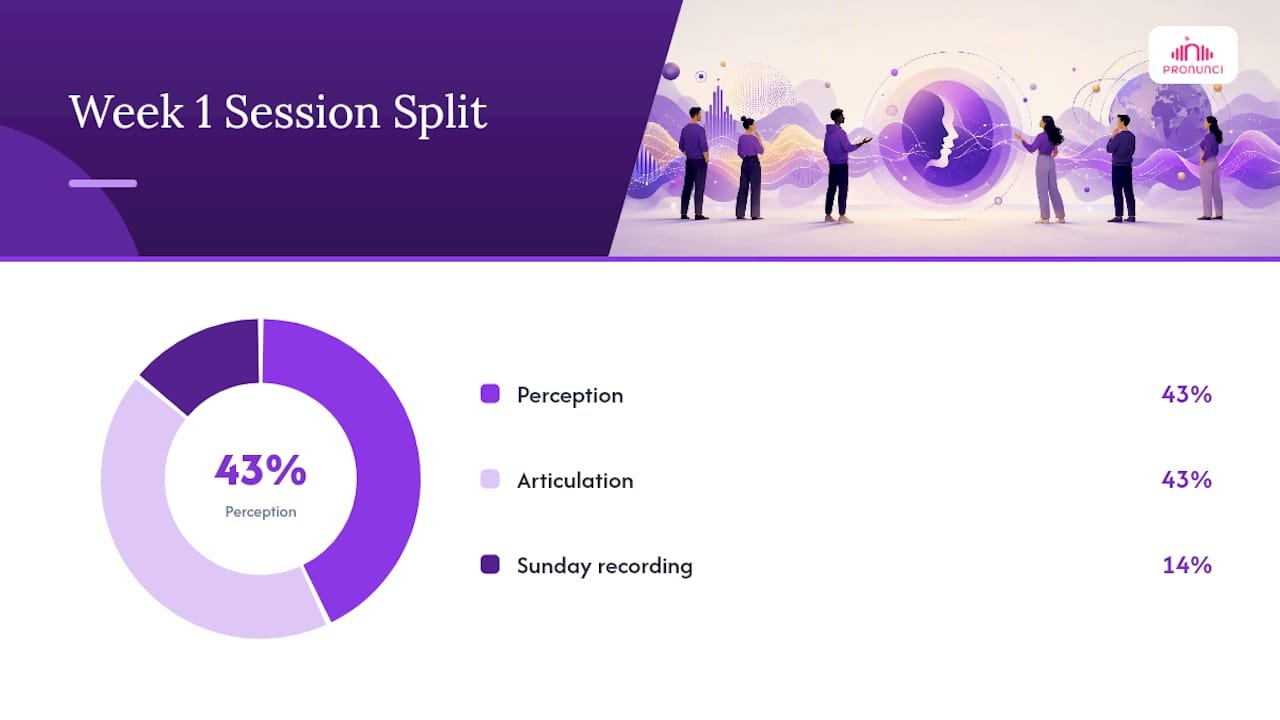
This program runs 10–20 minutes per day and cycles through perception, articulation, mixed production, and recording review. You need a recording device and a list of minimal pairs for your target phonemes.
-
Week 1: Perception days (Mon/Wed/Fri) + Articulation days (Tue/Thu/Sat)
- Perception days: Listen to 30 minimal-pair tokens per target phoneme; mark your responses; aim for 85% accuracy before moving to production.
- Articulation days: Practice the articulatory gesture in isolation for 2 minutes per phoneme; use the 2D simulator; no words yet.
- Sunday: Record yourself saying 10 words per target phoneme; note substitutions.
-
Week 2: Word-level production (Mon–Fri) + Recording review (Sat)
- Daily: Drill each target phoneme in 20 words, spoken at normal pace. Sentence prompts: “The thin thread broke.” (/θ/); “Very few vines grew.” (/v/); “She sang a long song.” (/ŋ/).
- Saturday: Record a 1-minute spontaneous description of your week; count target-phoneme errors.
-
Week 3: Phrase and sentence level (Mon–Fri) + Listener check (Sat)
- Daily: Read 5 sentences per target phoneme aloud, then paraphrase them without reading. Focus on stress placement.
- Saturday: Share your recording with a native speaker or AI feedback tool; log which errors caused confusion.
-
Week 4: Mixed production and consolidation
- Mon/Wed/Fri: Unscripted 2-minute recordings on a new topic each day; review for all target phonemes.
- Tue/Thu: Return to any phoneme still above 30% error rate; repeat Week 2 word-level drills.
- Saturday/Sunday: Full self-evaluation using the checklist below.
Self-evaluation checklist for each recording session:
- Did I produce the target phoneme accurately in more than 70% of tokens?
- Did any substitution cause a real word-meaning change (e.g., think → sink)?
- Did my consonant accuracy drop in longer, faster sentences compared to isolated words?
- Which phoneme still needs the most work next week?
For daily pronunciation practice guidance that explains why short, consistent sessions outperform long, infrequent ones, the evidence behind this schedule is worth reading before you start.
What Recent Research Tells Us About Consonant Mispronunciation
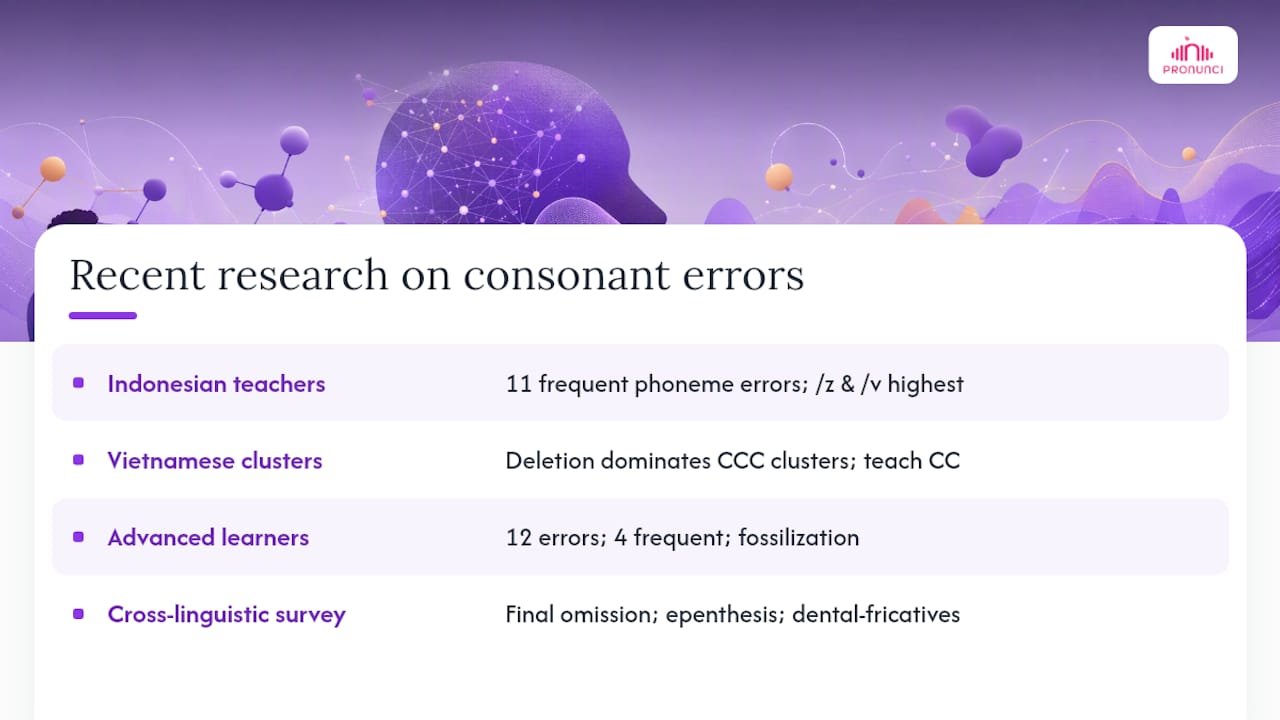
Three empirical studies and one broad synthesis stand out for their direct implications on diagnosis and remediation.
Indonesian English teachers (online YouTube corpus). An analysis of 24 English consonants in the speech of online Indonesian English teachers found 11 frequently mispronounced phonemes and 45 systematic deviations. Voiced fricatives /z/ and /v/ showed the highest error frequencies and can fossilize when instructional materials repeat teacher errors. The pedagogical implication is direct: if your teacher or your input materials contain systematic errors, your own production will reflect them. Seek input from native-speaker models or verified audio sources.
Vietnamese learner cluster study. A case study of Vietnamese learners tackling English consonant clusters documented deletion as the dominant strategy for CCC clusters, with feature change and epenthesis also present. Deletion of the pre-initial /s/ or earlier consonants in CCC clusters is the most frequent error type; aspiration differences drive many additional errors. The implication: cluster training should begin with CC sequences before moving to CCC, and aspiration should be treated as a separate training target, not assumed to transfer from voicing practice.
Advanced learner fossilization study. A study of final-year English students identified 12 mispronounced consonants, with four phonemes particularly frequent, showing that even advanced learners can fossilize consonant errors; targeted training is required to correct persistent error patterns. Proficiency level alone does not predict consonant accuracy.
Cross-linguistic survey. A broad compilation of L1 transfer phenomena across language groups confirms that final-consonant omission, cluster epenthesis, and dental-fricative substitutions are widespread cross-linguistic phenomena and should shape remediation priorities.
“Successful L2 consonant acquisition depends on both perceptual categorization and articulatory training. Theoretical frameworks including the Contrastive Analysis Hypothesis, the Speech Learning Model, PAM-L2, and the Markedness Differential Hypothesis converge on the recommendation to combine perception and production interventions and to use CAPT tools for immediate feedback.”
Source: Analyzing Phonological Features and Pronunciation Challenges in Second Language English Acquisition
For researchers pursuing follow-up, the Wikipedia synthesis of non-native pronunciations of English provides a broad inventory of L1-specific substitution patterns useful as a starting diagnostic checklist, best paired with the peer-reviewed sources above for authority.
The Cause Is Predictable — the Fix Has to Be Targeted
There is a persistent assumption in pronunciation teaching that more exposure equals better pronunciation. It does not. Exposure without structured feedback leaves L1 transfer patterns intact because the brain continues to map new input onto existing categories. What actually moves the needle is targeted contrast training: you identify the specific phonemic gap between your L1 and English, you train your ear to perceive the difference, and then you train your mouth to produce it in increasingly natural contexts.
The research on fossilization makes this point sharply. Learners who reach advanced fluency without ever addressing their consonant errors do not self-correct over time; the errors become more automatic, not less. The window for efficient correction is earlier than most learners think, and the method matters more than the hours spent.
One more thing worth saying directly: sociolinguistic and affective factors are real variables, not soft ones. A learner who feels their accent is part of their identity, or who fears judgment when they try a new sound, will unconsciously resist correction even during drills. Acknowledging that tension, rather than pushing through it, tends to produce faster results. The goal is not to erase an accent; it is to give you control over your consonants so you can be understood clearly when it counts.
Inpronunci Targets the Exact Causes Described in This Article
Every cause covered here, from articulatory mismatch to perceptual misclassification to cluster simplification, maps directly onto a specific feature in the Inpronunci American Accent Training Course.
The
InPronunci training structure
How InPronunci trains the American speech system
InPronunci trains the full American speech system: Interactive Visual 2D Sound Simulators and phonetic exercises for articulation and American sound development, sentence practice for intonation, melody, rhythm, and connected speech, paragraph practice for spontaneous speech, public speaking, and real communication confidence, and Advanced AI Accent Coach evaluation as you speak.
InPronunci is an advanced, linguistically structured American accent training platform with more than 1,000 downloads and a growing learner base. It is designed for serious ESL learners who want American pronunciation, stronger intonation, more natural rhythm, better connected speech, and the ability to speak English more confidently in real communication. The program is especially useful for intermediate and advanced English speakers who want to become independent speakers of English with confident communication, stronger speaking control, long-term speech improvement, and great public speaking skills. It is also designed for advanced speakers whose goal is to speak like a native or closer to native-like American speech, including people who were raised in the United States but still have slight accent patterns from the native language they were born with. It is a complete American accent training course and system created by Prof. Alex, Ph.D. Accent Coach, Doctor of Education, and professional linguist based in Austin, Texas, with Pronunci Instructions from Prof. Alex for each lesson that make self-learning more effective, supported, and clear.
show you exactly how native speakers position the tongue, lips, jaw, and airflow for each American consonant. No more guessing about where /θ/ is produced or how the American /ɹ/ differs from a Spanish trill. The AI Accent Coach gives you real-time feedback as you speak, so you catch substitutions immediately rather than after a week of drilling the wrong pattern. Human-Guided Instructions walk you through each exercise the way a real accent coach would, keeping you on track through the perception-to-production sequence that the research supports.
The course is designed for intermediate and advanced learners, which means it assumes you already know English and focuses entirely on retraining your sound system. You can see real learner results from Andrew, Thiago, and Tian.
Start with Free Chapter 1: “Get to Know Your Speech Organs” at learn.inpronunci.com/sign-up, available on App Store and Google Play. If you want personalized guidance from Prof. Alex, Ph.D. Accent Coach, the Premium Plan includes a 1-on-1 monthly session. Book a free Premium session at calendar.app.google/VATsvVHVb7HdU9Pb9.
Useful Sources for Learners and Researchers
-
English Consonant Mispronunciations by Online Indonesian English Teachers — International Journal of Language Teaching and Education. Empirical corpus study identifying 11 frequently mispronounced phonemes and 45 systematic deviations; directly useful for prioritizing remediation targets.
-
Analyzing Phonological Features and Pronunciation Challenges in Second Language English Acquisition — Liberal Journal of Language & Literature Review. Theoretical review synthesizing Contrastive Analysis, SLM, PAM-L2, and MDH; recommended for researchers building a theoretical framework.
-
Common Mistakes in Pronouncing English Consonant Clusters: A Case Study of Vietnamese Learners — CTU Journal of Science. Cluster-specific production study with deletion, epenthesis, and feature-change data; useful for phonotactics-focused diagnosis.
-
Pronunciation Challenges Faced by Non-Native Speakers (Zenodo) — Cross-linguistic survey of L1 transfer phenomena; broad reference for identifying which error types are most common across language groups.
-
Non-Native Pronunciations of English — Wikipedia. Extensive inventory of L1-specific substitution patterns; best used as a quick-reference starting checklist alongside peer-reviewed sources.
More than mechanics: InPronunci doesn’t teach only the mechanics of sounds. It teaches students how to become confident, fluent English speakers through a step-by-step system. Training may begin with how each American sound is made. Then it moves into sound combinations, sound contractions, phonetic exercises, practice sentences, and paragraphs in real rapid speech, so students start speaking English fluently and comfortably.
Questions & Answers
FAQ
01Why do non-native speakers mispronounce consonants?
The primary causes are L1 transfer (mapping a native-language sound onto an English phoneme), phonotactic gaps (the L1 forbids certain consonant sequences), articulatory mismatch, orthographic interference, and perceptual misclassification. Each cause requires a different training approach.
02How does your native language affect English consonant pronunciation?
Your L1 shapes which sounds you perceive as distinct and which articulatory gestures you have practiced. When English has a contrast absent in your L1, such as /p/ vs. /b/ for Arabic speakers or /r/ vs. /l/ for Japanese speakers, your brain defaults to the nearest available category, producing a systematic substitution.
03Which English consonants are hardest for non-native speakers?
The interdental fricatives /θ/ and /ð/, the American rhotic /ɹ/, and the voiced fricatives /v/ and /z/ are the most frequently mispronounced across L1 backgrounds. Research on Indonesian English teachers found that /z/ and /v/ had the highest error frequencies among all consonants tested.
04Can consonant errors fossilize even at advanced levels?
Yes. A study of final-year English students found 12 mispronounced consonants persisting at an advanced level, with four phonemes particularly frequent. Targeted, spaced training is required to correct fossilized errors; general fluency practice alone does not resolve them.
05How can Inpronunci help with consonant mispronunciation?
Inpronunci’s 2D Sound Video Mouth-Training Simulators train the exact tongue, lip, and jaw positions for each American consonant, while the AI Accent Coach gives real-time feedback on your production. The course covers the full perception-to-production sequence that SLA research identifies as best for correcting consonant errors.
Recommended

American Consonants for Non-Native Speakers | Inpronunci
Master American consonants for non-native speakers with our expert guide. Improve your pronunciation and gain confidence in speaking English.

American English Consonant Pronunciation Explained | Inpronunci
Master clear speech with our guide on American English consonant pronunciation explained. Improve your communication skills for professional success.

Pronunciation Challenges Asian English Speakers Face | Inpronunci
Why Mandarin, Korean, Japanese, and Vietnamese speakers struggle with American sounds like R/L, TH, and V/W, and how to train them sound by sound.
Plans
What InPronunci costs
InPronunci Basic
$35 per month
Chapter 1 is free after signup.
InPronunci Premium
$200 per month
Includes a coach:
Why InPronunci is worth the price
- Interactive Visual 2D Sound Simulators, built on 2D Sound Motion Technology developed by Prof. Alex, train your speech organs for each American sound.
- Prof. Alex's guided instructions in every lesson, like working with a real coach.
- The Advanced AI Accent Coach evaluates sounds, intonation, rhythm, stress, and connected speech against native American English speech (100 = native speaker).