TL;DR:
- Mastering 24 American English consonant phonemes is essential for clear, professional speech. Focused practice on aspiration and consonant clusters, supported by the IPA system, improves pronunciation. Consistent, structured training with real-time feedback leads to significantly better clarity in communication.
American English consonant pronunciation is defined as the accurate production of 24 distinct phonemes formed by partial or complete obstruction of airflow in the vocal tract. These 24 consonant phonemes are the foundation of clear, intelligible speech in professional settings. For non-native professionals, mastering these sounds is not optional. Mispronounced consonants reduce clarity in meetings, presentations, and interviews, regardless of vocabulary or grammar skill. This guide covers the American English sound system explained through articulation, aspiration, consonant clusters, and the International Phonetic Alphabet (IPA), with practical strategies you can apply immediately.
What are the 24 American English consonant phonemes?
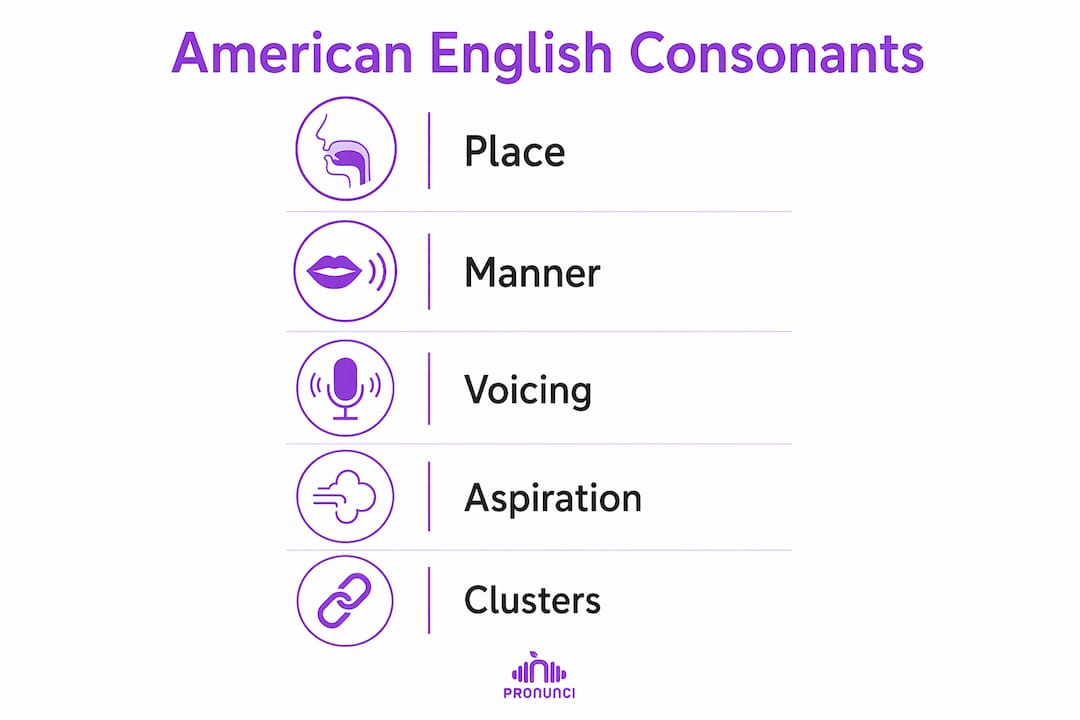
Consonants are produced by partial or complete obstruction of airflow, which contrasts with vowels where air flows freely. American English organizes these sounds by three features: place of articulation, manner of articulation, and voicing.
Place of articulation describes where in the mouth the obstruction occurs. Bilabial sounds like /p/, /b/, and /m/ use both lips. Alveolar sounds like /t/, /d/, /n/, /s/, and /z/ use the tongue tip against the ridge behind the upper teeth. Velar sounds like /k/ and /g/ use the back of the tongue against the soft palate. Interdental sounds like /θ/ (as in think) and /ð/ (as in this) place the tongue between the teeth.

Manner of articulation describes how airflow is shaped. Stops (/p/, /b/, /t/, /d/, /k/, /g/) block and release air completely. Fricatives (/f/, /v/, /s/, /z/, /ʃ/, /ʒ/, /h/, /θ/, /ð/) create continuous friction. Affricates (/tʃ/ as in church, /dʒ/ as in judge) combine a stop with a fricative. Nasals (/m/, /n/, /ŋ/) route air through the nose. Liquids (/l/, /r/) and glides (/w/, /j/) allow partial airflow with minimal friction.
| Sound category | Examples | Voicing |
|---|---|---|
| Stops | /p/, /b/, /t/, /d/, /k/, /g/ | Paired voiced/voiceless |
| Fricatives | /f/, /v/, /s/, /z/, /θ/, /ð/, /ʃ/, /ʒ/, /h/ | Paired + /h/ voiceless |
| Affricates | /tʃ/, /dʒ/ | Paired voiced/voiceless |
| Nasals | /m/, /n/, /ŋ/ | All voiced |
| Liquids and glides | /l/, /r/, /w/, /j/ | All voiced |
Understanding this structure gives you a map of the entire American English sound system. Once you know where and how a sound is made, you can train your mouth to produce it correctly.
How does aspiration affect American English stop consonants?
Aspiration is the primary cue that distinguishes voiceless stops /p/, /t/, and /k/ from their voiced counterparts in American English. It is a brief, forceful puff of air released immediately after the stop. Without it, native listeners hear the wrong consonant entirely.
The practical consequence is direct. Say pin without the puff of air, and a native listener hears bin. Say tin without aspiration, and it sounds like din. This is not a subtle difference. It changes the word completely and disrupts communication in professional contexts.
Voicing alone is a weak perceptual cue in American English. Listeners rely on aspiration far more than on whether your vocal cords vibrate. Many non-native professionals focus on voicing and miss the aspiration entirely. That is the wrong priority.
Key rules for aspiration:
- Aspirate /p/, /t/, /k/ at the start of a stressed syllable: pen, top, call
- Do not aspirate after /s/: spin, stop, skill have no puff of air
- Aspiration is reduced in unstressed syllables but never fully absent in stressed ones
Pro Tip: Hold a thin piece of paper in front of your mouth and say “pin.” The paper should move visibly. If it does not, you are not producing enough aspiration. Practice until the paper moves consistently.
For a deeper look at voiced vs. voiceless sounds in American English, including the mechanics behind each stop pair, Inpronunci’s dedicated guide covers the full picture.
Why are consonant clusters so difficult for non-native professionals?
Consonant clusters are sequences of two or more consonants with no vowel between them. American English uses them constantly, in words like strength, splash, script, and twelfth. Many languages do not permit these sequences, which makes them a major source of errors for non-native speakers.
Research shows that /spr/ clusters are mispronounced in 64% of intermediate learners’ speech, typically by omitting or delaying the /r/. That rate reflects how deeply cluster timing challenges run, even at intermediate proficiency levels.
The core problem is timing. Successful cluster production requires overlapping articulation, meaning your mouth begins moving toward the next sound before the current one finishes. Treating each consonant as a separate, full-length unit produces choppy, unnatural speech with inserted vowels.
Common errors and corrections:
| Cluster | Common error | Correction |
|---|---|---|
| /str/ (street) | “es-treet” or “s-treet” | Compress /s/ and /t/ together; no vowel before /s/ |
| /spl/ (splash) | “es-plash” | Lengthen /s/, move lips for /p/ simultaneously |
| /spr/ (spring) | /pring/ or /spring/ with delayed /r/ | Hold /s/ longer, blend /p/ and /r/ without pause |
| /ths/ (months) | “monts” or “monz” | Keep tongue between teeth for /θ/, add /s/ immediately |
Clusters like /str/, /spl/, and /ths/ require simultaneous control of tongue, lips, and airflow. The goal is not to say each sound separately. The goal is one fluid gesture that covers all the sounds together.
Pro Tip: Practice clusters in slow motion first. Say /s/ and hold it, then slide into /p/ and immediately into /r/ without stopping. Speed up only after the transition feels smooth at a slow pace.
For a full training plan on this topic, Inpronunci’s guide to mastering consonant clusters walks you through each cluster type with step-by-step mouth position guidance.
How does the IPA help you learn American consonants?
The International Phonetic Alphabet (IPA) is a standardized system of symbols where each symbol represents exactly one sound. Interactive IPA charts let you associate a symbol with its actual sound, independent of English spelling. This is critical because English spelling is an unreliable guide to pronunciation.
Consider these examples. The letter c represents /k/ in cat but /s/ in city. The letters th represent /θ/ in think but /ð/ in this. Without IPA, you guess. With IPA, you know.
Benefits of learning IPA for consonant work:
- You can look up any word in a dictionary and know exactly how to pronounce it
- You can identify which sounds you are producing incorrectly by comparing your output to the symbol
- You can communicate precisely with a coach or teacher about which sound needs correction
- You decode pronunciation patterns across word families, not just individual words
The phonetic alphabet for American English explained through IPA gives you a permanent reference system. You stop relying on spelling and start reading sounds directly. For professionals preparing presentations or client calls, this accuracy matters.
How to practice American English consonants for professional clarity
Effective consonant practice follows a clear sequence. You build accuracy at the sound level first, then move to words, then phrases, then real speaking situations.
- Identify your target sounds. Record yourself reading a short paragraph and compare it to a native speaker. Note which consonants sound different. Focus on stops, fricatives, and clusters first.
- Train mouth position before speed. Use Inpronunci’s
2D Sound Video Simulators to see exactly how the tongue, lips, and jaw move for each sound. Watching the movement removes the guesswork that “repeat after me” methods leave behind.
- Practice minimal pairs. Pairs like pin/bin, thin/tin, and ship/chip isolate the exact contrast you need to hear and produce. Drill them until the difference is automatic.
- Record and compare daily. Short daily sessions of 10–15 minutes produce stronger speech muscle memory than one long weekly session. Consistency builds the motor patterns that carry into real speech.
- Get real-time feedback. Inpronunci’s AI Accent Coach evaluates your pronunciation as you speak and flags errors immediately. That feedback loop accelerates correction far faster than self-monitoring alone.
Pro Tip: Practice target consonants in the words you actually use at work. If you present data, drill the /d/, /t/, and /r/ in “data,” “report,” and “results” until they are automatic in those specific words.
Key takeaways
Mastering American English consonant pronunciation requires accurate articulation of 24 phonemes, deliberate aspiration of voiceless stops, and fluid overlapping articulation of consonant clusters.
| Point | Details |
|---|---|
| 24 consonant phonemes | American English uses 24 consonant sounds organized by place, manner, and voicing. |
| Aspiration over voicing | Voiceless stops /p/, /t/, /k/ require a puff of air; without it, listeners hear the wrong word. |
| Cluster timing | Clusters like /str/ and /spl/ need overlapping articulation, not separate sounds with inserted vowels. |
| IPA as a reference tool | IPA symbols give you a reliable sound map that English spelling cannot provide. |
| Consistent daily practice | Short daily sessions with real-time feedback build the muscle memory needed for professional clarity. |
What I have learned after years of training non-native professionals
Most learners I work with arrive knowing the rules. They can explain aspiration. They can list the places of articulation. But their speech still lacks clarity. The gap is not knowledge. The gap is physical training.
Knowing that /p/ requires aspiration does not automatically make your mouth produce it. Your articulators have spent decades following the patterns of your first language. Retraining them takes deliberate, guided repetition at the sound level before you ever attempt a full sentence.
The second thing I see consistently: professionals underestimate clusters. They focus on individual sounds and assume clusters will follow. They do not. A cluster like /str/ is a separate motor skill from /s/, /t/, and /r/ practiced in isolation. Fluency in clusters requires training the transition, not the sounds themselves.
My honest recommendation is to stop practicing randomly and start practicing with a system. Map your errors, train the specific sounds causing them, and use technology that shows you what your mouth should be doing. That combination produces results that audio alone cannot match.
— Prof. Alex., Ph.D. Accent Coach
Inpronunci: structured training for American consonant clarity
Clear consonant pronunciation does not come from passive listening. It comes from guided, structured practice with feedback at every step.
Inpronunci’s American Accent Training Course is built for exactly this. The course uses Interactive 2D Sound Video Mouth-Training Simulators to show you how every American consonant is physically produced. The AI Accent Coach gives you real-time feedback as you speak. Human-guided instructions keep you on track the way a real coach would. You can start with the Free Chapter 1, “Get to Know Your Speech Organs,” at no cost. The Basic Plan gives you full self-study access. The Premium Plan connects you directly with Prof. Alex., Ph.D. for monthly 1-on-1 sessions. Sign up here and begin building the consonant clarity your professional communication requires.
FAQ
What are the 24 consonant sounds in American English?
American English uses 24 consonant phonemes organized by place of articulation, manner of articulation, and voicing. They include stops, fricatives, affricates, nasals, liquids, and glides.
Why does aspiration matter for American English consonants?
Aspiration is the primary cue that distinguishes /p/, /t/, and /k/ from /b/, /d/, and /g/ in American English. Without the puff of air, native listeners hear the wrong consonant and the word loses its meaning.
What makes consonant clusters hard to pronounce?
Consonant clusters require overlapping articulation, meaning the mouth must transition between sounds simultaneously rather than sequentially. Inserting a vowel between consonants or dropping a sound are the most common errors.
How does the IPA help with American consonant pronunciation?
The IPA assigns one symbol to each sound, giving learners a reliable reference that English spelling cannot provide. It lets you identify, describe, and correct specific consonant errors with precision.
How long does it take to improve consonant pronunciation?
Improvement depends on the number of target sounds, practice consistency, and the quality of feedback. Short daily sessions with real-time feedback, such as those in Inpronunci’s AI Accent Coach, produce measurable results faster than infrequent or unguided practice.