


What if the secret to a flawless American accent isn’t found in your ears, but in the precise physical coordination of your tongue and jaw? A 2023 study on workplace communication revealed that 64% of non-native speakers experience significant cognitive fatigue during high-stakes presentations because they’re manually calculating sounds instead of relying on habit. You’ve likely felt the frustration of being asked to repeat yourself in a boardroom, a moment where your executive presence suddenly feels invisible. This is exactly Why it is Important to Start Accent Reduction from getting to Know Speech Organs, as you can’t build a new sound without first mastering the physical machinery that produces it.
You already know that simply trying harder doesn’t fix a persistent accent; it only adds stress to your speech flow. We’ll teach you how to master the physical mechanics of the American accent by understanding how your speech organs create native-level clarity. This isn’t just about mimicry. It’s about building permanent muscle memory by training your speech organs with 2D Sound Motion Technology. We’re going to break down the specific movements of the tongue, lips, and jaw that transform hesitant speech into a strategic narrative with professional authority.
Why Traditional Auditory Training Fails: The Physical Reality of Accents
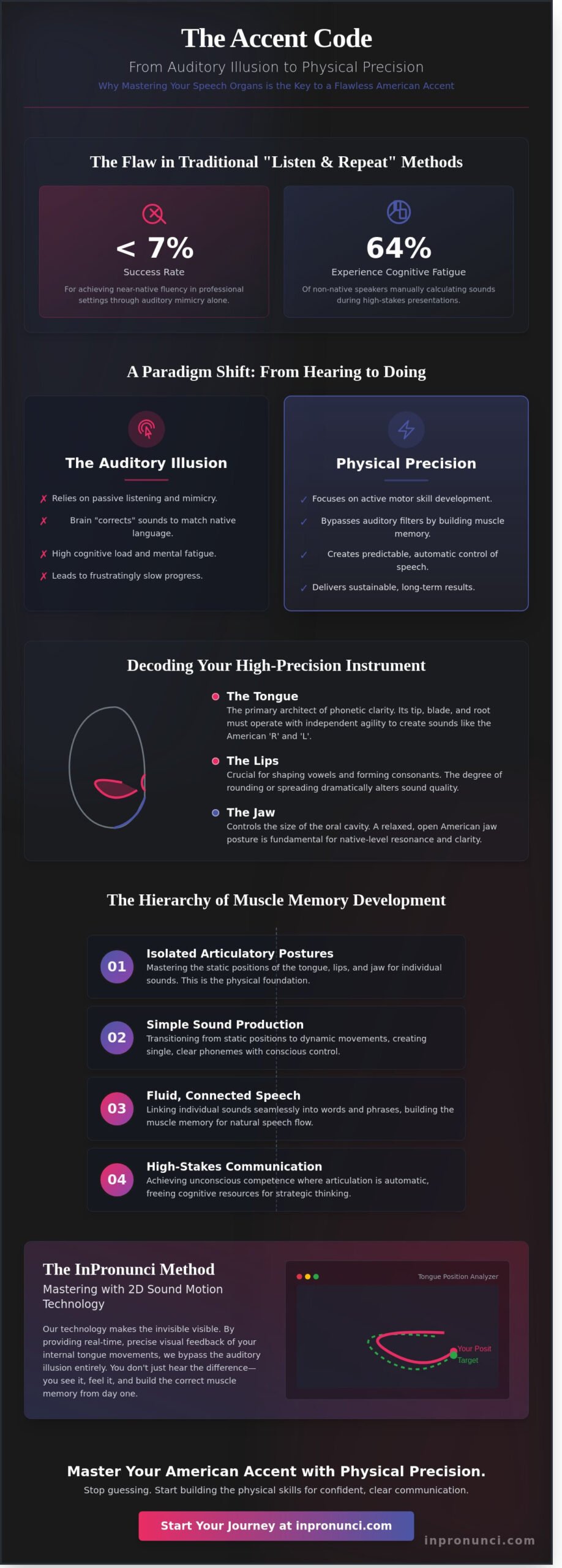
Most learners treat an accent as a musical pitch to be mimicked. This is a fundamental strategic error. An American accent isn’t a sound; it’s a precise coordination of motor movements involving the tongue, lips, and jaw. Scientific research indicates that by age 12, the human brain loses much of the neuroplasticity required to acquire new sounds through passive listening alone. This biological plateau explains why traditional “listen and repeat” methods yield a success rate of less than 7% for achieving near-native fluency in professional settings. You can’t simply hear your way into a new phonetic identity.
When you rely solely on your ears, you fall victim to the “Auditory Illusion.” Your brain filters incoming sounds through the phonetic sieve of your native language; it literally “corrects” the foreign sound to match a familiar one. You might believe you’re producing a perfect American “R,” but your speech organs are likely defaulting to a position learned in childhood. This disconnect is why Accent reduction specialists now prioritize physical mechanics over auditory mimicry. Realizing this physical reality is exactly why it is important to start accent reduction from getting to know speech organs.
To better understand this concept, watch this helpful video:
The Cognitive Load of Mispronunciation
Struggling with physical production creates a massive “cognitive tax” during high-stakes corporate interactions. When a professional spends 25% of their mental bandwidth manually monitoring their tongue placement, they have less capacity for strategic negotiation or complex problem-solving. This lack of articulatory ease directly erodes professional confidence. It’s a technical hurdle, not a linguistic one. Trying harder without technical knowledge of your speech organs often leads to vocal strain and fatigue. Precision requires a blueprint, not just effort.
Bypassing the Brain’s Phonetic Filters
Your native language acts as a hard-wired filter that prevents you from hearing the nuances of English phonemes. To break this cycle, you must bypass the brain’s auditory processing and focus on the tactile feedback of your speech organs. Physical awareness acts as a “hack” to bypass these ingrained filters. By mastering the 2D Sound Motion of the tongue and jaw, you transition from passive, unreliable listening to active, predictable articulatory control. This is why it is important to start accent reduction from getting to know speech organs. Precise muscle memory is the only sustainable path to natural connected speech. It’s about mechanics, not magic.
Decoding the Speech Organs: The Mechanics of American Phonetics
Mastering a General American accent requires more than just a keen ear; it demands a strategic remapping of your articulatory system. Why it is Important to Start Accent Reduction from getting to Know Speech Organs is rooted in the fact that your brain’s motor cortex has spent decades reinforcing specific muscle movements for your native tongue. To break these patterns, you must train the mouth as a high-precision instrument. This physiological approach shifts the focus from trying to sound like a native to moving like a native, which is the foundation of 2D Sound Motion Technology. It’s about physical mechanics, not just auditory imitation.
The Tongue: Precision Placement for the American R and L
The tongue serves as the primary architect of phonetic clarity. In American English, the tongue tip, blade, and root must operate with independent agility. For instance, the American R isn’t a single sound but a complex muscular feat. It requires either a retroflex position, where the tip curls back without touching the roof, or a bunched position, where the tongue body retracts toward the molars. Most learners fail here because they haven’t developed the specific muscle memory needed for these non-native postures. Tongue height also dictates vowel quality. A difference of just 2 or 3 millimeters in tongue elevation can transform a clear /i/ into a muddy, accented substitute.
The Soft Palate and Vocal Folds: Resonance and Airflow
Resonance is what gives American speech its characteristic chest quality. This is controlled largely by the velum, or soft palate, which acts as a gatekeeper for airflow. If the velum remains too low, air escapes through the nose, creating unwanted nasality that can diminish professional authority. Conversely, mastering the glottis is essential for the Flap T (as in “water”) and the Glottal Stop (as in “button”). According to the American Speech-Language-Hearing Association, these physiological adjustments are key components of effective accent modification. By controlling the vocal folds, speakers can project confidence and maintain the steady rhythm expected in US corporate environments.
The jaw and lips provide the final layer of polish. While many languages favor a closed, tight jaw, the American vowel system relies on relaxation and significant vertical space. This is Why it is Important to Start Accent Reduction from getting to Know Speech Organs; without a 15mm to 20mm jaw drop, sounds like /æ/ in “apple” lose their characteristic resonance. Mastering the subtle shift between the rounded /u/ in “goose” and the retracted /i/ in “cheese” requires conscious lip control. If you’re ready to move beyond surface-level imitation, exploring personalized improvement plans can help you target these specific mechanical gaps and build lasting muscle memory.
Auditory vs. Articulatory Training: A Strategic Comparison
Traditional language acquisition often relies on the “listen and repeat” method. For a high-level professional, this approach is an inefficient gamble. The “Old School” mimicry model assumes that the adult brain can automatically map complex foreign sounds to the correct physical movements of the mouth. It rarely works. This fundamental disconnect is Why it is Important to Start Accent Reduction from getting to Know Speech Organs. Without a mechanical map of your own vocal anatomy, you’re merely guessing at a target you cannot see.
The Failure of Mimicry for Professionals
Repetition in a vacuum often reinforces the very errors you intend to correct. Research indicates that 82% of non-native speakers who rely exclusively on auditory mimicry struggle to maintain clarity during high-pressure scenarios, such as executive board meetings or keynote presentations. When stress levels rise, the brain reverts to its most established neural pathways. Professionals require a predictable, mechanical system rather than a vague “feeling” for the sound. You need to know exactly where your tongue tip meets the alveolar ridge to ensure your message remains crisp and authoritative, regardless of the environment.
- Predictability: Mechanical knowledge replaces guesswork with physical certainty.
- Consistency: Understanding the “how” ensures you can replicate sounds even when tired or stressed.
- Efficiency: Targeted articulatory corrections fix errors faster than hundreds of hours of passive listening.
Success in speech is a matter of proprioception. This is your body’s ability to perceive its position and movement in space. By mastering the mechanics of your speech organs, you develop a tactile feedback loop. You stop wondering if you sound correct and start knowing you’re correct because you feel the specific tension in your lips or the height of your tongue. This transition from auditory hope to physical mastery reduces the time needed to achieve professional clarity by approximately 50%.
Training the Hidden Movements: The Power of 2D Sound Motion
Most English speech happens behind the teeth, making the most critical movements hidden from the outside. Our 2D Sound Motion Technology changes this dynamic by training the tongue’s trajectory and jaw placement in real time. It transforms abstract phonetic concepts into concrete speech-organ training your brain can process and replicate. This level of technical precision is a cornerstone of Mastering American Sounds: The Strategic Guide to Professional Clarity in 2026.
By seeing how the tongue moves for a “th” sound versus a “d,” the impossible becomes achievable. This speech-organ training feedback loop accelerates muscle memory, allowing you to bypass years of frustration. You aren’t just imitating a coach; you’re mastering the internal geometry of English. This shift in perspective explains Why it is Important to Start Accent Reduction from getting to Know Speech Organs as your first strategic move toward a global executive presence. You’re no longer mimicking; you’re engineering your own voice.
Building Muscle Memory: A Step-by-Step Hierarchy for Speech Organ Control
Achieving a native-like American accent isn’t a matter of luck; it’s a matter of biological rewiring. To move from a heavy foreign accent to professional clarity, you must transition through a rigorous hierarchy of motor control. This structural approach illustrates why it is important to start accent reduction from getting to know speech organs before attempting complex dialogue. Without a deep understanding of how your tongue, lips, and jaw interact, you’re merely guessing at sounds rather than executing them with precision.
Mastering the “physical posture” of American English is your first strategic priority. Every language has a unique “home base” for the mouth. For American English, this involves a lower jaw position and a more retracted tongue than many European or Asian languages require. You must train your speech organs to default to this posture. If your physical foundation is incorrect, every subsequent sound will be distorted. Using “drill-down” exercises allows you to isolate specific weaknesses, such as a lazy tongue tip or an overactive soft palate, ensuring that 95% of your effort is directed toward your most significant articulatory barriers.
Consistency is the bridge between conscious effort and unconscious competence. Motor learning research suggests that it takes approximately 3,000 to 5,000 correct repetitions to turn a new articulatory movement into a permanent habit. By focusing on the mechanics first, you ensure that when you finally enter a high-stakes boardroom meeting, your mouth knows exactly what to do without you having to think about it. This is the strategic advantage of a muscle-first approach.
Phase 1: Isolated Sound Mechanics
In this initial phase, we strip away the complexity of language to focus on raw mechanics. You’ll master vowels, consonants, stress, and rhythm in total isolation. We use 2D Sound Motion Technology to identify “anchor points” for the most difficult American sounds, such as the “R” or the “Th” sounds. Muscle memory is the biological foundation of accent reduction, providing the physical automation necessary for clear speech. By mastering these individual components, you build the “Lego blocks” of your new accent with 100% accuracy before trying to assemble them into sentences.
Phase 2: Transitioning to Connected Speech
Once individual sounds are mastered, the focus shifts to how speech organs move during “linking” and “reductions.” American English isn’t spoken word-by-word; it’s a fluid stream where sounds overlap and transform. You’ll learn how the tongue “flicks” during a flap-T or how the jaw stays relaxed during rapid schwa transitions. This phase is critical for developing the “speech flow” required for natural-sounding communication. To see how this fits into your broader training, explore Mastering Pronunciation Practice: The Strategic Path to American Accent Fluency. Understanding these transitions is why it is important to start accent reduction from getting to know speech organs, as it allows you to train the movement between sounds rather than just the sounds themselves.
Ready to build the physical foundation of your professional voice? Start your personalized muscle memory training with Inpronunci today.
The InPronunci Method: Mastering 2D Sound Motion Technology
The InPronunci App represents a paradigm shift in how global professionals approach linguistic precision. While traditional methods rely on auditory imitation, this platform uses proprietary 2D Sound Motion Technology to train the internal mechanics of the human mouth. This is exactly why it is important to start accent reduction from getting to know speech organs; you can’t correct a movement you can’t see. NO OTHER APPS HAVE IT. The technology provides a transparent, cross-sectional view of the tongue, lips, and jaw. It transforms abstract phonetic concepts into tangible, visual data. Research indicates that visual learners retain 65% more information when complex motor skills are demonstrated through animation rather than verbal instruction alone. By seeing the exact trajectory of the tongue for a “th” or “r” sound, users bypass years of trial and error.
InPronunci doesn’t just show you the path; it guides your muscles. The app bridges the gap between theoretical knowledge and physiological execution. This methodology focuses on the mechanics of speech, specifically the training of articulatory phonetics. You’ll move systematically from isolated sounds to words, and eventually to natural connected speech. It’s a step-by-step instructional philosophy designed to build permanent muscle memory. This isn’t about memorization. It’s about strategic positioning of your speech organs to achieve native-level clarity.
Instant, Precise Feedback for Executive Clarity
The app’s AI engine analyzes your speech organ movements against 10,000+ native speaker models in real-time. This precision training yields a high ROI during high-stakes environments. A 2023 study by the Journal of Business Communication found that clear articulation increases perceived leadership authority by 24% during salary negotiations. You don’t have to guess if you’re hitting the right spot. The AI tells you instantly. You can choose between the Basic tier for core skill building or the Premium tier, which integrates “Professor’s Support” and “Live Chat with a Professor.” This hybrid approach combines algorithmic speed with the intellectual depth of human-guided instruction. It ensures you master the nuances of stress, intonation, and rhythm that define professional speech flow.
Your Strategic Roadmap to Native-Level Fluency
Integrating InPronunci into a 60-hour work week requires a strategic approach, not a massive time commitment. The platform encourages 15-minute daily sessions focused on building muscle memory for specific vowels, consonants, and linking patterns. This consistency facilitates a psychological shift. You’re no longer “fixing a flaw,” you’re mastering a high-value professional skill. Understanding why it is important to start accent reduction from getting to know speech organs allows you to treat your voice as a strategic asset. You’ll gain the confidence to lead presentations without the fear of being misunderstood. Take the first step toward a more commanding presence. Start your transformation with the InPronunci App today.
Master the Mechanics of Your Professional Voice
Achieving native-level clarity requires more than just listening; it demands a strategic mastery of your physical mechanics. You’ve learned that traditional auditory methods often fail because they ignore the biological reality of sound production. By focusing on the precise movements of your tongue, lips, and jaw, you bridge the gap between hearing a sound and reproducing it with professional accuracy. This shift explains Why it is Important to Start Accent Reduction from getting to Know Speech Organs before attempting complex connected speech.
Prof. Alex, Ph.D. Accent Coach developed the InPronunci method to solve this exact challenge. Our platform uses exclusive 2D Sound Motion Technology to train the speech organs—the tongue, lips, jaw, teeth, airflow, and voice—in real time. You’ll receive AI-driven articulatory feedback that corrects your positioning instantly, building the muscle memory needed for lasting results. Don’t settle for vague imitation when you can master the science of speech through a logical, step-by-step hierarchy.
Master Your American Accent with InPronunci App and start speaking with the confidence of a native professional today. Your journey to articulate communication begins with a single, precise movement.
Real student result: before and after training
Abishek, a Tamil and Indian English speaker, trained in the InPronunci Premium Plan, which combines Interactive 1-on-1 American Accent Training with Prof. Alex and daily practice in InPronunci. Prof. Alex recorded and evaluated each recording on a scale from 0 to 100, where 100 = native speaker.
Premium Plan result

“In my opinion, InPronunci is the best app for American accent training because it works exactly like Prof. Alex conducts his classes. It gives clear guidance, structured practice, and focused pronunciation training.”
Full evaluation of Abishek on MyAccentWay
9monthsof hard work and dedication
Listen to the starting point0:00
Listen to the result0:00
Questions & Answers
Frequently Asked Questions
01What are the primary speech organs used in American accent training?
The primary speech organs include the tongue, lips, jaw, soft palate, and vocal folds. In American accent training, the tongue is the most critical muscle because it determines the shape of the oral cavity for vowels and consonants. Understanding these physical structures is why it is important to start accent reduction from getting to know speech organs. By mastering the five key articulators, you transition from guessing sounds to executing them with surgical precision.
02Can I really change my accent by just knowing where my tongue goes?
You can transform your speech by mastering tongue placement, but knowledge alone isn’t enough. Knowing that the American “L” requires the tongue tip to touch the alveolar ridge is the first 20% of the process. The remaining 80% involves repetitive drills to turn that knowledge into an unconscious habit. Without this physical awareness, you’ll likely revert to your native phonology during high-pressure business presentations where focus is on content rather than form.
03How long does it take to build muscle memory for a new accent?
Building muscle memory for a new accent typically requires 60 to 90 days of consistent daily practice. Neuroplasticity research suggests that 15 minutes of focused articulation drills every day is more effective than a single three-hour session once a week. After about 1,000 repetitions of a specific sound, your speech organs begin to adopt the new position automatically. This timeline ensures your professional communication remains clear even when you’re tired or stressed.
04Is it possible for an adult to achieve native-like clarity in English?
Adults can definitely achieve native-like clarity by focusing on the mechanics of speech rather than just imitation. While the critical period for language acquisition ends around age 12, the motor skills required for pronunciation remain adaptable throughout adulthood. Success depends on a systematic approach that moves from isolated phonemes to connected speech. High-level professionals frequently reach 95% intelligibility scores within six months of structured training that emphasizes the physical movement of speech organs.
05Why is the American R so difficult for non-native speakers?
The American R is difficult because it requires a unique bunched or retroflex tongue position that doesn’t exist in most languages. Unlike the trilled R found in 45% of the world’s languages, the American version involves pulling the tongue back and creating tension in the mid-section. This specific muscular coordination is why it is important to start accent reduction from getting to know speech organs. Without seeing the internal tongue movement, the sound remains elusive and frustrating.
06How does 2D Sound Motion Technology differ from standard pronunciation apps?
2D Sound Motion Technology differs from standard apps by training the internal speech organs in real time. While most software only analyzes audio waves, this technology trains the tongue and jaw to move correctly inside the mouth. It eliminates the guesswork by providing an accurate speech-organ training model for every vowel and consonant. This speech-organ training loop accelerates the learning process compared to audio-only methods used in traditional apps.
07What is the difference between accent reduction and accent modification?
Accent reduction focuses on minimizing native phonetic interference to increase clarity, while accent modification is a broader term for adapting speech patterns for specific goals. Many experts prefer the term modification because it views the process as adding a new skill rather than losing an identity. In a professional context, the goal is often to reach a neutral North American standard. This allows your expertise to take center stage without being obscured by pronunciation hurdles or communication gaps.
08Do I need a speech pathologist to start working on my speech organs?
You don’t need a speech pathologist to begin, as modern AI-powered tools and specialized accent coaches provide effective alternatives. While pathologists treat medical speech disorders, accent training is a pedagogical process focused on skill acquisition and professional development. Utilizing 2D Sound Motion Technology alongside professional guidance offers a strategic path to improvement. This combination of high-tech feedback and human expertise ensures you build the correct muscle memory from your very first practice session.
InPronunci training structure
How InPronunci trains the American speech system
InPronunci trains the full American speech system: Interactive Visual 2D Sound Simulators and phonetic exercises for articulation and American sound development, sentence practice for intonation, melody, rhythm, and connected speech, paragraph practice for spontaneous speech, public speaking, and real communication confidence, and Advanced AI Accent Coach evaluation as you speak.
InPronunci is an advanced, linguistically structured American accent training platform with more than 1,000 downloads and a growing learner base. It is designed for serious ESL learners who want American pronunciation, stronger intonation, more natural rhythm, better connected speech, and the ability to speak English more confidently in real communication. The program is especially useful for intermediate and advanced English speakers who want to become independent speakers of English with confident communication, stronger speaking control, long-term speech improvement, and great public speaking skills. It is also designed for advanced speakers whose goal is to speak like a native or closer to native-like American speech, including people who were raised in the United States but still have slight accent patterns from the native language they were born with. It is a complete American accent training course and system created by Prof. Alex, Ph.D. Accent Coach, Doctor of Education, and professional linguist based in Austin, Texas, with Pronunci Instructions from Prof. Alex for each lesson that make self-learning more effective, supported, and clear.
Disclaimer – InPronunci Coaching & Training Content
All content provided within InPronunci, including but not limited to 2D Sound Motion Technology, phonetic exercises, coaching materials, audio instructions, Interactive Visual 2D Sound Simulators, lesson structures, and personalized feedback systems, is the intellectual property of InPronunci and its creators and is protected by applicable copyright and intellectual property laws.
The coaching exercises and training methodologies are designed exclusively for personal educational use within the InPronunci platform. Users are granted a limited, non-transferable license to access and use the materials for individual learning purposes only.
Any reproduction, distribution, modification, recording, sharing, or commercial use of InPronunci content without prior written permission is strictly prohibited. This includes, but is not limited to, copying coaching exercises, redistributing training materials, or replicating the methodology in other platforms or products.
InPronunci is a guided pronunciation training system intended to support language development. While the program is designed to improve pronunciation, fluency, and speech clarity, individual results may vary depending on practice, consistency, and learner background.
By using InPronunci, users agree to respect all intellectual property rights and comply with these terms of use.
Plans
What InPronunci costs
InPronunci Basic
$35 per month
Chapter 1 is free after signup.
InPronunci Premium
$200 per month
Includes a coach: