
By Prof. Alex., Ph.D. Accent Coach
What is speech clarity training, and what does it actually improve?
Speech clarity training is a targeted practice of improving how clearly and intelligibly you speak, focusing on the physical and cognitive habits that shape your voice. It is not about sounding artificial or erasing your personality. The goal is to make your natural voice easier to understand and more persuasive in real communication settings.

Speech clarity training involves specific exercises focused on articulation, breath support, pacing, and resonance to improve spoken intelligibility by retraining motor pathways. These are not surface-level fixes. They target the root mechanics of how your mouth, breath, and voice work together.
The core skills developed through this training include:
- Articulation precision: How clearly you form individual sounds, especially consonants and word endings
- Pacing control: Speaking at a rate that lets listeners process your words without losing attention
- Breath support: Using diaphragmatic breathing to sustain volume and steadiness through a full phrase
- Resonance and voice projection: Placing your voice so it carries naturally without strain
- Self-monitoring: Recognizing in real time when your speech is drifting toward mumbling, rushing, or tension
Underlying all of this is neuroplasticity. Your brain and speech muscles can form new habits through repetitive, focused practice. Adults retain speech production plasticity, meaning you can genuinely retrain how you speak at any age. That is not motivational language. It is how motor learning works.
Why is your speech unclear? Common causes and how training fixes them
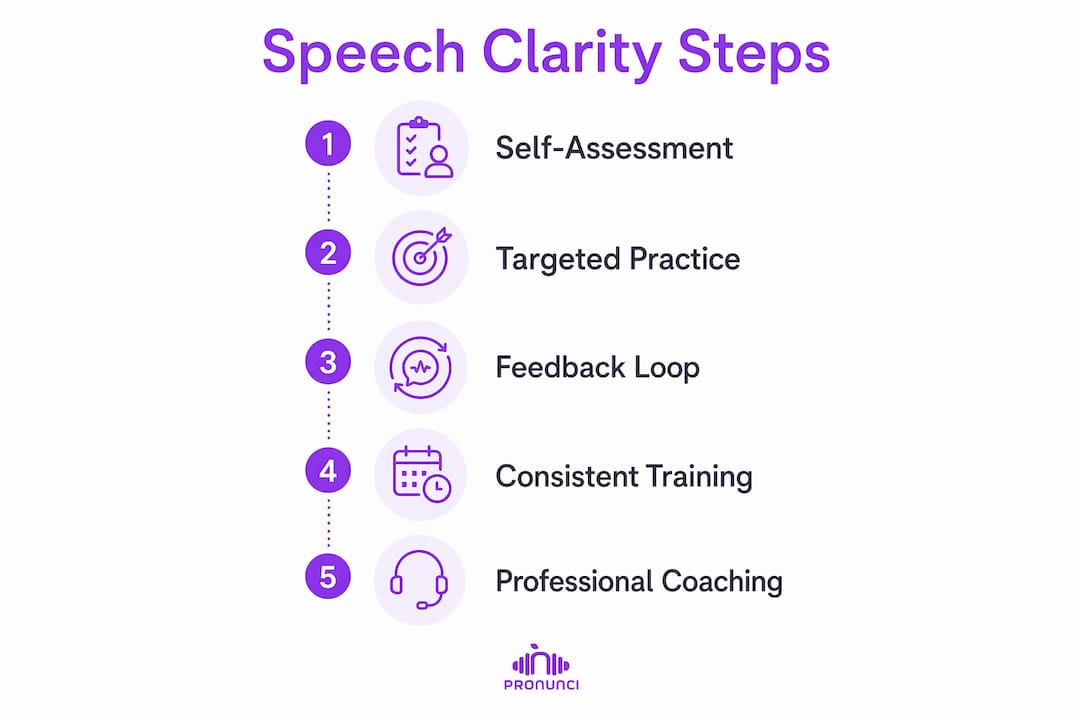
Unclear speech rarely comes from one single problem. Most people have two or three overlapping habits that compound each other. Identifying your specific pattern matters more than applying general tips.
The most common causes of unclear speech include:
- Mumbling: Reduced mouth opening and incomplete articulation of consonants, especially at word endings
- Rapid speech: Speaking too fast for your articulators to complete each movement, causing sounds to blur together
- Poor breath control: Running out of air mid-sentence, which drops volume and clarity on the most important words
- Vocal tension: A tight jaw or retracted tongue that muffles vowels and muddies consonants
- Filler words: Filling silence with “um,” “uh,” or “like” instead of using deliberate pauses
Each of these has a direct training solution. Mumbling responds to articulation drills and mouth-opening exercises. Rapid speech responds to pacing practice and deliberate pausing. Poor breath control responds to diaphragmatic breathing training. Vocal tension responds to jaw-release exercises and coordination work. Filler words respond to pause training and self-monitoring practice.
Self-awareness is the first step in all of them. You cannot fix a habit you cannot hear. Recording yourself speaking for two minutes on a familiar topic and listening back objectively is the fastest diagnostic tool available.

Pro Tip: Trying to fix clarity by speaking louder or forcing your consonants usually creates a harder, tighter sound. True clarity comes from coordination: your breath supports the phrase, your jaw and tongue stay free enough to articulate, and your pace gives words room to land.
Proven strategies to improve speech clarity in 2026
These strategies are evidence-based and ordered by impact. Start with the one that matches your primary weakness.
-
Slow your pace to 130–150 words per minute. At faster rates, your lips, tongue, and jaw cannot fully complete each movement before starting the next. Slowing to 130–150 words per minute reduces coarticulation errors and gives each sound room to land. Record yourself, then re-record at 70–80% of your natural pace. It will feel uncomfortably slow to you and sound noticeably clearer to your listeners.
-
Use diaphragmatic breathing. Breath is the engine of clear speech. Breathing from the diaphragm rather than the chest provides a steadier, fuller voice that sustains volume through the end of a phrase. Place one hand on your belly and one on your chest. When you inhale, your belly should rise. Your chest should stay relatively still.
-
Use deliberate pauses instead of filler words. Deliberate pauses improve listener comprehension by giving processing time and supporting your breath control. A two-second pause after a key point is purposeful to your audience, not a sign of struggling. Pause after complex information, before a new point, and before your main conclusion.
-
Over-articulate key sounds selectively. You do not need to punch every word. Focus on finishing word endings, opening your mouth wider on vowels, and shaping consonants with intention. Selective emphasis creates contrast, and contrast is what lets listeners track meaning.
-
Simplify your sentence structure. Grammatically complex speech is harder to process even when every word is articulated perfectly. Aim for an average spoken sentence length that avoids overly long or complex structures. Longer sentences are fine occasionally; as a consistent pattern, they force listeners to hold too many incomplete ideas at once.
-
Practice with real conversation, not just solo drills. Feedback-loop practice with real scenarios produces improvement 2–3 times faster than isolated practice, because you learn where your speech actually breaks down for listeners, not where you think it does.
-
Work on resonance. If your voice sounds thin or trapped in your throat, clarity suffers even when your articulation is technically correct. Humming gently on a comfortable pitch, then speaking a phrase immediately after, helps you sense forward vibration and a more focused tone.
Pro Tip: Feedback from a real listener or an AI coach accelerates progress faster than any amount of mirror practice alone. The gap between how you think you sound and how others actually hear you is where most self-practitioners stall.
Effective exercises to try at home for improving speech clarity
Short, focused daily sessions are more effective than occasional long ones. The brain builds new speech habits through repetition spread over time rather than intensity concentrated in a single sitting.
- Tongue twisters: Start slowly, exaggerating each sound and finishing every consonant. Gradually increase speed only when the sounds stay distinct. Classics like “red leather, yellow leather” or “unique New York” train precise articulation under pressure.
- Read aloud with your mouth open: Choose a paragraph from any book or article. Focus on opening your jaw wider than feels natural and finishing every word ending. This directly addresses the mumbling habit.
- Breath control drills: Lie on your back with a book on your belly. Breathe so the book rises on inhale and falls on exhale. Then practice speaking a full sentence on one breath, starting only after a complete diaphragmatic inhale.
- Lip trills: Blow air through loosely closed lips to create a buzzing vibration. This relaxes the lips and jaw, reduces tension, and warms up the articulators before speaking practice.
- Record and review: Record two minutes of yourself speaking on a familiar topic. Listen for patterns: Do words sound mushy? Does your volume drop at sentence ends? Does your pace rush? Specific observations lead to specific improvements.
- Realistic conversation practice: Prepared reading and real spontaneous speech are not identical skills. After any reading drill, speak freely on the same topic for 30 seconds. This transfers the clarity habits into natural speech.
Consistent short sessions, practiced daily, are what neuroplasticity requires for lasting change. Occasional marathon sessions do not produce the same results.
What science and expert linguists say about speech clarity training
The neuroscience behind speech clarity training is well established. Adults have speech production plasticity, meaning the brain can adapt articulation based on active self-monitoring and communication context. This is not a passive process. It requires deliberate attention and repetition to retrain motor pathways.
A 2021 study published in the Journal of Experimental Psychology found that listeners rated speakers with clearer articulation as significantly more credible and knowledgeable, regardless of the actual content of what was said. Your clarity shapes how your intelligence and authority are perceived before anyone analyzes your message.
Expert linguists draw a clear line between clear speech and over-enunciation. Over-worked diction sounds stiff and theatrical. Real clarity comes from precise movement with minimal strain. The jaw should release rather than clamp. The tongue should move efficiently, not aggressively. Coordination between breath, articulation muscles, and voice resonance is what produces natural-sounding clarity.
Expert recommendations for maintaining clarity without fatigue:
- Keep jaw and tongue muscles relaxed; tension reduces naturalness and intelligibility simultaneously
- Breathe before a phrase, not mid-word; mid-word air loss is a clarity problem, not a pacing tool
- Prioritize vowel formation; consonants matter, but vowels carry the line of speech
- Use random practice schedules rather than blocked repetition to build skills that transfer into real conversation
- Practice functional phrases from your actual daily life, not abstract word lists
Pro Tip: Breath support and articulation must be coordinated, not forced separately. If you feel your throat tightening when you try to speak more clearly, that is a sign you are pushing rather than coordinating. Ease the effort and focus on releasing jaw tension first.
Prof. Alex, Ph.D., who designed the Inpronunci curriculum, applies these same principles: training starts with speech-organ awareness, moves through individual sounds, and builds toward connected speech in real communication contexts. The
InPronunci training structure
How InPronunci trains the American speech system
InPronunci trains the full American speech system: Interactive 2D Sound Video Simulators and phonetic exercises for articulation and American sound development, sentence practice for intonation, melody, rhythm, and connected speech, paragraph practice for spontaneous speech, public speaking, and real communication confidence, and Advanced AI Accent Coach evaluation as you speak.
InPronunci is a newer, advanced, and linguistically structured American accent training platform with more than 1,000 downloads and a growing learner base. It is designed for serious learners who want clearer American pronunciation, stronger intonation, more natural rhythm, better connected speech, and the ability to speak English more confidently in real communication. The program is especially useful for intermediate and advanced English speakers who want to become independent speakers of English with confident communication, stronger speaking control, long-term speech improvement, and great public speaking skills. It is also designed for advanced speakers whose goal is to speak like a native or closer to native-like American speech, including people who were raised in the United States but still have slight accent patterns from the native language they were born with.
in Inpronunci show exactly how native speakers produce American sounds through tongue, lip, jaw, and airflow movement, replacing guesswork with guided physical understanding.
How do you assess your current speech clarity level?
Before you can improve, you need an honest baseline. Self-assessment and professional evaluation serve different purposes, and both are worth using.
Self-assessment starts with a two-minute recording of yourself speaking on a familiar topic at your natural pace. Listen back and ask: Are word endings clear or dropped? Does your pace rush? Does your volume drop at the end of sentences? Do you use filler words more than you realized? This recording gives you a concrete starting point and a reference to compare against as you train.
A more structured self-check involves reading a paragraph aloud and rating yourself on four dimensions: articulation, pacing, volume consistency, and breath control. You can track these ratings weekly to see where you are improving and where you are plateauing.
Professional evaluation goes deeper. A trained accent coach or speech-language pathologist can identify patterns you cannot hear yourself, including subtle coarticulation errors, tension habits, and prosody issues. For learners focused on American English specifically, measuring speech clarity improvement through structured feedback tools gives you data-driven insight rather than subjective impressions.
Inpronunci’s evaluation and feedback mode lets you check your pronunciation, stress, rhythm, and intonation across individual sounds and real speaking situations. The AI Accent Coach gives you feedback as you speak, so you are not waiting until the end of a session to learn what went wrong.
Tools and technologies used in speech clarity training today
The tools available for speech clarity training in 2026 range from simple recording apps to structured AI-powered coaching platforms. Each serves a different stage of practice.
Voice recording apps are the most accessible starting point. Recording yourself on a smartphone and listening back objectively costs nothing and delivers immediate diagnostic value. The key is listening for patterns, not just isolated mistakes.
Mirror and video feedback let you see your mouth positioning in real time. Watching yourself speak reveals jaw tension, reduced mouth opening, and lip movement habits that you cannot feel from the inside.
AI pronunciation feedback tools provide real-time analysis of your articulation, pacing, and intonation as you speak. They close the feedback loop that solo practice cannot. Inpronunci’s AI Accent Coach evaluates American pronunciation, rhythm, and connected speech as you practice, giving you specific, immediate feedback rather than general impressions.
Interactive mouth-training simulators go further by showing you exactly how sounds are physically produced. Inpronunci’s 2D Sound Motion Technology displays tongue, lip, jaw, and airflow movement for each American sound, so you understand the target before you attempt it. This replaces the “repeat after me” approach with guided physical understanding.
Human coaching remains the most effective tool for learners who have plateaued on self-study. A coach hears what you cannot and identifies miscoordination that technology alone may not flag. Inpronunci’s Premium Plan includes 1-on-1 monthly sessions with Prof. Alex., Ph.D., for exactly this level of personalized guidance.
How speech clarity training connects to accent modification and language learning
Speech clarity training and accent modification are closely related but not identical. Clarity training focuses on intelligibility: making your current speech easier to understand. Accent modification focuses on shifting specific phonetic patterns toward a target accent, such as American English. In practice, the two overlap significantly because unclear speech in a second language often comes from phonetic habits carried over from the first language.
For English learners, communicative language teaching approaches emphasize real spoken interaction as the vehicle for building clarity, not just drilling isolated sounds. This aligns with what the research shows: practice in realistic communication contexts produces faster and more durable improvement than blocked drills.
Inpronunci integrates both dimensions. The course builds from individual American sounds through words, sentences, paragraphs, and real speaking situations, training stress, rhythm, intonation, and connected speech alongside articulation. For ESL professionals and students, this means clarity training and accent work happen together in a single structured path, rather than as separate programs. You can explore how this applies to professional contexts through Inpronunci’s guide to structured accent training for ESL professionals.
The recommended duration for meaningful progress is consistent daily practice over several weeks. Structured programs like Inpronunci’s curriculum are designed around this principle, with sessions that build progressively rather than repeating the same drills at the same level.
Start training with Inpronunci today
Speech clarity training works when it is structured, guided, and consistent. Inpronunci gives you all three in one place.
The course is built by Prof. Alex., Ph.D., a linguist who trains translators and interpreters, and it is designed specifically for intermediate and advanced English learners who want real results, not just repetition. You get Interactive 2D Sound Video Simulators, an AI Accent Coach with real-time feedback, and Human-Guided Instructions that work like a real coach session.
Chapter 1: “Get to Know Your Speech Organs” is free. Start there to build the foundation for everything that follows.
See what real learners achieved: Andrew, Thiago, and Tian all trained with Inpronunci and speak with noticeably clearer, more confident American English.
Choose your path:
- Basic Plan: Self-study with AI Accent Coach and Human-Guided Instructions
- Premium Plan: 1-on-1 monthly sessions with Prof. Alex., Ph.D.
Sign up and start your free chapter · Download on the App Store · Get it on Google Play · Book a free Premium session
Ready to build a daily pronunciation practice that actually produces results? Inpronunci’s structured curriculum takes you from your first sound to confident real-world speaking, step by step.
Key Takeaways
Speech clarity training is a structured, evidence-based practice that improves articulation, breath support, pacing, and resonance to make your spoken English clearer and more persuasive in real communication.
| Point | Details |
|---|---|
| Core training areas | Articulation, breath support, pacing, and resonance are the four pillars of effective speech clarity training. |
| Optimal speaking pace | Targeting 130–150 words per minute reduces coarticulation errors and improves listener comprehension. |
| Feedback accelerates progress | Practice with real feedback produces improvement 2–3 times faster than isolated solo drills. |
| Neuroplasticity supports change | Adults retain speech production plasticity, meaning new speech habits can be built at any age through repetition. |
| Daily practice beats intensity | Short, focused daily sessions of 15–30 minutes produce more lasting change than occasional long sessions. |
FAQ
What is speech clarity training?
Speech clarity training is a targeted practice of improving how intelligibly you speak by retraining articulation, breath support, pacing, and resonance through focused, repetitive exercises. The goal is clearer, more natural communication, not an artificial or exaggerated speaking style.
How do you practice speech clarity effectively?
Record yourself speaking for two minutes, identify your primary weakness (pace, articulation, breath control, or filler words), and spend focused daily sessions of 15–30 minutes targeting that one area. Practicing with real feedback, rather than in isolation, produces improvement 2–3 times faster.
What is the 3-2-1 rule in speaking?
The 3-2-1 rule is a presentation structure guideline: make 3 key points, support each with 2 details, and close with 1 clear takeaway. It is a structural tool for organizing spoken content, not a pronunciation technique, though clear pacing and deliberate pausing make it more effective.
Why is speech clarity important for professionals?
Clear articulation shapes how listeners perceive your credibility and competence before they evaluate your content. A 2021 study in the Journal of Experimental Psychology found that speakers with clearer articulation were rated as significantly more credible and knowledgeable, regardless of what they actually said.
How long does it take to see results from speech clarity training?
With consistent daily practice and structured feedback, most learners notice meaningful improvement within 4–6 weeks. Lasting habit change requires repetition over time, which is why short daily sessions outperform occasional intensive ones.