
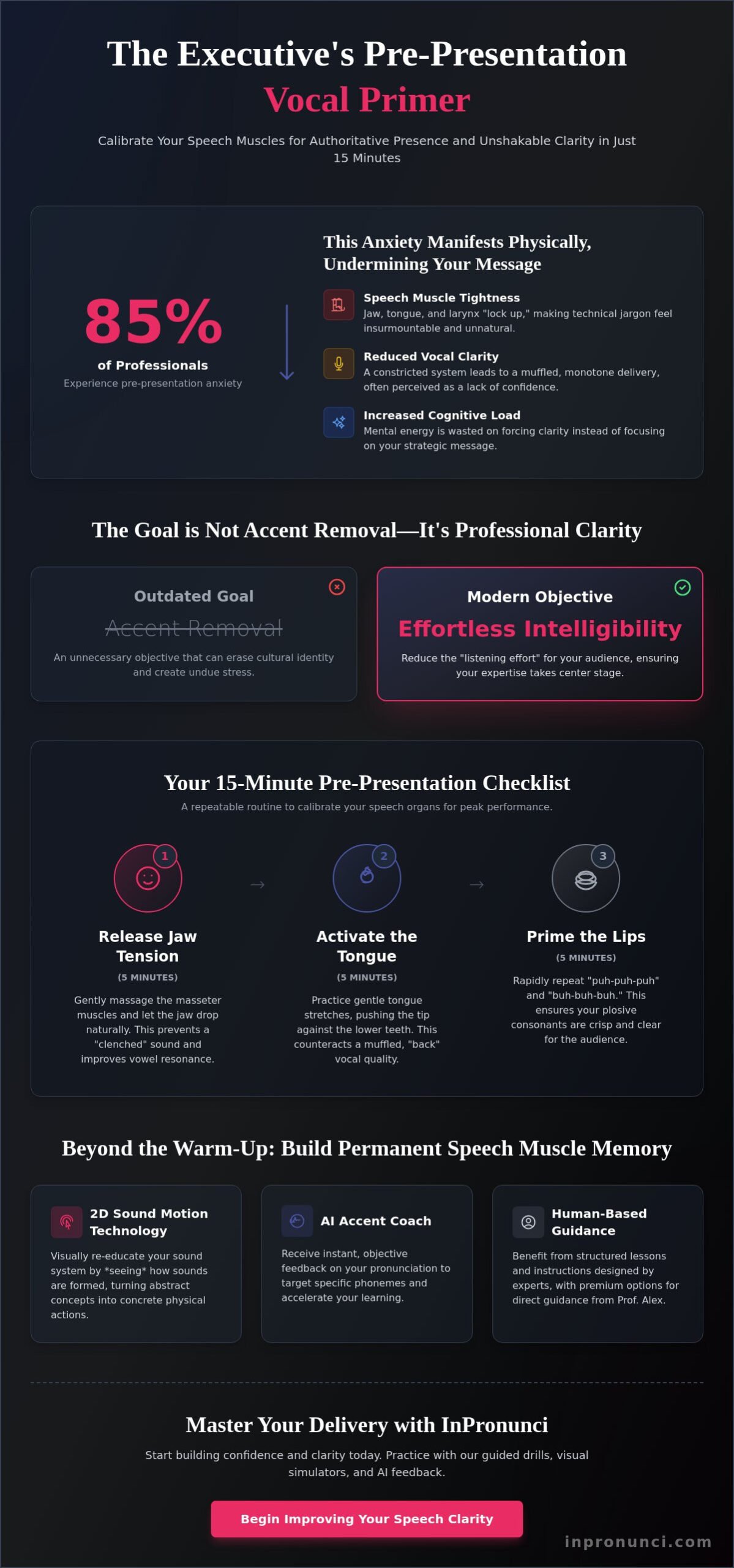
What if the primary barrier to your executive presence isn’t your vocabulary, but the physical readiness of your speech muscles? Research indicates that 85% of professionals experience anxiety before a high-stakes delivery, often manifesting as a physical tightness that makes technical jargon feel like an insurmountable hurdle. When your articulatory system isn’t properly calibrated, the cognitive load of focusing on clarity can detract from your strategic message. Integrating specific pronunciation drills before a presentation is not just a vocal exercise; it’s a necessary step in professional preparation that ensures your speech remains crisp and your presence remains authoritative.
You likely understand the frustration of feeling your speech muscles become unresponsive just as you need to land a critical point. We’ll show you how to master your articulatory precision through a structured routine designed specifically for non-native speakers. By the end of this guide, you’ll have a clear checklist to reduce vocal fatigue and increase your confidence in American English rhythm. We will examine how seeing sound motion through 2D simulators allows you to re-educate your sound system, turning a stressful performance into a controlled, professional delivery.
Key Takeaways
- Understand the strategic link between physical vocal priming and reduced cognitive load during high-stakes professional communication.
- Learn to identify and release latent tension in the jaw and tongue root to achieve the resonance and clarity required for an authoritative presence.
- Master a specific sequence of pronunciation drills before a presentation to navigate complex American phonemes like the bunched ‘R’ with absolute precision.
- Establish a repeatable 15-minute routine that utilizes 2D sound motion technology to calibrate your speech organs before you take the stage.
- Discover how to transition from temporary exercises to permanent speech muscle memory through human-based guidance and consistent articulatory habits.
Why Vocal Warm-Ups for Non-Native Speakers Are a Strategic Necessity
Vocal warm-ups are frequently misunderstood as the exclusive domain of stage actors or vocalists. In a high-stakes corporate environment, these exercises represent the strategic physical priming of the larynx, tongue, and jaw. For non-native speakers, the physiological demands of a keynote or board meeting are significantly higher. When you speak a second language under pressure, your cognitive load increases as the brain simultaneously manages complex syntax, vocabulary selection, and technical data. This mental strain often manifests as physical tightness in the speech organs. If these muscles remain “locked” or unresponsive, your delivery loses its natural flow. Engaging in targeted pronunciation drills before a presentation ensures that your articulatory system is calibrated to respond with precision, even when your mind is occupied by the nuances of your strategy.
Physical tension is the primary driver of speech patterns that hinder professional clarity. When the jaw is tight or the tongue root is constricted, the voice loses its natural resonance and variety. This often results in a monotone delivery that can be perceived as a lack of confidence or authority. Effective public speaking techniques rely on the speaker’s ability to use vocal inflection to highlight key points. By loosening the articulatory muscles, you allow for a broader range of pitch and rhythm. This variety is not just an aesthetic choice; it is a tool for maintaining audience engagement and establishing a commanding presence in any boardroom setting.
The Science of Speech Muscle Memory
Speech production is a complex motor task coordinated by the motor cortex. Under stress, the body tends to revert to the most deeply ingrained physical habits. For many professionals, these habits are rooted in the phonetics of their native language. Performing specific pronunciation drills before a presentation acts as a physical trigger that activates speech muscle memory for American English. This process moves the mechanics of sound production from conscious effort to automaticity. When your tongue and jaw “remember” the correct positions for specific phonemes, you free up mental resources to focus entirely on your audience and your message.
Clarity vs. Accent Removal: A Modern Perspective
Modern professional communication has shifted away from the outdated goal of accent removal. The objective for today’s global leaders is clarity and intelligibility, not the erasure of cultural identity. Drills serve as a “reset” for your sound system, helping you target the specific American English sounds that ensure your message is processed effortlessly by listeners. Intelligibility is the true currency of leadership. By focusing on crisp enunciation and proper rhythm, you reduce the “listening effort” required from your audience. This allows your strategic insights to take center stage, ensuring that your expertise is never overshadowed by a lack of phonetic precision.
Calibrating the Speech Organs: Physical Drills for Articulatory Precision
Strategic delivery starts with physical liberation. A tight jaw restricts the vertical space needed for clear American vowels, such as the open sounds in “strategy” or “analysis.” Before you speak, gently massage the masseter muscles and let the jaw drop naturally. This simple release is one of the most effective pronunciation drills before a presentation, as it immediately improves your resonance and prevents the “clenched” sound that often accompanies performance anxiety.
The tongue root often retains tension from native language habits, leading to a muffled or “back” vocal quality that can obscure technical jargon. You can counter this by practicing gentle tongue stretches, pushing the tip of the tongue against the lower teeth while relaxing the back of the throat. Pair this with lip activation drills. Rapidly repeating “p-p-p” and “b-b-b” ensures your plosives are crisp. Clear consonant endings are essential for professional clarity, helping your audience distinguish between similar terms like “product” and “produce” in a fast-paced environment. If you want to ensure these movements are technically accurate, you can begin practicing with guided simulators to calibrate your articulatory system.
Visualizing Movement with 2D Sound Motion
Traditional drills often fail because they rely on audio alone, which can be difficult for the brain to decode under stress. Integrating 2D Sound Motion Technology into your warm-up routine changes the paradigm. By seeing the specific “path” a sound takes, your brain can more effectively execute the physical move. These 2D simulators allow you to mimic mouth positions with mathematical precision, bridging the gap between hearing a sound and producing it correctly. This visual feedback loop ensures that your pronunciation drills before a presentation are focused on the correct articulatory targets.
The “Invisible” Muscles: Larynx and Diaphragm
Professional presence is built on consistent breath support. Use deep diaphragmatic breathing to ensure you have enough air to support sentence-final pitch drops, which signal authority in American English. Practice humming softly to activate the “mask” of the face, enhancing your vocal resonance and projection. These exercises help you avoid glottal fry, a creaky vocal quality that can make a speaker sound tentative or unprepared. By activating these “invisible” muscles, you ensure your voice remains steady and authoritative throughout your entire delivery.
Mastering High-Stakes Phonemes: Targeted Drills for Presentation Clarity
The transition from physical calibration to phonetic precision is where your strategic message gains its professional edge. While general vocal exercises prepare the muscles, specific pronunciation drills before a presentation focus on the high-stakes sounds that define American English clarity. One of the most critical adjustments for many non-native speakers is the American ‘R’. Moving away from a rolled or tapped ‘R’ toward the “bunched” American ‘R’ requires the tongue to retract and the sides to touch the upper molars. This position creates the resonant, stable sound that listeners associate with fluency. Practicing this shift ensures your delivery remains consistent, even during fast-paced segments of your speech.
Equally vital is the mastery of the ‘th’ sound, which exists in both voiced and unvoiced forms. Transitions between words like “the” (voiced) and “think” (unvoiced) often cause stumbling during technical explanations. Beyond individual sounds, you must also prioritize vowel neutralization. The “schwa” sound is the engine of American rhythm, allowing unstressed syllables to be shortened so that the primary message stands out. If every vowel is given full weight, your speech will sound staccato and robotic. Finally, pay close attention to consonant clusters at the ends of words. Terms like “results,” “costs,” or “impacts” require a precise “sts” or “ts” finish. Dropping these syllables can lead to misunderstandings in data reporting, undermining the perceived accuracy of your findings.
Strategic Drills for Technical Jargon
Technical jargon often contains multi-syllable words that are difficult to navigate under pressure. To maintain clarity, you must isolate the primary stress syllable in complex industry terms. Practicing “thought groups” allows you to break long sentences into digestible segments, ensuring you don’t rush through data-heavy slides. Achieving American sound system mastery involves more than just individual phonemes; it requires an understanding of how these sounds connect in a professional context. This approach prevents the cognitive fatigue that often occurs when trying to pronounce every syllable with equal intensity.
The Melody of Authority: Intonation Drills
Authority is often heard in the descent of a sentence, not its rise. American English follows a “staircase” intonation, where the pitch drops at the end of a statement to signal certainty. You should practice sentence stress exercises to ensure your key takeaways are highlighted through pitch and duration. It’s also crucial to avoid “up-talk,” the habit of using rising intonation at the end of statements. This pattern can make your conclusions sound like questions, subtly eroding your credibility. By mastering the melody of your speech, you ensure your voice reflects the confidence of your strategic vision.
Your 15-Minute Pre-Presentation Checklist: A Step-by-Step Routine
Strategic preparation is the bridge between technical expertise and perceived authority. A disciplined 15-minute routine ensures that your articulatory system is primed for the specific phonetic demands of American English. This sequence moves from general physical liberation to data-driven refinement, allowing you to enter the boardroom with absolute confidence. Integrating these pronunciation drills before a presentation into your standard workflow ensures that your delivery remains consistent, even under significant pressure.
- Step 1 (Minutes 0-3): Physical release of the jaw, neck, and shoulders. Tension in these areas directly constricts the larynx, leading to a thin or strained vocal quality. Simple rotations and jaw drops create the necessary space for resonant vowels.
- Step 2 (Minutes 3-7): Mimicking motion with 2D Sound Video Mouth Training Simulators. This stage is crucial for re-educating the sound system. By observing the precise movement of the speech organs on screen, your brain can coordinate the tongue and lip positions required for complex phonemes.
- Step 3 (Minutes 7-12): AI-driven practice using the AI Accent Coach. Recording your speech and receiving immediate scores allows for a tactical calibration. This isn’t about general practice; it’s about identifying specific sounds that may have drifted since your last session.
- Step 4 (Minutes 12-15): Paragraph-level rehearsal of your introduction and conclusion. These segments are the most critical for establishing and cementing your credibility. You can sign up for guided practice to ensure these anchors are phonetically flawless.
The AI Feedback Loop: Refining on the Fly
Interpreting AI scores ten minutes before a presentation requires a pragmatic approach. You don’t need a total overhaul; you need a “reset” for red flag sounds that might hinder intelligibility. If the AI Accent Coach identifies a drop in clarity on specific technical terms, use that data to perform a quick physical reset of the tongue or jaw. Using the InPronunci app to record and receive instant correction guidance provides a level of precision that traditional rehearsal simply cannot match. This data-driven feedback ensures that your pronunciation drills before a presentation are focused exactly where they are needed most.
Mental Rehearsal and Confidence Anchoring
Final preparation involves a shift toward mental readiness and physical presence. Visualize the “motion” of your most difficult slides, mentally mapping the mouth movements for complex technical jargon. This mental rehearsal, paired with positive self-talk focused on clarity rather than perfection, helps manage performance anxiety. Complete a final posture check to ensure your diaphragm is supported for optimal vocal projection. When you’ve physically and mentally calibrated your sound system, you can focus entirely on the strategic impact of your message.
Beyond the Warm-Up: Building Permanent Speech Muscle Memory
While tactical pronunciation drills before a presentation provide the immediate calibration necessary for a successful delivery, the long-term objective for any global professional is the development of permanent speech muscle memory. This transition from conscious effort to subconscious habit represents a shift from performance-based preparation to sustainable articulatory mastery. When your speech organs are conditioned to reach the correct phonetic targets automatically, the cognitive load of public speaking is permanently reduced. This allows you to focus entirely on the strategic nuances of your message, rather than the mechanics of its production.
Building this level of fluency requires a long-term strategic approach to professional communication. The InPronunci ecosystem is designed to support this growth through tiered resources. The Basic Subscription provides the essential foundation, offering the AI Accent Coach and 2D Sound Video Mouth Training Simulators with human-based instructions for daily maintenance. For leaders seeking nuanced refinement, the Premium Subscription adds direct guidance from Prof. Alex. This personalized feedback is critical for identifying and correcting deep-seated articulatory patterns that automated tools might overlook, ensuring your professional presence remains impeccable in any environment.
The Power of Consistency
In the pursuit of speech clarity, frequency outperforms intensity. Engaging in ten minutes of daily pronunciation practice is significantly more effective than infrequent, long-form training sessions. This consistent engagement keeps the speech muscles “warm” and responsive, preventing the physical tightness that often recurs after long breaks. By tracking your AI scores over time within the app, you can visualize your fluency growth and identify specific areas that require further attention. This data-driven habit builds a robust vocal toolbox that you can deploy not just for scheduled keynotes, but for any impromptu meeting or high-stakes negotiation.
Integrating Feedback into Professional Life
The most successful professionals treat every interaction as an opportunity to reinforce their articulatory habits. You can apply the same techniques used in your pronunciation drills before a presentation to daily Zoom calls, internal briefings, and even brief status updates. This real-world application bridges the gap between the training environment and your professional life. The InPronunci app serves as a portable accent coach for the modern executive, providing a private space to calibrate speech before every high-stakes interaction. By seeking human-based guidance for more complex phonetic challenges, you ensure that your progress is both technically accurate and professionally relevant.
Mastering American English rhythm and clarity is an ongoing process of refinement. We invite you to begin improving your speech clarity through guided practice today. Explore the 2D Sound Motion Technology or try the AI Accent Coach to see how a strategic vocal routine can transform your professional presence.
Elevate Your Professional Presence through Articulatory Mastery
Mastering the physical mechanics of speech is a strategic differentiator for global leaders. By moving beyond simple repetition and embracing a structured routine, you ensure that your message is delivered with the clarity and authority it deserves. Integrating focused pronunciation drills before a presentation allows you to mitigate the effects of performance anxiety, turning technical delivery into a controlled, professional asset. This preparation ensures that your cognitive resources remain focused on your strategy rather than the mechanics of sound.
Long-term success relies on the synergy between advanced technology and consistent practice. Whether you utilize 2D Sound Motion Technology for visual learning or rely on real-time AI scoring for tactical corrections, the goal remains the same: effortless intelligibility. Human-based guidance from specialists ensures that even the most nuanced articulatory patterns are refined for maximum impact. When your sound system is calibrated, your presence becomes undeniable.
Master your presentation clarity with the InPronunci AI Accent Coach and transform your vocal preparation into a permanent professional advantage. Your expertise is ready for the global stage; ensure your voice is too.
Frequently Asked Questions
Why do I mispronounce words I know well during a presentation?
High-stakes environments increase your brain’s cognitive load, causing it to revert to the most ingrained physical habits. While you understand the word intellectually, your motor cortex defaults to your native language’s phonetic patterns under stress. This is why performing targeted pronunciation drills before a presentation is essential; it physically resets your speech organs to the correct American English targets just before they’re needed.
How long should a vocal warm-up last before a speech?
A strategic vocal warm-up should last approximately 15 minutes to be effective without causing vocal fatigue. This duration allows for a three-stage progression: three minutes of physical release, seven minutes of articulatory calibration using simulators, and five minutes of targeted phonetic practice. This structured approach ensures your speech muscles are primed for clarity without consuming excessive energy before your delivery begins.
Are tongue twisters actually effective for non-native speakers?
Tongue twisters are only effective when they target the specific articulatory challenges of your native language background. Generic exercises like “Peter Piper” offer limited value for non-native speakers compared to drills that focus on high-stakes phonemes like the American ‘R’ or voiced ‘th’ transitions. Professional preparation requires exercises that address the precise mouth movements needed for American English rhythm rather than random linguistic puzzles.
How can I stop my voice from shaking when I am nervous?
A shaking voice is typically caused by shallow breathing and latent tension in the larynx. To stabilize your tone, engage in deep diaphragmatic breathing to provide a consistent column of air for your vocal folds. Grounding your physical posture and releasing jaw tension will also prevent the constricted airflow that leads to a tremulous or tentative vocal quality during high-pressure moments.
Can I use an app to check my pronunciation right before I start?
You can use the InPronunci app to perform a final calibration just minutes before your session begins. The AI Accent Coach provides immediate scores and correction guidance, allowing you to identify any red flag sounds that require a quick physical reset. This data-driven feedback loop gives you the objective reassurance that your articulatory precision is meeting professional standards before you take the stage.
What is the best way to practice difficult technical jargon?
The best way to master technical jargon is to isolate the primary stress syllable and visualize the sound’s motion. Multi-syllable terms often become muffled when the tongue root is tight. Using 2D Sound Video Mouth Training Simulators helps you see the exact path of the sound, ensuring you don’t drop syllables or misplace the stress, which are the two most common causes of jargon-related misunderstandings.
Does drinking water help with pronunciation clarity?
Hydration is a physiological necessity for articulatory precision and vocal health. Systemic hydration keeps the mucous membranes of the vocal folds and speech organs lubricated, reducing the friction that leads to vocal fatigue. Sipping room-temperature water before you speak ensures that your tongue and lips move smoothly, preventing the clicks or pops that can detract from your professional presence.
How can I sound more authoritative in an American business setting?
Sounding authoritative in an American business setting requires mastering staircase intonation and avoiding the rising pitch of up-talk. In American English, certainty is signaled by a drop in pitch at the end of a statement. Integrating intonation into your pronunciation drills before a presentation helps you anchor your conclusions with a downward inflection, which projects confidence and strategic depth to your colleagues.
Disclaimer – InPronunci Coaching & Training Content
All content provided within InPronunci, including but not limited to 2D Sound Motion Technology, phonetic exercises, coaching materials, audio instructions, visual simulations, lesson structures, and personalized feedback systems, is the intellectual property of InPronunci and its creators and is protected by applicable copyright and intellectual property laws.
The coaching exercises and training methodologies are designed exclusively for personal educational use within the InPronunci platform. Users are granted a limited, non-transferable license to access and use the materials for individual learning purposes only.
Any reproduction, distribution, modification, recording, sharing, or commercial use of InPronunci content without prior written permission is strictly prohibited. This includes, but is not limited to, copying coaching exercises, redistributing training materials, or replicating the methodology in other platforms or products.
InPronunci is a guided pronunciation training system intended to support language development. While the program is designed to improve pronunciation, fluency, and speech clarity, individual results may vary depending on practice, consistency, and learner background.
By using InPronunci, users agree to respect all intellectual property rights and comply with these terms of use.