
Ship is /ʃɪp/, built on the short, relaxed vowel /ɪ/. Sheep is /ʃiːp/, built on the long, tense vowel /iː/. Get that one distinction wrong and you can accidentally say something you never meant to. InPronunci: Accent Training App was built by Prof. Alex, Ph.D., specifically to fix contrasts like this one through guided, visual, and audio-based practice.
Download on the App Store · Get it on Google Play
TL;DR:
- Mastering the /ɪ/ and /iː/ vowels is essential, as the length difference alone heavily influences listener understanding and can change entire sentences.
- Proper mouth shaping involves raising the tongue and spreading the lips for sheep, then relaxing and lowering for ship, with muscle tension cues providing reliable separation.
- Focused listening practice with minimal pairs improves recognition skills, and recording yourself helps identify consistent production errors before transitioning to sentence-level exercises.
- Visual tools and guided feedback accelerate progress, especially for high-stakes situations like interviews, TOEFL, or professional communication where mispronounced vowels can cause critical misunderstandings.
- Vowel length and quality distinctions vary slightly across English dialects, so practice in context and at normal speech speed is necessary for effective, conversational mastery.
Table of Contents
- What Does the IPA for Ship vs Sheep Actually Mean?
- How Do You Shape Your Mouth for Ship vs Sheep?
- Why Should You Practice Listening Before Speaking?
- What’s the Best Way to Practice Producing the Contrast?
- Why Do Some Fixes Not Stick, and How Do You Troubleshoot Them?
- How Does Expert-Led, Visual Training Speed This Up?
- Does Vowel Length Work the Same Way in Every English Accent?
- Why Does This One Vowel Mistake Actually Matter for Communication?
- What the Research Gets Right, and What It Misses
- Ready to Train Ship vs Sheep the Guided Way?
- Sources
- FAQ
What Does the IPA for Ship vs Sheep Actually Mean?
The symbols /ɪ/ and /iː/ describe two different vowel qualities, not just two different letters. /ɪ/ is the vowel in ship, bit, and fill. It’s produced with the tongue slightly lower and further back than /iː/, and it’s released quickly. /iː/ is the vowel in sheep, beat, and feel. The tongue sits higher and further forward, and the sound is held longer.
The colon-like mark after /iː/ is a length symbol, and it’s doing real work. It tells you the vowel isn’t just a different shape, it’s also stretched out in time. Linguists sometimes call /ɪ/ a “lax” vowel and /iː/ a “tense” vowel, which points to a second, related difference: /iː/ involves more muscular effort in the tongue and lips, while /ɪ/ stays comparatively loose.
- /ɪ/: short, lax, tongue mid-high and slightly back
- /iː/: long, tense, tongue high and forward
- The length difference alone can be the deciding factor a listener hears
- Vowel quality (tongue position) and vowel length work together, not separately
This contrast carries a high functional load. Confusing /ɪ/ and /iː/ frequently changes the word entirely, which means listeners can misunderstand a sentence based on this vowel alone, not just the vocabulary around it.
How Do You Shape Your Mouth for Ship vs Sheep?
Your tongue, jaw, and lips move differently for each vowel, and once you feel the difference physically, you stop having to guess.
- Start with sheep. Spread your lips slightly, as if starting a smile, and raise the front of your tongue toward the roof of your mouth without touching it. Hold the vowel a beat longer than feels natural at first.
- Now say ship. Relax your lips back to neutral, drop your tongue slightly lower and back from the sheep position, and cut the vowel short. There’s no held smile shape.
- Check your jaw. Sheep should feel like a small, controlled jaw opening. Ship allows a touch more looseness in the jaw and lips.
- Use the mirror test. Watch your lip corners. If they pull sideways and stay there through the vowel, you’re likely in sheep territory. If your mouth barely commits to a shape, you’re closer to ship.
A physical trick many learners find useful: place two fingers lightly on your cheeks near the corners of your mouth while saying sheep, then ship. You should feel more muscle tension under your fingers on sheep and a quicker release on ship. Exaggerating lip spread on /iː/ while keeping /ɪ/ shorter and more relaxed is one of the most reliable cues teachers give for separating the two.
Pro Tip: Record yourself saying “ship, sheep, ship, sheep” five times in a row and watch the video with the sound off. If your mouth shape looks identical for both words, that’s your real problem, not your ear.

For a deeper walkthrough of tongue and lip mechanics, InPronunci’s guide to vowel sounds and mouth position breaks down the same physical cues used across other American vowel pairs.
Why Should You Practice Listening Before Speaking?
Your ear has to build a category for each sound before your mouth can produce it reliably. Trying to fix your pronunciation before you can consistently hear the difference is like trying to tune a guitar without knowing what “in tune” sounds like.
Start with focused minimal-pair sets, not random words:
- ship / sheep
- bit / beat
- fill / feel
- sit / seat
Run each pair through a simple four-step drill: listen to both words back to back, identify which one you heard (say “short” or “long” out loud), score yourself against the answer key, then repeat the pair three more times before moving on. Structured practice that separates listening from production tends to produce faster, more durable improvement than jumping straight into speaking drills.
Once you can identify pairs correctly nine times out of ten, layer in native-speaker audio and score your own recordings against it. Cambridge Dictionary’s entry for sheep gives you a clean model recording to compare your version against, which matters more than most learners expect, since your only reference point until now has probably been your own head.
What’s the Best Way to Practice Producing the Contrast?
Production practice works best in stages, moving from isolated sounds to full sentences.
- Isolate. Say a long, sustained “sheeeeep,” feeling the tongue height and lip spread. Then say a quick, clipped “ship” right after, noting how fast the vowel disappears.
- Alternate. Say ship, sheep, ship, sheep in a random order out loud, without writing them down first, so your mouth has to react rather than anticipate.
- Build sentences. Try: “The ship carried the sheep to the island.” Say it slowly first, then at normal conversational speed.
- Normalize. Once the sentence feels controlled slow, speed it up until it matches natural conversation pace.
A short recording checklist keeps this honest:
- Record yourself at slow speed and check the vowel length by ear
- Record the same sentence at normal speed
- Compare both recordings against a native model
- Flag any word where ship and sheep sound interchangeable, and repeat that word specifically
Sentence-level practice matters because connected speech often shortens vowels slightly under natural rhythm, so your goal isn’t a textbook-perfect long /iː/ every time. It’s a length and tension difference a listener can still detect at conversational speed. InPronunci’s guide on mastering American vowels walks through this slow-to-normal progression for other vowel pairs that follow the same pattern.
Why Do Some Fixes Not Stick, and How Do You Troubleshoot Them?
Most persistent errors trace back to one of a few habits, and each one has a specific fix.
- Over-smiling on every vowel. If your lips spread on both ship and sheep, you’re using mouth shape as decoration instead of a functional cue. Practice ship with a completely neutral mouth first, adding zero lip movement.
- Holding /ɪ/ too long. If your ship starts sounding like sheep, you’re likely stretching the vowel out of habit. Clip it deliberately short in isolation drills until the short version feels natural again.
- Letting /ɪ/ collapse into /iː/ mid-sentence. This often happens when a speaker rushes and defaults to the “safer,” more familiar long vowel. Slow down the sentence and exaggerate the short vowel until the habit resets.
- L1 transfer patterns. Speakers of languages with only one vowel in this space (many Spanish, Japanese, and Korean speakers face this) often merge both English vowels into one. Targeted minimal-pair drills, repeated daily, are the direct countermeasure.
Pro Tip: If you’ve drilled minimal pairs for two weeks and a native listener still can’t tell your ship from your sheep, the issue usually isn’t your ear anymore. It’s muscle memory, and that calls for guided feedback rather than more solo repetition.
How Does Expert-Led, Visual Training Speed This Up?
Prof. Alex, Ph.D., has spent over 20 years teaching, researching, and privately coaching American accent training, and that experience shaped how InPronunci approaches a contrast like ship vs sheep.
- The Interactive 2D Sound Video Simulator makes tongue, lip, and jaw movement visible in real time, so you’re not guessing what “raise the front of your tongue” is supposed to feel like. Watch the American [t] sound simulator to see exactly how this visual training approach works.
- AI feedback can flag length and tension errors on ship and sheep specifically, rather than giving a vague overall score.
- A tool allows you to compare a native-speaker model directly against your own recording, making the comparison visual and audible.
- Self-practice with mirrors and recordings works, but it plateaus once you stop being able to hear your own mistakes. That’s usually the point where structured, guided training starts paying off.
Learners preparing for interviews, TOEFL-style speaking sections, or client-facing calls tend to benefit most from this level of structure, since the cost of a misheard word is higher in those settings than in casual conversation.
Does Vowel Length Work the Same Way in Every English Accent?
Vowel length in ship vs sheep isn’t identical across every English dialect, though the underlying contrast survives everywhere it’s used natively. In General American, the accent InPronunci trains toward, /iː/ is reliably longer and tenser than /ɪ/, and that length difference is one of the clearest cues American listeners rely on.
Some varieties of English lean harder on vowel quality (tongue position) than on length to separate these sounds, particularly in fast, casual speech where vowels naturally shorten. Regional American accents can also compress vowel length slightly in rapid conversation, which is exactly why sentence-level, normal-speed practice matters more than isolated word drills alone. If you only ever practice ship and sheep as single words spoken slowly, you’ll sound accurate in isolation and still get misheard in real conversation, because natural speech rhythm changes how much length actually survives.
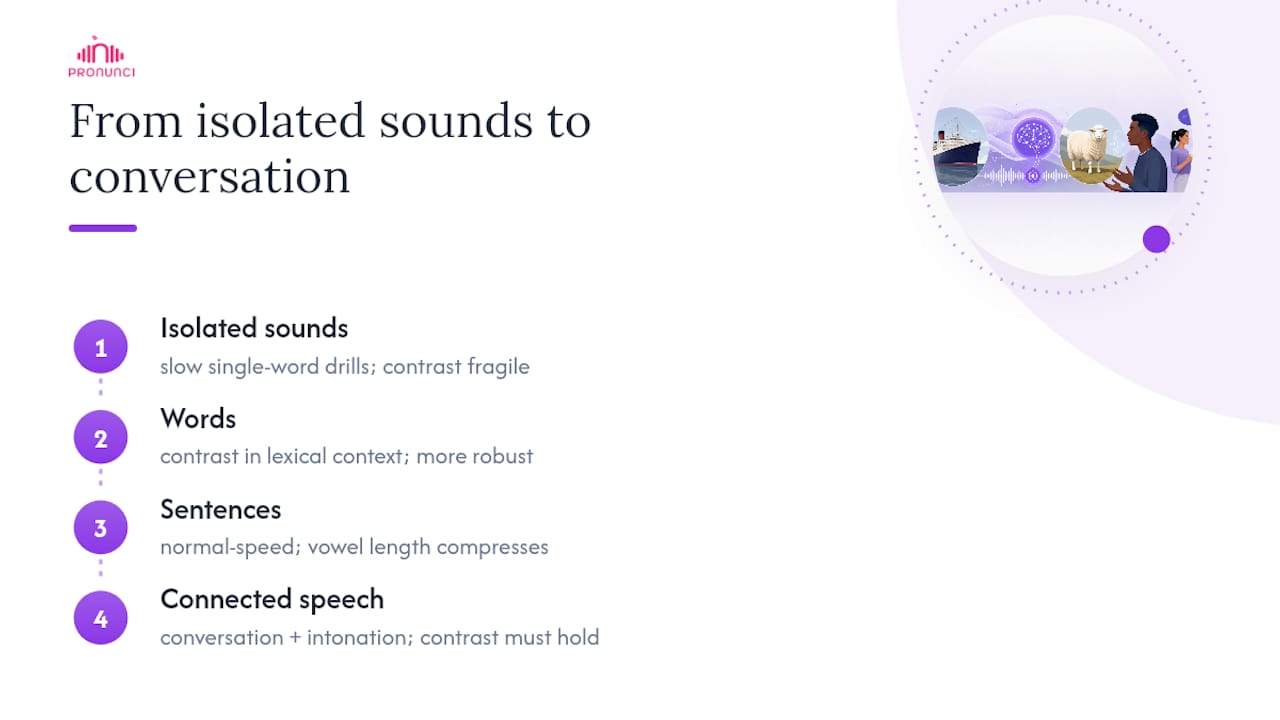
Some accent training programs move learners from isolated sounds through words, sentences, and eventually connected speech and intonation. A vowel contrast that only works in a controlled drill isn’t fully learned yet. The goal is a contrast that holds up at conversational speed, under normal sentence stress, in the target accent.
Why Does This One Vowel Mistake Actually Matter for Communication?
A single mispronounced vowel in ship vs sheep can shift a sentence’s entire meaning, and that’s a bigger deal in professional or academic settings than it sounds. “We need to check the ship” and “we need to check the sheep” describe two completely different tasks, and a listener who catches the wrong vowel will act on the wrong information, not just feel mildly confused.
This is what linguists mean by high functional load: some sound contrasts barely affect meaning, while others, like /ɪ/ versus /iː/, change words constantly across everyday vocabulary (bit/beat, sit/seat, fill/feel, hit/heat). Getting this specific contrast wrong tends to cost intelligibility more than most other pronunciation slips, which is exactly why it shows up in nearly every ESL pronunciation curriculum.
For professionals on client calls, healthcare workers relaying instructions, or students answering questions in a seminar, one dropped vowel length can force a listener to stop and ask for clarification, which quietly undermines confidence on both ends of the conversation. Aviation professionals face an especially high-stakes version of this problem, since a misheard word in radio communication has real consequences. Resources like ICAO English test preparation for pilots exist specifically because minimal-pair clarity isn’t optional in that field.
Fixing ship vs sheep isn’t really about sounding more American for its own sake. It’s about removing one specific, recurring source of miscommunication from your everyday speech.
What the Research Gets Right, and What It Misses
Most pronunciation guides treat ship vs sheep as a listening problem, and they’re not wrong. Ear training genuinely does need to come first. Where the conventional advice falls short is in assuming that once a learner can identify the difference in a quiet drill, the job is done.
It isn’t. The gap between hearing a contrast in isolation and producing it reliably inside a fast sentence is where most self-taught progress stalls. I’ve seen this pattern consistently in coaching: a learner scores well on minimal-pair recognition tests, then reverts to old habits the moment a sentence demands speed and rhythm at the same time. That’s not a listening failure. It’s a muscle memory gap that flashcards and quizzes were never designed to close.
Prioritize the physical cues, tongue height, lip spread, and jaw tension, before you worry about accent-neutral perfection. A learner who can feel the difference between /ɪ/ and /iː/ in their own mouth will self-correct in real conversation far faster than one relying purely on memorized word lists. Visual tools that show articulator movement, paired with structured, sentence-level practice, close that gap faster than isolated drilling ever will on its own.
— Prof. Alex., Ph.D. Accent Coach
Ready to Train Ship vs Sheep the Guided Way?
Reading about tongue height and lip spread only gets you so far. InPronunci: Accent Training App turns that explanation into something you can actually feel and hear, with the Interactive 2D Sound Video Simulator showing exactly how the tongue and lips move for each vowel, AI Accent Coach feedback flagging your specific length and tension errors, and the My Coach vs My Pronunci tool letting you compare your own recording directly against a native-speaker model.
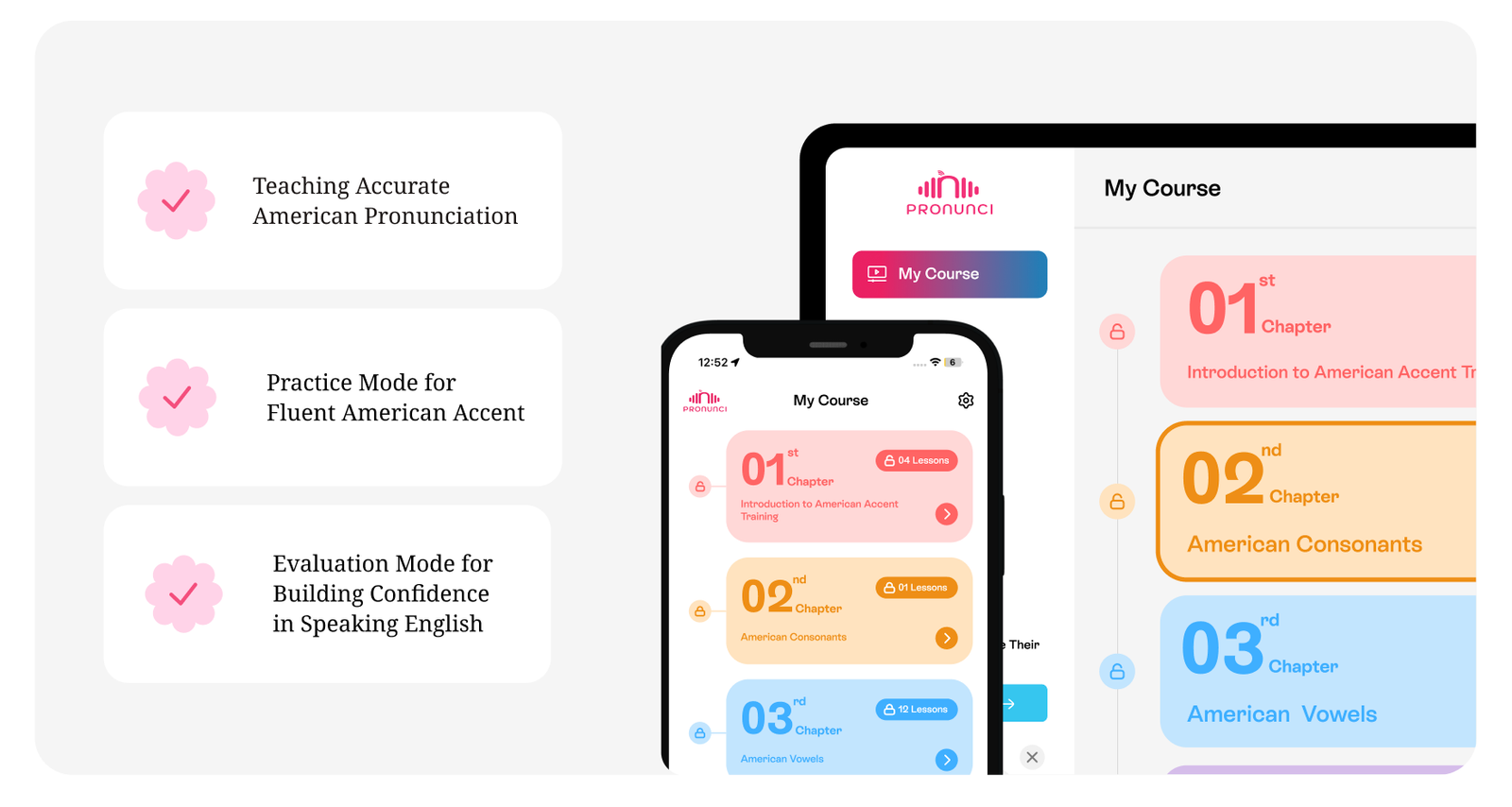
This kind of structured, visual practice tends to help most if you’re preparing for a job interview, a TOEFL-style speaking section, client calls, or any setting where one misheard vowel could cost you clarity. InPronunci starts with a free onboarding chapter, so you can try the 2D simulators and AI feedback on real vowel contrasts before deciding whether the full InPronunci: American Accent Training Course fits your goals. If you want a fuller sense of what the guided curriculum covers before you commit, the app guide to choosing your AI accent coach walks through the full path step by step.
Download on the App Store · Get it on Google Play
Start with the free onboarding chapter today and hear the difference between ship and sheep in your own recorded voice, not just in a textbook.
Sources
- Ship vs Sheep Pronunciation: /ɪ/ vs /iː/ Practice | Soundwise
- /ɪ/ vs /iː/: ship vs sheep: minimal pairs with audio | Speakmetry
- sheep | Meaning, pronunciation in English | Cambridge Dictionary
FAQ
How Do You Pronounce Ship Correctly?
Ship is pronounced /ʃɪp/, using the short, relaxed /ɪ/ vowel found in bit and fill. Keep your lips neutral and cut the vowel short rather than holding it.
What Is the Correct Pronunciation of Sheep?
Sheep is pronounced /ʃiːp/, using the long, tense /iː/ vowel found in beat and feel. Cambridge Dictionary’s model audio is a reliable reference for this exact sound.
Are Ship and Sheep Homophones?
No, ship and sheep are not homophones. They differ in vowel quality and length, /ɪ/ versus /iː/, which is what makes them a minimal pair rather than identical words.
What Sound Does the Vowel in Sheep Actually Represent?
The vowel in sheep is the long, tense /iː/ sound, produced with the tongue high and forward and the lips slightly spread. It’s held noticeably longer than the /ɪ/ vowel in ship.
How Can InPronunci Help Me Fix This Specific Contrast?
InPronunci pairs Prof. Alex’s guided instruction with the Interactive 2D Sound Video Simulator and AI Accent Coach feedback, so you can see the articulator movement and get specific correction on length and tension errors as you practice.