


Use a lower pitch, falling sentence-final intonation, a faster speech rate, and fewer filled pauses to sound more confident in interviews and professional conversations. That single vocal recipe, backed by converging research on paralinguistic features, is the core of what the role of intonation in sounding confident actually means in practice.
Three things to change right now:
- End statements with a falling pitch. Let your voice drop on the last word, not rise.
- Cut medial fillers. Move “um” and “uh” away from the middle of your sentences, or replace them with a brief silent pause.
- Try this line aloud: “I have experience leading cross-functional teams.” Say it with your voice dropping on “teams.” Record it. Listen back.
Download the InPronunci: Accent Training App to practice these patterns with guided feedback. Then watch the
InPronunci training structure
How InPronunci trains the American speech system
InPronunci trains the full American speech system: Interactive Visual 2D Sound Simulators and phonetic exercises for articulation and American sound development, sentence practice for intonation, melody, rhythm, and connected speech, paragraph practice for spontaneous speech, public speaking, and real communication confidence, and Advanced AI Accent Coach evaluation as you speak.
InPronunci is an advanced, linguistically structured American accent training platform with more than 1,000 downloads and a growing learner base. It is designed for serious ESL learners who want American pronunciation, stronger intonation, more natural rhythm, better connected speech, and the ability to speak English more confidently in real communication. The program is especially useful for intermediate and advanced English speakers who want to become independent speakers of English with confident communication, stronger speaking control, long-term speech improvement, and great public speaking skills. It is also designed for advanced speakers whose goal is to speak like a native or closer to native-like American speech, including people who were raised in the United States but still have slight accent patterns from the native language they were born with. It is a complete American accent training course and system created by Prof. Alex, Ph.D. Accent Coach, Doctor of Education, and professional linguist based in Austin, Texas, with Pronunci Instructions from Prof. Alex for each lesson that make self-learning more effective, supported, and clear.
to see how clear consonant release supports confident delivery.
Guide by Prof. Alex, Ph.D. Accent Coach, Accent Coach, professional linguist and creator of InPronunci.
Falling sentence-final intonation, combined with lower pitch, steady loudness, and fewer medial fillers, is a key vocal approach to sounding confident in U.S. professional settings. However, a confident tone raises listener scrutiny—so use it with strong, well-structured arguments for the best effect.
How do non-native speakers practice English intonation and stress patterns?
Practice them in order: first word stress (which syllable is longer and louder), then sentence stress (which words carry the meaning), then intonation (where the pitch falls or rises). Listen to a model, repeat it, record yourself, and compare. InPronunci: Accent Training follows this order in Chapter IV, American intonation and emphasis, and the Advanced level of the AI Accent Coach evaluates stress, rhythm, and intonation, not only individual sounds.
Cognitive Accent Training
Compare Your Coach vs. Your Pronunci
In every practice sentence, students listen to Your Coach, record their own voice, and compare it with Your Pronunci, so they consciously notice and correct each sound.
![InPronunci Cognitive Accent Training on web and mobile: practice sentence for the American voiced [r] consonant with Your Coach and Your Pronunci buttons and an overall match score](https://inpronunci.com/wp-content/uploads/2026/10/inpronunci-cognitive-accent-training-screens.webp)
- Listen to Your CoachThe model American pronunciation of each practice sentence.
- Compare with Your PronunciYour own recorded pronunciation, side by side with the coach.
- Correct with feedbackThe match score and color-coded letters guide each correction.
Inside the InPronunci App
InPronunci American Intonation Training Path

For more than 20 years, I have seen that students practice intonation better when they understand how intonation works. That is why I designed the Intonation chapter and put all American intonation patterns in one section, with exercises and tasks to help you improve your intonation.
Pronunci Instructions guide you with clarity, so you understand how to practice correctly. Listen to my instructions carefully and interact for success.
Prof. AlexPh.D. Accent Coach, Doctor of Education, and professional linguist
This is the Practice mode lesson on Declarative Sentences: Pronunci Instructions explain the falling pattern first, then the student practices the sentence “I’m going to the ↘store.”
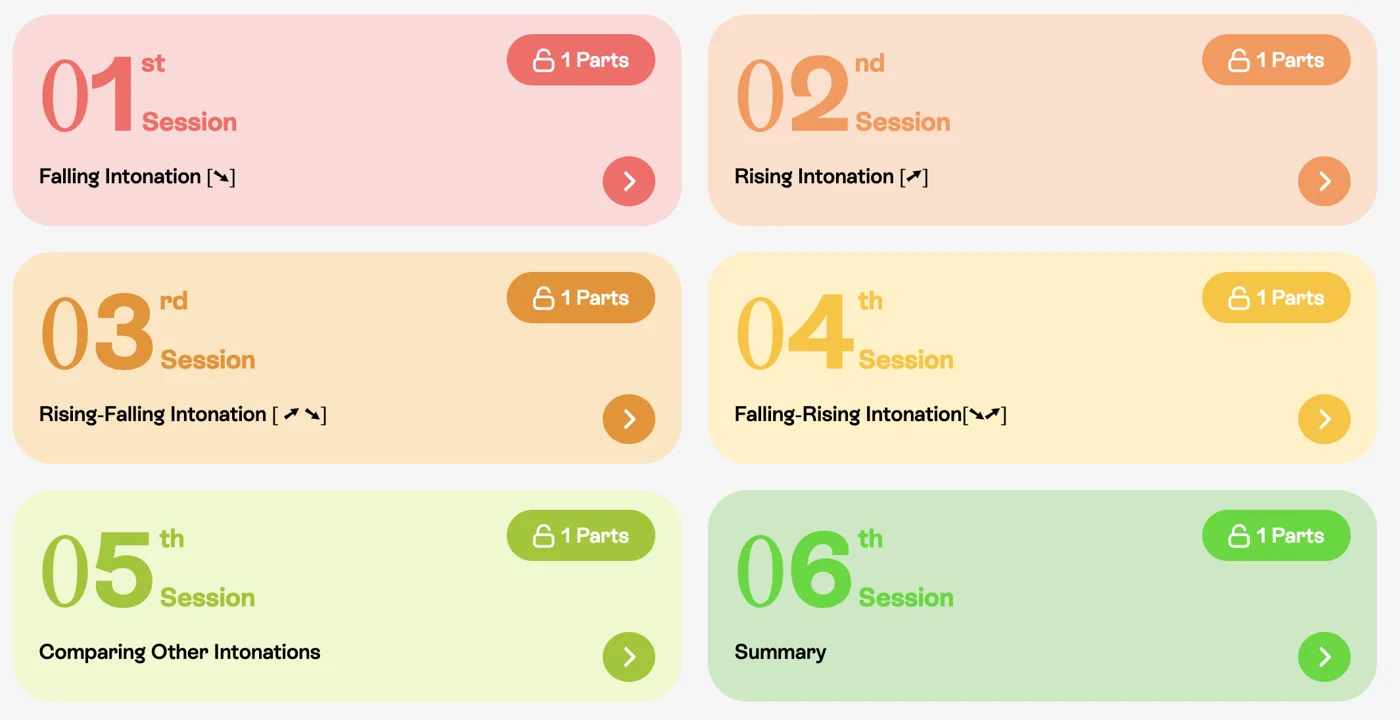
- Learn the patternsFour main American intonation patterns, taught in six sessions, with 15 sentence types.
- Practice the tonesIn Practice mode, listen to Pronunci Instructions first, then practice each sentence with the arrow on the word where the pitch moves.
- Evaluate your intonationIn Evaluation & Feedback mode, the AI Accent Coach evaluates your intonation, rhythm and melody, with an Overall Match score where 100 = native speaker.
What does intonation mean, and why does it matter for your speech?
Intonation is the melodic pattern of an utterance that signals expressive meaning and grammatical function, such as distinguishing a statement from a question. Think of it as the tune your voice follows across a phrase, separate from the individual sounds you produce.
Three practical aspects shape how intonation works in American English:
- Tune: whether your pitch rises, falls, or stays level at the end of a phrase.
- Range: how wide the gap is between your highest and lowest pitch across an utterance.
- Prominence: which word receives the most emphasis, signaling what matters most.
Research on intonation in English shows that pitch contours mark question types, focus, and attitude. Falling pitch is typical for statements; rising pitch signals yes/no questions.
Two quick examples show the difference:
The tune is identical in words, but the meaning shifts entirely. For non-native professionals in U.S. settings, that distinction shapes how a hiring manager or colleague reads your certainty. Explore the full picture in InPronunci’s guide to American intonation patterns, and continue your structured training with the InPronunci: American Accent Training Course.
How does intonation signal confidence to listeners?
Falling sentence-final intonation is reliably associated with higher perceived confidence. Experimental and theoretical evidence from Guyer et al. shows that a confident vocal tone raises listeners’ scrutiny, amplifying strong arguments but backfiring when the underlying argument is weak. The practical implication: before you work on sounding more confident, strengthen what you are saying.
Intonation does not work alone. Three experiments on vocal speed, intonation, and pitch found that these features influence perceived confidence and persuasion through different psychological routes depending on how carefully the listener is processing your message. In a high-stakes interview, listeners are paying close attention, so every vocal cue counts.
Key vocal features that combine with intonation:
- Lower fundamental frequency (pitch level): a slightly lower baseline pitch reads as more authoritative.
- Faster speech rate: moderate increases in rate signal fluency and certainty.
- Steady loudness: consistent volume projects control; trailing off at sentence ends undermines it.
- Fewer filled pauses: synthesized-speech research found that medial fillers (“um” mid-sentence) reduce perceived confidence more than fillers placed at the beginning of an utterance.
One cultural note: rising finals do not always signal uncertainty. In some Australian and New Zealand dialects, a rising contour on statements is a normal conversational feature, not hesitation. When you are speaking in U.S. professional contexts, however, American listeners tend to read a rising final on a declarative statement as uncertainty. Mirror the norms of your specific audience.
Which vocal features should you change, and how do you practice them?
Acoustic research confirms that intonation, loudness, and duration carry separable signals. Practicing only one cue at a time leaves the others unaddressed. Work through each feature below in short, focused repetitions.
Feature-by-feature guidance:
- Ending tune: Record a statement. Does your pitch rise or stay flat at the end? Aim for a clear downward movement on the final stressed syllable.
- Pitch level: Speak at the lower end of your comfortable range. Avoid straining; just avoid the higher register you might use when nervous.
- Pitch range: Expand slightly to avoid a monotone. Flat delivery sounds robotic, not confident. Let your pitch move on key words.
- Speech rate: A moderate increase signals fluency. Rushing harms clarity; too slow reads as uncertain.
- Loudness: Keep volume steady through the end of each sentence. Many non-native speakers drop volume on the last few words.
- Filled pauses: Replace medial “um/uh” with a brief silent pause. Silence reads as thoughtful; a mid-sentence filler reads as lost.
Contrast drill (record both versions):
Hesitant: “I think… um… I have experience with, uh, data analysis?”
Confident: “I have experience with data analysis.” (pitch falls on “analysis,” steady volume, no fillers)
Practice steps:
- Record the hesitant version. Listen for rising pitch and medial fillers.
- Record the confident version. Check that pitch falls on the final stressed word.
- Compare the two. Mark one specific fix per take.
- Repeat the confident version two more times without stopping.
Pro Tip: Pause briefly before your final key word, then deliver it with a falling pitch and full volume. That pause-plus-fall combination signals deliberate certainty without sounding aggressive.
For clear consonant articulation that supports confident delivery, train with the Interactive Visual 2D Sound Simulator for the American [t]. Crisp consonant release, especially on word-final [t], reinforces the impression of precision and control. You can also deepen your practice with InPronunci’s authoritative speech patterns guide.
How do you practice confident intonation before an interview? See the Admissions Interview Evaluation Criteria: Student Guide for additional tips on what interviewers listen for and how vocal confidence plays a role.
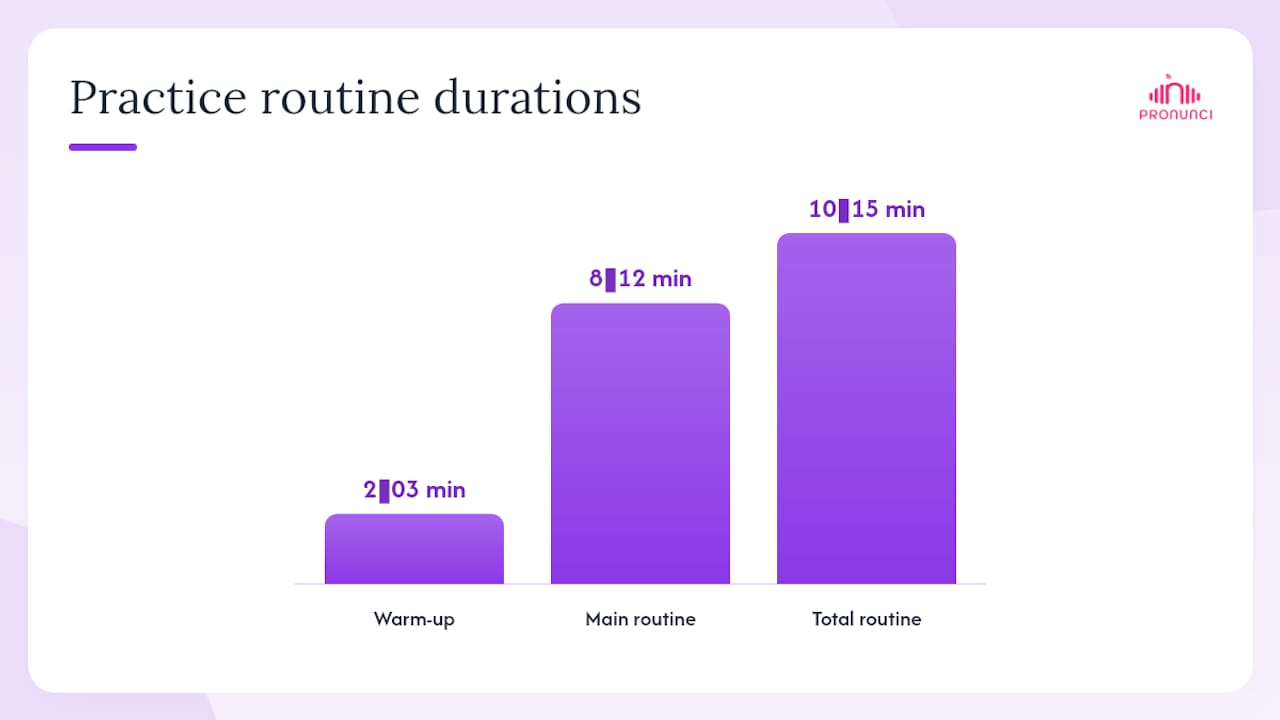
A focused 10–15 minute routine, repeated consistently, builds the muscle memory you need under pressure. Use this sequence the day before and the morning of your interview.
Warm-up (2–3 minutes):
- Take three slow breaths, exhaling fully each time to release tension in your throat.
- Hum at a comfortable low pitch for 30 seconds to warm up your vocal cords.
- Say “butter,” “water,” “better” five times each, focusing on a clean American t] release (train with the [2D simulator first if the sound feels unclear).
Main routine (8–12 minutes):
- Falling-final drill: Choose five typical interview answers (“My greatest strength is problem-solving”). Say each one, dropping your pitch on the final word. Record every take.
- Stress-on-key-words drill: Pick the one word in each sentence that carries the most important information. Emphasize it with slightly higher pitch and longer duration, then fall at the end.
- Filler-reduction drill: Record a 60-second answer to “Tell me about yourself.” Count your medial fillers. Re-record, replacing each one with a silent pause.
- Timed answer practice: Set a timer for 90 seconds. Answer a common interview question. Play it back and check for rising finals, dropped volume, and medial fillers.
Recording checklist:
- Did the pitch fall on the last stressed word of each statement?
- Was volume steady through the end of each sentence?
- Were there fewer than two medial fillers in the full answer?
Quick troubleshooting:
- Voice feels too low: You are probably straining. Return to your natural range and drop only slightly.
- Slipping into a sing-song pattern: Focus prominence on one word per phrase, not every word. For a full pre-presentation checklist, see InPronunci’s pronunciation drills before a presentation.
How can you assess your own intonation progress quickly?
Self-assessment works best when you have a clear checklist and a way to see what you hear.
What to record and listen for:
- Record full 60–90 second answers, not just isolated sentences.
- Listen for final pitch movement: does it fall, rise, or stay flat?
- Check for amplitude consistency: does your volume hold through the last word?
- Mark timestamps where fillers appear, noting whether they are medial or initial.
Reading simple speech-organ training feedback:
A pitch trace (available in voice analysis apps) shows a line that falls at sentence ends in confident speech and rises in hesitant speech. An amplitude waveform shows whether your volume drops at the end of phrases. Pauses and fillers appear as flat or near-flat sections in the waveform.
Suggested InPronunci workflow:
- Run the Interactive Visual 2D Sound Simulator for your target consonant sounds.
- Record your model sentence in the app’s Practice Mode.
- Compare your recording (My Pronunci) against the native-speaker model (My Coach).
- Review the AI Accent Coach feedback and re-record, targeting the one flagged feature.
For a deeper look at applying AI feedback to your practice sessions, see InPronunci’s guide on AI pronunciation feedback for professional clarity.
Pro Tip: After each recording session, give yourself a quick 1–5 rating for confidence and intelligibility. Tracking these subjective scores over a week shows you whether your self-perception is improving alongside your acoustic accuracy.
Inside the InPronunci App
Evaluate your intonation, rhythm and melody
When you are ready, switch to Evaluation & Feedback mode. Tap the mic and record the sentence. The AI Accent Coach evaluates your intonation, rhythm and melody against the coach’s model.
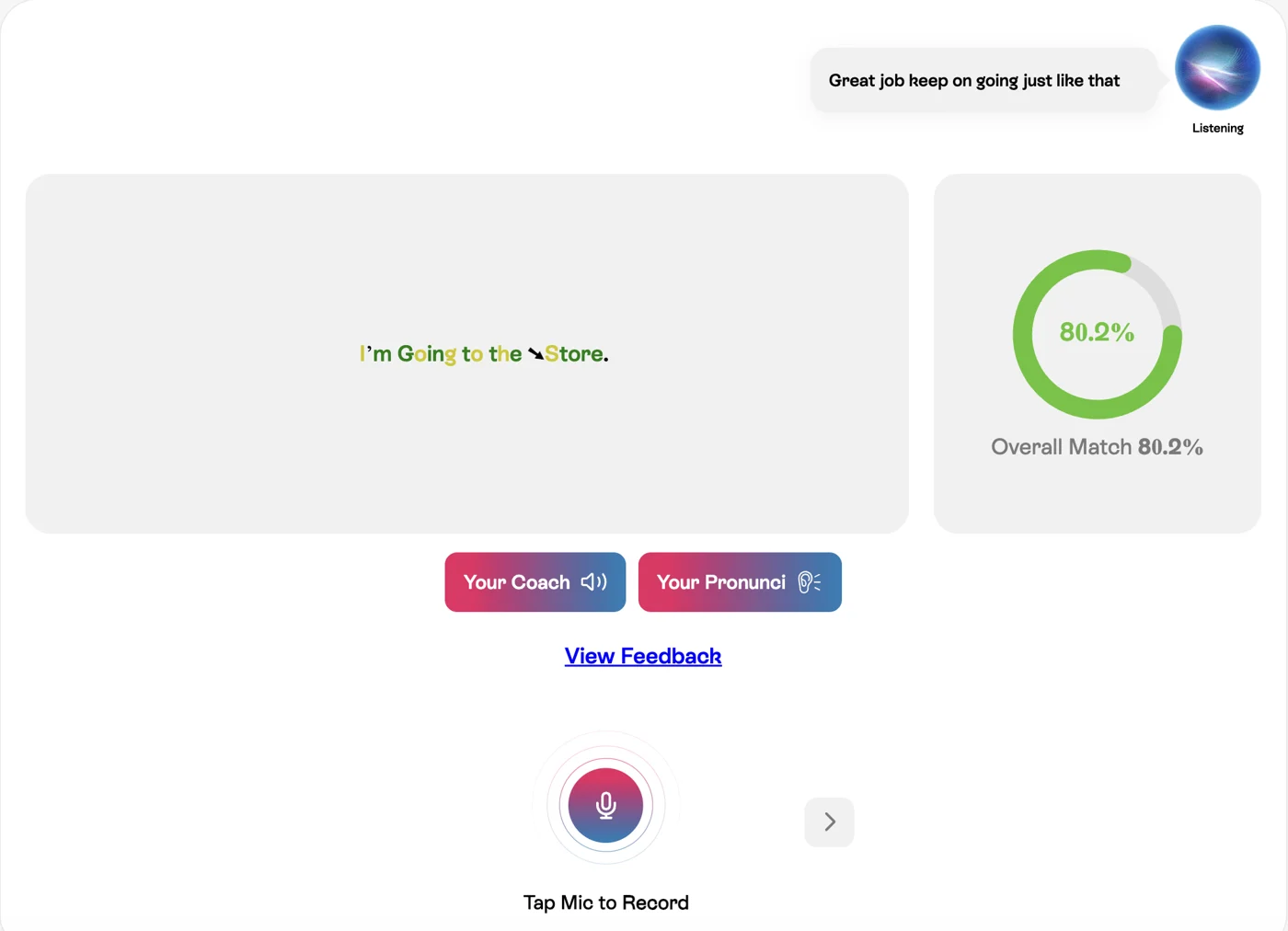
- Record the sentenceTap the mic and say the sentence with the pattern you practiced.
- Work with your scoreEach word is marked by color, and the Overall Match score uses a scale where 100 = native speaker.
- Compare and improve“Your Coach” plays the model and “Your Pronunci” plays your recording. “View Feedback” opens the details.
When do intonation rules differ, and when can a confident tone backfire?
Confident intonation is a tool, not a guarantee. Research on falling finals and persuasion makes the trade-off clear:
A confident vocal tone increases listener scrutiny. When your arguments are strong, that scrutiny works in your favor. When your arguments are weak, the same confident tone makes the weakness more visible, not less.
Prepare your content before you polish your delivery. A well-structured answer delivered with a confident tone is persuasive. A thin answer delivered confidently invites more critical questioning.
Cultural and dialect variation:
- Rising finals are a normal feature of some Australian and New Zealand conversational speech and do not carry the same hesitancy signal they do in U.S. professional contexts.
- In some South Asian English varieties, a higher pitch baseline is a natural feature of the accent, not a sign of uncertainty.
- When speaking with U.S. interviewers or colleagues, align with General American norms: falling finals on statements, rising only on genuine yes/no questions.
How to test what works with your audience:
- Use low-stakes conversations (a team meeting, a casual check-in) to try falling-final patterns and observe listener responses.
- Ask a trusted U.S.-based colleague to flag moments when your tone sounds uncertain or overly assertive.
Presenter warning checklist:
- Avoid extreme pitch lowering; it can sound flat or disengaged.
- A rate that is too fast harms clarity, which undermines the confidence you are trying to project.
- Watch for medial fillers, which research identifies as the most damaging filler position for perceived confidence.
- Pair confident intonation with strong content. Vocal confidence signals competence, but prosodic cues carry separable signatures of confidence and accuracy, and listeners can often sense the difference.
Why I prioritize intonation when coaching professionals
Intonation sits at the intersection of clarity, attitude, and audience response. When I work with non-native professionals preparing for U.S. interviews or presentations, intonation is consistently the fastest lever for a noticeable change in how they are perceived. A single shift, ending statements with a falling pitch instead of a rising one, can change a listener’s read of the speaker from uncertain to authoritative within the first sentence.
What makes intonation especially worth prioritizing is that it is learnable through structured, repetitive practice with clear feedback. The Interactive 2D Sound Video Mouth-Training Simulator in InPronunci trains articulation directly, which removes the guesswork from sound production and frees attention for the pitch patterns that shape confidence. The American Intonation and Emphasis chapter in InPronunci structures these steps into a course that moves from individual sounds to full professional sentences, with AI feedback and native-speaker comparison at every stage.
InPronunci: Accent Training App gives you a structured path to confident intonation
Confident intonation is not a talent. It is a trained skill, and the training works best when it is structured, guided, and tied to real feedback.
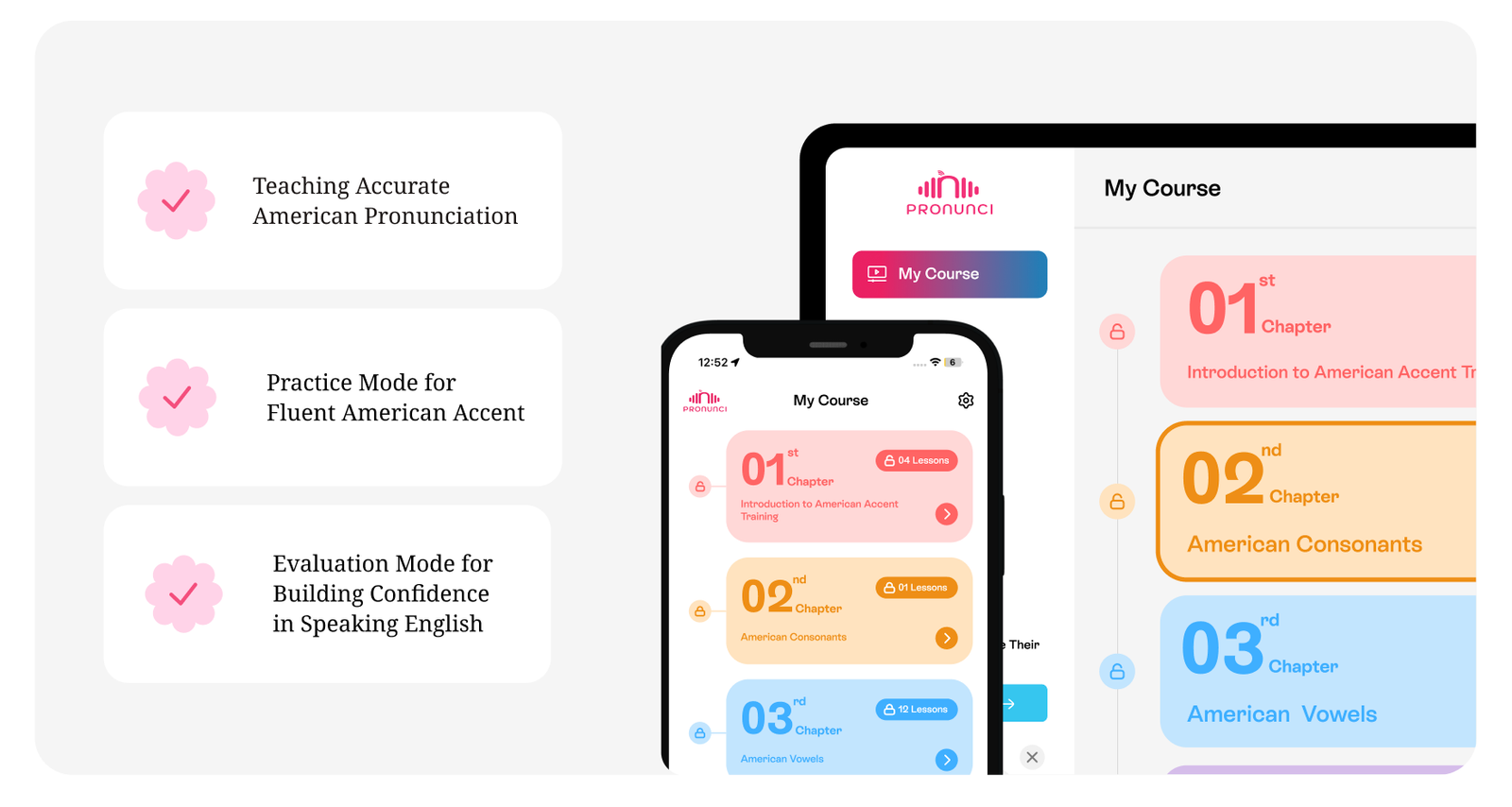
InPronunci: Accent Training App combines Prof. Alex.’s guided teaching method, Interactive Visual 2D Sound Simulators, AI Accent Coach feedback, and unlimited native-speaker comparison in one structured program. The American Intonation and Emphasis chapter trains falling finals, stress placement, rhythm, and connected speech in the exact contexts professionals need: interviews, presentations, and meetings. You are not practicing alone with a scoring tool; you have guided instructions, speech-organ articulation training, and a human coach available when you need one.
Structured American Accent Training Course
From Speech Organs Education to American Intonation
The InPronunci course is built step by step: every chapter prepares the next one, and by the end of the course students receive a certificate.
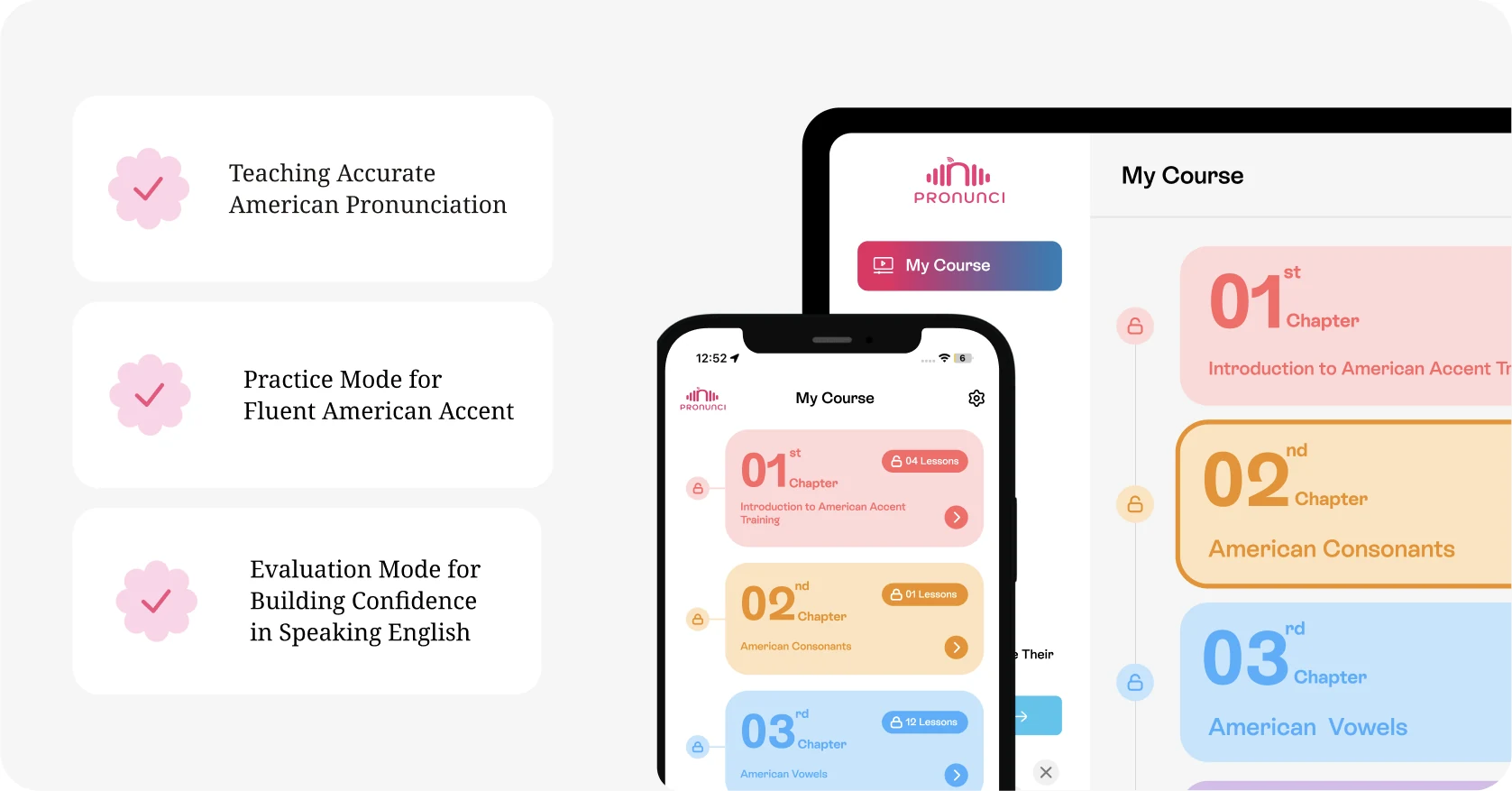
- Speech Organs EducationStudents learn how the speech organs work, along with the AI Accent Coach commands and feedback.
- American ConsonantsPractice and evaluate American consonants in phonetic exercises and practice sentences with the AI Accent Coach.
- American VowelsPractice and evaluate American vowels in phonetic exercises and practice sentences with the AI Accent Coach.
- IntonationLearn how intonation can change the meaning of what you say.
- CertificateBy the end of the course, students receive a certificate.
Start with the free Chapter 1 (Get to Know Your Speech Organs) to build the physical foundation, then move into the intonation modules. The InPronunci: American Accent Training Course is also available as a full desktop program. For a side-by-side look at your options, the AI accent coach guide walks you through the decision. Download the free chapter today and run your first 2-minute simulator exercise before your next interview.
Sources
- When Sounding Confident Helps, and When It Backfires | SPSP
- Paralinguistic features communicated through voice can affect appraisals of confidence and evaluative judgments | Journal of Nonverbal Behavior
- Speech rate, intonation, and pitch: Investigating the bias and cue effects of vocal confidence on persuasion
- Synthesized-speech study showing filled-pause position, mean f0, and speech rate affect perceived speaker confidence
- Study showing prosodic signatures of confidence and accuracy can be distinguished
- Intonation: Overview – Oral Communication for Non-Native Speakers of English, 2nd Edition
- Intonation (Britannica)
Inside the InPronunci App
Learn the four American intonation patterns and 15 sentence types
The InPronunci Intonation chapter teaches one pattern per session, then compares the patterns and ends with a summary.
-
01Statements ↘I’m going to the ↘store.
-
02Wh-questions ↘What ↘time is it?
-
03Commands ↘Close the ↘door.
-
04Exclamations ↘What a great ↘idea!
-
05Yes/no questions ↗Are you ↗ready?
-
06Statement as a question ↗You’re coming ↗tonight?
-
07Echo questions ↗You said ↗Tuesday?
-
08Tag question, real question ↗It’s open, ↗isn’t it?
-
09Tag question, expecting agreement ↘It’s a nice day, ↘isn’t it?
-
10Lists ↗ … ↘↗Apples, ↗bananas, and ↘grapes.
-
11Choice questions ↗ ↘Tea ↗or ↘coffee?
-
12Unfinished thought ↗ … ↘If you have ↗time, call ↘me.
-
13Strong feeling ↗↘That’s a↗↘mazing!
-
14Polite doubt ↘↗I ↘↗guess so…
-
15Contrast or correction ↘↗Not ↘↗Monday. ↘Tuesday.
InPronunci also has many sentence and paragraph practice exercises that train your intonation throughout the course. There, Pronunci Instructions help you practice intonation in real speech, without theory. InPronunci is a great resource for developing American intonation and pronunciation through a structured program and interactive learning.
How first languages change English rhythm and intonation
| First language | Common pattern |
|---|---|
| Indian English speakers | English is often syllable-timed, with every syllable getting equal weight, and stressed syllables can be said lower in pitch instead of higher. |
| Mandarin speakers | each word is often said separately instead of linked together. |
| Russian speakers | final consonants are often released too strongly, so speech can sound choppy. |
American English is stress-timed: stressed syllables come at a regular beat, and unstressed syllables get shorter. Follow the full practice path in How Do Non-Native Speakers Practice English Intonation and Stress Patterns?
Sources: Wikipedia: Indian English, San Diego Voice and Accent, Wikipedia: Non-native pronunciations of English
Questions & Answers
FAQ
01What is the best way to practice English stress patterns?
Start with word stress, then sentence stress, then intonation, and record yourself at each step. Feedback on each recording, like the AI Accent Coach gives in InPronunci, shows you what to change.
02What is the role of intonation in sounding confident?
Intonation shapes how listeners judge your certainty. Falling sentence-final intonation signals confidence in U.S. English; rising finals on statements tend to read as hesitation or a request for approval.
03Which intonation pattern sounds most confident in American English?
A falling pitch on the final stressed word of a declarative sentence is the pattern American listeners most consistently associate with confidence, according to research by Guyer et al. and converging acoustic studies. However, a confident-sounding intonation increases listener scrutiny and can amplify both strengths and weaknesses in your speech, so strong content is as important as delivery.
04Do filled pauses really affect how confident you sound?
Yes. Synthesized-speech research found that medial fillers (“um” or “uh” in the middle of a sentence) reduce perceived confidence more than fillers placed at the start of an utterance. Replacing them with a brief silent pause is more effective.
05Can a confident tone ever hurt your credibility?
It can. A confident vocal tone increases listener scrutiny. When your arguments are strong, that works in your favor. When the content is weak, a confident tone makes the weakness more noticeable, not less.
06How does InPronunci help with intonation training?
InPronunci’s American Intonation and Emphasis chapter trains falling finals, stress placement, and rhythm with AI Accent Coach feedback, native-speaker comparison, and the Interactive Visual 2D Sound Simulator for clear consonant production.
Recommended

InPronunci Accent Training App for Professional Communication
Improve American pronunciation with InPronunci, an accent training app using AI feedback, human guidance, and 2D Sound Motion Technology.

InPronunci: The Revolutionary American Accent Training App for Real Speech Transformation
Master the American accent for your career with the InPronunci App. Our 2026 guide shows how visual tech & AI feedback build executive vocal presence.
American Accent Training Course | InPronunci Curriculum
Explore InPronunci, a global American accent training course with AI feedback, human guidance, 2D Sound Motion Technology, vowels, consonants, and intonation.
Plans
What InPronunci costs
InPronunci Basic
$35 per month
Chapter 1 is free after signup.
InPronunci Premium
$200 per month
Includes a coach: