
Elision is the omission of one or more sounds in connected speech, and it happens because fluent speakers favor efficiency over the full articulation you find in dictionaries. This single habit reshapes word boundaries, shortens syllable counts, and explains why native speech sounds faster and blurrier than textbook English. For learners, recognizing elision in English is the difference between hearing “want to” and hearing only “wanna.”
Apple App Store | Google Play
TL;DR:
- Most elision occurs in casual, rapid speech, particularly with /t/ and /d/ sounds at word boundaries, such as “next day” becoming “nex’ day.”
- Schwa deletion frequently reduces unstressed syllables in words like “family” and “interesting,” leading to significant morphology compression.
- Recognizing elision cues like vowel quality shrinking, bursting sounds disappearing, and timing compression improves listening comprehension and natural speech production.
- American English leans heavily on /t/ and /d/ elision and schwa deletion, with regional dialects exhibiting their own specific patterns of sound reduction.
- Effective practice involves listening to native speech, identifying reduction patterns, and imitating timing rather than focusing solely on individual sounds.
Table of Contents
- What Is Elision, and Why Does It Happen?
- Common Types of Elision in English
- Examples of Elision With Transcriptions You Can Practice
- Why Elision Matters for Listening and Speaking
- How to Practice Recognizing and Producing Elision
- Prof. Alex’s Method: Seeing the [t] Sound Disappear
- How Elision Has Shifted Across History and Dialect
- Elision vs. Assimilation vs. Liaison: What’s the Difference?
- Does Elision Change English Spelling Rules?
- Why Elision Trips Up Non-Native Speakers, and How to Fix It
- Prof. Alex’s Perspective: Elision as a Real Milestone
- Practice Elision With Guided, Structured Training
- Sources
- FAQ
What Is Elision, and Why Does It Happen?
Every word has a citation form, the clean, fully articulated version you find printed in a dictionary entry with its own pronunciation guide. Connected speech rarely matches that citation form. When words link together in real sentences, speakers routinely compress, weaken, or drop sounds that would otherwise force the mouth to do extra work in a short span of time.
The technical reason is articulatory economy. Producing every consonant and vowel with full strength takes muscular effort and time. When two demanding gestures land close together, a phenomenon linguists call temporal crowding, the tongue, lips, or vocal folds often simplify one of them rather than execute both in full. The Cambridge Dictionary defines elision simply as the not-pronouncing of a particular sound, and its American and British audio entries let you hear the same word both ways.
Elision is not universal. It shows up far more in casual, rapid, or spontaneous speech than in a slow, formal reading. A newscaster enunciating a script will preserve more of the citation form than that same person chatting with a friend at lunch. This is exactly why elision falls under the broader umbrella of elision connected speech rather than being treated as a spelling rule or an accent quirk. It is a byproduct of speed and social register, and it appears in some form across nearly every English dialect.
Common Types of Elision in English
Elision clusters around a handful of predictable environments. Once you know the categories, spotting them in real speech gets much easier.
- T/d elision in clusters. The alveolar stops /t/ and /d/ frequently disappear when squeezed between other consonants, especially at word boundaries. “Next day” often becomes something closer to “nex’ day,” and past-tense endings like “asked” can lose their final /t/ sound entirely in American English.
- Schwa deletion in unstressed syllables. Words like “camera,” “family,” and “interesting” regularly shrink by one syllable in fast speech, since the weak schwa /ə/ vowel is the easiest sound to drop without harming intelligibility, a pattern well documented in phonetics resources on schwa behavior.
- H-loss in weak forms. Pronouns like “him,” “her,” and “his” frequently lose their initial /h/ when they are unstressed and mid-sentence, turning “give him it” into something closer to “give ‘im it.”
- Consonant cluster simplification. English avoids piling up three or more consonants in a row when it can help it, so a middle consonant in a heavy cluster often weakens or vanishes.
Pro Tip: Elision usually weakens a sound rather than deleting it outright. Instead of training yourself to “cut” the /t/ in words like “want to,” practice softening it until it barely registers. That gradient approach matches how native speakers actually produce it.
Examples of Elision With Transcriptions You Can Practice
Seeing citation forms next to their elided counterparts makes the pattern concrete. Here are pairs you will hear constantly in everyday American speech:
- “Going to” → “gonna” (/ˈɡʌnə/), with the /t/ dropped and the vowels merged.
- “Don’t know” → “duno” (/dəˈnoʊ/), collapsing three syllables into two.
- “First light” → “firs’ light,” where the final /t/ in “first” disappears before the consonant that follows.
- “Want to” → “wanna,” a near-universal reduction across American registers.
- “Him” → “’im,” as in “tell ‘im to call.”
When you listen for these patterns, three cues matter more than trying to catch a missing consonant outright. First, vowel quality shrinks toward a neutral schwa sound. Second, the sharp release, or burst, that normally follows a /t/ or /d/ often disappears, leaving only a brief pause. Third, timing shifts. A phrase that should take five beats compresses into four, which is often the biggest clue that elision happened. According to connected speech research from Columbia University, the articulatory gesture is frequently still present at a reduced level, even when your ear registers nothing at all.
Why Elision Matters for Listening and Speaking
Elision changes the expected shape of words, and that mismatch is where most listening breakdowns happen. If you learned “interesting” as four syllables, hearing it collapse into three syllables in natural speech can make the word unrecognizable, even though you know it perfectly well in writing.
This is also why advanced learners often understand slow, careful English but struggle with fast native conversation. Your brain is matching incoming sound against a stored citation form that rarely occurs outside classrooms and audiobooks. Retraining that expectation is the real skill, not memorizing a list of contractions.
The payoff extends to your own speech. Learners who recognize elision tend to produce more natural rhythm, because they start chunking phrases the way native speakers do instead of pronouncing every word with equal, deliberate weight. Recognition comes first. Production follows once the pattern is familiar.
How to Practice Recognizing and Producing Elision
Training elision works best in a specific order: listen, notice, imitate, then produce under time pressure.
- Start with listening-first tasks. Try short dictation exercises using elided speech, then gap-fill activities where you predict which sound got dropped. The British Council recommends exactly this sequence for building recognition before asking learners to produce anything.
- Move to controlled contrast drills. Say a phrase in its full citation form, then again in its natural elided form. Minimal pairs like “want to” versus “wanna” build the muscle memory for when reduction is appropriate.
- Practice timed chunk repetition. Repeat short phrases at increasing speed, aiming to keep the rhythm even as sounds naturally weaken. Speed forces your mouth toward the reductions a slow, careful pace would never require.
- Shadow native audio. Play a short clip, pause, and repeat it at the same speed and rhythm before moving to the next line.
- Use roleplay for transfer. Elision only sticks when it shows up in spontaneous exchanges, not scripted reading, so practice unscripted responses with a partner or coach.
Pro Tip: Teachers can gauge progress quickly by listening for timing rather than for individual sounds. A learner who compresses phrases to the correct syllable count, even with imperfect elision, is usually further along than one who says every sound perfectly but at citation-form speed.
Prof. Alex’s Method: Seeing the [t] Sound Disappear
I teach elision as a timing problem, not a deletion rule. Once learners see the tongue, jaw, and airflow involved in a sound, the idea of “weakening a gesture under pressure” becomes concrete instead of abstract. That is exactly what the Interactive 2D Sound Video Simulator for the American [t] sound was built to show.

The simulator visualizes the tongue tip contact, the airflow release, and the timing window where a /t/ gets crowded by neighboring consonants, the same temporal crowding that drives most t/d elision. Try this micro-exercise: watch the simulator, listen to the native model, record yourself saying the same phrase, then play both back side by side. Adjust once, and repeat. That listen, compare, record, replay loop is the core of how InPronunci: Accent Training App trains connected speech.
How Elision Has Shifted Across History and Dialect
Elision is not a new feature of casual American speech. Historical linguists trace vowel and consonant reduction back through centuries of English sound change, where unstressed syllables have consistently been the first casualties of faster speech. What changes across time and geography is not whether elision happens, but which sounds it targets and how aggressively.
American English leans heavily on t/d elision and schwa deletion in casual registers, particularly in fast-paced professional and conversational contexts. British varieties often show more h-dropping in regional accents, alongside different patterns of consonant cluster simplification. Southern American dialects and African American Vernacular English each carry their own elision tendencies, some overlapping with General American patterns and some distinct to their communities.
The practical takeaway for learners is that no single “correct” elision pattern exists across English. What you are actually training when you study American pronunciation is the specific set of reductions common to General American speech, not a universal rulebook. That is one reason a structured American Accent Training Course focuses narrowly on the patterns you will actually encounter in US professional and academic settings, rather than teaching every regional variant at once.
Elision vs. Assimilation vs. Liaison: What’s the Difference?
These three terms get confused constantly, and the confusion causes real problems when learners try to look up why a sound changed.
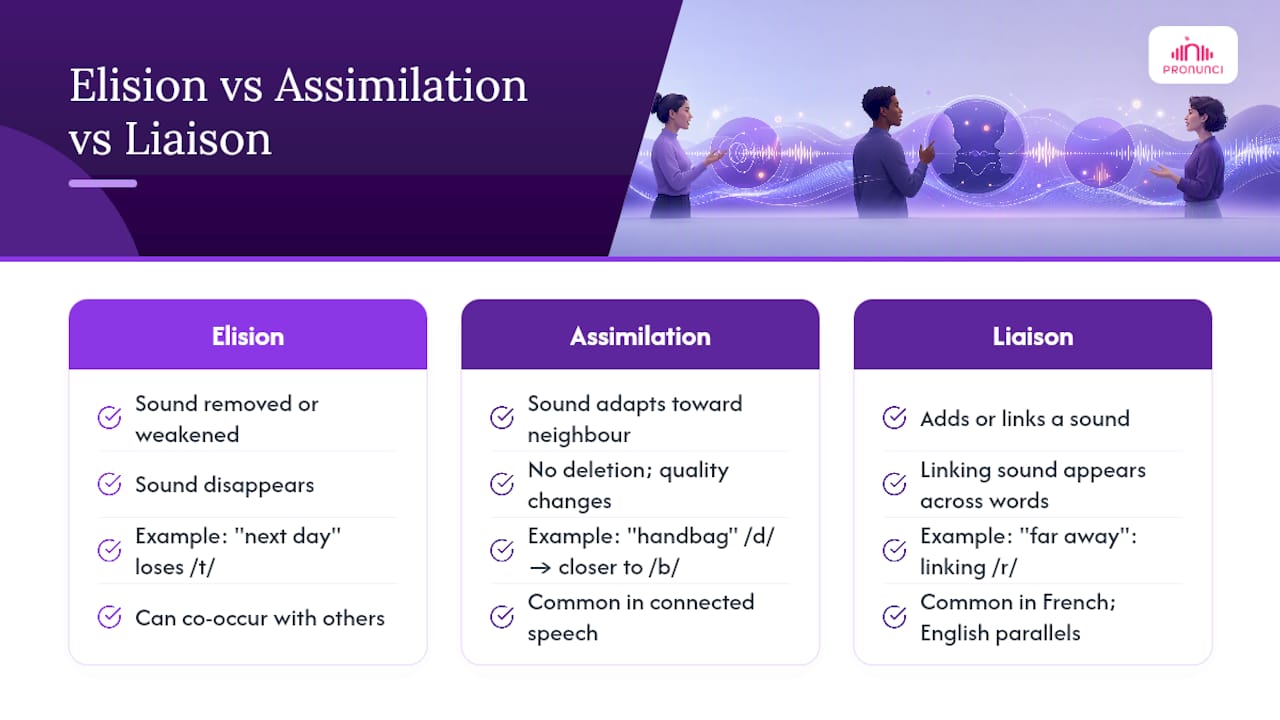
Elision removes a sound entirely, or weakens it past the point of easy recognition. “Next day” losing its /t/ is elision: something is gone.
Assimilation changes a sound so it becomes more similar to a neighboring sound, without deleting anything. In “handbag,” the /d/ often shifts toward a sound closer to /b/ because of the following consonant. Nothing disappears; a sound simply adapts to its neighbor.
Liaison, more common in French phonology than in English, adds or links a sound across a word boundary that would not appear if the word were said alone. English has a loose parallel in linking /r/, where a word ending in a written “r” connects smoothly into a vowel that follows, as in “far away.”
The three phenomena often stack together in the same phrase, which is part of why connected speech feels dense to non-native listeners. A single sentence might show assimilation at one boundary, elision at another, and a linking sound at a third, all within a few words.
Does Elision Change English Spelling Rules?
English spelling almost never updates to reflect elision, and that gap between sound and spelling is one of the biggest sources of confusion for learners. Words like “interesting” and “camera” keep every syllable in writing even though speech regularly drops one. The written form preserves the historical, fully articulated citation form, while speech moves on without it.
Contractions are the one place where spelling does catch up, at least partially. “Don’t,” “can’t,” and “won’t” are essentially frozen elisions that earned their own spelling. But these are the exception, not the rule. The vast majority of elided sounds, like the dropped /t/ in “next day” or the missing schwa in “family,” never get written down anywhere. You will not find them in a dictionary entry, only in transcripts of real speech or phonetics teaching materials.
This mismatch explains why reading ability and listening ability can diverge so sharply for advanced learners. You can read “interesting” correctly a thousand times and still mishear it in conversation, because your eyes and ears are working from two different versions of the same word.
Why Elision Trips Up Non-Native Speakers, and How to Fix It
Non-native learners typically struggle with elision for one core reason: they learned vocabulary from its citation form, so their brain expects every syllable and every consonant to show up on schedule. When speech compresses that expectation, the result feels like missing information rather than a predictable pattern.
A second challenge is that most classroom instruction, even at intermediate and advanced levels, still emphasizes clear, careful articulation. That is useful for building accuracy early on, but it can leave learners unprepared for how fast native speech actually moves once they leave the classroom.
The fix starts with reframing expectations before drilling production. Deliberate listening practice, where you actively predict which sounds will weaken or disappear in a given phrase, retrains your ear faster than production drills alone. Pair that with short, daily exposure to unscripted native audio rather than only scripted teaching materials. Programs like structured accent training build this listening-first sequence directly into the curriculum, so recognition comes before you are asked to reproduce the reduction yourself. Resources built around dialog practice, such as conversational English exchanges designed for shadowing, also give you repeatable material to test your ear against.
Prof. Alex’s Perspective: Elision as a Real Milestone
Mastering elision is one of the clearest signs a learner has moved past textbook English into natural rhythm. It is not about sounding lazy. It is about timing control, and that control takes weeks of consistent, short exposure rather than one long study session. The most common hurdle I see is learners trying to force a sound out fully instead of letting it weaken naturally. My advice stays simple: pair a few minutes of focused listening with a few minutes of production every single day, and let the reduction happen on its own.
— Prof. Alex., Ph.D. Accent Coach
Practice Elision With Guided, Structured Training
Most learners try to fix connected speech by watching random videos or memorizing contraction lists, and both approaches leave the actual timing problem untouched. InPronunci is built around a different core idea: you need to see the articulation, compare it against a native model, and record your own attempt before the reduction becomes automatic. That structured sequence is what separates a guided accent-training system from scattered practice videos.
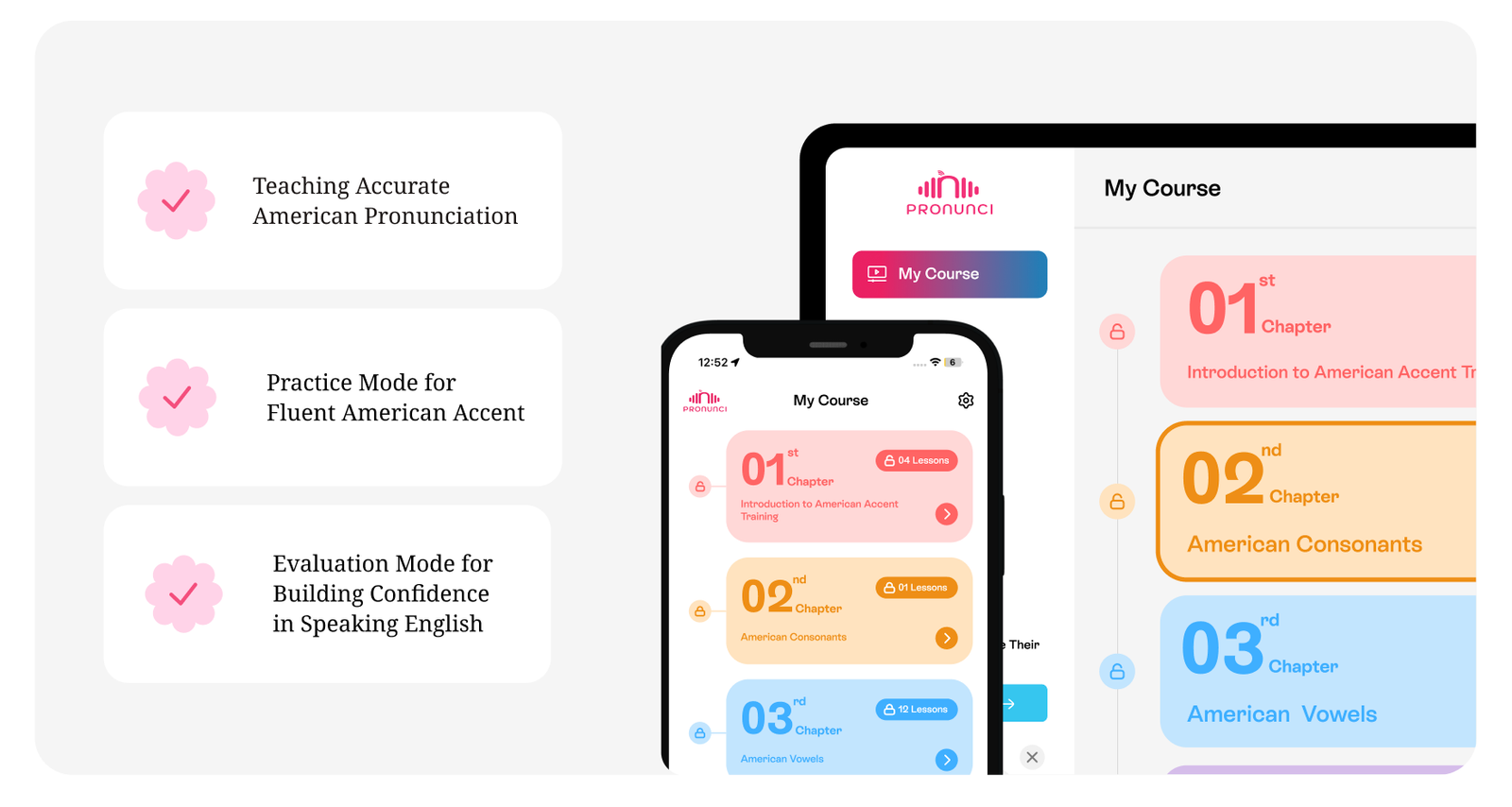
Inside the app, the Interactive 2D Sound Video Simulator makes gestures like t/d elision visible instead of abstract, so you can watch exactly where the tongue and airflow compress under time pressure. The AI Accent Coach then evaluates your recorded attempt against the native model, called My Coach, next to your own version, My Pronunci, so you know precisely where timing slipped. Add unlimited recording and comparison, daily rhythm and stress drills, and in-app chat access to a human coach, and you get a full connected-speech training loop rather than an isolated exercise.
The free onboarding chapter lets you try the 2D sound simulator and the AI feedback loop before committing to anything. If you are ready to build a full plan around connected speech, rhythm, and elision, the InPronunci: American Accent Training Course lays out the complete curriculum, chapter by chapter, so you can start with Speech Organs Education and work toward natural, elided, native-rhythm speech.
Sources
- Elision — Wikipedia
- Elision — Cambridge Dictionary
- Connected speech lecture notes — Columbia University
FAQ
What Are Examples of Elision in English?
Common examples include “going to” becoming “gonna,” “want to” becoming “wanna,” and “next day” losing its /t/ sound to become “nex’ day.” Schwa deletion in words like “camera” and “family” is also a frequent form of elision.
What Does Elision Mean?
Elision means the omission of one or more sounds, a vowel, a consonant, or an entire syllable, in a word or phrase, and it is especially common in connected speech.
What Does Elision Mean in French?
In French, elision refers to the dropping of a final unstressed vowel before another vowel, typically marked with an apostrophe, as in “le” plus “ami” becoming “l’ami.” The underlying idea, avoiding two vowel sounds colliding, parallels the efficiency motive behind English elision.
How Is Elision Pronounced?
Elision is pronounced /ɪˈlɪʒən/, with stress on the second syllable, and you can hear both American and British audio versions on the Cambridge Dictionary entry.
Recommended
- Coach Led 2D Drills: Train Dark L in 7–14 Days for Advanced Speakers
- Mastering Clarity: The Strategic Power of 2D Sound Video Mouth Training Simulators
- American Voicing T-D Practice: How InPronunci Trains the Flap T Sound
- 2D Sound Motion Technology for Accent Reduction: The Professional’s X-Ray to American English