



The dark L is the velarized L you hear at the end of words like “ball” and “milk.” You produce it by raising the back of your tongue toward your soft palate while your tongue tip rests lightly near the ridge behind your teeth. It shows up after a vowel or at the end of a syllable, never before one. Master that single rule and the drills below will click fast.
Try InPronunci’s Apple app | Get it on Google Play
What is dark L pronunciation in American English?
English speakers use two versions of the letter L, and most learners never notice the switch happening. Linguists call them light L and dark L, and the difference comes down entirely to tongue position, not spelling.
Light L appears before a vowel, as in “love” or “yellow.” Your tongue tip taps the ridge behind your top teeth while the rest of your tongue stays relatively flat and forward. Dark L works differently. It occurs after a vowel or at the end of a syllable, and it involves a secondary tongue movement called velarization, where the back of the tongue lifts toward the soft palate (the velum) at the same time the tip makes contact near the alveolar ridge.
Phoneticians transcribe this sound with the symbol [ɫ] (sometimes written lˠ), distinguishing it from the plain [l] used for light L. Velarization is the technical name for this back-of-tongue raising, and it’s what gives dark L its heavier, rounder quality compared to the crisper light L.
Here’s the rule broken down simply:
- Light L: before a vowel sound. Examples: “look,” “silly,” “value.”
- Dark L: after a vowel or at the end of a syllable. Examples: “ball,” “milk,” “little.”
- The switch happens based on position, not spelling. Some words contain both. “Little” opens with a light L and closes with a dark one.
Cambridge Dictionary defines dark L as the way of saying /l/ in which the back of the tongue is raised slightly, typically before a consonant or at the end of a word. That definition matches how native speakers actually produce it, even though most never learned the term.
How do you physically make the dark L sound?
Getting the mechanics right takes less time than most learners expect. The motion is small, but it needs to happen in the right order.
- Say the vowel first, cleanly. Before you attempt “ball,” isolate the “ah” sound and hold it for two full seconds. Your tongue should be low and relaxed.
- Raise the back of your tongue while keeping the tip near the ridge. This is the velarization step. Don’t press the tip hard against the roof of your mouth. It should hover close, not clamp down.
- Close into the L quickly, then release. Connect the vowel to the raised tongue-back position, then let the tip make light contact. Practice this in slow motion first, saying “baaaaaaaaal” as one long, connected motion, then speed it up to normal pace.
The hardest part for most learners isn’t the tongue tip. It’s remembering to lift the back of the tongue at all, since many languages don’t require that movement for any consonant. Watching the motion helps close that gap fast, which is exactly what InPronunci’s
is built for. It renders the tongue, jaw, and airflow in a moving diagram so you can see the velar raising happen instead of guessing at it.
Pro Tip: Place two fingers lightly under your chin while producing a dark L in a word like “pool.” You should feel a subtle shift in muscle tension as the back of your tongue lifts. If you feel nothing change, you’re likely skipping the velarization step and producing a flatter, more “light L” version by accident.
Pedagogical research on this sound consistently treats it as a two-part motion, a vowel-like off-glide followed by the L closure, and recommends training it with slow-motion drills before returning to normal speech speed, a method described in phonetics teaching resources.
Where does dark L show up in real words?
Dark L clusters into a few predictable positions, and hearing them grouped this way makes the pattern easier to internalize than memorizing individual words at random.
- Word-final position: ball [bɑɫ], pool [puɫ], call [kɑɫ]
- Before a consonant, same syllable: help [hɛɫp], milk [mɪɫk], self [sɛɫf]
- Medial, after a vowel, before another syllable: almost [ɑɫ.moʊst], bottle [bɑ.tɫ̩]
- Syllable-boundary contrast pairs: “real” (one syllable, dark L: [ɹiɫ]) versus “really” (two syllables, the first L stays dark, [ɹi.ə.li])
Notice that spelling never tells you which L you’ll use. “Little” and “look” both start with L, but only “look” gets the light version, because only “look” puts the L directly before a vowel. This is why FluentU’s breakdown of dark L and light L recommends learning the position rule instead of trying to memorize word lists by spelling pattern.
What drills actually build automatic dark L production?
Isolated sounds are easy to fake. Automatic, fluent dark L production under normal speaking pressure is the real goal, and that only comes from a structured progression, not random repetition.
Start with the warm-up every session:
- Vowel-hold, three steps. Say the vowel alone for two seconds. Add the velarized tongue-back raise while holding the vowel. Close into the L. This isolates the exact motion your mouth needs to learn before you add speed.
- Word drills by position, five repetitions each. Work through word-final (“ball,” “call,” “wheel”), pre-consonant (“help,” “milk,” “self”), and medial (“bottle,” “almost,” “little”) sets separately, since each position asks your tongue to time the velarization slightly differently.
- Phrase drills, three repetitions each. Try “a small ball,” “help yourself,” “little bottle.” Phrases force you to keep the dark L intact while your tongue is already moving toward the next word.
- Sentence drills, two repetitions each. “The little girl felt cold.” “I’ll call you after school.” Sentences test whether the sound survives at natural speed, not slow-motion practice speed.
Structuring practice this way, moving from isolation to word to phrase to sentence, is a sequence pronunciation instruction consistently recommends because it forces the sound to transfer into connected speech instead of staying trapped in careful, deliberate pronunciation.
After each pass, run a quick self-evaluation: record yourself, compare your recording against a native-speaker model, and fix exactly one thing before you record again. Inside InPronunci, this comparison routine is built directly into the app through My Coach (the native-speaker model) and My Pronunci (your own recording), so you’re never guessing whether your dark L actually landed or just felt right in your mouth.
Cognitive Accent Training
Compare Your Coach vs. Your Pronunci
In every practice sentence, students listen to Your Coach, record their own voice, and compare it with Your Pronunci, so they consciously notice and correct each sound.
![InPronunci Cognitive Accent Training on web and mobile: practice sentence for the American voiced [r] consonant with Your Coach and Your Pronunci buttons and an overall match score](https://inpronunci.com/wp-content/uploads/2026/10/inpronunci-cognitive-accent-training-screens.webp)
- Listen to Your CoachThe model American pronunciation of each practice sentence.
- Compare with Your PronunciYour own recorded pronunciation, side by side with the coach.
- Correct with feedbackThe match score and color-coded letters guide each correction.
A reasonable daily schedule: ten minutes on warm-ups and word drills for the first week, then shift half that time to phrases and sentences in week two. Check your progress by re-recording the same three sentences every few days and listening for whether the dark L holds steady at full speaking speed.
How does dark L behave in connected, natural speech?
Dark L rarely sits in isolation once you’re speaking in full sentences, and the sound changes slightly depending on what surrounds it. Understanding this keeps your practice from falling apart the moment you leave the drill sheet.
- The preceding vowel often gets a slight off-glide or centralization. In words like “fall” or “call,” you’ll hear a small vowel shift right before the L closes, almost like a quiet second vowel sneaking in.
- Chunking helps. Practice dark L words inside short phrase chunks (“call me,” “feel free”) rather than as standalone words, since that’s closer to how you’ll actually use them.
- Shadowing trains timing. Play a short clip of natural speech and speak along with it in real time, matching rhythm more than individual sounds at first.
- Tapping out the rhythm while you repeat a sentence keeps your dark L from getting rushed or dropped when you’re speaking faster than drill pace.
What mistakes do learners make with dark L, and how do you fix them?
Two mistakes account for most of the trouble learners run into, and both are easy to diagnose once you know what to listen for.
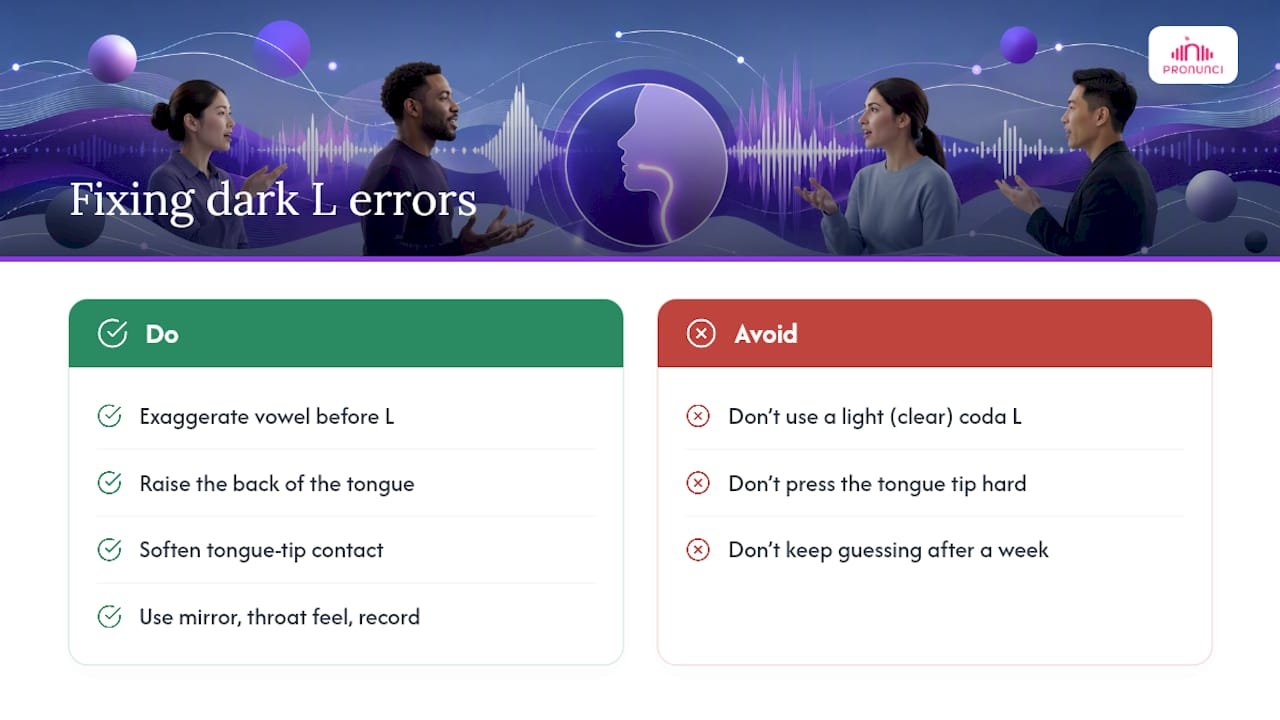
The first is producing a clear, light-sounding L in coda position, which often happens because your native language doesn’t distinguish the two L types at all. The fix: exaggerate the vowel before the L and consciously add the back-of-tongue raise before you close the sound.
The second is pressing the tongue tip too hard against the ridge, which makes the L sound overly sharp or clipped. The fix: soften the tip contact and shift more of the effort to the back-raising motion instead.
Three fast self-checks: watch yourself in a mirror for tongue tip tension, place a hand near your throat to feel voicing continue through the L, and record then compare against a native model. If the same error keeps showing up after a week of focused practice, that’s the point to book targeted feedback from a coach rather than keep guessing alone.
Who is Prof. Alex, and how does InPronunci train this sound?
Prof. Alex, Ph.D., has spent more than 20 years teaching, researching, and coaching American accent training, and that experience shapes every drill inside InPronunci: Accent Training App. The method starts with Speech Organs Education, so learners understand tongue, lip, and jaw mechanics before attempting any sound, then moves into Cognitive Accent Training, an active listen-compare-correct cycle rather than passive repetition.
For a sound like dark L, where the key movement happens out of sight, the app’s Interactive Visual 2D Sound Simulator trains the tongue’s back-raising motion instead of leaving it theoretical. Pair that with the My Coach versus My Pronunci recording comparison, and you get a concrete answer to “did I actually do it right?” instead of a guess. Speech organ awareness like this is covered in more depth in InPronunci’s Speech Organs Education resource.
An accent coach’s honest take on dark L training
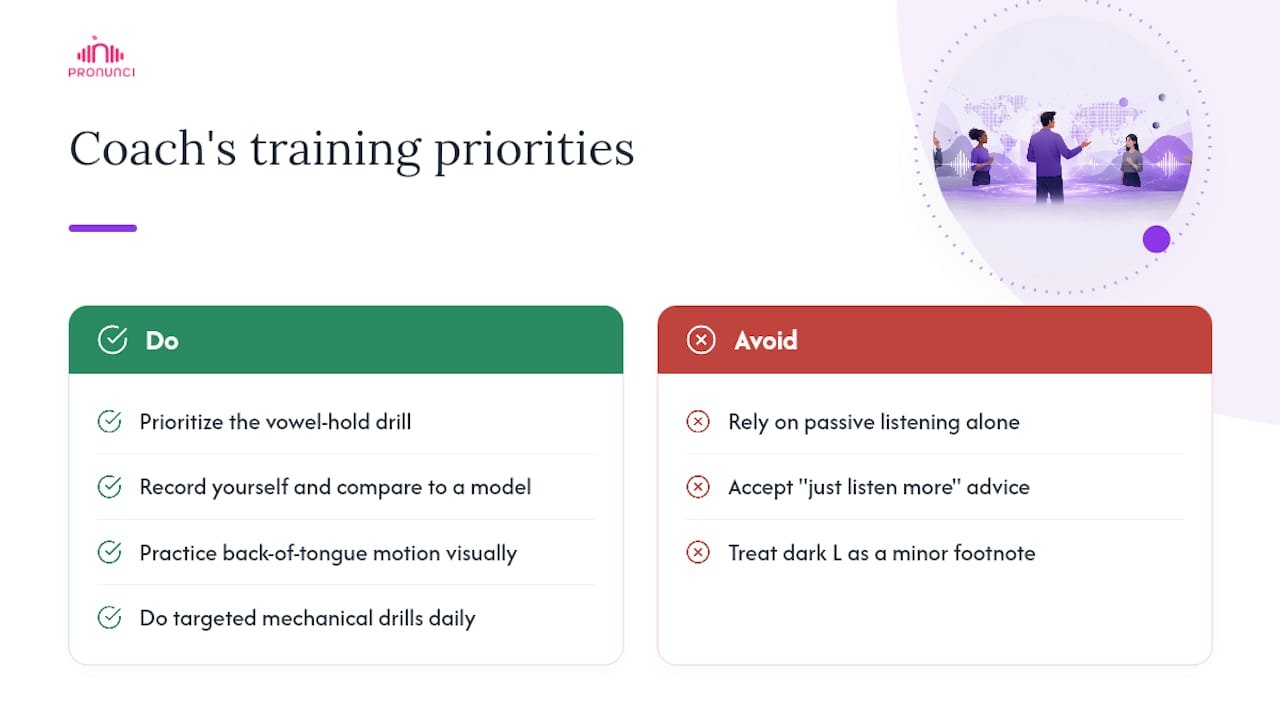
Most pronunciation content treats dark L as a minor footnote, one line in a chart about consonant sounds, when it’s actually one of the more consequential sounds in American English because it appears so often and hides in plain sight. The conventional advice, “just listen more and it’ll come,” fails a specific kind of learner: the advanced speaker who already sounds fluent but still gets flagged as non-native in professional settings. For that learner, the gap usually isn’t vocabulary or grammar. It’s exactly this kind of invisible articulatory detail.
What gets overrated is passive exposure. Hearing thousands of dark L instances in podcasts and shows does very little if you’ve never consciously felt the back-of-tongue motion in your own mouth. What gets underrated is targeted, mechanical speech-organ training, training the tongue movement and then comparing your own recording against a model. If you take one thing from this article, prioritize the vowel-hold drill and the recording comparison over everything else. That combination closes the gap faster than any amount of casual listening ever will.
— Prof. Alex, Ph.D. Accent Coach
Ready to train dark L with structured, guided practice?
Reading about tongue placement only gets you so far. What actually changes your pronunciation is practicing the movement, attempting it yourself, and getting immediate feedback on whether you got it right, which is precisely what a self-study article cant give you. InPronunci: Accent Training App closes that gap with the Interactive Visual 2D Sound Simulator, guided drills built around real articulation science, and AI Accent Coach feedback that tells you exactly where your dark L production drifts from the model.
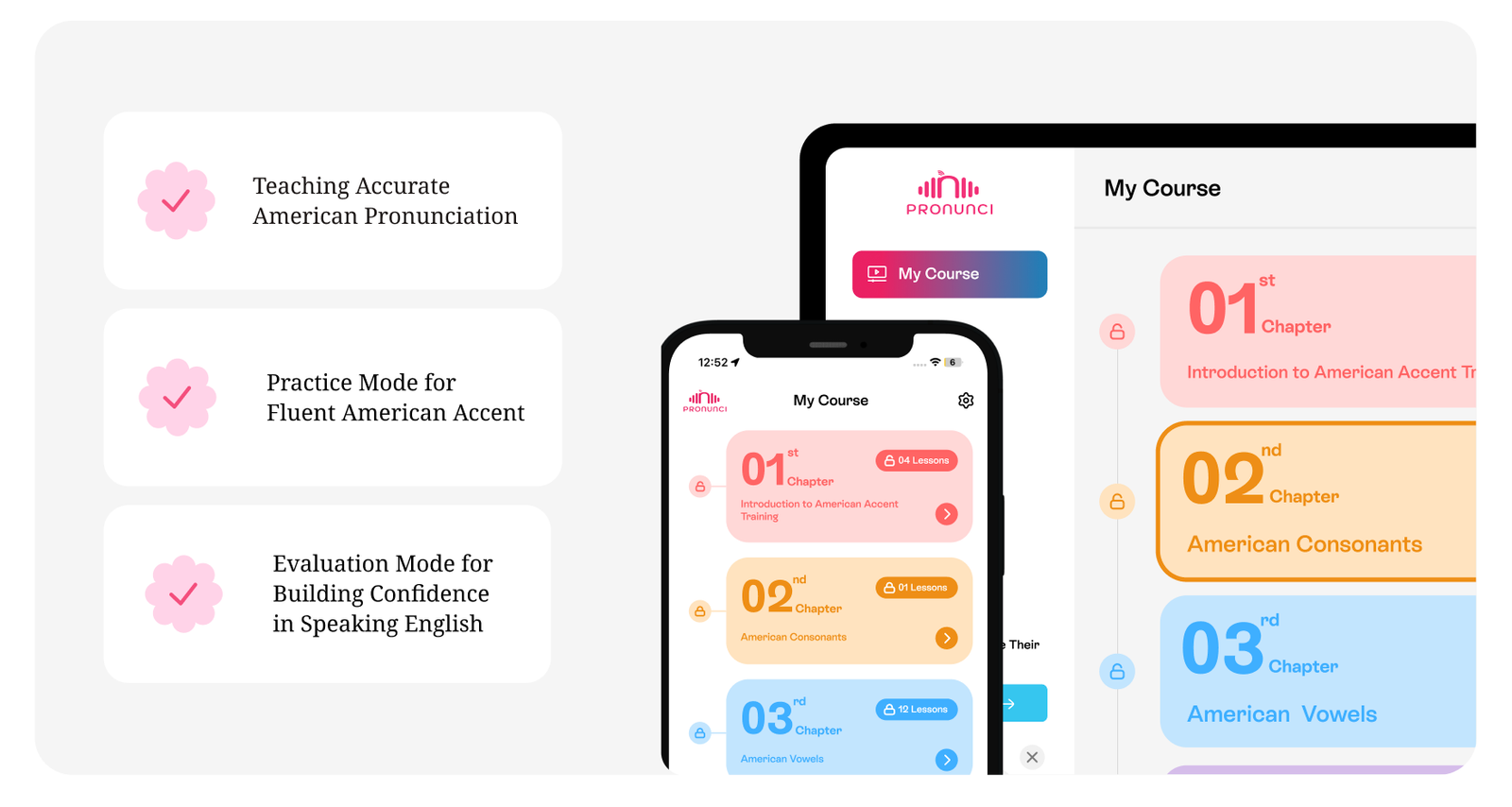
The full InPronunci: American Accent Training Course walks you through consonants, vowels, and intonation in the same structured sequence used in this article: isolation, word, phrase, sentence. If dark L has been quietly undermining your speaking clarity, start with the free onboarding chapter and commit to a focused seven to fourteen day practice block using the daily practice plan as your framework. Advanced speakers looking to push further can explore advanced ESL pronunciation techniques once the basic motion feels automatic.
Sources
- Velarization — Wikipedia
- dark l — Cambridge Dictionary
- Dark L — University of Manitoba (phonetics resource)
- Dark L and Light L: Learn the Difference and Pronunciation | FluentU
How Russian, Mandarin and Indian English speakers often pronounce the American L
| First language | Common pattern |
|---|---|
| Russian speakers | the L can sound too dark or heavy. |
| Mandarin speakers | the dark L at the end is said like a vowel, so "table" sounds like "tay-bow". |
| Indian English speakers | the L is always clear; the American dark L, as in "feel", is missing. |
In InPronunci, each sound is trained with the Interactive Visual 2D Sound Simulators, guided by Pronunci Instructions, and checked with the AI Accent Coach.
Sources: Wikipedia: Non-native pronunciations of English, San Diego Voice and Accent, Wikipedia: Indian English
Questions & Answers
FAQ
01What does dark L mean?
Dark L refers to the velarized version of the /l/ sound, produced when the back of the tongue raises toward the soft palate. It occurs after a vowel or at the end of a syllable, as in “ball” or “milk.”
02How do you pronounce dark L?
Say the preceding vowel clearly, raise the back of your tongue toward your soft palate, then close lightly with your tongue tip near the alveolar ridge. Practice the motion slowly before speeding up to natural pace.
03What is the l called in phonetics?
The English /l/ has two main variants: light L (the plain alveolar lateral before vowels) and dark L (the velarized lateral, transcribed [ɫ], after vowels or at syllable ends).
04What is the l speech impediment called?
Difficulty producing /l/ sounds accurately is sometimes called lambdacism, a speech pattern where L sounds are distorted, substituted, or omitted; this differs from simply learning the light L and dark L distinction as a non-native speaker.
05Does InPronunci teach dark L specifically?
Yes. InPronunci’s American Consonants Speech Training sessions include guided instruction, the Interactive Visual 2D Sound Simulator, and AI Accent Coach feedback built specifically to train sounds like dark L that involve hidden tongue movement.
Recommended

Mastering Clarity: The Strategic Power of 2D Sound Video Mouth Training Simulators
Struggling with your American accent? Learn how 2D Sound Video Mouth Training Simulators train your speech organs to build professional clarity.

Cultivating Elite Voice Training Habits for American Accent Mastery
Stuck with a robotic American accent? Develop elite voice training habits to master natural pronunciation. Learn our 15-minute daily routine for lasting resu...

Mastering Pronunciation Practice: The Strategic Path to American Accent Fluency
Unlock professional authority with strategic pronunciation practice. This guide offers a 15-min daily routine to master the American accent and command any r...
Plans
What InPronunci costs
InPronunci Basic
$35 per month
Chapter 1 is free after signup.
InPronunci Premium
$200 per month
Includes a coach: