



A note from Prof. Alex
Connected speech is where pronunciation becomes real communication. Students first need accurate American sounds, but then they must learn how words connect, reduce, and carry stress inside phrases and sentences. This is how speech begins to sound smoother, clearer, and more natural in professional settings.Prof. Alex, Ph.D. Accent Coach
Use connected speech selectively in professional U.S. English: reduce function words and link smoothly within thought-groups, but protect content-word clarity in presentations, interviews, and client-facing conversations. That one rule covers most situations you will face at work.
Three things you can do before your next meeting:
- Link consonants to vowels in phrases like “turn it on” (say “tur-ni-ton”) to sound more natural without losing meaning.
- Reduce function words such as “and,” “of,” and “to” to their weak forms (“n,” “uh,” “tuh”) in casual team talk, but restore full forms when a word carries logical weight.
- Pause at thought-group boundaries rather than rushing through sentences, so listeners can process each idea before you move to the next.
InPronunci: Accent Training App is the structured American accent training program built specifically for professionals who want measurable clarity gains. Start with the
to see exactly how articulation works before you practice connected speech in full sentences.


Connected speech in professional settings works best when you reduce function words and link within thought-groups while keeping full articulation on every content word your listener needs to catch.
What connected speech actually means for workplace intelligibility
Connected speech is what happens to individual words when they are spoken at natural speed inside a continuous stream of sound. Sounds merge, weaken, disappear, or change depending on their neighbors. The result is that “did you eat yet?” sounds like “dijeet yet?” to a native listener, and that is completely normal. The technical term linguists use is connected speech, and it covers both segmental changes (individual sounds) and suprasegmental features (rhythm, stress, and intonation patterns) that shape how listeners process what you say.
For professionals, the trade-off is real. Weak forms and rhythm are central to natural English, and ignoring them makes you sound over-formal, which can reduce listener comfort and slow down comprehension. At the same time, over-reducing content words strips away the very information your listener needs. The goal is not to sound “native” at all costs. The goal is to sound natural enough that listeners stay comfortable, while keeping your key words clear enough that your message lands.
Benefits of using connected speech well:
- Listeners predict your next word more easily, reducing cognitive load on their end.
- Your speech rhythm matches the patterns native speakers expect, which builds rapport.
- You sound fluent and confident rather than word-by-word and stilted.
Risks to watch for:
- Reducing content words (“meeting,” “deadline,” “budget”) makes them hard to catch.
- Over-linking across thought-group boundaries blurs the logical structure of your message.
- Monotone delivery without pausing removes the prosodic cues listeners rely on to follow you.
Pro Tip: After your next meeting, replay a 30-second recording of yourself and ask: “Could a non-native colleague catch every content word?” If even one key term sounds swallowed, that is your first fix.
Understanding how pronunciation affects listening comprehension helps you see why this balance matters so much in professional contexts.
The five core connected-speech processes you need to master
Linking, elision, intrusion, assimilation, and reductions (weak forms) are the five processes that shape connected speech in American English. Master these and you can both produce natural speech and decode fast native speakers in meetings and calls.
Linking rules and recognition tips help learners convert written phrases into natural spoken forms and give you concrete before-and-after practice targets.
| Process | Written / Careful Form | Connected / Natural Form | Workplace Example |
|---|---|---|---|
| Linking (catenation) | “turn it on” | “tur-ni-ton” | “Can you turn it on?” |
| Elision | “next week” | “nex’ week” | “Let’s meet next week.” |
| Intrusion | “I agree” | “I-y-agree” | “I agree with that point.” |
| Assimilation | “this year” | “thish year” | “This year’s targets are set.” |
| Weak forms | “I can do it” | “I c’n do it” | “I can do it by Friday.” |
A practical taxonomy from RMIT University also includes geminates (when two identical consonants meet at a word boundary, one is held rather than doubled), which is worth noting when you practice phrases like “black coffee” or “good day.”
Three shadowing practice cards:
- “The report is due at the end of the week.” Shadow at 75% speed first. Listen for the /t/ in “at” linking to the /ð/ in “the” and the weak “uh” form of “of.” Restore full articulation on “report,” “due,” and “week.”
- “Let me know if you need anything else.” Notice “let me” blending toward “lemme” in casual speech. Keep “know,” “need,” and “anything” fully stressed.
- “We’re going to go over the numbers now.” The phrase “going to” reduces to “gonna” in informal talk. In a client presentation, keep “going to” intact.
Reductions are safe on function words: articles (“a,” “the”), prepositions (“of,” “to,” “for”), auxiliaries (“can,” “have,” “will”), and conjunctions (“and,” “but”). Avoid reducing content words: nouns, main verbs, adjectives, and adverbs carry your meaning. Teaching weak forms and rhythm alongside vocabulary creates better transfer to spontaneous speech than isolated sound drills alone.
When and how to use connected speech in professional settings
The right level of reduction depends on your audience, the stakes of the interaction, and the channel you are using. Adapting message structure and delivery to your audience measurably improves workplace communication, and connected speech is one of the delivery variables you can tune.
| Setting | Reduction Level | Pausing Strategy | Key Rule |
|---|---|---|---|
| Informal team meeting | Moderate reductions on function words | Pause at idea boundaries | Link freely; keep content words clear |
| Formal presentation | Minimal reductions; full articulation on key terms | Longer pauses after main points | Slow pace; mark thought-groups with pauses |
| Phone / video call | Light reductions; slightly slower pace | Pause more often to check understanding | No training cues; clarity beats speed |
| Job interview | Minimal reductions; deliberate rhythm | Pause before answering; breathe | Intelligibility signals confidence |
| Cross-cultural team | Minimal reductions; avoid elision of content words | Frequent short pauses | Assume diverse listening backgrounds |
Do before a meeting or presentation:
- Identify the three or four content words in each key sentence and commit to full articulation on those words.
- Plan your thought-group boundaries in advance for any scripted section.
- Practice the opening two sentences aloud at slightly slower pace than feels natural.
Avoid in high-stakes settings:
- Reducing “can” to the point it sounds like “can’t” (a common intelligibility trap).
- Linking across sentence boundaries without a pause, which removes the listener’s processing time.
- Dropping the final consonant of a content word before a pause.
Effective communication strategies such as clarifying purpose, adapting tone, and active listening work alongside pronunciation practice to produce better outcomes in real workplace interactions. For client-facing contexts specifically, a client-facing pronunciation checklist gives you a quick pre-call review.
A daily practice routine that builds connected speech safely
The most efficient daily routine combines a short warm-up, one focused connected-speech drill, integrated phrase practice, and a recorded review. Even 10 minutes done consistently outperforms a 90-minute session once a week.
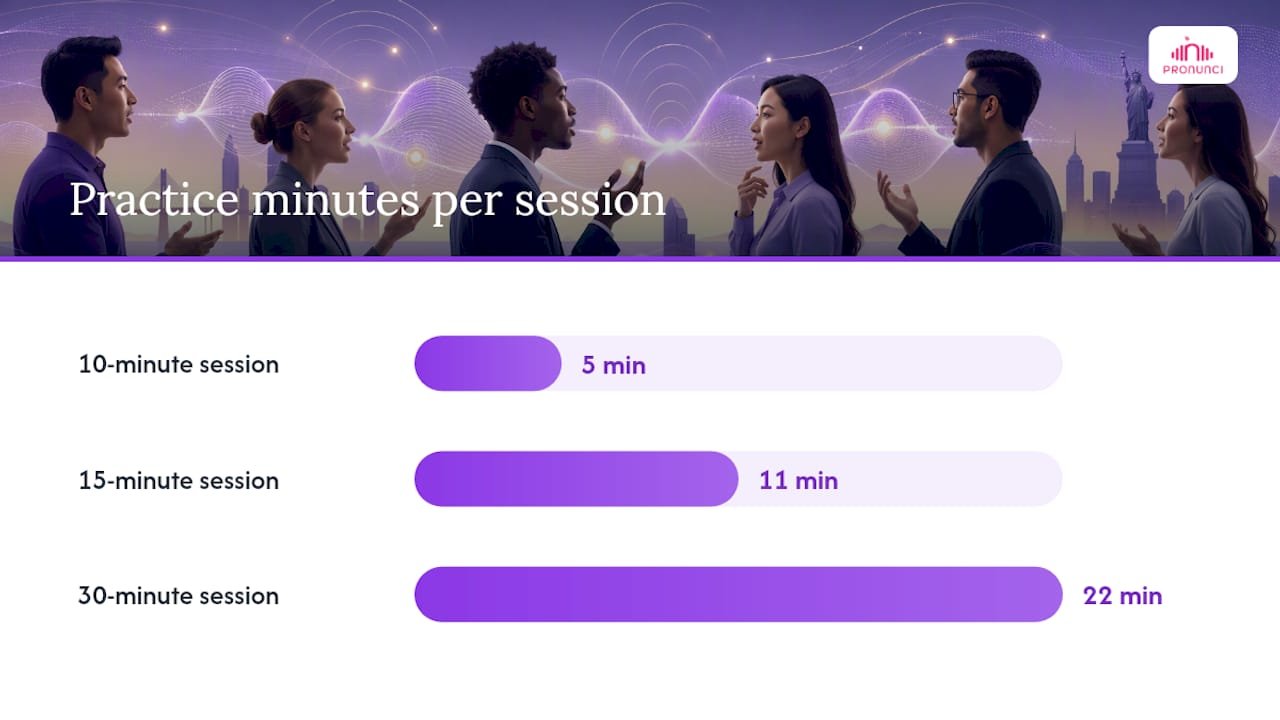
10-minute session:
- Warm-up (2 min): Read three sentences aloud at 80% speed, focusing on linking consonants to vowels. Example: “I’ll look at it after the call.”
- Focused drill (5 min): Pick one process from the table above (e.g., weak forms). Take five workplace sentences and say each twice: once with full forms, once with natural reductions. Record both.
- Review (3 min): Play back your recording. Mark one place where a content word sounded unclear. Repeat that sentence with restored articulation on that word.
15-minute session:
- Warm-up (2 min): Same as above.
- Shadowing (8 min): Choose a 30-second clip of a native American English speaker in a professional context (a TED Talk excerpt, a business podcast). Play it at normal speed once, then shadow it phrase by phrase at 75% speed, then at full speed. Focus on rhythm and thought-group pauses, not individual sounds.
- Phrase drill (3 min): Practice three workplace phrases from the next section using the connected forms.
- Review (2 min): Compare your recording to the original. Note one rhythm difference to fix tomorrow.
30-minute session:
- Warm-up (3 min): Articulation warm-up: five sentences with consonant-to-vowel linking.
- Shadowing (10 min): Full paragraph shadowing at normal speed. Record yourself.
- Scenario drill (12 min): Role-play a meeting opening, a phone call, and a short presentation segment using the phrase pairs below. Record each.
- AI feedback review (5 min): Use AI pronunciation feedback tools to compare your recording against a native model. Note the top two differences.
For articulation work, the Interactive Visual 2D Sound Simulator for the American [t] sound trains exactly where the tongue contacts the alveolar ridge and how airflow releases. Using it for training before practicing phrases with /t/ (like “at the end of” or “let me know”) makes the physical adjustment concrete rather than guesswork. Shadowing and targeted repetition are among the highest-impact methods for retraining oral motor patterns and prosodic timing.
High-frequency professional phrases with connected-speech forms
Practicing whole phrases beats drilling isolated sounds for workplace intelligibility. Your brain stores and retrieves speech in chunks, so training phrase-level patterns transfers directly to real conversations.
| Scenario | Full Form | Connected Form | What Changes |
|---|---|---|---|
| Meeting | “Let us get started.” | “Le’s get started.” | Elision of /t/ in “let us” |
| Meeting | “I want to follow up on that.” | “I wanna follow up on that.” | “want to” → “wanna” (informal) |
| Phone | “Can I speak to Sarah?” | “C’n I speak tuh Sarah?” | Weak “can,” weak “to” |
| Phone | “I will get back to you.” | “I’ll get back tuh you.” | Contraction + weak “to” |
| Presentation | “I would like to walk you through…” | “I’d like tuh walk you through…” | Contraction + weak “to” |
| Presentation | “As you can see on the slide…” | “As y’can see on the slide…” | Weak “you” + weak “can” |
| Small talk | “How are you doing?” | “How’re you doin’?” | Contraction + elision of /g/ |
| Small talk | “What do you think about that?” | “Whadya think about that?” | “what do you” → “whadya” |
| Introduction | “Nice to meet you.” | “Nice tuh meet you.” | Weak “to” |
| Introduction | “I am based out of Chicago.” | “I’m based outta Chicago.” | Contraction + “out of” → “outta” |
| Client call | “Thank you for your time.” | “Thank you f’r your time.” | Weak “for” |
| Client call | “I will send that over to you.” | “I’ll send that over tuh you.” | Contraction + weak “to” |
Recording task: Record yourself saying each connected form three times. On the third take, use it inside a full sentence without stopping to think. Then compare your recording to a native speaker saying the same phrase. Listen specifically for rhythm: does your version have the same number of stressed beats in the same places? Context-sensitive phrase practice like this accelerates workplace transfer compared with abstract pronunciation drills.
Common traps that reduce your clarity and how to fix them fast
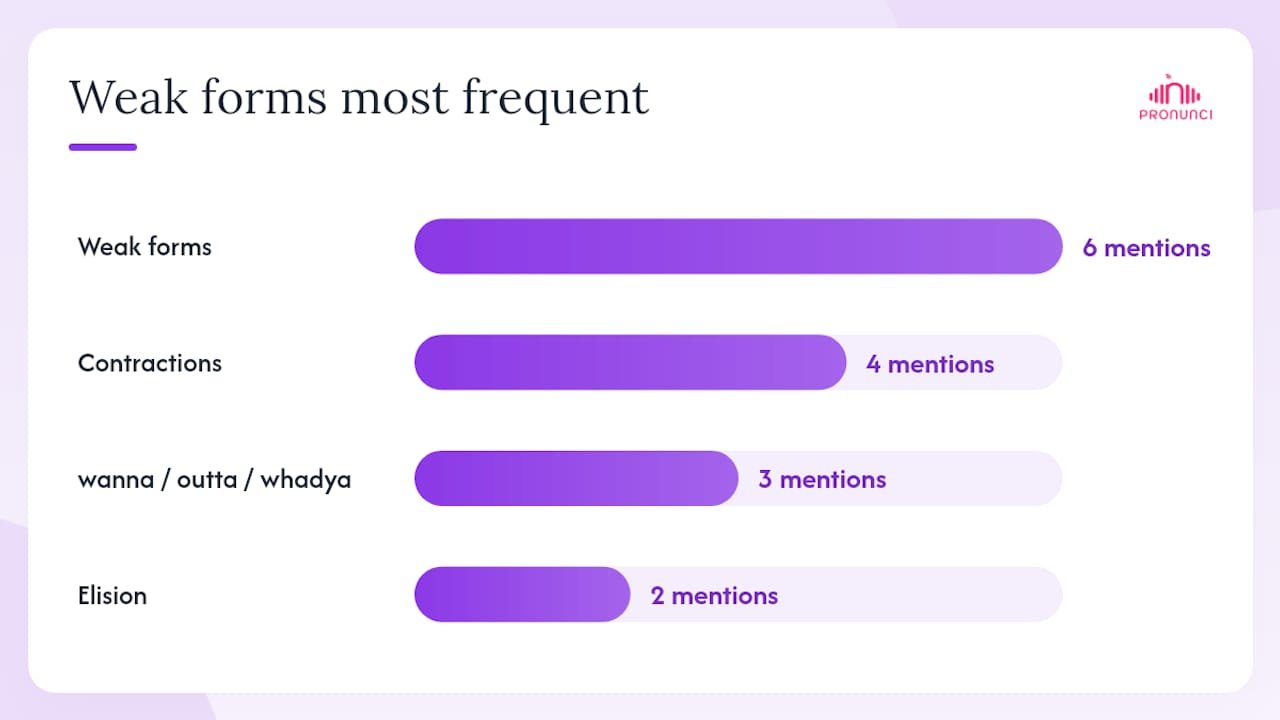
Six errors account for most intelligibility problems advanced ESL professionals face with connected speech:
-
Over-reducing content words. Error: “The budget report” sounds like “thuh buh-juh repor.” Fix: Say the phrase slowly, mark the two content words in bold in your notes, and practice it five times with full stress on “budget” and “report.”
-
Monotone rhythm. Error: Every syllable gets equal stress, removing the natural rise-and-fall that helps listeners predict meaning. Fix: Record one sentence and tap the table on every stressed syllable. If you tap more than three times in a six-word sentence, you are stressing too many syllables.
-
Failing to mark thought-groups. Error: “We need to finish the proposal and send it to the client before Friday” said as one unbroken stream. Fix: Insert a micro-pause after “proposal” and after “client.” Listeners need those gaps to process the logical structure.
-
Confusing “can” and “can’t.” Error: Reducing “can” so heavily it sounds like “can’t,” especially before a consonant. Fix: In formal settings, use the full form “can” with a clear short vowel. Reserve the reduced form for clearly informal contexts.
-
Linking across sentence boundaries. Error: Running the end of one sentence into the start of the next without a pause. Fix: Practice ending each sentence with a slight drop in pitch and a half-beat pause before starting the next.
-
Ignoring weak forms in listening. Error: Mishearing “I should have gone” as “I should of gone” because you do not recognize the weak form of “have.” Fix: Train your ear by listening to the same 10-second clip five times, transcribing what you hear, then checking the transcript.
Pro Tip: Record two minutes of yourself in a real or simulated meeting. Errors in rhythm and thought-group structure become much more obvious at faster playback, and you will catch over-reductions you missed at normal speed.
Realistic timelines, progress checkpoints, and U.S. training costs
Expect to notice a difference in your own comfort and rhythm within a few weeks of daily 15-minute practice. Colleagues and listeners tend to perceive improvement before standardized tests register it, which is a useful signal that your training is working even when scores have not shifted yet.
Progress milestones:
- Weeks 1–4: You recognize the five core processes in native speech and can produce them in isolated phrases. Self-assessment: can you hear the weak form of “to” in a recorded meeting?
- Weeks 5–12: You use moderate reductions consistently in informal team conversations without thinking about it. Peer check: ask a trusted colleague if your speech sounds more natural.
- Months 3–6: You modulate reduction level by context (presentation vs. casual chat) and receive positive feedback in high-stakes settings. Objective check: record a presentation, then have a blind listener rate your clarity on a 1–5 scale.
Measurement works best at three levels: self-assessment (weekly recording review), peer feedback (a trusted colleague or manager), and objective scoring (AI pronunciation feedback or a trained rater). Using all three gives you a fuller picture than any one method alone. For a structured view of accent training milestones and career readiness, InPronunci’s guide maps each stage to professional outcomes.
Typical U.S. training formats and cost shapes:
A subscription app gives you the highest practice frequency per dollar. One-on-one pronunciation coaching accelerates progress when you have a specific deadline (a job interview, a conference presentation) and need targeted feedback fast.
What the research actually shows about workplace intelligibility
Perceived improvement in workplace communication can happen before measured scores change, and that distinction matters for how you set expectations.
A workplace-focused pronunciation instruction case study published in PMC followed one ESL professional through a form-focused pronunciation program. The learner, tutor, and colleagues all reported perceived improvement in intelligibility. Blinded listener ratings, however, showed no statistically significant change. The study points to real measurement limits: listener familiarity, rater variability, and the gap between perceived and standardized-test progress.
Three practical conclusions for professionals and employers:
- Perceived improvement is real and professionally useful. If your team finds you easier to follow, that is a genuine workplace win, even if a standardized score has not moved yet.
- Use multiple measurement methods. Self-report, peer feedback, and objective scoring each capture different dimensions of progress. Relying on one alone gives an incomplete picture.
- Instructional design matters. Form-focused instruction (targeting specific sounds, patterns, and connected-speech processes) produces more transferable gains than general conversation practice alone, especially for professional contexts.
What I have learned training professionals to speak with authority and clarity
Most professionals who come to me for accent training have the same problem: they know their content cold, but their delivery does not match their expertise. The issue is rarely vocabulary or grammar. It is rhythm. They speak in a flat, word-by-word pattern that forces listeners to work harder than they should.
My core coaching principle is this: connected speech is not decoration. It is the delivery system for your ideas. When you link sounds naturally, pause at the right moments, and reduce function words without touching content words, your listener’s brain can predict and process your message with much less effort. That is what makes you sound authoritative, not just fluent.
How I integrate connected speech into professional training:
- Start with thought-group awareness before touching individual sounds. A professional who pauses in the right places is already 60% of the way to sounding clear.
- Use recorded role-plays of real workplace scenarios (meetings, calls, presentations) rather than abstract drills. Scenario-based phrase work transfers to real speech far faster.
- Train articulation with speech-organ support. The Interactive Visual 2D Sound Simulator for the American [t] sound is a good example of how training hidden speech-organ movement accelerates learning. When a professional can learn where the tongue goes and how air releases, they stop guessing and start correcting.
- Pair every connected-speech pattern with a real phrase from the learner’s actual job. “Let me pull up the data” is more useful than “let me go to the store.”
The professionals who improve fastest are the ones who record themselves in real meetings, not just in practice sessions. Real speech under real pressure is where the patterns either hold or break down.
How InPronunci helps professionals master connected speech
Professionals who need measurable clarity gains in American English need more than a pronunciation scoring app. They need a structured training system with expert guidance built in.
InPronunci: Accent Training App is a complete American accent training program designed for goal-oriented learners. Prof. Alex’s guided instructions (called Pronunci Speaks) walk you through exactly what to listen for, how to position your speech organs, and how to compare your recording against a native-speaker model. Every feature maps directly onto the routines in this article:
Cognitive Accent Training
Compare Your Coach vs. Your Pronunci
In every practice sentence, students listen to Your Coach, record their own voice, and compare it with Your Pronunci, so they consciously notice and correct each sound.
![InPronunci Cognitive Accent Training on web and mobile: practice sentence for the American voiced [r] consonant with Your Coach and Your Pronunci buttons and an overall match score](https://inpronunci.com/wp-content/uploads/2026/10/inpronunci-cognitive-accent-training-screens.webp)
- Listen to Your CoachThe model American pronunciation of each practice sentence.
- Compare with Your PronunciYour own recorded pronunciation, side by side with the coach.
- Correct with feedbackThe match score and color-coded letters guide each correction.
- Connected-speech modules cover linking, elision, assimilation, intrusion, and weak forms inside real sentence and paragraph drills.
- Interactive Visual 2D Sound Simulatorstrain full articulation details for sounds like the American [t], so you know precisely what to do before you practice in connected speech.
- My Coach vs. My Pronunci lets you record yourself and compare directly to the native-speaker model, phrase by phrase.
- AI Accent Coach provides pronunciation evaluation at Intermediate and Advanced levels, with View Feedback analysis showing exactly where your rhythm and clarity differ from the target.
- Optional 1-on-1 coaching gives you targeted sessions when you have a high-stakes deadline.
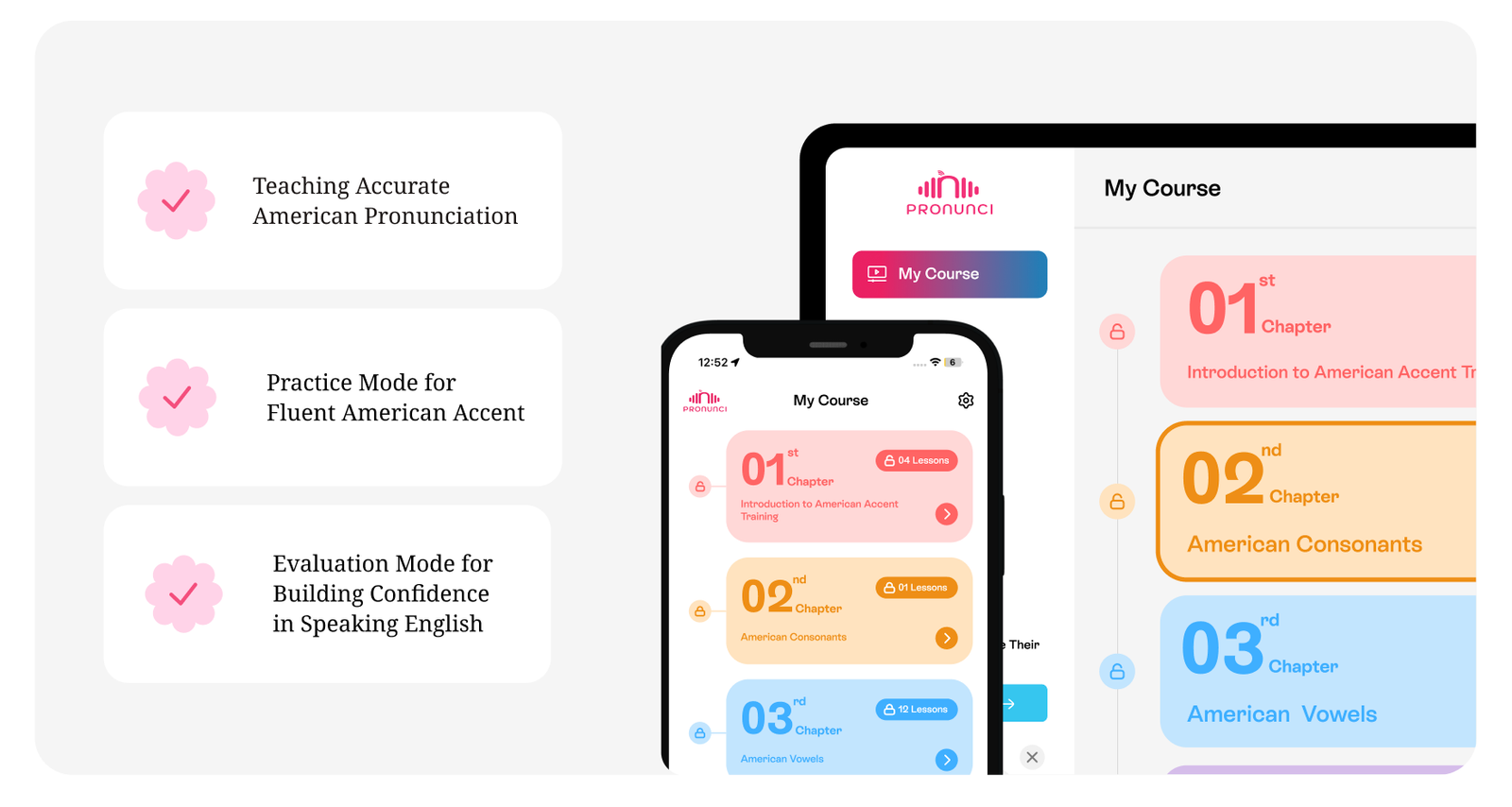
The InPronunci: American Accent Training Course on desktop covers four structured chapters: Speech Organs Education, American Consonants, American Vowels, and American Intonation and Emphasis, including connected speech and public speaking clarity. Start with the free onboarding chapter, then move into the paid program when you are ready for full structured training. Visit InPronunci: Accent Training App to get started today.
Structured American Accent Training Course
From Speech Organs Education to American Intonation
The InPronunci course is built step by step: every chapter prepares the next one, and by the end of the course students receive a certificate.
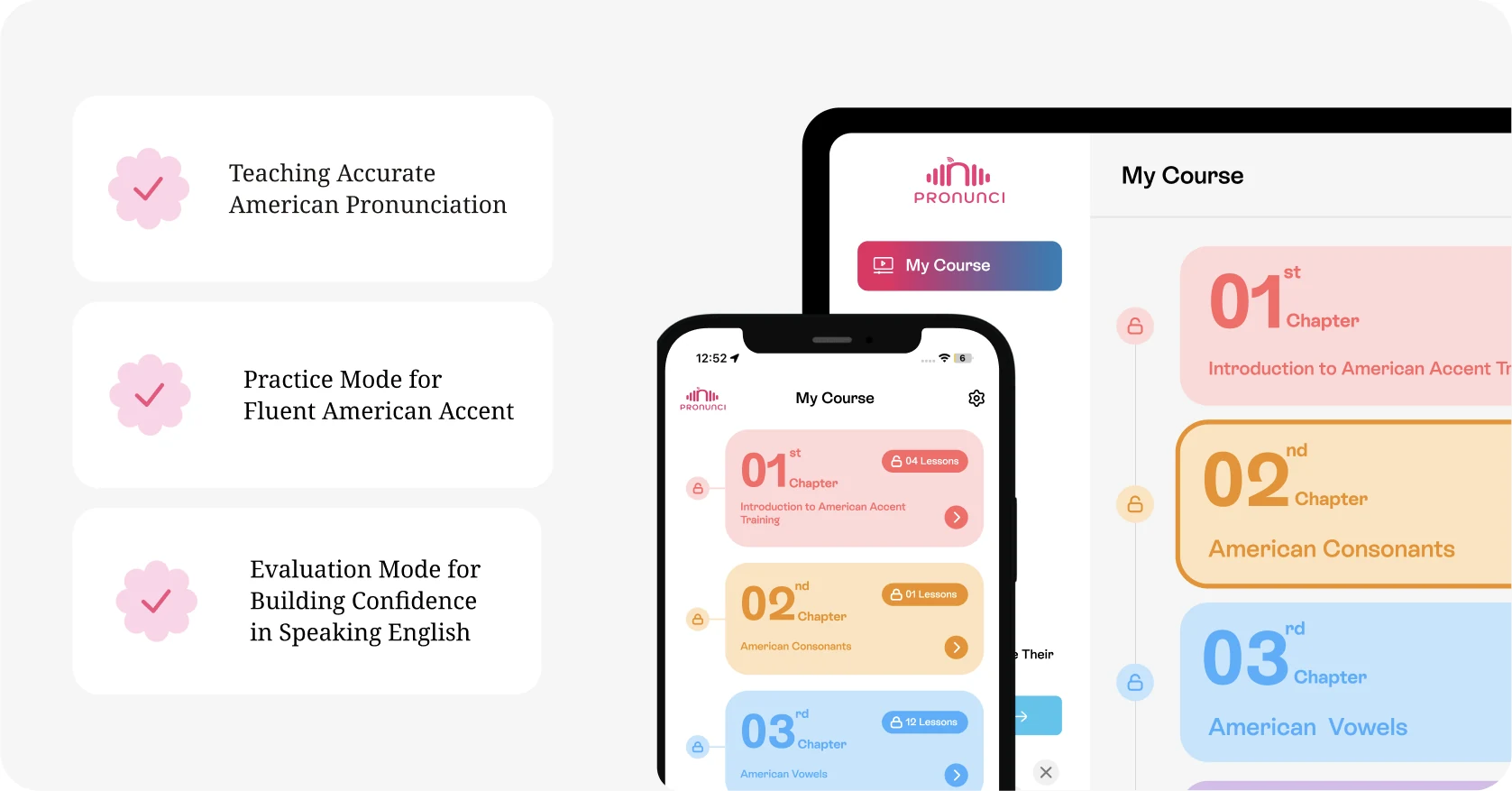
- Speech Organs EducationStudents learn how the speech organs work, along with the AI Accent Coach commands and feedback.
- American ConsonantsPractice and evaluate American consonants in phonetic exercises and practice sentences with the AI Accent Coach.
- American VowelsPractice and evaluate American vowels in phonetic exercises and practice sentences with the AI Accent Coach.
- IntonationLearn how intonation can change the meaning of what you say.
- CertificateBy the end of the course, students receive a certificate.
Sources
- Workplace intelligibility: form-focused pronunciation instruction on ESL spontaneous speech – PMC
- Introduction to Linking & Connected Speech
- Effective communication in the workplace
Questions & Answers
FAQ
01What are the five main aspects of connected speech?
The five main aspects are linking (catenation), intrusion, elision, assimilation, and weak forms (reductions). RMIT University’s taxonomy also includes geminates, where two identical consonants at a word boundary are held as one rather than doubled.
02Can you give examples of connected speech in a professional context?
Yes. “Let us get started” becomes “le’s get started” (elision), “I can do it by Friday” becomes “I c’n do it by Friday” (weak form), and “this year’s targets” becomes “thish year’s targets” (assimilation). These are all normal in professional American English conversation.
03How do you improve connected speech for workplace settings?
Daily shadowing of native-speaker audio, phrase-level recording and comparison, and targeted weak-form drills are the best methods. A structured program like InPronunci: Accent Training App combines guided instruction, 2D articulation simulators, and AI feedback to make improvement measurable and consistent.
04How long does it take to see real improvement?
Most learners notice a difference in their own comfort and rhythm within four to six weeks of daily 15-minute practice. Colleagues often perceive improvement before standardized scores reflect it, as the PMC workplace intelligibility study found.
05Should you use connected speech in a job interview?
Use it lightly. Reduce function words and link naturally within phrases, but keep full articulation on every content word. Deliberate rhythm and clear pausing signal confidence and competence to interviewers more than speed does.
Recommended

InPronunci Accent Training App for Professional Communication
Improve American pronunciation with InPronunci, an accent training app using AI feedback, human guidance, and 2D Sound Motion Technology.
A Strategic Feature Comparison: How InPronunci Differs from Traditional Accent Apps in 2026
Ready for executive clarity? Compare InPronunci with other apps and learn how 2D Sound Motion Technology trains each American sound step by step.

How Do Non-Native Speakers Practice English Intonation and Stress Patterns?
English intonation and stress, step by step: how non-native speakers practice word stress, rhythm and pitch, up to full paragraphs.
InPronunci training structure
How InPronunci trains the American speech system
InPronunci trains the full American speech system: Interactive Visual 2D Sound Simulators and phonetic exercises for articulation and American sound development, sentence practice for intonation, melody, rhythm, and connected speech, paragraph practice for spontaneous speech, public speaking, and real communication confidence, and Advanced AI Accent Coach evaluation as you speak.
InPronunci is an advanced, linguistically structured American accent training platform with more than 1,000 downloads and a growing learner base. It is designed for serious ESL learners who want American pronunciation, stronger intonation, more natural rhythm, better connected speech, and the ability to speak English more confidently in real communication. The program is especially useful for intermediate and advanced English speakers who want to become independent speakers of English with confident communication, stronger speaking control, long-term speech improvement, and great public speaking skills. It is also designed for advanced speakers whose goal is to speak like a native or closer to native-like American speech, including people who were raised in the United States but still have slight accent patterns from the native language they were born with. It is a complete American accent training course and system created by Prof. Alex, Ph.D. Accent Coach, Doctor of Education, and professional linguist based in Austin, Texas, with Pronunci Instructions from Prof. Alex for each lesson that make self-learning more effective, supported, and clear.
Plans
What InPronunci costs
InPronunci Basic
$35 per month
Chapter 1 is free after signup.
InPronunci Premium
$200 per month
Includes a coach:
Why InPronunci is worth the price
- Interactive Visual 2D Sound Simulators, built on 2D Sound Motion Technology developed by Prof. Alex, train your speech organs for each American sound.
- Prof. Alex's guided instructions in every lesson, like working with a real coach.
- The Advanced AI Accent Coach evaluates sounds, intonation, rhythm, stress, and connected speech against native American English speech (100 = native speaker).