


The best tool for non-native professionals who want to sound more American is a structured, hybrid American-accent training program that combines 2D mouth-training simulators, AI real-time feedback, and human-guided lessons. Inpronunci is built exactly on that model. It sequences your training from individual sounds through connected speech and into real professional situations, giving you measurable checkpoints along the way. Start with Free Chapter 1 “Get to Know Your Speech Organs” at no cost and hear the difference within your first week of practice.
Research supports this approach directly. A quasi-experimental study found that AI-based pronunciation tools used inside a structured curriculum produced significant pre/post gains in segmental accuracy (t = 3.88; p < .001) and stronger learner self-monitoring compared to traditional classroom methods. That is not a small effect. It means a well-designed app, used consistently, can move the needle on the specific sounds that make your English harder to understand at work.
What to look for in a tool that will actually make you sound more American at work
Not every accent app is built for professional results. Most are built for casual learners. Here is what separates a tool worth your time from one that will leave you repeating words into a microphone with no real improvement.
- Real-time, objective feedback (ASR/AI scoring). You need a system that tells you immediately whether your /æ/ or your /ɪ/ landed correctly, not a teacher note three days later. ASR-based tools produce meaningful segmental gains and encourage self-assessment, which is exactly the habit professionals need.
- Speech-organ training. Hearing a sound and producing it correctly are two different skills. A tool that shows you tongue position, lip shape, and jaw movement closes that gap faster than audio alone.
- Suprasegmental modules (intonation, rhythm, connected speech). This is where most apps fail professionals. A 14-session program targeting both segmental and prosodic features showed large effect sizes in intelligibility for both scripted and spontaneous speech. Rhythm and intonation are not extras; they are what makes you sound authoritative in a presentation.
- Professional-context content. Practice material should mirror your actual work: meeting openings, interview answers, presentation phrases. Generic sentences do not transfer.
- Structured curriculum with a clear sequence. Random drills do not build fluency. You need a path from sounds to words to sentences to real speech.
- Measurable progress tracking. If you cannot see your scores improve, you cannot stay motivated or know when to move on.
- Human coaching access. AI catches segmental errors well. It misses prosodic nuance. A human coach closes that gap.
Pro Tip: If you are at an intermediate level, prioritize segmental accuracy and speech-organ training feedback first. If you are advanced, shift your focus to intonation, rhythm, and connected speech. The two stages need different tools and different practice intensity.
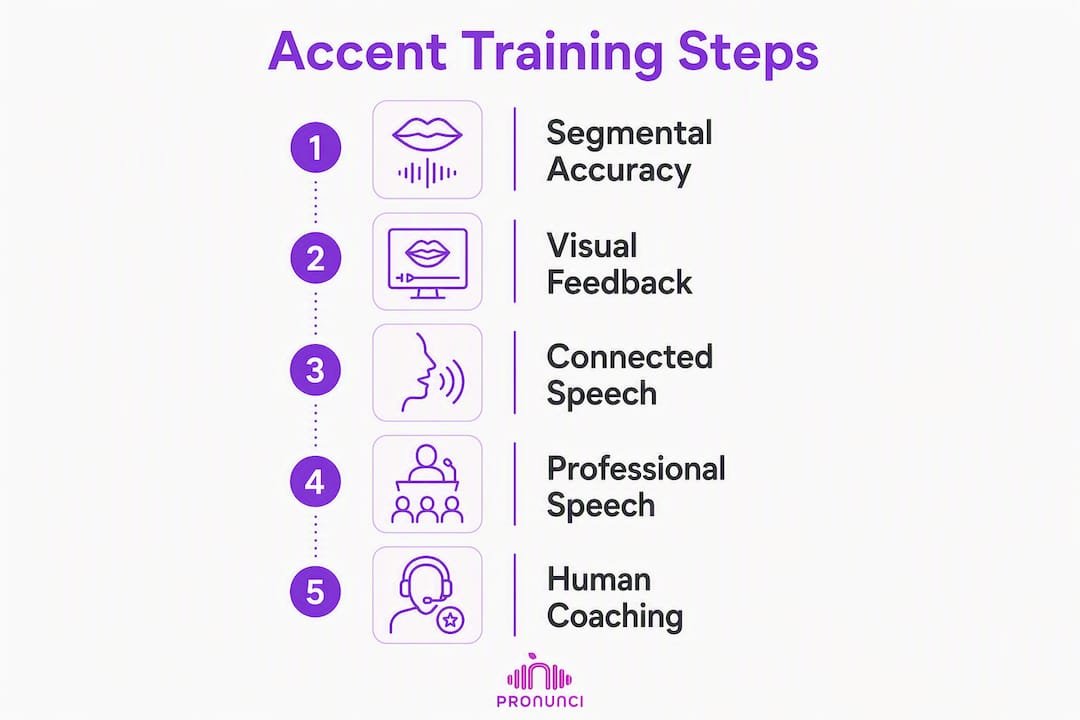
How Inpronunci works: core features that train American pronunciation for professional contexts
Inpronunci’s structured curriculum moves you step by step from individual sounds to connected speech and professional speaking situations. Each feature is mapped to a specific skill.

| Feature | What it trains | Professional application |
|---|---|---|
| Interactive 2D Sound Video Mouth-Training Simulators | Precise tongue, lip, jaw, and airflow placement for American sounds | Accurate vowel and consonant production in meetings and interviews |
| AI Accent Coach (real-time feedback) | Segmental accuracy and self-monitoring as you speak | Immediate error correction during daily drills and practice recordings |
| Suprasegmental modules | Stress, rhythm, intonation, and connected speech | Natural pacing and authority in presentations and client calls |
| Human-guided instructions | Structured practice with coach-like direction | Confidence that you are practicing correctly, not reinforcing errors |
| Native-speaker comparison and unlimited recording | Ear training and self-assessment | Benchmarking your progress against a clear target |
| Progress tracking | Measurable score trends over time | Knowing when you are ready for a higher-stakes speaking situation |
The 2D Sound Motion Technology (SMT)trains how native speakers produce each sound through simulated tongue, lip, and jaw movement. Watch the
InPronunci training structure
How InPronunci trains the American speech system
InPronunci trains the full American speech system: Interactive Visual 2D Sound Simulators and phonetic exercises for articulation and American sound development, sentence practice for intonation, melody, rhythm, and connected speech, paragraph practice for spontaneous speech, public speaking, and real communication confidence, and Advanced AI Accent Coach evaluation as you speak.
InPronunci is an advanced, linguistically structured American accent training platform with more than 1,000 downloads and a growing learner base. It is designed for serious ESL learners who want American pronunciation, stronger intonation, more natural rhythm, better connected speech, and the ability to speak English more confidently in real communication. The program is especially useful for intermediate and advanced English speakers who want to become independent speakers of English with confident communication, stronger speaking control, long-term speech improvement, and great public speaking skills. It is also designed for advanced speakers whose goal is to speak like a native or closer to native-like American speech, including people who were raised in the United States but still have slight accent patterns from the native language they were born with. It is a complete American accent training course and system created by Prof. Alex, Ph.D. Accent Coach, Doctor of Education, and professional linguist based in Austin, Texas, with Pronunci Instructions from Prof. Alex for each lesson that make self-learning more effective, supported, and clear.
to understand why this replaces guesswork with precision.
Plan overview:
- Free Chapter 1 “Get to Know Your Speech Organs” — onboarding access, no cost, teaches speech-organ positioning and sets the foundation for smart practice.
- Basic Plan — self-study guided by the AI Accent Coach and human-guided instructions.
- Premium Plan — everything in Basic, plus monthly 1-on-1 sessions with Prof. Alex, Ph.D. Accent Coach for personalized guidance.
A simple 6–8 week plan to sound more American at work
This plan assumes 15–25 minutes of daily practice. Each week builds on the last.
- Week 1: Baseline and speech-organ foundation. Complete Free Chapter 1. Record yourself reading three professional sentences. Save the recording as your baseline. Note which sounds feel uncertain.
- Week 2: American vowels. Work through the vowel modules using the 2D simulators. Practice /æ/, /ɑ/, /ɪ/, and /iː/ in isolation, then in single words from your industry vocabulary.
- Week 3: Consonants and word stress. Focus on sounds that differ most from your first language. Add word-stress drills. Practice saying your job title, company name, and three common meeting phrases with correct stress.
- Week 4: Sentence rhythm and intonation. Move to sentence-level practice. Record yourself opening a meeting (“Good morning, everyone. Today we’ll cover…”) and compare it to the native-speaker model. Use the AI Accent Coach score as your benchmark.
- Weeks 5–6: Connected speech and fluency. Practice reductions, linking, and thought groups. Use American intonation patterns for professionals as your reference. Simulate a 60-second presentation opening daily.
- Weeks 7–8: Live-role simulations and coach checkpoint. Record a full mock interview answer and a presentation introduction. Compare AI scores to Week 4. Premium members: schedule your 1-on-1 session with Prof. Alex, Ph.D. Accent Coach to review prosodic nuance.
Daily practice checklist:
- 5 minutes: AI Accent Coach drill on the current module
- 5 minutes: recording and native-speaker comparison
- 5–10 minutes: professional micro-task (one meeting phrase, one interview answer, one presentation sentence)
- 2 minutes: log your AI score and note one specific improvement
Track your progress using self-monitoring techniques for professionals to build the habit of noticing your own errors before anyone else does.
Why this approach works: what the research and expert practice show
The evidence for structured, hybrid pronunciation training is consistent across study designs.
AI-based tools used inside a curriculum produce significant segmental gains and build learner autonomy. ASR feedback alone, however, tends to yield smaller suprasegmental improvements. Prosodic features, including intonation, rhythm, and connected speech, require targeted instruction to improve. That is precisely why a hybrid model matters: AI handles the high-frequency segmental drilling; a human coach corrects the prosodic nuances the algorithm misses.
Structured American Accent Training Course
From Speech Organs Education to American Intonation
The InPronunci course is built step by step: every chapter prepares the next one, and by the end of the course students receive a certificate.
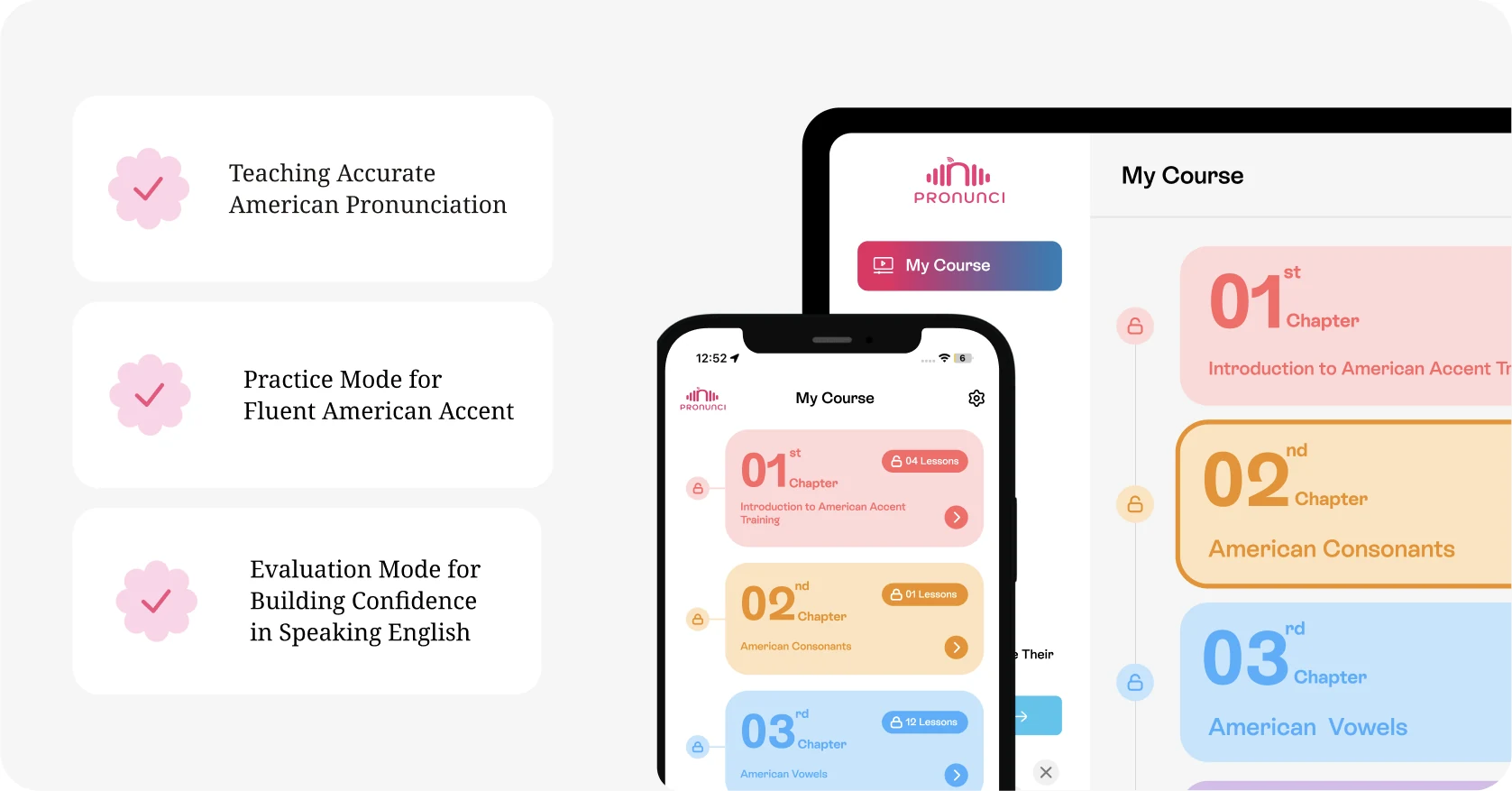
- Speech Organs EducationStudents learn how the speech organs work, along with the AI Accent Coach commands and feedback.
- American ConsonantsPractice and evaluate American consonants in phonetic exercises and practice sentences with the AI Accent Coach.
- American VowelsPractice and evaluate American vowels in phonetic exercises and practice sentences with the AI Accent Coach.
- IntonationLearn how intonation can change the meaning of what you say.
- CertificateBy the end of the course, students receive a certificate.
| Evidence type | Finding | Implication for your training |
|---|---|---|
| AI/ASR in structured curricula | Significant segmental gains; improved self-monitoring | Use AI feedback daily inside a sequenced program, not as a standalone app |
| ASR-only approaches | Larger segmental gains; smaller prosodic gains | Pair AI drills with intonation and rhythm modules |
| Combined segmental + prosodic programs | Large effect sizes in intelligibility for scripted and spontaneous speech | Train both layers; do not skip suprasegmentals |
Practitioners in the field consistently report that intonation, rhythm, and connected speech are underestimated by professionals, yet they are critical for perceived authority and clarity. A technically correct vowel in a flat, monotone sentence still sounds foreign to an American listener.
CNBC reporting on accent coaching also highlights an important ethical dimension: organizations should pair coaching with bias-awareness efforts so that the burden of communication adjustment does not fall entirely on the non-native speaker.
What to expect: timeline, progress metrics, and pricing
Typical milestones:
- Weeks 1–4: Diagnostic clarity. You will identify your highest-priority sounds and begin correcting them. AI scores on individual sounds typically show measurable movement within the first four weeks of daily practice.
- Weeks 6–12: Workplace clarity. Most learners notice clearer feedback from colleagues, fewer requests to repeat themselves, and more confidence in meetings and presentations.
- Beyond 12 weeks: Fluency and automaticity. Connected speech, intonation, and spontaneous speech begin to feel natural rather than monitored.
How progress is measured:
- AI Accent Coach score trends across recorded sessions
- Recording-based intelligibility checks compared to your Week 1 baseline
- Self-monitoring logs noting error frequency per session
- Coach assessments at Premium checkpoints (prosody, connected speech, professional fluency)
Structured assessment frameworks, such as the Compton Phonological Assessment of Foreign Accent, give practitioners a credible way to demonstrate measurable client gains over time.
Pricing:
- Free Chapter 1 — no cost; available at sign-up and on App Store and Google Play
- Basic Plan — self-study with AI Accent Coach and human-guided instructions
- Premium Plan — includes monthly 1-on-1 sessions with Prof. Alex, Ph.D. Accent Coach; book a free Premium session to experience it before committing
The case for ethical, structured accent training
Most professionals who come to accent training have already tried the “repeat after me” approach. They have watched videos, mimicked native speakers, and still felt uncertain the moment a high-stakes meeting started. The problem is not effort. It is method.
What the research shows clearly is that unstructured repetition does not retrain your sound system. Your brain needs to understand how a sound is produced, not just what it sounds like. That is why speech-organ training feedback, structured sequencing, and corrective coaching are not optional extras. They are the mechanism of change.
There is also a broader point worth making. Accent training, done well, is about communication equity. It gives non-native speakers the tools to be heard as clearly as they think. It is not about erasing an identity. The goal is clarity and confidence, not conformity. Organizations that invest in structured pronunciation training for their teams should pair it with bias-awareness work, so the responsibility for clear communication is shared, not placed entirely on the non-native speaker.
If you are ready to train with a method that is grounded in phonology and built for professional results, Free Chapter 1 is the right place to start.
Inpronunci: structured American accent training built for professionals
Inpronunci gives you a concrete alternative to generic language apps and one-off coaching sessions. The program is designed specifically for intermediate and advanced learners who need measurable results in professional settings, not casual vocabulary builders.
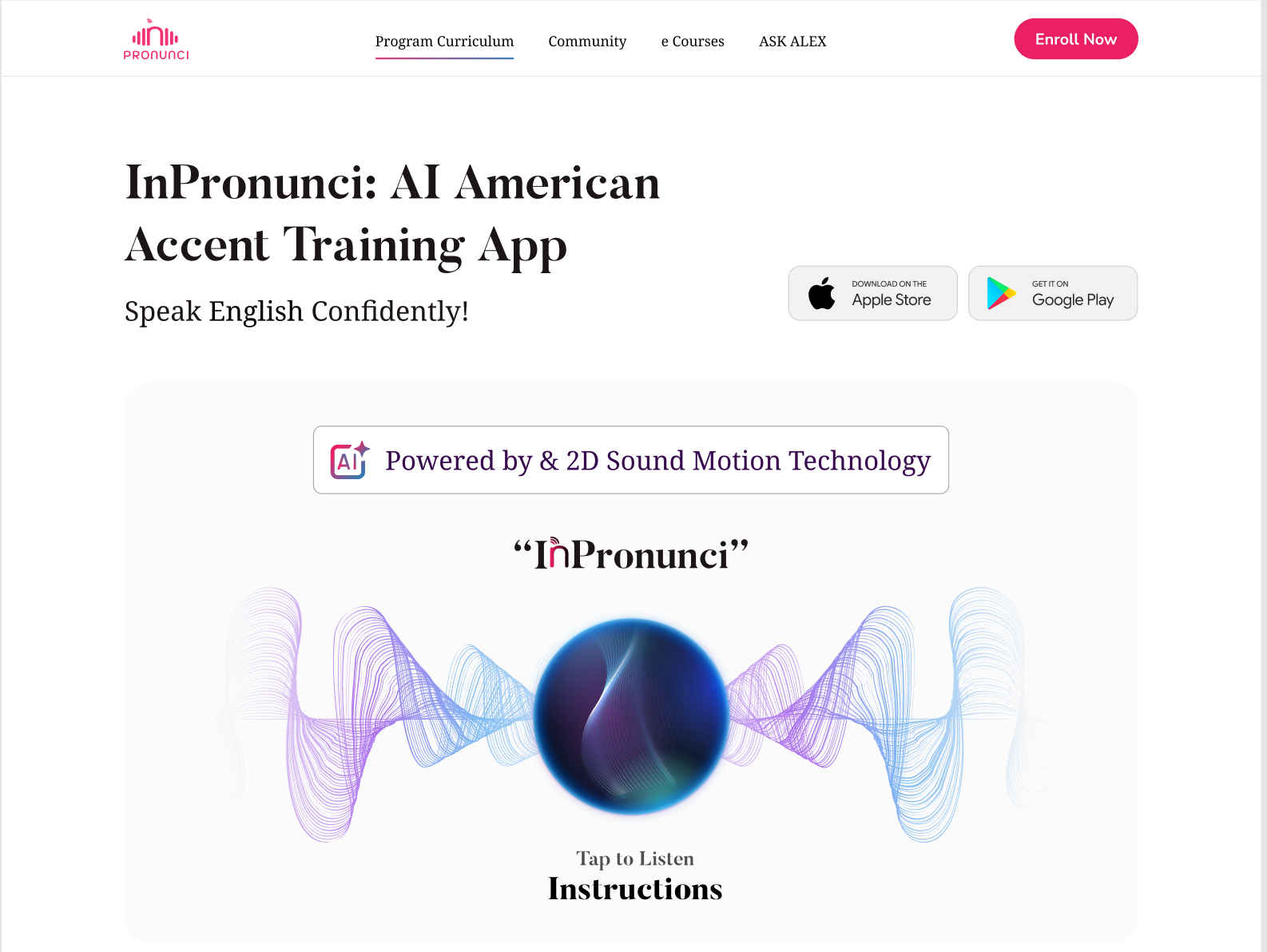
Three features set it apart. The Interactive Visual 2D Sound Simulators train you to position your speech organs for each American sound. The AI Accent Coach gives you real-time feedback as you speak, so every practice session is corrective, not just repetitive. Human-guided instructions walk you through each module the way a real coach would, so you always know you are on the right path.
The step-by-step program covers everything from individual sounds to presentations and interviews. Start with Free Chapter 1 at no cost, continue with the self-study Basic Plan, or get monthly 1-on-1 guidance under the Premium Plan with Prof. Alex, Ph.D. Accent Coach Sign up now, or book your free Premium session to experience personalized coaching before you commit.
Questions & Answers
FAQ
01What are the best tools for sounding more American professionally?
The best tools combine AI real-time pronunciation feedback, 2D mouth-training simulators, and structured curricula that cover both individual sounds and prosodic features like intonation and rhythm. Inpronunci integrates all three in a single program built for professional contexts.
02How long does it take to sound noticeably more American at work?
Most learners see measurable segmental gains within the first weeks of daily practice, with clearer workplace results, such as fewer requests to repeat themselves, appearing with continued practice.
03Does AI pronunciation feedback alone produce professional-level results?
AI feedback produces strong segmental gains and builds self-monitoring habits, but research shows that prosodic improvements, covering intonation, rhythm, and connected speech, are smaller without targeted instruction. A hybrid approach that adds human coaching closes that gap.
04Is accent training ethical for non-native professionals?
Yes, when framed as communication empowerment rather than identity erasure. Expert commentary recommends pairing accent coaching with organizational bias-awareness efforts so the responsibility for clear communication is shared.
05Can I try Inpronunci before paying for a plan?
Yes. Free Chapter 1 “Get to Know Your Speech Organs” is available at no cost through sign-up and on the App Store and Google Play. You can also book a free Premium session with Prof. Alex, Ph.D. Accent Coach before choosing a paid plan.
Sources and further reading
Empirical studies cited:
- The Effectiveness of Speechace Application in Enhancing EFL Learners’ Speaking Skills | LingPoet
- Evaluating the Effectiveness of Speech-to-Text Technology in Improving Pronunciation among ESL Learners | DSSR
- University clinic-based accent management program targeting segmental and prosodic aspects
- The Growing Demand for Accent Coaching: Insights from Research and Implications for P-ESL Practitioners | Institute of Language & Phonology
- Accent reduction: Racist or empowering? | CNBC
Inpronunci resources:
- Inpronunci Curriculum: a strategic path to American accent fluency
- How to Use AI Pronunciation Feedback for Professional Clarity
- Speech-Organ Training Feedback: Why Your Ears Are Lying to You About Your Accent
- Mastering American Vowels: A Practical Guide to Clear Pronunciation
- Student result: Andrew | Thiago | Tian
Recommended

American Intonation Patterns for Professionals | Inpronunci
Master American intonation patterns for professionals to enhance your communication skills. Improve perception and authority in your speech.

Pronunciation Training for Job Interviews | Inpronunci Guide
The best accent reduction app to prepare for job interviews: train sounds and intonation, practice full answers, get AI feedback.

InPronunci: The Revolutionary American Accent Training App for Real Speech Transformation
Master the American accent for your career with the InPronunci App. Our 2026 guide shows how visual tech & AI feedback build executive vocal presence.
Plans
What InPronunci costs
InPronunci Basic
$35 per month
Chapter 1 is free after signup.
InPronunci Premium
$200 per month
Includes a coach: