


English articulation exercises train the tongue, lips, jaw, and airflow to produce accurate American vowel and consonant sounds, building the foundation non-native speakers need before rhythm and intonation can sound natural. They work by isolating a sound, repeating its correct speech-organ position until it becomes automatic, then moving that sound into words, sentences, and conversation. The seven exercises below follow this progression, from tongue-twister style drills to full-sentence practice, so you can target the sounds that most affect how clearly Americans understand you.
Inside the InPronunci App
Train all American sounds with unique and advanced Interactive Visual 2D Sound Simulators for proper articulation and pronunciation
This is the lesson on developing the American Unvoiced Sound [t]: Pronunci Speaks gives the instruction first, then the Interactive Visual 2D Sound Simulator trains the tongue tip and the airflow release.
- EffectiveMost apps offer visual learning. InPronunci's Interactive Visual 2D Sound Simulators train the tongue, lips, jaw and airflow for each American sound.
- ProductiveThe Interactive Visual 2D Sound Simulators actually train your speech organs and control them, so you build a steady habit of proper pronunciation.
- ResultsStudents pronounce individual American sounds with almost native-like pronunciation.
1. Mirror-Based Tongue and Lip Positioning Drills
A mirror lets you compare your lip shape and jaw opening against a known correct model while you form a sound, catching errors you cannot otherwise feel. This is particularly relevant for English articulation exercises.
Adult learners have weak proprioceptive awareness, the sense of where the tongue and lips sit inside the mouth, because childhood sound habits became automatic decades ago. A mirror forces conscious correction by giving visual proof when a movement is off, which is why it belongs near the start of any set of English articulation exercises for a true beginner.
This drill works best for someone who has never been taught where to place the tongue for sounds like TH or the American R. A simple example: watch the lips round and push forward for the vowel in “boot,” then spread wide and flat for “beat.” The contrast is visible and easy to self-check.
The limitation is that a mirror only shows external movement. Tongue placement against the teeth ridge or the soft palate happens out of sight, so mirror work needs to be paired with a reference model of the internal mouth position, not just the visible lip shape, which is a step most beginner guides skip entirely.
2. Minimal Pair Drills for Vowel Contrasts
Minimal pairs like ship/sheep or bit/beat isolate a single vowel feature so the ear and mouth learn to tell two close American sounds apart.
The mechanism is simple: by holding every other sound in the word constant and changing only the vowel, the exercise trains tongue height, tongue tension, or length as the one variable the learner has to control. Full/fool contrasts jaw opening and lip rounding. Bet/bat contrasts tongue height, with the jaw dropping lower for “bat.” Cup/cop contrasts tongue position and lip rounding, since “cop” pulls the tongue back and rounds the lips slightly more than “cup.”
What’s the difference between the American vowels in ‘bit’ and ‘beat’?
“Bit” uses a shorter, more relaxed vowel with the tongue slightly lower and more centered, while “beat” stretches the tongue higher and more forward, with noticeably more muscle tension and lip spreading. Speakers whose native language does not make this length and tension distinction often produce both words with the same vowel. When considering English articulation exercises, this point stands out.
This drill serves Spanish, Portuguese, Japanese, and other speakers whose native vowel inventories have fewer contrasts than American English, since English distinguishes close vowel pairs that these languages treat as a single sound. The detail most pages miss is sequencing: a Spanish speaker’s priority pairs (bit/beat, full/fool) differ from a Japanese speaker’s (bit/beat, cup/cop), because the interference pattern depends on the learner’s first language, not a fixed list. Lee, Jang, and Plonsky’s 2015 meta-analysis found that explicit pronunciation instruction produces measurable gains in L2 sound development compared to unstructured exposure [1], which supports targeted minimal pair sequencing over generic drills.
3. Consonant Cluster Breakdown Exercises
Breaking a difficult consonant into its sub-movements before blending it into full words lowers the coordination demand on the tongue, lips, and airflow at once.
The American R is a clear case: train the tongue-bunching position alone first, then add voicing, then add the surrounding vowels. Trying to coordinate all three at once is why many learners can say the sound in isolation but lose it in a word.
How do you train the American R sound if your native language doesn’t have it?
Start with the tongue pulled back and the sides bunched toward the upper molars, without touching the roof of the mouth, then add voice, then attach a vowel like “ar” or “or.” Speakers whose native language uses a tapped or trilled R, common among Spanish, Japanese, and Mandarin speakers, need this staged approach because their tongue habit is built for a completely different movement.
What exercises help non-native speakers master the TH sounds?
Place the tongue tip lightly between the upper and lower teeth and push air out steadily for the voiceless TH in “think,” then add vocal cord vibration for the voiced TH in “this.” Mandarin, Russian, French, and German speakers commonly substitute /t/, /d/, /s/, or /z/ for these sounds because their languages lack an interdental consonant entirely. For those exploring English articulation exercises, this matters.
This level of drill suits intermediate speakers who can already hear the difference between the target sound and their substitution but cannot yet produce it consistently. The flap T (the quick tongue tap in “water” or “better”) and the dark L (the back-of-tongue L in “milk” or “full”) are two more patterns that need this same isolated sub-movement treatment, rather than the generic “practice your R and TH” advice found on most articulation pages. Sequencing practice by the specific substitution pattern tied to the learner’s native language, rather than treating all learners the same, is what separates structured English articulation exercises from a general tongue-twister list.
4. Phonetic Repetition Sequences for Automaticity
Structured repetition moves a sound from conscious effort to automatic use by practicing it across widening contexts, not by repeating the same word over and over.
Automaticity develops when a sound is drilled alone, then in a syllable, then in a full word, then in a short phrase. This differs from tongue-twister practice, which repeats a sound in one fixed context and does little to prepare the learner for how that sound behaves elsewhere in connected speech.
How many repetitions does it take to make an articulation exercise automatic?
There is no fixed number, but a practical routine is ten repetitions of the isolated sound, ten in a syllable, ten in a word, and ten in a short phrase, increasing complexity at each stage rather than staying at one level. This structure suits learners who can produce a sound correctly on its own but lose it the moment they speak at normal speed, since the breakdown happens when sounds meet each other in real sentences.
The differentiator here is building repetitions around sound combinations, reductions, and assimilations, how sounds actually change next to each other in fast speech, instead of isolated word lists that never prepare a learner for connected speech. Thomson and Derwing’s 2015 review found that explicit, structured pronunciation practice produces more reliable gains than unstructured listening or exposure alone [2], which is the rationale for this staged repetition model over free-form repeating.

5. Airflow and Voicing Control Exercises
These drills train the timing of vocal cord vibration so a learner can reliably produce voiced sounds like /b/ or /z/ versus voiceless sounds like /p/ or /s/. This directly impacts English articulation exercises outcomes.
Voiced consonants require the vocal cords to vibrate during the sound, while voiceless consonants require a brief delay before voicing starts. Many learners substitute one for the other because their native language times voicing differently, producing “Sue” when they mean “zoo” or softening a final /d/ into something closer to /t/.
A concrete test makes the difference tangible: hold a hand lightly against the throat and say “zoo,” feeling the vibration, then say “Sue” and notice it stops. This exercise is especially useful for Arabic speakers working on the /p/-/b/ contrast, which Arabic does not distinguish the same way, and for German or Russian speakers working on final consonant devoicing, where a final /d/ or /z/ tends to lose its voicing entirely.
The piece most generic articulation pages skip is the connection to connected speech: weak airflow control is why voiced sounds disappear or shift at word boundaries in fast conversation, not just in careful, isolated pronunciation. Linking breath and voicing control to real sentence flow, rather than stopping at the isolated consonant, is what turns airflow drills into practical English articulation exercises instead of a static speech lab test.

6. Sentence-Level Articulation Carryover Drills
Sentence-level carryover drills take a sound you can already produce correctly in isolation and train it inside full sentences at natural speaking speed. This is the step where many English articulation exercises fail learners: they stop at the word level, before the sound has to survive contact with stress and rhythm.
How do you apply individual sound training to natural speech and presentations?
A sound produced correctly in a single word often breaks down once it sits inside a sentence, because stress and rhythm pull attention away from precise articulation. The mouth reverts to old habits under the cognitive load of planning a full utterance. Carryover drills address this directly by combining both tasks at once instead of training them separately.
A concrete example: practice the flap T in “water” and “better” as isolated words, then move to a full sentence like “I need a bottle of water” at conversational speed, keeping the flap T consistent while also hitting the right stressed syllables. This drill type suits advanced speakers preparing for interviews, presentations, or client calls who already have their individual sounds under control and need them to hold up under pressure.
The differentiator here is the focus on sentence stress and emphasis alongside articulation. Correct sounds delivered with flat or misplaced stress still sound non-native, even when every consonant and vowel is accurate. Readers who want the next layer of this work, beyond single sentences, can look at our guide to connected speech for how sounds link, reduce, and blend across whole phrases. This is particularly relevant for English articulation exercises.
7. Guided Feedback and Self-Comparison Practice
Guided feedback and self-comparison practice means recording your own speech and comparing it directly against a native-speaker model to find specific articulation gaps instead of guessing at progress.
What does detailed articulation feedback look like beyond a simple pronunciation score?
Learners often cannot hear their own errors, because their perception is tuned to the sound system of their native language. A side-by-side comparison with a model recording trains the ear as well as the mouth, making errors audible that would otherwise go unnoticed. This matters for self-motivated learners training without a live coach, who still need a reliable way to catch mistakes.
The differentiator is depth: feedback that breaks a recording down to the sound level inside specific words and sentences, not just an overall pronunciation score. A number alone cannot tell a learner which sound in which word needs adjustment, and that gap is where many scoring-app reviews stop short.
How do you track which sounds are improving and which still need work?
InPronunci structures this kind of self-comparison through the Your Coach vs. My Pronunci Pronunciation Comparison Tool, where students record a sentence, compare it against the native-speaker model, and consciously adjust what they hear. The AI Accent Coach adds full-speech feedback on pronunciation, intonation, melody, rhythm, and connected speech as students speak, rather than evaluating a single word in isolation. Feedback & Analysis then breaks a paragraph into sentences, sentences into words, and words into sounds, so a learner knows exactly which sound in which sentence to revisit.
Cognitive Accent Training
Compare Your Coach vs. Your Pronunci
In every practice sentence, students listen to Your Coach, record their own voice, and compare it with Your Pronunci, so they consciously notice and correct each sound.
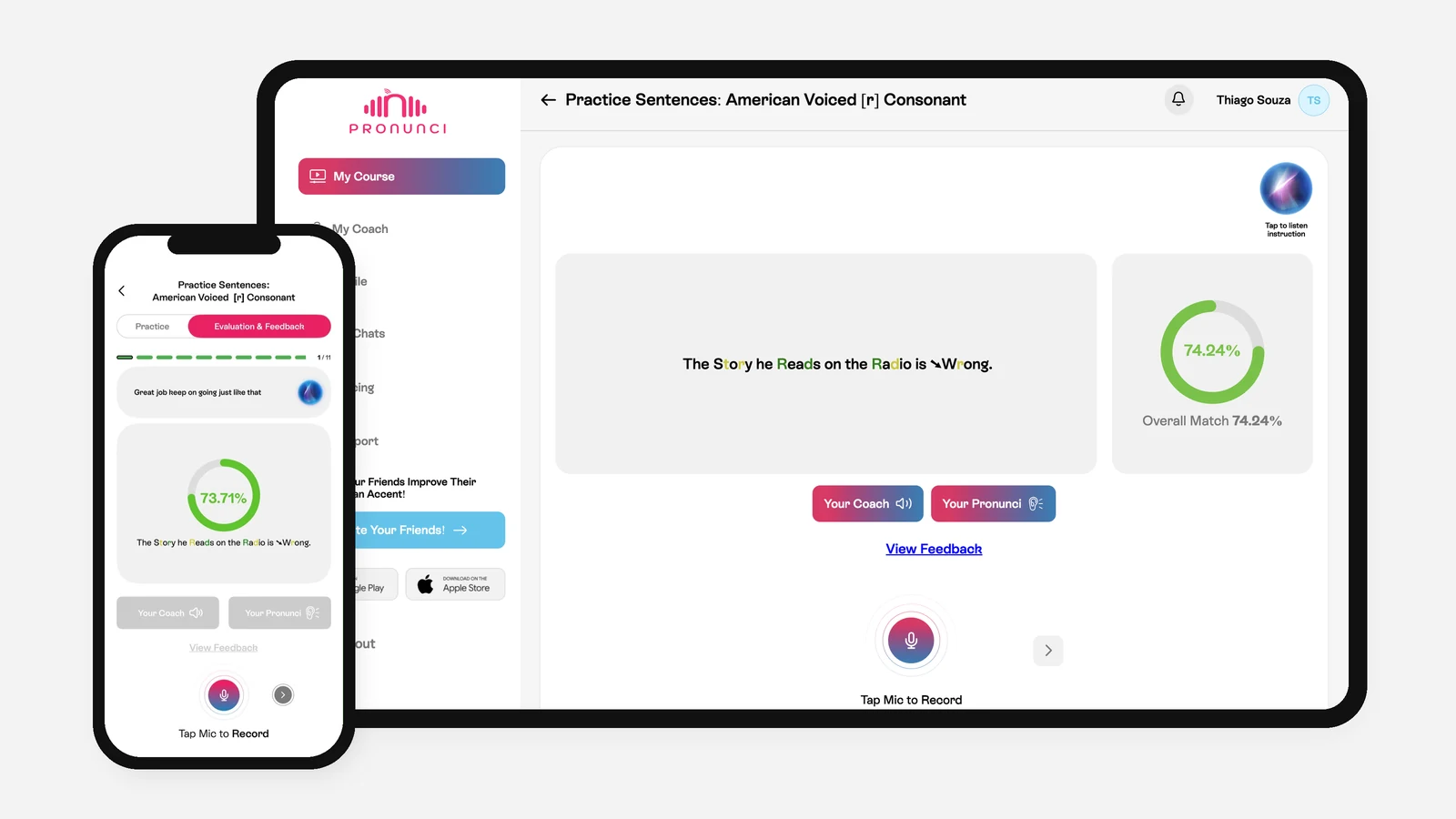
- Listen to Your CoachThe model American pronunciation of each practice sentence.
- Compare with Your PronunciYour own recorded pronunciation, side by side with the coach.
- Correct with feedbackThe match score and color-coded letters guide each correction.
How to Choose the Right Articulation Exercises for Your Accent Goals
Choose exercises based on your current level: mirror and minimal pair work for beginners, consonant clusters and repetition drills at intermediate level, and sentence-level carryover plus feedback tools once sounds are already under control. When considering English articulation exercises, this point stands out.
What comes after sound articulation training in a structured accent program?
Isolated sound exercises plateau on their own. Without phonetic exercises to build automaticity, and without sentence practice for stress and intonation, correctly produced sounds rarely transfer into real speech under the pressure of a conversation or presentation. This is why English articulation exercises work best as a sequence, not a pick-and-choose list.
Structured American Accent Training Course
From Speech Organs Education to American Intonation
The InPronunci course is built step by step: every chapter prepares the next one, and by the end of the course students receive a certificate.
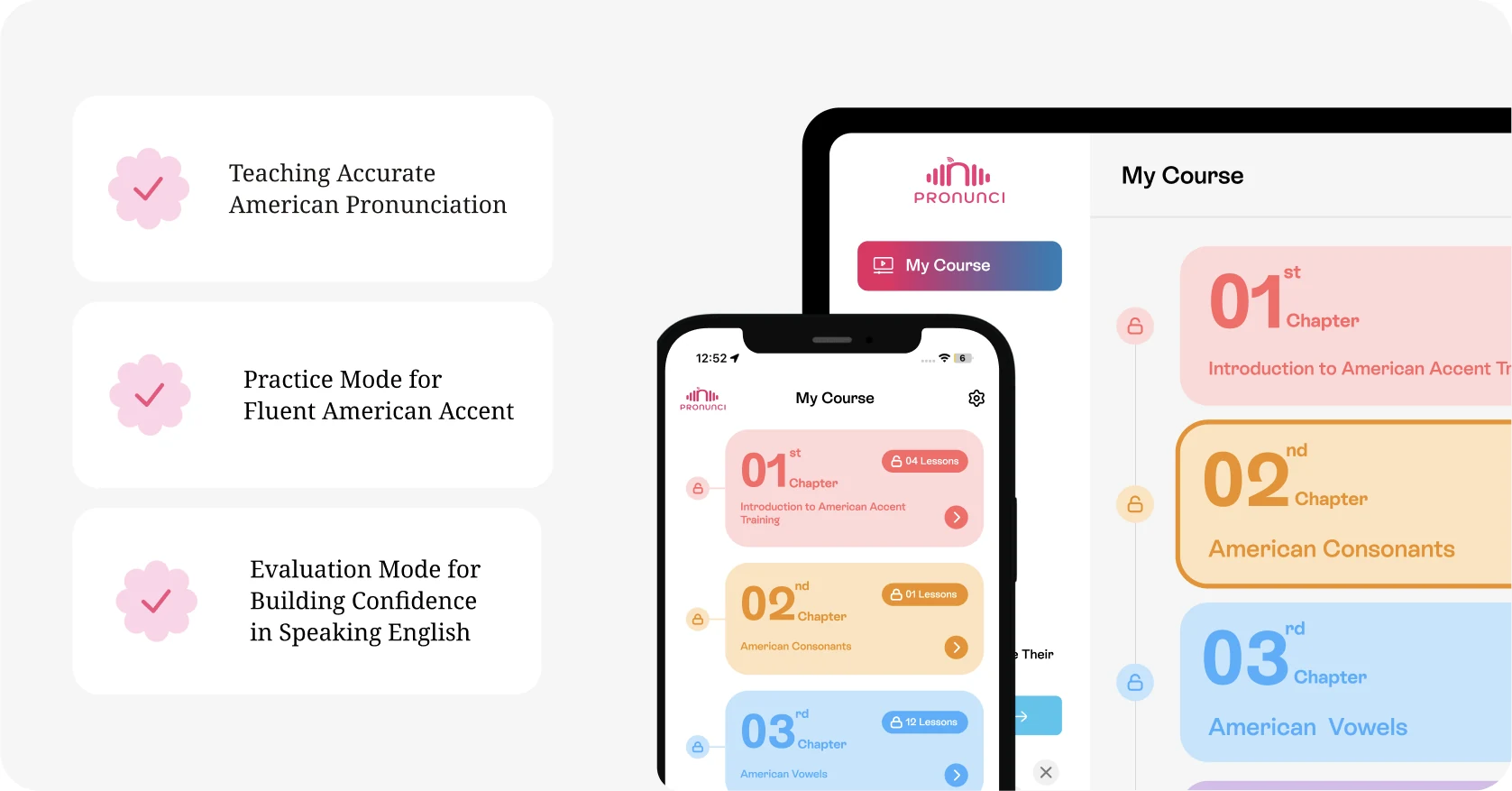
- Speech Organs EducationStudents learn how the speech organs work, along with the AI Accent Coach commands and feedback.
- American ConsonantsPractice and evaluate American consonants in phonetic exercises and practice sentences with the AI Accent Coach.
- American VowelsPractice and evaluate American vowels in phonetic exercises and practice sentences with the AI Accent Coach.
- IntonationLearn how intonation can change the meaning of what you say.
- CertificateBy the end of the course, students receive a certificate.
Native-language background shapes where to spend extra time. Hindi and Tamil speakers often need extra flap T and word-stress work. Mandarin speakers often need focused practice on final consonants and the TH sounds. Spanish speakers often need work on vowel-length contrasts, such as the difference between “ship” and “sheep.” These are common tendencies, not fixed rules for every speaker of a language.
InPronunci organizes this progression into four connected stages: sound articulation with the Interactive Visual 2D Sound Simulators and Pronunci Instructions, phonetic exercises that make sounds automatic, sentence practice with intonation, and paragraph practice with presentation-style delivery. Following this structure means not having to assemble English articulation exercises from scattered sources and guess at sequencing.
New students can start with Free Chapter 1, which covers speech-organ foundations at no cost. From there, the Basic Plan gives self-guided access to all four stages for learners ready to work independently. Readers comparing structured options can see the full system on our American accent training course overview or start directly from the InPronunci homepage.

Questions & Answers
Frequently Asked Questions
01How are articulation exercises different from vocal warm-ups or general enunciation drills?
Articulation exercises for non-native speakers target specific speech-organ positions for sounds that don’t exist in the learner’s first language, not general clarity. A warm-up loosens the jaw and voice before speaking; sound-specific training rebuilds how the tongue, lips, and airflow produce an unfamiliar vowel or consonant, like the American R or the TH sounds, until the new position becomes automatic.
02Why do non-native English speakers struggle with American consonants and vowels?
Speakers map new English sounds onto the closest sound in their native language, so the ear and mouth default to familiar patterns instead of accurate ones. Hindi speakers often merge /v/ and /w/, Spanish speakers may not distinguish short and long vowels like “ship” and “sheep,” and Japanese speakers often insert extra vowels after consonants. These are first-language tendencies, not errors, and they respond to targeted practice.
03Why focus on individual sound training before moving to words and sentences?
A sound produced incorrectly in isolation stays incorrect in every word and sentence built on it, so fixing the root articulation first prevents repeating the same mistake at scale. This is why InPronunci’s four training stages start with sound articulation before phonetic exercises, sentence intonation, and paragraph delivery, each stage depends on the one before it. For those exploring English articulation exercises, this matters.
04How does airflow and voice control affect articulation of different sounds?
Airflow determines whether a sound is voiced or voiceless, and controlling it precisely separates pairs like /f/ and /v/ or /s/ and /z/. Voiced sounds require the vocal cords to vibrate while air passes through; voiceless sounds use airflow alone. Weak airflow control is a common reason consonants sound unclear even when tongue and lip position are correct.
05How do you practice vowel sounds that don’t exist in your first language?
Practice the exact jaw height, tongue position, and lip shape for that vowel in isolation before using it in words, since the ear can’t fully correct what it has never been trained to produce accurately. Comparing your own recording against a native-speaker model, sound by sound, helps you notice the gap and adjust consciously rather than guessing. This is the principle behind InPronunci’s Your Coach vs. My Pronunci comparison tool.
Conclusion
Clear American articulation starts with the speech organs, not with repeating words faster or louder. Train the tongue, lips, jaw, and airflow for one sound at a time, confirm the position is accurate before building it into phonetic patterns, and only then move to sentences and paragraphs where stress and intonation take over. Skipping the sound stage is why many learners plateau despite years of speaking English daily.
Start with Free Chapter 1 of InPronunci’s Speech Organs Education on the App Store, Google Play, or the web, and train your first American sound with the Interactive Visual 2D Sound Simulators today.
Sources & References
- What Should I Look For in a Structured American Accent Training…
- What is American Accent Training? – Accent Advisor
Recommended Articles

What Interactive Pronunciation Teaching Is and Why It Works
Interactive pronunciation teaching works better than static apps because it trains the speech organs directly and evaluates full speech as you talk, not just...

How an AI Pronunciation Trainer Gives Instant Feedback
An AI pronunciation trainer gives instant feedback by listening to your full spoken sentence or paragraph, not just a single word, and scoring pronunciation...

Why Adults Can Still Learn a Native-Like American Accent
How to reduce a foreign accent as an adult: train each sound consciously, then words, sentences and intonation, with regular feedback.
Plans
What InPronunci costs
InPronunci Basic
$35 per month
Chapter 1 is free after signup.
InPronunci Premium
$200 per month
Includes a coach: