


Short answer
A Nigerian accent in English comes from Nigerian English and from first languages such as Yoruba, Igbo and Hausa. Nigerian English uses fewer vowel contrasts than American English, so pairs like ship / sheep and cut / cart can sound the same. TH often becomes T or D, unstressed vowels stay full instead of becoming a schwa, and the R after vowels is usually not pronounced. Nigerian English is also syllable-timed. The fix is to train the American vowels, TH, the American R and the schwa one at a time, then use them in sentences with American stress and rhythm.
Which American accent app helps Nigerian speakers?
Choose an app that trains the sounds Nigerian English does not have, one at a time, and then trains American word stress, rhythm and intonation. InPronunci: Accent Training is a structured American accent course created by Prof. Alex, Ph.D. Accent Coach, Doctor of Education, and professional linguist. Interactive Visual 2D Sound Simulators train your tongue, lips, jaw, airflow and voice for each sound, Pronunci Speaks gives instructions before every exercise, and the AI Accent Coach gives feedback on your sounds, words and sentences. Chapter 1 is free after signup.
Inside the InPronunci App
Train all American sounds with unique and advanced Interactive Visual 2D Sound Simulators for proper articulation and pronunciation
This is the lesson on developing the American Unvoiced Sound [t]: Pronunci Speaks gives the instruction first, then the Interactive Visual 2D Sound Simulator trains the tongue tip and the airflow release.
- EffectiveMost apps offer visual learning. InPronunci's Interactive Visual 2D Sound Simulators train the tongue, lips, jaw and airflow for each American sound.
- ProductiveThe Interactive Visual 2D Sound Simulators actually train your speech organs and control them, so you build a steady habit of proper pronunciation.
- ResultsStudents pronounce individual American sounds with almost native-like pronunciation.
Why Nigerian speakers have an accent in English
Every language trains the tongue, lips, jaw and airflow in its own way. Adults who learned Nigerian English and languages such as Yoruba, Igbo and Hausa first have strong, automatic habits for those sounds. English is an official language in Nigeria, so most Nigerian professionals speak English fluently. The accent comes from Nigerian English and from languages such as Yoruba, Igbo and Hausa: fewer vowel contrasts, TH pronounced as T or D, full vowels in unstressed syllables, and a syllable-timed rhythm. Nigerian English is also non-rhotic, so the American R after vowels is often missing. This is normal, and it is trainable. The goal is not to erase your identity but to speak clear, natural American English that listeners understand easily.
Structured American Accent Training Course
From Speech Organs Education to American Intonation
The InPronunci course is built step by step: every chapter prepares the next one, and by the end of the course students receive a certificate.
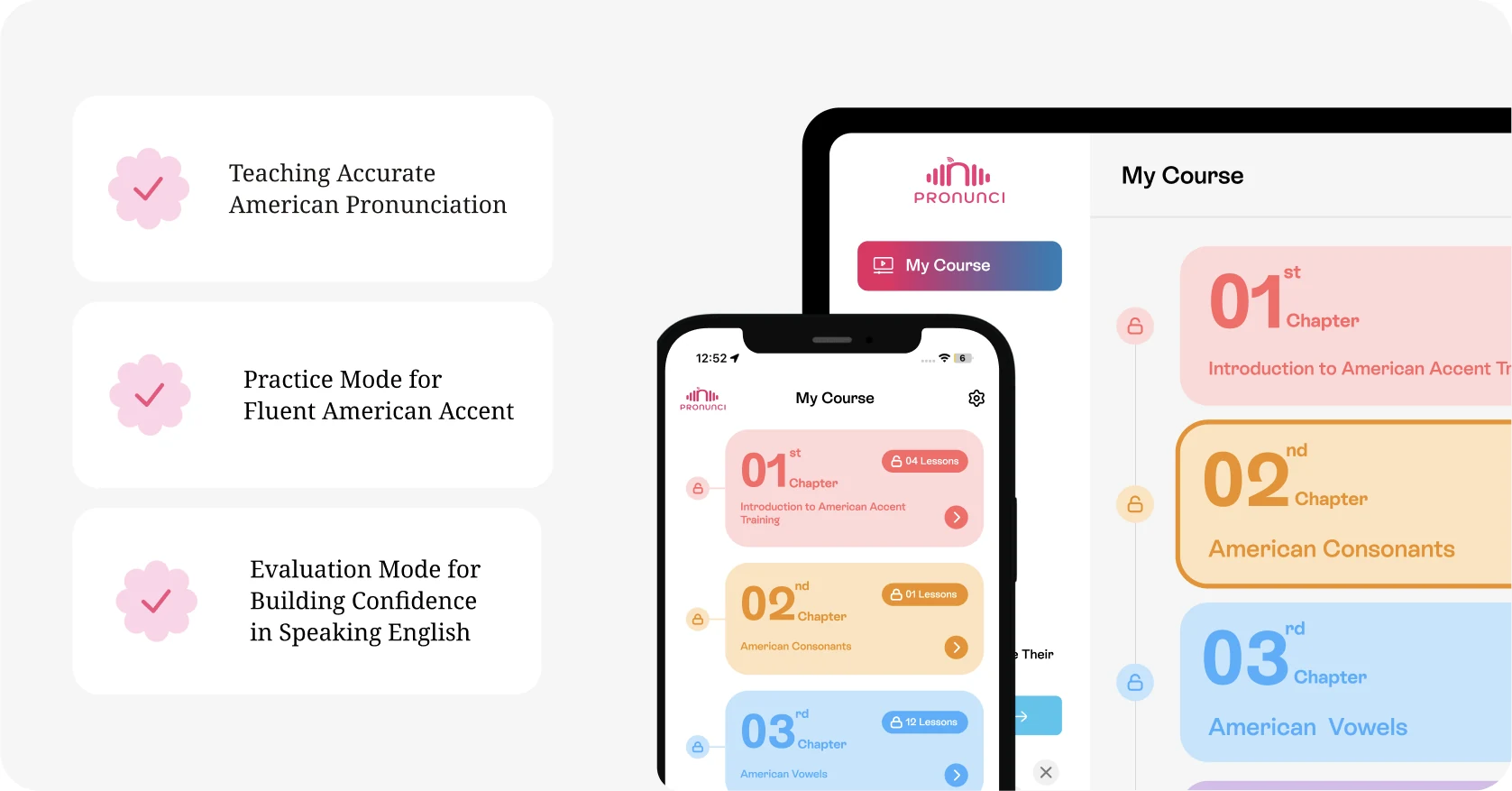
- Speech Organs EducationStudents learn how the speech organs work, along with the AI Accent Coach commands and feedback.
- American ConsonantsPractice and evaluate American consonants in phonetic exercises and practice sentences with the AI Accent Coach.
- American VowelsPractice and evaluate American vowels in phonetic exercises and practice sentences with the AI Accent Coach.
- IntonationLearn how intonation can change the meaning of what you say.
- CertificateBy the end of the course, students receive a certificate.
Nigerian accent in English: the 8 most common pronunciation problems
1. TH sounds [θ] and [ð]
“Think” often becomes “tink” and “this” becomes “dis”. For TH, the tongue tip touches the edge of the top teeth and the air flows out over the tongue.
Practice: think / tink, three / tree, they / day
2. Short and long vowels
Pairs like ship / sheep and full / fool often sound the same.
Practice: ship / sheep, full / fool, live / leave
3. The vowels in cat, cut and cart
In Nigerian English, these vowels are often pronounced the same. American English keeps them separate: [æ] in “cat”, [ʌ] in “cut”, and [ɑr] in “cart”.
Practice: cat / cut / cart, bad / bud, hat / hut
4. The schwa [ə]
Nigerian English often pronounces every vowel fully. In American English, most unstressed vowels become a short, relaxed schwa: “banana”, “problem”, “the”.
5. The American R
Nigerian English is non-rhotic: the R after a vowel is not pronounced, so “car” sounds like “cah”. In American English, the R is pronounced in every position. The tongue tip does not touch anything, it pulls back and up.
Practice: car, work, better, first
6. V and F, P and F
Yoruba has no V sound, so some speakers say F for V. Some Hausa speakers mix P and F.
Practice: very / ferry, van / fan, fine / pine
7. Word stress
Nigerian English often stresses a different syllable than American English. Stress placement changes how easily American listeners understand a word.
8. Rhythm
Nigerian English is syllable-timed: each syllable gets about the same length. American English is stress-timed, with long stressed syllables and short reduced ones.
The 3 most challenging sounds in a Nigerian accent in English, and how InPronunci trains them
These three areas affect fluency and American-accent clarity the most in a Nigerian accent in English, so InPronunci trains them step by step.
1. American vowels and the schwa
Why it matters: Vowels carry most of the sound of a word. When ship / sheep, full / fool or cat / cut sound the same, and unstressed vowels are not reduced, speech sounds less American and is harder to follow.
How InPronunci trains it: The Interactive Visual 2D Sound Simulators for each American vowel train the jaw opening, the tongue height and the lip shape. Students then train the schwa [ə] in unstressed syllables, and the AI Accent Coach gives feedback on each vowel in words and sentences.
2. The American R
Why it matters: The R appears in thousands of common words, and in American English it is pronounced in every position: red, car, work, better.
How InPronunci trains it: The Interactive Visual 2D Sound Simulator for the American [r] trains the tongue to pull back and up without touching anything, with the lips slightly rounded. Students train it at the start, in the middle and at the end of words, then in sentences.
3. Rhythm, stress and intonation
Why it matters: Rhythm affects fluency more than any single sound. Syllable-by-syllable speech sounds slow and choppy to American listeners, even when every sound is correct.
How InPronunci trains it: After the sounds, InPronunci trains American word stress, sentence stress, reductions, linking and intonation in sentences and paragraphs recorded by Prof. Alex. Students record themselves in My Coach vs My Pronunci and compare their rhythm with the model.
Cognitive Accent Training
Compare Your Coach vs. Your Pronunci
In every practice sentence, students listen to Your Coach, record their own voice, and compare it with Your Pronunci, so they consciously notice and correct each sound.
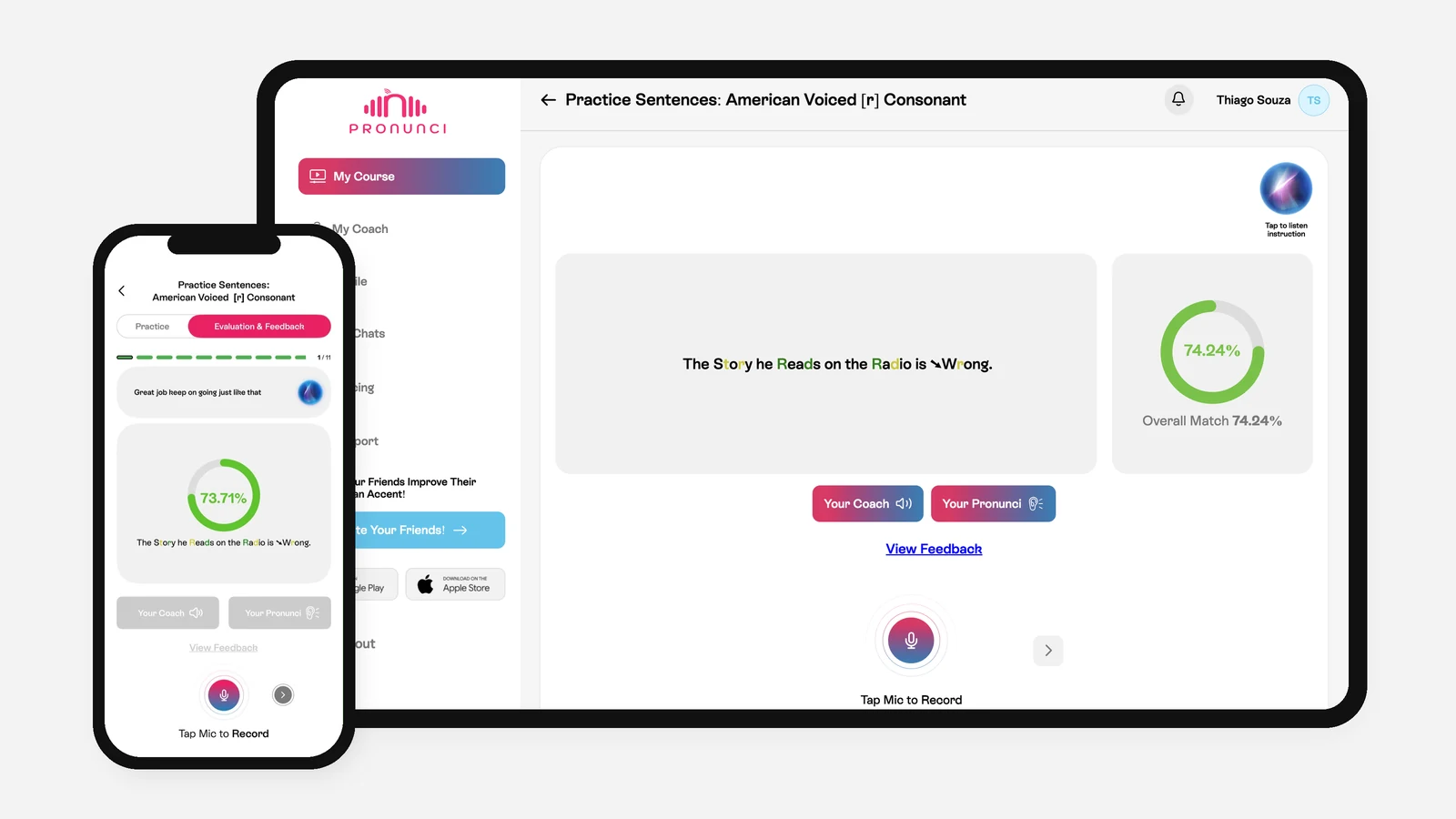
- Listen to Your CoachThe model American pronunciation of each practice sentence.
- Compare with Your PronunciYour own recorded pronunciation, side by side with the coach.
- Correct with feedbackThe match score and color-coded letters guide each correction.
InPronunci Method: Prof. Alex’s Interactive Accent Training Path to Fluency
The InPronunci Method is Prof. Alex’s structured interactive American accent training program inside InPronunci, the linguistically structured American Accent Training App he developed. It follows his sound-by-sound path to fluency: every American sound in the course goes through the same steps, from sound development with the Interactive Visual 2D Sound Simulators to phonetic exercises, practice sentences and paragraph practice, including American intonation, emphasis, melody and rhythm.
Students develop and train each sound first, and the evaluation comes after. InPronunci places the student in a student-centered, active role at every step. Because every sound follows the same path, students always know what to practice next, from the first sound to fluent, natural speech.
Develop Each American Sound Before Your Speech Practice
Start with 2D Sound Development to understand how the sound is produced.
At this stage, the student doesn’t just get information.
The student develops the sound with the Interactive Visual 2D Sound Simulators, which train the tongue, lips and jaw to produce it.
This is interactive learning: InPronunci places the student in a student-centered, active role.
Scoring first and then giving information is that traditional approach in digital form.
Practice the Sound in Phonetic Exercises
Use phonetic exercises to build steady sound control.
In Practice mode, the student trains the sound and sound combinations with phonetic exercises, guided by Pronunci Instructions at every step.
At this stage, InPronunci uses the shadowing technique: the student speaks along with the model, so the sound becomes natural in the student’s own speech and fluent pronunciation develops.
Evaluate Each Sound Before Full Sentences
One sound at a time, learners record the target American sound and receive AI Accent Coach feedback before moving into full sentence practice.
After Practice mode is done, Evaluation mode opens. The AI Accent Coach evaluates the student’s pronunciation of the sound at the phoneme level, to help the student retain the sound system.
The sound is its main task, but it also evaluates intonation, rhythm, melody and word stress, so students receive an accurate score, not just a game-style result.
Beyond the score, the AI Accent Coach and Pronunci Instructions work together to support the student all the way, explaining what went wrong and how to fix it.
Then InPronunci places the student in cognitive accent training: the student listens to My Coach vs My Pronunci and compares the two speech samples. This helps the student start applying critical thinking and improve their speech.
Practice the Sound, Intonation and Melody in Sentences
Practice the sound and American Intonation inside real sentence structure.
Training continues with practice sentences.
In Practice mode, InPronunci puts the student back in the shadowing technique, now at the sentence level.
This builds the student’s sound pronunciation, intonation, melody and rhythm together, the way they work in real speech.
Evaluate Your Intonation & Connected Speech
Now the AI Accent Coach listens to the full sentence — not just the sound
InPronunci then puts the student in Evaluation mode for the practice sentences, to evaluate their progress. The AI Accent Coach’s main task is the sound of the session. It also evaluates intonation, rhythm, melody and word stress, so students receive an accurate score, not just a game-style result.
The feedback breaks each sentence into words, and each word into sounds and complex sound combinations. The AI Accent Coach highlights all the mistakes in the sentences on one page. For every sound that needs work, Pronunci provides the Interactive Visual 2D Sound Simulator to train it again.
Then InPronunci places the student in cognitive accent training again: the student listens to My Coach vs My Pronunci for each sentence and compares the two speech samples, applying critical thinking to improve their speech.
Practice Your Speech in Paragraphs
Train longer speech, storytelling, and connected speech.
After practice sentences, the student moves on to more serious work: paragraph practice. InPronunci puts the student into the shadowing technique again.
At this stage, the student practices the sounds they learned and the intonation they developed in sentence practice, and starts building public speaking skills.
After the paragraph practice, students review their paragraph evaluation word by word and sound by sound, then move to the next sound and follow the same path again. That is the core of the method: sound-by-sound training.
This path follows the same connected training stages Prof. Alex uses in his 1-on-1 Interactive American Accent Training.
Alain's before and after: a Nigerian English speaker
1-on-1 training result

AlainNigerian English
speaker
Rhythm was the biggest change: from syllable-by-syllable delivery toward stress-timed American rhythm. Linking and connected speech moved from 46 to 68.
Full evaluation of Alain on MyAccentWay
8monthsof hard work and dedication
Listen to the starting point0:00
Listen to the result0:00
Alain, a Nigerian English speaker, moved from 57 to 72 out of 100 (100 = native speaker) after 8 months of 1-on-1 Interactive American Accent Training with Prof. Alex. The biggest changes were in rhythm, linking and connected speech (46 to 68) and reductions (45 to 66), the same areas this guide describes for Nigerian English speakers. This is a result we see with a student, not a research study. Read the full evaluation of Alain on MyAccentWay.
Real student result: Abishek before and after
Premium Plan result

“In my opinion, InPronunci is the best app for American accent training because it works exactly like Prof. Alex conducts his classes. It gives clear guidance, structured practice, and focused pronunciation training.”
Full evaluation of Abishek on MyAccentWay
9monthsof hard work and dedication
Listen to the starting point0:00
Listen to the result0:00
Abishek, a data science engineer, moved from 62 to 84 out of 100 (100 = native speaker) in 9 months with InPronunci Premium: 1-on-1 coaching with Prof. Alex and daily practice in InPronunci. Abishek's first language is Tamil, not Nigerian English, but the method is the same for every speaker: train each American sound, then stress, rhythm and intonation. This is a result we see with a student, not a research study.
Practice words to reduce a Nigerian accent in English
| Sound | Practice words |
|---|---|
| TH sounds [θ] and [ð] | think / tink, three / tree, they / day |
| Short and long vowels | ship / sheep, full / fool, live / leave |
| The vowels in cat, cut and cart | cat / cut / cart, bad / bud, hat / hut |
| The American R | car, work, better, first |
| V and F, P and F | very / ferry, van / fan, fine / pine |
Say each pair slowly first, then in a short sentence, then at normal speed.
How to reduce a Nigerian accent in English: a practice plan
- Learn how the speech organs work. Know where the tongue, lips and jaw go for each American sound.
- Train one sound at a time. Start with the sounds in this guide that affect understanding most.
- Use minimal pairs. Pairs like ship / sheep train your ear and your speech organs at the same time.
- Move into sentences. A sound is not trained until you can say it inside real speech.
- Train rhythm and intonation. Stress the important words, reduce the small words and link words together.
- Get feedback. It is hard to hear your own accent. Recording yourself and getting sound-by-sound feedback shows what to fix next.
American accent training for Nigerian speakers: InPronunci
InPronunci is an American accent training app created by Prof. Alex. Prof. Alex has more than 20 years of teaching experience and teaches adult ESOL at Austin Community College. InPronunci places the student in a student-centered, active role, and it trains the sounds of a Nigerian accent in English step by step:
- Interactive Visual 2D Sound Simulators train the speech organs for each sound: the tongue for TH and the American R, the lips for V and W, the jaw for each vowel.
- Pronunci Speaks instructions from Prof. Alex before every exercise.
- Phonetic exercises with minimal pairs, then sentences and paragraphs with American stress, intonation and connected speech.
- My Coach vs My Pronunci: listen to Prof. Alex's model, record yourself and compare.
- AI Accent Coach feedback word by word and sound by sound, with scores where 100 = native speaker.
The course has four chapters: Speech Organs Education (free), American Consonants, American Vowels and American Intonation. InPronunci Premium adds 1-on-1 live American accent training sessions with Prof. Alex.
Nigerian speakers around the world
Nigerian speakers who use English at work live in Nigeria, the United States, the United Kingdom, Canada, Ireland and the UAE. Many work in healthcare, nursing, IT, finance, engineering, law and international business, where clear American English matters in meetings, presentations, job interviews and calls with American clients. InPronunci works online in every country, on the web and in the App Store and Google Play, so speakers with a Nigerian accent in English can train the same American sounds wherever they live.
Questions & Answers
FAQ
01Why do Nigerian speakers have an accent in English?
English is an official language in Nigeria, so most Nigerian professionals speak English fluently. The accent comes from Nigerian English and from languages such as Yoruba, Igbo and Hausa: fewer vowel contrasts, TH pronounced as T or D, full vowels in unstressed syllables, and a syllable-timed rhythm. Nigerian English is also non-rhotic, so the American R after vowels is often missing. The speech organs replace missing English sounds with the closest sounds they already know.
02How can I reduce my Nigerian accent in English?
Train the sounds your first language does not have one at a time, practice them in minimal pairs and sentences, and then train American rhythm and intonation. Feedback on each sound shows what to fix next.
03Do Nigerians need accent training if they already speak English?
Many Nigerian professionals speak English fluently. Accent training is about the sound system: American vowels, the R, the schwa and stress-timed rhythm, so that American listeners understand them easily at work.
04Can I use InPronunci outside the United States?
Yes. InPronunci works online in every country, on the web and in the App Store and Google Play. Chapter 1 is free after signup.
Plans
What InPronunci costs
InPronunci Basic
$35 per month
Chapter 1 is free after signup.
InPronunci Premium
$200 per month
Includes a coach: