


Interactive pronunciation teaching works better than static apps because it trains the speech organs directly and evaluates full speech as you talk, not just isolated words against a stored score. Traditional pronunciation apps compare a recording to a reference clip and output a number, but they don’t show the learner what to change physically or assess rhythm, intonation, and connected speech together. Research on explicit pronunciation instruction, including Saito (2012) and Thomson & Derwing (2015), shows that structured, feedback-driven training produces measurable gains in intelligibility that passive listening or scoring alone does not.

How Does Interactive Pronunciation Teaching Differ From Traditional or App-Based Scoring Methods?
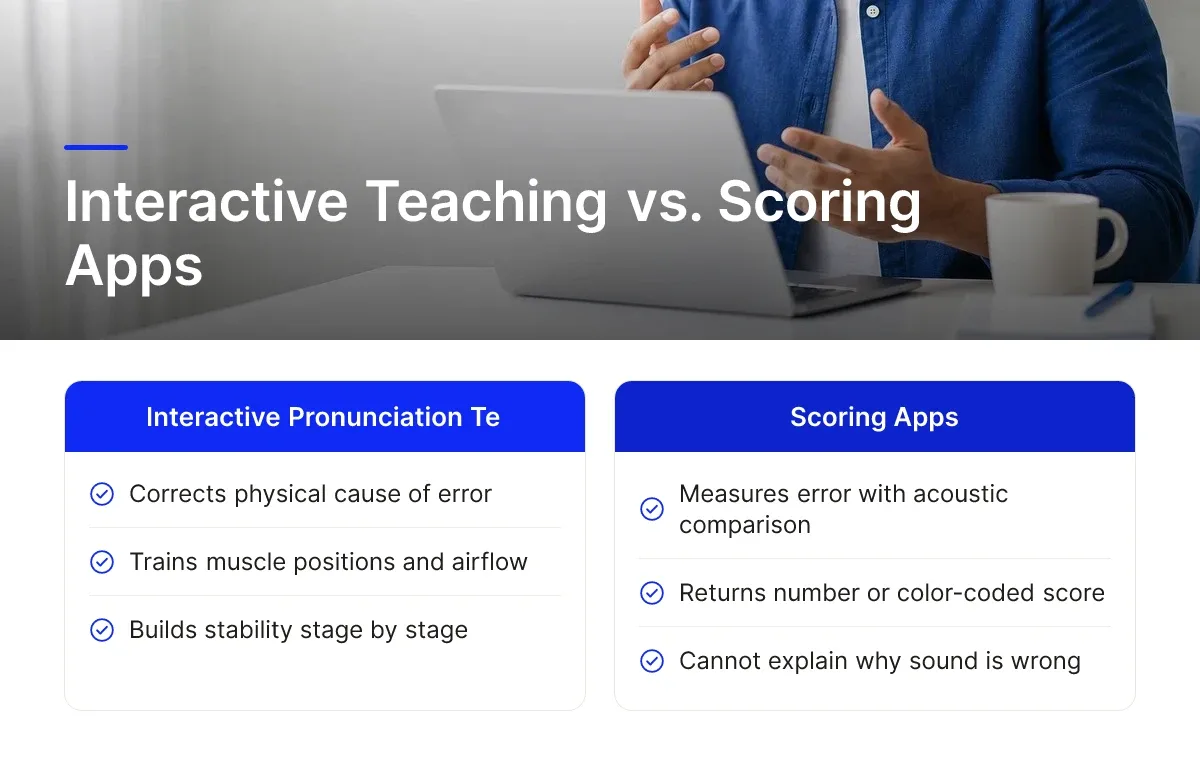
The difference comes down to mechanism: scoring tools measure an error, while interactive pronunciation teaching corrects the physical cause of that error.
Why Do Most Pronunciation Apps Only Give Scores, and What’s Missing From That Approach?
Most pronunciation apps work the same way under the hood. The app records the learner’s voice, compares the acoustic pattern against a stored reference clip, and returns a number or a color-coded score. That comparison can flag that a word sounds “off,” but it has no mechanism to explain why. It cannot tell a learner that their tongue tip touched the teeth instead of the ridge, or that their lips stayed rounded when they should have spread. This is particularly relevant for interactive pronunciation teaching.
Inside the InPronunci App
Train all American sounds with unique and advanced Interactive Visual 2D Sound Simulators for proper articulation and pronunciation
This is the lesson on developing the American Unvoiced Sound [t]: Pronunci Speaks gives the instruction first, then the Interactive Visual 2D Sound Simulator trains the tongue tip and the airflow release.
- EffectiveMost apps offer visual learning. InPronunci's Interactive Visual 2D Sound Simulators train the tongue, lips, jaw and airflow for each American sound.
- ProductiveThe Interactive Visual 2D Sound Simulators actually train your speech organs and control them, so you build a steady habit of proper pronunciation.
- ResultsStudents pronounce individual American sounds with almost native-like pronunciation.
That gap matters more than it looks. A learner who sees a low score knows something is wrong, but not which speech organ caused it or how to move differently next time. Without that corrective information, the learner tends to repeat the same tongue, lip, or jaw position and get the same score again. Thomson and Derwing’s 2015 review of pronunciation instruction research points to this exact limitation: instruction that doesn’t target the specific articulatory mechanism behind an error produces little lasting change in intelligibility [1].
What Makes Technology-Enabled Speech Organ Training More Effective Than General Pronunciation Tips?
Technology-enabled training works when it gives the learner a physical target, not just a verbal description of one. Scoring a single word or an isolated sound also misses how English actually gets spoken: words link together, stress shifts, and intonation carries meaning across a full sentence, not one syllable at a time. A system that only grades isolated words never evaluates rhythm or connected speech, the features that most affect how natural a speaker sounds.
InPronunci: American Accent Training App builds the mechanism directly into the lesson. Its Interactive Visual 2D Sound Simulators train the tongue, lips, jaw, and airflow to produce each American vowel and consonant, so the learner practices the actual movement rather than guessing from a score. Each simulator comes with Pronunci Instructions, step-by-step guidance from Prof. Alex, Ph.D. Accent Coach, Doctor of Education, and professional linguist, that tells the learner exactly what to adjust. The AI Accent Coach then evaluates full speech, including intonation, rhythm, and connected speech, rather than a single scored word.
What Are the Key Stages of Structured American Accent Training?
Structured American accent training moves through four stages in a fixed order: sound articulation, phonetic exercises, sentence practice with intonation, and paragraph-level delivery. Skipping ahead undermines the stages that follow, because each one depends on the stability built in the one before it.
The first stage trains individual sounds. Before a learner works on rhythm or sentence flow, the tongue, lips, jaw, and airflow need to learn the physical shape of each American vowel and consonant. This is where interactive pronunciation teaching matters most: a learner who only hears a sound modeled, without training the muscles that produce it, tends to default back to the closest sound in their native language. Getting the American R, the TH sounds, or the short-long vowel contrast (ship vs. sheep) physically correct first gives every later stage something solid to build on.
How Do Phonetic Exercises Build on Sound Articulation Training?
Phonetic exercises take sounds a learner can already produce correctly in isolation and drill them until production is automatic rather than deliberate. This stage covers sound combinations, reductions, and assimilations: how “want to” becomes “wanna” in casual speech, or how a /t/ softens into a flap between vowels, as in “water” or “better.” Without this repetition, a learner can produce a sound correctly when thinking about it but lose it the moment they speak at normal speed. Phonetic drilling closes that gap by moving the skill from conscious control to habit. When considering interactive pronunciation teaching, this point stands out.
Why Does Sentence Practice With Intonation Come After Individual Sound Work?
Sentence-level stress, rhythm, and intonation only hold up if the underlying sounds are already stable, because melody and emphasis add cognitive load that competes for the same attention sounds still need. A learner who tries to practice American sentence stress before their vowels and consonants are secure usually reverts to old sound habits under the pressure of also managing pitch and timing. Research on second-language pronunciation instruction has found that explicit, targeted practice improves segmental accuracy more reliably when it precedes broader fluency work [3]. Sequencing sound training before intonation training respects that order.
The final stage, paragraph practice with presentation-style delivery, applies everything to real communication: meetings, interviews, client calls, and everyday conversation. This is where a learner stops practicing speech and starts using it.
InPronunci: American Accent Training App follows this exact progression across its four chapters. Chapter 2 covers American consonant sounds, Chapter 3 covers vowel sounds, and Chapter 4 moves into intonation and emphasis, each chapter layering sentence and paragraph practice on top of the sound work that came before. For a closer look at how tongue and jaw position shape individual sounds, see the guide to tongue placement in English sounds.
Structured American Accent Training Course
From Speech Organs Education to American Intonation
The InPronunci course is built step by step: every chapter prepares the next one, and by the end of the course students receive a certificate.
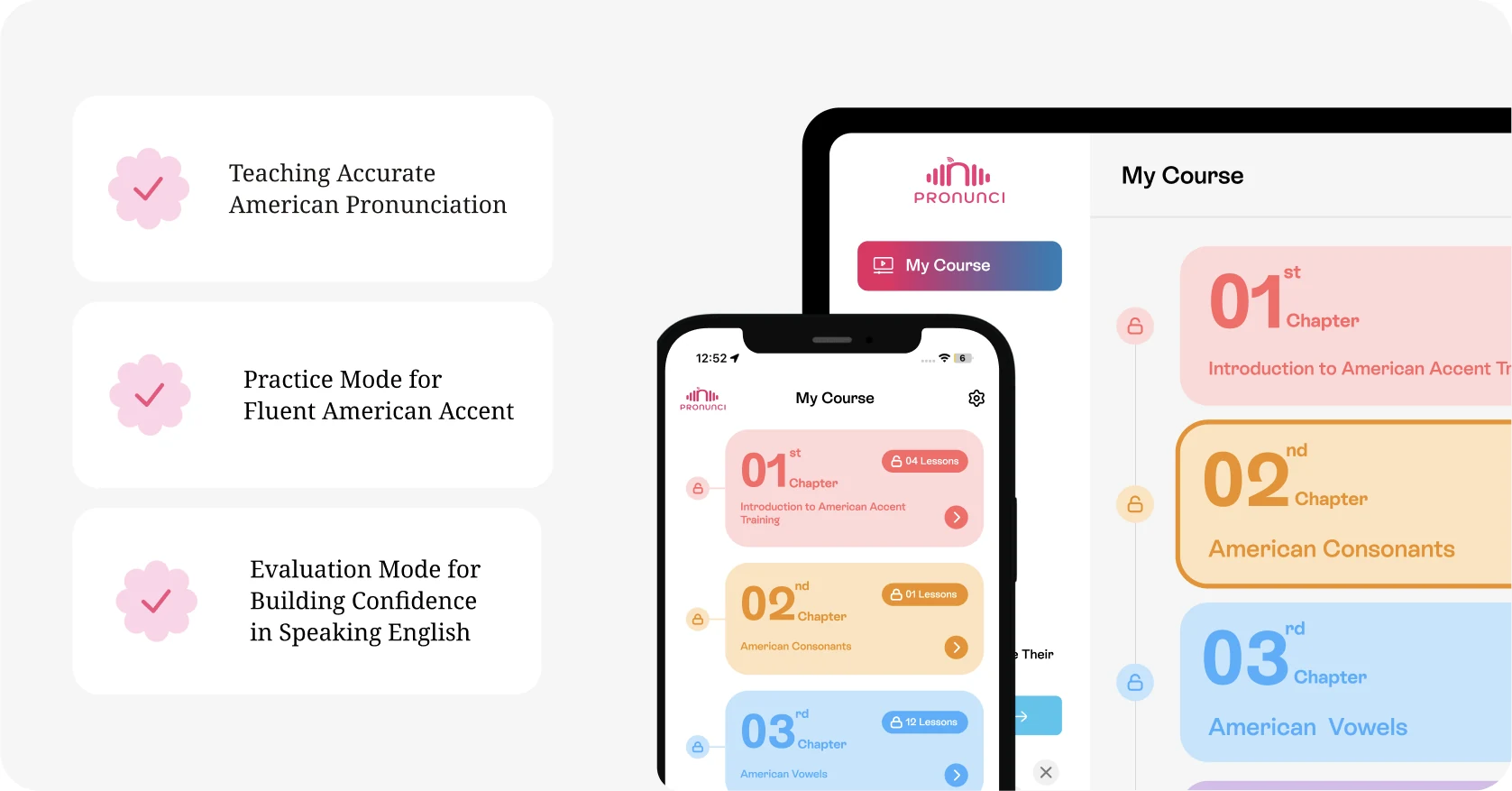
- Speech Organs EducationStudents learn how the speech organs work, along with the AI Accent Coach commands and feedback.
- American ConsonantsPractice and evaluate American consonants in phonetic exercises and practice sentences with the AI Accent Coach.
- American VowelsPractice and evaluate American vowels in phonetic exercises and practice sentences with the AI Accent Coach.
- IntonationLearn how intonation can change the meaning of what you say.
- CertificateBy the end of the course, students receive a certificate.
How Does Real-Time AI Feedback Improve Pronunciation Learning Compared to Scoring Alone?
Real-time feedback corrects a learner at the exact moment the error happens, while a single accuracy score only tells them something went wrong after the fact. That timing difference is what separates interactive pronunciation teaching from a pass/fail word check.
When a learner mispronounces the vowel in “ship” as “sheep,” a delayed score might just flag the word as incorrect. Feedback tied to the moment of speech lets the learner connect the correction to the exact tongue position or airflow pattern that caused the slip, while the attempt is still fresh in muscle memory. This is closer to how a human coach works in a live lesson: the correction lands while the student can still feel what their mouth just did, not minutes or sentences later.
What Aspects of Speech Does Advanced AI Evaluation Assess Beyond Individual Sounds?
A single accuracy score usually judges one word or one sound in isolation, but natural speech is not built from isolated sounds. Full-speech evaluation needs to cover sound accuracy, intonation, melody, rhythm, connected speech, and overall sentence flow, because a learner can pronounce every sound correctly and still sound unnatural if stress falls on the wrong syllable or words run together incorrectly. For those exploring interactive pronunciation teaching, this matters.
Research on pronunciation teaching supports moving past narrow, segment-only correction toward broader feedback models that account for fluency and prosody, not just isolated articulation [3]. Multi-sensor and algorithmic feedback approaches tested in ESL contexts have aimed at exactly this: capturing accuracy, fluency, and completeness together rather than scoring sounds one at a time [3].
How Can Learners Use Detailed Feedback to Adjust Their Pronunciation Consciously?
Breaking a paragraph into sentences, sentences into words, and words into individual sounds lets a learner pinpoint exactly which sound or stress pattern needs work instead of guessing from a vague overall grade. A comparison tool that places a learner’s own recording next to a native-speaker model builds a different kind of awareness than a percentage score does, it shows the gap directly, so the learner hears and feels the difference rather than just reading a number.
InPronunci’s AI Accent Coach evaluates sound accuracy, intonation, melody, rhythm, connected speech, and sentence flow as a student speaks, not just one word or sound. Its Feedback & Analysis then breaks that speech down into sentences, words, and sounds, with articulation detail for each sound in an Interactive Visual 2D Sound Simulator. Prof. Alex, Ph.D. Accent Coach, Doctor of Education, and professional linguist, trained the AI Accent Coach to reflect the same approach he uses in 1-on-1 coaching, so the feedback behaves like guided correction rather than a scoreboard. Learn more about how this works on the AI Accent Coach page.

What Role Does Speech Organ Training Play in Developing Accurate American Pronunciation?
Speech organ training matters because American sounds are produced by specific, learnable positions of the tongue, lips, jaw, and airflow, not by imitation alone. Interactive pronunciation teaching works by making those positions visible and repeatable, so the student retrains the muscles instead of just retraining the ear.
How Do Tongue, Lips, Jaw, and Airflow Positions Differ Across American Vowels and Consonants?
Each American sound has a precise articulation target. The American R, for example, requires the tongue tip pulled back and curled slightly, without touching the roof of the mouth, while the sides of the tongue press against the upper back teeth to shape the airflow. Many learners substitute a trilled or tapped R from their native language because that position feels more familiar to the tongue.
The flap T, heard in words like “water” and “better,” works differently. It uses a quick, light tap of the tongue tip against the alveolar ridge, the bump behind the upper front teeth, rather than the fuller stop used for T at the start of a word like “top.” Students who were taught a hard T in school often over-pronounce these words, which makes their speech sound more formal or foreign than intended. This directly impacts interactive pronunciation teaching outcomes.
Vowel length and tenseness follow a similar logic. The difference between “ship” and “sheep” is not just about how long the vowel sounds. It comes from tongue height and muscle tension: “sheep” uses a tenser, higher tongue position held longer, while “ship” uses a more relaxed, slightly lower position held briefly. Without training this distinction directly, the two words can become indistinguishable to a listener.
Why Is Retraining Speech Organs Necessary for Non-Native Speakers to Reduce an Accent?
Retraining is necessary because the tongue, lips, and jaw have built muscle memory around the sound system of the first language, and that memory does not update just from hearing a correct model. Spanish and Portuguese speakers often shorten vowel length distinctions, collapsing pairs like “ship” and “sheep” toward a single vowel quality. Hindi and Tamil speakers often substitute /v/ and /w/, since many Indian languages do not separate the two sounds the way American English does. Mandarin speakers often drop final consonants, since Mandarin syllables rarely end in consonant sounds other than /n/ and /ŋ/. These are general tendencies, not rules that apply to every speaker of a given language.
Saito (2012) found that explicit pronunciation instruction, focused on specific segmental sounds, produced measurable gains in accuracy over time compared to instruction without that focus [1]. This supports why guided, repeatable movement practice outperforms passive listening: the speech organs need directed repetition, not just correct audio input, to form a new motor pattern. For a deeper look at how tongue position drives individual sounds, the tongue placement pillar guide breaks down articulation point by point.
How Can You Measure Pronunciation Improvement Beyond a Numerical Score?
A score tells you a number went up. It does not tell you whether a listener now understands you the first time, whether your sentences keep their rhythm under pressure, or whether your intonation holds up when you are not reading from a script. Those three markers matter more than any single digit, and they are the ones interactive pronunciation teaching is designed to build toward.
What Does Natural, Fluent American Pronunciation Look Like in Real Communication?
Progress shows up as fewer “sorry, can you repeat that?” moments in meetings, calls, and casual conversation. It also shows up in rhythm: words link together in a sentence instead of landing one by one with equal weight, and stressed syllables stand out the way they do in natural American speech. A third marker is intonation that survives spontaneous speech, not just a rehearsed sentence you practiced ten times. If your pitch still rises and falls naturally when you are thinking on your feet, in an unplanned answer during an interview or a stand-up meeting, that is a stronger sign of change than a single high score on a repeated phrase.
How Do You Know When You’re Ready to Move From Sound Practice to Sentence and Paragraph Work?
Readiness is not about getting a sound right once. It is about the sound staying correct even when your attention moves to meaning, speed, or emotion, the conditions of real conversation. If you can hold the American R or the TH sound steady while telling a quick story or answering an unplanned question, you are ready to shift from isolated sound drills toward sentence practice and paragraph delivery. This is also the logic behind InPronunci’s four-stage structure: sound articulation first, then phonetic exercises, then sentences with intonation, then paragraph practice with presentation-style delivery, so the sound survives the jump to real speech. This is particularly relevant for interactive pronunciation teaching.
A Short Practice Routine You Can Start Today
- Pick one problem sound, for example the American R or a vowel pair like ship/sheep.
- Drill it slowly, paying attention to tongue, lip, and jaw position, not just the sound you hear.
- Say the sound in three example sentences at normal speaking speed.
- Record yourself and compare it against a native-speaker model, noticing where your version diverges.
Self-assessment has a ceiling. Many learners cannot hear their own stress or intonation errors consistently, which is where full-speech evaluation helps: InPronunci’s AI Accent Coach evaluates pronunciation, intonation, melody, rhythm, connected speech, and sentence flow as you speak, and the Your Coach vs. My Pronunci Pronunciation Comparison Tool lets you compare your recording against the native-speaker model directly. A human coach adds another layer; Pronunci Instructions from Prof. Alex, Ph.D. Accent Coach, Doctor of Education, and professional linguist, guide each lesson so you know exactly what to listen for.
Cognitive Accent Training
Compare Your Coach vs. Your Pronunci
In every practice sentence, students listen to Your Coach, record their own voice, and compare it with Your Pronunci, so they consciously notice and correct each sound.
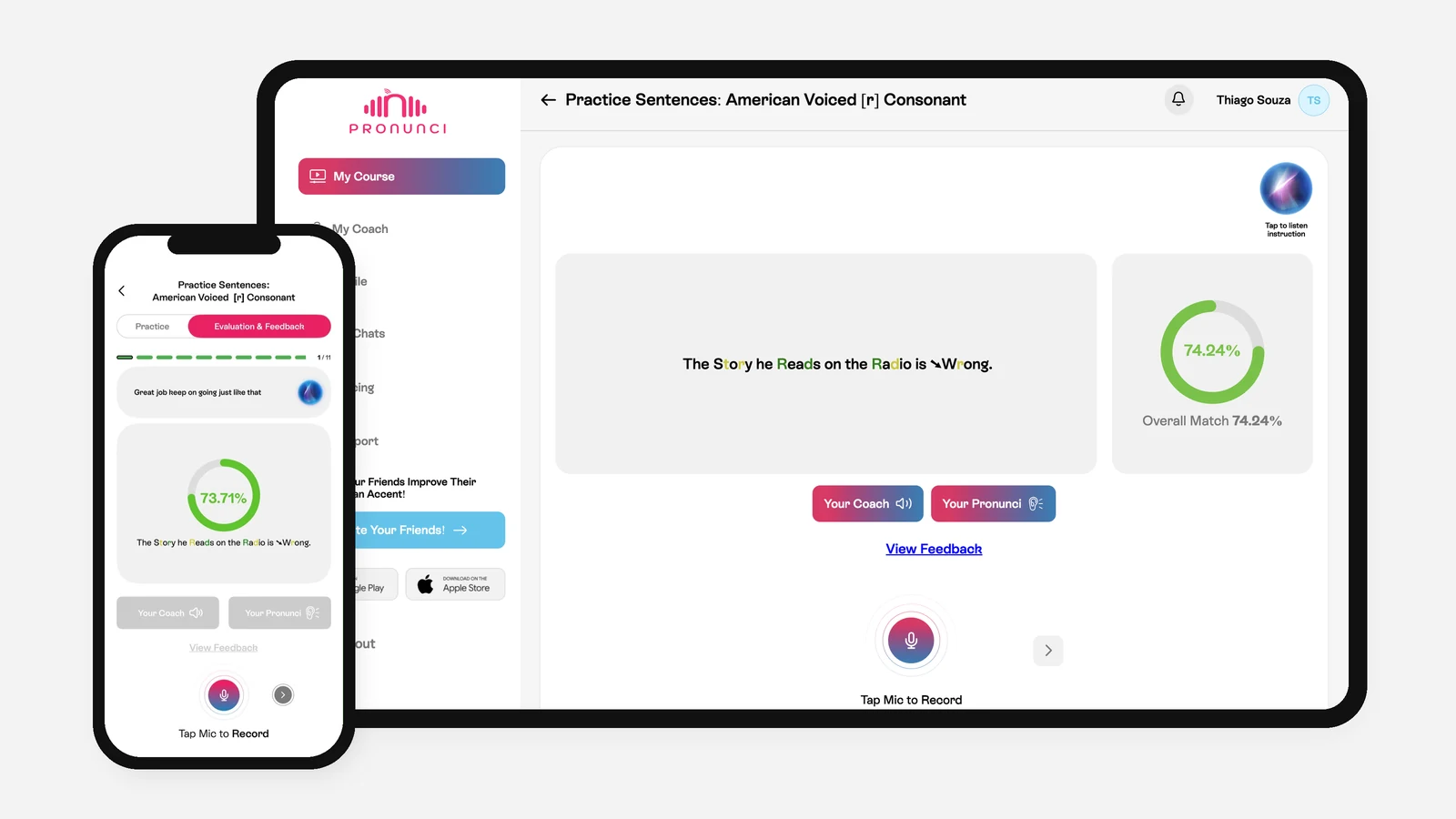
- Listen to Your CoachThe model American pronunciation of each practice sentence.
- Compare with Your PronunciYour own recorded pronunciation, side by side with the coach.
- Correct with feedbackThe match score and color-coded letters guide each correction.
InPronunci is supportive practice, not therapy or diagnosis. If you suspect a speech or hearing difficulty beyond typical accent patterns, consult a licensed speech-language pathologist or appropriate medical professional.
Questions & Answers
Frequently Asked Questions
01Can interactive pronunciation teaching fully eliminate a foreign accent?
No method, interactive or otherwise, eliminates an accent completely, and that is not the realistic goal. Structured, sound-by-sound training can substantially reduce the influence of your native language on pronunciation, rhythm, and intonation, making your speech clearer and easier to understand. InPronunci’s own goal is natural American English and confident communication, not erasing your identity or accent entirely.
02Do I need daily practice for speech organ training to work?
Consistency matters more than any fixed daily minimum. Speech organ training works by building new muscle habits in the tongue, lips, and jaw, so regular short sessions tend to outperform occasional long ones. Follow the Pronunci Instructions for pacing rather than forcing an arbitrary schedule.
03Is real-time AI feedback as useful as feedback from a human coach?
They serve different, complementary roles rather than competing directly. AI feedback, like InPronunci’s AI Accent Coach, can evaluate pronunciation, intonation, rhythm, and connected speech every time you practice, which a human coach cannot do continuously. A human coach adds judgment, personalization, and troubleshooting that current AI tools cannot fully replicate, which is why InPronunci’s Premium Plan pairs both with monthly live sessions with Prof. Alex. When considering interactive pronunciation teaching, this point stands out.
04What if I have a diagnosed speech or hearing difficulty?
Interactive pronunciation tools can offer helpful supportive practice, but they are not a substitute for medical care. If you have a diagnosed speech or hearing difficulty, consult a licensed speech-language pathologist or appropriate medical professional first. InPronunci’s structured articulation training can complement that guidance, not replace it.
Conclusion
Interactive pronunciation teaching works because it puts the learner in an active role: training the speech organs directly, comparing their own speech against a model, and getting feedback on full sentences rather than isolated words [1][4]. If you are evaluating tools, look for three things: speech-organ-level instruction, feedback that covers rhythm and intonation rather than just word accuracy, and a structured path from sounds to sentences to paragraphs. Start by training one sound properly instead of switching topics randomly. A practical next step: try Free Chapter 1 of InPronunci on the web platform to see how speech-organ training and Pronunci Instructions work together before committing to a plan.
Sources & References
- Research-Based Interactive American Accent Training
- Frontiers | Innovative approaches to English pronunciation instruction in ESL contexts: integration of multi-sensor detection and advanced algorithmic feedback
- How can digital tools improve student pronunciation accuracy? – Sanako
Recommended Articles
How an AI Pronunciation Trainer Gives Instant Feedback
An AI pronunciation trainer gives instant feedback by listening to your full spoken sentence or paragraph, not just a single word, and scoring pronunciation...

Why Adults Can Still Learn a Native-Like American Accent
How to reduce a foreign accent as an adult: train each sound consciously, then words, sentences and intonation, with regular feedback.

How to Speak English More Clearly and Be Understood
You speak English more clearly by training the individual sounds, stress, and intonation patterns of American English with deliberate, structured.
Plans
What InPronunci costs
InPronunci Basic
$35 per month
Chapter 1 is free after signup.
InPronunci Premium
$200 per month
Includes a coach: