


American accent training online works by combining structured, sound-by-sound instruction with guided practice and feedback, typically moving through four stages: individual sound articulation, phonetic exercises, sentence-level stress and intonation, and paragraph-length delivery. Rather than general conversation practice, effective programs isolate how the tongue, lips, jaw, and airflow produce each American vowel and consonant, then build those sounds into fluent, natural speech. Expect a mix of instructor guidance (video or live coaching) and technology-based feedback that evaluates pronunciation, rhythm, and connected speech as you actually talk, not just isolated words.
Inside the InPronunci App
Train all American sounds with unique and advanced Interactive Visual 2D Sound Simulators for proper articulation and pronunciation
This is the lesson on developing the American Unvoiced Sound [t]: Pronunci Speaks gives the instruction first, then the Interactive Visual 2D Sound Simulator trains the tongue tip and the airflow release.
- EffectiveMost apps offer visual learning. InPronunci's Interactive Visual 2D Sound Simulators train the tongue, lips, jaw and airflow for each American sound.
- ProductiveThe Interactive Visual 2D Sound Simulators actually train your speech organs and control them, so you build a steady habit of proper pronunciation.
- ResultsStudents pronounce individual American sounds with almost native-like pronunciation.
Structured American Accent Training Course
From Speech Organs Education to American Intonation
The InPronunci course is built step by step: every chapter prepares the next one, and by the end of the course students receive a certificate.
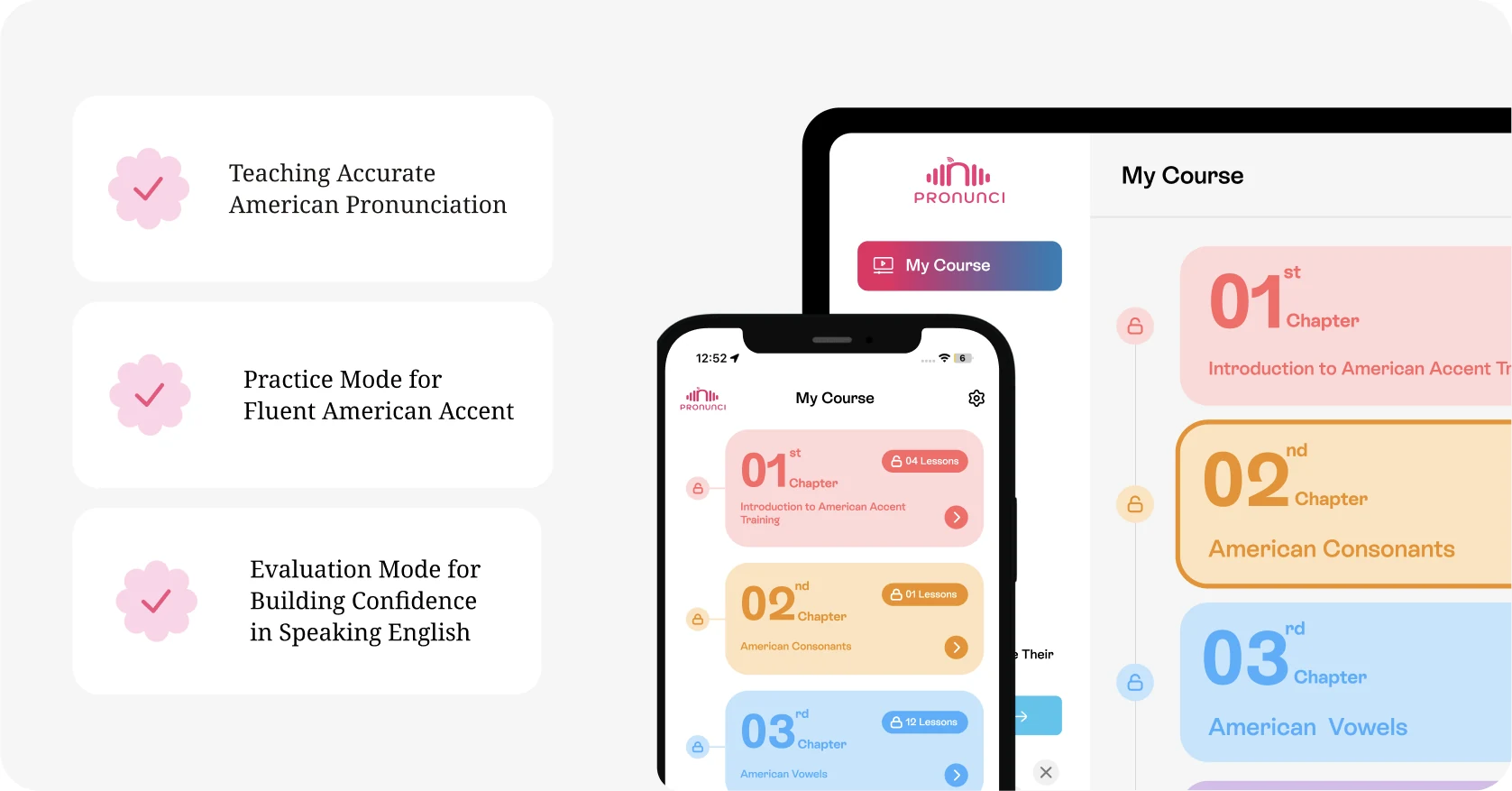
- Speech Organs EducationStudents learn how the speech organs work, along with the AI Accent Coach commands and feedback.
- American ConsonantsPractice and evaluate American consonants in phonetic exercises and practice sentences with the AI Accent Coach.
- American VowelsPractice and evaluate American vowels in phonetic exercises and practice sentences with the AI Accent Coach.
- IntonationLearn how intonation can change the meaning of what you say.
- CertificateBy the end of the course, students receive a certificate.
What Does American Accent Training Online Actually Involve?
Accent training targets how specific sounds, stress patterns, and intonation are physically produced, while general English learning builds vocabulary, grammar, and conversation skills. The two overlap, but they solve different problems.
A learner can have advanced grammar and a wide vocabulary and still be asked to repeat themselves in meetings. That happens because the issue isn’t what they say, it’s how the tongue, lips, jaw, and airflow shape individual sounds, and how stress and rhythm move across a sentence. American accent training online addresses that layer directly, isolating a sound like the American R or the TH sound and retraining the exact articulation before moving to connected speech.
Is There a Real Difference Between Accent Training Apps and General English Learning Apps?
Yes. General English apps mostly drill vocabulary and conversation scenarios, while accent training works at the level of speech-organ movement. Coursera’s pronunciation specialization, for example, organizes its curriculum around consonant and vowel sounds plus the rhythm and “music” of spoken English, rather than vocabulary building [1]. That distinction matters because mispronunciation and unnatural rhythm often persist even after years of fluent conversation practice. Sound-by-sound work asks a learner to notice exactly where the tongue touches the teeth ridge for a flap T, or how far the jaw drops for a vowel like the one in “cup”, details that conversation apps rarely touch.
What Qualifications Should an Accent Coach or Instructor Have?
Look for a linguistics background, documented accent-coaching experience, and formal academic credentials, not just general ESL tutoring. Accent reduction sits closer to applied phonetics than to conversational teaching, so the instructor should understand articulatory phonetics and the specific first-language interference patterns learners bring from Spanish, Mandarin, Hindi, or other native languages. A generic tutor can correct grammar; retraining a vowel contrast or a stress pattern usually takes someone trained specifically in that area.
Serious programs also structure training in stages, moving from individual sounds to phonetic exercises to sentence-level intonation to paragraph delivery, rather than offering scattered tips or random word repetition. InPronunci, led by Prof. Alex, Ph.D. Accent Coach, Doctor of Education, and professional linguist with 20 years of accent and pronunciation teaching experience, follows this exact progression. Each lesson includes Pronunci Instructions that give step-by-step guidance, the same structure used in his 1-on-1 training, so the method behind the app matches the method behind the coaching.
How Do You Train Your American Accent Through Structured Lessons?
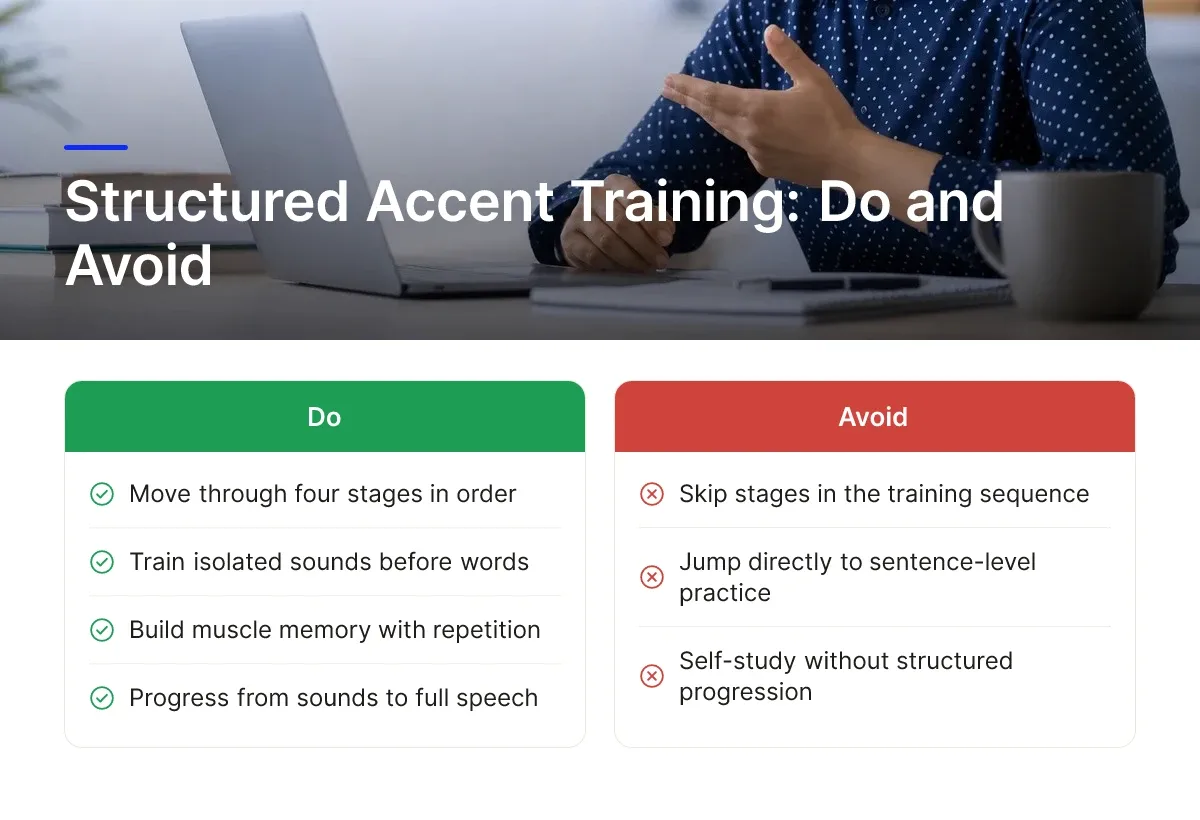
Structured training moves through four stages in order: isolated sound articulation, phonetic exercises, sentence-level stress and intonation, then paragraph-level delivery. Skipping stages is the most common reason self-study stalls.
What Are the Stages You Work Through in a Sound-by-Sound Accent Training Course?
The first stage trains a sound by itself, before it ever touches a word. This means positioning the tongue, lips, jaw, and airflow correctly and repeating that position until the muscle memory holds, independent of any sentence around it.
This order matters because rhythm and connected speech depend on sounds that are already reliable. If a learner tries to work on sentence stress or linking words together while the underlying sounds are still inconsistent, the sounds revert to old habits the moment attention shifts to meaning or pace. Research on explicit pronunciation instruction supports this sequencing: Saito 2012 found that focused instruction on specific sound features produced measurable gains in how learners produced those sounds in later speech. Building the sound first, then layering rhythm and melody on top, is a sequencing principle, not a shortcut.
Once a sound is stable in isolation, training moves to phonetic exercises: sound combinations, reductions, and assimilations. This is where a sound stops being something a speaker performs on purpose and starts happening on its own.
How Do Phonetic Exercises and Sentence Practice Fit Into Accent Training?
Phonetic exercises bridge the gap between an isolated sound and real speech by drilling that sound inside sound clusters, word boundaries, and common reductions until it becomes habitual rather than something tracked consciously mid-sentence.
Take the American R. The tongue pulls back and up without the tip touching the roof of the mouth, unlike the tapped or trilled R many languages use. A learner first produces that shape alone, then in words like “car” and “river,” where the R shows up in different positions, and only then inside full sentences such as “The driver parked near the river.” By the sentence stage, the R needs to survive contact with surrounding vowels, stress patterns, and speaking speed without collapsing back into a native-language substitute.
This is the structure InPronunci follows for American accent training online: the Interactive Visual 2D Sound Simulators, part of 2D Sound Motion Technology, train the tongue, lips, jaw, and airflow for sounds like the American R before phonetic exercises make the sound automatic. Pronunci Instructions from Prof. Alex, Ph.D. Accent Coach, Doctor of Education, and professional linguist, guide each lesson so learners know exactly what to adjust at every stage. From there, training moves into sentence practice with stress and intonation, then paragraph-level, presentation-style delivery for meetings, interviews, and everyday conversation. For more on how tongue and lip positioning drives individual sounds, see our guide to tongue placement in English sounds.
What App or Online Course Should You Choose for American Accent Training?
Evaluate any platform on three things: how deeply it trains individual sounds, how specific its feedback is, and whether the structure actually moves from sounds to full speech or stops at the word level.
Many learners comparing American accent training online options focus first on price or app store ratings. Those matter less than what happens inside a single lesson. A platform that only asks you to repeat isolated words, then scores you on accuracy, teaches you to pass that one exercise. It does not teach you to carry a sound into a sentence, a meeting, or a presentation, where stress, rhythm, and connected speech change how that sound behaves.
How Do InPronunci and Other Platforms Compare in Their Training Approach?
ELSA Speak offers AI-powered English speaking practice with instant personalized feedback, role-plays, and broad communication practice. It covers many everyday speaking scenarios, which suits learners who want general conversational reps.
BoldVoice takes a different approach: an accent app built around guided video practice, with coach videos and AI speech evaluation. This model emphasizes demonstration and modeling, learners watch a coach produce a sound or pattern, then practice it themselves.
InPronunci: American Accent Training App works differently from both. It evaluates pronunciation, intonation, melody, rhythm, connected speech, and sentence flow as students speak, through the AI Accent Coach, not just one word or isolated sound. Every lesson also includes Pronunci Instructions, step-by-step guidance written by Prof. Alex, Ph.D. Accent Coach, Doctor of Education, and professional linguist, so students know exactly what to adjust before they move to the next exercise. These two elements, full-speech evaluation and expert-written guidance, are the two places where InPronunci differs most from other tools in this category.
What Features Matter Most: AI Feedback, Instructor Guidance, or Speech-Organ Training?
Instructor-led video series are valuable for showing what a correct sound or sentence should sound like. Demonstration and modeling help learners build a mental reference point. But modeling alone does not train the tongue, lips, and jaw to physically produce that sound on command.
Structured systems close that gap by adding two things on top of modeling: interactive speech-organ training and full-speech evaluation. InPronunci does this through the Interactive Visual 2D Sound Simulators, which train the tongue, lips, jaw, teeth, airflow, and voice for every American vowel and consonant, followed by phonetic exercises, sentence practice with intonation, and paragraph-level delivery. For a side-by-side look at how this compares specifically with ELSA Speak’s feature set, see the InPronunci vs. ELSA Speak comparison. For the full four-stage structure behind this approach, the course overview walks through each chapter in detail.
How Long Does It Take to See Noticeable Improvement in Your American Accent?
No fixed timeline applies to everyone: progress depends on consistency, the quality of corrective feedback, and how targeted the practice is, not just total hours logged.
A learner who practices 15 focused minutes a day on a specific sound, with correction each time, typically builds habitual accuracy faster than someone who listens to English for hours without ever adjusting tongue or lip position. Saito (2012) found that explicit pronunciation instruction, where learners receive direct guidance on how to produce a sound rather than relying on exposure alone, supports measurable gains in second-language pronunciation [4]. The instruction itself, not passive listening, drives the change.
Thomson & Derwing (2015) reviewed pronunciation instruction research and pointed to practice conditions that actually move the needle: focused attention on specific sounds, repeated opportunities to produce them, and feedback that tells the learner what to fix [4]. Their review also shows that pronunciation gains are uneven across sounds and learners, which is part of why no single number of weeks applies across the board.
What Time Commitment Does Structured Online Accent Training Actually Require?
Most learners who pursue American accent training online see change build through short, repeated sessions rather than occasional long ones. A 10 to 20-minute daily session focused on one or two sounds, followed by sentence practice that applies them, tends to outperform a single 2-hour session once a week. The reason is mechanical: speech organs learn new movement patterns through repetition, and that repetition needs to happen often enough that the old pattern does not take back over between sessions.
This is why InPronunci structures practice into four stages, sound articulation, phonetic exercises, sentence practice, and paragraph delivery, so each session builds on stable groundwork instead of skipping ahead.
How Do Different Training Methods Affect the Speed of Accent Improvement?
Methods that combine instruction with correction accelerate noticeable change; methods based only on listening or repetition without feedback tend to plateau. A learner repeating words after a recording may reinforce an existing mispronunciation if nothing flags the error. Pronunci Instructions guide each lesson step by step, and the AI Accent Coach evaluates pronunciation, intonation, rhythm, and connected speech as the learner speaks, not just a single word, so corrective feedback happens at the sentence level where habits actually form. Readers can compare how instruction methods differ in our InPronunci vs. ELSA Speak breakdown, or review tongue and lip positioning fundamentals in the tongue placement guide.
Cognitive Accent Training
Compare Your Coach vs. Your Pronunci
In every practice sentence, students listen to Your Coach, record their own voice, and compare it with Your Pronunci, so they consciously notice and correct each sound.
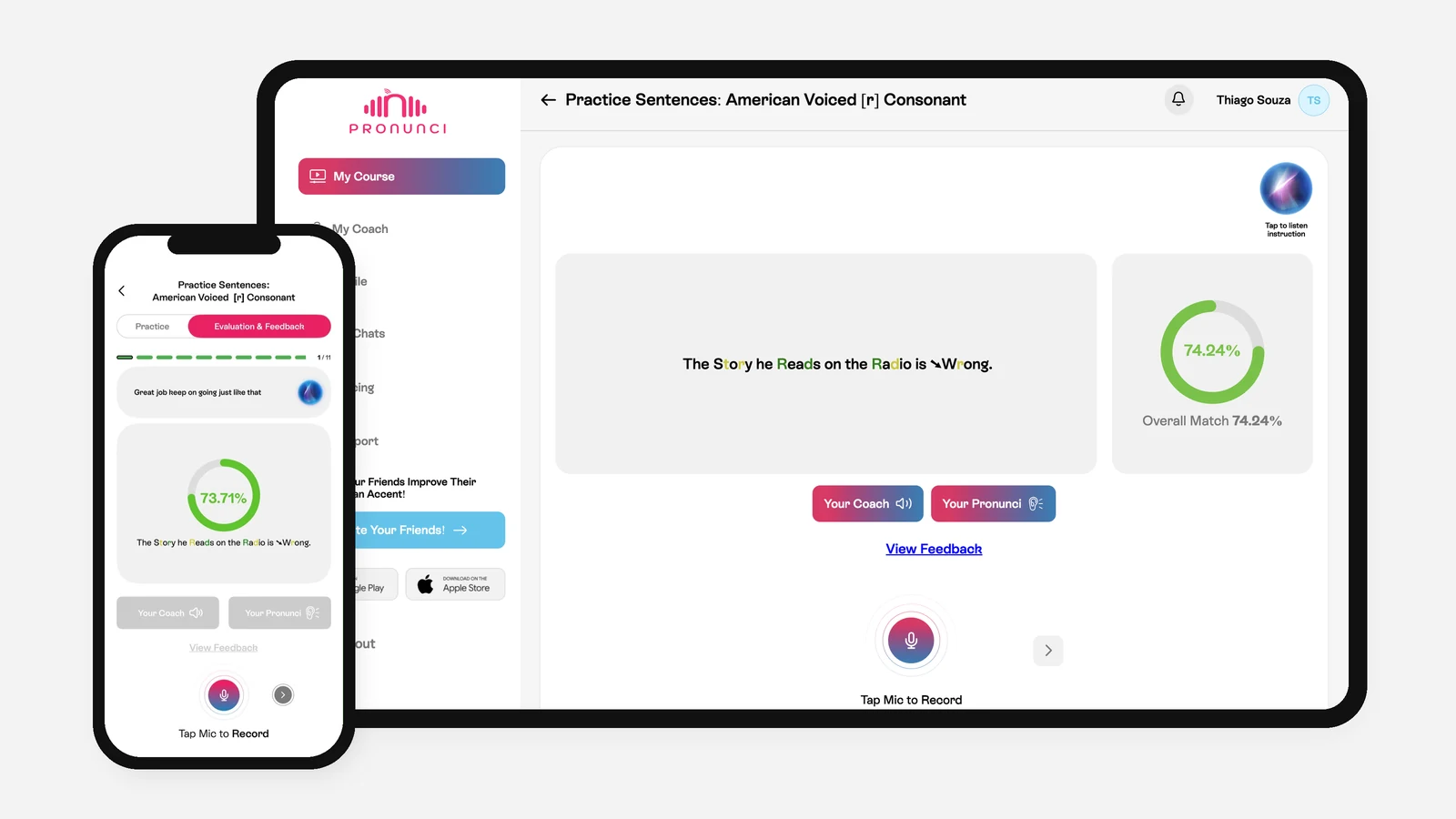
- Listen to Your CoachThe model American pronunciation of each practice sentence.
- Compare with Your PronunciYour own recorded pronunciation, side by side with the coach.
- Correct with feedbackThe match score and color-coded letters guide each correction.
What Specific Accent Challenges Do Speakers From Different Language Backgrounds Face?
First-language sound systems shape which American English sounds feel natural and which feel foreign, producing patterns tied to Spanish, Mandarin, Hindi, and other native languages. These patterns are common tendencies, not rules that apply to every speaker, and good American accent training online addresses them through explicit instruction in tongue, lip, and jaw positioning rather than generic repetition.
What Pronunciation Mistakes Do Spanish Speakers Commonly Make in American English?
Spanish and Portuguese have five core vowel sounds, while American English uses around 14, so speakers often merge pairs that sound distinct to American ears. The classic example is “ship” versus “sheep”: Spanish has one vowel where English has two, /ɪ/ and /i/, so both words can come out sounding the same.
Spanish also lacks a clear /v/-/b/ distinction, which leads to “vote” and “boat” blending together. A third pattern involves rhythm: Spanish and Portuguese are syllable-timed, giving each syllable roughly equal weight, while American English is stress-timed, compressing unstressed syllables and stretching stressed ones. Carrying syllable-timed rhythm into English can make speech sound evenly paced in a way that native listeners perceive as monotone or overly deliberate.
What Vowel and Consonant Sounds Are Hardest for Mandarin or Other Language Speakers?
Mandarin and Cantonese speakers face a different set of obstacles rooted in syllable structure and tone. Mandarin syllables typically end in a vowel or one of a few nasal consonants, so final consonants in English words like “cat” or “stopped” sometimes get dropped or softened. The /l/-/r/ distinction and the two “th” sounds (as in “think” and “this”) also pose difficulty, since none of these exist in the same form in Mandarin or Cantonese.
Tonal rhythm creates a separate challenge: Mandarin uses pitch to distinguish word meaning, while American English uses pitch and stress to mark sentence-level emphasis and emotion. Speakers sometimes carry syllable-by-syllable tonal patterns into English sentences, which can flatten the natural rise and fall that signals which words matter most.
Hindi and other Indian language speakers often show a /v/-/w/ merge (“vest” and “west” sounding alike), retroflex articulation of /t/ and /d/ where the tongue curls back rather than touching the ridge behind the upper teeth, and intonation that can read as flatter than General American’s wider pitch range. Our guide for Indian English speakers covers these patterns in more detail.
A Spanish speaker working on ship/sheep practices raising the tongue slightly higher and tensing the lips for /i/ in “sheep,” while keeping the tongue lower and more relaxed for /ɪ/ in “ship.” InPronunci’s Interactive Visual 2D Sound Simulators train this exact tongue-height and lip-tension adjustment, sound by sound, inside the structured path from Chapter 1 through intonation training.

Want 1-on-1 support while you train? The InPronunci: American Accent Online Course adds a complimentary Orientation Session, private chat, WhatsApp practice feedback, and a complimentary 1-hour 1-on-1 Accent Training with Prof. Alex every month.
Related guide: How Long Does It Take to Learn an American Accent?
Questions & Answers
Frequently Asked Questions
01Can online accent training fully eliminate a foreign accent?
No reputable program eliminates an accent completely, and that is not the right goal. Structured training reduces the sounds, rhythm, and intonation patterns borrowed from a first language so speech becomes clearer and easier to understand. The aim is natural American English and confident communication, not erasing where someone comes from.
02Do I need daily practice for American accent training to work?
Consistent, shorter sessions generally work better than occasional long ones, since articulation is a motor skill built through repetition. Explicit pronunciation instruction has been shown to produce measurable gains in L2 pronunciation [3]. A short daily routine, even 15 to 20 minutes, builds the muscle memory needed for new sounds to become automatic.
03Is American accent training useful for people who already speak English fluently?
Yes, fluency and pronunciation are separate skills, and many fluent speakers still get asked to repeat themselves. Advanced learners often need to refine intonation, connected speech, and specific sounds rather than basic vocabulary or grammar. InPronunci’s Advanced AI Accent Coach level is built for this group: professionals who want to sound closer to a native speaker.
04Can accent training help with specific situations like job interviews or exams?
Yes, targeted practice in sentence stress, intonation, and paragraph-length delivery directly supports interviews, presentations, and speaking exams. TOEFL and IELTS Speaking both reward clear pronunciation and natural rhythm, not just correct grammar. Paragraph practice with presentation-style delivery, one of InPronunci’s four training stages, mirrors the longer, spontaneous speech these situations demand.
Conclusion
Effective American accent training online follows a sequence: train the speech organs for each sound, drill those sounds until they’re automatic, apply them in sentences with stress and intonation, then extend them into paragraph-length, presentation-style speech. Skipping straight to conversation practice, as many apps do, leaves the underlying sound system untouched.
If you want to start building that foundation, begin with InPronunci’s Free Chapter 1 on the web, the App Store, or Google Play, and learn how your tongue, lips, and airflow shape every American sound before moving to full lessons.
Sources & References
- The Pronunciation of American English | Coursera
- Continuing Education |Get into the Rhythm of Speaking with an American Accent
- How Online Accent Lessons Work: What to Expect
Recommended Articles

What Is Accent Reduction and How Does It Really Work?
Accent reduction works by retraining how your speech organs produce American English sounds, stress, and intonation through structured, repeated practice...
Why Do I Have an Accent and What Causes It in English?
You keep your native accent in English because your speech organs learned to produce sounds, rhythm, and intonation for your first language first, and those...
What Cognitive Accent Training Is and How It Rewires Speech
Cognitive accent training retrains your speech organs and listening habits together: you train the tongue, lips, jaw, and airflow to produce accurate...
Plans
What InPronunci costs
InPronunci Basic
$35 per month
Chapter 1 is free after signup.
InPronunci Premium
$200 per month
Includes a coach: