


Final -s and -es have exactly three pronunciations: /s/, /z/, or /ɪz/. The choice is not random. It depends entirely on the very last sound of the word before you add the ending, and that one fact resolves nearly every mistake learners make with plurals, third-person verbs, and possessives. Voiceless sounds get /s/, voiced sounds get /z/, and hissing “sibilant” sounds get /ɪz/, adding a small extra syllable.
Download InPronunci: Accent Training App on the App Store or Google Play to practice these endings with guided audio and speech-organ training feedback.
Why English uses three pronunciations for s and es endings
The pattern comes down to two things: voicing and sibilants. Voicing means whether your vocal cords vibrate while you make a sound. Try this right now: put a finger lightly on your throat and say “ZZZ.” You’ll feel a buzz. Now say “SPSS.” No buzz. That’s the entire difference between /z/ and /s/, and it’s why linguists call one “voiced” and the other “voiceless.”
English speakers automatically match the ending to the sound before it, because switching voicing mid-word (voiceless sound followed suddenly by a voiced /z/) takes extra muscular effort your mouth naturally avoids. This matching is called voicing agreement, and it’s the same logic behind voiced vs. voiceless sound pairs elsewhere in American English.
Sibilants are the hissing or buzzing consonants: /s/, /z/, /ʃ/, /ʒ/, /tʃ/, /dʒ/. You cannot glue an /s/ or /z/ directly onto one of these, because English blocks that consonant cluster. So speakers insert a short vowel, /ɪ/, to separate them, a process called epenthesis. That’s why “bus” becomes “buses,” with a new syllable, not a silent letter.
- Voiceless final sound → /s/ (no buzz)
- Voiced final sound → /z/ (buzz)
- Sibilant final sound → /ɪz/ (buzz plus extra syllable)
This three-way split isn’t a quirk to memorize word by word. Phonotactic constraints make it close to automatic once you know the rule.
When do you say /s/, /z/, or /ɪz/?
Here’s the working rule, with word lists you can read aloud right now.
/s/ after voiceless sounds. If the word ends in a voiceless consonant, sound /p/, /t/, /k/, /f/, or /θ/ (the “th” in “think”), add /s/.
- cat → cats
- help → helps
- stop → stops
- book → books
- laugh → laughs
- month → months
- work → works
- hope → hopes
/z/ after voiced sounds. If the word ends in a voiced consonant or any vowel sound, add /z/. Most consonants and every vowel in English are voiced, which is why /z/ is actually the most common of the three endings, despite being spelled with “s.”
- dog → dogs
- key → keys
- run → runs
- play → plays
- live → lives
- boy → boys
- car → cars
- game → games
/ɪz/ after sibilants. If the word ends in a sibilant sound, /s/, /z/, /ʃ/, /ʒ/, /tʃ/, or /dʒ/, insert /ɪz/ and pronounce it as its own syllable.
- bus → buses
- watch → watches
- wish → wishes
- judge → judges
- box → boxes
- church → churches
- size → sizes
- garage → garages
One spelling trap worth flagging: words like “goes,” “does,” and “closes” look similar but don’t behave the same way phonetically, because the sound before the ending, not the letter, decides everything. “Goes” ends in a voiced vowel, so it’s just /z/, one syllable. “Closes” ends in a sibilant /s/ sound, so it becomes /ɪz/, two syllables.
Where do “has,” “does,” and possessives break the rule?
A handful of common words don’t follow the pattern cleanly, and native speakers use these so often that mispronouncing them stands out.
- Has is pronounced /hæz/, not /hæs/, even though the base word “have” doesn’t obviously signal /z/.
- Does is /DMZ/, following the voiced-vowel rule, but learners often default to /s/ from the spelling.
- Says is the odd one out: it’s /SAZ/, with a vowel shift from “say,” not the expected /ETZ/.
These exceptions exist mostly because of vowel changes and historical spelling that never caught up to how the words are actually said, a mismatch documented in teaching resources on inflection endings.
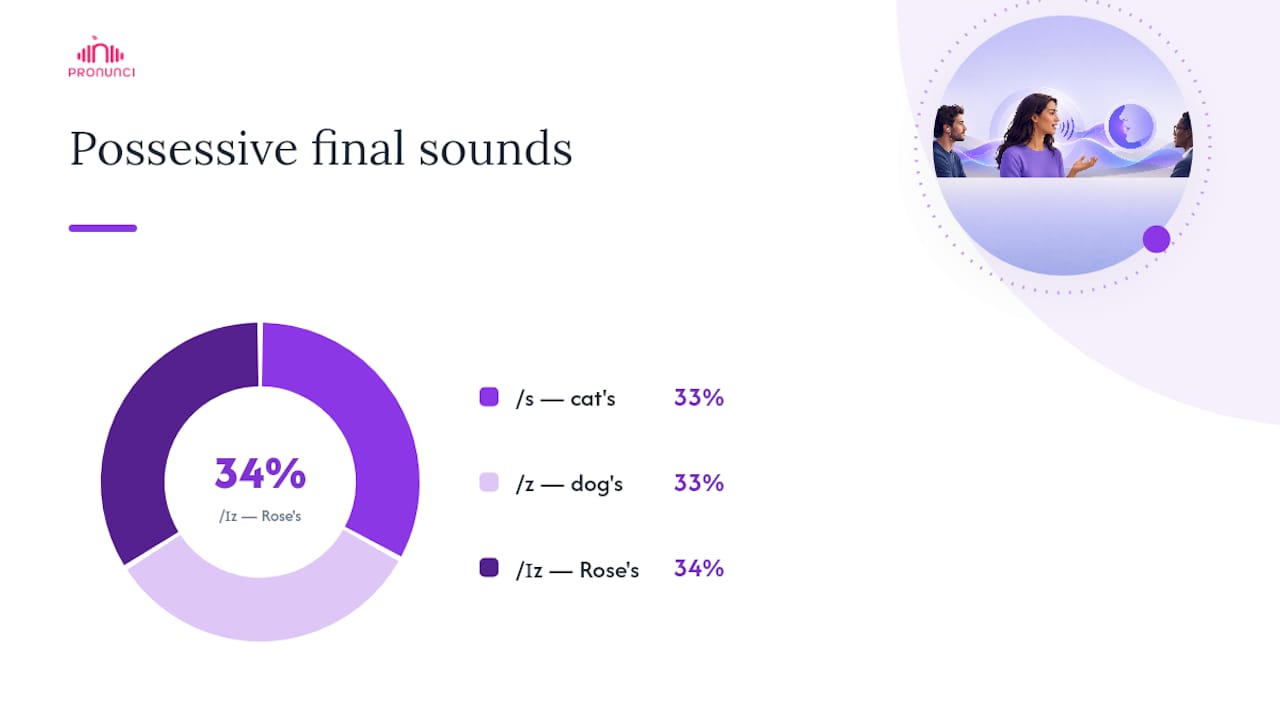
Possessives follow the identical /s/, /z/, /ɪz/ rule: “cat’s” is /s/, “dog’s” is /z/, “Rose’s” is /ɪz/. Names ending in -s get more variation in real usage: “Charles’s” is often shortened to just an apostrophe with no added syllable in casual speech, though formal writing keeps the full form.
Spelling changes don’t change the sound rule. Words ending in a consonant plus -y often shift to -ies in writing (city → cities), and words ending in -o sometimes take -es (potato → potatoes). These are orthographic conventions, not new pronunciation categories. The sound you produce still depends purely on the final sound of the base word, never on how it’s spelled.
How can you practice s and es endings in 5 minutes a day?
Rules stick when your mouth does the work, not just your memory. Try this short routine for two to four weeks.
- Listen first. Play minimal pairs back to back: “bus/buzz,” “rice/rise,” “face/phase.” Notice the throat buzz difference before you try to produce it yourself.
- Feel the voicing. Rest a finger on your throat and say five voiced words (“dogs,” “keys,” “runs”) then five voiceless ones (“cats,” “books,” “hopes”). Feel the buzz appear and disappear.
- Produce in isolation. Say each /s/, /z/, and /ɪz/ list from the rules section above slowly, checking your finger each time.
- Produce in sentences. Say “The dogs chase the cats” and “She watches the buses,” exaggerating the ending sound only, not the whole word.
- Speed up naturally. In connected speech, endings shorten and blend into the next word, but the voicing itself should never disappear, only its duration.
Pro Tip: Record yourself saying ten mixed words from the lists above, then play it back and mark which ones sound “flat” or unsure. That single recording usually reveals your one recurring pattern, often confusing /s/ and /z/ after certain consonants, faster than any written rule.
For a fuller daily structure, InPronunci’s beginner practice plan extends this same feel-then-produce method across full sessions.
How does Prof. Alex’s method sharpen suffix accuracy?
Prof. Alex, Ph.D. Accent Coach, has spent over 20 years teaching and researching American pronunciation, and the -s and -es endings are one of the most common sticking points he sees across every language background. The rule is simple to state but hard to hear in your own voice, which is exactly the gap InPronunci’s training was built to close.
The Interactive Visual 2D Sound Simulator, used here for the American [t] sound, trains tongue, jaw, and airflow position step by step, the same speech-organ training approach InPronunci applies across consonant training so learners develop real voicing control inside the mouth, not just hear a description of it.
Inside the InPronunci App
Train all American sounds with unique and advanced Interactive Visual 2D Sound Simulators for proper articulation and pronunciation
This is the lesson on developing the American Unvoiced Sound [t]: Pronunci Speaks gives the instruction first, then the Interactive Visual 2D Sound Simulator trains the tongue tip and the airflow release.
- EffectiveMost apps offer visual learning. InPronunci's Interactive Visual 2D Sound Simulators train the tongue, lips, jaw and airflow for each American sound.
- ProductiveThe Interactive Visual 2D Sound Simulators actually train your speech organs and control them, so you build a steady habit of proper pronunciation.
- ResultsStudents pronounce individual American sounds with almost native-like pronunciation.
Acoustic research on final -s shows measurable duration differences depending on whether the ending marks a plural, a contraction, or something else entirely, meaning suffix length itself carries meaning, not just the /s/ versus /z/ choice. Careful duration modeling confirms this is a real, learnable acoustic pattern.
That’s precisely why InPronunci pairs the simulator with My Coach and My Pronunci, recording your own attempt against a native model and using AI feedback to flag exactly where your final sound runs too short, too long, or slips into the wrong voicing category.
Cognitive Accent Training
Compare Your Coach vs. Your Pronunci
In every practice sentence, students listen to Your Coach, record their own voice, and compare it with Your Pronunci, so they consciously notice and correct each sound.
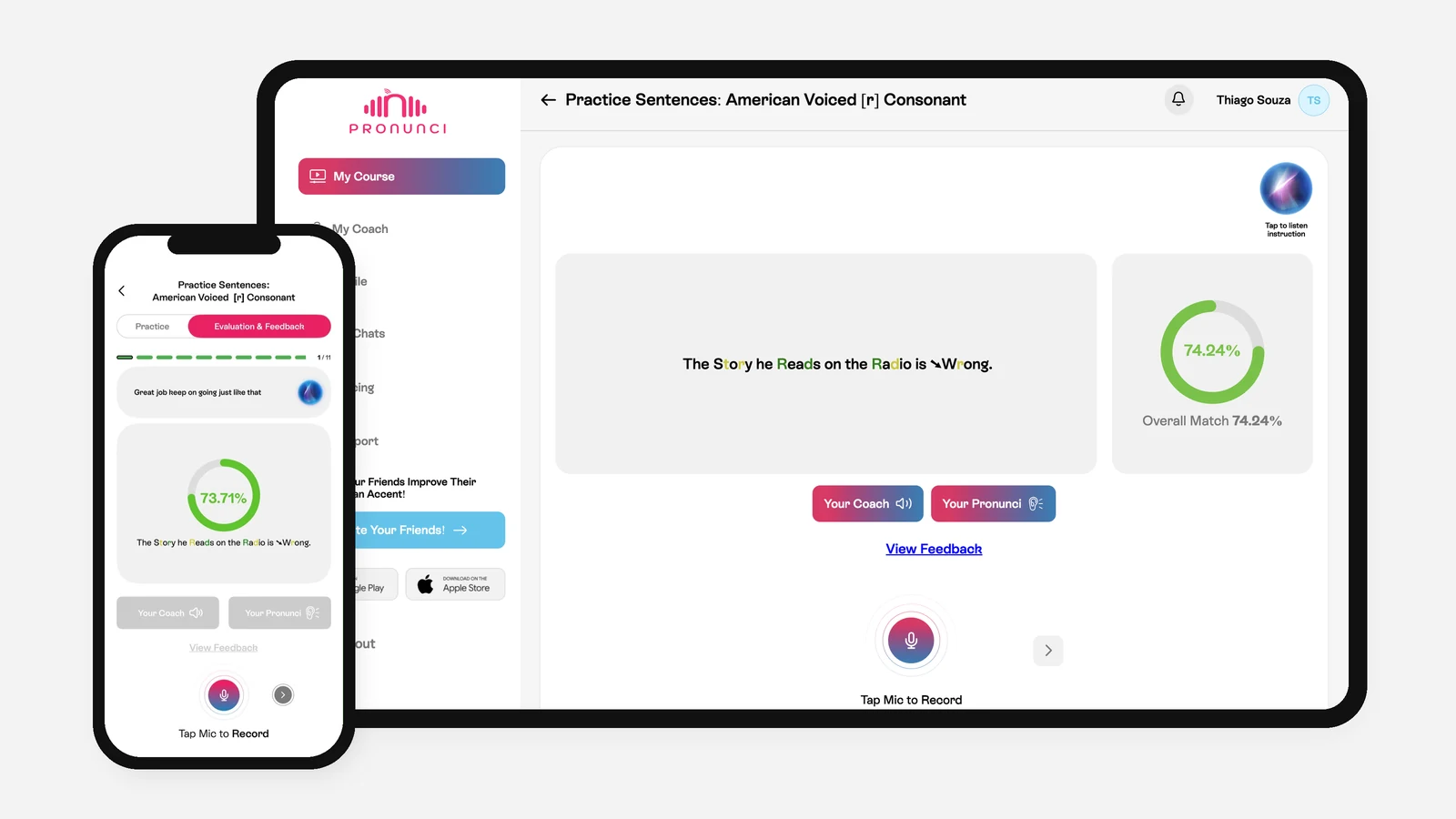
- Listen to Your CoachThe model American pronunciation of each practice sentence.
- Compare with Your PronunciYour own recorded pronunciation, side by side with the coach.
- Correct with feedbackThe match score and color-coded letters guide each correction.
A coach’s take on where learners actually go wrong
Most learners over-study the rule and under-practice the feel. Listen first, feel the voicing with your hand on your throat, then repeat, in that exact order, every time. In my sessions, the most persistent error is a learner’s native language treating /s/ and /z/ as interchangeable, so “goes” comes out as “ghost.” The fastest fix is contrasting minimal pairs out loud, ten times each, until your ear catches the buzz before your mouth does. Build that habit inside the five-minute routine above and it becomes automatic within a few weeks.
— Prof. Alex, Ph.D. Accent Coach
Turn the rule into fluent speech with InPronunci
Knowing the /s/, /z/, /ɪz/ rule gets you halfway. Hearing your own voice clearly enough to correct it is the harder half, and that’s where most self-study stalls out. InPronunci solves that gap with guided speech-organ lessons, the 2D sound simulator, and AI-driven feedback that flags voicing and suffix-duration errors most learners can’t catch on their own, a level of detail generic pronunciation-scoring apps simply don’t offer.
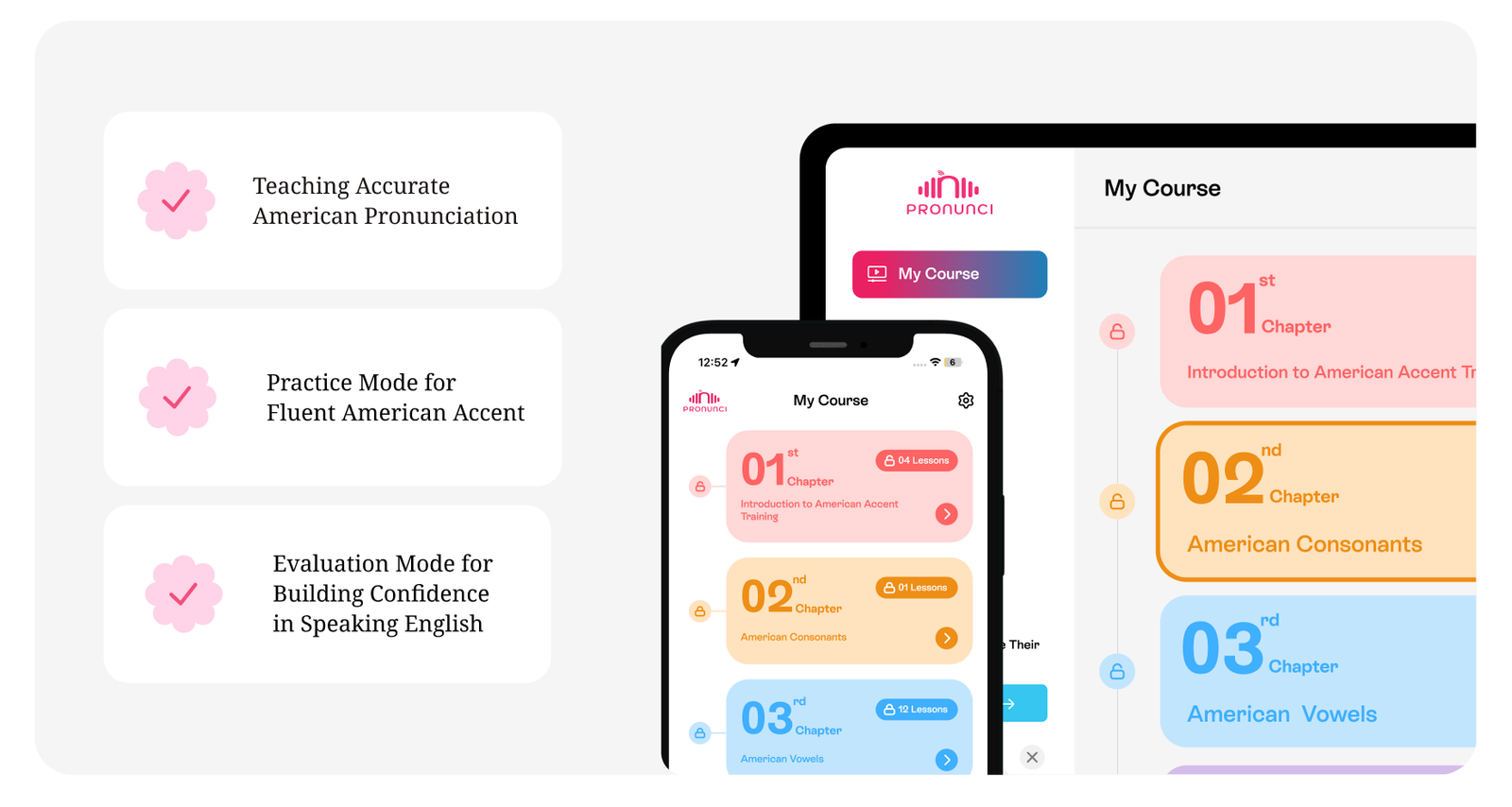
The full program builds from speech-organ awareness through consonants, vowels, and intonation, so endings like -s and -es aren’t practiced in isolation but as part of connected, natural speech. Start with the Basic Plan to explore the core lessons and 2D simulators, or move straight into the Premium Plan for one-on-one coaching alongside Prof. Alex’s guided method. For the complete curriculum, visit the InPronunci: American Accent Training Course and start your first onboarding chapter today.
Structured American Accent Training Course
From Speech Organs Education to American Intonation
The InPronunci course is built step by step: every chapter prepares the next one, and by the end of the course students receive a certificate.
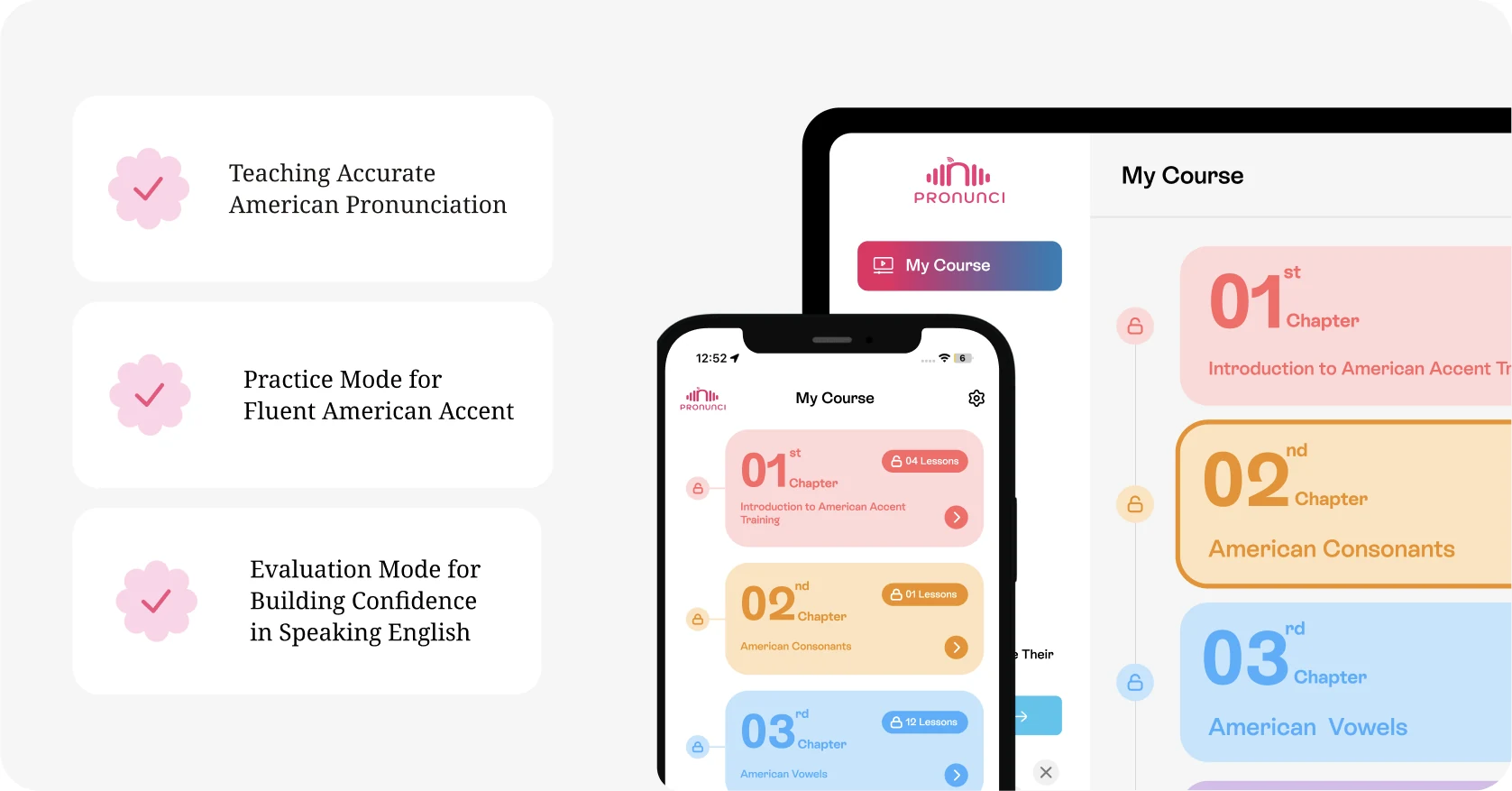
- Speech Organs EducationStudents learn how the speech organs work, along with the AI Accent Coach commands and feedback.
- American ConsonantsPractice and evaluate American consonants in phonetic exercises and practice sentences with the AI Accent Coach.
- American VowelsPractice and evaluate American vowels in phonetic exercises and practice sentences with the AI Accent Coach.
- IntonationLearn how intonation can change the meaning of what you say.
- CertificateBy the end of the course, students receive a certificate.
Sources
- Phonetic effects of morphology and context: Modeling the duration of word-final S in English with naïve discriminative learning (Cambridge PDF)
- Why are there three pronunciations for the plural “-s”? (ELL Stack Exchange)
Questions & Answers
FAQ
01How do you pronounce the s/es ending?
It depends on the final sound of the base word: /s/ after voiceless sounds like “cat” or “help,” /z/ after voiced sounds like “dog” or “key,” and /ɪz/ after sibilants like “bus” or “watch,” where it adds an extra syllable.
02What is the rule for S or ES?
The spelling “-es” is mostly used after sibilant sounds (buses, watches) or after -o and consonant plus -y patterns (potatoes, cities), but the actual sound always follows the voicing rule, not the spelling. Say the word aloud and check the final consonant sound to know whether it’s /s/, /z/, or /ɪz/.
03How do I pronounce es?
The “-es” spelling is usually pronounced /ɪz/, adding a whole extra syllable, when the base word ends in a sibilant sound such as /s/, /z/, /ʃ/, /tʃ/, or /dʒ/, as in “boxes” or “churches.” When the base word ends in a voiced vowel, like “goes,” the “-es” spelling is just pronounced /z/ with no extra syllable.
04What is the plural rule for words ending in “s”?
Words already ending in a sibilant sound take /ɪz/ in the plural, adding a syllable, so “bus” becomes “buses” and “glass” becomes “glasses.” This follows the same three-way voicing pattern used for verbs and possessives, which InPronunci’s speech-organ training practices alongside consonant clarity drills.
Recommended

ESL: Prof. Alex’s 6 Drills for American vs British Pronunciation
Follow Prof. Alex's six short drills to master American vs British pronunciation contrasts. Try minimal pairs and InPronunci's 2D simulator for guided...

American Accent Training Step by Step: 2026 Guide
Master your speech with our American accent training step by step guide. Improve clarity and confidence for meetings, presentations, and interviews.

Accent Reduction For Professionals: Methods That Work
Master workplace clarity. Discover effective accent reduction for professionals with proven methods for sound retraining, intonation, and daily practice — by Prof. Alex,
Plans
What InPronunci costs
InPronunci Basic
$35 per month
Chapter 1 is free after signup.
InPronunci Premium
$200 per month
Includes a coach:
Why InPronunci is worth the price
- Interactive Visual 2D Sound Simulators, built on 2D Sound Motion Technology developed by Prof. Alex, train your speech organs for each American sound.
- Prof. Alex's guided instructions in every lesson, like working with a real coach.
- The Advanced AI Accent Coach evaluates sounds, intonation, rhythm, stress, and connected speech against native American English speech (100 = native speaker).