
IPA for American English is the set of International Phonetic Alphabet symbols and example words that let you read, hear, and practice General American pronunciation with precision. The chart and drills below, developed with guidance from InPronunci: Accent Training App, give you consonants, vowels, r-colored sounds, and a daily practice routine, including the Interactive 2D Sound Video Simulator for the American [t] sound.
TL;DR:
- Recognizing IPA symbols alone is insufficient; consistent production practice and native speaker feedback are essential for accurate American English pronunciation.
- Focus on mastering the /θ/ and /ð/ sounds and the flapped /t/ because they cause most miscommunication in everyday speech and should receive early, prioritized practice.
- Using interactive charts with audio and visual articulation aids significantly improves long-term sound acquisition compared to static printouts.
- Regional differences like the cot-caught merger affect transcription accuracy and pronunciation, requiring awareness of regional vowel variations.
- Prioritize frequent and challenging sounds for initial mastery before attempting rarer ones, ensuring steady progress toward a native-like accent.
Table of Contents
- What is IPA for American English, and how do you use this chart?
- Consonants: the American IPA symbols you must know
- Vowels and diphthongs: mapping American vowels to IPA
- R-colored vowels and rhotic transcription
- Broad versus narrow transcription: what changes and why it matters
- Practice drills: minimal pairs, articulation steps, and a daily routine
- Reading IPA: stress marks, brackets, and transcription shortcuts
- Prof. Alex on how InPronunci builds IPA into real training
- What actually matters when you’re learning IPA for American English
- Turn chart knowledge into speaking skill with InPronunci
- Sources
- FAQ
What is IPA for American English, and how do you use this chart?
The International Phonetic Alphabet gives every English sound one unambiguous symbol, which matters because English spelling almost never does. The word “through,” “though,” and “tough” share letters but not a single vowel sound. IPA fixes that problem by mapping sound to symbol, one to one, so you can look at /run/ and know exactly what your tongue and lips need to do.
An interactive American IPA chart organizes sounds into four zones: consonants, monophthong vowels, diphthongs, and r-colored vowels. Each symbol usually sits next to a clickable audio example, so you hear a native pronunciation before attempting the sound yourself. That sequencing matters. Reading a symbol and guessing at its sound trains bad habits faster than not knowing the symbol at all.
Here’s how to get real use out of a chart like this:
- Click each symbol first and listen twice before saying anything out loud.
- Use minimal-pair audio (word pairs like “ship” and “sheep”) to train your ear to hear the difference before you try producing it.
- Record yourself repeating the example word, then play your recording back next to the native audio.
- Download a printable PDF version for symbols you keep forgetting, and tape it near your desk or mirror.
- Return to the interactive version when you want audio and want to test yourself on symbol recognition speed.
Printed charts are useful for quick reference and for marking up your own trouble sounds with a pen. Interactive charts with audio, like the Interactive American IPA chart, are more effective for the listening and comparison work that actually changes how you speak, since they let you isolate one sound and repeat it dozens of times in a single sitting.
Consonants: the American IPA symbols you must know
General American English uses 24 consonant symbols, and most of them map closely to their letter equivalents, which is a relief compared to the vowel system. The tricky ones are the symbols that don’t look like any letter you’d expect, plus a handful of pairs that confuse even advanced speakers.
A learner-friendly rundown of the full consonant set, complete with example words, is available through the IPA pronunciation guide, which is worth bookmarking as a reference table. For daily practice, focus on these:
- /θ/ as in “think” — tongue tip between the teeth, voiceless, air flows past the tongue.
- /ð/ as in “this” — same tongue position as /θ/, but the vocal cords vibrate.
- /ʃ/ as in “shoe” — lips rounded slightly, tongue pulled back from the /s/ position.
- /ʒ/ as in “measure” — the voiced twin of /ʃ/, rare at the start of English words.
- /ŋ/ as in “sing” — back of the tongue against the soft palate, air through the nose.
- /ɹ/ as in “red” — many resources simplify this to /r/ for readability, though the actual sound involves no tongue tap or trill.
- /t/ as in “top” — often produced as a tapped [ɾ] between vowels, covered in detail below.
The pairs that trip up most learners are /θ/ versus /ð/, /ʃ/ versus /to/, and /l/ versus the syllabic [l̩] found in words like “bottle.” That last one isn’t a full vowel plus /l/. It’s the consonant carrying its own syllable weight, no vowel required. InPronunci’s consonant pronunciation guide breaks down articulation for each of these in more depth, sound by sound.
Vowels and diphthongs: mapping American vowels to IPA
American English vowels split into two groups that behave differently: tense vowels, which can end a word on their own, and lax vowels, which almost always need a following consonant. That single distinction explains why “see” works but “si” doesn’t feel complete to a native speaker’s ear, while “sit” sounds fine.
Standard vowel charts for American English include the following core symbols, with example words:
- /i/ as in “see” (tense) and /ɪ/ as in “sit” (lax) — a pair that causes most of the confusion between “beach” and its vulgar-sounding near miss.
- /ɛ/ as in “bed” and /æ/ as in “cat.”
- /ʌ/ as in “cup” and /ə/ (schwa) as in the second syllable of “sofa.”
- /u/ as in “boot” and /ʊ/ as in “book.”
- /ɔ/ as in “law” and /ɑ/ as in “father.”
Schwa deserves special attention because it’s the most common vowel sound in the language, showing up in unstressed syllables constantly, and it never carries stress. Standard American vowel inventories also document the caret symbol /ʌ/ separately from schwa, even though many speakers produce them almost identically in casual speech, a distinction covered well in the University of Arizona’s phonetics archive.
Five diphthongs round out the vowel system: /aɪ/ (“time”), /aʊ/ (“now”), /ɔɪ/ (“boy”), /eɪ/ (“day”), and /oʊ/ (“go”). Notice that /eɪ/ and /oʊ/ are technically single tense vowels in many phonemic analyses, but pronunciation resources often transcribe them as diphthongs anyway because that’s closer to how they actually sound in connected speech.
One regional wrinkle matters for transcription accuracy: the cot-caught merger. Millions of American speakers, especially in the West and parts of New England, pronounce “cot” and “caught” identically, collapsing /ɑ/ and /ɔ/ into one vowel. If your reference material assumes a merger your ear doesn’t have, or vice versa, some transcriptions will look wrong when they’re just regional. InPronunci’s guide to mastering American vowels walks through mouth position for each vowel if you want a slower, more hands-on approach.
R-colored vowels and rhotic transcription
American English is rhotic, meaning the /r/ sound gets pronounced after vowels, unlike many British dialects that drop it. That rhotic quality creates a distinct vowel category: r-colored vowels, transcribed as /ɝ/ in stressed syllables and /ɚ/ in unstressed ones. Some resources instead write these as /ɜr/ and /ər/, a purely editorial choice rather than a different sound.
You’ll see the r-colored vowel in words like:
- “nurse” (/nɝs/), where the stress falls directly on the r-colored vowel.
- “butter” (/ˈbʌtɚ/), where the second syllable carries the unstressed version.
- “purple” (/ˈpɝpəl/), showing the stressed form again.
To hear and produce this sound accurately, pull your tongue back and curl the tip slightly upward while keeping your lips relaxed, not rounded. Most learners overcorrect by rounding their lips, which pulls the sound toward a different vowel entirely. Record the word “bird” ten times and compare each attempt against a native model before moving to sentence-level practice.
Broad versus narrow transcription: what changes and why it matters
Broad transcription, written between slashes like /ˈwɔtɚ/, shows the underlying phonemes, the sounds a word is built from at the abstract, meaningful level. Narrow transcription, written in brackets like [ˈwɔɾɚ], captures the actual physical detail of how the word gets pronounced, including sound changes that don’t affect meaning.
The word “water” is the textbook example. Broadly, it’s /ˈwɔtɚ/, a /t/ between two vowels. Narrowly, most Americans actually produce that /t/ as a quick tap of the tongue against the ridge behind the teeth, a sound closer to a fast /d/, transcribed [ɾ] and called flapping. This is documented clearly in work on broad and narrow transcription from the University of Manitoba’s phonetics resources.
For most learners, broad transcription is the right daily tool. It tells you which sound to aim for without burying you in phonetic detail that shifts by speaker and region. Reach for narrow transcription only when you’re specifically troubleshooting a sound that keeps coming out wrong, like the flapped T, where the physical detail actually explains the gap between how you’re saying it and how natives say it. InPronunci’s breakdown of the flap T sound is built around exactly this kind of narrow, targeted correction.
Practice drills: minimal pairs, articulation steps, and a daily routine
Reading a chart teaches recognition. Producing accurate sounds under real speaking pressure takes repetition with feedback, and that’s where most self-taught learners stall out. You know the symbol, but your mouth hasn’t learned the movement yet.
Start with minimal pairs targeting your specific confusions:
- /i/ versus /ɪ/: “leave” vs. “live,” “sheep” vs. “ship.”
- /ʌ/ versus /ə/: “cup” vs. the unstressed “a” in “sofa.”
- /θ/ versus /ð/: “thin” vs. “then.”
- /t/ versus [ɾ]: “writer” vs. “rider,” a pair that sounds nearly identical in fast American speech because of flapping.
Once you can hear the difference reliably, work through this five-step articulation sequence for each new sound: get aware of what your tongue, lips, and jaw are doing; watch the movement in a mirror; record yourself saying the target word ten times; compare your recording against a native model, sound by sound; then speed up to natural conversational pace once the isolated sound is accurate.
That third and fourth step, record and compare, is where most self-study breaks down without a structured tool, because catching your own errors by ear alone is genuinely hard even for advanced speakers. Pairing recorded practice with immediate comparative feedback speeds up correction meaningfully compared to guessing on your own.
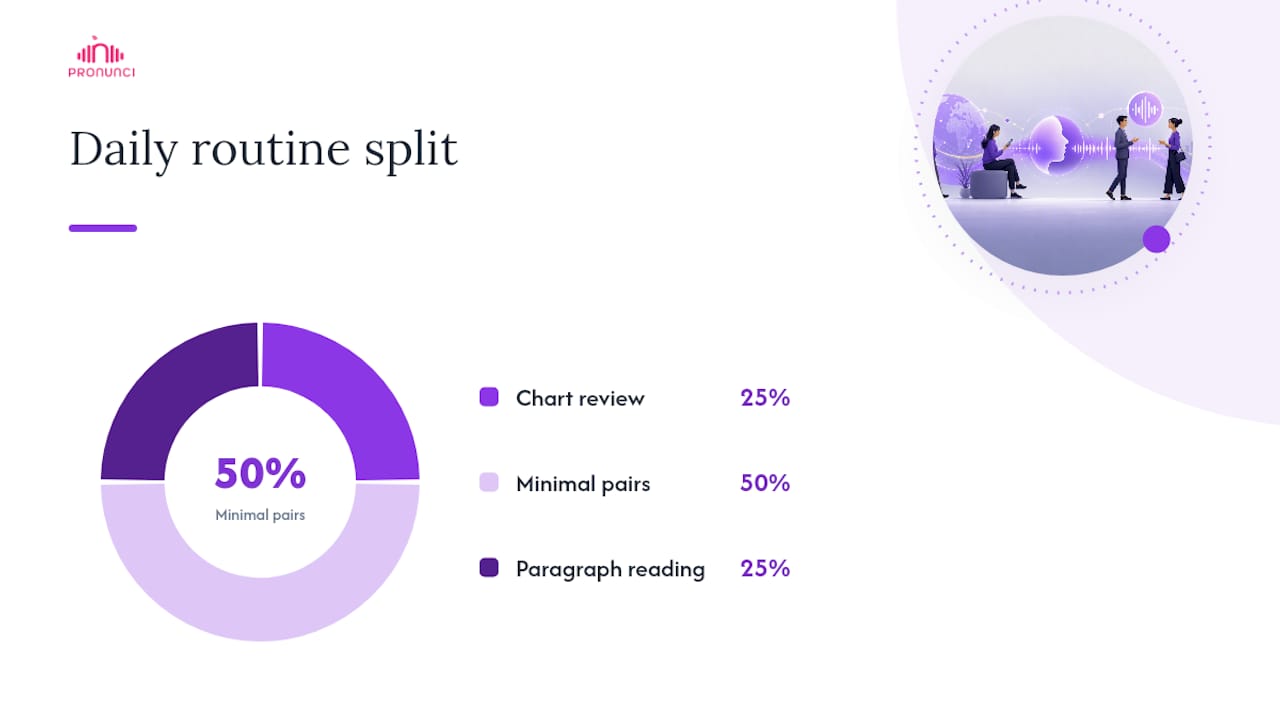
For a daily routine, spend 10 to 20 minutes: five minutes reviewing chart symbols and audio for sounds you’re targeting, ten minutes on minimal pairs and recorded repetition, and five minutes reading a short paragraph aloud focused on natural rhythm rather than individual sounds. Watch the
before your flapping practice specifically. Seeing the tongue tap visualized in motion, rather than just described in text, makes the movement far easier to copy.
Pro Tip: Practice the flapped [ɾ] in “butter” and “little” before tackling longer sentences. Once your tongue learns that fast, light tap in isolation, it carries automatically into connected speech without you having to think about it.
Reading IPA: stress marks, brackets, and transcription shortcuts
Dictionary and textbook transcriptions follow conventions that look confusing until you know the code, and then they become second nature almost immediately.
- A small vertical mark before a syllable, ˈ, shows primary stress, as in /ɪmˈpɔrtənt/ for “important.”
- A lower mark, ˌ, shows secondary stress in longer words, as in /ˌɪntərˈnæʃənəl/.
- A small vertical line under a consonant, as in bottle’s [l̩], marks a syllabic consonant, one that carries a syllable without a vowel beside it.
- A raised h, [ʰ], marks aspiration, the small puff of air after voiceless stops like the /p/ in “pin.”
- A question-mark-without-the-dot symbol, [ʔ], marks a glottal stop, the catch in your throat you hear in “uh-oh.”
You’ll also notice that some resources write /r/ where others write /ɹ/, or use /ɜr/ instead of /ɝ/. These aren’t disagreements about the sound itself, they’re editorial choices made for readability and typing convenience, as noted in resources like the IPA pronunciation guide. The simple rule: slashes / / mean broad, phonemic transcription; brackets [ ] mean narrow, phonetic detail. Learn to read across both conventions rather than expecting every source to match exactly.
Prof. Alex on how InPronunci builds IPA into real training
I’ve spent more than 20 years teaching American pronunciation, and the pattern I see most often is learners who can recite the IPA chart from memory but still can’t produce half the sounds correctly under pressure. Symbol knowledge and articulation skill are two different competencies, and most self-study resources only build the first one.
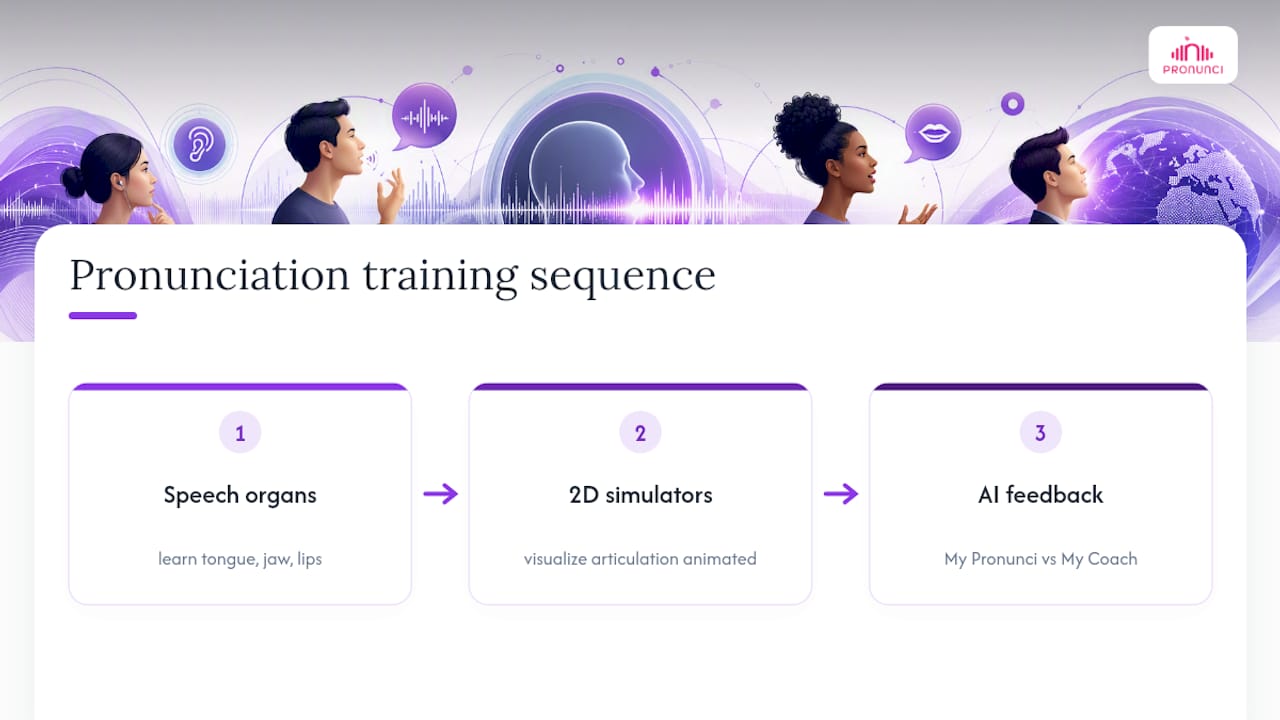
InPronunci sequences training to build both. It starts with speech-organ education, teaching you what your tongue, jaw, and lips are actually doing before you attempt a single sound, an approach detailed on our speech organs training page. From there, learners move into Interactive 2D Sound Video Simulators, which visualize articulation directly, followed by AI Accent Coach feedback that compares your recorded attempt (My Pronunci) against a native model (My Coach).
The [t] sound simulator embedded throughout this guide is one example of that method in action. Watching the tongue tap animated in real time, rather than reading a description of a tap, closes the gap between knowing the symbol /ɾ/ and actually producing it correctly in a word like “water.” That visual, comparative feedback loop is what turns chart knowledge into speaking skill.
What actually matters when you’re learning IPA for American English
Most IPA resources treat the chart as the finish line. Memorize the symbols, match them to letters, done. That’s backwards, and it’s why so many advanced English speakers can transcribe a word perfectly on paper while mispronouncing it out loud. The chart is a map, not the trip.
What the evidence on articulation training actually supports is this: symbol recognition should take you a week, maybe two. The real work is in the production and feedback loop, saying the sound, hearing where it drifted from the model, and correcting it, repeated across dozens of sessions until the movement becomes automatic. Skipping straight to sentence-level practice before individual sounds are solid just cements the same errors at a faster pace.
If you’re serious about accent training, prioritize sounds by frequency and difficulty, not alphabetical order on the chart. Master the flapped T, the /θ/ and /ð/ pair, and your r-colored vowels before you worry about rarer sounds like /ʒ/. Those three areas cause more miscommunication in everyday American speech than almost anything else on the chart, and I’d argue they deserve 80 percent of a beginner’s early practice time.
— Prof. Alex., Ph.D. Accent Coach
Turn chart knowledge into speaking skill with InPronunci
Working through symbols and audio examples on your own gets you recognition. It rarely gets you correction, because you can’t always hear your own errors the way a trained ear or an AI model can. InPronunci: Accent Training App closes that gap with the exact sequence covered in this guide: speech-organ awareness, Interactive 2D Sound Video Simulators, and AI Accent Coach feedback that compares your recording against a native model, sound by sound.
Download on the App Store | Get it on Google Play
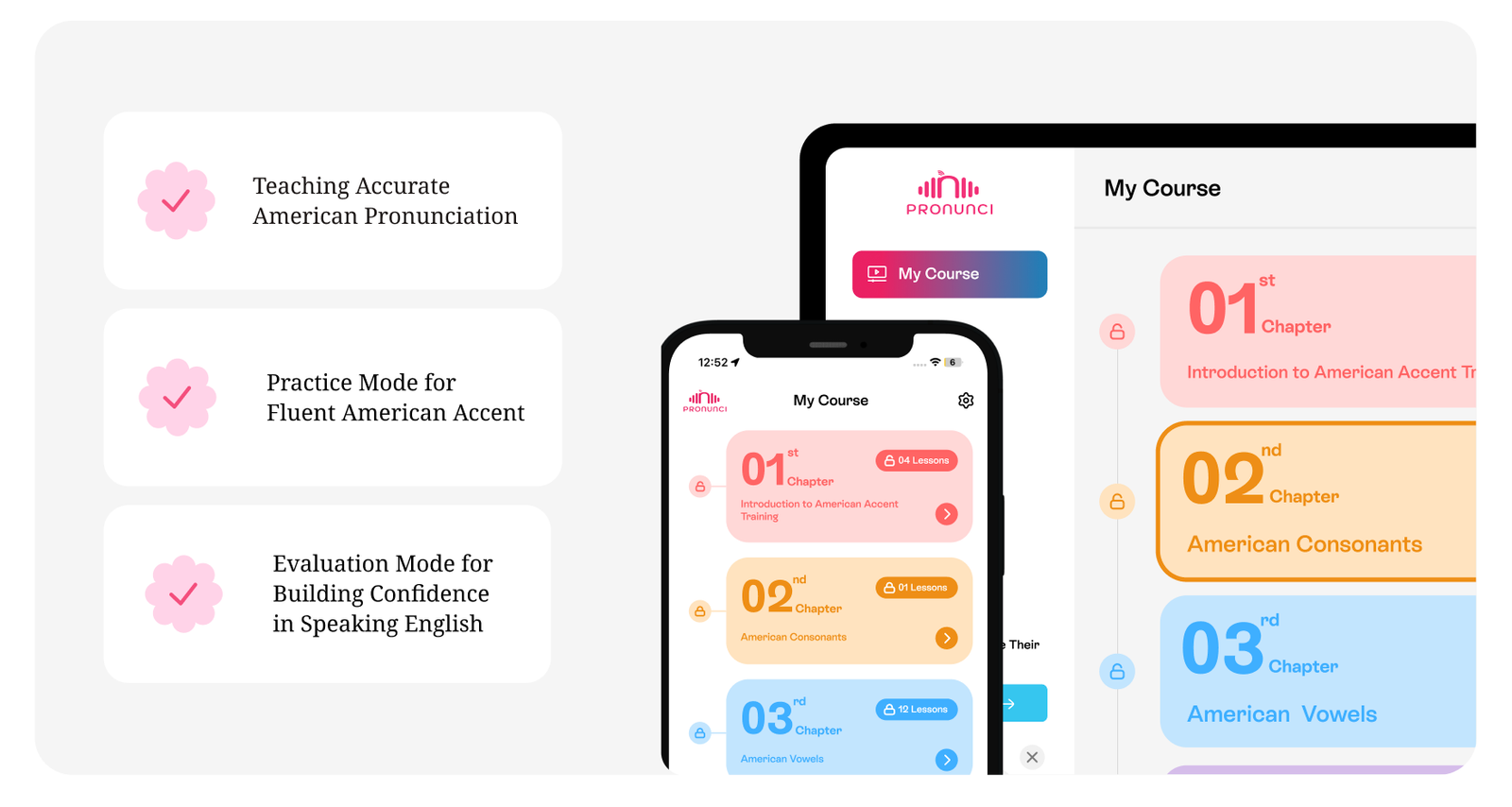
The program moves through four chapters, from speech organs through consonants, vowels, and intonation, with 13 consonant sessions and 12 vowel sessions built around the same broad-to-narrow transcription logic explained above. If you found the flapped T section useful, the full American Accent Training Course covers that sound and dozens more with guided drills and progress tracking. Start with the free onboarding chapter and see how the beginner practice plan fits your daily routine before committing to a paid tier.
Sources
- Broad and narrow transcription (University of Manitoba)
- The sounds of Standard American English (University of Arizona archive)
- Interactive American IPA chart
FAQ
What are the phonetics for American English?
American English uses General American phonetics, roughly 24 consonant sounds and a number of vowel sounds and diphthongs depending on dialectal variations such as the cot-caught merger, all represented through IPA symbols with matching example words.
Is there an American version of the phonetic alphabet?
There’s no separate alphabet, but American English pronunciation guides commonly use a General American symbol set, including r-colored vowels like /ɝ/ and /ɚ/, that differs somewhat from charts built for British or other English dialects.
How many IPA symbols are there in American English?
Most General American charts list 24 consonant symbols and a core set of vowel and diphthong symbols, though exact counts shift slightly depending on whether a resource treats certain diphthongs or r-colored vowels as separate categories.
What are the key differences between American IPA and English IPA?
The biggest differences involve rhoticity, American English pronounces /r/ after vowels while many British varieties drop it, plus vowel quality shifts like the broad /ɑ/ American speakers use in words like “dance” versus the different vowel British speakers use there.