
Thought groups are short chunks of speech, usually a few words to a full clause, built around one stressed focus word. Grouping your words this way, instead of speaking in a flat string of syllables, is the fastest route to sounding clear and natural. The immediate fix: pick the last important word in each chunk, stress it a little harder, and drop in a brief pause right after.
TL;DR:
- Most natural speech patterns rely on grouping ideas with a focus word and a brief pause, which improves clarity and comprehension.
- Identifying thought groups involves listening for natural pauses and pitch changes, and marking equivalent breaks in transcripts daily accelerates learning.
- Effective chunking follows four rules: stress only one focus word per group, emphasize the last content word, pause briefly without stopping, and keep grammar intact.
- Formal speech emphasizes shorter, deliberate groups with longer pauses, while casual speech elongates groups and shortens pauses, depending on context.
- Guided practice with tools like viewing native models and recording oneself speeds up mastery more than passive listening alone.
Table of Contents
- What Are Thought Groups in English Speech?
- How Do You Identify Thought Groups When Listening or Reading?
- Rules for Chunking and the Grammar Behind Thought Groups
- Practice Drills to Build Thought Group Fluency
- Why Expert Feedback Speeds Up Thought Group Mastery
- How Thought Groups Affect Reading Comprehension and Fluency
- Do Thought Groups Change Across English Dialects and Registers?
- Common Chunking Mistakes and a Short Practice Plan
- Practice Thought Groups With Guided Feedback From InPronunci
- Sources
- FAQ
What Are Thought Groups in English Speech?
A thought group is a short segment of speech that carries one complete idea and one focus word, the word that gets the strongest stress in that chunk. That focus word is almost always the last content word in the group, a noun, verb, adjective, or adverb that carries real meaning rather than a grammatical function word like “the” or “of.” When you hit that word with slightly more pitch, length, and volume, then pause, you signal to the listener: this idea is finished.
Read these two versions of the same sentence aloud and listen to what changes:
- “I saw my brother’s / friend / at the store.” (You saw a friend belonging to your brother.)
- “I saw my brother / friend / at the store.” (You’re addressing someone as “friend” while mentioning your brother.)
The words barely change, but the grouping and pausing shift the meaning entirely. That’s the practical power of chunking in English: it isn’t decoration, it’s how meaning gets delivered. Native speakers do this automatically. Most ESL speakers, especially those trained through reading rather than listening, speak in a steady stream of separate words instead, which flattens intonation and buries the focus word a listener needs to catch the idea.
Try another pair:
- “My sister, who lives in Denver, / called me yesterday.” (Extra detail, then the main point.)
- “My sister who lives in Denver / called me yesterday.” (Distinguishing which sister, no comma pause.)
Same words, different chunk boundaries, different grammar entirely.
How Do You Identify Thought Groups When Listening or Reading?
Spotting thought groups is a trainable skill, not a talent you either have or don’t. Follow this sequence:
- Start with punctuation. Commas, periods, and conjunctions like “and,” “but,” and “because” often mark a boundary, though not every boundary has visible punctuation.
- Listen for the pause, not the comma. Native speakers insert a short break, sometimes just a fraction of a second, at the end of a group even mid-sentence with no punctuation at all.
- Mark up a transcript. Take a short talk or podcast transcript and draw a slash mark everywhere you hear a pause. This is a standard classroom exercise for training the ear to catch chunk boundaries in real speech.
- Follow along while listening. Read the transcript silently while the audio plays, watching where your eye naturally wants to pause versus where the speaker actually pauses.
- Shadow the speaker. Play a short clip, pause it, and repeat the exact chunk you just heard, matching pause length and stress placement as closely as you can.
- Watch pitch, not just pause length. The pitch usually rises slightly through the group and falls or steadies on the focus word, giving you a second cue beyond silence alone.
Do this daily with something short, even sixty seconds of audio, and the pattern starts to feel automatic within a couple of weeks.
Rules for Chunking and the Grammar Behind Thought Groups
Four rules cover almost every situation you’ll run into:
- One focus word per group. If you find yourself stressing three words in a row, the group is probably too long. Break it.
- Stress the last content word, not the last word overall. Function words like “to,” “at,” or “the” rarely get the emphasis, even when they end the sentence.
- Pause briefly, don’t stop dead. A thought-group pause is closer to a comma’s worth of silence than a period’s. Overpausing makes speech sound robotic; underpausing runs ideas together.
- Keep grammar and meaning intact. A group has to make sense as a unit. Splitting an idea in a place that breaks its grammatical or semantic logic confuses the listener rather than helping them.
Certain grammatical structures form natural thought-group boundaries almost every time:
| Structure | Example |
|---|---|
| Noun phrase | “the tall building on Fifth Avenue” |
| Prepositional phrase | “after the meeting” |
| Verb phrase | “has been waiting for hours” |
| Dependent clause | “because the flight was delayed” |
Pro Tip: Speed changes group length, not the rules themselves. Fast, casual speech tends to fold several short phrases into one longer group; careful, formal speech breaks the same sentence into more, shorter groups. Neither is wrong, but consistency within a sentence is what keeps you sounding fluent rather than random.
Practice Drills to Build Thought Group Fluency
Structured, escalating practice beats random repetition. This four-stage sequence mirrors how ESL pronunciation courses build the skill, moving from heavy support to none at all.
- Warm-up marking. Take a short paragraph, mark every likely pause with a slash, and underline the focus word in each group. Do this before you speak a single word aloud.
- Shadow with the transcript. Play a native-speaker recording, transcript in hand, and repeat each group immediately after hearing it, copying pause length and pitch as closely as possible.
- Re-chunk a long sentence. Take a sentence with more than fifteen words and try grouping it two different ways. Notice how the emphasis, and sometimes the meaning, shifts.
- Record and self-evaluate. Record yourself reading the marked paragraph, then listen back specifically for three things: did you pause where you marked, did you stress the right word, and did the pause length feel natural rather than choppy.
- Drop the scaffolding. Once a passage feels comfortable, retell it in your own words without the transcript, keeping the same grouping instincts.
Pro Tip: When you listen back to your own recording, resist the urge to judge your accent overall. Listen for one thing at a time, pause placement on one pass, focus-word stress on the next. Trying to fix everything at once is why most self-practice stalls.
Why Expert Feedback Speeds Up Thought Group Mastery
Reading about thought groups gets you halfway there. Hearing exactly where your own chunking breaks down gets you the rest of the way, and that’s the gap self-study alone struggles to close. Comparing your recording against a native model, catching the half-second where you rushed past a focus word, is far easier with guided correction than with guesswork.
This is where InPronunci: Accent Training App fits directly into thought-group practice, built by Prof. Alex, a linguist and American accent coach with over 20 years of teaching and private coaching experience. The app’s training method has you record a sentence, compare it against a native model side by side with your own recording, then review AI feedback on where your stress and pausing landed.
For chunking specifically:
- Use the intonation and emphasis sessions to isolate focus-word stress before combining it with full-sentence pacing.
- Record the same sentence multiple times, checking View Feedback analysis for consistency in pause placement.
- Watch the
while practicing sentences that end a thought group on a [t], since a clipped or dropped final consonant right before a pause is one of the most common ways chunking gets muddy.
Chunking is fundamentally a memory and processing shortcut. Grouping speech into manageable units reduces the cognitive load) for both speaker and listener, which is exactly why deliberate, corrected practice moves the needle faster than passive listening alone.
How Thought Groups Affect Reading Comprehension and Fluency
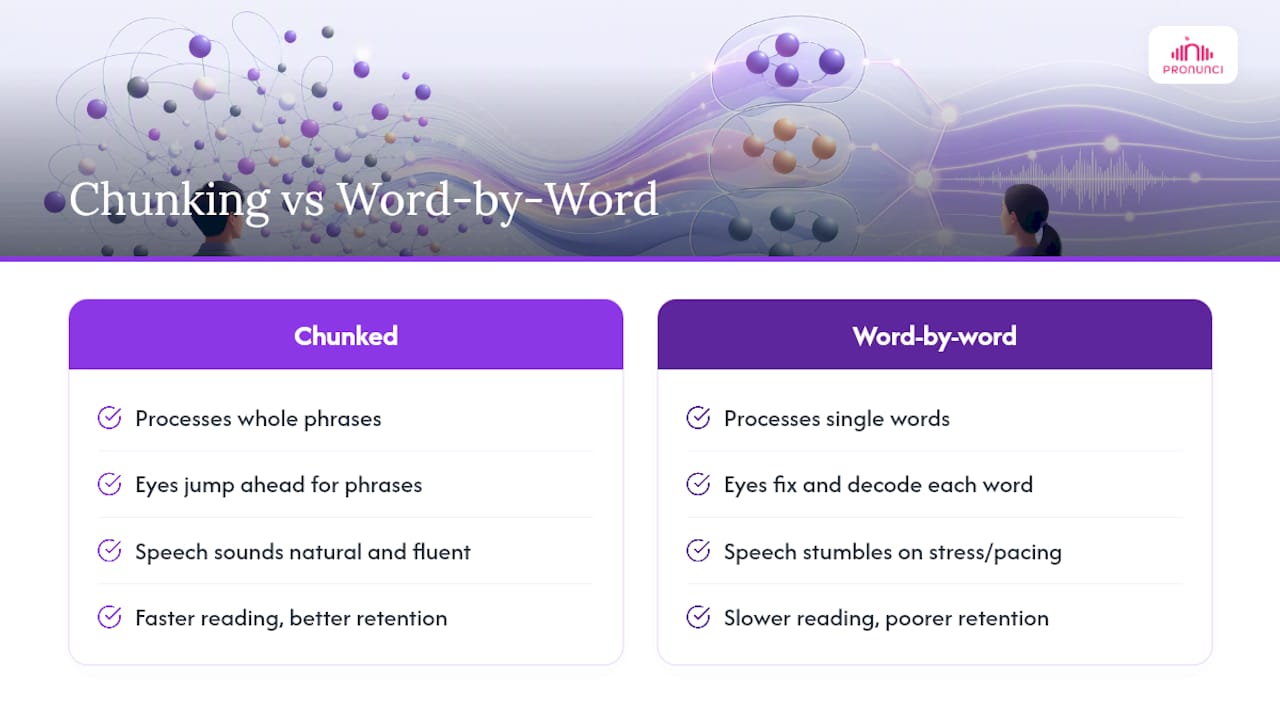
Thought groups don’t just shape how you speak. They shape how efficiently you read and how fluent you sound doing it. When you read aloud in flat, word-by-word chunks, you’re forcing your listener (and often yourself) to reconstruct meaning from scratch, word by word, instead of receiving it in pre-packaged units.
Fluent readers, including fluent readers of a second language, process text in chunks rather than single words. Your eyes actually jump ahead to grab a whole phrase before your voice produces it, which is why skilled oral readers sound natural even on unfamiliar text. Learners who read word-by-word, by contrast, often stumble on stress and pacing precisely because they’re deciding what to say one word at a time instead of seeing the phrase as a unit.
Practicing thought groups on the page carries straight over into comprehension speed. If you can glance at “after the meeting ends” and process it as one grammatical and semantic unit, you read faster and retain more than if you decode it word by word. The same skill that makes your speech sound native also makes your silent reading faster, because both rely on recognizing which words cluster together as a single idea. This is one reason marking transcripts for pauses works so well: it trains your eye and your voice to chunk simultaneously, rather than treating reading and speaking as separate skills.
Do Thought Groups Change Across English Dialects and Registers?
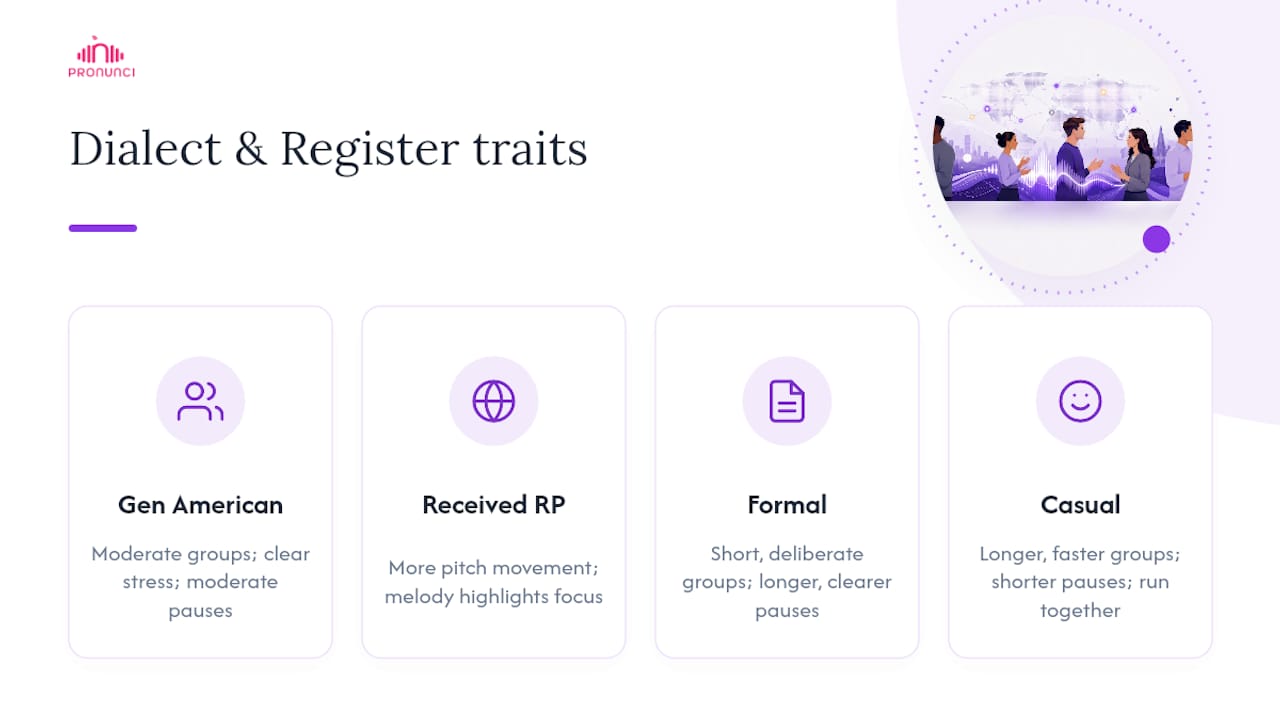
The core mechanism, one focus word, a following pause, stays consistent across English varieties. What shifts is pace, pause length, and how much stress contrast a speaker uses. General American speech tends toward moderate-length groups with a clear but not exaggerated stress on the focus word. British Received Pronunciation often uses slightly more pitch movement across the group, which can make the focus word stand out through melody as much as loudness.
Register matters just as much as dialect. Formal registers, a prepared speech, a news broadcast, an academic lecture, tend to use shorter, more deliberate thought groups with longer, clearer pauses. This gives the listener more processing time and signals structure. Casual conversation compresses the same content into longer, faster groups with shorter pauses, sometimes running two grammatical units together where formal speech would split them.
This has a direct, practical consequence for learners: the “correct” thought-group length isn’t fixed. A newscaster’s careful, short-chunked delivery is a different, equally valid target than a friend’s rapid-fire storytelling. If your goal is professional clarity, business presentations, interviews, academic speaking, model your chunking on the more deliberate, formal end of the spectrum first. You can always compress groups and speed up once the underlying stress-and-pause pattern is solid. Trying to sound casually fast before you’ve nailed where the focus word goes tends to produce mumbled, hard-to-follow speech instead of natural fluency.
Common Chunking Mistakes and a Short Practice Plan
The three mistakes I see most often: stressing every word instead of one focus word per group, pausing at random spots that ignore grammar, and reading in a monotone with no pauses at all, usually from over-preparation on vocabulary and under-preparation on rhythm. The fix for all three is the same: mark before you speak.
Here’s a 7 to 14 day plan. Days 1 to 3, mark and shadow one short paragraph daily. Days 4 to 7, re-chunk longer sentences two different ways and notice the meaning shift. Days 8 to 14, record daily, compare against a native model, and track whether your pause placement gets more consistent. Keep your early recordings. The improvement is usually more obvious than it feels in the moment.
— Prof. Alex., Ph.D. Accent Coach
Practice Thought Groups With Guided Feedback From InPronunci
Marking transcripts and shadowing recordings gets you real progress, but knowing whether your pause landed in the right place, or your focus word actually carried enough stress, is hard to judge from inside your own head. InPronunci: Accent Training App closes that gap with side-by-side native comparison instead of leaving you to guess.
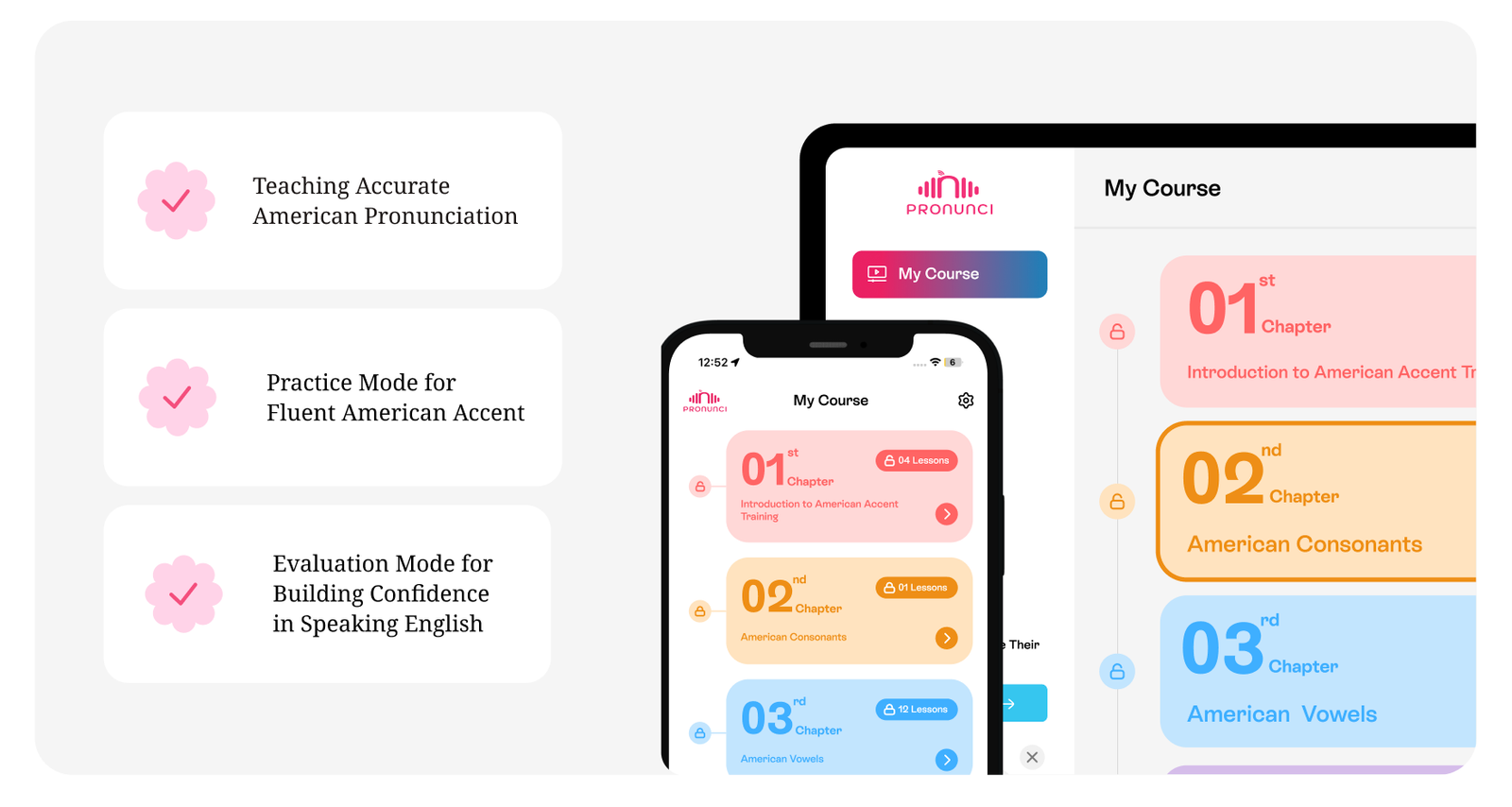
The American Intonation and Emphasis chapter builds directly on the chunking work covered here, walking you through rhythm, stress, and connected speech using guided drills, AI Accent Coach feedback, and the same Interactive 2D Sound Video Simulator for the [t] sound. The free onboarding chapter is a good place to start if you want to test the recording-and-comparison workflow before committing to a full plan. Once you’re ready to go deeper, the InPronunci: American Accent Training Course walks through the full four-chapter program on desktop, from speech-organ basics through advanced intonation control, and pairs well with the app’s daily practice mode. For a structured, day-by-day approach to building this into a habit, the step-by-step curriculum guide lays out a practical starting sequence.
Get the app on Apple or Google Play, start with the free onboarding chapter, and record your first marked paragraph today to see exactly where your chunking needs work.
Sources
FAQ
What Are the 7 Rules for Clear English Speaking?
Common versions focus on stressing content words, weakening function words, linking words across boundaries, using clear thought groups with pauses, matching intonation to meaning, controlling speech rate, and practicing with feedback rather than in isolation.
What Are the Four Types of Pronunciation Skills Learners Focus On?
Most pronunciation programs, including InPronunci’s four-chapter structure, organize training around speech-organ awareness, consonants, vowels, and intonation with emphasis, since these cover both individual sounds and connected speech patterns like thought groups.
How Do Thought Groups Improve Intelligibility?
Thought groups signal where one idea ends and another begins through a brief pause and a stressed focus word, which gives listeners time to process meaning instead of parsing a continuous, unbroken stream of syllables.
What’s a Good First Exercise for Practicing Thought Groups?
Take a short transcript, mark a slash wherever you hear a pause on the recording, underline the focus word in each group, then shadow the recording matching those same pause points.
Can InPronunci Help Me Practice Thought Groups Specifically?
Yes. InPronunci’s intonation and emphasis sessions target focus-word stress and pausing directly, and the AI Accent Coach feedback lets you compare your recorded pauses and stress against a native-speaker model.