


Self-study pronunciation usually stalls for one reason: you repeat errors into motor memory because no external listener or diagnostic tool tells you what you’re actually producing. The fix is straightforward, though not easy. Add reliable corrective feedback and pair it with targeted perception-production drills. Here are three things you can do right now:
- Record one sentence and send it to a trained listener or AI tool for a single intelligibility-focused correction.
- Practice one minimal pair or prosodic target for 10 minutes with guided feedback on each attempt.
- Schedule weekly blinded-listener checks so someone who doesn’t know what you meant rates how clearly you were understood.
Those three steps won’t replace a structured program, but they will immediately interrupt the cycle of reinforcing mistakes. The rest of this guide explains why that cycle forms, what the research says about breaking it, and how to build a practice routine that produces real, measurable gains.


Without corrective feedback, pronunciation self-study typically reinforces errors into motor memory rather than correcting them, and structured guided practice with measurable checkpoints is the most reliable path to real intelligibility gains.
Why self-study pronunciation fails without guidance: the error-entrenchment problem
Every time you repeat a mispronounced sound, your brain strengthens the motor pattern that produced it. This is error-entrenchment, and it’s the core reason why self-study pronunciation challenges are so persistent. Repetition alone doesn’t fix errors. It cements them.
The deeper problem is perceptual. Adults who grew up speaking a different language have already undergone perceptual narrowing, a process where the brain tunes itself to the sound categories of the native language and loses sensitivity to contrasts that don’t exist in it. Perceptual narrowing and the perceptual magnet effect mean you often cannot hear the distinction you’re failing to produce. You listen to your own recording, it sounds correct to you, and you move on. The error stays.
Consider a common example. A learner whose first language is Spanish or Mandarin practices the English /r/ sound in isolation. In a slow, careful drill, it sounds close enough. But in connected speech, the tongue position shifts, the vowel before it changes, and the sound collapses back toward the native-language approximant. The learner hears “good enough.” A native listener hears something different. Without an external correction at that moment, the wrong motor pattern gets another repetition.
Pronunciation teachers and ELT researchers have noted for years that pronunciation is frequently neglected in curricula and teacher preparation, which means many learners never receive the guided feedback they need in a classroom setting either. Self-study fills that gap, but without the diagnostic component, it often makes the problem worse.
Watch for these signs that error-entrenchment has set in:
- You sound accurate in slow, rehearsed speech but make the same errors in natural conversation.
- Listeners rarely correct you, not because you’re right, but because they’ve adjusted to your pattern.
- You’ve been practicing the same sounds for months with no measurable change in listener comprehension.
- You feel more confident but your intelligibility scores haven’t improved.
Pro Tip: Record yourself reading the same five sentences every two weeks in a natural, conversational pace, not a careful reading pace. The gap between your careful and natural speech is where entrenchment lives.
What the science says about why external feedback is necessary
Motor memory and perceptual tuning make new pronunciations stable only when corrective feedback closes the perception-production loop. That’s the short version. Here’s what the research actually shows.
Motor learning research establishes that skill acquisition requires an error signal: the learner must perceive a mismatch between what they produced and what the target sounds like. Without that signal, the motor plan doesn’t update. Variable practice, meaning practicing a sound across different phonetic environments and speaking rates, accelerates consolidation, but only when each attempt is evaluated against a clear target. Explicit pronunciation instruction generally improves learner performance, though methodological variability across studies makes precise effect-size estimates difficult. The consistent finding is that instruction with feedback outperforms exposure alone.
Perceptual bottlenecks compound the motor problem. Adults’ early perceptual tuning reduces sensitivity to certain phonemic contrasts, so the self-monitoring loop that native speakers rely on is less reliable for non-native speakers. You produce a sound, your auditory system checks it against your internal category, and it passes, even when a native listener would flag it. This is why self-practice without an external listener typically reinforces errors rather than correcting them.
Phonolexical encoding adds a third layer. Every word in your mental lexicon is stored with a sound form. If that stored form is slightly off, every time you retrieve the word, you retrieve the wrong pronunciation template. Focused corrective feedback, especially feedback that draws attention to the specific articulatory feature that’s wrong, gradually reshapes those stored representations. Without it, the fuzzy form stays fuzzy.
Classroom input quantity and quality are also frequently insufficient. Meaning-focused activities dominate most language classes, leaving little room for pronunciation-focused work. Self- and peer-assessment training can raise learner awareness and bring self-ratings closer to native listener judgments, which makes self-directed practice more productive, but only after learners have been trained to hear what to listen for.
Perception-focused training must precede production practice for many adult learners. Iowa State’s pronunciation teaching resource makes this point directly: if you start producing before your ear is calibrated, you entrench the wrong target. Listening discrimination drills come first.
Common self-study mistakes that block your progress
Most learners aren’t failing because they lack effort. They’re failing because their practice design has structural gaps. These are the patterns that appear most often.
- Unfocused repetition. Saying a word 20 times without knowing which feature to change produces 20 repetitions of the same error. Fix: identify the single articulatory feature to change (tongue height, lip rounding, voicing) before each attempt.
- Overreliance on shadowing without diagnosis. Shadowing is useful, but only after you know what you’re listening for. Without a diagnostic baseline, you shadow the rhythm and miss the segmental errors. Fix: run a short intelligibility check before starting a shadowing routine so you know which sounds to monitor.
- Drilling single words instead of phrases. Isolated word drilling is commonly ineffective for transfer. Sounds change in connected speech. Fix: practice target sounds inside short phrases and sentences from the start, not in isolation.
- Ignoring prosody and stress. Many intelligibility problems come from stress placement and rhythm, not individual sounds. A misplaced stress can make a word unrecognizable. Fix: include one prosodic target in every practice session.
- Using poor input models. Practicing with non-native or regionally inconsistent audio trains the wrong target. Fix: use verified native-speaker models for the specific accent variety you’re targeting.
- No measurement. Without a weekly intelligibility check, you can’t tell whether you’re improving or just getting more comfortable with your current errors. Fix: log a short recording every week and get at least one external rating.
Pro Tip: Take one minimal pair (e.g., “ship” / “sheep”) and practice it inside a short phrase: “I need to ship it” vs. “I need to sheep it.” The phrase context forces your articulatory system to handle the contrast under real speech conditions, which is where transfer actually happens.
What kinds of feedback actually produce change
Corrective feedback that identifies the error type and provides a corrective target changes motor plans faster than unguided repetition. The 1994 controlled comparison of practice types found no single overwhelming winner among drilling, self-study with recordings, and interactive activities, which supports the conclusion that input type and feedback design matter more than the delivery format alone.
Here’s how the four main feedback modes compare:
| Feedback type | What it fixes | How feedback is delivered | Time to noticeable improvement | Cost / accessibility |
|---|---|---|---|---|
| Human coach | Awareness, motor patterns, intelligibility, prosody | Real-time verbal correction and modeling | 4–8 weeks with weekly sessions | Higher cost; scheduling required |
| AI feedback | Segmental accuracy, intelligibility scoring, pattern detection | Automated scoring with written or visual analysis | 2–6 weeks with daily use | Low cost; available anytime |
| Peer exchange | Awareness, listener perspective, motivation | Peer ratings using a shared rubric | Variable; depends on peer calibration | Free; requires trained peers |
| Self-assessment | Awareness only | Self-rating against a native model | Slow without prior calibration training | Free; limited without training |
No single mode covers everything. The best combinations tend to be AI feedback for daily practice plus a periodic human check for prosody and connected speech, or self-assessment training followed by regular peer exchange using a structured rubric. Adaptive frameworks that respond to learner performance outperform fixed-sequence instruction, which is why programs that adjust based on your recorded output tend to produce faster gains than static curricula.
Practical combinations worth considering:
- For professional deadlines: weekly human coaching session plus daily AI-assessed practice targeting the specific sounds flagged in the human session.
- For budget-conscious learners: daily AI feedback with a monthly human check to catch prosodic patterns the AI may miss.
- For peer-supported learners: structured peer exchange with a shared intelligibility rubric, supplemented by AI scoring to calibrate peer ratings.
How to change from ineffective self-study to guided practice
Short, frequent, feedback-anchored practice beats long unguided drilling. A 20-minute session with a clear target and corrective feedback after each attempt produces more durable change than an hour of unfocused repetition.
Here is a structured 20-minute session:
- Listening discrimination warm-up (3 minutes). Play 10 minimal-pair examples of your target contrast. Mark which you hear. Check your accuracy. This calibrates your ear before you produce anything.
- Targeted perception drill (4 minutes). Listen to 5 sentences containing your target sound. Identify where the sound appears and what the surrounding phonetic context is. Don’t produce yet.
- Focused production with feedback (8 minutes). Record each sentence. Compare your recording to the native model. Use AI feedback or a trained listener to flag the specific feature that’s off. Adjust and re-record. Aim for 3–4 iterations per sentence.
- Slow-to-fast transfer practice (3 minutes). Say the target phrase at 70% speed, then at natural speed, then in a short spontaneous sentence. This forces the motor pattern to generalize beyond the drill context.
- Reflection and logging (2 minutes). Note which feature improved, which didn’t, and what to target next session. A one-line log is enough.
The British Council’s learner guidance reinforces this: recording, imitation, and external checks work best when you already know what to listen for. The session structure above builds that awareness before production begins. You can also use AI pronunciation feedback to make each production attempt diagnostic rather than just repetitive.
A sample weekly plan for three sessions:
- Session 1: Target one consonant contrast in isolation, then in phrases.
- Session 2: Target the same contrast in short paragraphs with natural rhythm.
- Session 3: Target one prosodic pattern (stress shift or sentence rhythm) using the same vocabulary from sessions 1 and 2.
Pro Tip: Integrated training combining mouth position, minimal pairs, and phrase-level imitation improves transfer more than any single method alone. Build all three into each session, rather than cycling through them on separate days.
How to get corrective feedback and when each option fits
Match your feedback choice to three variables: your goal (intelligibility vs. near-native accent), your weekly time commitment, and your budget. Getting that match right saves months of misdirected effort.
- Micro-coaching sessions (15–30 minutes with a trained coach). Best for learners with a specific professional deadline, such as a job interview or presentation. A trained coach can identify your top two or three intelligibility barriers in a single session and give you a targeted drill plan. The limitation is cost and scheduling.
- Scheduled human feedback (weekly or biweekly). Best for learners who want steady, long-term improvement. Weekly sessions allow the coach to track progress across recordings and adjust the plan. Works well paired with daily AI practice between sessions.
- AI-assessed audits. Best for daily practice and pattern detection across many repetitions. AI tools can flag segmental accuracy and provide visual or written analysis at any hour. They’re less reliable for prosody and connected speech nuance, which is where human review remains valuable. An AI accent coach that integrates human-guided instruction addresses this gap directly.
- Peer exchange with guided rubrics. Best for learners in study groups or language exchange programs. Effective only when peers use a structured rubric, otherwise ratings are too subjective to be useful. Free, but requires calibration.
- Self-assessment training. Best as a supplement, not a primary method. Self- and peer-assessment training can raise awareness and bring self-ratings closer to native listener judgments, but only after learners have been trained to hear the relevant distinctions.
Pro Tip: If you use peer exchange, give your partner a three-item rubric: (1) Did you understand every word? (2) Did you have to re-listen to any phrase? (3) Which word sounded most different from what you expected? Three specific questions produce far more useful feedback than “How did I sound?”
What a realistic improvement timeline looks like
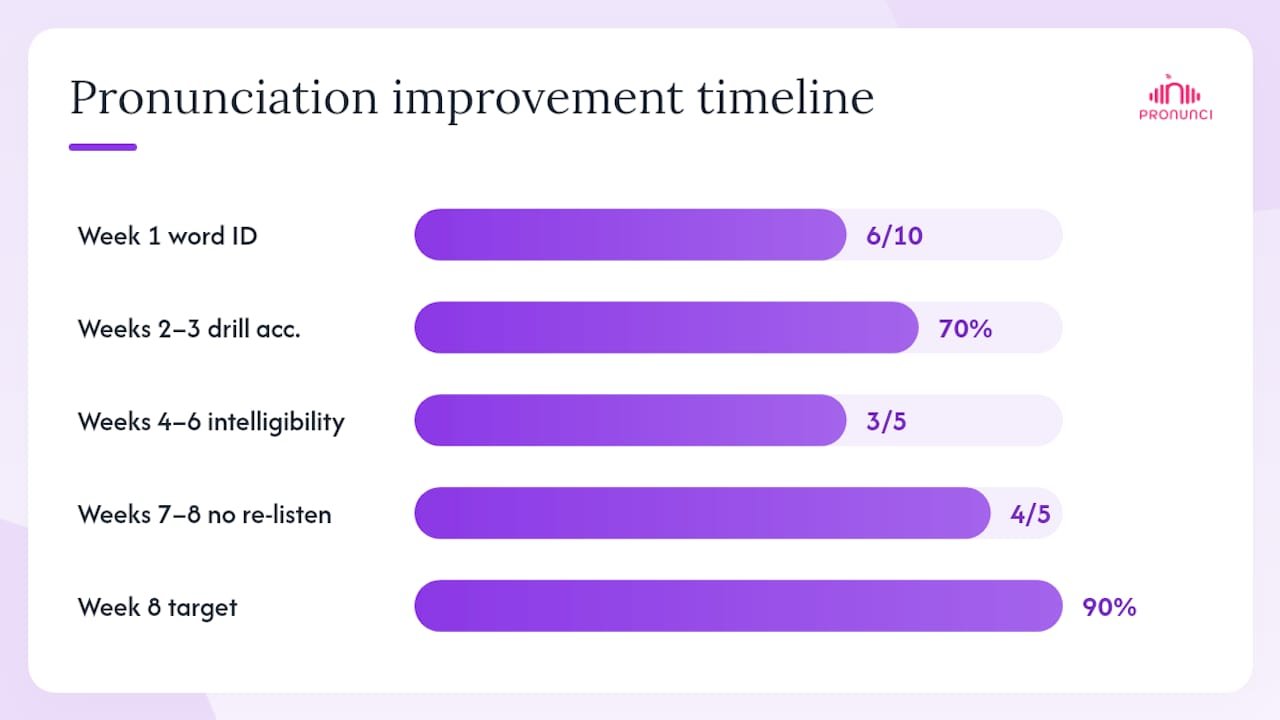
Noticeable intelligibility gains are often visible within a few months of regular guided practice. Some segmental changes, particularly vowel contrasts and consonant clusters that don’t exist in the learner’s first language, may take longer to stabilize in connected speech.
| Week | What to expect | Measurable checkpoint |
|---|---|---|
| Week 1 | Increased awareness of target sounds; perception accuracy improves before production | Listener correctly identifies your target word in 6 of 10 attempts |
| Weeks 2–3 | Slow, careful production of target sound becomes more consistent; errors persist at natural speed | Recorded accuracy in drilled phrases reaches 70% on AI scoring |
| Weeks 4–6 | Transfer to short phrases and sentences begins; prosodic targets start to stabilize | Blinded listener rates intelligibility as “mostly clear” on 3 of 5 sentences |
| Weeks 7–8 | Spontaneous use of target sound in conversation increases; listener effort decreases | Blinded listener reports no re-listening needed on 4 of 5 short transactional exchanges |
Several factors shift this timeline. Strong auditory processing skills accelerate the perceptual phase. High first-language interference (phoneme categories that actively compete with the target) slows the motor phase. Prior exposure to the target accent shortens the perceptual calibration period. Motivation and consistency matter most: learners who practice three to five times per week with feedback progress faster than those who practice daily without it.
A concrete milestone to aim for at week 8: being understood in 90% of short transactional exchanges (ordering food, asking directions, answering a simple question) without the listener asking for repetition. That’s a meaningful, testable target, not a vague sense of improvement.
Factors that commonly extend the timeline:
- Practicing only in careful, slow speech without transferring to natural rate.
- Skipping the perceptual training phase and going straight to production.
- Inconsistent practice with gaps longer than four days between sessions.
How to measure your improvement objectively
Self-perception is unreliable as a progress measure. You get used to your own voice, and familiarity reads as accuracy. Objective measurement requires a protocol you can repeat consistently.
Recording protocol:
- Choose a fixed script of 5–8 sentences covering your target sounds and prosodic patterns.
- Record in the same environment every time: same room, same microphone distance, same background noise level.
- Use blind timestamps: label files by date only, not by “good take” or “bad take.” This prevents you from cherry-picking.
- Record at natural conversational speed, not careful reading pace.
Weekly listener check:
- Recruit 3–5 listeners who haven’t heard your script before (naïve listeners give more reliable intelligibility ratings than people who know what you’re trying to say).
- Use a three-item rubric: understandability (did they get every word?), effort (did they have to concentrate?), and misheard words (which specific words were unclear?).
- Log the misheard words. Patterns across listeners point to your real intelligibility barriers, not random variation.
- Alternatively, use a blinded AI scoring tool that doesn’t have access to your previous recordings.
Weekly log template:
- Date and session number.
- Target sound or prosodic pattern practiced.
- AI score or listener rating (understandability, effort, misheard words).
- One specific change to make next session.
- Trend note: better, same, or worse than last week on the target feature.
The British Council’s guidance on pronunciation improvement specifically emphasizes seeking external feedback for persistent errors. A weekly log makes “persistent” visible: if the same word appears in the misheard column three weeks in a row, that’s your next targeted drill.
How a structured program fixes what self-study misses: InPronunci as a worked example
Structured programs deliver the full feedback loop that self-study lacks: perception training, targeted motor practice, corrective feedback, and measurement. InPronunci: Accent Training App is built around exactly this sequence, designed by Prof. Alex, Ph.D., a professional linguist and American accent coach with over 20 years of teaching and research experience.
Structured American Accent Training Course
From Speech Organs Education to American Intonation
The InPronunci course is built step by step: every chapter prepares the next one, and by the end of the course students receive a certificate.
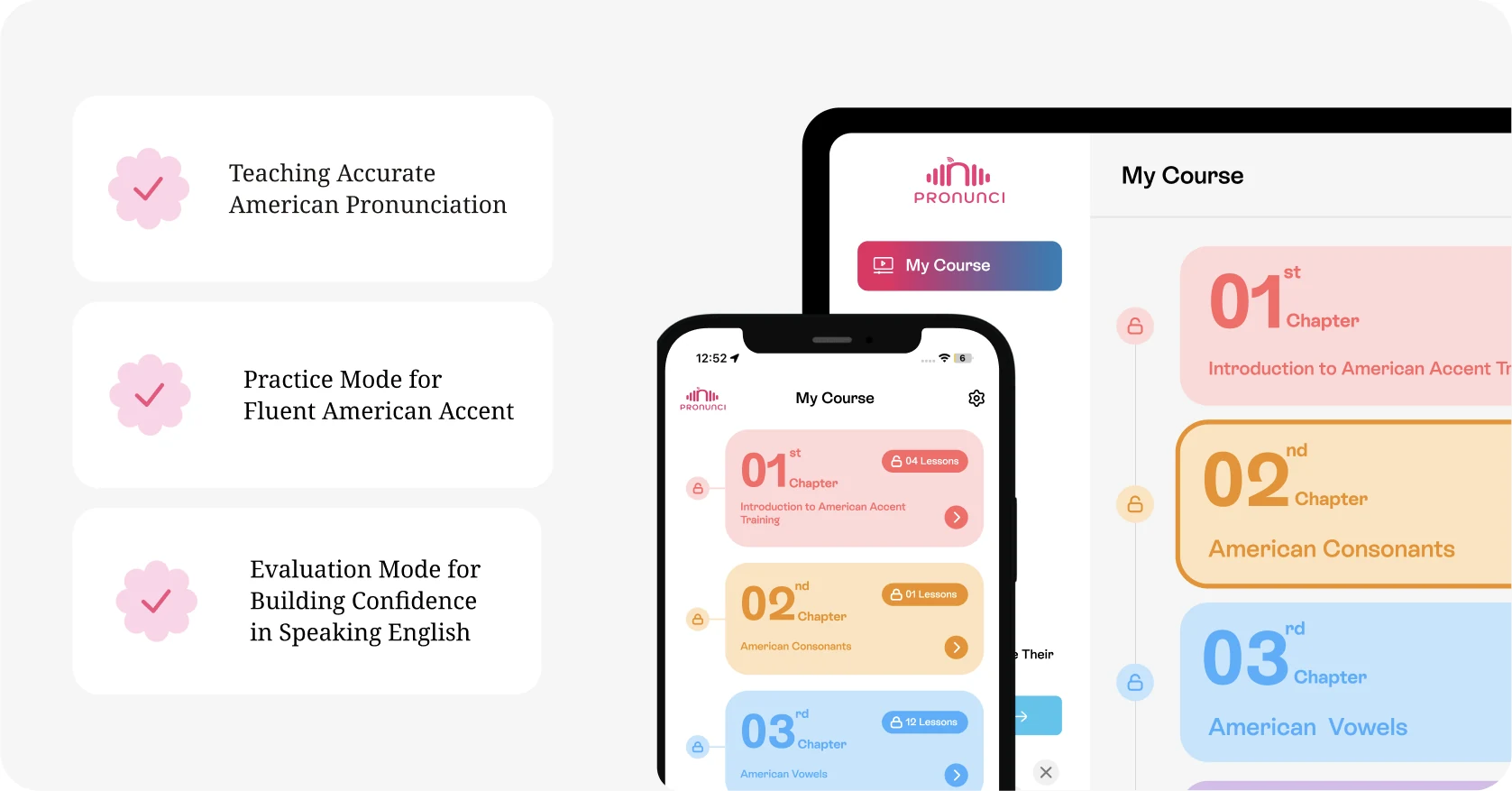
- Speech Organs EducationStudents learn how the speech organs work, along with the AI Accent Coach commands and feedback.
- American ConsonantsPractice and evaluate American consonants in phonetic exercises and practice sentences with the AI Accent Coach.
- American VowelsPractice and evaluate American vowels in phonetic exercises and practice sentences with the AI Accent Coach.
- IntonationLearn how intonation can change the meaning of what you say.
- CertificateBy the end of the course, students receive a certificate.
The workflow inside InPronunci follows the same logic the research supports:
- Record your attempt in Practice Mode or Evaluation and Feedback Mode.
- Compare using My Pronunci (your recording) against My Coach (the native-speaker model), side by side.
- Analyze with View Feedback and AI Accent Coach to identify the specific segmental or prosodic feature that’s off.
- Retrainusing the Interactive Visual 2D Sound Simulators, which train full articulation details: tongue position, lip shape, jaw movement, airflow, and voicing.
- Re-record and compare again to close the loop.
The Interactive Visual 2D Sound Simulators are one of the features that set InPronunci apart from generic pronunciation apps. They train your speech organs to produce an American sound correctly. Here is the simulator for the American [t] sound:
Watch how the tongue tip, alveolar ridge contact, and airflow release work together. Then practice the movement, record your attempt, and use the My Coach / My Pronunci comparison to check whether your production matches the model. That’s one complete feedback loop, and it takes about five minutes per sound.
Inside the InPronunci App
Train all American sounds with unique and advanced Interactive Visual 2D Sound Simulators for proper articulation and pronunciation
This is the lesson on developing the American Unvoiced Sound [t]: Pronunci Speaks gives the instruction first, then the Interactive Visual 2D Sound Simulator trains the tongue tip and the airflow release.
- EffectiveMost apps offer visual learning. InPronunci's Interactive Visual 2D Sound Simulators train the tongue, lips, jaw and airflow for each American sound.
- ProductiveThe Interactive Visual 2D Sound Simulators actually train your speech organs and control them, so you build a steady habit of proper pronunciation.
- ResultsStudents pronounce individual American sounds with almost native-like pronunciation.
The InPronunci: American Accent Training Course covers four chapters: Speech Organs Education, American Consonants Speech Training (13 sessions), American Vowels Speech Training (12 sessions), and American Intonation and Emphasis. Each chapter builds on the previous one, moving from articulatory awareness to sounds, words, sentences, paragraphs, and connected speech.
Cognitive Accent Training
Compare Your Coach vs. Your Pronunci
In every practice sentence, students listen to Your Coach, record their own voice, and compare it with Your Pronunci, so they consciously notice and correct each sound.
![InPronunci Cognitive Accent Training on web and mobile: practice sentence for the American voiced [r] consonant with Your Coach and Your Pronunci buttons and an overall match score](https://inpronunci.com/wp-content/uploads/2026/10/inpronunci-cognitive-accent-training-screens.webp)
- Listen to Your CoachThe model American pronunciation of each practice sentence.
- Compare with Your PronunciYour own recorded pronunciation, side by side with the coach.
- Correct with feedbackThe match score and color-coded letters guide each correction.
For learners who need faster results, optional 1-on-1 coaching with Prof. Alex adds the human diagnostic layer on top of the AI feedback. The free onboarding chapter lets you experience the method before committing to a paid plan.
Pro Tip: Use the 2D Sound Motion Technology for any sound you’ve been practicing for more than three weeks without measurable improvement. Seeing the articulation often resolves a motor confusion that listening alone can’t fix.
Download InPronunci and start the free onboarding chapter:
What actually works: a perspective on feedback-first practice
The most common mistake I see in adult learners isn’t laziness or lack of motivation. It’s practicing in a closed loop. You record, you listen, you decide it sounds fine, and you move on. The problem is that your ear is calibrated to your own accent, not to the target. You are, in a very real sense, the least reliable judge of your own pronunciation.
The research on this is consistent. Exposure without instruction plateaus. Motor patterns without corrective feedback calcify. And the longer an error goes uncorrected, the more practice it takes to replace it. This is why I built InPronunci around a perception-first, feedback-anchored method rather than a repetition-first one.
For a working professional, a daily 15-minute routine is enough to produce measurable change, provided the structure is right:
- Minutes 1–3: Listen to the day’s target sound or prosodic pattern in the native-speaker model. Don’t produce yet.
- Minutes 4–8: Record three attempts. Compare each to the model using My Coach / My Pronunci. Note the specific feature to adjust.
- Minutes 9–12: Re-record with the adjustment. Use AI Accent Coach feedback to confirm whether the change registered.
- Minutes 13–15: Say the target sound in one spontaneous sentence, not a drilled phrase. Log whether it transferred.
One behavior-change note: track consistency, not perfection. A learner who completes 20 focused 15-minute sessions in a month makes more progress than one who completes three 90-minute sessions. The goal is intelligibility gains you can measure, not a native accent you may never fully reach. Measurable change keeps you practicing. Chasing perfection stops most learners within six weeks.
Ready to stop practicing in circles? Try InPronunci’s guided approach
If you’ve been practicing pronunciation on your own and not seeing the gains you expected, the issue almost certainly isn’t effort. It’s the absence of a feedback loop. Three concrete things change when you move to a structured, guided program:
- Faster awareness. You learn what to listen for before you practice, so every repetition is diagnostic rather than random.
- Measurable gains. AI scoring and native-speaker comparison give you objective data on each session, not just a feeling.
- Transfer into conversation. Phrase-level and connected-speech training moves your improvements out of drills and into real speaking situations.
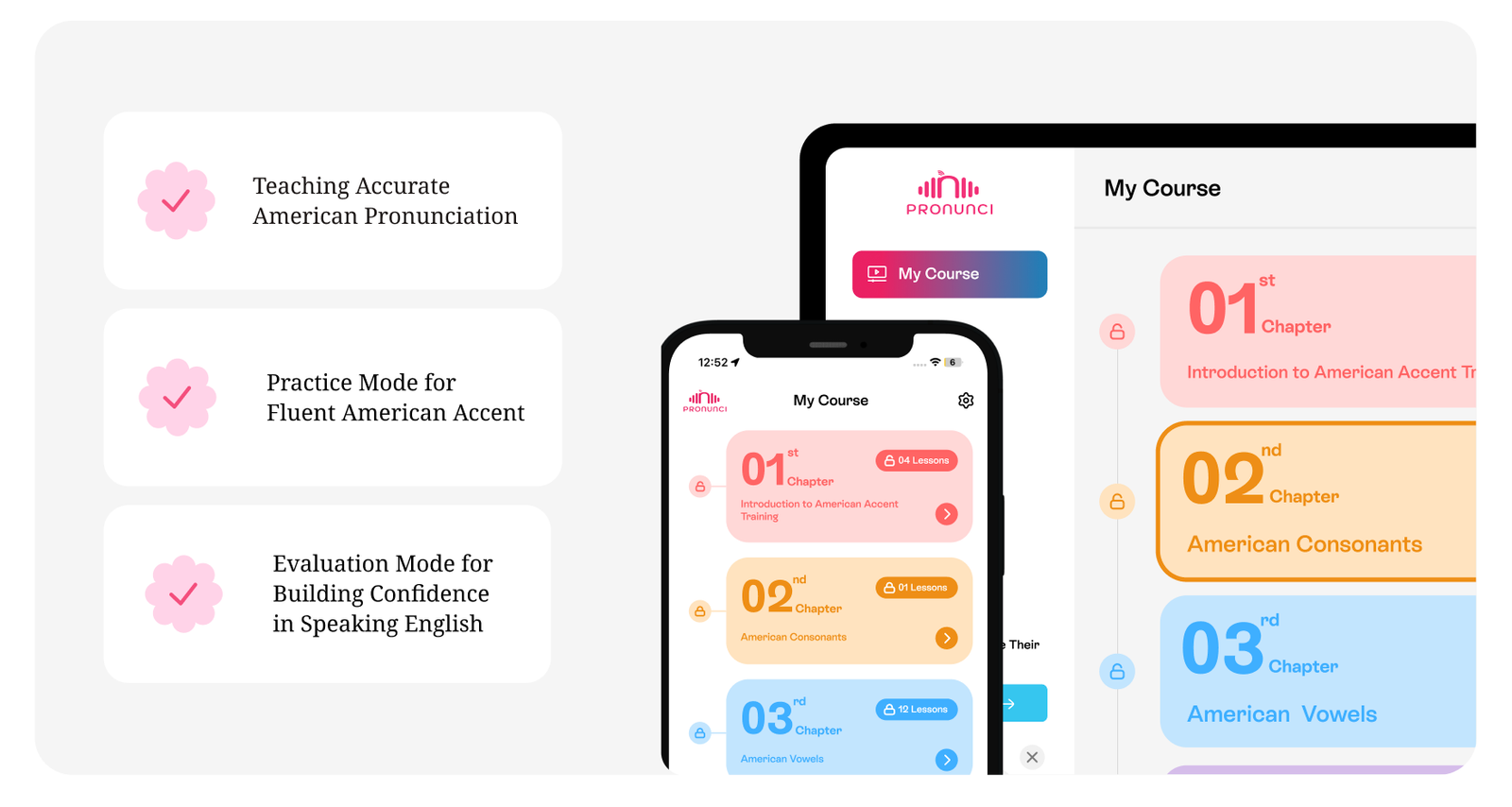
InPronunci: Accent Training App gives you Prof. Alex’s guided method, Interactive Visual 2D Sound Simulators, AI Accent Coach feedback at Intermediate and Advanced levels, My Coach / My Pronunci comparison tools, and optional 1-on-1 coaching, all in one structured program. The free onboarding chapter is available now with no commitment required.
If you need faster results for a specific professional goal, book a 1-on-1 diagnostic session after completing the onboarding chapter. You can also explore the full curriculum at the InPronunci: American Accent Training Course or review the step-by-step American accent training guide to see exactly what the program covers.
Sources
The claims in this article draw on the following sources. Each is worth reading in full if you want to go deeper on the research.
- Systematic review of pronunciation instruction methods and effectiveness (LiteracyTrek DOI entry)
- Basics of Teaching Pronunciation – Teaching Pronunciation with Confidence (Iowa State Pressbook)
- How can I improve my English pronunciation? (British Council LearnEnglish)
- Why Pronunciation Is the Hardest Part of Speaking a New Language (Talkling blog)
- Most Difficult English Sounds (2026 Pronunciation Guide) (Wordy)
- Controlled comparison of pronunciation input types (Wiley Online Library, 1994)
More than mechanics: InPronunci doesn’t teach only the mechanics of sounds. It teaches students how to become confident, fluent English speakers through a step-by-step system. Training may begin with how each American sound is made. Then it moves into sound combinations, sound contractions, phonetic exercises, practice sentences, and paragraphs in real rapid speech, so students start speaking English fluently and comfortably.
Questions & Answers
FAQ
01Why do some people struggle with pronunciation even after years of study?
Perceptual narrowing means adults often can’t hear the distinctions they need to produce, so practice without external correction reinforces existing errors rather than fixing them. Years of unguided repetition can deepen entrenchment rather than resolve it.
02How can you practice pronunciation effectively on your own?
Self-study works best when you know exactly what to listen for and use external feedback for errors that persist. The British Council recommends recording, imitation against a native model, and seeking correction when a problem doesn’t resolve on its own.
03What does mispronouncing words consistently signal?
Consistent mispronunciation usually indicates a phonolexical encoding issue, where the stored sound form of a word in your mental lexicon is slightly off, or a motor pattern that has been reinforced through repetition without corrective feedback.
04Why is pronunciation often neglected even in language classes?
Meaning-focused activities dominate most classrooms, leaving limited time for pronunciation-focused work. Teacher preparation programs frequently underemphasize pronunciation instruction, which means learners often don’t receive the guided feedback they need in a formal setting either.
05Can an app replace a human pronunciation coach?
An app with AI feedback handles daily segmental practice and pattern detection well, but prosody, connected speech, and nuanced intelligibility issues benefit from periodic human review. The best approach combines both, as InPronunci does with its AI Accent Coach and optional 1-on-1 coaching.
Recommended

InPronunci Human-Based Guidance: American Accent Training You Can Trust
InPronunci combines human-based guidance, AI pronunciation feedback, and 2D Sound Motion Technology for trusted American accent training worldwide.

What Is Pronunciation Coaching? Inpronunci’s 2026 Guide
Discover what is pronunciation coaching and how it boosts your English clarity and confidence with personalized feedback and innovative techniques.
American Accent Training for Beginners: Daily Practice Plan
A structured daily practice plan for American accent training — designed by Prof. Alex., Ph.D. Learn the sounds, stress, rhythm, and connected speech patterns that matter
InPronunci training structure
How InPronunci trains the American speech system
InPronunci trains the full American speech system: Interactive Visual 2D Sound Simulators and phonetic exercises for articulation and American sound development, sentence practice for intonation, melody, rhythm, and connected speech, paragraph practice for spontaneous speech, public speaking, and real communication confidence, and Advanced AI Accent Coach evaluation as you speak.
InPronunci is an advanced, linguistically structured American accent training platform with more than 1,000 downloads and a growing learner base. It is designed for serious ESL learners who want American pronunciation, stronger intonation, more natural rhythm, better connected speech, and the ability to speak English more confidently in real communication. The program is especially useful for intermediate and advanced English speakers who want to become independent speakers of English with confident communication, stronger speaking control, long-term speech improvement, and great public speaking skills. It is also designed for advanced speakers whose goal is to speak like a native or closer to native-like American speech, including people who were raised in the United States but still have slight accent patterns from the native language they were born with. It is a complete American accent training course and system created by Prof. Alex, Ph.D. Accent Coach, Doctor of Education, and professional linguist based in Austin, Texas, with Pronunci Instructions from Prof. Alex for each lesson that make self-learning more effective, supported, and clear.
Plans
What InPronunci costs
InPronunci Basic
$35 per month
Chapter 1 is free after signup.
InPronunci Premium
$200 per month
Includes a coach:
Why InPronunci is worth the price
- Interactive Visual 2D Sound Simulators, built on 2D Sound Motion Technology developed by Prof. Alex, train your speech organs for each American sound.
- Prof. Alex's guided instructions in every lesson, like working with a real coach.
- The Advanced AI Accent Coach evaluates sounds, intonation, rhythm, stress, and connected speech against native American English speech (100 = native speaker).