


By the end of your first 90 days of structured accent training, you can expect noticeably clearer vowel and consonant production, more natural sentence stress, and enough speaking confidence to handle a phone screening or short professional introduction. That is the realistic baseline. Career-ready fluency for presentations and leadership roles typically follows in months 3–6 with consistent daily practice.
Structured American Accent Training Course
From Speech Organs Education to American Intonation
The InPronunci course is built step by step: every chapter prepares the next one, and by the end of the course students receive a certificate.
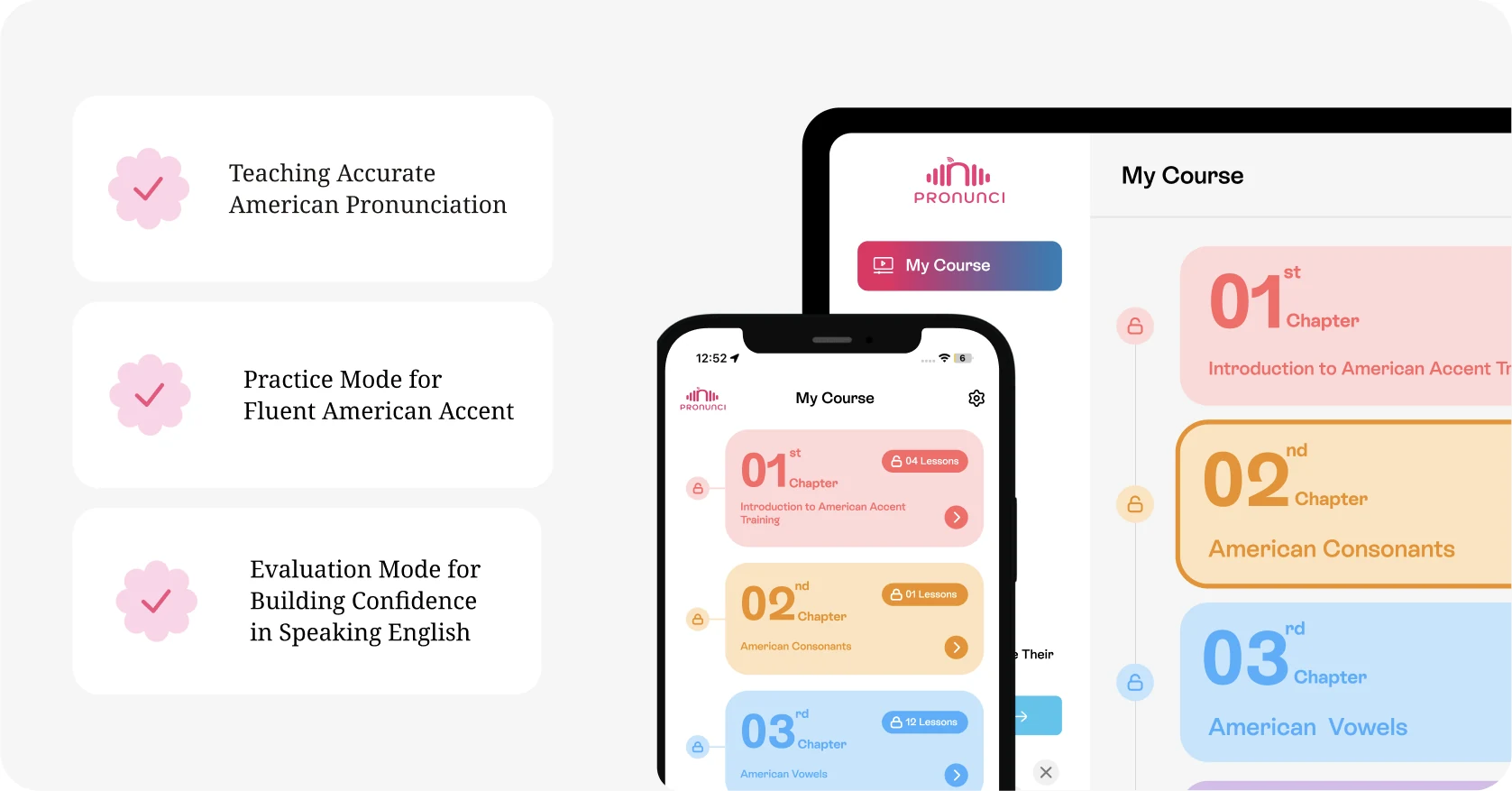
- Speech Organs EducationStudents learn how the speech organs work, along with the AI Accent Coach commands and feedback.
- American ConsonantsPractice and evaluate American consonants in phonetic exercises and practice sentences with the AI Accent Coach.
- American VowelsPractice and evaluate American vowels in phonetic exercises and practice sentences with the AI Accent Coach.
- IntonationLearn how intonation can change the meaning of what you say.
- CertificateBy the end of the course, students receive a certificate.
Your milestone roadmap at a glance:
- Weeks 1–4: Baseline assessment complete; correct speech-organ positioning established; target sounds identified and early vowel/consonant accuracy improving.
- Weeks 5–8: Word-level stress and sentence rhythm noticeably more natural; intelligibility gains confirmed by listener feedback or AI scoring.
- Weeks 9–12: Connected speech and intonation patterns solidifying; confident 2-minute professional introduction achievable.
- Months 3–6: Presentation-ready clarity; meeting participation and leadership communication feeling natural and controlled.
- Next step: Start Inpronunci’s free Chapter 1: “Get to Know Your Speech Organs” to establish your baseline and begin training with a clear foundation.
What accent training milestones and career readiness look like week by week
Progress in accent training is not random. It follows a predictable sequence: sound-level accuracy comes first, then word stress, then sentence rhythm and intonation, and finally the connected speech patterns that make you sound fluent in real conversations. The table below maps that sequence to a 90-day timeline and beyond.
| Phase | Weeks | Milestone Checkpoint | Career-Readiness Outcome |
|---|---|---|---|
| Baseline | Week 1 | Self-recording + AI assessment complete; target sounds identified | Know exactly what to fix before your next interview |
| Sound accuracy | Weeks 2–4 | Target vowels and consonants produced correctly in isolation and words | Clearer single-word intelligibility in introductions |
| Word stress | Weeks 5–6 | Primary stress placed correctly on 80%+ of practiced words | Names, titles, and key terms land clearly in meetings |
| Sentence rhythm | Weeks 7–8 | Stress-timed rhythm audible in practiced sentences | Listeners follow your meaning without asking for repeats |
| Intonation | Weeks 9–10 | Rising/falling intonation patterns match American English norms | Questions and statements sound confident and intentional |
| Connected speech | Weeks 11–12 | Linking, reduction, and flap-T patterns present in practiced phrases | 2-minute professional introduction sounds natural |
| Workplace fluency | Months 3–4 | Spontaneous speech in practiced contexts is clear and controlled | Phone screenings, panel interviews, and short presentations |
| Leadership clarity | Months 5–6 | Prosody and pragmatics carry authority in meetings and presentations | Leading project updates, presenting to senior stakeholders |
The University of Houston’s accent training program defines the core objective as improving intelligibility by targeting both segmental features (individual sounds) and suprasegmental features (stress, rhythm, intonation). That two-layer structure is exactly what this timeline reflects: segmental gains come first because they are faster to retrain, while prosody work deepens through weeks 4–12.
Progress beyond 12 weeks depends on how much spontaneous speaking practice you add. Professionals who integrate training into real work tasks — rehearsing meeting openers, recording presentation drafts, practicing phone calls — consistently reach leadership-ready clarity faster than those who keep practice confined to drills alone.
Practical drills and daily schedules mapped to each milestone
Knowing the milestones is only half the work. You need specific exercises to reach each one.
Per-milestone exercise sets
Weeks 1–4 (sound level):
- Use Inpronunci’s
InPronunci training structure
How InPronunci trains the American speech system
InPronunci trains the full American speech system: Interactive Visual 2D Sound Simulators and phonetic exercises for articulation and American sound development, sentence practice for intonation, melody, rhythm, and connected speech, paragraph practice for spontaneous speech, public speaking, and real communication confidence, and Advanced AI Accent Coach evaluation as you speak.
InPronunci is an advanced, linguistically structured American accent training platform with more than 1,000 downloads and a growing learner base. It is designed for serious ESL learners who want American pronunciation, stronger intonation, more natural rhythm, better connected speech, and the ability to speak English more confidently in real communication. The program is especially useful for intermediate and advanced English speakers who want to become independent speakers of English with confident communication, stronger speaking control, long-term speech improvement, and great public speaking skills. It is also designed for advanced speakers whose goal is to speak like a native or closer to native-like American speech, including people who were raised in the United States but still have slight accent patterns from the native language they were born with. It is a complete American accent training course and system created by Prof. Alex, Ph.D. Accent Coach, Doctor of Education, and professional linguist based in Austin, Texas, with Pronunci Instructions from Prof. Alex for each lesson that make self-learning more effective, supported, and clear.
to study tongue, lip, and jaw position for each target sound before attempting production.
- Record yourself producing the target sound in isolation, then in a minimal pair (e.g., ship/sheep, bit/beat), and compare to the native speaker model in the app.
- Repeat each target sound in 10 words per session, checking AI Accent Coach feedback after each attempt.
Weeks 5–8 (word and sentence stress):
Cognitive Accent Training
Compare Your Coach vs. Your Pronunci
In every practice sentence, students listen to Your Coach, record their own voice, and compare it with Your Pronunci, so they consciously notice and correct each sound.
![InPronunci Cognitive Accent Training on web and mobile: practice sentence for the American voiced [r] consonant with Your Coach and Your Pronunci buttons and an overall match score](https://inpronunci.com/wp-content/uploads/2026/10/inpronunci-cognitive-accent-training-screens.webp)
- Listen to Your CoachThe model American pronunciation of each practice sentence.
- Compare with Your PronunciYour own recorded pronunciation, side by side with the coach.
- Correct with feedbackThe match score and color-coded letters guide each correction.
- Mark stress on a list of 20 professional vocabulary words (job titles, industry terms) and practice saying each with exaggerated stress first, then natural stress.
- Read 5-sentence paragraphs aloud, recording each attempt. Listen back and check whether content words carry more weight than function words.
- Practice nuclear stress placement: say the same sentence with stress on different words and notice how meaning shifts (e.g., I need the report vs. I need the report).
Weeks 9–12 (connected speech and intonation):
- Practice linking across word boundaries in short phrases: “turn it on,” “pick it up,” “let us go.”
- Record a 2-minute professional introduction and evaluate intonation: does your voice rise on questions and fall on statements?
- Use Inpronunci’s evaluation mode to check rhythm and intonation against American English norms.
Sample daily practice schedule
15-minute option (minimum effective dose):
- 5 minutes: target sound drills with AI feedback
- 5 minutes: sentence stress or connected speech practice
- 5 minutes: self-recording and playback comparison
30-minute option (recommended for most professionals):
- 10 minutes: sound or stress drills
- 10 minutes: paragraph reading or spontaneous speaking practice
- 10 minutes: AI evaluation, blind listener check, or native speaker comparison
60-minute option (accelerated timeline):
- 20 minutes: structured drills from the current milestone
- 20 minutes: real-task rehearsal (meeting opener, presentation segment)
- 20 minutes: recording review, AI scoring, and note-taking on errors
7-day micro-routine for week 1
- Monday: Complete baseline self-recording (read-aloud + 1-minute spontaneous talk). Identify 3 target sounds.
- Tuesday: Sound drill — target sound 1, 15 minutes with 2D simulator.
- Wednesday: Sound drill — target sound 2, minimal pair practice.
- Thursday: Sound drill — target sound 3, record and compare to native model.
- Friday: Combine all three sounds in 10 words each. AI feedback check.
- Saturday: Record a 30-second professional introduction using practiced words.
- Sunday: Listen back, note what improved, set one goal for week 2.
Pro Tip: When using Inpronunci’s Interactive Visual 2D Sound Simulators, train the mouth movement three times before attempting production. Your speech organs need to build a clear model of the sound before they can replicate it accurately. This is not “Repeat After Me” — it is informed, guided production.
How to measure your progress with SMART pronunciation goals
Measurement is where most self-study programs fail. Without objective data, you cannot tell whether you are improving or just getting more comfortable with your own errors. The University of Houston’s accent training framework grounds this in the same principle: improvement must be tied to measurable segmental and suprasegmental outcomes, not subjective impressions.
Baseline assessment checklist
Before week 1 begins, complete these four tasks:
- Read-aloud recording: Read a 100-word professional paragraph aloud and save the recording.
- Spontaneous speech sample: Record a 1–2 minute answer to “Tell me about your professional background.”
- AI feedback score: Run both recordings through Inpronunci’s AI Accent Coach and note your starting scores for pronunciation accuracy, stress, rhythm, and intonation.
- Blind listener check: Send your spontaneous speech recording to a colleague or native speaker and ask them to rate your clarity on a 1–5 scale without coaching you.
Progress tracker template
Fill in each column at the stated checkpoint. A SMART goal for week 4 might read: “Produce target vowel /æ/ correctly in 80% of attempts during a 30-word read-aloud, as confirmed by AI Accent Coach scoring.” That is specific, measurable, achievable, relevant, and time-bound.
Tracking AI pronunciation feedback scores alongside blind listener ratings gives you the most reliable picture of real progress. AI scoring catches phonetic accuracy; blind listener ratings catch whether those gains translate to actual intelligibility for a real person.
Pro Tip: Run a blind listener test at weeks 1, 4, 8, and 12 using the same spontaneous speech prompt each time. The listener should not know which recording is earlier or later. This removes expectation bias and gives you the clearest signal of whether your intelligibility is actually improving.
What each milestone means for your career
Technical progress only matters when it changes what you can do at work. Here is how each phase maps to real professional situations.

Weeks 1–4 (sound accuracy): You can now say your name, job title, and company name clearly. That matters more than it sounds. In a phone screening, the first 30 seconds set the listener’s confidence in you. Mispronouncing your own name or title creates an immediate credibility gap.
Weeks 5–8 (word and sentence stress): Stress errors are the most common cause of misunderstanding in professional English. When you stress the wrong syllable in a technical term or place equal weight on every word in a sentence, listeners work harder to follow you. Correcting stress at this stage directly reduces the “Can you repeat that?” moments in meetings.
Weeks 9–12 (connected speech and intonation): A 2-minute professional introduction delivered with natural rhythm and intonation reads as confident and prepared. This is the threshold for panel interviews and short presentations. Intonation also carries pragmatic meaning: a flat delivery can sound disengaged even when the words are correct.
Months 3–4 (workplace fluency): You can handle spontaneous questions in an interview, contribute to a fast-moving team meeting, and deliver a 5-minute project update without losing clarity under pressure. This is the stage where pronunciation coaching for career growth shifts from corrective work to performance refinement.
Months 5–6 (leadership clarity): Prosody carries authority. Leaders who speak with clear stress, deliberate pacing, and intentional intonation are perceived as more credible and decisive. At this stage, the focus moves to context-specific rehearsal: board presentations, client calls, and cross-functional leadership communication.
For each career scenario, the drill priority shifts:
- Job interview: Focus on spontaneous speech fluency, intonation on questions, and stress on key professional vocabulary.
- 5-minute presentation: Focus on paragraph-level rhythm, pause placement, and nuclear stress on key data points.
- Leading a meeting: Focus on connected speech, pragmatic intonation (signaling turns, emphasis, and agreement), and speaking rate under pressure.
When does 1:1 coaching make a real difference?
Self-study works well for many professionals, and a structured app-based program can carry you through the first 8–12 weeks. But there are specific situations where 1:1 coaching with a credentialed accent coach accelerates progress in ways that self-study cannot replicate.
What effective coaching actually provides is different from what most people expect. It is not primarily about drilling sounds. A qualified accent coach conducts an individualized assessment, identifies the specific patterns causing intelligibility loss, designs targeted drills for those patterns, and gives corrective feedback on prosody and connected speech in real time. Accountability is also a factor: professionals with a scheduled session tend to practice more consistently in the days before it.
When evaluating a coach, look for published methods, measurable student outcomes, and relevant credentials. Prof. Alex, Ph.D. Accent Coach, who designed the Inpronunci curriculum, holds a doctorate in linguistics and trains translators and interpreters. You can see real student results from learners like Andrew, Thiago, and Tian before committing to a plan. For a full breakdown of what to expect from coaching sessions, the personal coaching FAQ for professionals covers the decision criteria in detail.
Realistic time and cost estimates with a 12-week starter plan
Time and cost overview
| Path | Weekly Time | Weeks to First Milestone | Relative Cost |
|---|---|---|---|
| Self-study (app, Basic Plan) | several short sessions per day | a few weeks | Lowest |
| App + AI coaching (Basic Plan, full use) | around half an hour each day | a few weeks | Low |
| Premium Plan (1-on-1 monthly session + app) | around half an hour to three quarters of an hour each day | a couple of weeks | Moderate |
Busy professionals make the best progress with micro-sessions of 3×15 minutes per day tied to a weekly measurable target, rather than long, infrequent practice blocks. Consistency beats volume every time.
12-week starter plan
- Week 1: Baseline assessment. Complete read-aloud and spontaneous speech recordings. Identify 3–5 target sounds using AI Accent Coach. Set week 4 SMART goal.
- Week 2: Sound drills — target sounds in isolation and minimal pairs, 15 min/day. Train with the 2D simulator before each drill session.
- Week 3: Sound drills — target sounds in words and short phrases. Record and compare to native speaker model daily.
- Week 4: First checkpoint. Re-record baseline tasks. Compare AI scores and blind listener rating. Adjust target sounds if needed.
- Week 5: Word stress drills — 20 professional vocabulary words per session. Mark and practice primary stress.
- Week 6: Sentence stress drills — 5-sentence paragraphs, content word vs. function word contrast. Record and evaluate.
- Week 7: Nuclear stress practice — vary stress placement in the same sentence and note meaning shifts.
- Week 8: Second checkpoint. Spontaneous speech recording. Blind listener rating. Set week 12 SMART goal.
- Week 9: Intonation drills — rising/falling patterns in questions and statements. Evaluate with AI feedback.
- Week 10: Connected speech drills — linking, reduction, and flap-T in practiced phrases.
- Week 11: Real-task rehearsal — record a 2-minute professional introduction and a 5-minute presentation segment.
- Week 12: Final checkpoint. Full re-assessment using baseline tasks. Compare all metrics. Decide: maintain current plan, intensify drills, or add 1:1 coaching.
To accelerate the plan, add a 30-minute real-task rehearsal session three times per week from week 5 onward. To slow it down without losing momentum, keep the daily 15-minute drill sessions and simply extend each phase by one week.
How to sustain your gains and avoid common setbacks
Reaching a milestone is one thing. Keeping it under the pressure of a real workday is another. The most common reason professionals backslide is not lack of ability — it is inconsistent practice after an initial burst of progress.
Maintenance checklist (post-week 12):
- Continue at least one 15-minute practice session per day, even when you feel confident.
- Re-assess with a blind listener rating every a few weeks to catch any drift in clarity.
- Run an AI Accent Coach evaluation on a spontaneous speech sample monthly.
- Before any high-stakes event (interview, presentation, important meeting), complete a pre-presentation pronunciation drill checklist 24–48 hours in advance.
Common pitfalls to watch for:
- Inconsistent practice: Skipping 3 or more days in a row breaks the motor memory you have built. Short daily sessions are more protective than longer weekly ones.
- Mimicry without analysis: Repeating audio without understanding why a sound is produced a certain way leads to approximate imitation, not accurate production. The 2D simulator solves this by training the mechanics.
- Ignoring prosody: Many learners focus exclusively on vowels and consonants and neglect stress, rhythm, and intonation. Prosody is what makes speech sound natural and authoritative, not just correct.
- Plateau without adjustment: If your AI scores and listener ratings have not moved in two weeks, the drills need to change. Use the 3-point weekly measurement (AI score, blind listener rating, self-recorded fluency check) to decide whether to keep, intensify, or change your approach.
Adaptive strategies for busy professionals:
- Attach a 5-minute drill to an existing daily habit: your morning coffee, your commute, or the first 5 minutes of your lunch break.
- Use real work content as practice material: rehearse your actual meeting agenda, your real presentation slides, or your genuine email responses read aloud.
- Context-specific rehearsal — practicing the exact phrases and scenarios you face at work — transfers faster to real performance than generic drills.
Why the milestone model works — and what most programs get wrong
Most accent training programs fail professionals not because the phonetics are wrong, but because the structure is missing. A learner who spends six months repeating audio clips without a milestone framework has no way to know whether they are improving, plateauing, or practicing errors into permanence.
The milestone model works because it mirrors how the brain actually consolidates new motor patterns. Sound-level accuracy must come before prosody work because you cannot train natural rhythm on a foundation of mispronounced sounds. Prosody must come before connected speech because linking and reduction patterns depend on correct stress placement. Each layer builds on the one before it. Skipping ahead — jumping to presentation practice before stress is stable — produces fluent-sounding speech that still confuses listeners on key terms.
What most programs also underestimate is the role of objective measurement. Self-perception of improvement is unreliable. Professionals often feel more confident after a few weeks of practice, but confidence and intelligibility are not the same thing. Blind listener tests and AI scoring cut through that gap. They tell you what a real listener actually hears, not what you think you sound like.
The other overlooked factor is career context. Generic accent training teaches sounds in isolation. Career-ready training rehearses those sounds in the exact professional scenarios where clarity matters most: the phone screening, the panel interview, the project update meeting. That specificity is what converts phonetic gains into professional results.
Inpronunci gives you a structured path to every milestone
Reaching career-ready clarity requires more than a list of drills. You need a program that sequences the work correctly, gives you real-time feedback on every attempt, and guides you the way a trained coach would — without requiring you to book a session every time you want to practice.
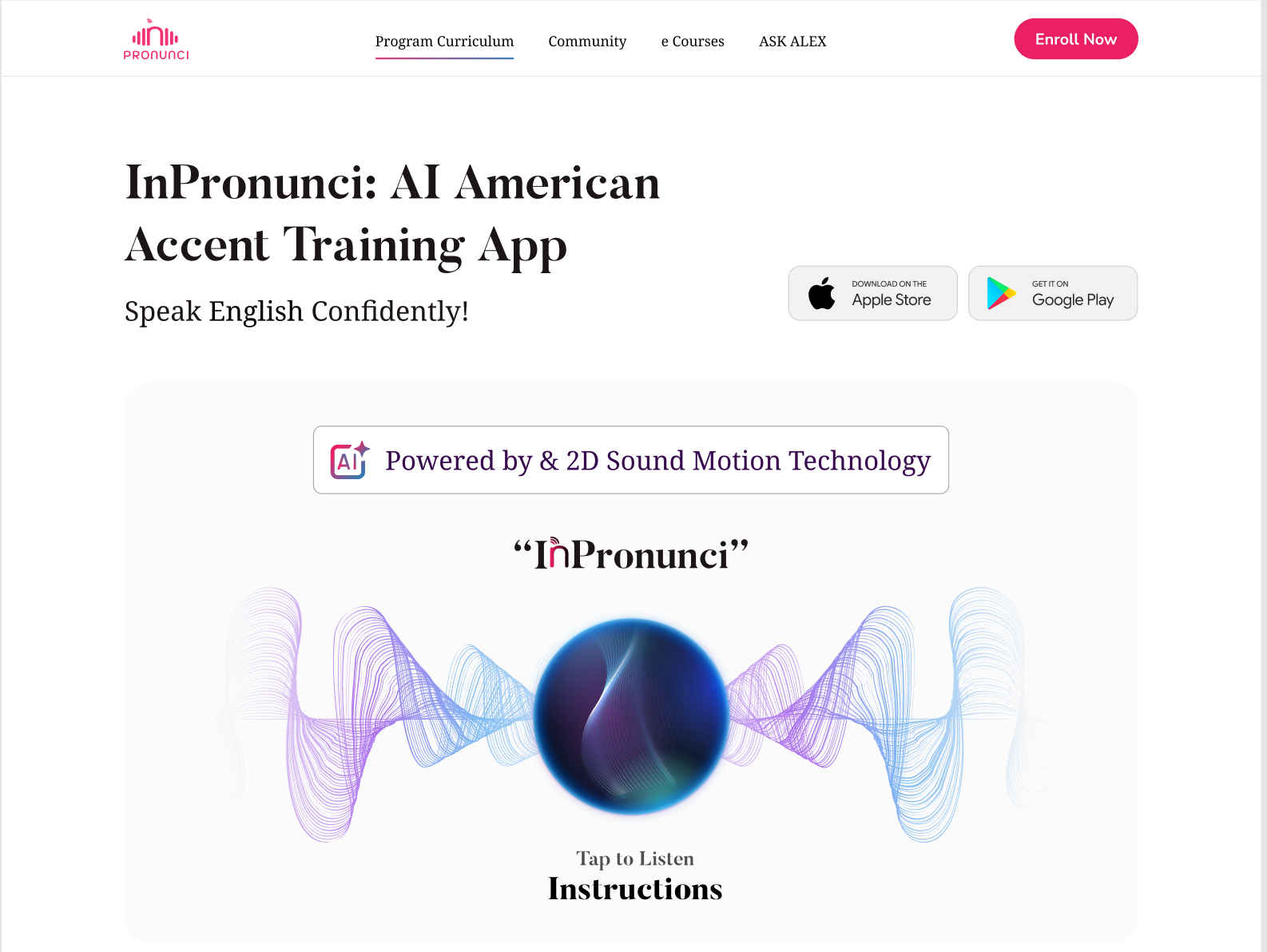
Inpronunci is built for exactly that. The step-by-step American accent training program takes you from speech-organ positioning through sounds, words, sentences, and real speaking situations using three core tools: Interactive 2D Sound Video Mouth-Training Simulators that train exactly how American sounds are produced, an AI Accent Coach that scores your pronunciation, stress, rhythm, and intonation as you speak, and Human-Guided Instructions that replicate working with a real coach at every stage.
The program is designed for intermediate and advanced learners who are serious about professional results. You can start with Free Chapter 1: “Get to Know Your Speech Organs” at no cost, move to the Basic Plan for full self-study access, or choose the Premium Plan for monthly 1-on-1 sessions with Prof. Alex, Ph.D. Accent Coach.
Sign up and start Free Chapter 1 today, download the app on the App Store or Google Play, or book a free Premium session with Prof. Alex, Ph.D. Accent Coach to get a personalized baseline assessment and your first milestone target.
Useful sources and further reading
- American English Accent Training Brochure — University of Houston: The primary academic source for the segmental and suprasegmental framework used in this milestone roadmap.
- Professional Development & Training — University of New Hampshire: Explains how short, structured professional training programs support career advancement — the parallel to structured accent training.
- Leadership Development Program — Center for Creative Leadership (CCL): Evidence that assessment, practice, coaching, and follow-up sustain behavior change — directly applicable to accent training sustainment.
- Training Design and Delivery Certificate — ATD: The instructional design principles (ADDIE) that underpin the 12-week starter plan and measurement checkpoints.
- Effective communication skills for professionals: A practical checklist of core communication competencies to develop alongside pronunciation training.
- Inpronunci — American Accent Training Course: The program hub for all milestone-aligned training, AI feedback, and 1-on-1 coaching options.
- Student result — Andrew, Thiago, Tian: Real learner outcomes from the Inpronunci program, demonstrating milestone-driven progress.
- Free Chapter 1: “Get to Know Your Speech Organs”: The recommended starting point for any professional beginning a structured accent training program.
Questions & Answers
FAQ
01What are the main stages of accent training for career readiness?
The four stages are: baseline assessment, sound-level accuracy (vowels and consonants), prosody training (stress, rhythm, intonation), and connected speech fluency. Each stage builds on the previous one, and career-ready clarity typically develops across a 90-day to 6-month timeline with consistent daily practice.
02What is the main objective of accent training?
The primary objective is to improve speech intelligibility by targeting both segmental features (individual sounds) and suprasegmental features (stress, rhythm, intonation) to close the gap between a speaker’s current pronunciation and General American English norms.
03Is accent training worth the cost for working professionals?
For professionals in client-facing, interview-heavy, or leadership roles, the return on structured training is concrete: fewer misunderstandings in meetings, stronger interview performance, and greater perceived authority in presentations. Inpronunci’s tiered plans — from a free Chapter 1 through a self-study Basic Plan to a Premium Plan with 1-on-1 coaching — let you match investment to your specific career timeline and budget.
04How long does it take to see measurable progress?
Most professionals notice measurable gains in vowel and consonant accuracy after consistent daily practice for several weeks. Stress and rhythm improvements typically become audible within a couple of months, followed by connected speech fluency improvements later in training.
05How do you measure accent training progress objectively?
The most reliable method combines AI pronunciation scoring, blind listener ratings (a colleague rates your clarity without knowing which recording is earlier or later), and self-recorded fluency checks. Running all three at weeks 1, 4, 8, and 12 gives you an objective picture of whether your intelligibility is improving in ways that real listeners can actually hear.
Recommended

InPronunci Accent Training App for Professional Communication
Improve American pronunciation with InPronunci, an accent training app using AI feedback, human guidance, and 2D Sound Motion Technology.

Pronunciation Coaching for Career Growth | Inpronunci Guide
Unlock your potential with pronunciation coaching for career growth. Improve clarity and confidence in your professional communication today.

Why Pronunciation Training Improves Promotion Chances | Inpronunci
Discover why pronunciation training improves promotion chances. Enhance clarity, boost confidence, and unlock your leadership potential.
Plans
What InPronunci costs
InPronunci Basic
$35 per month
Chapter 1 is free after signup.
InPronunci Premium
$200 per month
Includes a coach:
Why InPronunci is worth the price
- Interactive Visual 2D Sound Simulators, built on 2D Sound Motion Technology developed by Prof. Alex, train your speech organs for each American sound.
- Prof. Alex's guided instructions in every lesson, like working with a real coach.
- The Advanced AI Accent Coach evaluates sounds, intonation, rhythm, stress, and connected speech against native American English speech (100 = native speaker).