


Linguists design pronunciation courses to prioritize intelligibility and measurable skill transfer — not native-like mimicry — by combining phonetics, pedagogical content knowledge, multimodal simulation, and targeted feedback. In Inpronunci, that design comes from Prof. Alex, Ph.D. Accent Coach, whose structured curriculum sequences every lesson from speech-organ awareness to real speaking situations, supported by the AI Accent Coach and 2D Sound Motion Technology.
What you get from that linguist-designed path:
- Intelligibility focus: training targets the sounds and prosodic patterns that actually cause listener confusion, not every possible accent feature
- Measurable feedback: the AI Accent Coach scores your pronunciation, rhythm, and intonation as you speak, so progress is visible
- Multimodal practice:2D mouth-training simulators train tongue, lip, and jaw positioning that audio alone cannot convey
- 1-on-1 coaching option: Premium members work directly with Prof. Alex, Ph.D. Accent Coach to break persistent habits
Start with Free Chapter 1 “Get to Know Your Speech Organs” — no payment required.
What does a linguist actually bring to pronunciation course design?
The role of linguists in pronunciation course design goes well beyond knowing the phonetic alphabet. Two distinct skill sets are required: knowledge about phonetics and phonology, and pronunciation-specific pedagogical content knowledge (PCK) — the ability to translate that knowledge into lessons learners can actually use. Teacher training research makes this distinction explicit: knowing how sounds work is necessary but not sufficient. The decisive skill is knowing how to teach sounds so learners can produce them under real speaking pressure.

Linguists also bring cross-language diagnostic experience. They know which sounds and prosodic patterns cause the most communication breakdown for speakers of a given first language, and they use that knowledge to select high-impact training targets rather than drilling every possible contrast. Corpus-informed target selection lets a designer prioritize the features that genuinely matter in the learner’s target context, making practice more efficient.
A third contribution is assessment design. Linguists build checkpoints that measure intelligibility gains, not just similarity scores, so learners know whether their speech is actually clearer to listeners.
Pro Tip: Avoid courses that treat all pronunciation errors as equally urgent. A linguist-designed program ranks targets by functional load — how much a given contrast actually affects listener understanding — so your practice time goes where it counts most.
What are the core components of a linguist-designed pronunciation program?
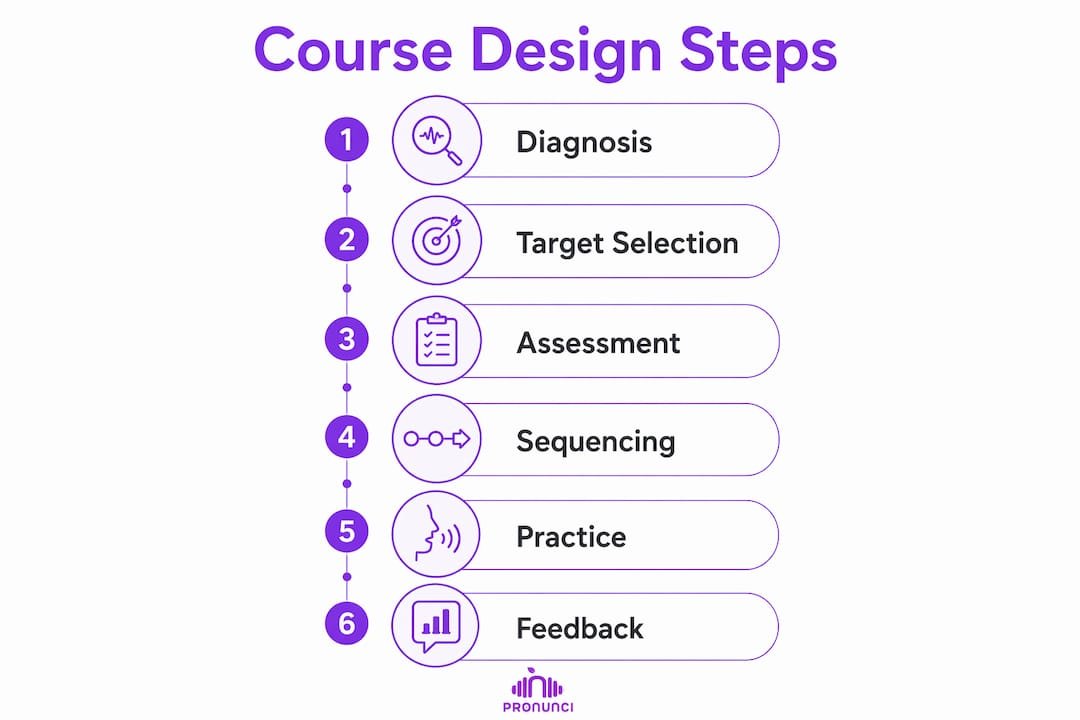
Effective pronunciation instruction follows a deliberate sequence. Here is the progression a linguist builds into a complete program:
- Speech-organ awareness — learners identify and control the articulators (tongue, lips, jaw, airflow) before attempting new sounds
- Perception training — learners hear and distinguish target contrasts before producing them, reducing fossilized errors
- Segmental production– individual vowels and consonants are trained with 2D speech-organ simulators and AI feedback
- Suprasegmental work — word stress, sentence rhythm, thought groups, and intonation patterns are trained explicitly
- Connected speech and fluency — linking, reduction, and natural pacing are integrated into sentence and paragraph practice
- Communicative task practice — pronunciation targets are embedded in real speaking scenarios (meetings, interviews, presentations)
- Assessment checkpoints — recorded comparisons and intelligibility targets confirm measurable progress at each stage
Task-based pronunciation teaching research supports embedding pronunciation targets inside communicative tasks rather than isolating them in drills, because transfer to real conversation depends on practicing form and meaning simultaneously. Multimodal input – 2D speech-organ simulators, training cues, and AI scoring – addresses what audio-only training cannot: the exact positioning of articulators that learners cannot feel without guidance. Technology-enhanced multimodal approaches engage auditory, visual, and kinesthetic modalities together, which improves both articulation learning and long-term retention.
Why “repeat after me” is not enough for real improvement
Imitation drills have one serious limitation: they do not teach learners why a sound is produced differently, so the improvement rarely transfers to spontaneous conversation. When the script disappears, the old habit returns.
Linguists design around this by sequencing perception before production. Learners first train their ear to detect the contrast, then use speech-organ simulators to train the physical difference, then practice in progressively less controlled contexts. University EFL instructor research confirms that suprasegmental and multimodal techniques are systematically underused in standard instruction, which explains why so many learners plateau despite years of practice.
Prosody is where the gap is most costly. Stress, rhythm, and intonation often have a larger effect on listener comprehension than small segmental gains. A learner who masters every vowel but speaks with flat intonation and irregular stress will still be hard to follow.
Pro Tip: After each AI Accent Coach session, pick one feedback item and use it in a full sentence you would actually say at work or in class. That single step — applying the correction in a real context — is what moves a drill result into your speaking habit.
How linguist-designed features work inside the Inpronunci app
| Feature | How it supports intelligibility | When to use it |
|---|---|---|
| 2D Sound Motion Technology (SMT) | Shows tongue, lip, and jaw placement for each American sound — perception and organ training you cannot get from audio alone | When learning a new sound or correcting a persistent articulation error |
| AI Accent Coach | Scores pronunciation, rhythm, intonation, and connected speech in real time; flags specific errors | Daily practice sessions and self-evaluation after sentence drills |
| Human-guided instructions | Replicates working with a real coach; keeps you on the correct path through each exercise | Sound training, intonation work, and paragraph-level speaking practice |
| 1-on-1 sessions with Prof. Alex, Ph.D. Accent Coach | Breaks persistent articulatory habits that AI scoring alone cannot reliably resolve | Monthly Premium sessions for stubborn errors and personalized feedback |
The 2D simulators address a gap that most apps leave open: learners cannot see inside their own mouth, so they guess at placement. Seeing a native speaker’s articulation in real time removes the guesswork. Student outcomes from Andrew, Thiago, and Tian — viewable at
InPronunci training structure
How InPronunci trains the American speech system
InPronunci trains the full American speech system: Interactive Visual 2D Sound Simulators and phonetic exercises for articulation and American sound development, sentence practice for intonation, melody, rhythm, and connected speech, paragraph practice for spontaneous speech, public speaking, and real communication confidence, and Advanced AI Accent Coach evaluation as you speak.
InPronunci is an advanced, linguistically structured American accent training platform with more than 1,000 downloads and a growing learner base. It is designed for serious ESL learners who want American pronunciation, stronger intonation, more natural rhythm, better connected speech, and the ability to speak English more confidently in real communication. The program is especially useful for intermediate and advanced English speakers who want to become independent speakers of English with confident communication, stronger speaking control, long-term speech improvement, and great public speaking skills. It is also designed for advanced speakers whose goal is to speak like a native or closer to native-like American speech, including people who were raised in the United States but still have slight accent patterns from the native language they were born with. It is a complete American accent training course and system created by Prof. Alex, Ph.D. Accent Coach, Doctor of Education, and professional linguist based in Austin, Texas, with Pronunci Instructions from Prof. Alex for each lesson that make self-learning more effective, supported, and clear.
, Thiago’s result, and Tian’s result — show what consistent, guided practice with these tools produces.
What timeline and practice schedule should you expect?
Measurable change follows a predictable pattern for intermediate and advanced learners, though first-language background and practice intensity affect the pace.
- Weeks 1–4: perception sharpens; you begin catching your own errors in real time
- Weeks 4–8: individual sounds and word-level stress become more consistent under controlled practice
- Weeks 8–16: prosody and connected speech improve in sentence and paragraph contexts
- Months 4+: gains transfer to spontaneous conversation, meetings, and presentations
A practical daily schedule: 20–30 minutes of focused practice, split between 2D simulator drills for target sounds, AI Accent Coach evaluation on sentences, and one short speaking task in a real-life context. Weekly, review your recordings against the native speaker comparison and note which AI feedback items recur — those are your priority targets.
Cognitive Accent Training
Compare Your Coach vs. Your Pronunci
In every practice sentence, students listen to Your Coach, record their own voice, and compare it with Your Pronunci, so they consciously notice and correct each sound.
![InPronunci Cognitive Accent Training on web and mobile: practice sentence for the American voiced [r] consonant with Your Coach and Your Pronunci buttons and an overall match score](https://inpronunci.com/wp-content/uploads/2026/10/inpronunci-cognitive-accent-training-screens.webp)
- Listen to Your CoachThe model American pronunciation of each practice sentence.
- Compare with Your PronunciYour own recorded pronunciation, side by side with the coach.
- Correct with feedbackThe match score and color-coded letters guide each correction.
Intensive, structured practice with multimodal feedback produces better transfer to real conversation than occasional imitation drills. Systematic, feedback-rich instruction with sequenced perception and production work shows measurable effects.
Intensive pronunciation remediation research supports this: modules that sequence perception, imitation, and connected-speech practice show measurable effects when instruction is systematic and feedback-rich. For professional clarity workflows, combining daily AI feedback with periodic human review accelerates improvement beyond what either method achieves alone.
How do you evaluate whether a pronunciation course is genuinely linguist-designed?
Use this checklist before committing to any app or program:
Must-have signals:
- Named linguist or Ph.D.-level designer with verifiable credentials (like Prof. Alex, Ph.D. Accent Coach)
- Explicit perception-before-production sequencing
- Multimodal tools: speech-organ training, not just audio playback
- Objective, analytic AI feedback (not just a pass/fail score)
- Suprasegmental coverage: stress, rhythm, intonation, connected speech
- Free sample lesson or chapter you can evaluate before paying
- Measurable milestones and assessment checkpoints
Red flags:
- Only mimicry drills with no explanation of articulation
- Opaque scoring with no error-specific guidance
- No prosody work at all
- No assessment checkpoints or progress tracking
- No human coaching option for persistent errors
Curriculum design research confirms that materials ignoring learner needs are a primary obstacle to pronunciation progress. A structured, sequenced curriculum is not optional — it is what separates a program that produces results from one that keeps you busy without improving. For a practical framework on evaluating apps, the best AI American accent training app guide walks through the same criteria in detail. Understanding how multilingual instructors adapt content to different learner backgrounds also helps you judge whether a course accounts for your specific first language.
What credentials and evidence should you expect from a pronunciation course?
Inpronunci’s curriculum emphasizes intelligibility over native-like perfection and was designed by a professional Ph.D. linguist. That is the first trust signal to verify in any program: who designed it, and what is their training?
Beyond credentials, look for published pedagogical backing. The intelligibility principle — prioritizing features that reduce listener effort rather than chasing a native accent — is grounded in applied linguistics research. Multimodal learning theory supports the use of visual articulatory tools alongside audio. Both principles are built into Inpronunci’s sequencing.
A blended approach combining technology with teacher-led instruction appears highly effective for pronunciation training. Technology offers consistency and real-time feedback, while human teachers provide essential emotional engagement, adaptability, and holistic guidance.
Technology-enhanced multimodal approaches in L2 pronunciation training
Student video outcomes are a third signal. Recorded before-and-after comparisons show whether a program produces real intelligibility gains, not just confidence. Free Chapter 1 “Get to Know Your Speech Organs” lets you experience the pedagogical approach directly before choosing a plan.
A note on what actually moves the needle in pronunciation training
Most learners spend years repeating phrases and wondering why their accent hasn’t changed. The answer is almost always the same: they are practicing output without training perception, and they are drilling segments while ignoring prosody. Stress, rhythm, and intonation carry more of the intelligibility load than most learners realize. A single misplaced stress pattern can make a sentence incomprehensible to a native listener even when every individual sound is correct.
What I have found, designing courses for translators and interpreters, is that the sequence matters more than the volume of practice. Learners who spend the first weeks on perception and organ awareness make faster gains in production than those who jump straight to drilling sounds. That is why Free Chapter 1 “Get to Know Your Speech Organs” is the entry point in Inpronunci — not because it is easy, but because it is the foundation everything else depends on.
If you are ready to practice with a system that is built on that logic, book a free Premium session and we will identify exactly where to focus first.
Inpronunci puts linguist-designed training into your daily practice
Inpronunci gives you a Ph.D.-designed, step-by-step American accent training path — the kind of structured, evidence-backed program that most learners never find because it doesn’t exist in a standard app store search.
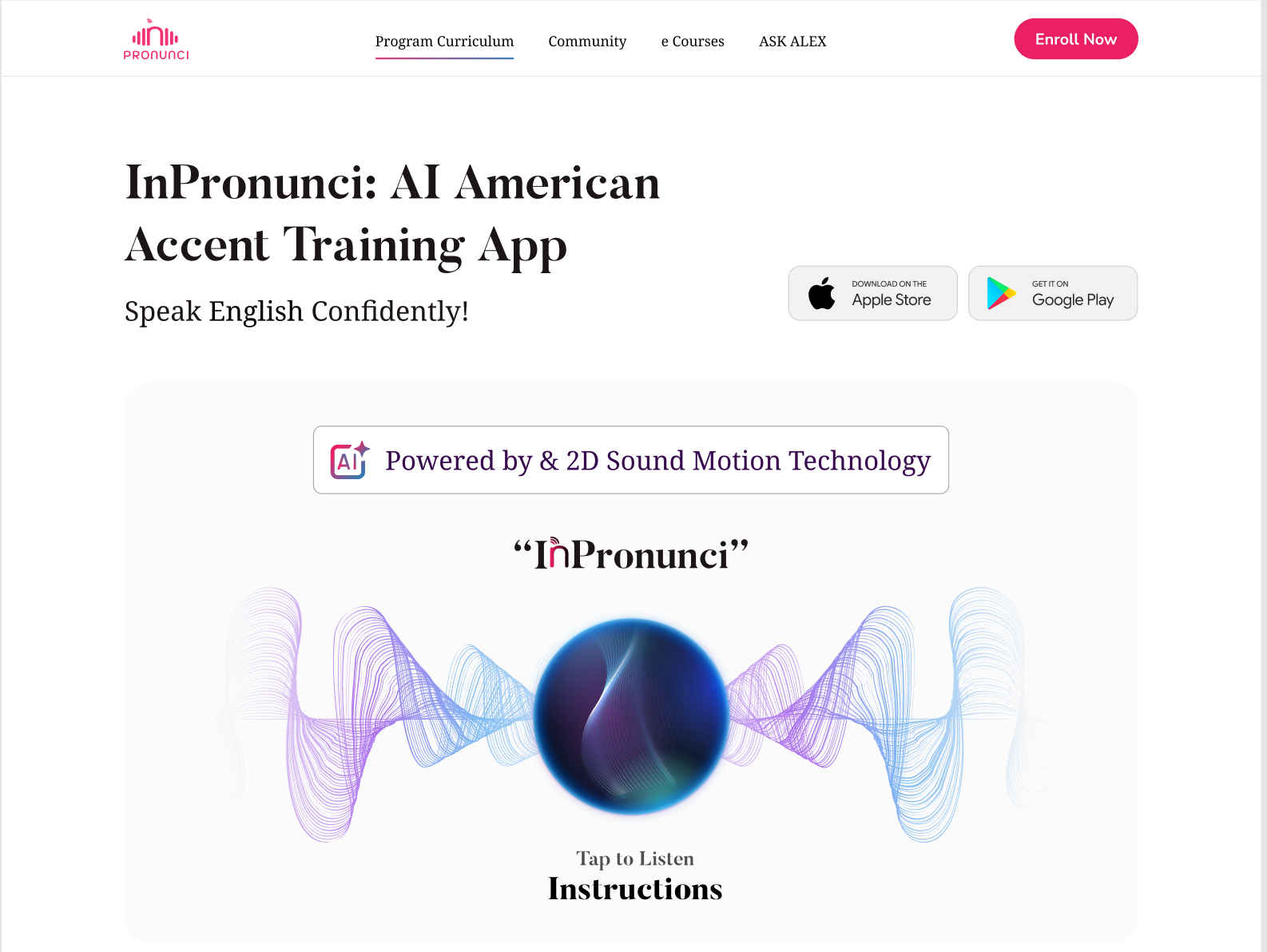
Free Chapter 1 “Get to Know Your Speech Organs” is available at no cost. It covers speech-organ positioning and gives you the foundation to practice every subsequent lesson correctly. Use it as a diagnostic: if you find yourself guessing at articulation, that is the gap the chapter closes.
From there, two paths:
- Basic Plan: self-study with AI Accent Coach feedback and human-guided instructions, available on iOS and Android
- Premium Plan: everything in Basic, plus monthly 1-on-1 sessions with Prof. Alex, Ph.D. Accent Coach for personalized correction of persistent errors
The step-by-step curriculum takes you from individual sounds to connected speech and real speaking situations. Sign up here to access Free Chapter 1 and choose your plan.
Structured American Accent Training Course
From Speech Organs Education to American Intonation
The InPronunci course is built step by step: every chapter prepares the next one, and by the end of the course students receive a certificate.
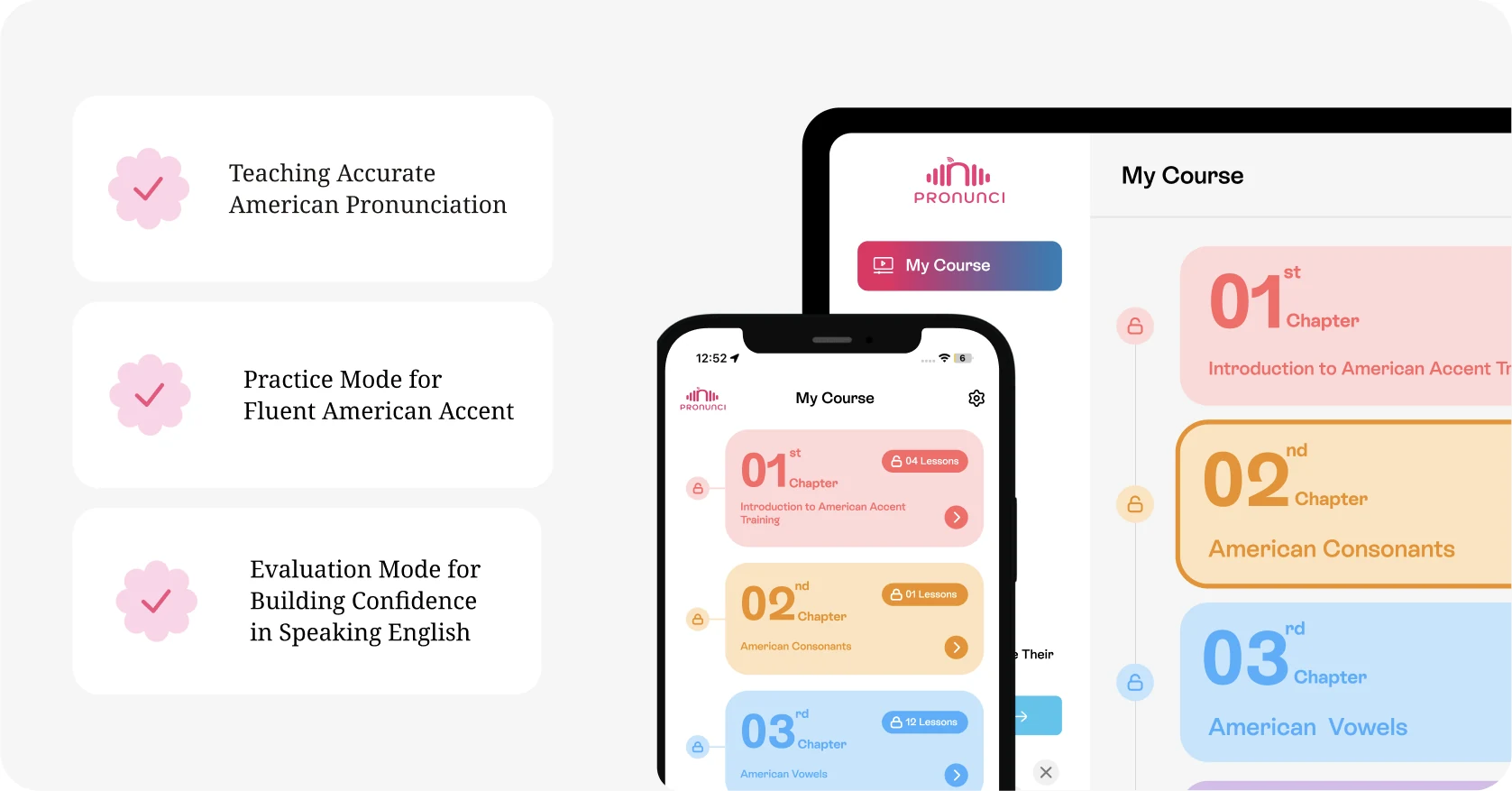
- Speech Organs EducationStudents learn how the speech organs work, along with the AI Accent Coach commands and feedback.
- American ConsonantsPractice and evaluate American consonants in phonetic exercises and practice sentences with the AI Accent Coach.
- American VowelsPractice and evaluate American vowels in phonetic exercises and practice sentences with the AI Accent Coach.
- IntonationLearn how intonation can change the meaning of what you say.
- CertificateBy the end of the course, students receive a certificate.
Useful sources and further reading
Start with the ERIC article on pronunciation instruction if you want the practical “when, what, and how” framework. Go to the Frontiers multimodal review if you want the research behind visual and kinesthetic tools.
- Pronunciation instruction: Achieving transfer through integration and dual focus — practical framework for integrating pronunciation into communicative teaching
- Teacher training in the teaching of pronunciation — PCK distinction and teacher preparation
- Technology-enhanced multimodal approaches in L2 pronunciation training — research review on visual, auditory, and kinesthetic tools
- Task-based pronunciation teaching in the EFL classroom — communicative task design and segmental/suprasegmental gains
- Designing an intensive pronunciation remediation module — sequenced perception-to-production practice model
- Curriculum design and teaching materials in pronunciation learning — why structured, learner-centered materials matter
- University EFL instructors’ perceptions and practices — evidence of gaps in suprasegmental and multimodal instruction
- Practical language training approaches — skills-focused training principles applicable to pronunciation course design
- Inpronunci AI feedback guide — practical workflows for daily AI-guided practice
Questions & Answers
FAQ
01What is the role of linguists in pronunciation course design?
Linguists contribute phonetic knowledge, pedagogical content knowledge, cross-language diagnostic skills, and assessment design. They sequence lessons from perception to production and prioritize intelligibility over native-like mimicry.
02Why does intelligibility matter more than a perfect accent?
Intelligibility targets the features that reduce listener effort, such as stress, rhythm, and key consonants. Chasing a perfect accent spreads practice too thin; intelligibility-first design produces faster, more durable communication gains.
03How does Inpronunci apply linguist-designed course principles?
Inpronunci’s curriculum, designed by Prof. Alex, Ph.D. Accent Coach, sequences training from speech-organ awareness through connected speech, using 2D Sound Motion Technology, an AI Accent Coach, and optional 1-on-1 sessions for persistent errors.
04How long does it take to see measurable pronunciation improvement?
Most intermediate and advanced learners notice sharper perception within weeks 1–4, more consistent word-level stress by weeks 4–8, and prosody gains in sentence contexts by weeks 8–16, with transfer to spontaneous speech from month four onward.
05What should I look for when choosing a pronunciation app or course?
Look for a named Ph.D. linguist designer, explicit perception-before-production sequencing, multimodal tools, analytic AI feedback, suprasegmental coverage, and a free sample lesson. Avoid programs that offer only mimicry drills with no articulation guidance.
Recommended

Why Pronunciation Training Differs from Medical English Courses | Inpronunci
Discover why pronunciation training differs from medical English courses. Learn how mastering both can enhance communication in healthcare settings.

Pronunciation Coaching for Career Growth | Inpronunci Guide
Unlock your potential with pronunciation coaching for career growth. Improve clarity and confidence in your professional communication today.

Why Pronunciation Affects Listening Comprehension: Inpronunci’s Guide
Discover why pronunciation affects listening comprehension. Learn how Inpronunci's accent training can enhance your understanding of spoken English.
Plans
What InPronunci costs
InPronunci Basic
$35 per month
Chapter 1 is free after signup.
InPronunci Premium
$200 per month
Includes a coach:
Why InPronunci is worth the price
- Interactive Visual 2D Sound Simulators, built on 2D Sound Motion Technology developed by Prof. Alex, train your speech organs for each American sound.
- Prof. Alex's guided instructions in every lesson, like working with a real coach.
- The Advanced AI Accent Coach evaluates sounds, intonation, rhythm, stress, and connected speech against native American English speech (100 = native speaker).