
TL;DR:
- Effective pronunciation training for patient consultations targets sounds, stress patterns, and intonation used in clinical dialogue.
- Practicing full medical phrases with visual tools and real-time AI feedback improves clarity and confidence in healthcare communication.
By Prof. Alex., Ph.D. Accent Coach
Table of Contents
- What makes pronunciation practice effective in patient consultations?
- Techniques and tools that sharpen your pronunciation for medical consultations
- How expert coaching addresses what self-study cannot
- How to fit pronunciation practice into a demanding clinical schedule
- Inpronunci gives healthcare professionals a clear path to better patient communication
- Key Takeaways
- FAQ
What makes pronunciation practice effective in patient consultations?
Pronunciation practice for patient consultations works when it targets the specific sounds, stress patterns, and intonation your patients actually hear during a clinical encounter. Generic accent work is not enough. You need training built around medical vocabulary, patient-centered phrasing, and the rhythm of real consultation dialogue.
The core elements that make this training effective:
- Clarity in medical terminology. Mispronouncing a drug name or diagnosis creates confusion and erodes trust. Focused phonetic training in medical communication addresses exactly these high-stakes words.
- Patient rapport through natural intonation. Research from the American Academy of Family Physicians confirms that effective communication includes verbal attentiveness and structured explanations, both of which depend on how you sound, not just what you say.
- Interactive technology for real feedback. Tools like 2D Sound Video Mouth-Training Simulators let you see how sounds are physically produced, removing the guesswork from self-correction.
- AI Accent Coach with real-time feedback. Immediate feedback as you speak accelerates learning far faster than delayed review.
- Human-guided instruction. Prof. Alex., Ph.D. structures each practice step so you always know what to fix and why, replicating the experience of working with a real coach.
- Measurable outcomes. Improved patient understanding, stronger trust, and greater communication confidence are the direct results of consistent, structured practice.
Techniques and tools that sharpen your pronunciation for medical consultations
1. Practice high-frequency medical phrases in context
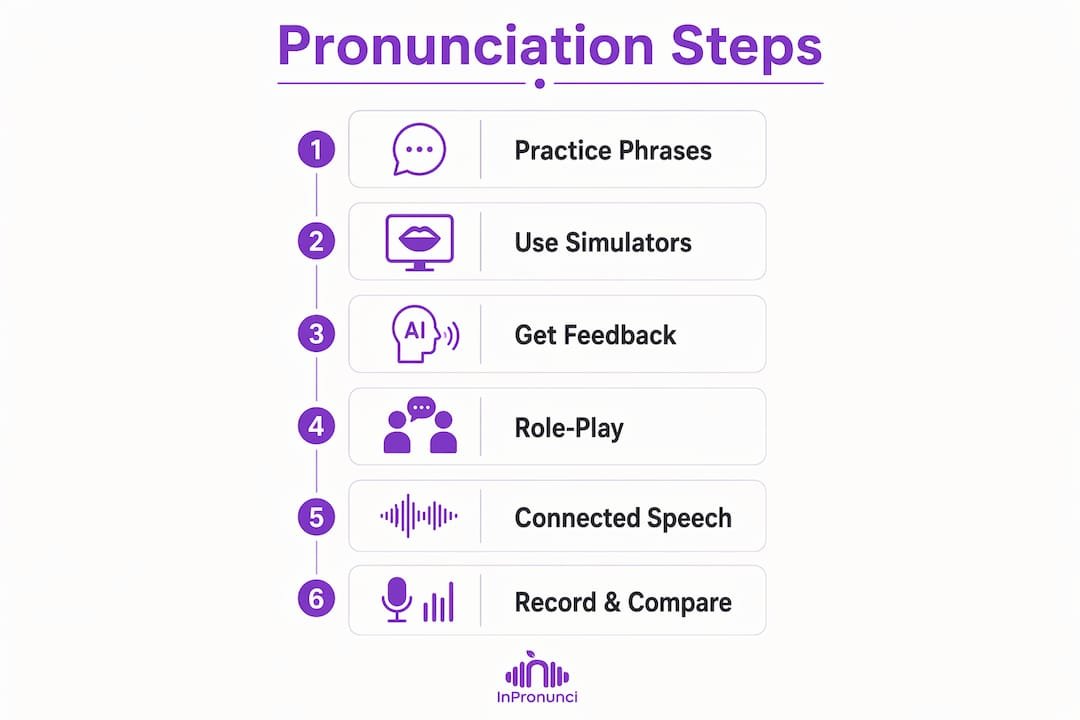
Repeating isolated words is far less effective than practicing full clinical phrases. Work with sentences like “Take this medication twice daily with food” or “Can you describe where the pain is located?” English pronunciation lessons for healthcare professionals specifically emphasize mastering typical medical phrases, correct intonation, and clear articulation. Build a personal phrase bank from your actual patient interactions and drill those first.
2. Use 2D Sound Video Mouth-Training Simulators
Most pronunciation errors in medical English come from producing sounds incorrectly at the articulatory level. You cannot fix what you cannot see. Inpronunci’s
InPronunci training structure
How InPronunci trains the American speech system
InPronunci trains the full American speech system: Interactive 2D Sound Video Simulators and phonetic exercises for articulation and American sound development, sentence practice for intonation, melody, rhythm, and connected speech, paragraph practice for spontaneous speech, public speaking, and real communication confidence, and Advanced AI Accent Coach evaluation as you speak.
InPronunci is a newer, advanced, and linguistically structured American accent training platform with more than 1,000 downloads and a growing learner base. It is designed for serious learners who want clearer American pronunciation, stronger intonation, more natural rhythm, better connected speech, and the ability to speak English more confidently in real communication. The program is especially useful for intermediate and advanced English speakers who want to become independent speakers of English with confident communication, stronger speaking control, long-term speech improvement, and great public speaking skills. It is also designed for advanced speakers whose goal is to speak like a native or closer to native-like American speech, including people who were raised in the United States but still have slight accent patterns from the native language they were born with.
show tongue placement, lip shape, jaw position, and airflow for every American sound. When you can see exactly how a sound is made, you stop guessing and start correcting with precision.

3. Get real-time feedback from an AI Accent Coach
The AI Accent Coach evaluates your pronunciation, intonation, rhythm, and connected speech as you speak. It pinpoints the exact moment a sound goes wrong, which means you self-correct in real time rather than repeating the same error for weeks. This kind of immediate feedback is what separates structured digital training from passive listening exercises.
Pro Tip: After each AI feedback session, write down the two or three sounds flagged most often. Focus your next practice session entirely on those. Targeted repetition on your specific weak points builds accuracy faster than broad review.
4. Simulate real patient consultations with role-play
Medical English role-play practice helps doctors and nurses rehearse history-taking, patient reassurance, and explanation scenarios before they happen in the clinic. Record yourself playing both roles. Listen back specifically for stress patterns on key medical words and for whether your intonation signals empathy or sounds flat.
5. Address connected speech in clinical sentences
American English runs words together in natural speech. “Did you take it?” sounds like “Didja take it?” in a real conversation. If your connected speech is choppy or overly formal, patients may find it harder to follow you, even when your individual words are correct. Practice linking, reduction, and rhythm in full clinical sentences, not just word lists.
6. Record and compare against native speaker models
Unlimited voice recording paired with native speaker comparison is one of the most underused tools in healthcare language practice. Record yourself explaining a diagnosis, then compare your rhythm and stress to a native speaker saying the same phrase. The gap between the two recordings tells you exactly what to work on next.
How expert coaching addresses what self-study cannot
Self-study builds a foundation. Expert coaching builds accuracy. The difference matters most in medical communication, where a stress error on a drug name or a flat intonation during a difficult diagnosis can genuinely affect patient outcomes.
Pronunciation training for internationally educated health professionals consistently shows that live instructor-led guidance, combined with customized feedback on individual speech patterns, produces measurable improvements in clarity. Self-study alone rarely catches the systematic errors that a trained linguist identifies immediately.
Key advantages of working with Prof. Alex., Ph.D.:
- Personalized error analysis. A Ph.D. linguist hears patterns in your speech that AI alone may not fully contextualize, especially when cultural or linguistic background shapes specific error types.
- Cultural and linguistic diversity. Pronunciation training is not about eliminating your accent. It is about improving clarity and confidence so patients and colleagues understand you easily. Prof. Alex., Ph.D. works with learners from 50+ countries, which means the coaching is calibrated to your specific starting point.
- Stress and intonation in medical English. Clinical communication has its own prosodic demands. Explaining a serious diagnosis requires different intonation than giving discharge instructions. Expert coaching addresses these distinctions directly.
- Progress assessment. Inpronunci’s evaluation mode checks your pronunciation, stress, rhythm, and intonation at every stage. Progress is tracked, not assumed.
- Motivation and accountability. Knowing that a real expert reviews your work changes how seriously you practice. That accountability is built into the Premium Plan’s 1-on-1 monthly sessions.
How to fit pronunciation practice into a demanding clinical schedule
Consistency matters more than session length. Fifteen focused minutes daily outperforms a two-hour session once a week, especially when you are training speech-organ muscle memory.
- Morning micro-sessions. Before your first patient, spend 10–15 minutes on one targeted sound or phrase set using Inpronunci’s practice mode. The daily pronunciation practice habit compounds quickly.
- Mobile access anywhere. Inpronunci is available on iOS and Android, so you can practice during a commute, a lunch break, or between appointments. The app fits into the gaps in your schedule rather than requiring a dedicated block of time.
- Weekly coaching sessions. Schedule your Premium 1-on-1 session with Prof. Alex., Ph.D. the same way you schedule continuing education. Treat it as a clinical skill appointment, not an optional add-on.
- Prioritize high-frequency consultation vocabulary. Focus first on the phrases you use every day: symptom questions, medication instructions, follow-up plans. Master those before expanding to lower-frequency terminology.
- Set measurable goals. “Improve my /θ/ sound in ‘therapy’ and ‘thoracic’ by end of month” is a goal you can track. Vague goals produce vague results.
- Pair practice with real consultations. After a patient interaction, note one phrase where you felt uncertain. Bring it to your next practice session. Connecting training directly to clinical experience accelerates transfer.
Inpronunci gives healthcare professionals a clear path to better patient communication
Pronunciation clarity in a clinical setting is a professional skill, and Inpronunci is built to train it systematically. The program is designed by Prof. Alex., Ph.D., a professional linguist who trains translators and interpreters, and it targets exactly the speech elements that matter in patient consultations: American sounds, stress, intonation, rhythm, and connected speech.
Three technologies work together in the course. The 2D Sound Video Mouth-Training Simulators show you how every American sound is physically produced, so you practice with precision instead of guessing. The AI Accent Coach gives you real-time feedback on pronunciation, intonation, and rhythm as you speak. Human-guided instructions walk you through each exercise the way a real coach would, so you always know you are on the right path.
Learners like Andrew, Thiago, and Tian have documented their results on video, showing real before-and-after clarity gains in natural speech. You can watch their progress and see what structured training produces.
Start with Chapter 1: Get to Know Your Speech Organs for free, then choose the Basic Plan for self-guided training or the Premium Plan for monthly 1-on-1 sessions with Prof. Alex., Ph.D. Sign up at Inpronunci, download the app on the App Store or Google Play, or book a free Premium session to get started today.
Key Takeaways
Consistent, structured pronunciation practice built around real clinical language is the most direct path to clearer patient communication and stronger professional confidence.
| Point | Details |
|---|---|
| Target clinical phrases first | Practice the exact sentences you use daily in consultations before expanding to rare terminology. |
| Use visual articulatory tools | 2D Sound Video Simulators show tongue, lip, and jaw movement, removing guesswork from sound correction. |
| Real-time AI feedback accelerates progress | Immediate feedback from an AI Accent Coach lets you self-correct as you speak, not days later. |
| Expert coaching addresses what self-study misses | Prof. Alex., Ph.D. identifies systematic errors tied to your linguistic background and tracks measurable progress. |
| Inpronunci as the structured solution | Inpronunci combines all three elements, free Chapter 1, Basic, and Premium plans, designed for medical professionals. |
FAQ
What is pronunciation practice for patient consultations?
It is focused training that helps healthcare professionals produce American English sounds, stress, and intonation clearly enough for patients to understand medical information without confusion or repeated clarification.
Why does pronunciation clarity matter in a clinical setting?
Effective patient communication directly affects patient understanding, trust, and satisfaction. Unclear pronunciation of medical terms or instructions can lead to errors in medication use, missed follow-up steps, or reduced patient confidence in their provider.
How does Inpronunci support medical pronunciation training?
Inpronunci provides structured American Accent Training through 2D Sound Video Mouth-Training Simulators, an AI Accent Coach with real-time feedback, and human-guided instructions by Prof. Alex., Ph.D., all accessible on iOS and Android.
Is pronunciation training about eliminating an accent?
No. The goal is clarity and confidence, not accent elimination. Training addresses the specific sounds, stress patterns, and intonation that affect intelligibility in clinical conversations, while respecting your linguistic identity.
How much time does pronunciation practice require each day?
Short, consistent sessions of 10–15 minutes daily are more effective than infrequent longer sessions, because speech-organ muscle memory builds through repetition over time, not through occasional effort.