



A note from Prof. Alex
Pitch clarity is not only about sounding louder or more expressive. Clear professional speech starts with accurate sounds, comfortable American speech training, correct stress placement, and natural American intonation. When students train these skills together, speaking becomes easier to understand and more confident.Prof. Alex, Ph.D. Accent Coach
A pitch clarity checklist for non-native speakers is a structured set of pronunciation and delivery criteria that targets word stress, final consonant articulation, vowel distinction, and pitch control to raise professional credibility in workplace presentations. The industry term for this practice is speech intelligibility training, and it covers the physical and acoustic features that determine whether listeners follow you with ease or struggle to keep up. IELTS Band 8 standards identify misplaced word stress, dropped final consonants, and vowel confusion as the top three factors that separate clear professional speech from unclear delivery. Inpronunci’s structured American Accent Training Course addresses each of these factors directly, using AI feedback, Interactive Visual 2D Sound Simulators, and human-guided instruction.
Structured American Accent Training Course
From Speech Organs Education to American Intonation
The InPronunci course is built step by step: every chapter prepares the next one, and by the end of the course students receive a certificate.
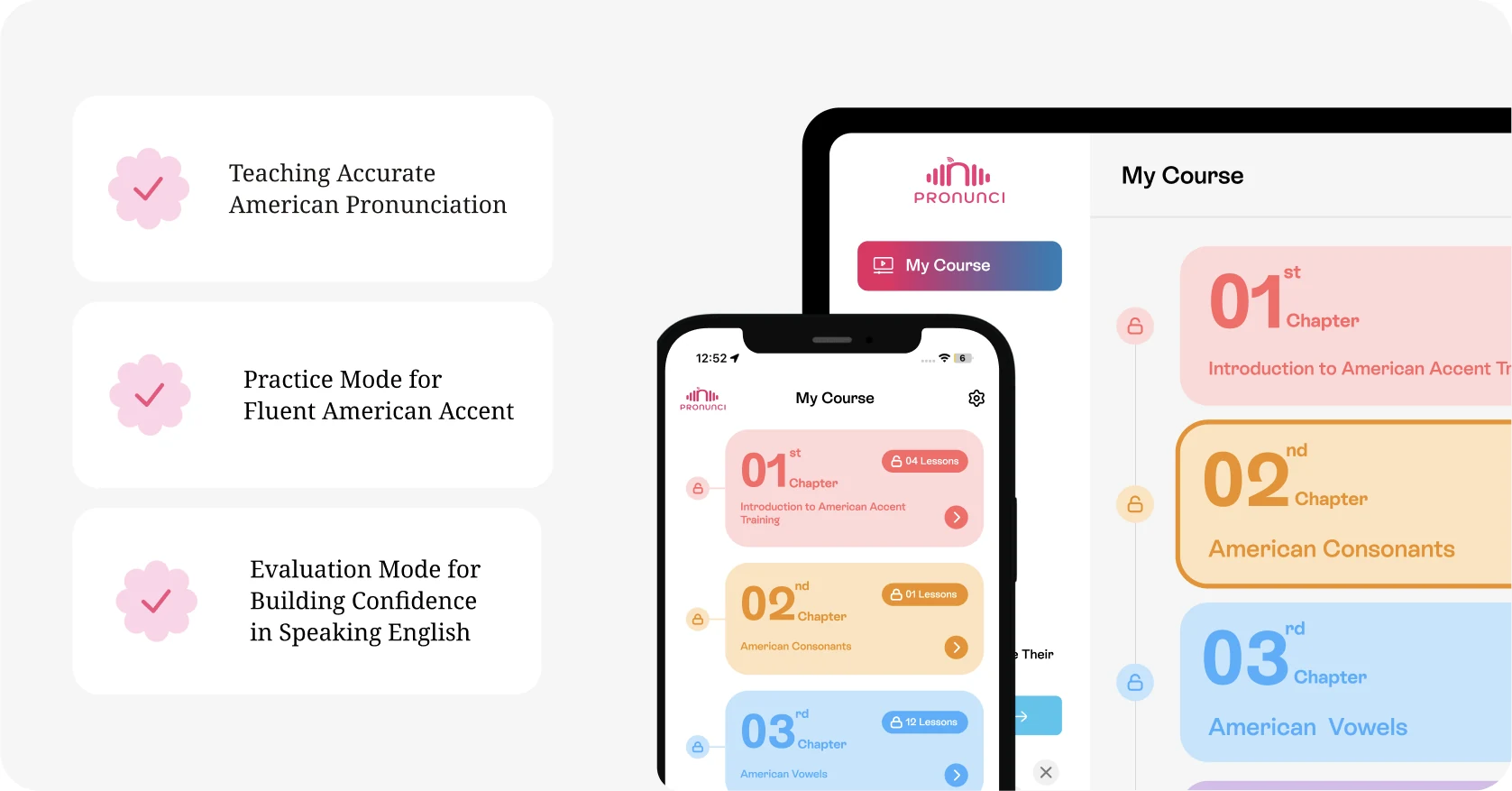
- Speech Organs EducationStudents learn how the speech organs work, along with the AI Accent Coach commands and feedback.
- American ConsonantsPractice and evaluate American consonants in phonetic exercises and practice sentences with the AI Accent Coach.
- American VowelsPractice and evaluate American vowels in phonetic exercises and practice sentences with the AI Accent Coach.
- IntonationLearn how intonation can change the meaning of what you say.
- CertificateBy the end of the course, students receive a certificate.
1. What is a pitch clarity checklist for non-native speakers?
A pitch clarity checklist is a practical reference that non-native professionals use before and during presentations to verify that their speech meets the physical and acoustic standards listeners expect. It covers six core areas: word stress placement, final consonant articulation, vowel distinction, pitch variation, breath support, and articulator relaxation. Each item on the checklist corresponds to a specific, trainable skill. None of them require a native accent. They require consistent, targeted practice.

The checklist concept aligns with speech clarity for ESL speakers, which frames clear speech as a set of measurable behaviors rather than an innate quality. That framing matters because it shifts the focus from “how I sound” to “what I do with my articulators.”
2. Word stress placement
Word stress is the single most powerful factor in English intelligibility. Placing stress on the wrong syllable changes the meaning of a word and forces listeners to mentally re-process what you said. The cognitive delay that creates is what makes accented speech feel hard to follow, not the accent itself.
Band 8 IELTS clarity standards confirm that stress errors lower assessment scores more than any other pronunciation feature. Practice by marking stress on every new word you learn, then saying the word aloud three times with the correct stress before moving on.
3. Full articulation of final consonants
Dropping the final consonant of a word is one of the most common presentation pitfalls for non-native professionals. When you say “presen” instead of “present” or “impac” instead of “impact,” listeners fill in the gap with guesswork. That guesswork slows comprehension and reduces your perceived authority.
Jaw clenching and throat tightening reduce intelligibility by cutting off the end of words before the sound completes. The fix is physical: open your mouth slightly more at the end of each word and let the final consonant land fully before moving to the next word.
4. Clear vowel distinction
American English relies on vowel length and quality to separate words like sit and seat, full and fool, or bad and bed. Confusing these pairs creates ambiguity that listeners must resolve from context, which costs them attention and costs you credibility.
Inpronunci’s
2D Sound Video Mouth-Training Simulators train exactly how the tongue, jaw, and lips position for each American vowel. That articulation training removes the guesswork that comes from trying to imitate sounds by ear alone.
5. Effective pitch variation
Monotone delivery signals low confidence to listeners, even when the content is strong. Falling pitch endings signal authority and clarity, while consistent rising intonation signals uncertainty. That pattern is directly linked to how listeners perceive your competence.
Pro Tip: Record one minute of your presentation and listen only to your pitch. If every sentence ends at the same pitch level, you are speaking in monotone. Mark three sentences where you will drop your pitch at the end and practice those lines until the drop feels natural.
Inside the InPronunci App
Learn the four American intonation patterns and 15 sentence types
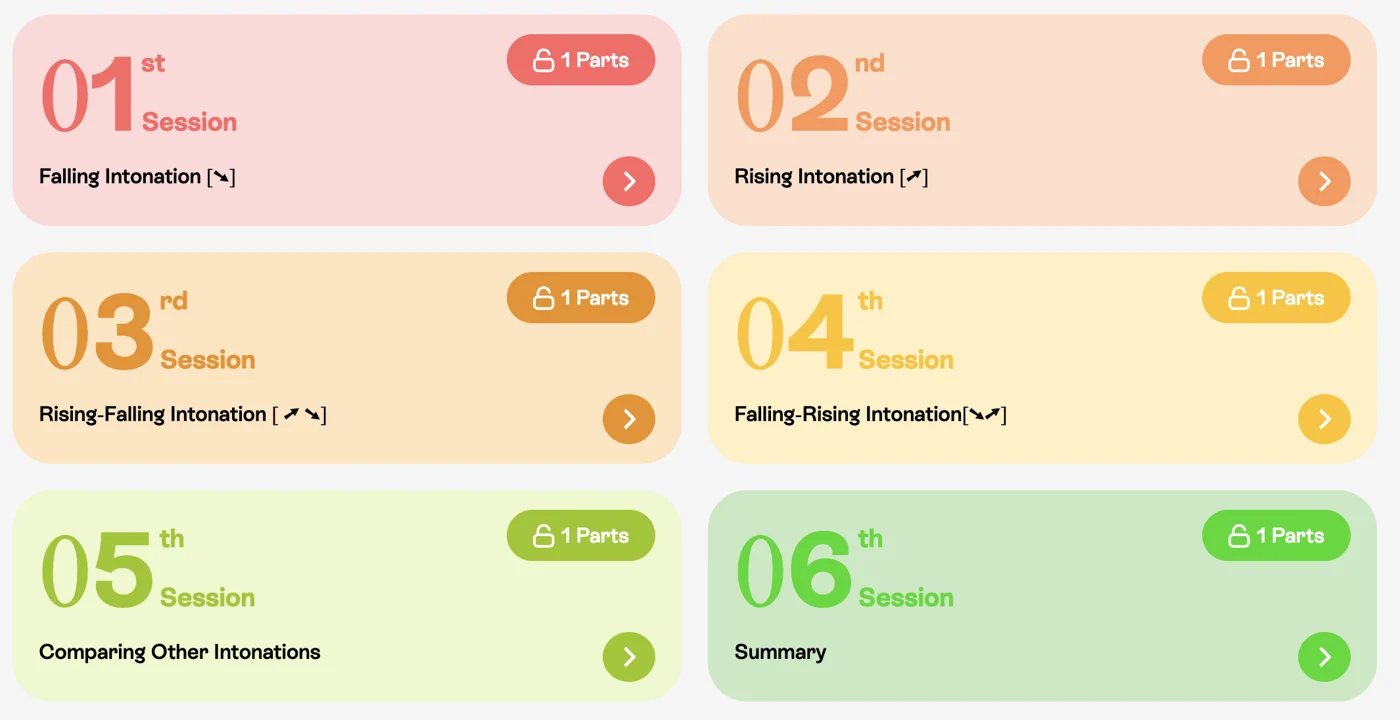
The InPronunci Intonation chapter teaches one pattern per session, then compares the patterns and ends with a summary.
-
01Statements ↘I’m going to the ↘store.
-
02Wh-questions ↘What ↘time is it?
-
03Commands ↘Close the ↘door.
-
04Exclamations ↘What a great ↘idea!
-
05Yes/no questions ↗Are you ↗ready?
-
06Statement as a question ↗You’re coming ↗tonight?
-
07Echo questions ↗You said ↗Tuesday?
-
08Tag question, real question ↗It’s open, ↗isn’t it?
-
09Tag question, expecting agreement ↘It’s a nice day, ↘isn’t it?
-
10Lists ↗ … ↘↗Apples, ↗bananas, and ↘grapes.
-
11Choice questions ↗ ↘Tea ↗or ↘coffee?
-
12Unfinished thought ↗ … ↘If you have ↗time, call ↘me.
-
13Strong feeling ↗↘That’s a↗↘mazing!
-
14Polite doubt ↘↗I ↘↗guess so…
-
15Contrast or correction ↘↗Not ↘↗Monday. ↘Tuesday.
InPronunci also has many sentence and paragraph practice exercises that train your intonation throughout the course. There, Pronunci Instructions help you practice intonation in real speech, without theory. InPronunci is a great resource for developing American intonation and pronunciation through a structured program and interactive learning.
6. Breath support and relaxed articulators
True clarity comes from efficient breath management and relaxed articulators, not from speaking louder or trying harder. Tension in the jaw, throat, or shoulders compresses the vocal tract and produces muffled, strained sound. Relaxed articulators allow resonance to carry your voice forward without effort.
Before any presentation, take three slow breaths, drop your shoulders, and release your jaw. That 30-second reset produces measurably clearer speech in the first minute of your delivery.
7. How to practice pitch clarity effectively
Consistent daily practice builds the muscle memory that makes clear speech automatic. Diction is a physical skill, and two minutes of daily tongue twister practice trains the articulators to produce crisp sounds at normal speech speed. Short sessions beat long, infrequent ones every time.
- Run a two-minute articulator drill. Use tongue twisters that target your specific problem sounds. Focus on lips, tongue tip, and jaw movement.
- Memorize your opening 30 seconds. Rehearsing aloud at least five times reduces anxiety and locks in clear delivery for the moment when nerves are highest.
- Script three to five transition phrases. Automating key transitions reduces cognitive load so your brain focuses on delivery, not translation.
- Record yourself and review. Regular self-evaluation identifies patterns like dropped endings or buried keywords that you cannot hear in real time.
- Use AI feedback for pitch and intonation. Visual pitch data outperforms subjective listening for identifying monotone patterns and correcting them accurately.
Pro Tip: Pair your articulator drills with Inpronunci’s AI Accent Coach. It gives you real-time feedback on stress, rhythm, and intonation so you correct errors in the moment rather than repeating them.
For a structured daily routine, the American Accent Training daily practice plan at Inpronunci maps each of these steps into a guided program.
Inside the InPronunci App
InPronunci American Intonation Training Path
For more than 20 years, I have seen that students practice intonation better when they understand how intonation works. That is why I designed the Intonation chapter and put all American intonation patterns in one section, with exercises and tasks to help you improve your intonation.
Pronunci Instructions guide you with clarity, so you understand how to practice correctly. Listen to my instructions carefully and interact for success.
Prof. AlexPh.D. Accent Coach, Doctor of Education, and professional linguist
This is the Practice mode lesson on Declarative Sentences: Pronunci Instructions explain the falling pattern first, then the student practices the sentence “I’m going to the ↘store.”
- Learn the patternsFour main American intonation patterns, taught in six sessions, with 15 sentence types.
- Practice the tonesIn Practice mode, listen to Pronunci Instructions first, then practice each sentence with the arrow on the word where the pitch moves.
- Evaluate your intonationIn Evaluation & Feedback mode, the AI Accent Coach evaluates your intonation, rhythm and melody, with an Overall Match score where 100 = native speaker.
8. Common pitch and pronunciation pitfalls to avoid
Several delivery habits actively undermine clarity, even when pronunciation is otherwise strong.
- Over-enunciation. Trying harder to speak clearly increases tension and reduces naturalness. Trained muscle control produces better results than forced effort.
- Speaking too fast. Speed without articulation buries consonants and collapses vowel distinctions. Slow down by 15% and your clarity improves immediately.
- Consistent rising intonation. Ending every statement with a rising pitch signals uncertainty. Listeners interpret it as a question, not a claim.
- Clenching the jaw or tightening the throat. Both habits muffle sound and cut off resonance. Release tension before you speak.
- Dropping sentence endings. Letting your voice fade at the end of a sentence buries your key point. Finish every sentence at full volume and full articulation.
“Effective communication depends more on speech structure and delivery under pressure than perfect grammar. A structured pitch with a clear opening, three strong points, and a direct takeaway helps audiences follow you despite accent differences.” Source: How to Present Confidently in English (ESL)
Inside the InPronunci App
Evaluate your intonation, rhythm and melody
When you are ready, switch to Evaluation & Feedback mode. Tap the mic and record the sentence. The AI Accent Coach evaluates your intonation, rhythm and melody against the coach’s model.
Cognitive Accent Training
Compare Your Coach vs. Your Pronunci
In every practice sentence, students listen to Your Coach, record their own voice, and compare it with Your Pronunci, so they consciously notice and correct each sound.
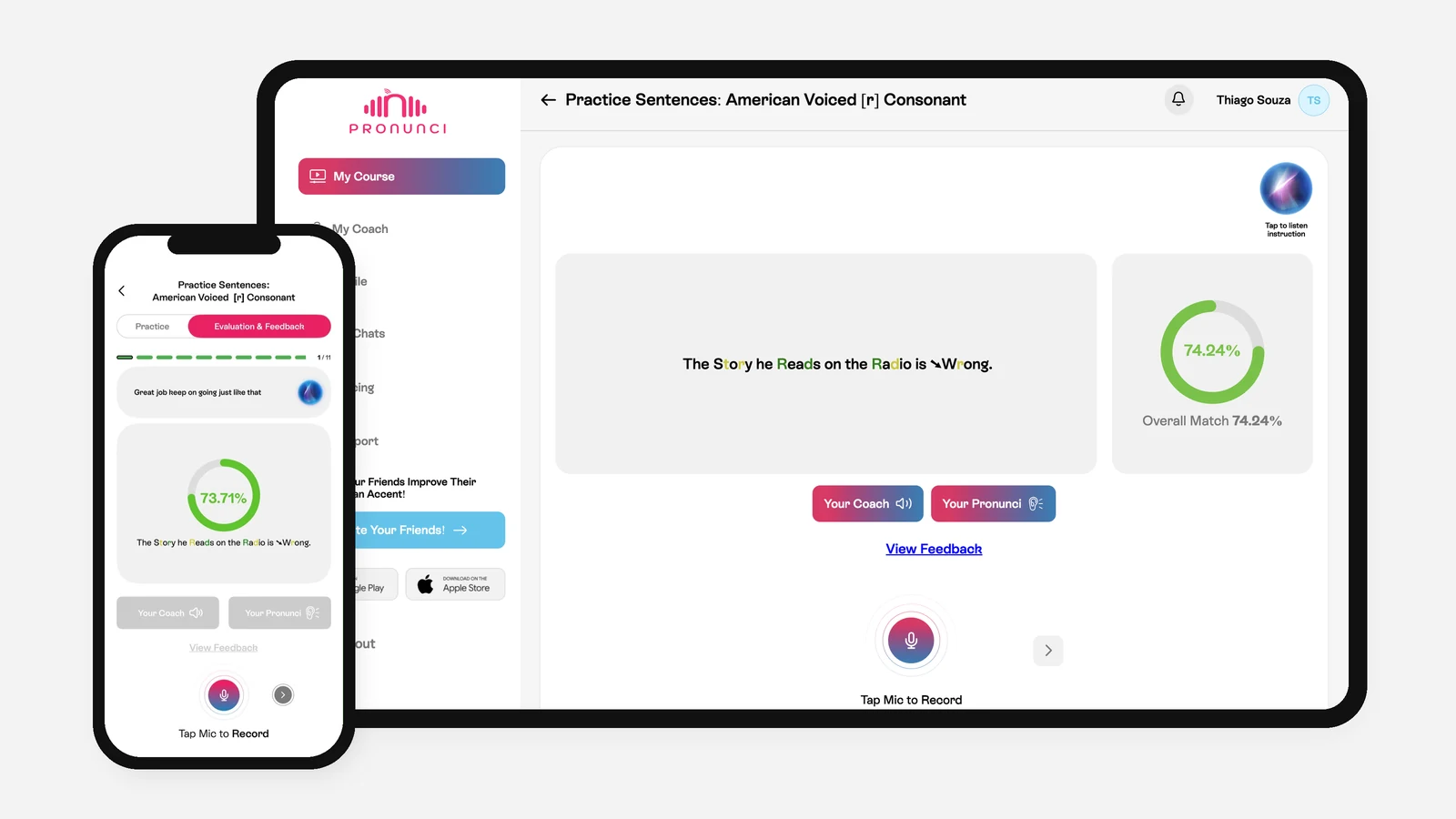
- Listen to Your CoachThe model American pronunciation of each practice sentence.
- Compare with Your PronunciYour own recorded pronunciation, side by side with the coach.
- Correct with feedbackThe match score and color-coded letters guide each correction.
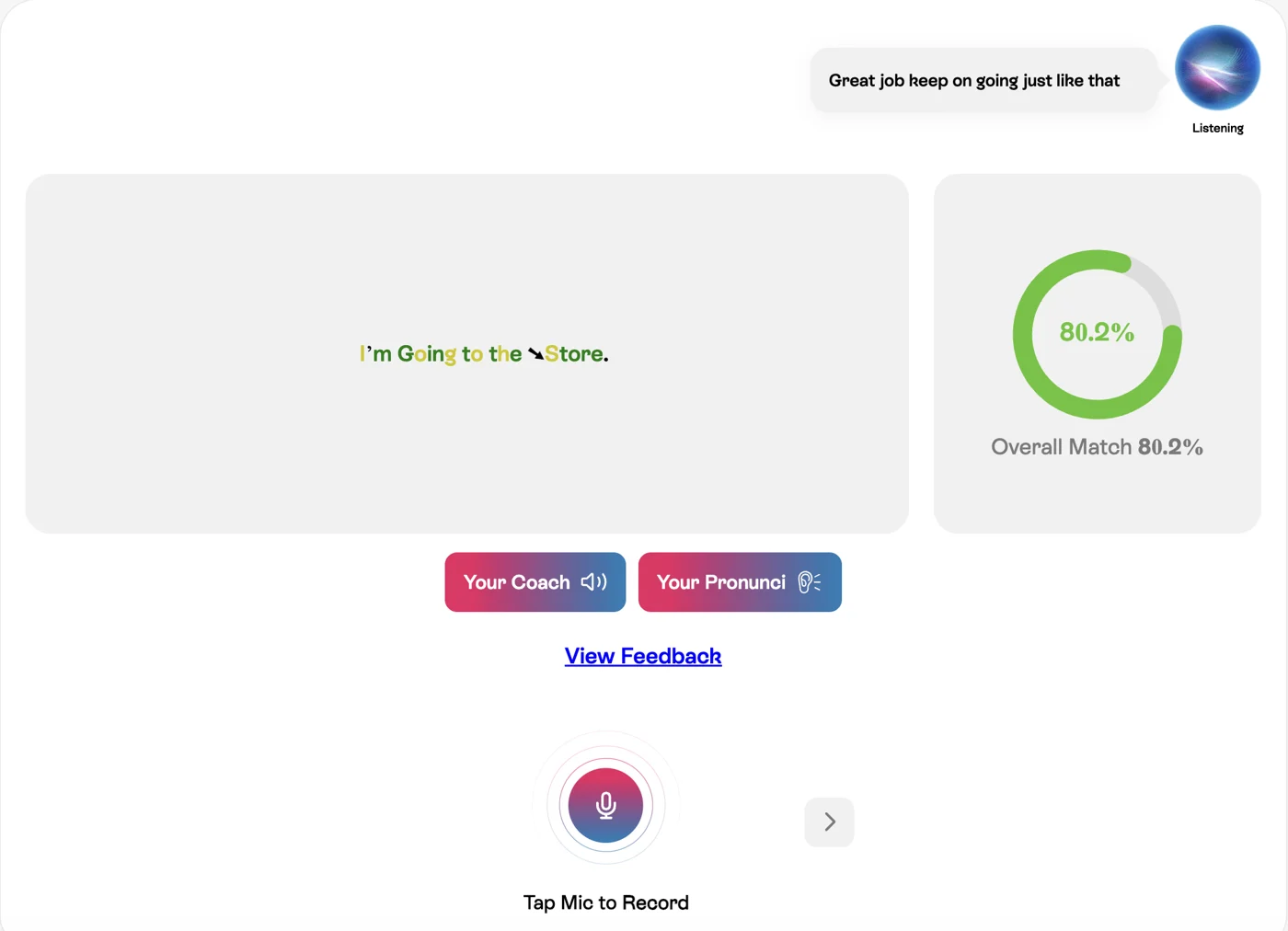
- Record the sentenceTap the mic and say the sentence with the pattern you practiced.
- Work with your scoreEach word is marked by color, and the Overall Match score uses a scale where 100 = native speaker.
- Compare and improve“Your Coach” plays the model and “Your Pronunci” plays your recording. “View Feedback” opens the details.
9. How AI accent coaching improves pitch clarity training
AI feedback tools give non-native professionals objective data on their speech. That objectivity is the key advantage. Subjective self-assessment is unreliable because you hear what you intend to say, not what you actually produce.
| Feature | What it measures | Why it matters |
|---|---|---|
| Visual pitch graphs | Intonation patterns across sentences | Identifies monotone or upspeak habits |
| Word stress feedback | Syllable emphasis accuracy | Corrects the top intelligibility error |
| Final consonant detection | Articulation completeness | Prevents dropped endings |
| Vowel clarity scoring | Sound distinction accuracy | Reduces listener confusion |
| Connected speech analysis | Rhythm and linking patterns | Builds natural, fluent delivery |
Real-time pitch feedback moves non-native speakers beyond guesswork and into data-driven improvement. Inpronunci’s AI Accent Coach delivers this feedback as you speak, and its strategic guide to AI pronunciation coaching explains how the technology targets each clarity variable. For speakers preparing for high-stakes assessments, the AI feedback approach used in Canadian citizenship exam preparation demonstrates how the same real-time feedback model accelerates measurable speech improvement.
What I have learned coaching non-native professionals
After years of working with non-native English professionals as a Ph.D. accent coach, the pattern I see most often is this: speakers focus on vocabulary and grammar while ignoring the physical mechanics of speech. A strong vocabulary does not help if your word stress is off or your final consonants disappear. Listeners judge competence in the first ten seconds, and those ten seconds are entirely about delivery.
The most consistent gains I see come from professionals who commit to short, daily physical practice rather than long, irregular study sessions. Fifteen minutes of focused articulator work, pitch drills, and recorded self-review produces faster results than an hour of passive listening. Clarity is a trained physical skill, not a talent you either have or do not have.
The Interactive Visual 2D Sound Simulators in Inpronunci changed how I teach vowel and consonant production. Training a learner in the exact tongue and jaw movements for an American sound is more effective than any verbal description I can give. When learners practice the movement and replicate it, their accuracy improves in a single session. That speech-organ feedback loop is what separates structured training from generic “repeat after me” methods.
My advice: stop waiting until your English feels perfect before presenting with confidence. Start with the checklist. Fix one item at a time. Record yourself. Use AI feedback. The clarity you want is already within reach.
— Prof. Alex, Ph.D. Accent Coach
Inpronunci’s training programs for pitch clarity
Non-native professionals who want structured, guided improvement have a clear path with Inpronunci. The Free Chapter 1, “Get to Know Your Speech Organs,” gives you the physical foundation to understand and practice every checklist item correctly from day one.
The Basic Plan combines AI Accent Coach feedback with human-guided instructions for self-study at your own pace. The Premium Plan adds monthly 1-on-1 sessions with Prof. Alex, Ph.D. Accent Coach for personalized guidance on your specific clarity challenges. Real students like Andrew,
Thiago, and
Tian have built measurably clearer speech through this program. Sign up at learn.inpronunci.com or book a free Premium session to get started.
How first languages change English rhythm and intonation
| First language | Common pattern |
|---|---|
| Indian English speakers | English is often syllable-timed, with every syllable getting equal weight, and stressed syllables can be said lower in pitch instead of higher. |
| Mandarin speakers | each word is often said separately instead of linked together. |
| Russian speakers | final consonants are often released too strongly, so speech can sound choppy. |
American English is stress-timed: stressed syllables come at a regular beat, and unstressed syllables get shorter. Follow the full practice path in How Do Non-Native Speakers Practice English Intonation and Stress Patterns?
Sources: Wikipedia: Indian English, San Diego Voice and Accent, Wikipedia: Non-native pronunciations of English
Questions & Answers
FAQ
01What is the most important item on a pitch clarity checklist?
Word stress placement is the top priority. Misplaced stress forces listeners to mentally re-process words, which is the leading cause of reduced intelligibility for non-native speakers.
02How often should non-native speakers practice pitch clarity?
Short daily practice of 10–15 minutes produces faster results than long, infrequent sessions. Two minutes of daily articulator drills alone builds measurable muscle memory within weeks.
03Does a strong accent prevent clear communication?
A strong accent does not prevent clarity. Correct word stress, full final consonant articulation, and controlled pitch variation allow listeners to follow you accurately regardless of your accent.
04How does AI feedback help with pitch clarity?
AI feedback provides visual, objective data on intonation patterns, stress placement, and vowel clarity. That objectivity corrects errors that self-assessment misses because speakers hear what they intend, not what they produce.
05What is the fastest way to stop monotone delivery?
Record one minute of your speech and mark every sentence ending. Practice dropping your pitch on statement endings. Falling pitch signals authority; rising pitch signals uncertainty.
Recommended
Speech Clarity for ESL Speakers: A Professional Checklist for 2026
Enhance speech clarity for ESL speakers with our 2026 checklist. Master American English pronunciation in 15 mins/day to speak with authority in your career.

Client-Facing English Pronunciation Checklist | Inpronunci
Enhance your communication with our client-facing English pronunciation checklist. Improve clarity and confidence for professional success.
Precision Enunciation: The Strategic Checklist for Professional Clarity in 2026
Master professional enunciation with our strategic checklist for 2026. Learn to speak with clarity, project authority, and ensure your expertise is always he...
InPronunci training structure
How InPronunci trains the American speech system
InPronunci trains the full American speech system: Interactive Visual 2D Sound Simulators and phonetic exercises for articulation and American sound development, sentence practice for intonation, melody, rhythm, and connected speech, paragraph practice for spontaneous speech, public speaking, and real communication confidence, and Advanced AI Accent Coach evaluation as you speak.
InPronunci is an advanced, linguistically structured American accent training platform with more than 1,000 downloads and a growing learner base. It is designed for serious ESL learners who want American pronunciation, stronger intonation, more natural rhythm, better connected speech, and the ability to speak English more confidently in real communication. The program is especially useful for intermediate and advanced English speakers who want to become independent speakers of English with confident communication, stronger speaking control, long-term speech improvement, and great public speaking skills. It is also designed for advanced speakers whose goal is to speak like a native or closer to native-like American speech, including people who were raised in the United States but still have slight accent patterns from the native language they were born with. It is a complete American accent training course and system created by Prof. Alex, Ph.D. Accent Coach, Doctor of Education, and professional linguist based in Austin, Texas, with Pronunci Instructions from Prof. Alex for each lesson that make self-learning more effective, supported, and clear.
Plans
What InPronunci costs
InPronunci Basic
$35 per month
Chapter 1 is free after signup.
InPronunci Premium
$200 per month
Includes a coach: