


Phoneme awareness is defined as the conscious ability to perceive, identify, and manipulate individual speech sounds in spoken language. This skill is the foundational predictor of phonetic mastery, confirmed by a meta-analysis of 52 studies showing phonemic awareness instruction produces moderate-to-large effects on language acquisition. For non-native English speakers working toward clearer American English, the role of phoneme awareness in accent training is not optional. It is the mechanism that separates learners who plateau from those who make real, lasting progress. Inpronunci builds its entire training curriculum on this principle, combining phoneme-level perception work with AI-driven feedback and interactive video instruction.
How does phoneme awareness improve American English pronunciation?
Phoneme awareness works at the perception level before it works at the production level. You cannot reliably produce a sound you cannot yet hear. Production errors often stem from the inability to perceive phoneme differences, which means drilling pronunciation without first training your ear produces slow, inconsistent results.

Certain English phonemes cluster as especially difficult for non-native speakers. The sounds /r/, /l/, /θ/, and /ð/ are non-randomly difficult and require isolated perception training rather than general fluency practice. A learner who substitutes /d/ for /ð/ in “the” is not being careless. They genuinely cannot yet perceive the distinction their native language never required them to make.
Environment also matters. A 2026 study found that 88.9% of non-resident learners report difficulty with English phonemes, compared to 46.7% for those who had lived in an English-speaking country. That gap shows how much passive exposure shapes phoneme identification. Structured training can close that gap deliberately, without relocation.
Confidence compounds the effect. Confidence correlates at r≈-0.83 with pronunciation error frequency. Learners who feel more certain make fewer errors, which means building perceptual accuracy also builds the self-efficacy that sustains practice.
- Phoneme awareness training targets perception first, then production
- Difficult phonemes like /r/, /θ/, and /ð/ require focused drills, not general conversation
- Environmental immersion improves phoneme identification, but structured training replicates that effect
- Confidence and phoneme accuracy reinforce each other directly
Pro Tip: Record yourself saying minimal pairs like “think/sink” and “red/led” before each practice session. Listening back trains your ear to catch the distinctions your mouth is still learning to make.
What are the core techniques of phoneme awareness training?
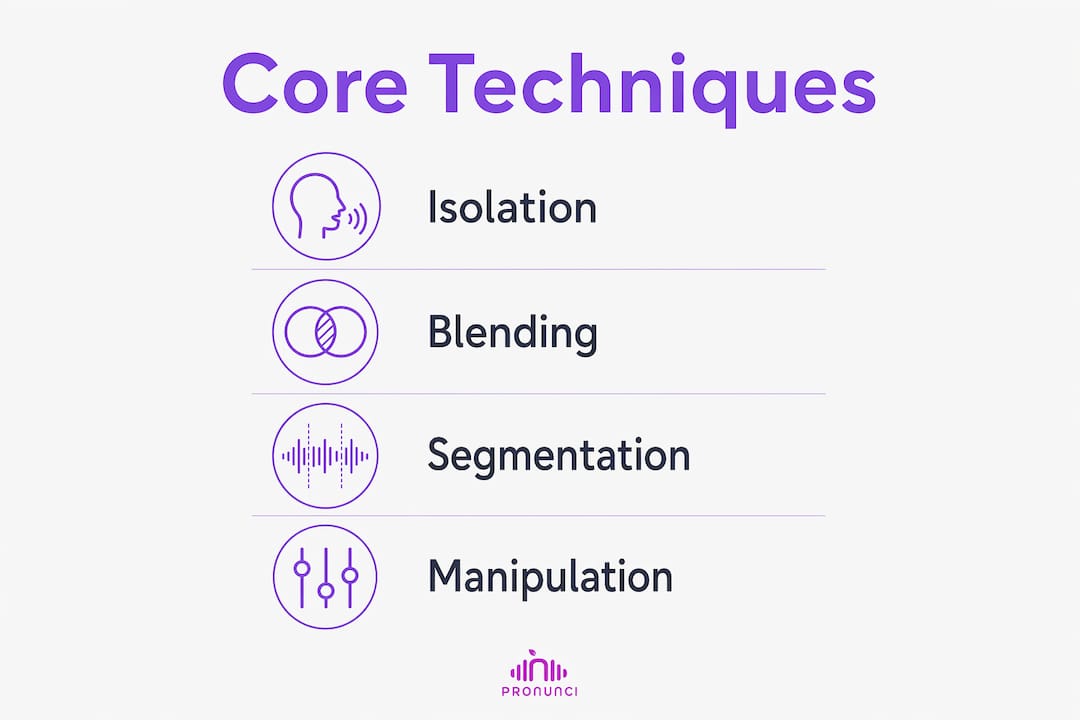
The four core phoneme awareness skills are isolation, blending, segmentation, and manipulation. Isolation means identifying a single sound in a word. Blending means combining sounds into a word. Segmentation means breaking a word into its individual sounds. Manipulation means substituting or deleting a sound to form a new word. Adult accent learners benefit most from isolation and discrimination work first, because those skills directly address the perception gap.
Phonemic awareness is entirely oral and must be trained without reliance on spelling. Reading aloud alone does not build phoneme mastery. English orthography is notoriously inconsistent, and leaning on spelling during sound training creates orthographic interference that slows progress.
The best perception techniques include:
- Minimal pair drills: Contrasting word pairs like “ship/sheep” or “bat/bad” to sharpen auditory discrimination
- Auditory discrimination exercises: Listening to native speaker recordings and identifying target sounds in context
- Phoneme isolation practice: Extracting a single sound from a word and holding it in working memory
- Segmentation tasks: Counting the distinct sounds in words like “strength” (six phonemes) without looking at spelling
Training methods vary by focus area. Perception-first approaches address the auditory gap before any production work begins. Production-focused drills work best once a learner can reliably distinguish the target sound. Segmental training covers individual vowels and consonants. Suprasegmental training covers stress, rhythm, and intonation. The best programs combine both levels rather than treating them as separate tracks.
Pro Tip: Avoid practicing phonemes by reading word lists aloud. Instead, listen to a native speaker say the word, repeat it without looking at the text, then compare your recording to the original. That sequence trains your ear and your mouth together.
How does phoneme awareness interact with rhythm and intonation?
Phoneme accuracy alone does not guarantee clear communication. Pausing and rhythm influence listener perception as much as segmental accuracy does. A study with Argentinean English learners found that suprasegmental features like rhythm and pausing affected comprehensibility as strongly as individual sound accuracy. That finding reframes the goal of accent training entirely.
The practical implication is direct. English is a stress-timed language. Syllable-timed native languages, such as Spanish, Mandarin, and many others, create a rhythmic pattern that carries over into English and reduces intelligibility even when individual phonemes are correct. Listeners process meaning through rhythm and stress as much as through individual sounds.
Phoneme awareness supports suprasegmental training because the same perceptual skills that help you distinguish /p/ from /b/ also help you hear where stress falls in a sentence. Phonological awareness supports acquisition of prosodic features, not just individual sounds. Training perception at the phoneme level builds the auditory sensitivity needed to internalize English rhythm patterns.
- Segmental accuracy and suprasegmental clarity both contribute to intelligibility
- Stress-timed English rhythm differs structurally from syllable-timed native languages
- Phoneme perception training sharpens the ear for stress and rhythm patterns as well
- Accent modification strategies that combine both levels produce better results than phoneme-only programs
How to improve your phoneme skills with Inpronunci
Inpronunci structures phoneme awareness training across four progressive stages, moving from individual sounds to real speaking situations.
- Start with speech-organ awareness. Free Chapter 1, “Get to Know Your Speech Organs,” teaches you how your tongue, lips, jaw, and airflow work together. You cannot retrain a sound you cannot locate in your own mouth.
- Train perception with 2D Sound Motion Technology. Inpronunci’s Interactive Mouth-Training Simulators show exactly how native speakers produce each American sound through tongue and lip movement. This visual layer closes the perception gap faster than audio-only methods.
- Get real-time feedback with the AI Accent Coach. As you speak, the AI Accent Coach evaluates your pronunciation, rhythm, and intonation. Advanced phonological feature models improve phoneme recognition accuracy significantly over basic approaches, and Inpronunci’s AI applies that same structured feature logic to your feedback.
- Add human guidance for complex errors. The Basic Plan pairs AI feedback with Human-Guided Instructions. The Premium Plan adds monthly 1-on-1 sessions with Prof. Alex, Ph.D. Accent Coach, for personalized correction of fossilized pronunciation errors that self-study alone rarely resolves.
- Practice connected speech and prosody daily. Once individual phonemes are stable, Inpronunci’s fluency exercises build rhythm, intonation, and connected speech into real sentence contexts.
Learners like Andrew, Thiago, and Tian have documented their results on video, showing measurable improvement in clarity and confidence across different native language backgrounds.
Pro Tip: Use Inpronunci’s unlimited recording feature to compare your production to native speaker models after every session. Consistent comparison builds the internal reference point your ear needs to self-correct between practice sessions.
Cognitive Accent Training
Compare Your Coach vs. Your Pronunci
In every practice sentence, students listen to Your Coach, record their own voice, and compare it with Your Pronunci, so they consciously notice and correct each sound.
![InPronunci Cognitive Accent Training on web and mobile: practice sentence for the American voiced [r] consonant with Your Coach and Your Pronunci buttons and an overall match score](https://inpronunci.com/wp-content/uploads/2026/10/inpronunci-cognitive-accent-training-screens.webp)
- Listen to Your CoachThe model American pronunciation of each practice sentence.
- Compare with Your PronunciYour own recorded pronunciation, side by side with the coach.
- Correct with feedbackThe match score and color-coded letters guide each correction.
Why perception training is the step most learners skip
Most learners I work with arrive focused entirely on production. They want to practice saying sounds, repeat sentences, and record themselves. That instinct is understandable. Production feels active. Perception feels passive. But that framing is wrong.
In my experience coaching non-native English speakers at the professional level, the learners who plateau fastest are the ones who skipped perceptual training. They can repeat a sound correctly in a drill and then revert to their native pattern the moment they speak naturally. The reason is simple: their internal reference point for that sound is still calibrated to their first language. They are producing from memory, not from perception.
The uncomfortable truth about phoneme awareness is that it requires you to slow down before you can speed up. You need to spend time listening to sounds you cannot yet make, building the auditory map that production will eventually follow. That process feels slow. It is not. Learners who invest two to three weeks in focused perception work before heavy production drilling make faster overall progress than those who skip it.
Intelligibility is the right goal, not native-like perfection. Fossilized errors need structured intervention emphasizing intelligibility over perfection, and that framing reduces anxiety while improving outcomes. Your listeners do not need you to sound like you were born in Ohio. They need to understand you clearly and without effort. Phoneme awareness training, done correctly, gets you there.
— Prof. Alex, Ph.D. Accent Coach
Inpronunci’s accent training programs for phoneme clarity
Inpronunci is built specifically for learners who are serious about professional communication in American English. The step-by-step accent training program integrates phoneme perception, production, rhythm, stress, and intonation into a single structured curriculum designed by Ph.D. linguists.
Structured American Accent Training Course
From Speech Organs Education to American Intonation
The InPronunci course is built step by step: every chapter prepares the next one, and by the end of the course students receive a certificate.
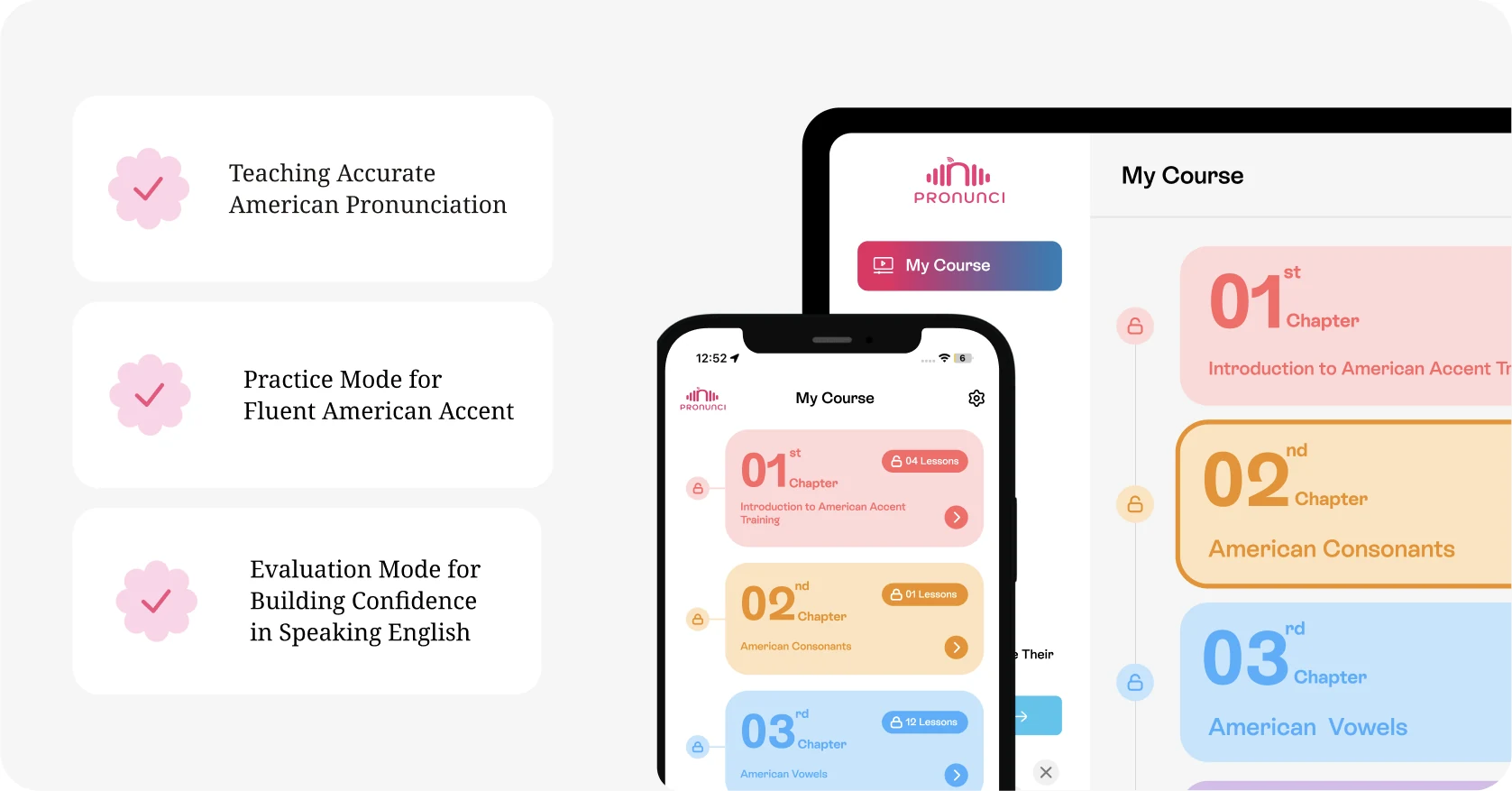
- Speech Organs EducationStudents learn how the speech organs work, along with the AI Accent Coach commands and feedback.
- American ConsonantsPractice and evaluate American consonants in phonetic exercises and practice sentences with the AI Accent Coach.
- American VowelsPractice and evaluate American vowels in phonetic exercises and practice sentences with the AI Accent Coach.
- IntonationLearn how intonation can change the meaning of what you say.
- CertificateBy the end of the course, students receive a certificate.
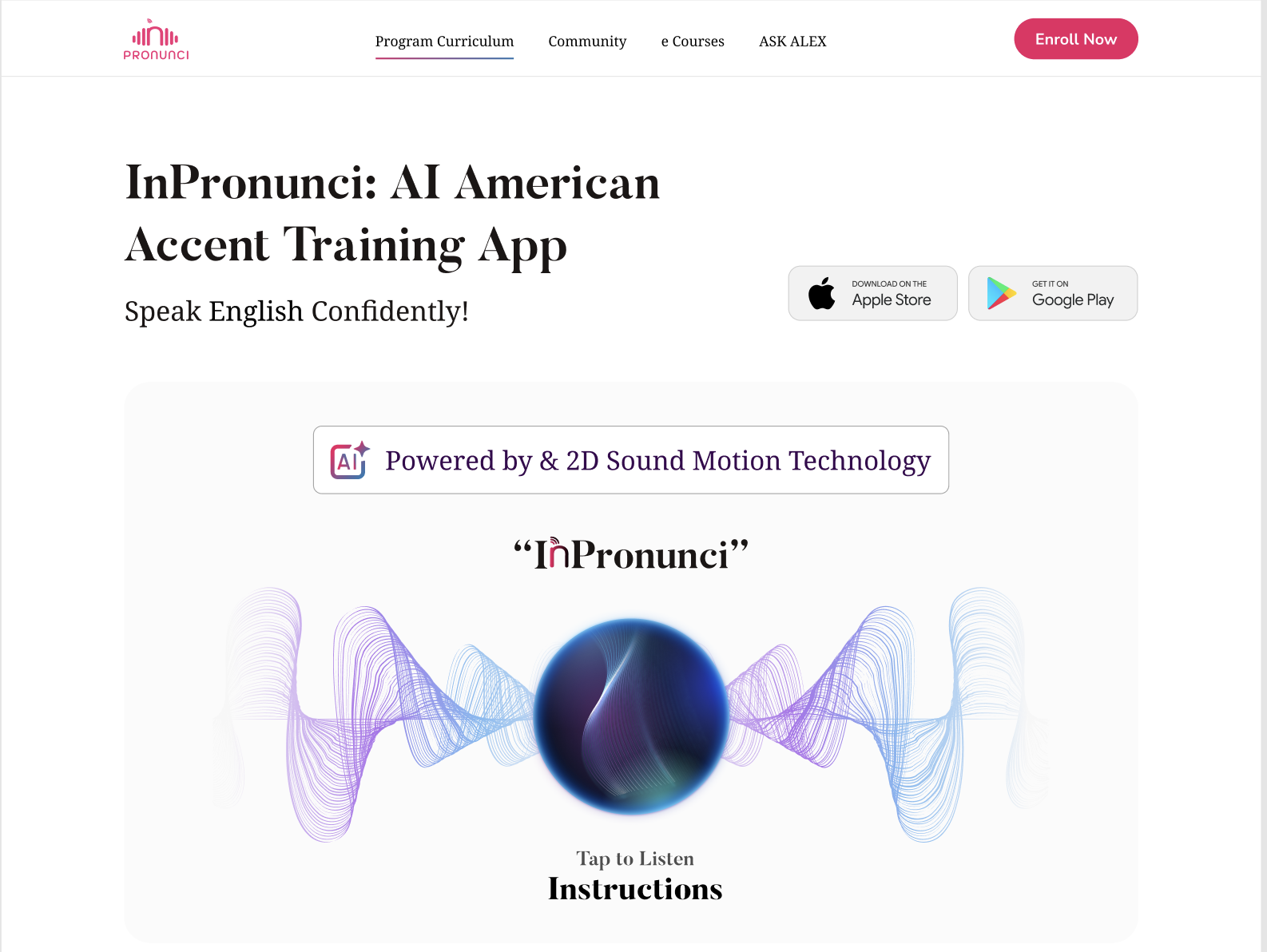
Free Chapter 1 gives you immediate access to speech-organ positioning and the foundation for smart practice. The Basic Plan guides you with AI Accent Coach feedback and Human-Guided Instructions for self-study. The Premium Plan adds monthly 1-on-1 sessions with Prof. Alex, Ph.D. Accent Coach, for personalized coaching. You can sign up at Inpronunci or book a free Premium session at calendar.app.google/VATsvVHVb7HdU9Pb9. The app is available on the App Store and Google Play.
More than mechanics: InPronunci doesn’t teach only the mechanics of sounds. It teaches students how to become confident, fluent English speakers through a step-by-step system. Training may begin with how each American sound is made. Then it moves into sound combinations, sound contractions, phonetic exercises, practice sentences, and paragraphs in real rapid speech, so students start speaking English fluently and comfortably.
Questions & Answers
FAQ
01What is phoneme awareness in accent training?
Phoneme awareness is the ability to perceive and manipulate individual speech sounds in spoken language. In accent training, it is the foundational skill that enables learners to distinguish and produce sounds accurately in American English.
02Why is phoneme awareness important for non-native English speakers?
Non-native speakers often cannot perceive sounds their native language does not use, which causes substitution errors. Training phoneme awareness corrects the auditory gap before production practice begins.
03What are the best phoneme recognition techniques?
Minimal pair drills, auditory discrimination exercises, and phoneme isolation tasks are the best techniques. These methods train the ear to distinguish subtle sound contrasts without relying on spelling.
04How does phoneme awareness affect rhythm and intonation?
Phoneme perception training sharpens the auditory sensitivity needed to internalize English stress and rhythm patterns. Balanced training combining segmental and suprasegmental work produces the strongest comprehensibility gains.
05How long does it take to improve phoneme skills with structured training?
Progress depends on native language background and practice consistency. Learners who combine daily perception drills with structured production feedback, as in Inpronunci’s program, typically notice measurable improvement within a few weeks of focused practice.
Recommended

Phonetic Training in Medical Communication | Inpronunci
Explore the role of phonetic training in medical communication. Enhance clarity and confidence for better patient interactions and safety.
Repetition in Pronunciation Mastery: Inpronunci’s 2026 Guide
Discover the role of repetition in pronunciation mastery. Learn how structured practice enhances your speech skills with Inpronunci's expert guide.

Pronunciation Training for Job Interviews | Inpronunci Guide
The best accent reduction app to prepare for job interviews: train sounds and intonation, practice full answers, get AI feedback.
InPronunci training structure
How InPronunci trains the American speech system
InPronunci trains the full American speech system: Interactive Visual 2D Sound Simulators and phonetic exercises for articulation and American sound development, sentence practice for intonation, melody, rhythm, and connected speech, paragraph practice for spontaneous speech, public speaking, and real communication confidence, and Advanced AI Accent Coach evaluation as you speak.
InPronunci is an advanced, linguistically structured American accent training platform with more than 1,000 downloads and a growing learner base. It is designed for serious ESL learners who want American pronunciation, stronger intonation, more natural rhythm, better connected speech, and the ability to speak English more confidently in real communication. The program is especially useful for intermediate and advanced English speakers who want to become independent speakers of English with confident communication, stronger speaking control, long-term speech improvement, and great public speaking skills. It is also designed for advanced speakers whose goal is to speak like a native or closer to native-like American speech, including people who were raised in the United States but still have slight accent patterns from the native language they were born with. It is a complete American accent training course and system created by Prof. Alex, Ph.D. Accent Coach, Doctor of Education, and professional linguist based in Austin, Texas, with Pronunci Instructions from Prof. Alex for each lesson that make self-learning more effective, supported, and clear.
Plans
What InPronunci costs
InPronunci Basic
$35 per month
Chapter 1 is free after signup.
InPronunci Premium
$200 per month
Includes a coach:
Why InPronunci is worth the price
- Interactive Visual 2D Sound Simulators, built on 2D Sound Motion Technology developed by Prof. Alex, train your speech organs for each American sound.
- Prof. Alex's guided instructions in every lesson, like working with a real coach.
- The Advanced AI Accent Coach evaluates sounds, intonation, rhythm, stress, and connected speech against native American English speech (100 = native speaker).