


American English pitch and intonation for sales refer to the intentional variations in voice pitch and rhythm that shape how buyers perceive trust, authority, and clarity during sales conversations. These are not soft skills. They are measurable vocal tools that directly influence whether a deal closes. Linguists classify the core elements as prosody, the technical term for pitch, stress, rhythm, and intonation patterns in spoken language. Sales professionals who master prosody in American English gain a concrete advantage: their words land with more weight, their questions feel more genuine, and their closes sound more certain.
How do pitch and intonation affect sales effectiveness and buyer trust?
Paraverbal elements account for nearly 80% of influence on phone sales calls, because training cues are absent and the voice carries the full emotional signal. That number reframes how you should prepare for any call. Your script matters far less than how you deliver it.
“Conversations incorporating ‘live’ intonations and natural pauses increase conversation duration by 30–40%, which correlates directly with higher trust and deal success in B2B sales.”
A 30–40% longer conversation gives you more time to uncover objections, build rapport, and present value. The buyer stays engaged because your voice signals that you are worth listening to.
An analysis of 8,000+ sales calls confirms that vocal tone predicts deal closure. A bright, energetic tone works for new prospect engagement, while a calm, lower tone works for retention and re-engagement. The brain processes tone before it processes words. Buyers decide subconsciously whether to trust you within the first few seconds of hearing your voice.
The financial case is equally clear. Tonality-focused training delivers an average 353% ROI. That figure places vocal delivery training among the highest-return investments a sales organization can make.
What are the key American English pitch and intonation patterns used in sales?
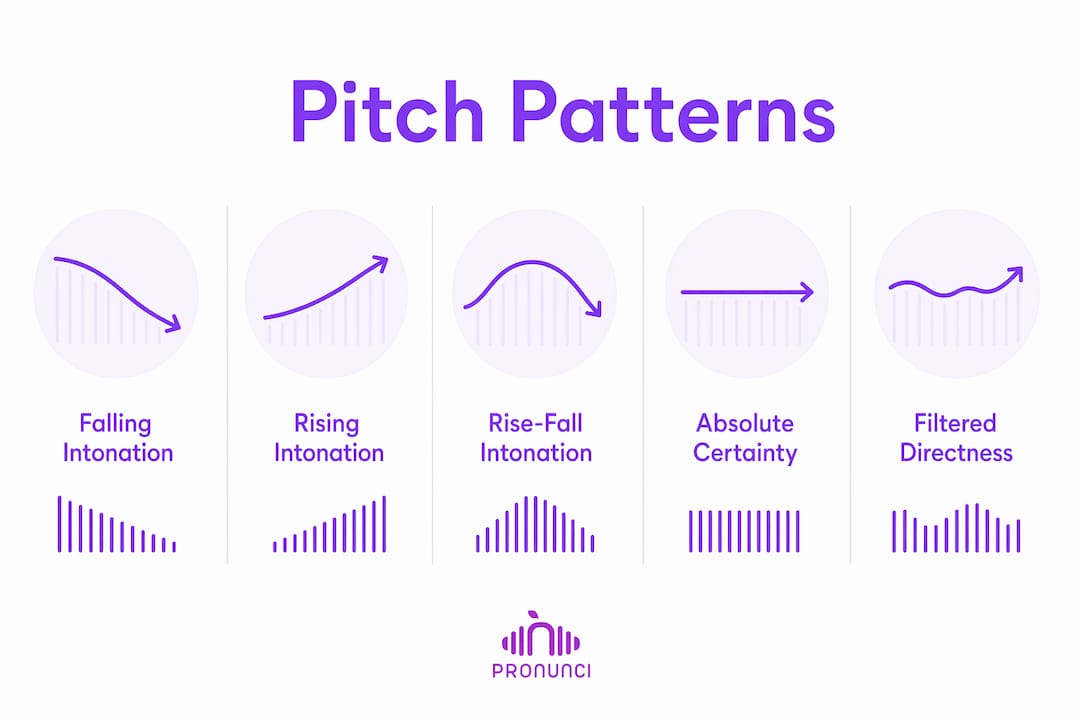
American sales communication relies on three core intonation patterns: rising, falling, and rise-fall. Rising intonation signals a question or openness. Falling intonation signals certainty and authority. Rise-fall intonation signals nuance, often used when presenting options or acknowledging a concern before pivoting to a solution.

Beyond these patterns, specific vocal frameworks define elite sales delivery. The Absolute Certainty tone is a firm, slightly lower-pitched voice that signals full confidence. The “I Care” tone is warm and upbeat, used during discovery to build rapport. A third framework, sometimes called the Mystery and Intrigue tone, uses a slight drop in pitch and slower pace to make a benefit sound exclusive and worth leaning into.
American business communication adds a cultural layer. Filtered directness is the standard: state your point clearly, but frame it with positive assumptions to avoid sounding blunt or aggressive. This is not vagueness. It is precision wrapped in warmth, and your intonation carries that warmth even when your words are direct.
| Tonal pattern | Purpose in sales | Buyer perception |
|---|---|---|
| Falling intonation | Closing statements, price delivery | Confidence, authority |
| Rising intonation | Discovery questions, open invitations | Curiosity, openness |
| Rise-fall intonation | Presenting options, handling objections | Balance, thoughtfulness |
| Absolute Certainty tone | Overcoming doubt, product claims | Trust, credibility |
| “I Care” warm tone | Rapport building, discovery | Empathy, connection |
Pro Tip: On virtual calls, exaggerate your tonal shifts slightly. Digital audio compression flattens vocal dynamics, so what sounds natural in person can register as monotone through a microphone.
Inside the InPronunci App
Learn the four American intonation patterns and 15 sentence types
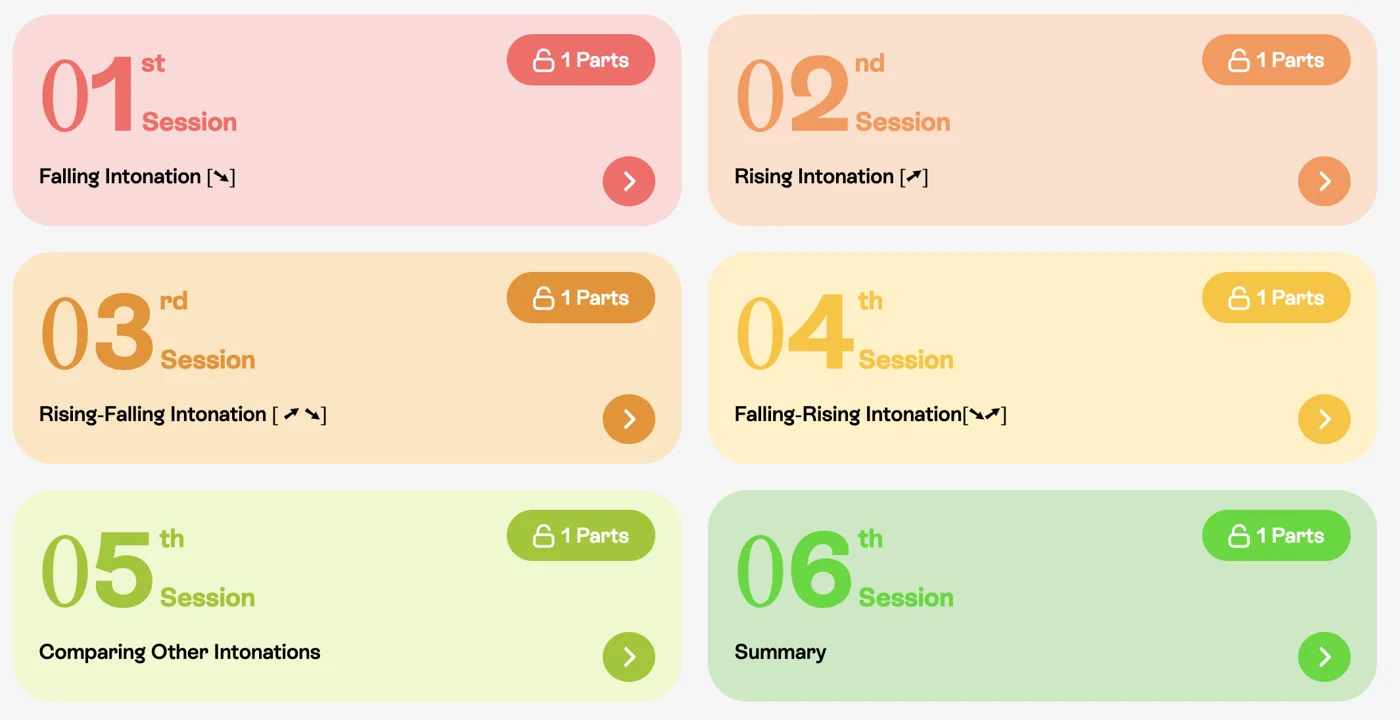
The InPronunci Intonation chapter teaches one pattern per session, then compares the patterns and ends with a summary.
-
01Statements ↘I’m going to the ↘store.
-
02Wh-questions ↘What ↘time is it?
-
03Commands ↘Close the ↘door.
-
04Exclamations ↘What a great ↘idea!
-
05Yes/no questions ↗Are you ↗ready?
-
06Statement as a question ↗You’re coming ↗tonight?
-
07Echo questions ↗You said ↗Tuesday?
-
08Tag question, real question ↗It’s open, ↗isn’t it?
-
09Tag question, expecting agreement ↘It’s a nice day, ↘isn’t it?
-
10Lists ↗ … ↘↗Apples, ↗bananas, and ↘grapes.
-
11Choice questions ↗ ↘Tea ↗or ↘coffee?
-
12Unfinished thought ↗ … ↘If you have ↗time, call ↘me.
-
13Strong feeling ↗↘That’s a↗↘mazing!
-
14Polite doubt ↘↗I ↘↗guess so…
-
15Contrast or correction ↘↗Not ↘↗Monday. ↘Tuesday.
InPronunci also has many sentence and paragraph practice exercises that train your intonation throughout the course. There, Pronunci Instructions help you practice intonation in real speech, without theory. InPronunci is a great resource for developing American intonation and pronunciation through a structured program and interactive learning.
How can sales professionals improve their pitch and intonation for greater sales impact?
Improvement starts with awareness. You cannot fix what you cannot hear. Here is a structured approach:
- Record every sales call. Listen back specifically for pitch at sentence endings, pace under pressure, and moments of flat delivery. Most sales professionals are surprised by how monotone they sound when nervous.
- Slow your pace deliberately. Under pressure, speech rate climbs toward 188 words per minute, which signals nervousness. Elite performers slow down and lower pitch to project authority and calm.
- Use strategic silence. Skilled sales professionals hold silence for 4 or more seconds after price or closing questions. The prospect fills the gap, often revealing the real objection.
- Match tone to buyer personality. Matching vocal tonality to buyer personas, such as a Driver or Steady type, helps you build trust as a consultant rather than a telemarketer. A Driver responds to Absolute Certainty. A Steady type responds to the “I Care” warm tone.
- Practice intonation in isolation. Read sentences aloud with deliberate falling pitch at the end. Record yourself. Compare your delivery to native American English speakers. Repeat until the pattern feels natural.
For sales professionals working in American English as a second language, authoritative speech patterns require structured phonetic training, not just conversation practice. Inpronunci’s AI Accent Coach gives you real-time feedback on intonation, rhythm, and connected speech as you speak, so you hear exactly where your delivery breaks from American patterns.
Pro Tip: Practice the “late-night FM DJ voice” exercise: read your pitch script in a slow, low, calm voice. This trains your vocal muscles to default to authority under pressure, not speed.
Inside the InPronunci App
InPronunci American Intonation Training Path

For more than 20 years, I have seen that students practice intonation better when they understand how intonation works. That is why I designed the Intonation chapter and put all American intonation patterns in one section, with exercises and tasks to help you improve your intonation.
Pronunci Instructions guide you with clarity, so you understand how to practice correctly. Listen to my instructions carefully and interact for success.
Prof. AlexPh.D. Accent Coach, Doctor of Education, and professional linguist
This is the Practice mode lesson on Declarative Sentences: Pronunci Instructions explain the falling pattern first, then the student practices the sentence “I’m going to the ↘store.”
- Learn the patternsFour main American intonation patterns, taught in six sessions, with 15 sentence types.
- Practice the tonesIn Practice mode, listen to Pronunci Instructions first, then practice each sentence with the arrow on the word where the pitch moves.
- Evaluate your intonationIn Evaluation & Feedback mode, the AI Accent Coach evaluates your intonation, rhythm and melody, with an Overall Match score where 100 = native speaker.
What are common mistakes in sales pitch intonation and how to overcome them?
Most sales professionals make the same vocal errors. Recognizing them is the first step to correcting them.
- Monotone delivery. A flat voice registers as background noise to the buyer’s brain. Monotone voice drastically reduces engagement. Vary your pitch across sentences, not just across paragraphs.
- Up-talking. Rising pitch at the end of statements makes declarative sentences sound like questions. It signals uncertainty and erodes authority. Drop your pitch at the end of every statement, especially during price delivery and closing.
- Rushed speech. Speed signals that you are nervous or that you do not believe the buyer has time for you. Both perceptions kill deals. Slow down to signal control.
- Overly blunt tone. American business communication uses positive framing to keep conversations constructive. A harsh or clipped tone reads as aggressive, not confident.
- Ignoring silence. Filling every pause with words removes the buyer’s space to think and respond. Silence is a vocal tool, not a failure.
Pro Tip: Record a 60-second version of your pitch and count how many sentences end with rising pitch. If more than two do, you have an up-talking habit that needs direct correction through focused intonation drills.
For sales professionals who want to build voice training habits that stick, consistent daily practice with structured feedback produces faster results than occasional coaching sessions. Voice feedback tools designed for client-facing roles, like those covered in this 2026 guide for consultants, show how pitch awareness transfers directly to high-stakes professional conversations.
Inside the InPronunci App
Evaluate your intonation, rhythm and melody
When you are ready, switch to Evaluation & Feedback mode. Tap the mic and record the sentence. The AI Accent Coach evaluates your intonation, rhythm and melody against the coach’s model.
Cognitive Accent Training
Compare Your Coach vs. Your Pronunci
In every practice sentence, students listen to Your Coach, record their own voice, and compare it with Your Pronunci, so they consciously notice and correct each sound.
![InPronunci Cognitive Accent Training on web and mobile: practice sentence for the American voiced [r] consonant with Your Coach and Your Pronunci buttons and an overall match score](https://inpronunci.com/wp-content/uploads/2026/10/inpronunci-cognitive-accent-training-screens.webp)
- Listen to Your CoachThe model American pronunciation of each practice sentence.
- Compare with Your PronunciYour own recorded pronunciation, side by side with the coach.
- Correct with feedbackThe match score and color-coded letters guide each correction.
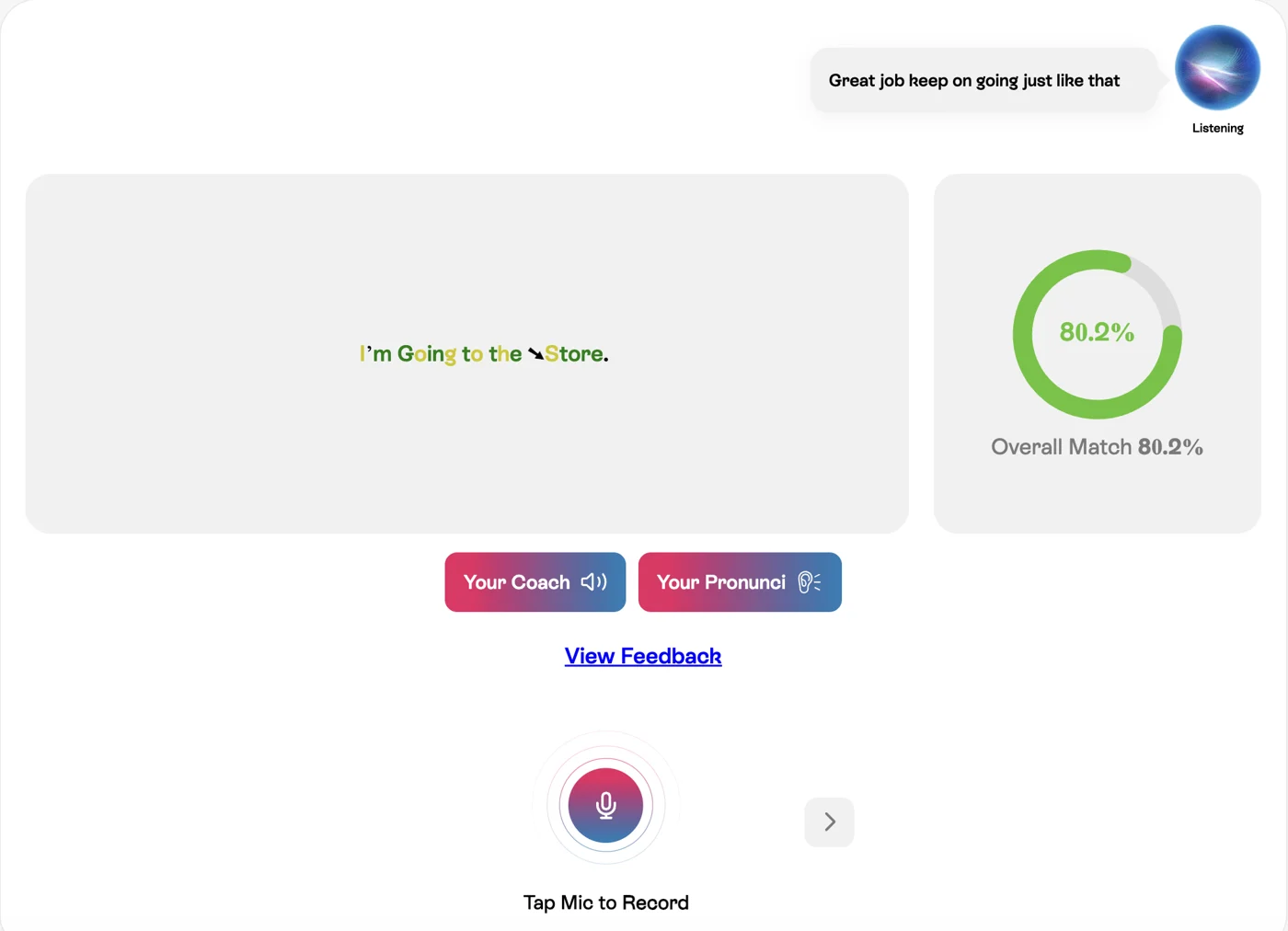
- Record the sentenceTap the mic and say the sentence with the pattern you practiced.
- Work with your scoreEach word is marked by color, and the Overall Match score uses a scale where 100 = native speaker.
- Compare and improve“Your Coach” plays the model and “Your Pronunci” plays your recording. “View Feedback” opens the details.
What I’ve learned coaching sales professionals on American intonation
After years of working with sales professionals and entrepreneurs on American English pronunciation, one pattern stands out clearly. Most people focus entirely on what they say and almost nothing on how they say it. They memorize scripts, rehearse objection handling, and study buyer psychology. Then they deliver all of it in a flat, rushed, or uncertain voice, and the deal dies before the words even land.
The clients who improve fastest are the ones who accept that intonation is a physical skill, not a personality trait. You train it the same way you train any motor skill: with repetition, feedback, and correction. The moment a client hears their own up-talking on a recording, something shifts. They stop defending their voice and start working on it.
What I find most encouraging is how quickly the brain adapts when training is structured correctly. Inpronunci’s American English intonation guide and AI Accent Coach give sales professionals a way to practice intonation patterns with real feedback, not guesswork. The Interactive Visual 2D Sound Simulators train exactly how sounds and pitch shifts are produced, which removes the ambiguity that makes self-study so frustrating. You are not alone with the technology. The Human-Guided Instructions keep you on the right path, and the AI Accent Coach tells you when you are there.
The sales professionals who commit to this kind of structured vocal training close more deals. That is not an opinion. It is what the data and my direct coaching experience both confirm.
— Prof. Alex, Ph.D. Accent Coach
Inpronunci: structured training for American sales communication
Sales professionals who want to close more deals need more than a better script. They need a voice that buyers trust from the first sentence.
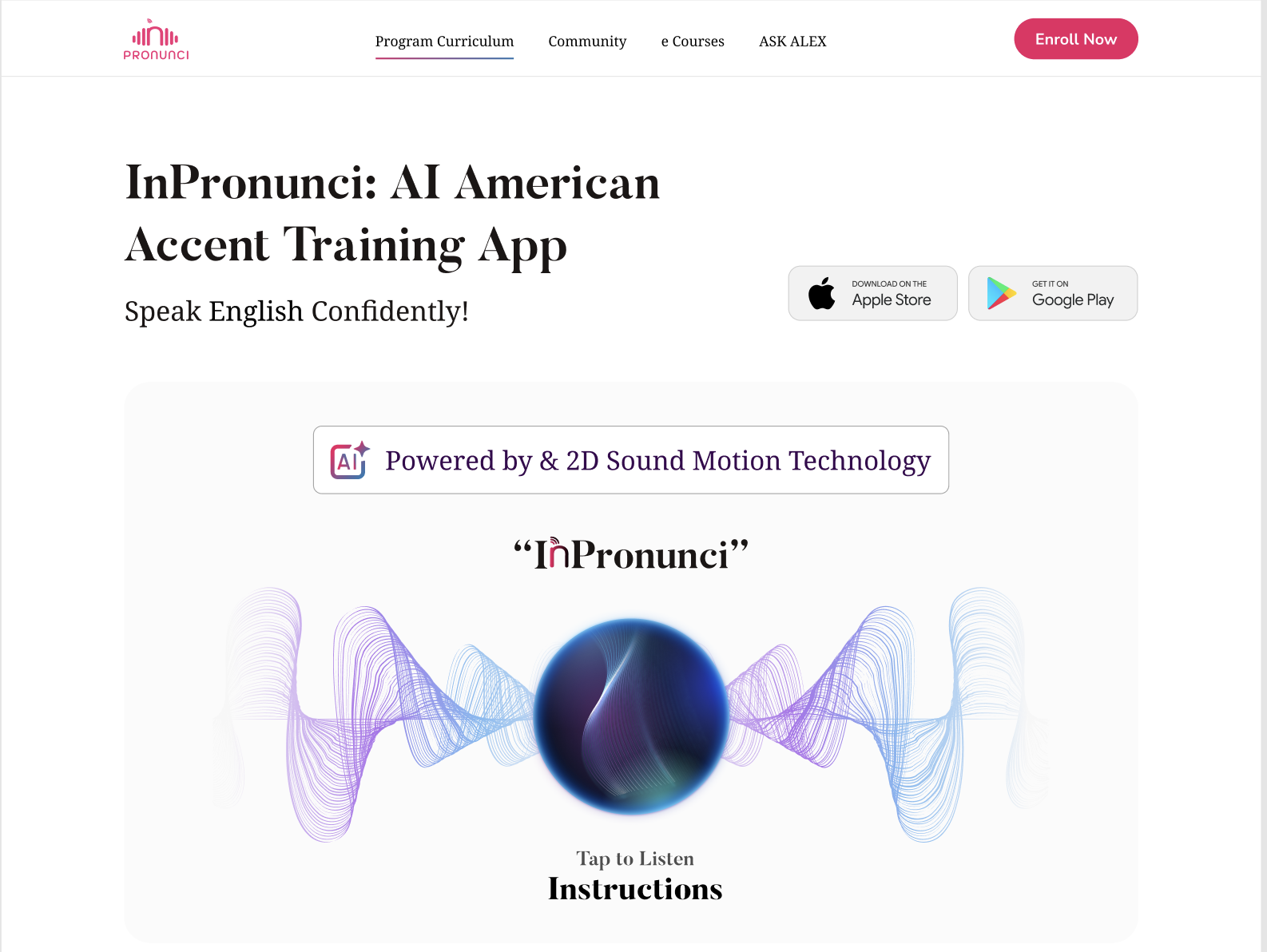
Inpronunci’s American accent training course is built specifically for this. The AI Accent Coach gives you real-time feedback on intonation, rhythm, and connected speech as you practice. The
Structured American Accent Training Course
From Speech Organs Education to American Intonation
The InPronunci course is built step by step: every chapter prepares the next one, and by the end of the course students receive a certificate.
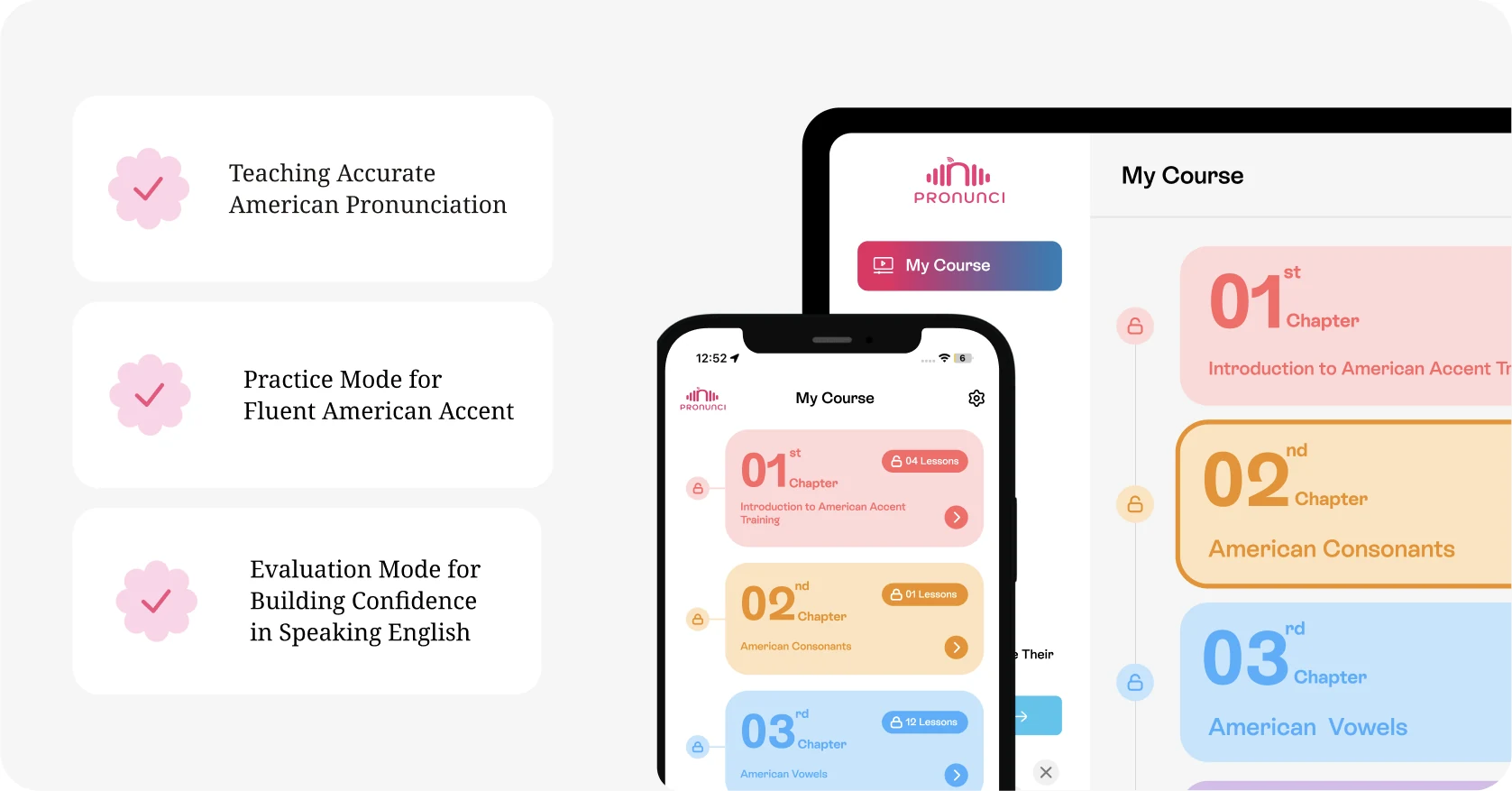
- Speech Organs EducationStudents learn how the speech organs work, along with the AI Accent Coach commands and feedback.
- American ConsonantsPractice and evaluate American consonants in phonetic exercises and practice sentences with the AI Accent Coach.
- American VowelsPractice and evaluate American vowels in phonetic exercises and practice sentences with the AI Accent Coach.
- IntonationLearn how intonation can change the meaning of what you say.
- CertificateBy the end of the course, students receive a certificate.
InPronunci training structure
How InPronunci trains the American speech system
InPronunci trains the full American speech system: Interactive Visual 2D Sound Simulators and phonetic exercises for articulation and American sound development, sentence practice for intonation, melody, rhythm, and connected speech, paragraph practice for spontaneous speech, public speaking, and real communication confidence, and Advanced AI Accent Coach evaluation as you speak.
InPronunci is an advanced, linguistically structured American accent training platform with more than 1,000 downloads and a growing learner base. It is designed for serious ESL learners who want American pronunciation, stronger intonation, more natural rhythm, better connected speech, and the ability to speak English more confidently in real communication. The program is especially useful for intermediate and advanced English speakers who want to become independent speakers of English with confident communication, stronger speaking control, long-term speech improvement, and great public speaking skills. It is also designed for advanced speakers whose goal is to speak like a native or closer to native-like American speech, including people who were raised in the United States but still have slight accent patterns from the native language they were born with. It is a complete American accent training course and system created by Prof. Alex, Ph.D. Accent Coach, Doctor of Education, and professional linguist based in Austin, Texas, with Pronunci Instructions from Prof. Alex for each lesson that make self-learning more effective, supported, and clear.
Interactive Visual 2D Sound Simulators train exactly how American pitch patterns are produced, so you can replicate them accurately. Human-Guided Instructions keep your practice on track, like working with a real coach. Start with the free Chapter 1, “Get to Know Your Speech Organs,” choose the Basic Plan for self-study, or work directly with Prof. Alex, Ph.D. Accent Coach in the Premium Plan. Sign up here and hear the difference in your next sales call.
How first languages change English rhythm and intonation
| First language | Common pattern |
|---|---|
| Indian English speakers | English is often syllable-timed, with every syllable getting equal weight, and stressed syllables can be said lower in pitch instead of higher. |
| Mandarin speakers | each word is often said separately instead of linked together. |
| Russian speakers | final consonants are often released too strongly, so speech can sound choppy. |
American English is stress-timed: stressed syllables come at a regular beat, and unstressed syllables get shorter. Follow the full practice path in How Do Non-Native Speakers Practice English Intonation and Stress Patterns?
Sources: Wikipedia: Indian English, San Diego Voice and Accent, Wikipedia: Non-native pronunciations of English
Questions & Answers
FAQ
01What is intonation in American English sales communication?
Intonation in American English sales communication refers to the rise and fall of pitch across sentences to signal confidence, questions, empathy, or authority. It is the primary vocal tool that shapes how buyers perceive trust and credibility.
02Why does up-talking hurt sales performance?
Up-talking, or rising pitch at the end of statements, makes declarative sentences sound like questions. Buyers interpret this as uncertainty, which reduces the sales professional’s perceived authority and credibility.
03How does silence improve sales outcomes?
Holding silence for 4 or more seconds after price or closing questions prompts the buyer to fill the gap. That response often reveals the real objection, giving the sales professional critical information to advance the deal.
04Can intonation training improve sales results financially?
Tonality-focused sales training delivers an average 353% ROI, making it one of the highest-return investments in sales skill development.
05How can I practice American English intonation for sales?
Record your sales calls, identify sentences where your pitch rises at the end, and practice falling intonation on statements. Structured tools like Inpronunci’s AI Accent Coach provide real-time feedback to accelerate this process.
Recommended

Startup Pitch Pronunciation: A Strategic Guide to Investor Clarity
Improve your startup pitch pronunciation for investor clarity. Learn strategic techniques to reduce cognitive load and secure the funding your vision deserves.
American English Intonation: The Strategic Guide to Natural Speech in 2026
Stop sounding robotic. Master American English intonation to project confidence and authority. Our guide covers pitch and rhythm for persuasive business speech.

Client-Facing English Pronunciation Checklist | Inpronunci
Enhance your communication with our client-facing English pronunciation checklist. Improve clarity and confidence for professional success.
Plans
What InPronunci costs
InPronunci Basic
$35 per month
Chapter 1 is free after signup.
InPronunci Premium
$200 per month
Includes a coach: