


Daily pronunciation practice is a highly valuable habit for building clear, confident American English speech. Linguists classify pronunciation as a motor skill, not an intellectual exercise. That distinction changes everything about how you should train. Techniques like shadowing, self-recording, and targeted phonetic drills are the established tools of accent training, and consistent daily sessions of 15–30 minutes produce measurable clarity gains within 4–6 weeks. That result outperforms longer, less frequent sessions by a significant margin. For professionals and students working toward clearer American English, the question is not whether to practice daily. It is how to practice well.
Why daily pronunciation practice matters for speech motor skills
Pronunciation is a physical skill. Your tongue, lips, jaw, and airflow must coordinate precisely to produce American sounds. Understanding rules alone does not guarantee correct speech production. You need thousands of targeted repetitions to move from conscious effort to automatic muscle memory.
Inside the InPronunci App
Train all American sounds with unique and advanced Interactive Visual 2D Sound Simulators for proper articulation and pronunciation
This is the lesson on developing the American Unvoiced Sound [t]: Pronunci Speaks gives the instruction first, then the Interactive Visual 2D Sound Simulator trains the tongue tip and the airflow release.
- EffectiveMost apps offer visual learning. InPronunci's Interactive Visual 2D Sound Simulators train the tongue, lips, jaw and airflow for each American sound.
- ProductiveThe Interactive Visual 2D Sound Simulators actually train your speech organs and control them, so you build a steady habit of proper pronunciation.
- ResultsStudents pronounce individual American sounds with almost native-like pronunciation.
This is why gaps in practice hurt more than most learners expect. Gaps greater than 48 hours between sessions cause motor skill decay and increase the warm-up time needed before fluent articulation returns. Daily short sessions prevent that decay and keep your neural pathways ready for speech.
Short, frequent practice also beats long, infrequent sessions for a specific reason: fatigue. 10–30 minute daily sessions maintain automaticity without overloading your articulators. Your muscles stay trained, your brain stays primed, and your progress compounds.
Key reasons why daily practice builds stronger motor skills:
- Repetition shifts pronunciation from conscious effort to automatic production
- Short daily sessions prevent the skill decay that longer gaps create
- Consistent practice reduces warm-up time before fluent speech kicks in
- Frequent exposure reinforces neural pathways tied to specific American sounds
- Muscle memory for stress, rhythm, and intonation builds only through physical repetition
Pro Tip: Set a fixed 15-minute window each morning before your first meeting or class. Attaching practice to an existing routine is the fastest way to make it automatic.
What does an effective daily pronunciation routine look like?
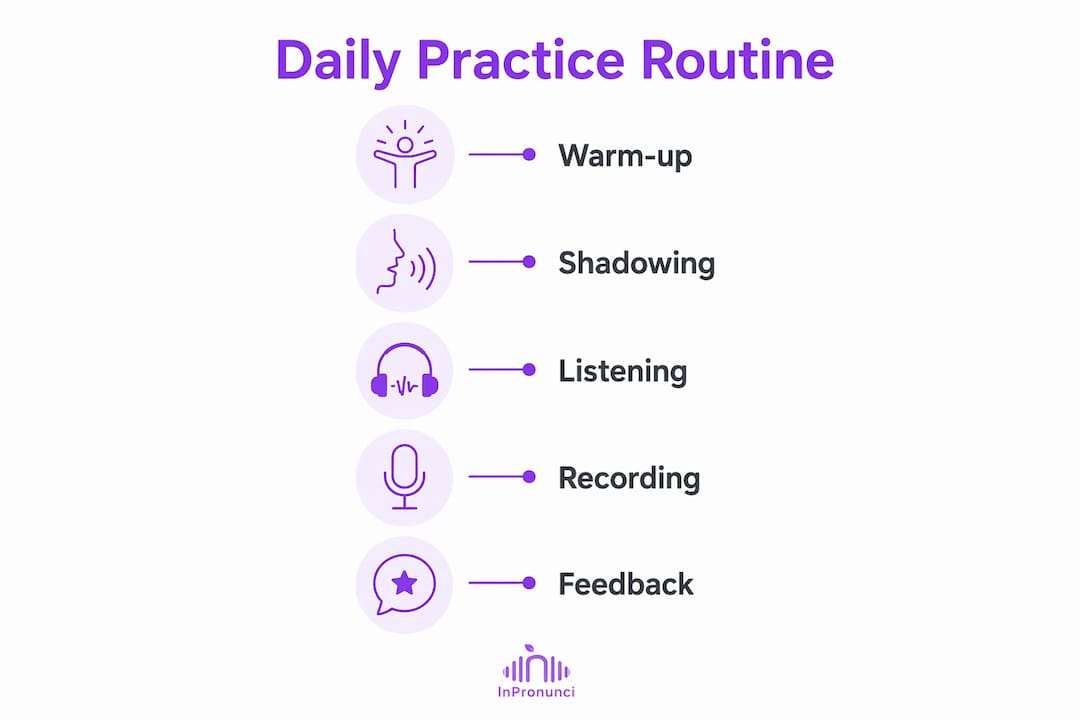
Structure matters as much as frequency. A well-designed 30-minute session covers five components, each targeting a different layer of speech production. Balancing these five elements daily leads to sustained, visible improvement.
| Component | Time | Purpose |
|---|---|---|
| Shadowing | 10 minutes | Builds phonemic accuracy and natural rhythm simultaneously |
| Self-recording | 5 minutes | Reveals production-perception gaps for targeted correction |
| Targeted drills | 5 minutes | Isolates problem sounds through minimal pairs and repetition |
| Rhythm and intonation focus | 5 minutes | Trains stress patterns and sentence melody |
| Vocabulary review | 5 minutes | Reinforces new words with correct pronunciation from the start |
Shadowing bypasses analytical thinking and trains phonemic accuracy alongside natural rhythm at the same time. That dual effect makes it the cornerstone of professional voice training programs. Self-recording closes the feedback loop. Learners who self-record regularly improve clarity up to 30% faster than those who rely on memory alone. Hearing your own speech against a native model reveals errors your ear misses in real time.
Effective pronunciation practice cycles between listening, producing, receiving feedback, and adjusting until correct patterns become automatic. That cycle is what separates structured daily practice from casual repetition. You can find a detailed breakdown of these techniques in Inpronunci’s advanced pronunciation methods guide.
Pro Tip: Record yourself reading the same paragraph at the start and end of each week. The difference you hear is your most reliable measure of real progress.
How pronunciation affects communication in professional and academic settings
The goal of pronunciation training is intelligibility, not accent elimination. Intelligibility is the realistic target for professional communication. When listeners spend cognitive energy decoding unclear speech, they absorb less of your message. Clear pronunciation reduces that load and keeps attention on your ideas.
Daily speaking practice improves cognitive function and strengthens the neural pathways tied to language comprehension and speech production. That benefit extends beyond accent. It sharpens attention and supports the mental agility needed for high-stakes communication.
Rhythm, stress, and connected speech carry as much weight as individual sounds. American English relies heavily on stress timing. When you misplace stress or speak in a flat, syllable-timed pattern, listeners struggle even if every sound is technically correct. Mastering these layers is what makes speech sound natural and authoritative.
Specific benefits for professionals and students include:
- Reduced listener cognitive load during meetings, presentations, and lectures
- Greater perceived authority and confidence in spoken communication
- Faster comprehension in academic discussions and group work
- Stronger performance in interviews, where clarity signals competence
- Improved self-monitoring, which reduces hesitation and filler words
Pronunciation training also builds academic confidence in a measurable way. Students who practice daily report less anxiety before presentations and greater willingness to participate in class discussions. That participation compounds over time into stronger academic outcomes. Inpronunci’s guide on pronunciation and academic confidence covers this connection in depth.
How do you stay consistent with daily pronunciation practice?
The most common barrier to consistent practice is not motivation. It is the absence of feedback. Without knowing whether your production is correct, practice reinforces errors as easily as it corrects them. That is the perception-to-production gap, and it is the central challenge of self-study.
Learners who anchor a daily practice ritual including a quick check-in or voice practice are 2–3 times more likely to stay consistent long-term. The ritual itself, not the length of the session, drives retention. A five-minute focused session beats a skipped hour every time.
Practical strategies for building a sustainable habit:
- Attach practice to an existing daily anchor, such as breakfast, commute, or a lunch break
- Use AI pronunciation feedback to get objective data on each session, not just impressions
- Set a weekly goal by number of sessions, not total minutes, to reduce all-or-nothing thinking
- Track your recordings in a folder by date so progress is visible and concrete
- Review pronunciation improvement tips regularly to refresh your technique and avoid plateaus
Pro Tip: If you miss a day, do not double up the next day. Return to your normal session length. Consistency over time matters far more than any single session.
What I have learned from watching learners practice every day
After years of training professionals and students in American English pronunciation, the pattern I see most often is this: learners who practice for 20 minutes every day progress faster than those who practice for two hours on weekends. That is not a motivational claim. It is a motor learning reality.
What surprises most learners is how quickly skill decay sets in. A 48-hour gap does not feel significant, but your articulators notice it. The warm-up time before fluent speech returns is longer, and the session feels harder. Daily practice keeps that threshold low.
The second thing I have observed is that feedback quality matters more than session length. A learner who records themselves, listens critically, and adjusts one specific sound per session will outpace someone who repeats phrases without any self-evaluation. Structured feedback, whether from an AI system or a trained coach, is what separates practice that builds skill from practice that builds habit without improvement.
Inpronunci was built around both of these realities. The AI Accent Coach gives you feedback as you speak. The Human-Guided Instructions keep you on the correct path. And the Interactive Visual 2D Sound Simulators train you to position your speech organs for each American sound. You are not guessing. You are training with precision.
— Prof. Alex, Ph.D. Accent Coach
Inpronunci: structured daily practice that delivers real results
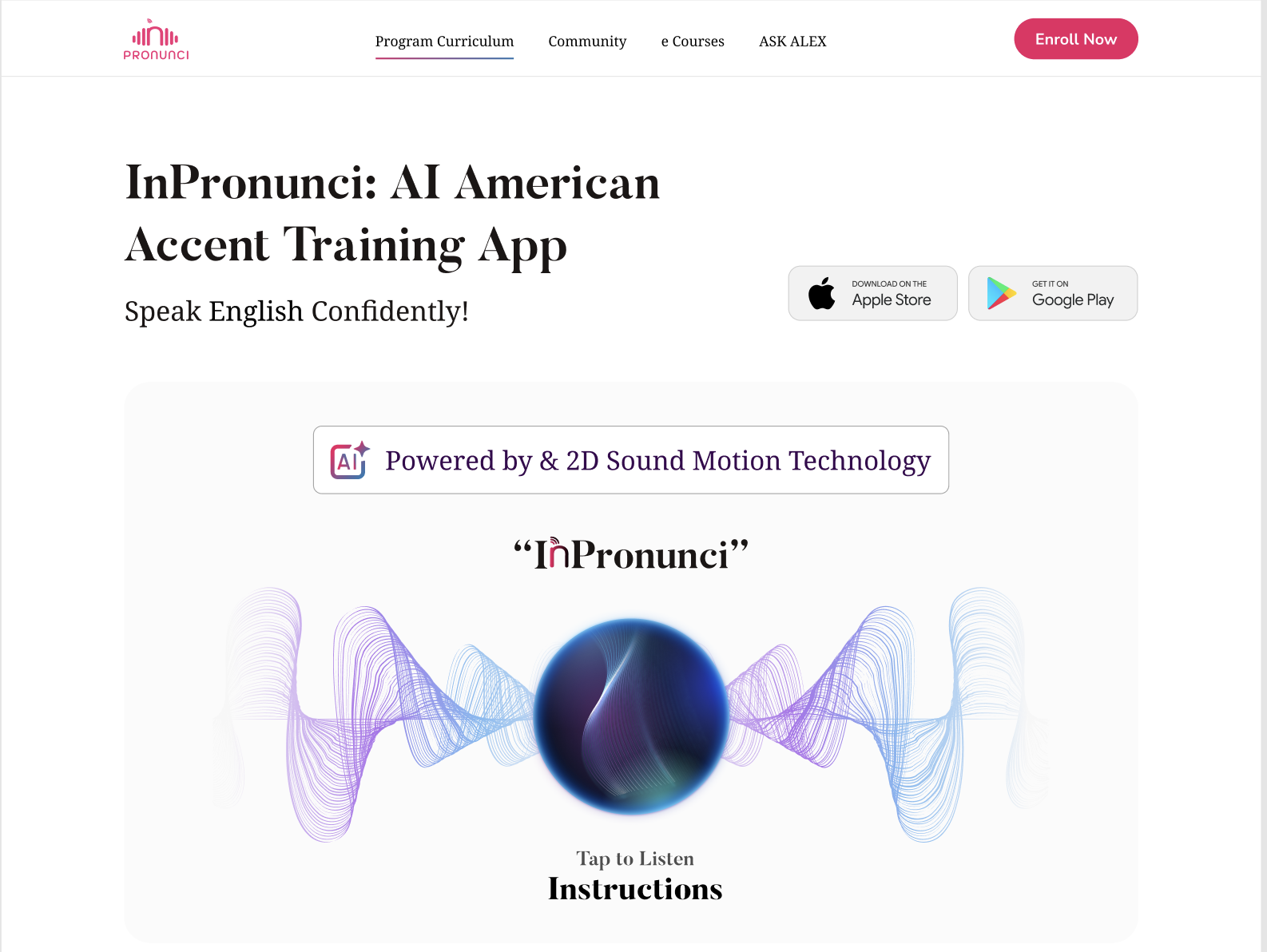
Inpronunci is a structured American Accent Training Course built for professionals and students who need clear, confident speech in real situations. The daily practice plan guides you from individual American sounds through words, sentences, and full speaking situations. Every session combines 2D Sound Video Mouth-Training Simulators, an AI Accent Coach with real-time feedback, and Human-Guided Instructions that work like a real coach.
Free Chapter 1, “Get to Know Your Speech Organs,” gives you immediate access to the foundation of smart practice. The Basic Plan supports self-study with AI and human-guided instruction. The Premium Plan adds monthly 1-on-1 sessions with Prof. Alex, Ph.D. Accent Coach for personalized guidance. Sign up and start your first session today, or book a free Premium session to see exactly how Inpronunci fits your goals.
Questions & Answers
FAQ
01Why does daily pronunciation practice matter more than weekly sessions?
Daily practice prevents motor skill decay and keeps neural pathways active. Short daily sessions of 10–30 minutes outperform longer, infrequent sessions by maintaining automaticity and reducing fatigue.
02How long before I see results from daily pronunciation practice?
Measurable clarity improvements appear within 4–6 weeks of consistent 15–30 minute daily sessions. Results come faster when practice includes self-recording and targeted feedback.
03What is the best technique for improving pronunciation daily?
Shadowing is the best single technique because it builds phonemic accuracy and rhythm simultaneously. Pairing it with self-recording and AI feedback produces the fastest results.
04Does pronunciation practice help with professional communication?
Clear pronunciation directly reduces listener cognitive load in meetings, interviews, and presentations. Daily speaking practice also strengthens the neural pathways tied to attention and language comprehension.
05How do I stay consistent with pronunciation practice?
Attach practice to a fixed daily anchor such as a morning routine or lunch break. Learners who build a daily practice ritual are 2–3 times more likely to stay consistent over weeks 2–4 compared to those who practice without structure.
Recommended
Why Pronunciation Affects Listening Comprehension: Inpronunci’s Guide
Discover why pronunciation affects listening comprehension. Learn how Inpronunci's accent training can enhance your understanding of spoken English.
Repetition in Pronunciation Mastery: Inpronunci’s 2026 Guide
Discover the role of repetition in pronunciation mastery. Learn how structured practice enhances your speech skills with Inpronunci's expert guide.
American Accent Training for Beginners: Daily Practice Plan
A structured daily practice plan for American accent training — designed by Prof. Alex., Ph.D. Learn the sounds, stress, rhythm, and connected speech patterns that matter
InPronunci training structure
How InPronunci trains the American speech system
InPronunci trains the full American speech system: Interactive Visual 2D Sound Simulators and phonetic exercises for articulation and American sound development, sentence practice for intonation, melody, rhythm, and connected speech, paragraph practice for spontaneous speech, public speaking, and real communication confidence, and Advanced AI Accent Coach evaluation as you speak.
InPronunci is an advanced, linguistically structured American accent training platform with more than 1,000 downloads and a growing learner base. It is designed for serious ESL learners who want American pronunciation, stronger intonation, more natural rhythm, better connected speech, and the ability to speak English more confidently in real communication. The program is especially useful for intermediate and advanced English speakers who want to become independent speakers of English with confident communication, stronger speaking control, long-term speech improvement, and great public speaking skills. It is also designed for advanced speakers whose goal is to speak like a native or closer to native-like American speech, including people who were raised in the United States but still have slight accent patterns from the native language they were born with. It is a complete American accent training course and system created by Prof. Alex, Ph.D. Accent Coach, Doctor of Education, and professional linguist based in Austin, Texas, with Pronunci Instructions from Prof. Alex for each lesson that make self-learning more effective, supported, and clear.
Plans
What InPronunci costs
InPronunci Basic
$35 per month
Chapter 1 is free after signup.
InPronunci Premium
$200 per month
Includes a coach: